By Clay Shumate
Student self assessment in group work is a short structured rating in which each student judges their own contribution against criteria everyone saw before the project started. It is not a popularity form and it is not a way to catch a freeloader. Its job is to make individual effort visible inside a shared product, which is the one thing a group grade cannot do.
That is a narrower purpose than most group-work reflection sheets claim, and the narrowness is what makes it work. What follows is what the research supports, the one design decision that determines whether the ratings mean anything, and a form that takes a student four minutes.
Key Takeaways
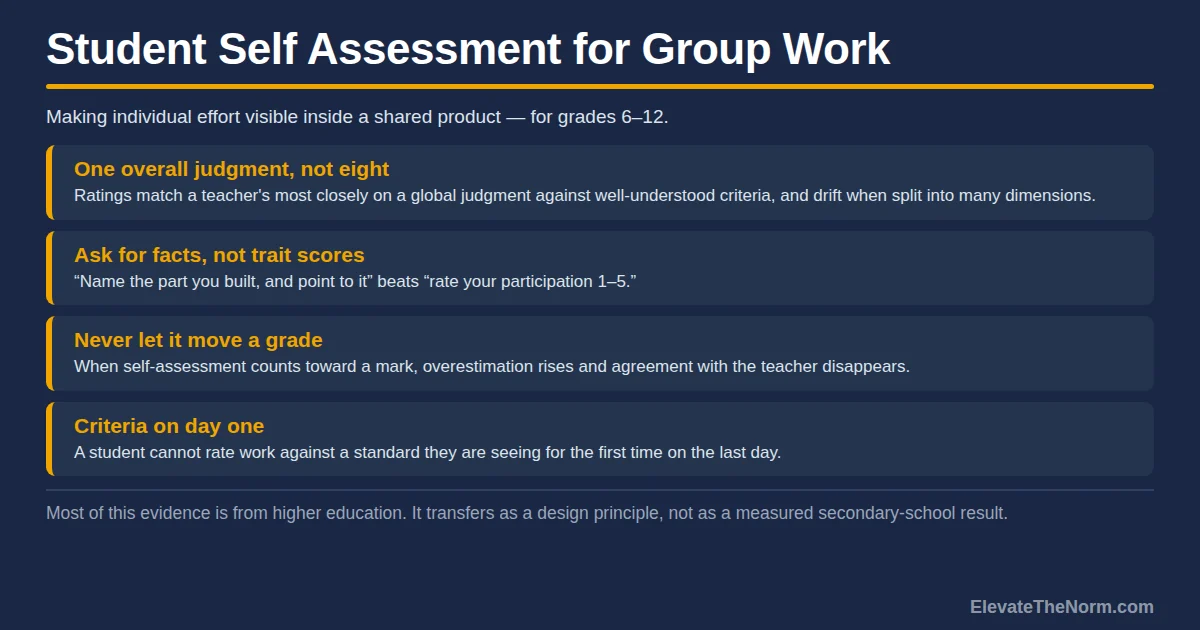
- Ask for one overall judgment, not eight. The clearest finding in the peer-assessment literature is that ratings line up with a teacher’s when students make a global judgment against criteria they understand — and drift when they are asked to score many separate dimensions.
- Self-assessment is the individual-accountability half of group work. Cooperative learning research names individual accountability as one of five elements that have to be present. A self-rating with evidence is the cheapest way to supply it.
- Never let it change anybody’s grade. When self-assessment counts toward a mark, overestimation rises and agreement with the teacher disappears.
- Criteria before the project, not after. A student cannot rate a contribution against a standard they are seeing for the first time on the last day.
- Most of this evidence is from higher education. It transfers as a design principle. It is not a measured secondary-school result, and you should not be told otherwise.
Free Download · PDF
Student Self-Assessment Forms for Grades 6–12
A general self-assessment form, a project reflection, a group-work accountability form, and a conference preparation sheet — reflection that asks for evidence instead of a confidence rating.
Free. No email address required. Designed for grades 6–12. Browse every printable in Your Free Library.
What Is Student Self Assessment for Group Work?
It is each student, separately and in writing, answering three questions about a shared project: what did I actually do, how well does it meet the criteria we agreed on, and what would I do differently next time. Three parts. Take away the criteria and it is a feelings check. Take away the evidence and it is a claim.
It is worth distinguishing from the thing it gets confused with. Self-assessment is not peer assessment. Peer assessment asks students to rate each other, which raises questions about friendship, retaliation and social cost that a self-rating does not. The two can coexist, and plenty of published teamwork instruments combine them, but they are different instruments doing different jobs, and mixing them without saying so is how a reflection sheet turns into a blame form.
The wider practice is covered in the guide to student self assessment. Group work only changes what sits in the criteria column — and it adds a problem that individual work does not have, which is that the product no longer tells you who did what.
Why Bother, When the Project Already Has a Grade?
Because a group grade is a measurement of the artifact, and you are also trying to teach something about contribution. One number on one poster cannot carry both jobs.
Cooperative learning is one of the better-evidenced practices in education, and the research is specific about what has to be in place. Robyn Gillies’s 2016 review in the Australian Journal of Teacher Education names five elements: positive interdependence, promotive interaction, individual accountability, explicitly taught social skills, and group processing. The effect sizes she reports from Johnson and Johnson’s syntheses run in the 0.58 to 0.70 range across 117 studies, and the underlying work spans preschool to tertiary and most subject areas.
The sentence in that review that matters most for a secondary teacher is the plainest one: simply placing students in groups does not guarantee cooperation. Gillies notes that discord shows up when students struggle with the task and with managing each other, and that without teacher mediation high-level talk appears with low frequency. Group work is not self-executing. Individual accountability and group processing are the two elements a self-assessment directly supplies, and they are the two most often left out.
She also reports two structural findings worth acting on for free: optimal group size is three or four, and lower-attaining students benefit most from mixed-attainment grouping while middle-attaining students tend to do better in more homogeneous groups. Neither costs anything to apply.
What Should Students Rate — and How Many Things?
One overall judgment against two or three criteria they already know. Not a scorecard. This is the single most actionable finding in this whole literature and almost every classroom teamwork form gets it backwards.
Falchikov and Goldfinch’s 2000 meta-analysis in the Review of Educational Research pooled 48 studies comparing peer marks with teacher marks. Their central result: agreement was closest when students made global judgments based on well-understood criteria, and worse when they were asked to break a judgment into many separate components and score each one.
That is the opposite of how most group-work forms are built. The typical sheet asks a student to rate themselves on participation, preparation, communication, reliability, respect, leadership and time management, on a five-point scale, seven times. The literature predicts exactly what you see when you collect them: rows of fours, no discrimination between the dimensions, and no usable information.
The honest caveat: those 48 studies were higher education, and they were peer marks rather than self-marks. The mechanism — that people judge a whole thing against a standard better than they decompose it — is a reasonable thing to carry into a secondary classroom. It is not a measured result about fifteen-year-olds, and nobody should sell it to you as one.
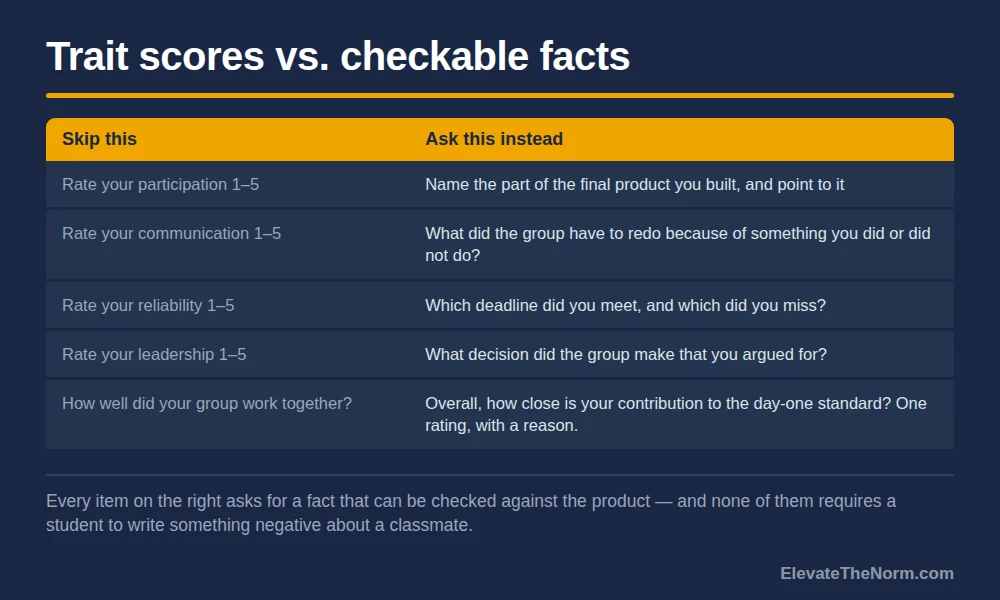
So what goes on the form:
| Skip this | Ask this instead |
|---|---|
| Rate your participation 1–5 | Name the part of the final product you built, and point to it |
| Rate your communication 1–5 | What did the group have to redo because of something you did or did not do? |
| Rate your reliability 1–5 | Which deadline did you meet, and which did you miss? |
| Rate your leadership 1–5 | What decision did the group make that you argued for? |
| How well did your group work together? | Overall, how close is your own contribution to the standard we set on day one? One rating, with a reason. |
Every item on the right asks for a fact rather than a number about a personality trait. Facts are checkable against the product, and a student who claims to have built the timeline can be asked to show it. That is also what makes the sheet safe: it never requires a teenager to say something negative about a classmate in writing.
Does a Rubric Make the Self-Rating Better?
For the work, clearly. For the teamwork part, less clearly, and the evidence is thinner than the enthusiasm.
Heidi Andrade’s 2019 critical review in Frontiers in Education reports that criterion-referenced self-assessment — using a rubric or checklist — showed main effects on every criterion assessed, and that concrete, task-specific criteria outperform vague competence-based criteria. If the rubric says “the claim is supported by at least two sources,” a student can check. If it says “demonstrates strong collaboration,” they cannot.
On the teamwork side specifically, one study is worth reporting honestly because it cuts both ways. Pang, Kootsookos, Fox and Pirogova compared two cohorts of 186 first-year engineering undergraduates on a team design project: one got a marking scheme, the next got a detailed rubric. The rubric cohort reported more helpful feedback, higher satisfaction and achieved higher grades, and 96 percent said the rubric helped them reach the learning goals. But only 52 percent found it useful for constructive feedback on teamwork specifically. The authors list the limits themselves: one course, one institution, one grading instructor.
Read that as the useful signal it is. A rubric is very good at telling a student whether the work meets a standard. It is much weaker at telling them whether they were a good group member, because that is a harder thing to write criteria for. So write the rubric for the product, and handle contribution with the evidence questions above rather than by inventing a collaboration scale. The project rubric guide covers the product side.
A Four-Minute Group Work Self-Assessment
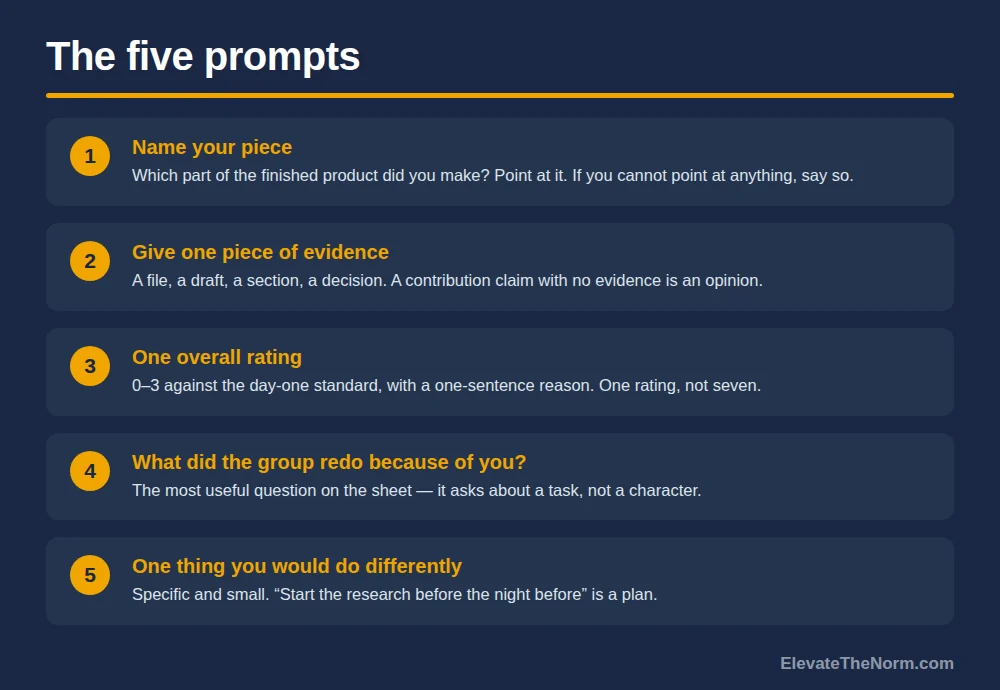
Five prompts, filled in individually, before anyone talks about it. Individually and before matters: a student who has already heard the group’s version writes the group’s version.
- Name your piece. Which part of the finished product did you make? Point at it. If you cannot point at anything, say that — it is real information and it is not a punishment.
- Give one piece of evidence. A file, a draft, a section, a specific decision. This is the step that does the work; a contribution claim with no evidence is an opinion.
- One overall rating against the day-one standard. 0–3, with the anchors written out, and a one-sentence reason. One rating, not seven.
- What did the group have to redo because of you? The most useful question on the sheet, and the one students answer more honestly than you expect, because it is about a task rather than a character.
- One thing you would do differently on the next project. Specific and small. “Start the research before the night before” is a plan.
The first time you run it, teach it. Students have almost never been asked to describe their own contribution in specific terms, and left alone most will write “I helped with the slides.” Show a worked example on the board — a vague answer next to a specific one — and say plainly that naming a real limit is not going to be held against them. Ten minutes once. Every version of this that gets abandoned was abandoned because the first round produced nothing and the teacher concluded students could not do it.
Then hold the group conversation. Gillies’s fifth element is group processing — students reflecting together on how the work went and what to do next. The sheet is the private half; five minutes of the group comparing what each person wrote is the public half, and the sequence only works in that order. If you want a ready-made form to adapt, the free self-assessment pack has one you can retype the criteria into.
Be realistic about what reading twenty-eight of these costs you. It is not a stack to mark. Read them once, fast, looking only for the two things that matter: who could not point at a piece of the product, and what any group says it had to redo. That is a scan, not a grading session, and it should take about fifteen minutes for a full class. If you find yourself writing responses on them, you have turned a diagnostic into an assignment and you will stop doing it by November.
One accessibility note. The written form is one container, not the only one. A student who cannot produce five written answers quickly — a writing disability, a newcomer building English — can answer the same five prompts out loud in ninety seconds while you note it down. The judgment against criteria is the part that has to survive, not the paragraph.
Should Any of This Touch the Grade?
No. Not the student’s own, and not anybody else’s. This is the one place where the research gives a clean answer and the answer is unambiguous.
Andrade’s review reports the Tejeiro finding directly: when self-assessment counted toward a final grade, student overestimation increased dramatically and no correlation emerged between the instructor’s assessment and the student’s. Run formatively, agreement with external evaluators improved substantially, and every study in the review that used self-assessment formatively showed a positive association with learning.
There is a second reason specific to group work, and it is about fairness rather than accuracy. A self-rating that moves a grade creates an incentive to inflate, which rewards confidence rather than contribution — and confidence is not evenly distributed across a class. The students most likely to under-claim are often the ones who did the quiet, unglamorous work. Attaching marks to self-report turns that into a penalty.
This is also the answer to the most common complaint families raise about group work, which is that a child did most of the work and shared the grade with people who did not. That complaint is often correct, and the fix families usually ask for — let my child report who slacked, and grade accordingly — is the one the evidence says not to build. The better answer, and the one worth putting in an email before the project starts rather than after it: the group grade covers the product, every student also produces something individual, the groups are small enough that contribution is visible, and the self-assessment exists so a student’s own account of their work is on the record. That is a real answer rather than a deflection, and it holds up at a conference.
If you have a genuine contribution problem, solve it with the design instead. Assign distinct, visible roles so the product itself shows who did what. Keep the groups at three or four, where hiding is harder. Collect an individual artifact from every student alongside the group one. All three make effort visible without asking a sixteen-year-old to adjudicate it in writing.
Four Ways This Goes Wrong
All four are design errors, and all four are cheaper to prevent than to repair.
The criteria arrive at the end. A student handed a rating scale on the last day is being asked to judge work against a standard they did not have while doing it. The criteria go up on day one, in the same words you will use on the form.
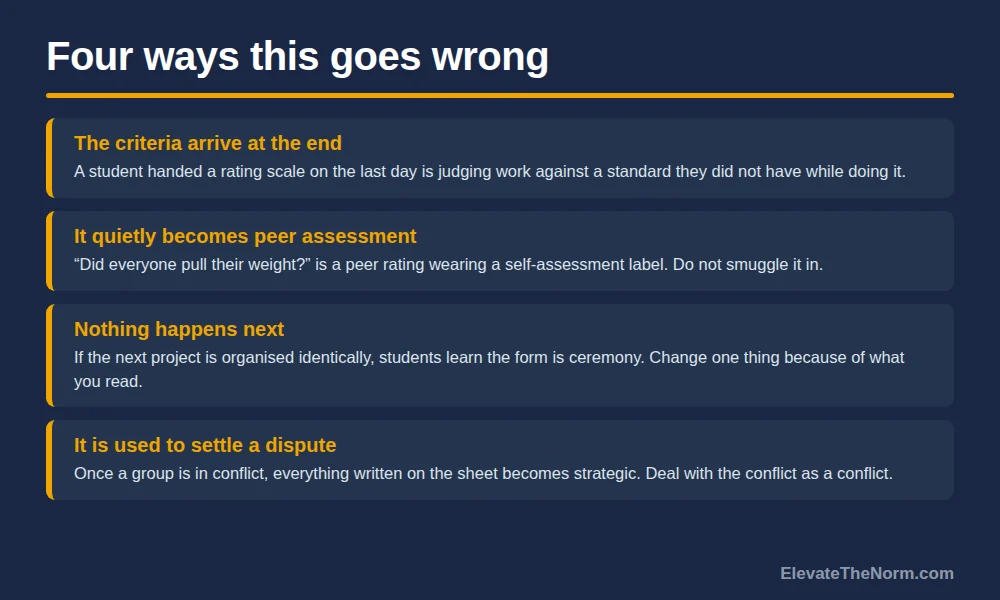
It quietly becomes peer assessment. A question like “did everyone pull their weight?” is a peer rating wearing a self-assessment label. If you want peer input, say so openly, design it properly, and be clear about who reads it. Do not smuggle it in.
Nothing happens next. If the sheets go in a folder and the next project is organized the same way, students learn the form is ceremony. The minimum honest follow-through is one change to the next project that came from reading them — a different group size, a required interim deadline, distinct roles.
It is used to settle a dispute. When a group is already in conflict, a self-assessment form becomes evidence in a case, and everything anyone writes becomes strategic. Deal with the conflict as a conflict. The sheet is a routine instrument for ordinary projects; it is not an investigation tool and it will not survive being used as one.
Where to Start on the Next Project
Pick the next group project you already have planned. On day one, put two criteria for the product on the board in the words you will use again at the end. Keep the groups at three or four. On the last day, before any group talks, give every student the five prompts and four minutes.
Then read them for one thing only: which groups had someone who could not point at a piece of the product. That is the design question, not a discipline question, and the answer usually turns out to be that the task had fewer real jobs in it than it had people.
Keep it out of the gradebook, keep it to one overall rating, and change one thing about the next project because of what you read. The point is not to catch anybody. It is that a student who has had to name their own contribution in writing, against a standard, has done something a group grade will never make them do — which is the same argument as handing a teenager the job of naming their own conduct against a standard they were taught rather than waiting to be told how they did.
Before you go: grab the free Student Self-Assessment Forms for Grades 6–12 (PDF) — ElevateTheNorm.com branded, printable, no email required.
Frequently Asked Questions
Should a group work self-assessment ever change a student’s grade?
No. Andrade’s review reports that when self-assessment counted toward a final grade, overestimation rose sharply and the correlation with the instructor’s own assessment disappeared; run formatively, agreement improved substantially. There is a fairness reason on top of the accuracy one: attaching marks to self-report rewards confidence rather than contribution, and the students most likely to under-claim are often the ones who did the quiet work. If you have a contribution problem, fix it with distinct roles, smaller groups and an individual artifact — not with a self-rating that moves numbers.
How do I stop one student doing all the work without making others rate each other?
Change the task before you change the paperwork. Three or four to a group rather than five or six, so there is less room to disappear. Distinct visible roles, so the product itself shows who did what. An individual artifact from every student alongside the group one. Those three do more about free-riding than any rating form, and none of them asks a teenager to write something negative about a classmate.
Why one overall rating instead of scoring several categories?
Because the evidence points that way. Falchikov and Goldfinch’s meta-analysis of 48 studies found that student ratings matched teacher marks most closely when students made a global judgement against well-understood criteria, and less closely when asked to break the judgement into many separate dimensions. The seven-category teamwork form produces rows of fours and no usable information. Be aware that those studies were higher education and were peer rather than self ratings — the mechanism travels, the measurement has not been repeated with secondary students.
What do I do with a student who writes that they did nothing?
Take it as information and not as a confession. A student who says honestly that they cannot point at a piece of the product has told you something valuable and has told you the truth, which is exactly the behaviour the form is supposed to make safe. Ask what the group’s tasks were and how they got divided. About half the time the answer is that the project had three real jobs and four people in the group, which is a design problem you own.
Is peer assessment ever worth adding?
Sometimes, but never by stealth. Peer rating carries social costs that self-rating does not — friendship, retaliation, and the position you put a student in by asking them to write something about a classmate that a teacher will read. If you use it, say plainly that you are using it, be specific about who sees the responses, keep it to observable contributions rather than judgements about people, and never let it move a grade. A question like “did everyone pull their weight?” buried in a self-assessment is peer assessment without the safeguards.
When should students fill this in — during the project or at the end?
Both is better than either, and the end alone is the common mistake. A short version at the halfway point can still change something while the project is running, which is the whole difference between formative and post-mortem. The end-of-project version is where the overall rating and the “what would you do differently” question belong. What matters more than timing is that students write individually before the group discusses anything.
Does this work for a long project or only a short one?
It scales better to longer projects, because a longer project has more distinguishable pieces for a student to point at. On a two-day task, the honest answer to “name your piece” is often that everyone did a bit of everything, and the form has little to work with. If your groups are doing short tasks, run the group processing conversation and skip the written self-assessment until there is a project big enough to have parts.
Sources
- Gillies, Robyn M. “Cooperative Learning: Review of Research and Practice.” Australian Journal of Teacher Education, vol. 41, no. 3, 2016. https://files.eric.ed.gov/fulltext/EJ1096789.pdf (The Johnson & Johnson and Slavin effect sizes quoted above are reported in this review; the primary syntheses were not read directly.)
- Falchikov, Nancy, and Judy Goldfinch. “Student Peer Assessment in Higher Education: A Meta-Analysis Comparing Peer and Teacher Marks.” Review of Educational Research, vol. 70, no. 3, 2000, pp. 287–322. https://eric.ed.gov/?id=EJ630369
- Andrade, Heidi L. “A Critical Review of Research on Student Self-Assessment.” Frontiers in Education, vol. 4, art. 87, 2019. https://www.frontiersin.org/journals/education/articles/10.3389/feduc.2019.00087/full (The Tejeiro et al. 2012 and Fastré et al. 2010 findings are reported in this review; the primary papers were not read directly.)
- Pang, Vinh, Alex Kootsookos, Rebecca Fox, and Elena Pirogova. “Does an assessment rubric provide a better learning experience for undergraduates in developing transferable skills?” Journal of University Teaching & Learning Practice, vol. 19, no. 3, 2022. https://files.eric.ed.gov/fulltext/EJ1361716.pdf
- Avina, A., Boyle, S., Duble Moore, T., Hicks, T., and Wiggins, A. “Intensive Intervention Practice Guide: Self-Monitoring Systems to Support Students’ Behavioral Needs.” U.S. Department of Education, Office of Special Education Programs / National Center on Intensive Intervention, Fall 2022. https://files.eric.ed.gov/fulltext/ED628226.pdf