By Clay Shumate
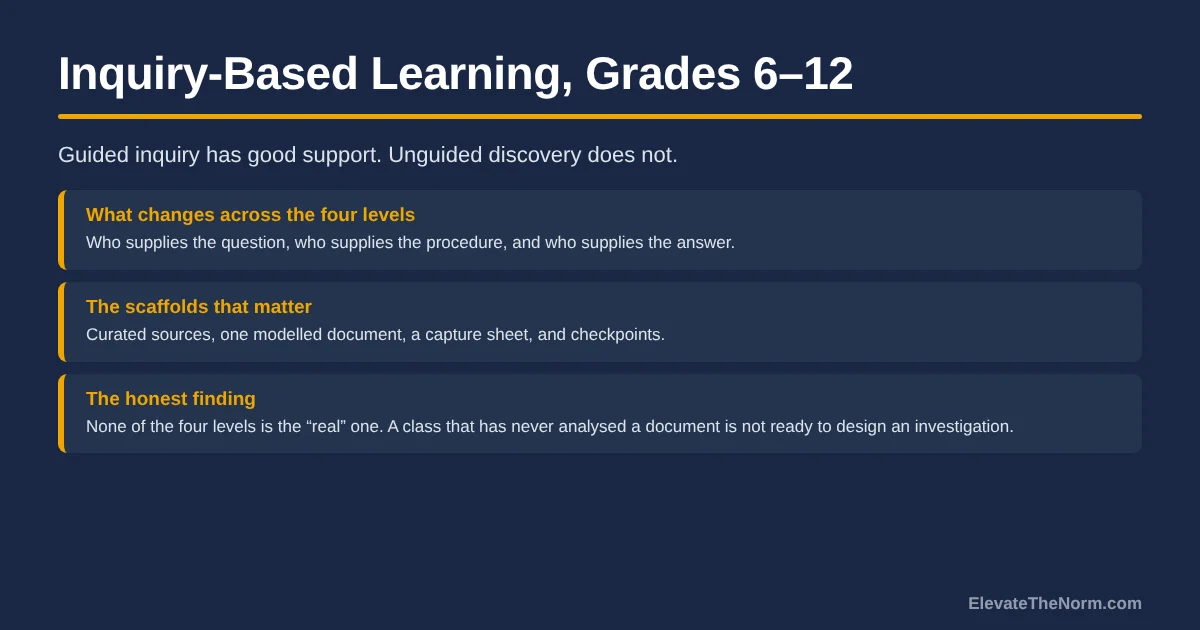
Inquiry-based learning is teaching that starts with a question students answer by investigating evidence, instead of receiving the answer first. It runs on a scale of four levels: confirmation, structured, guided and open, depending on how much the teacher supplies. Research favors guided, well-scaffolded inquiry over leaving students to discover things on their own.
Key Takeaways
- Inquiry is a scale, not a switch. Banchi and Bell’s four levels run from confirmation, where students verify a known result, to open inquiry, where students write their own question and method.
- Unguided discovery loses to explicit teaching. A meta-analysis of 164 studies found unassisted discovery underperformed explicit instruction, while enhanced, guided discovery outperformed other methods.
- The famous critique and its response agree on more than they seem to. Kirschner, Sweller and Clark argue novices need strong guidance; Hmelo-Silver, Duncan and Chinn reply that good inquiry is heavily scaffolded.
- Social studies has a ready-made model. The C3 Framework’s Inquiry Arc has four dimensions, from developing questions to taking informed action.
- Guided inquiry is the practical default for grades 6–12. You supply the question and the sources; students build the method and the answer with scaffolds you remove over time.
What is inquiry-based learning?
Inquiry-based learning, sometimes called question-based learning, organizes a lesson or unit around a question students have to answer with evidence. Instead of “here is the cause of the Dust Bowl, now practice it,” the lesson opens with “What caused the Dust Bowl?” and students work through data, documents or experiments to build an answer they can defend.
It overlaps with project-based learning but isn’t the same thing. An inquiry can last one class period and end in a paragraph. A project usually runs longer and ends in a product for an audience. Many projects contain an inquiry; our explainer on what project-based learning is covers the difference in more detail.
What are the four levels of inquiry?
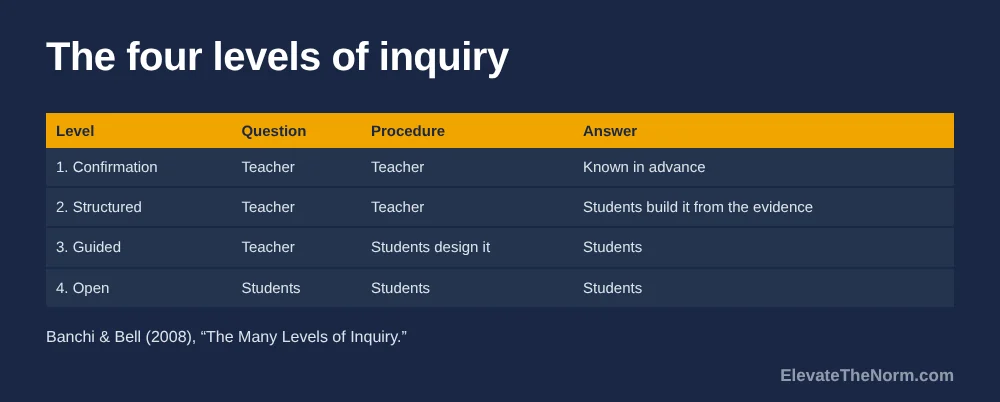
The most widely used model comes from Heather Banchi and Randy Bell’s 2008 article “The Many Levels of Inquiry,” which describes a continuum from teacher-directed to student-directed. What changes from level to level is who supplies the question, the procedure and the answer.
| Level | Question | Procedure | Answer | Example (history) |
|---|---|---|---|---|
| 1. Confirmation | Teacher | Teacher | Known in advance | After a lesson on the causes of the Dust Bowl, students find those causes in a set of documents. |
| 2. Structured | Teacher | Teacher | Students build the explanation from the evidence | Students follow a step-by-step document analysis and write their own conclusion. |
| 3. Guided | Teacher | Students design it | Students | Given the question and a source set, students decide which sources to use and how to weigh them. |
| 4. Open | Students | Students | Students | Students choose their own question about the 1930s and find their own sources. |
None of these levels is the “real” inquiry. Confirmation and structured inquiry teach the moves students need before they can do guided or open work. A class that has never analyzed a document is not ready to design its own investigation.
How does the C3 Framework’s Inquiry Arc work in social studies?
The College, Career, and Civic Life (C3) Framework, released in 2013 and published by the National Council for the Social Studies, organizes social studies around an Inquiry Arc with four dimensions:
- Developing Questions and Planning Inquiries
- Applying Disciplinary Concepts and Tools
- Evaluating Sources and Using Evidence
- Communicating Conclusions and Taking Informed Action
C3 Teachers built a planning format on top of the framework, the Inquiry Design Model. It starts with a compelling question, an open-ended, arguable question that drives the inquiry, then breaks it into supporting questions that each get a formative performance task and a set of featured sources. It ends with a summative argument answering the compelling question and an option for taking informed action.
In Banchi and Bell’s terms, a standard Inquiry Design Model lesson is guided inquiry: the teacher sets the compelling question and selects the sources, and students build the argument. Much of the class time in a guided inquiry goes to Dimension 3, which rests on the same skills covered in our guide to primary source analysis.
Does inquiry-based learning work?
Guided inquiry has good support; unguided discovery does not. The most cited argument and its most cited reply, read together, point to the same practical answer.
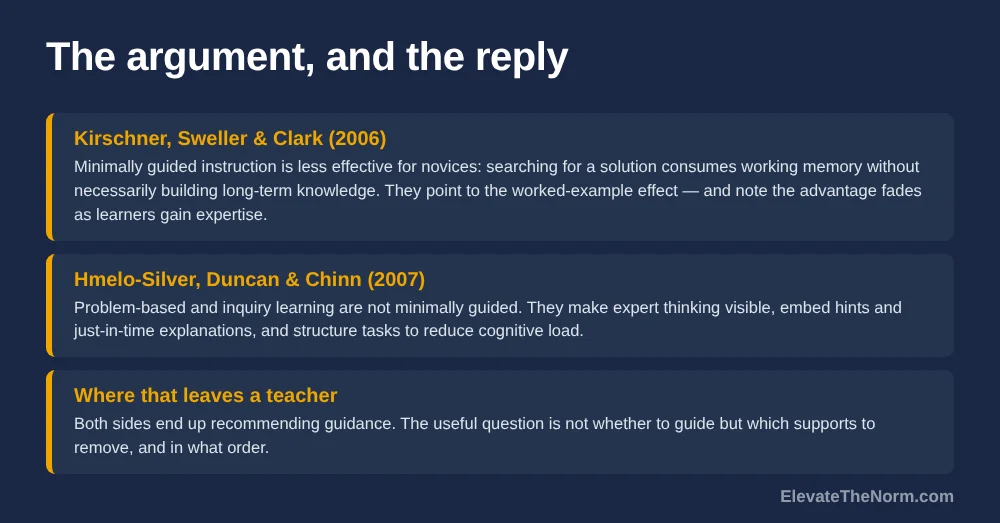
The critique. In 2006, Kirschner, Sweller and Clark argued in Educational Psychologist that minimally guided instruction, a group in which they placed discovery, problem-based, experiential and inquiry-based teaching, is less effective for novice learners. Their reasoning rests on how memory works: working memory can hold only a few new items at once, so searching for a solution uses up that capacity without necessarily building knowledge in long-term memory. They point to the worked-example effect, where students who study solved examples outperform students who solve the same problems unaided. They also note that this advantage fades as learners gain expertise.
The response. In 2007, Hmelo-Silver, Duncan and Chinn replied in the same journal that problem-based and inquiry learning are not minimally guided at all. They described the scaffolding these approaches use: making expert thinking visible, embedding expert guidance such as hints and just-in-time explanations, and structuring tasks to reduce cognitive load. They argued these supports resemble the worked examples Kirschner and colleagues recommend, cited studies with positive results, and said the better question is under what conditions inquiry works and for whom. They also said they were not arguing against direct instruction and that the right balance between the two was still an open question.
The meta-analysis. Alfieri and colleagues pooled 164 studies in 2011. Unassisted discovery did worse than explicit instruction (d = −0.38). Enhanced discovery, meaning discovery with feedback, worked examples, scaffolding or prompts to explain, did better than other approaches (d = 0.30), and guided discovery had the largest effect within that group (d = 0.50).
Put together: don’t hand novices a question and walk away. Give them a question, a curated set of sources, a model of the thinking, and checkpoints. That is guided inquiry, and it is what both sides of the debate would accept.
How do I scaffold a guided inquiry?
Scaffold the parts where novices get lost: choosing what to look at, knowing how to read it, and turning notes into a claim. These six supports line up with the research above.
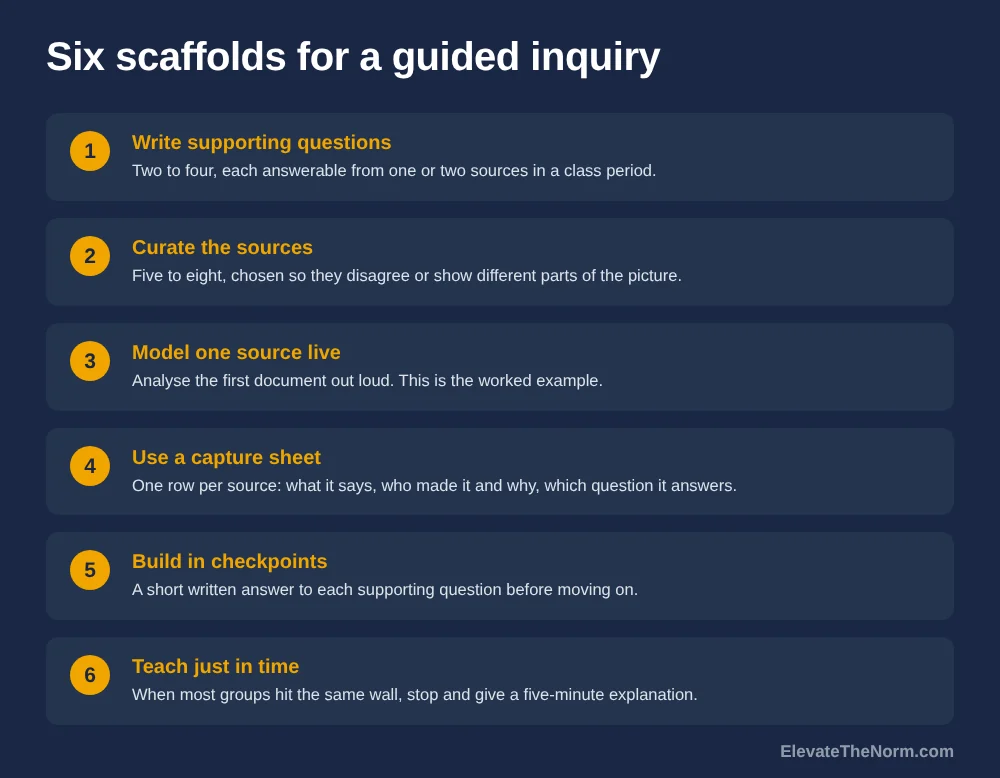
- Write supporting questions. Break the compelling question into two to four smaller ones. Each supporting question should be answerable from one or two sources in a class period.
- Curate the sources. Five to eight sources, chosen so they disagree or show different parts of the picture. An open internet search is open inquiry; save it for later.
- Model one source live. Analyze the first document in front of the class, thinking out loud. This is the worked example.
- Use a capture sheet. One row per source: what it says, who made it and why, which supporting question it helps answer.
- Build in checkpoints. A short written answer to each supporting question before moving on, so you catch misreadings early.
- Teach just in time. When most groups hit the same wall, stop and give a five-minute explanation. Hmelo-Silver and colleagues describe this kind of short lecture as part of inquiry, not a departure from it.
Plan which supports to remove by the next inquiry, and in what order. Our guide to scaffolding strategies covers fading in detail, and productive struggle covers how to tell useful difficulty from the kind that just burns time.
What does a one-week inquiry plan look like?
This template fits five 50-minute periods and follows the Inquiry Arc. Swap in your own compelling question; the structure holds for history, civics, geography, economics or science.
| Day | Inquiry Arc step | What happens | Checkpoint |
|---|---|---|---|
| Monday | Developing questions | Launch the compelling question with a short hook source. Students write what they already think and what they’d need to know. Introduce supporting questions. | Initial claim and three “need to know” questions |
| Tuesday | Applying concepts; evaluating sources | Teacher models analysis of source 1. Groups analyze sources 2–3 for supporting question 1. | Written answer to supporting question 1 |
| Wednesday | Evaluating sources and using evidence | Groups work sources 4–6 for supporting questions 2 and 3. Just-in-time mini-lesson on the most common misreading. | Capture sheet complete; answers to supporting questions 2 and 3 |
| Thursday | Communicating conclusions | Students draft a claim with evidence answering the compelling question. Peer check: does every claim have a source behind it? | Draft argument |
| Friday | Communicating conclusions; taking informed action | Final argument (paragraph, short essay or structured discussion). Close with a brief discussion of what someone could do about the issue today. | Summative argument; reflection on how the initial claim changed |
Sample compelling questions that work in a week: Was the Dust Bowl a natural disaster? Did the printing press do more to spread knowledge or conflict? Is a river more often a border or a connection? Each has evidence on more than one side, which is what makes the summative argument worth writing.
When should I use open inquiry?
Use open inquiry after students have done several guided inquiries in the same discipline and can analyze sources without the capture sheet. Kirschner and colleagues’ own article notes that the advantage of heavy guidance shrinks as learners build knowledge, though they stop short of saying less guidance is better. Open inquiry fits well at the end of a semester, in a capstone, or in a choice-driven block where students already know how to find and judge sources.
Even then, keep two supports: an approval step for each student’s question, so nobody spends a week on a question with no available evidence, and a midpoint check on sources.
Clay’s take: the question is the easy part
Most inquiry lessons that fall flat don’t fail because of the question. They fail because the sources weren’t chosen carefully or the students didn’t know how to read them. Spend most of your planning time on the source set and on the one document you’ll model, not on wording the compelling question.
The other recommendation is to stop treating the research debate as a choice between inquiry and direct instruction. A good inquiry week has direct instruction in it: the modeled source on Tuesday and the just-in-time mini-lesson on Wednesday. Teaching explicitly inside an inquiry is how it’s supposed to work.
What the inquiry evidence does not settle
The Kirschner–Hmelo-Silver exchange is usually presented as a winner-takes-all fight, and reading it that way costs you the useful part. Neither paper is a meta-analysis. The 2006 piece is an argument from cognitive architecture supported by selected studies; the 2007 reply is a counter-argument supported by different selected studies. Between them they establish that guidance matters and that the amount should depend on how much the learner already knows. They do not establish an effect size for inquiry teaching in a secondary classroom, and anyone quoting one is quoting something else.
The expertise reversal point is the one most worth carrying. Kirschner and colleagues note that the worked-example advantage fades as learners gain expertise, which means the correct amount of scaffolding is not a fixed property of your teaching style. It is a property of what this class knows about this topic this month. A group that handled a guided inquiry on the Dust Bowl in October may still need structured inquiry for a new unit in February, and that is not a regression.
What to do next week
Do not start at level four. Pick a topic your students already know something about, and run a level-two structured inquiry: you write the question, you supply the procedure, and they build the explanation from the evidence. Five to eight sources, chosen so they disagree.
Model the first document live, out loud, including the part where you are unsure. That is the single scaffold most often skipped and the one the research most clearly supports, because it is the worked example both sides of the debate agree on. Then use a capture sheet with one row per source and collect it at the end of the period, not the end of the week. If the capture sheets show students writing what a source says but not who made it or why, that is your next mini-lesson, and it is a better use of a day than moving up a level.
Frequently Asked Questions
What is inquiry-based learning in simple terms?
It is teaching that starts with a question instead of an answer. Students investigate evidence such as documents, data or experiments to build and defend an answer. The teacher decides how much to supply, from the full procedure in confirmation inquiry to almost nothing in open inquiry. In grades 6–12, guided inquiry with scaffolds is the most common and best-supported form.
What are the 4 levels of inquiry-based learning?
Banchi and Bell describe four levels. In confirmation inquiry the teacher provides the question and procedure and the answer is known. In structured inquiry the teacher provides the question and procedure and students explain the results. In guided inquiry the teacher provides only the question. In open inquiry students choose the question, design the method and reach their own conclusions.
Is inquiry-based learning effective?
Guided inquiry is; unguided discovery is not. A 2011 meta-analysis of 164 studies by Alfieri and colleagues found unassisted discovery did worse than explicit instruction, while discovery enhanced with feedback, worked examples, scaffolding or prompts to explain did better than other methods. Guided discovery showed the largest effect within the enhanced group.
What is the Kirschner, Sweller and Clark critique of inquiry learning?
Their 2006 article argues that minimally guided approaches, including inquiry, discovery and problem-based learning, are less effective for novices because working memory is limited and unguided problem-solving can use it up without building lasting knowledge. They recommend strong guidance such as worked examples, while noting its advantage fades as learners gain expertise.
How did researchers respond to Kirschner, Sweller and Clark?
Hmelo-Silver, Duncan and Chinn replied in 2007 that problem-based and inquiry learning are heavily scaffolded, not minimally guided. They described supports like modeling expert thinking, just-in-time explanations and structured tasks, cited studies with positive results, and argued the real question is under what conditions inquiry works. They said they were not arguing against direct instruction.
What is the C3 Inquiry Arc?
The Inquiry Arc is the organizing structure of the C3 Framework for Social Studies, released in 2013 and published by the National Council for the Social Studies. Its four dimensions are developing questions and planning inquiries, applying disciplinary concepts and tools, evaluating sources and using evidence, and communicating conclusions and taking informed action.
What is the difference between inquiry-based and project-based learning?
Inquiry-based learning centers on answering a question with evidence and can fit in one class period. Project-based learning usually runs longer and ends in a product or presentation for an audience. Most good projects contain an inquiry, but not every inquiry becomes a project. Both work best with explicit teaching and scaffolds built in.
Sources
- Banchi, H., & Bell, R. (2008). The Many Levels of Inquiry. Science and Children, 46(2). NSTA. Used for the four-level continuum; the level-by-level breakdown was checked against the summaries in this open education text and the University of Liverpool enquiry guide, because the full article is behind the NSTA login.
- National Council for the Social Studies (2013). C3 Framework Inquiry Arc (introduction to NCSS inquiry methods texts). Used for the four dimensions and the framework’s release and publisher.
- C3 Teachers (n.d.). Inquiry Design Model. Used for the compelling question, supporting questions, formative tasks, featured sources, summative argument and informed action components.
- Kirschner, P. A., Sweller, J., & Clark, R. E. (2006). Why minimal guidance during instruction does not work. Educational Psychologist, 41(2), 75–86. Used for the critique, the working-memory argument, the worked-example effect and the note on expertise.
- Hmelo-Silver, C. E., Duncan, R. G., & Chinn, C. A. (2007). Scaffolding and achievement in problem-based and inquiry learning: A response to Kirschner, Sweller, and Clark (2006). Educational Psychologist, 42(2), 99–107. Used for the response, the types of scaffolding, and the authors’ stated position on direct instruction.
- Alfieri, L., Brooks, P. J., Aldrich, N. J., & Tenenbaum, H. R. (2011). Does discovery-based instruction enhance learning? Journal of Educational Psychology, 103(1), 1–18. Used for the number of studies and the effect sizes for unassisted, enhanced and guided discovery.