The Elevate Blog banner: Real Classrooms. Practical Ideas. Higher Expectations. Three students climb a rocky ridge at sunrise, each pulling the next one up, toward a teacher reaching down to help.

Tag: social studies

  • Project Based Learning Social Studies: 25 Authentic Projects for Grades 6–12

    Project Based Learning Social Studies: 25 Authentic Projects for Grades 6–12

    By Clay Shumate

    Project based learning social studies means students investigate a real question using the discipline’s own tools — primary sources, data, maps, competing interpretations — and produce something for an audience outside the gradebook. It is not a poster made after the unit ends. The inquiry comes first, the content is learned in service of answering it, and the product has to survive someone else reading it.

    Key takeaways

    • The strongest evidence in social studies is narrow. The best-designed study is a randomized trial of one course — AP U.S. Government — in five urban districts. It found real gains, and its authors publish real caveats. Nobody has run that study on 7th grade geography.
    • A project is PBL when the question drives the learning. If you could delete the project and still teach the unit the same way, it is a dessert project, not project based learning.
    • Social studies has a built-in structure for this. The C3 Framework’s Inquiry Arc — question, disciplinary tools, sources and evidence, informed action — is already a four-step PBL spine.
    • The failure modes are specific to this subject: craft projects with no argument, presentism, simulations of atrocity, and claims students cannot source.
    • Start with one project, not a redesign. Nearly every teacher who tries to convert a whole course at once abandons it by November.

    Free Download · 2-page PDF

    Social Studies Project Planner

    The driving-question test, a C3 Inquiry Arc map, the audience line, three checkpoints, the four failure-mode checks, and a grading split that keeps group work from hiding a weak student.

    Download the free PDF

    Free. No email address required. Designed for grades 6–12. Browse every printable in Your Free Library.

    What makes a social studies project actually project based learning?

    The test is whether the question comes first. In a dessert project, you teach the Industrial Revolution for three weeks and then students build a model factory. In project based learning, students open with a question they cannot answer yet — “Was industrialization worth what it cost the people who lived through it?” — and the three weeks of content exist because they need it to answer.

    That distinction is not a style preference. It changes what students do all day. In the first version they are receiving and then decorating. In the second they are sorting evidence, finding that two sources disagree, and deciding what they are willing to claim in public. If you want the full breakdown of that line, I wrote about it in what project based learning actually is and in the seven steps from driving question to public product.
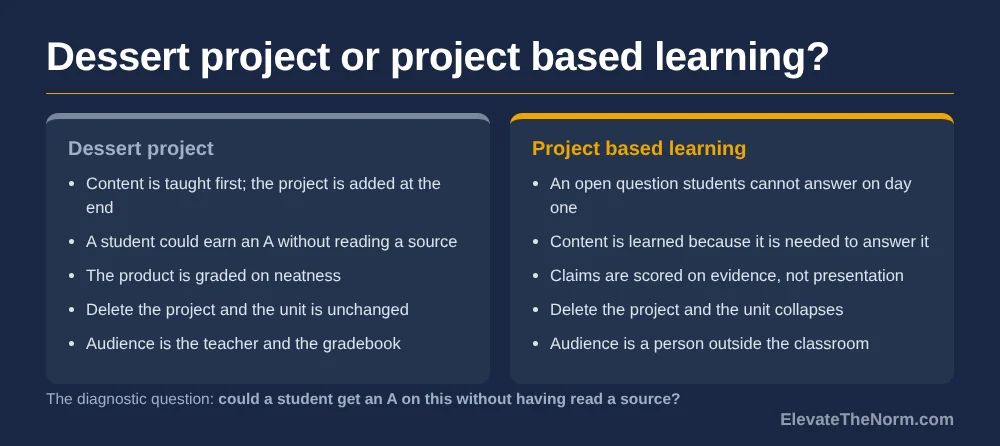
    Two-column comparison of a dessert project and project based learning in social studies, listing five differences including when content is taught and who the audience is.
    The diagnostic question: could a student get an A on this without having read a source?

    The C3 Framework already gives you the spine

    Social studies teachers have an advantage here that science and math teachers do not: our professional organization published the structure in 2013 and most state standards have absorbed it. The College, Career, and Civic Life (C3) Framework, from the National Council for the Social Studies, organizes inquiry into four dimensions — developing questions and planning inquiries, applying disciplinary concepts and tools, evaluating sources and using evidence, and communicating conclusions and taking informed action.

    Read that list again as a project plan. Dimension 1 is your driving question. Dimension 2 is your content instruction. Dimension 3 is the research phase. Dimension 4 is your public product. The C3 Framework is not a PBL document and does not claim to be, but the Inquiry Arc and a well-built project are the same shape, which means a project you design this way is easier to defend to an administrator asking what standard it serves.

    What the research actually says — and what it does not

    The best evidence for project based learning in social studies comes from one course, and it is genuinely good evidence. I am going to give you the numbers and then the caveats, because the caveats are the part most articles skip.

    Researchers at USC ran a school-level randomized controlled trial of Knowledge in Action, a project-based version of AP U.S. Government and AP Environmental Science, across five primarily urban districts. In year one, 74 teachers in 68 schools and 3,645 students. Among students who actually sat the exam, 44.8% of the project-based group earned a qualifying score of 3 or higher, against 37.2% of the comparison group — a 7.6-point difference, effect size 0.457. Students who had a second-year KIA teacher did better still, 51.3% against 41.6% (Saavedra et al., 2021).

    Now the caveats, which come from the authors themselves rather than from critics:

    • The full-sample number is smaller than the headline. Counting every enrolled student rather than only exam-takers, the year-one gap was 35.1% against 31.1% — four points, not eight.
    • Unadjusted year-one estimates were close to zero. The results depend on covariate adjustment. The authors say so plainly.
    • Attrition exceeded What Works Clearinghouse thresholds — 32% overall from randomization to year two, with a 22-point differential.
    • Year two on its own was inconclusive. The year-two-versus-year-one difference was not statistically significant.
    • Most of the effect was front-loaded. 83% of the exam-taker effect came from the first year, which is also the year teachers got the most external coaching (Saavedra & Rapaport, 2021).

    So here is the honest summary. A carefully built, heavily supported project-based social studies course beat a lecture-based version of the same course on the same external exam, for low-income and higher-income students alike. That is a real result and it is better evidence than most instructional fashions ever produce. It is also one AP course, in urban districts, with coaching most of us will never get. Nobody has run that trial on 8th grade U.S. History. Anyone who tells you the research proves PBL works in social studies generally is quoting a study they did not read.
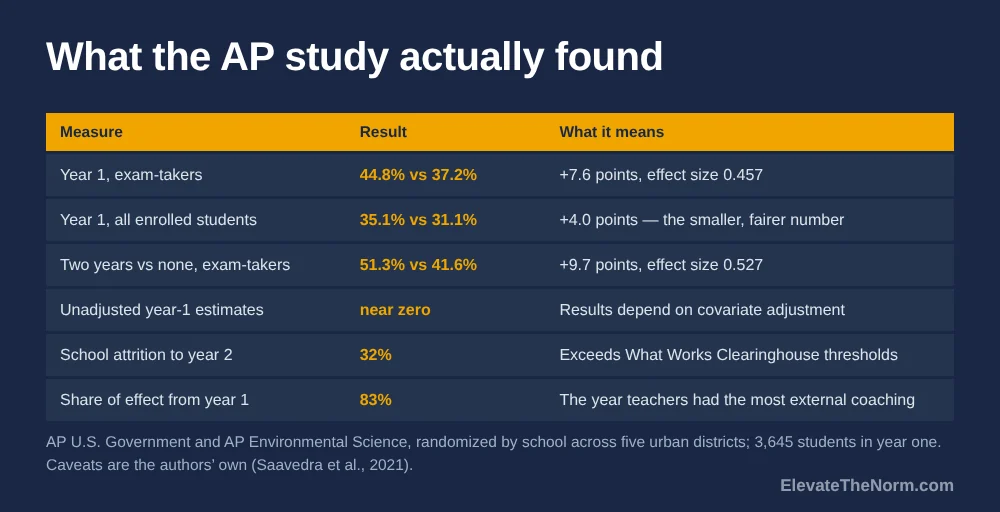
    Table of results from the randomized trial of a project-based AP U.S. Government and AP Environmental Science curriculum, including the exam-taker gap, the smaller full-sample gap, and the authors' caveats about attrition and covariate adjustment.
    The headline numbers and the authors’ own caveats, side by side.

    25 project based learning social studies projects for grades 6–12

    Each of these starts with a question students cannot answer on day one, ends with something a person outside the classroom will read or watch, and uses the discipline’s actual tools to get from one to the other. Time estimates assume a standard period. Grade bands are a starting point, not a ceiling — most of these scale up by raising the source difficulty rather than changing the task.

    Civics and government (1–5)

    #ProjectDriving questionGradesTimePublic product
    1Local ordinance auditWhich city ordinance most needs updating, and what would we replace it with?9–123 weeksWritten proposal delivered to a council member’s office
    2School policy review boardIs our school’s phone policy achieving what it was written to achieve?7–122 weeksRecommendation memo and presentation to administration
    3Ballot measure explainerWhat is actually on our ballot, and what would each option change?9–122 weeksNonpartisan voter guide distributed before an election
    4Rights case fileWhere is the line between student speech and school disruption?8–122 weeksCase brief and moot argument before a visiting attorney
    5Budget tradeoff hearingIf the district had to cut three percent, where should it come from?9–122–3 weeksCosted proposal with tradeoffs named, presented publicly

    Why these are PBL and not reports: every one has a decision at the end that a reasonable person could make differently. A report on how a bill becomes a law has a right answer in the textbook. “Which ordinance most needs updating” does not, so students have to defend a choice. If you want more in this strand, the civics project ideas collection goes deeper on the government side.

    United States history (6–10)

    #ProjectDriving questionGradesTimePublic product
    6Monument reviewWho does our town’s commemorative landscape remember, and who is missing?8–123 weeksProposed marker text submitted to a historical commission
    7Census block biographyWho lived on this street in 1940, and what happened to them?7–122 weeksAnnotated neighborhood map for the public library
    8Oral history archiveHow did people here experience a decade the textbook summarizes in a paragraph?9–124 weeksTranscribed, indexed interviews donated to a local archive
    9Textbook auditWhat does our textbook leave out about this event, and does it matter?8–122 weeksSupplement written for next year’s students
    10Disputed photographCan we establish when and where this image was taken, and who it served?7–101 weekSource analysis published as a museum-style wall label

    Why these are PBL: each one requires corroboration. A student cannot finish #7 without reconciling a census record against a city directory, and that reconciliation — not the map — is the learning. Projects 6 through 10 all build toward the same skill the local legend evidence lesson uses as a warm-up: separating what the record supports from what people repeat.

    World history (11–15)

    #ProjectDriving questionGradesTimePublic product
    11Trade route investigationWhat moved along this route besides goods, and which movement mattered most?6–102 weeksLayered map with an argued caption, displayed in the hall
    12Revolution comparisonWhy did two revolutions with similar grievances end so differently?9–123 weeksComparative essay defended in a seminar with outside guests
    13Translation problemHow much does a founding document change depending on who translates it?10–122 weeksSide-by-side annotated edition for the school library
    14Famine or epidemic inquiryWas this catastrophe natural, political, or both — and how would we know?9–123 weeksEvidence-weighted briefing paper for a community panel
    15Artifact repatriationWho should hold this object, and what principle decides?8–122 weeksPosition paper and recorded debate shared with a museum educator

    Why these are PBL: none of them resolve cleanly. Project 14 is the one I would hand a strong class, because the honest answer is almost always “both,” and getting a sixteen-year-old to argue for a weighted “both” with evidence attached is harder and more valuable than getting them to pick a side.

    Geography and human systems (16–20)

    #ProjectDriving questionGradesTimePublic product
    16Food access mappingHow far is a full grocery store from each part of our town, and for whom?7–122 weeksMap and findings sent to a food bank or planning office
    17Redlining overlayDo lines drawn eighty years ago still show up in our city today?9–123 weeksOverlay analysis presented at a public meeting
    18Walkability surveyWhich route to our school is the most dangerous, and what would fix it?6–102 weeksField-data report to the city engineer
    19Migration story mapWhy did people come to or leave this county in the last fifty years?8–123 weeksDigital story map with sourced interviews
    20Place-name originsWhat do our road and building names reveal about who had power here?6–91–2 weeksResearched name index for the local historical society

    Why these are PBL: students generate original data. Project 18 cannot be completed from a browser — somebody has to walk the route with a clipboard and count the crossings without a signal. That is the cheapest authentic fieldwork in the whole list and it consistently produces the findings administrators actually act on.

    Economics and civic data (21–25)

    #ProjectDriving questionGradesTimePublic product
    21Real cost of a first jobWhat does it cost to get to and keep a minimum-wage job in this town?9–122 weeksBudget model and guide for graduating seniors
    22Local business case studyWhy did this business close, and could anything have been done?10–123 weeksCase study shared with a chamber of commerce
    23Tax dollar traceWhere does a dollar of local sales tax actually go?8–122 weeksExplainer infographic with sourced figures, published online
    24Price history investigationHas this everyday good gotten more or less affordable since our parents were our age?7–111–2 weeksData brief with an argued conclusion
    25Survey the school honestlyWhat do students here actually believe about a question adults keep guessing at?9–123 weeksMethodologically documented survey report to staff

    Why these are PBL: project 25 is the one that teaches the most and goes wrong the most. Students discover that a badly worded question produces a useless answer, that response rates matter, and that they cannot claim what their sample will not support. Make them publish the limitations section. That section is the assignment.

    Four ways social studies projects go wrong

    Every subject has its own failure modes. These four are ours, and three of them are things a well-meaning teacher does on purpose.

    1. The craft project with no argument

    Building a model of something is not studying it. A sugar-cube pyramid, a shoebox diorama, a hand-drawn travel brochure for ancient Rome — these take hours and produce no claim anybody could disagree with. The diagnostic question is simple: could a student get an A on this without having read a source? If yes, it is a craft, and the class time belongs somewhere else. The fix is usually small. Keep the travel brochure, but require that it cite three primary sources and that one of them complicate the picture.

    2. Presentism

    Judging the past purely by present standards feels like moral clarity and teaches almost nothing. “Write a letter telling a historical figure why they were wrong” produces a paragraph any student could write before the unit started. The harder and more useful task is explaining why a decision made sense to the people who made it, and then evaluating it. Students can do both. Asking for the second without the first skips the history.

    This is not an argument for neutrality about atrocity. It is an argument that “they were monsters” is a conclusion, not an analysis, and that a student who can reconstruct the reasoning of someone they disagree with has learned something a student who cannot has not.

    3. Simulations that should never be run

    Do not simulate slavery, the Holocaust, genocide, internment, lynching, or the Middle Passage. Not as a role-play, not as an auction, not as a “walk in their shoes” exercise, not with desks arranged as a ship’s hold. These make the news every year, they humiliate the students who most identify with the victims, and no learning objective requires them. The United States Holocaust Memorial Museum’s guidelines for teaching the Holocaust state plainly that “simulating experiences from the Holocaust remains pedagogically unsound” — even when great care is taken to prepare a class — because students are “left with the impression that they now know what it was like to suffer.” The museum recommends primary sources and survivor testimony instead, and the reasoning generalizes to the rest of the list.

    Politically loaded simulations are a smaller version of the same problem. A mock election is fine — students research platforms and argue. A simulation that assigns students to argue for a position about their own identity group is not. The rule I use: students may be assigned a policy position, never an identity.

    4. Claims the student cannot source

    The most common defect in a finished social studies project is a confident sentence with nothing behind it. It usually appears in the conclusion, where the student has run out of evidence and reaches for a summary that sounds like the end of a documentary. Catch it with a mechanical check: every claim in the final product gets a footnote, a bracket, or a source line. Claims that cannot get one get cut. Students hate this for about a week and then start writing more carefully, because they can see the cuts coming.
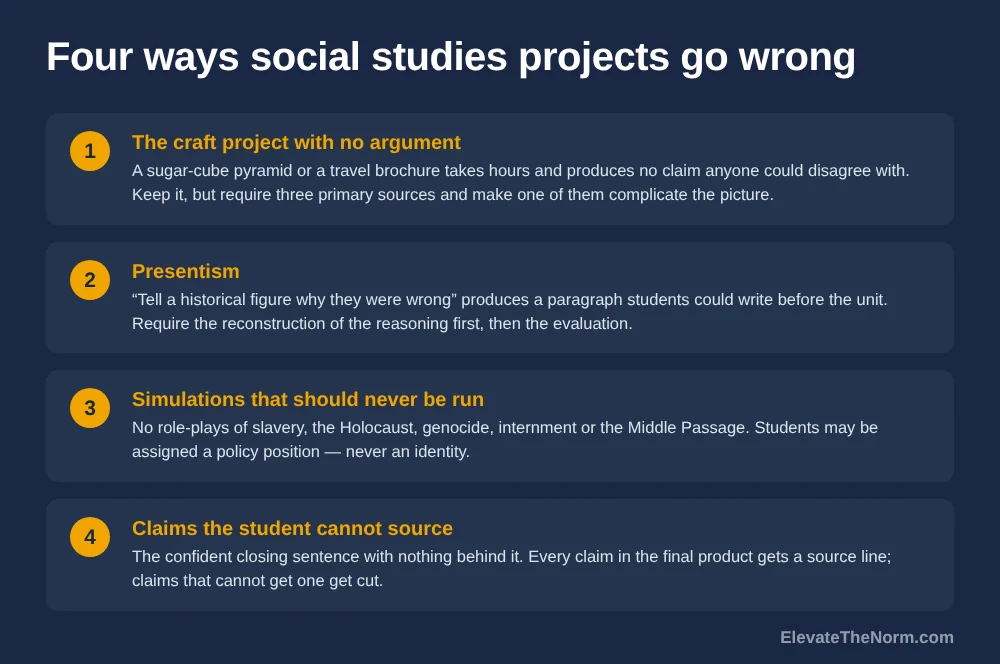
    Four numbered failure modes for social studies projects: craft projects with no argument, presentism, simulations that should never be run, and claims the student cannot source.
    The four failure modes specific to social studies, and the fix for each.

    How to run your first one without blowing up the semester

    Pick one unit, one project, one class period — not the whole course. The research above is a useful caution here, not just an endorsement: the strongest gains in the AP study came in the year teachers had the most external coaching. If a funded program with on-call coaches saw effects concentrate in year one, a teacher converting five preps alone over a summer should expect a rough first attempt. That is not a reason to skip it. It is a reason to make the first attempt small enough to survive.

    1. Choose the unit you are most tired of teaching. You know its content cold, which frees your attention for managing the process.
    2. Write the driving question before anything else. It should be answerable in more than one defensible way and not answerable by a single search. The driving question examples page has a revision formula for this.
    3. Name the audience out loud on day one. “This goes to the city engineer” changes the quality of student work more than any rubric line ever has.
    4. Build the checkpoints before students start. Three is usually right: sources approved, draft claim, revision after critique.
    5. Score the thinking, not the poster. A rubric that awards points for neatness will get you neatness. The PBL rubric template separates content knowledge from presentation so collaboration points cannot hide a weak argument.
    6. Keep the first one to two weeks. You will find the problems faster and you will still have a semester left to use what you learned.

    What to do next

    Pick one project from the list above that fits a unit you are teaching in the next two months. Write its driving question down. Then find the audience — the council office, the historical society, the librarian, the engineer — and send one email asking whether they would look at student work. That email is the whole difference between project based learning social studies and a unit that ends in a poster, and it takes about four minutes to write.

    If the audience says no, run it anyway and send the work to next year’s class. An audience of the students who come after you is still an audience, and it is the one that never falls through.

    Before you go: grab the free Social Studies Project Planner (PDF) — ElevateTheNorm.com branded, printable, no email required.

    Teaching the other half of the schedule? The companion piece on 25 science projects for grades 6–12 follows the same structure and adds the lab-safety constraints a social studies project never has to plan around.

    Frequently Asked Questions

    What is project based learning in social studies?

    It is an approach where students investigate an open question using the discipline’s own tools — primary sources, maps, data, competing interpretations — and produce something for a real audience. The question comes first and the content is learned in order to answer it. A project assigned after the unit is taught is a dessert project, not project based learning.

    Does project based learning actually raise social studies test scores?

    The strongest study says yes, in one course, under good conditions. A randomized trial of a project-based AP U.S. Government and AP Environmental Science curriculum across five urban districts found 44.8% of exam-takers scored a qualifying 3 or higher against 37.2% of the comparison group. The same researchers caution that the full-sample gap was smaller (35.1% vs 31.1%), that unadjusted estimates were near zero, that attrition exceeded What Works Clearinghouse thresholds, and that most of the effect came in the year teachers had external coaching. No equivalent trial exists for general middle or high school social studies.

    How long should a social studies project take?

    One to three weeks for a first attempt. Oral history and mapping projects that involve outside people or fieldwork run three to four. Resist the semester-long project until you have run two or three short ones — long projects hide their problems until it is too late to fix them.

    How do I grade a project without group work hiding a weak student?

    Separate the scores. Give an individual grade for content knowledge and evidence use, assessed from something each student produces alone, and a separate grade for collaboration and the group product. If one number covers both, a strong group will carry a student who learned nothing and the grade will not show it.

    What if I have no budget, no technology and no field trips?

    Most of the twenty-five projects here need a clipboard, a free online archive and a stamp. Census records, Chronicling America, state archives and National Register nomination forms are free. Walkability surveys and place-name research require no technology at all. The expensive part of project based learning is time, not money.

    How do I keep a project from becoming political in a way that gets me in trouble?

    Assign policy positions, never identities, and require every claim to carry a source. A student arguing for a budget tradeoff they did not choose is doing analysis. A student assigned to argue about their own identity group is being put in an unfair position. Tell families what the project is before it starts — a one-paragraph note heads off almost every complaint.

    Can project based learning work if my students read below grade level?

    Yes, and this is where social studies has an advantage: you control source difficulty independently of task difficulty. A seventh grader who reads at a fourth-grade level can still corroborate two sources, notice a disagreement and defend a claim — if the sources are excerpted, the vocabulary is pre-taught and the graphic organizer does the structural work. Lower the reading load, not the thinking.

    What is the difference between the C3 Framework and project based learning?

    The C3 Framework is a set of standards guidance from the National Council for the Social Studies, built around a four-dimension Inquiry Arc: developing questions, applying disciplinary tools, evaluating sources and evidence, and communicating conclusions and taking informed action. It is not a PBL program. But the arc and a well-built project are the same shape, which makes C3 a useful way to show an administrator which standards a project serves.

    Sources

    About Clay Shumate

    Clay Shumate is a certified secondary Social Studies teacher in the public schools of West Alabama, with seven years of classroom experience, a B.A. in History, and an M.Ed. in Secondary Education. He writes about project-based learning, student responsibility, respect, and practical ways to hold young people to a higher standard while giving them room to learn from mistakes. He is a member of the Society of Professional Journalists and writes to its Code of Ethics; this site’s editorial standards and corrections policy are published in full. More about Clay.

  • Fun History Facts for Students: 55 Sourced Bell Ringers for Grades 6–12

    Fun History Facts for Students: 55 Sourced Bell Ringers for Grades 6–12

    By Clay Shumate

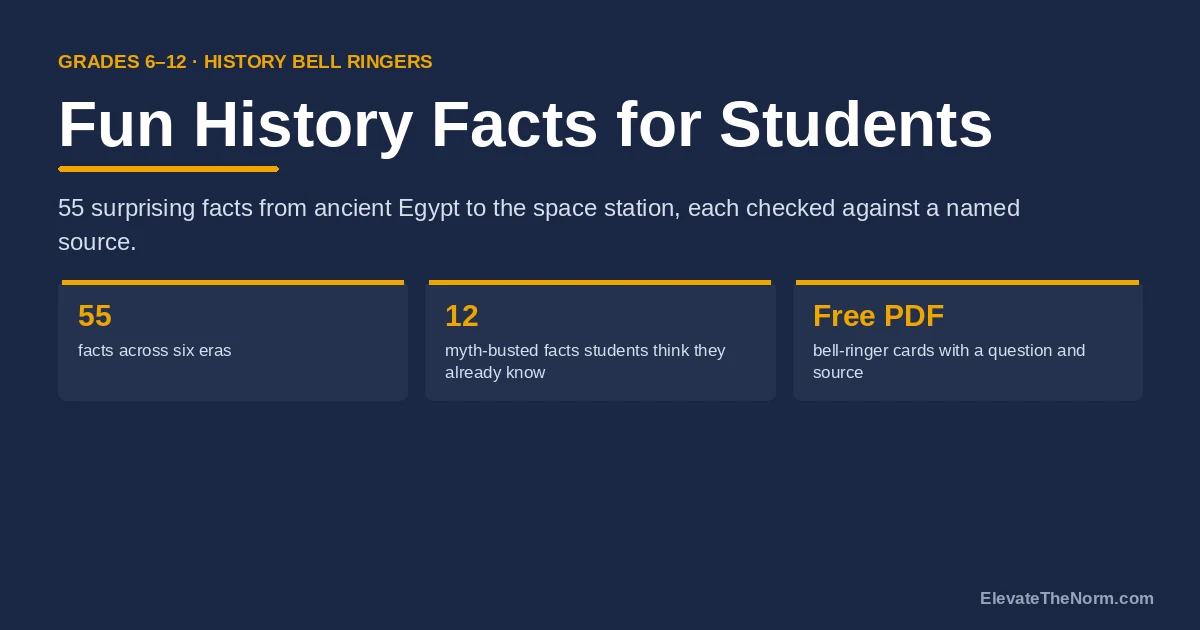
    Fun history facts for students work best as short, surprising openers: one fact, one question, four minutes. Below are 55 fun facts for students in grades 6–12, grouped by era from the ancient world to the space station. Every fact links to the source it was checked against, and 9 of them bust a myth students probably already believe.

    If you searched for “facts of fun” or “fun facts for students,” this is the history version, built for teachers. Each fact comes with an opinion question, so it works as a bell ringer, a discussion starter or a quick brain break. There is a free printable card set below, with no email required.

    Key Takeaways

    • 55 facts across six eras, mixing world and U.S. history.
    • Every fact has a named source. The source is linked here and printed on each card, so students can check it themselves.
    • 9 myth-busting facts correct stories students think they know, like horned Viking helmets and George Washington’s wooden teeth.
    • Each fact has a discussion question that asks for an opinion and a reason, not a definition.
    • Four minutes, four steps: read the fact, ask the question, take two answers, check the source.

    How to use fun history facts as bell ringers

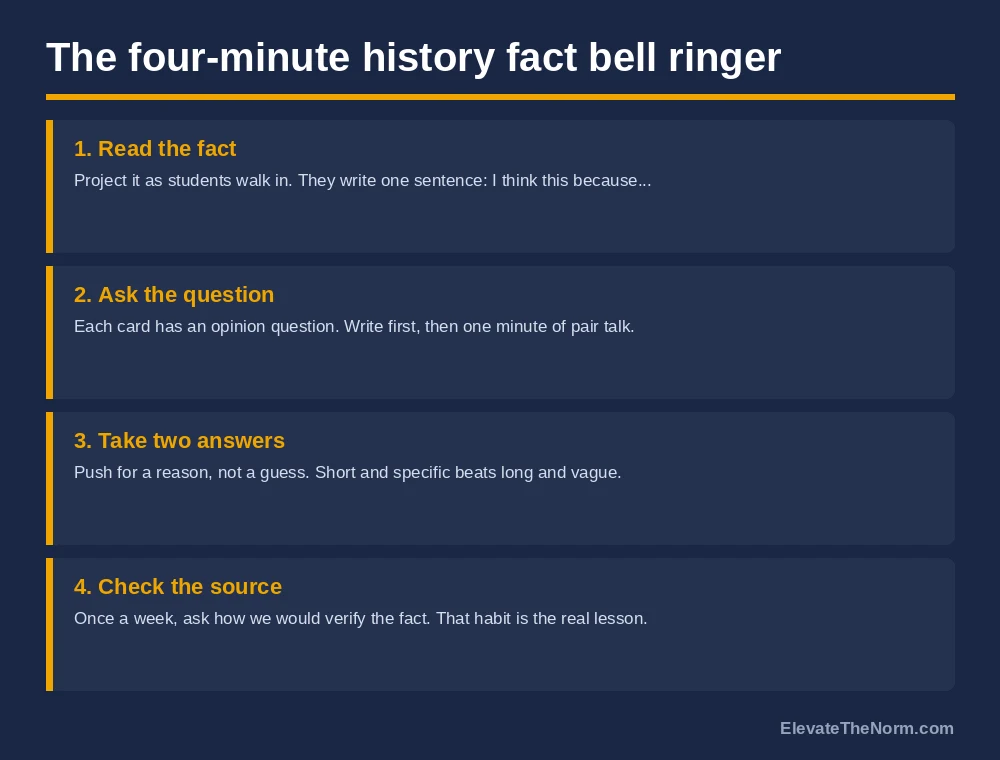
    The fact gets attention, and the question does the teaching. A surprising fact on the board gives students a reason to look up when they walk in. The opinion question that follows asks them to explain, compare or predict, which is the thinking a history class runs on. Here is the four-minute routine:

    1. Read the fact. Project it or read it as students sit down. Each student writes one sentence that starts with “I think this because…”
    2. Ask the question. Students answer in writing first, then talk with a partner for one minute.
    3. Take two answers. Call on two students. Push for a reason, not a guess.
    4. Check the source. At least once a week, point to the source and ask, “How would we check this?”

    That last step is the one that pays off all year. A class that gets used to asking where a fact came from is a class that is ready for primary sources, research projects and the history projects that ask students to build an argument from evidence. For more warm-up formats, see our full list of bell ringer ideas. When the class needs to talk rather than write, 105 classroom-safe would-you-rather prompts, sorted into icebreaker, history, thinking and funny sets run on the same kind of five-minute routine.

    Four steps of a history fact bell ringer: read the fact, ask the question, take two answers, check the source
    The same four steps every day keep the warm-up to four minutes.

    Why the myth-busting facts matter most

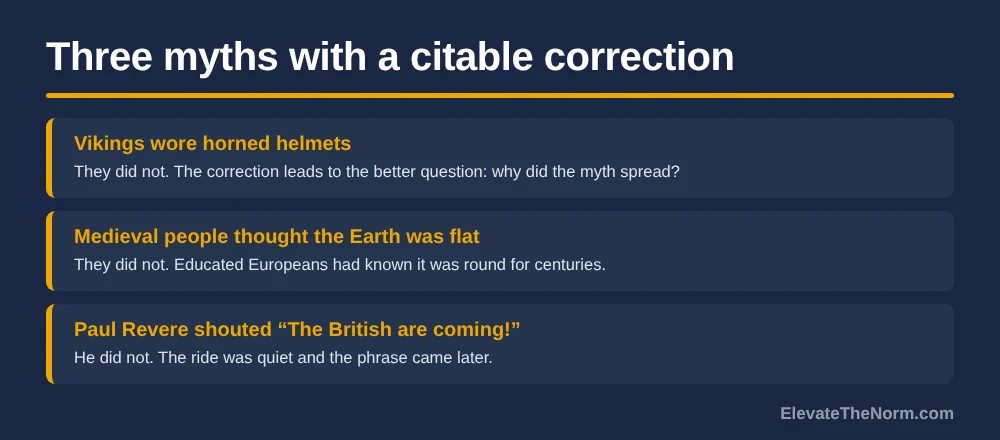
    The myth-busting facts teach the most important habit in a history class: a story everyone repeats is not the same as a story someone checked. Students arrive believing that Vikings wore horned helmets, that medieval people thought the Earth was flat, and that Paul Revere shouted “The British are coming!” Each of those has a clear, citable correction, and each correction leads to a better question: why did the myth spread in the first place?

    Graphic titled Three myths with a citable correction, listing horned Viking helmets, the flat Earth belief in the Middle Ages, and Paul Revere shouting The British are coming, each with the correction beneath it.
    Three myths students arrive with, and the correction for each.

    Use one in the first week of school and then come back to the idea all year. When a student later repeats something from a video or social media, “Is this a horned-helmet fact?” becomes a quick shared shorthand for checking it.

    Free download: 55 fun history fact bell ringer cards

    Fifteen pages. Page 1 is the four-minute routine. The rest are 55 cards, four per page, each with the fact, an opinion question and the source it was checked against. Numbered to match this article.

    Free. No email address required. Built for grades 6–12.

    Fun history facts: Ancient World (to 500 CE)

    Pyramids, pirates and a Greek machine with gears. These work well in the first unit of a world history course, or any time students think ancient people were simple.

    1. For about 3,800 years, the Great Pyramid of Giza was the tallest human-made structure on Earth. Discuss: Why do you think people in ancient Egypt put so much time and effort into building something so huge? (Britannica – How long did the Great Pyramid of Giza hold the record as the tallest man-made structure in the world?)
    2. Evidence suggests the Egyptian pyramids were built by paid laborers, not by slaves as many people believe. Discuss: Why do you think the myth that slaves built the pyramids has lasted so long? (History.com – 11 Things You May Not Know About Ancient Egypt)
    3. Cleopatra came from a family of Greek Macedonians, but she was the first ruler in her family line to learn the Egyptian language. Ancient writers said she may have known as many as a dozen languages. Discuss: How do you think speaking many languages helped Cleopatra as a ruler? (History.com – 10 Little-Known Facts About Cleopatra)
    4. When pirates captured a young Julius Caesar and demanded a ransom of 20 talents, Caesar laughed at them and said he was worth at least 50. Discuss: Was Caesar being brave or just showing off? Explain your thinking. (Britannica – The Time Julius Caesar Was Captured by Pirates)
    5. The month of July was first called Quintilis, Latin for 'fifth month.' It was renamed to honor Julius Caesar in 44 BCE. Discuss: If you could rename a month after someone from history, who would you choose and why? (Britannica – July)
    6. Some ancient Roman concrete can heal its own cracks: reactive chunks of lime in the mix help seal tiny cracks before they spread. Rome's Pantheon, dedicated in 128 CE, still has the world's largest unreinforced concrete dome. Discuss: Why do you think modern builders are now studying ancient Roman concrete? (MIT News – Riddle solved: Why was Roman concrete so durable?)
    7. The Rosetta Stone, found in 1799, has the same decree carved in three scripts: Egyptian hieroglyphs, demotic, and ancient Greek. It helped scholars finally learn to read hieroglyphs. Discuss: Why do you think having the same message in three scripts made the Rosetta Stone so valuable? (Britannica – Rosetta Stone)
    8. Divers pulled the Antikythera mechanism, sometimes called an 'ancient Greek computer,' from a shipwreck in 1900–1901. Its gears could track the Sun, Moon, and planets, predict eclipses, and show when the Olympic Games would happen. Discuss: Why do you think nothing this advanced appeared again for more than a thousand years? (Smithsonian Magazine – What Is the Antikythera Mechanism, the World's First Computer?)
    9. In 1974, farmers digging a well in China found China's Terracotta Army. Archaeologists have since found about 8,000 life-size clay soldiers, and each one appears to have its own unique face. Discuss: Why do you think an emperor wanted an army of clay soldiers buried near his tomb? (History.com – 5 Things You May Not Know About the Terracotta Army)

    Fun history facts: Medieval World (500–1450)

    This set is heavy on myths students already believe, which makes it a strong set for teaching how to question a story everyone repeats.

    1. Myth busted: Vikings almost certainly did not wear horned helmets. The horned look became popular in the 1870s, when a costume designer created horned helmets for an opera by Richard Wagner. Discuss: Why do you think movies and costumes keep the horned-helmet myth alive? (History.com – Did Vikings really wear horned helmets?)
    2. Scientists proved Vikings were cutting down trees in Newfoundland, Canada, in the year 1021, using a solar storm signal locked inside tree rings. That is more than 470 years before Columbus sailed in 1492. Discuss: Why do you think Columbus is remembered more than the Vikings who reached North America first? (Smithsonian Magazine – New Dating Method Shows Vikings Occupied Newfoundland in 1021 C.E.)
    3. In 1324, Mansa Musa, king of Mali, traveled to Mecca with a huge caravan carrying hundreds of pounds of gold. He spent and gave away so much gold in Egypt that its value dropped, and the economy took 12 years to recover. Discuss: Can being too generous ever cause problems? Explain using Mansa Musa as an example. (History.com – This 14th-Century African Emperor Remains the Richest Person in History)
    4. Myth busted: Educated people in the Middle Ages knew the Earth was round. The idea that they believed in a flat Earth was largely made up in 1828 in a popular biography of Columbus by Washington Irving. Discuss: Why do you think a made-up story can become 'common knowledge'? (History.com – Christopher Columbus Never Set Out to Prove the Earth Was Round)
    5. Myth busted: The image of medieval people as dirty and unwashed is false. Bathing and handwashing were common and were treated as important routines. Discuss: Why do you think people today often imagine the past as dirtier or less advanced than it really was? (National Geographic – What life in medieval Europe was really like)
    6. The computer word 'algorithm' comes from the name of al-Khwarizmi, a Muslim scholar who lived in the 800s, through a Latin translation of his math book. Discuss: Why do you think so many science and math words come from other languages and cultures? (Britannica – Algorithm)
    7. At its peak in the late 1200s, the Mongol Empire covered about 9 million square miles, making it the largest connected land empire in history. Discuss: What challenges do you think came with ruling such a huge empire? (History.com – What Were the Biggest Empires in History?)
    8. Explorer Marco Polo was one of the first Europeans to see an Asian rhinoceros, and he thought the horned animals were unicorns. Discuss: Why do you think Marco Polo compared the rhino to something he already knew about from stories? (History.com – 11 Things You May Not Know About Marco Polo)
    9. The famous Bayeux Tapestry is not actually a woven tapestry. It is a strip of linen about 230 feet (70 meters) long with scenes embroidered on it. Discuss: Why do you think people told history through pictures like this instead of only in writing? (Britannica (Compton's) – The Bayeux tapestry is not a woven tapestry)
    10. Only four original copies of the 1215 Magna Carta still exist today. It was sealed by King John at Runnymede, England. Discuss: Why do you think a document from 1215 still matters to people today? (Library of Congress – Lincoln Magna Carta (Magna Carta: Muse and Mentor exhibit))

    Fun history facts: Early Modern / Age of Exploration & Revolutions (1450–1800)

    Explorers, revolutions and the founders, including several things American students are usually taught wrong.

    1. Ferdinand Magellan's 1519 voyage set out with about 240 men on five ships, but only 18 men made it back to Spain in 1522. Magellan himself died in the Philippines before the trip was finished. Discuss: Why do you think explorers were willing to take such huge risks? (National Geographic – 240 men started Magellan's voyage around the world. Only 18 finished it.)
    2. Tomatoes were first grown in Mexico and came to Europe in the 1500s. For a long time, many Europeans thought tomatoes were poisonous, and tomato sauce did not become a regular part of Italian cooking until the late 1700s. Discuss: Why do you think people are sometimes afraid to try new foods? (Smithsonian Magazine – A Passion for Tomatoes)
    3. In January 1610, Galileo used a homemade telescope to discover four moons circling Jupiter. Astronomers still call them the Galilean moons. Discuss: Why do you think Galileo's discovery upset people who believed everything circled the Earth? (NASA – 415 Years Ago: Astronomer Galileo Discovers Jupiter's Moons)
    4. During the Dutch 'tulip mania' of the 1630s, one rare tulip bulb sold for more than the cost of a mansion in Amsterdam. Historians now say the famous 'crash' was overblown and few people were ruined. Discuss: Why do you think people pay huge amounts for things that are popular or rare? (Smithsonian Magazine – There Never Was a Real Tulip Fever)
    5. Isaac Newton served in Parliament, but he reportedly spoke only once—to ask an usher to close a window because it was chilly. Discuss: Can someone be a genius in one area and quiet or unsure in another? Explain. (History.com – 9 Things You May Not Know About Isaac Newton)
    6. Congress voted for independence on July 2, 1776. The Declaration of Independence is dated July 4, but it was not actually signed until August 2. Discuss: Why do you think Americans celebrate July 4 instead of July 2? (National Archives – Did You Know… Independence Day Should Actually Be July 2?)
    7. Myth busted: Paul Revere almost certainly did not shout 'The British are coming!' on his 1775 ride. Most colonists still thought of themselves as British, and he most likely warned that 'the regulars are coming out.' Discuss: Why do you think the more dramatic version of the story became so popular? (Paul Revere House – Revisit the Ride: What Did Paul Revere Actually Say?)
    8. Myth busted: Benjamin Franklin never officially proposed the turkey as America's national bird. He did write a letter to his daughter calling the bald eagle a bird of 'bad moral character' and the turkey 'a much more respectable bird.' Discuss: Which animal do you think best represents the United States, and why? (The Franklin Institute – Did Benjamin Franklin Want the National Bird To Be A Turkey?)
    9. Myth busted: George Washington's false teeth were never made of wood. His dentures used materials like tin, gold, lead, and human teeth; staining over time made them look like wood grain. Discuss: Why do you think people like to tell surprising (but false) stories about famous leaders? (George Washington's Mount Vernon – Wooden Teeth Myth)

    Fun history facts: 19th Century (1800–1900)

    Inventions, purchases and one very loud volcano. Good openers for U.S. history units on expansion and industry.

    1. Former presidents John Adams and Thomas Jefferson died within hours of each other on July 4, 1826—exactly 50 years after the Declaration of Independence. Discuss: Is this just a coincidence, or does it feel like something more? Explain your opinion. (Thomas Jefferson's Monticello – John Adams)
    2. The oldest surviving photograph from a camera was made in 1827 by Joseph Nicéphore Niépce. It showed the view from his window and took several days of sunlight to capture. Discuss: How would life be different if taking a photo still took days? (Harry Ransom Center, University of Texas at Austin – The Niépce Heliograph)
    3. Ketchup most likely began centuries ago as a fermented fish sauce, similar to sauces found in Southeast Asia. The first published recipe for tomato ketchup did not appear until 1812. Discuss: What other everyday foods do you think might have surprising origins? (Smithsonian Magazine – A Brief (But Global) History of Ketchup)
    4. Abraham Lincoln is the only U.S. president to hold a patent. In 1849 he patented a device that used inflatable air chambers to lift riverboats over sandbars. Discuss: Why do you think problem-solving skills are useful for a president? (Smithsonian Magazine – Abraham Lincoln Is the Only President Ever to Have a Patent)
    5. Myth busted: Napoleon was not unusually short. He was probably about 5 feet 6 or 7 inches—average or taller for a Frenchman of his time—but British cartoonists drew him as tiny. Discuss: How can cartoons and media shape the way people see a leader? (Britannica – Was Napoleon Short?)
    6. The Pony Express mail service started in April 1860 but lasted only about 18 months. The new transcontinental telegraph made it outdated in October 1861. Discuss: What modern technology do you think will become outdated as fast as the Pony Express did? (Smithsonian National Postal Museum – Pony Express)
    7. In 1867, the United States bought Alaska from Russia for $7.2 million. Critics mocked the deal as 'Seward's Folly,' but a later gold discovery proved it was a smart buy. Discuss: Have you ever made a choice others doubted that turned out well? How is that like the Alaska purchase? (U.S. Department of State, Office of the Historian – Purchase of Alaska, 1867)
    8. The 1883 eruption of the Krakatoa volcano in Indonesia is considered the loudest sound in modern history. People heard it as far as 3,000 miles away. Discuss: How do you think people 3,000 miles away explained a sound they could not see the cause of? (Britannica – What's the Loudest Sound in History?)
    9. The Statue of Liberty was not always green. Its copper skin, only about as thick as two pennies, slowly reacted with the air and formed a green layer called a patina that protects the metal. Discuss: Do you think the statue looks better green or would it look better copper-colored? Why? (National Park Service – Frequently Asked Questions About the Statue of Liberty)

    Fun history facts: 20th Century (1900–1945)

    World wars, famous landmarks and a stolen painting. Several of these lead straight into a lesson on how ordinary people shaped big events.

    1. The teddy bear is named after President Theodore Roosevelt. In 1902 he refused to shoot a bear that had been tied to a tree on a hunting trip, and a toy maker soon sold a stuffed 'Teddy's Bear.' Discuss: Why do you think this story made Roosevelt more popular with Americans? (National Park Service – The Story of the Teddy Bear (Theodore Roosevelt Birthplace))
    2. The Wright brothers' first powered flight on December 17, 1903, lasted just 12 seconds and went 120 feet. Pieces of their airplane later traveled to the Moon with Neil Armstrong and to Mars on NASA's Ingenuity helicopter. Discuss: Why do you think astronauts and NASA chose to carry pieces of the Wright Flyer into space? (NASA – 120 Years Ago: The First Powered Flight at Kitty Hawk)
    3. In 1911, the Mona Lisa was stolen from the Louvre by Vincenzo Peruggia, a former handyman there, who hid it in his Paris apartment for about two years. The theft actually made the painting far more famous. Discuss: Why do you think a crime made the Mona Lisa more famous instead of less? (History.com – The Heist that Made the Mona Lisa Famous)
    4. On Christmas Day 1914, during World War I, some British and German soldiers met in 'No Man's Land' between the trenches, exchanged gifts, and played informal games of football (soccer). Discuss: What does the Christmas Truce tell us about the soldiers on both sides? (Imperial War Museums – The Real Story of the Christmas Truce of 1914)
    5. Jeannette Rankin of Montana became the first woman elected to Congress in 1916—nearly four years before the 19th Amendment gave women across the U.S. the right to vote. Discuss: How do you think Rankin felt serving in Congress when most American women still could not vote? (Library of Congress (Picture This blog) – Jeannette Rankin: First Woman Elected to Congress)
    6. Almost 400 men and women worked on carving Mount Rushmore from 1927 to 1941, and despite the dangerous conditions, no one died during the carving. Discuss: What do you think made it possible for such a dangerous project to have no deaths? (National Park Service – The Workers (Mount Rushmore National Memorial))
    7. The top of the Empire State Building was built as a docking port for dirigibles (giant airships), but strong winds at the top made docking nearly impossible. Discuss: Why do you think people in the 1930s imagined airships would be the future of travel? (History.com – 10 Surprising Facts About the Empire State Building)
    8. During World War II, the U.S. 'Ghost Army,' a unit full of artists and designers, fooled the enemy with 93-pound inflatable tanks and loudspeakers playing recorded troop sounds. Its records stayed secret until 1996. Discuss: Do you think creativity can be as important as strength in a conflict? Why? (Smithsonian Magazine – The Ghost Army of World War II Used Art to Deceive the Nazis)
    9. The code created by Navajo Code Talkers in World War II was never broken. Because Navajo had no word for 'submarine,' they used 'besh-lo,' meaning 'iron fish.' Discuss: Why do you think a code based on a spoken language was so hard for the enemy to crack? (The National WWII Museum – American Indian Code Talkers)

    Fun history facts: Cold War & Modern (1945–present)

    Satellites, space and the end of the Cold War, through the invention of the web. Students tend to find this era closest to their own lives.

    1. Sputnik 1, the world's first artificial satellite, was launched by the Soviet Union on October 4, 1957. It was about the size of a beach ball and circled Earth about every 98 minutes. Discuss: Why do you think a satellite the size of a beach ball worried so many Americans? (NASA – Sputnik and The Dawn of the Space Age)
    2. In 1960, six-year-old Ruby Bridges helped integrate New Orleans schools, walking to school with federal marshals. Her teacher, Barbara Henry, taught her as her only student for an entire year. Discuss: What do you think gave a six-year-old the courage to keep going to school every day? (History.com – Who Is Ruby Bridges?)
    3. Myth busted: The Cold War 'hotline' between Washington and Moscow, set up in 1963 after the Cuban Missile Crisis, was never a red telephone. It used teletype machines that sent typed messages. Discuss: Why do you think written messages might have been safer than phone calls in a crisis? (Smithsonian Magazine – There Never Was Such a Thing as a Red Phone in the White House)
    4. Myth busted: NASA did not invent Velcro or Tang. Velcro is a Swiss invention from the 1940s, and Tang was made by General Foods in 1957; astronauts just made them famous. Discuss: Why do you think people give NASA credit for inventions it did not create? (NASA – Tang, Teflon, Velcro)
    5. The Voyager Golden Record, sent into space aboard NASA's Voyager probes, carries greetings in 55 languages along with pictures, music, and sounds from Earth. Discuss: If you could add one sound or song to represent Earth, what would it be and why? (NASA Science – Golden Record Greetings)
    6. In 1980, the World Health Organization declared smallpox eradicated. It is still the only human disease that has been completely wiped out. Discuss: Why do you think it has been so hard to eradicate other diseases the way smallpox was? (World Health Organization – History of smallpox vaccination)
    7. Tim Berners-Lee invented the World Wide Web in 1989 while working at CERN in Switzerland. The world's first website was at the address info.cern.ch. Discuss: How would your daily life be different without the World Wide Web? (CERN – A short history of the Web)
    8. The Berlin Wall opened on November 9, 1989, partly because of a mistake: East German official Günter Schabowski announced new travel rules would start 'immediately,' though they were meant to begin the next day. Crowds rushed to the border. Discuss: Can one mistake change history? What other examples can you think of? (History.com – 10 Things You May Not Know About the Berlin Wall)
    9. People have lived on the International Space Station without a break since November 2000. The station circles Earth 16 times a day, so its crew sees 16 sunrises and sunsets every 24 hours. Discuss: Would you want to live on the space station for six months? Why or why not? (NASA – International Space Station Facts and Figures)

    Turning a fun fact into a full lesson

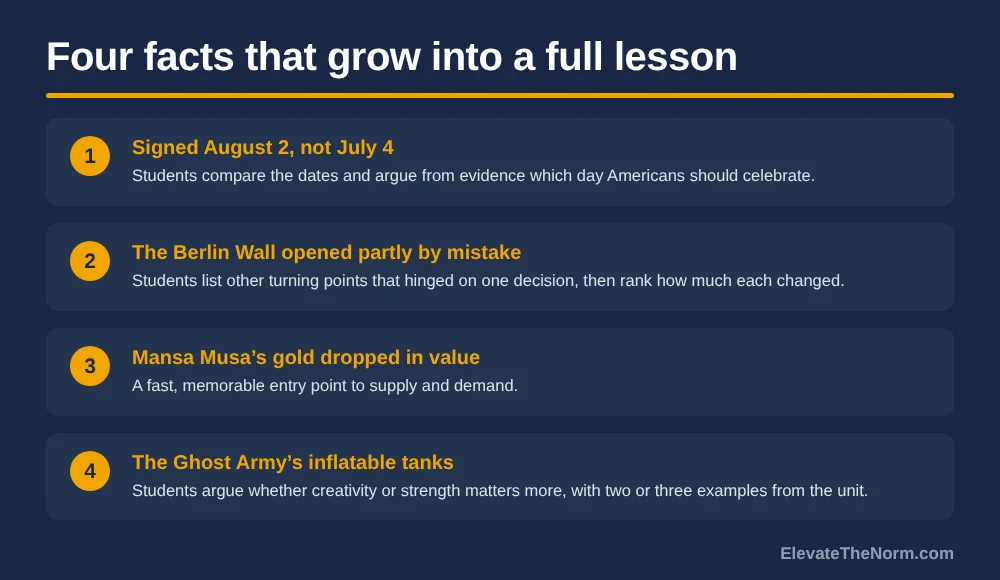
    Some of these facts are big enough to carry a whole class period. A few that grow well:

    Graphic titled Four facts that grow into a full lesson, listing the August 2 signing of the Declaration, the Berlin Wall opening partly by mistake, Mansa Musa devaluing gold, and the Ghost Army inflatable tanks, each with the classroom activity it supports.
    Four facts big enough to carry a whole class period.
    • The Declaration was signed August 2, not July 4. Students compare the dates and decide which day Americans should really celebrate, using evidence. It pairs with our civics project ideas.
    • The Berlin Wall opened partly because of a mistake. Students list other turning points that hinged on one decision, then rank how much each one changed.
    • Mansa Musa spent so much gold that its value dropped. A fast, memorable entry point to supply and demand in a world history or economics class.
    • The Ghost Army fooled the enemy with inflatable tanks. Students argue whether creativity or strength matters more, using two or three examples from the unit.

    To review a whole era at the end of a unit, mix a few of these facts into one of the classroom review games that actually review, or use them as true-or-false rounds where students must name the source to earn the point.

    How these facts were checked

    Every fact on this page was checked against the page it links to, and the wording was adjusted when a source did not fully support it. The sources include Britannica, CERN, George Washington’s Mount Vernon, Harry Ransom Center, University of Texas at Austin, History.com, Imperial War Museums, Library of Congress, MIT News, NASA, NASA Science, National Archives, National Geographic, National Park Service, Paul Revere House, Smithsonian Magazine, Smithsonian National Postal Museum, The Franklin Institute, The National WWII Museum, Thomas Jefferson’s Monticello, U.S. Department of State, Office of the Historian, and World Health Organization. Several popular “fun facts” were left out because no reliable source supported them. If you find an error, the site’s corrections policy explains how to report it.

    Frequently Asked Questions

    What are some fun history facts for students?

    A few favorites: the Great Pyramid of Giza was the tallest human-made structure on Earth for about 3,800 years; the Declaration of Independence was not signed until August 2, 1776; Abraham Lincoln is the only U.S. president to hold a patent; and Vikings almost certainly did not wear horned helmets. Each fact on this page links to the source it was checked against.

    What does “facts of fun” mean?

    People who search for “facts of fun” are usually looking for fun facts: short, surprising true statements. This page collects fun facts about history for students in grades 6 to 12, each with a discussion question and a source.

    How do you use fun facts as bell ringers?

    Show one fact as students arrive, have them write one sentence about it, ask an opinion question, take two answers out loud, and once a week ask how the class could check the source. The whole routine takes about four minutes.

    Are these history facts true?

    Each fact was checked against the reputable source it links to, such as the Smithsonian, the National Archives, the Library of Congress, NASA, the National Park Service or Britannica. Popular facts that could not be verified were left out.

    What grade level are these fun facts for?

    They are written for grades 6 to 12, at roughly a middle school reading level, so they work in middle school social studies and in high school world history and U.S. history.

    What are some history myths students believe?

    Common ones include that Vikings wore horned helmets, that medieval people believed the Earth was flat, that George Washington had wooden teeth, that Napoleon was unusually short, and that Paul Revere shouted “The British are coming!” This page includes the correction and the source for each.

    Is there a printable version?

    Yes. All of the facts come as free printable bell ringer cards in a PDF, with the discussion question and source on each card. It downloads directly with no email or sign-up.

    About Clay Shumate

    Clay Shumate is a certified secondary Social Studies teacher in the public schools of West Alabama, with seven years of classroom experience, a B.A. in History, and an M.Ed. in Secondary Education. He writes about project-based learning, student responsibility, respect, and practical ways to hold young people to a higher standard while giving them room to learn from mistakes. He is a member of the Society of Professional Journalists and writes to its Code of Ethics; this site’s editorial standards and corrections policy are published in full. More about Clay.

Teacher Emergency Toolkit — practical resources, real classroom support. Shop on TPT.Teacher Emergency Toolkit — practical resources, real classroom support. Shop on TPT.