By Clay Shumate
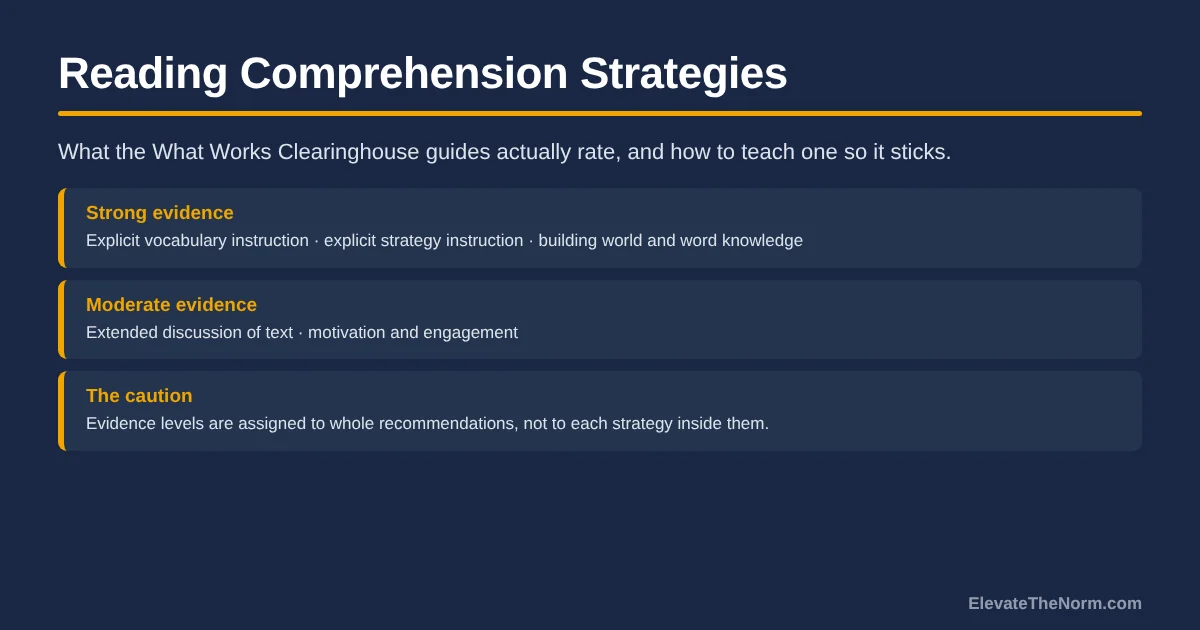
The reading comprehension strategies with the strongest federal evidence for grades 6–12 are explicit vocabulary instruction and direct, explicit teaching of comprehension strategies such as summarizing, questioning, and inferring. Extended discussion of texts has moderate support. Background knowledge matters too: what students already know about a topic strongly affects what they understand and remember.
Key Takeaways
- Two federal practice guides cover adolescent reading. Improving Adolescent Literacy (2008, grades 5–12) and Providing Reading Interventions for Students in Grades 4–9 (2022). There is no 2016 grades 4–9 comprehension guide; the 2016 reading guide covers K–3.
- Vocabulary and explicit strategy instruction carry “strong” evidence ratings in the 2008 guide. Discussion and motivation are rated “moderate.”
- The 2022 guide bundles four comprehension practices into one strong recommendation: build world and word knowledge, ask and answer questions, find the gist, and monitor comprehension.
- Strategies are taught, not assigned. Both guides describe modeling first, then guided practice, then independent use.
- Background knowledge is a comprehension strategy for teachers, not just students. A classic 1988 study found prior knowledge affected recall on every measure, for strong and weak readers alike.
Which research should teachers trust on reading comprehension?
Start with the What Works Clearinghouse practice guides from the Institute of Education Sciences. They’re written by research panels, they rate each recommendation by the strength of its evidence, and they’re free. Two apply to secondary teachers.
Improving Adolescent Literacy: Effective Classroom and Intervention Practices (Kamil et al., 2008) covers grades 5–12 and is addressed to teachers and other school staff who work directly with students, with content-area classes named explicitly in its vocabulary recommendation. It’s older, but it’s still the federal guide aimed squarely at middle and high school classrooms.
Providing Reading Interventions for Students in Grades 4–9 (Vaughn et al., 2022) is newer and more detailed, but its main audience is people delivering reading intervention: special educators, interventionists, reading specialists, and coaches. Its comprehension practices still translate well to a general classroom, as long as you remember the population it was written for.
If you’ve seen a reference to a “2016 WWC guide for grades 4–9 on reading comprehension,” that guide doesn’t appear in the WWC’s own list. The 2016 reading guide is Foundational Skills to Support Reading for Understanding in Kindergarten Through 3rd Grade; the grades 4–9 guide is the 2022 one.
What reading comprehension strategies does the evidence support?
Here’s what the two guides recommend, with the evidence level each panel assigned. One caution on reading the table: evidence levels are assigned to whole recommendations, not to each individual strategy inside them.
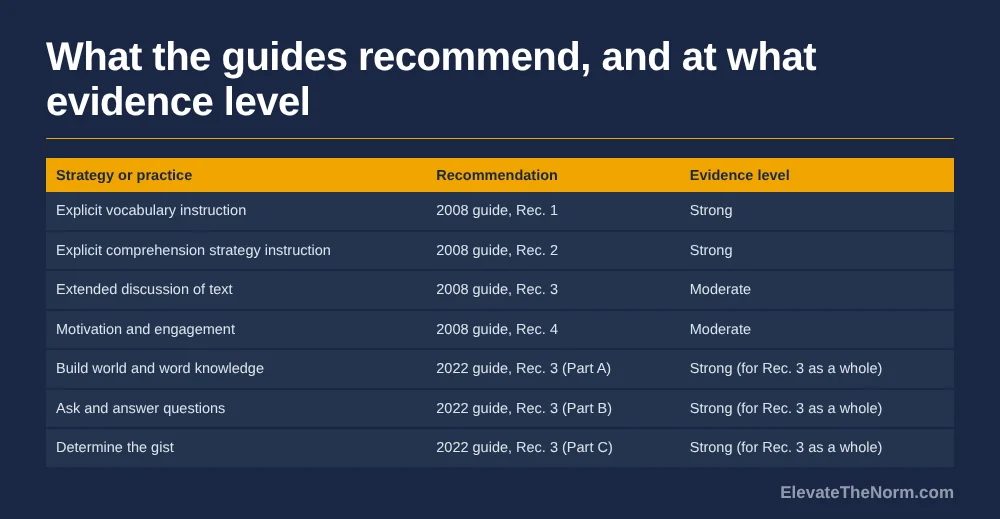
| Strategy or practice | What it looks like in class | Recommendation it falls under | Evidence level |
|---|---|---|---|
| Explicit vocabulary instruction | Teach the few words that carry a passage’s meaning, plus word-learning skills like word parts and context | 2008 guide, Rec. 1 | Strong |
| Explicit comprehension strategy instruction | Teacher explains and models summarizing, questioning, inferring, predicting, or using a graphic organizer, then fades support | 2008 guide, Rec. 2 | Strong |
| Extended discussion of text | Sustained talk about meaning, with open questions and follow-ups, in whole class or small groups | 2008 guide, Rec. 3 | Moderate |
| Motivation and engagement | Clear content goals, some student choice, reading tied to students’ interests or current events, and collaborative work | 2008 guide, Rec. 4 | Moderate |
| Build world and word knowledge | A few minutes of background before reading; pre-teach essential words | 2022 guide, Rec. 3 (Part A) | Strong (for Rec. 3 as a whole) |
| Ask and answer questions | Teach question types; students write their own using stems | 2022 guide, Rec. 3 (Part B) | Strong (for Rec. 3 as a whole) |
| Determine the gist | A routine for stating the main idea of a short section, using text structure | 2022 guide, Rec. 3 (Part C) | Strong (for Rec. 3 as a whole) |
| Monitor comprehension | Students check whether the text makes sense while reading and reflect after | 2022 guide, Rec. 3 (Part D) | Strong (for Rec. 3 as a whole) |
| Practice with stretch text | Supported work with challenging, grade-level text | 2022 guide, Rec. 4 | Moderate |
| Intensive intervention | Individualized help from trained specialists for struggling readers | 2008 guide, Rec. 5 | Strong |
Two items missing from that table are worth noticing. The 2022 guide’s first two recommendations, decoding multisyllabic words and building fluency, both rated strong, are foundational skills rather than comprehension strategies. They matter enormously for students who can’t read the words, and they’re usually outside what a content teacher can deliver in a period. And many popular classroom routines don’t appear by name in either guide at all.
How do you teach a comprehension strategy so it sticks?
The 2008 guide is specific: explain the strategy, model it with a think-aloud, give guided practice with feedback, then move students toward independent use. Support fades in stages, from small groups with the teacher helping, to pairs, to students applying the strategy alone. The 2022 panel describes the same sequence: model first, then guided and collaborative practice, then independent use.
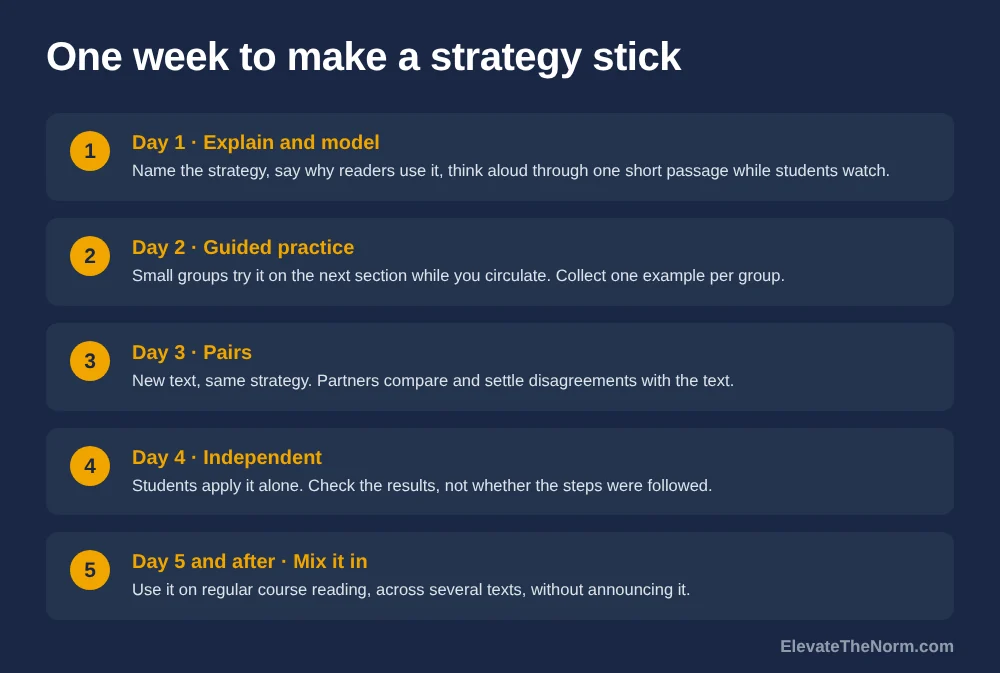
Here’s a one-week template built on that sequence. Copy it and swap in your strategy and your text.
- Day 1, explain and model. Name the strategy, say why readers use it, and think aloud through one short passage while students watch. “I’m going to stop after this paragraph and say the gist in ten words or fewer.”
- Day 2, guided practice. Students try it on the next section in small groups while you circulate and give feedback. Collect one example per group.
- Day 3, pairs. New text, same strategy. Partners compare their results and settle disagreements with the text.
- Day 4, independent. Students apply it alone on a short passage. Check the results, not whether the steps were followed.
- Day 5 and after, mix it in. Use the strategy on regular course reading, across several texts, without announcing it each time.
The guide adds two cautions that are easy to skip. Choose texts that fit the strategy and the students’ reading level, and keep the goal on understanding the text, not on performing the strategy for its own sake. A worksheet full of perfect “predictions” about a passage nobody understood is the failure case.
Does background knowledge improve reading comprehension?
Yes, and this is the part content teachers can act on most directly. In a widely cited study, Donna Recht and Lauren Leslie (1988) grouped 64 junior high students by reading ability and by how much they knew about baseball, then had them read an account of half an inning of a game. The abstract reports a significant main effect for prior knowledge on all measures, with no interaction between prior knowledge and reading ability. In plain terms: knowing about baseball helped every group remember and summarize the passage.
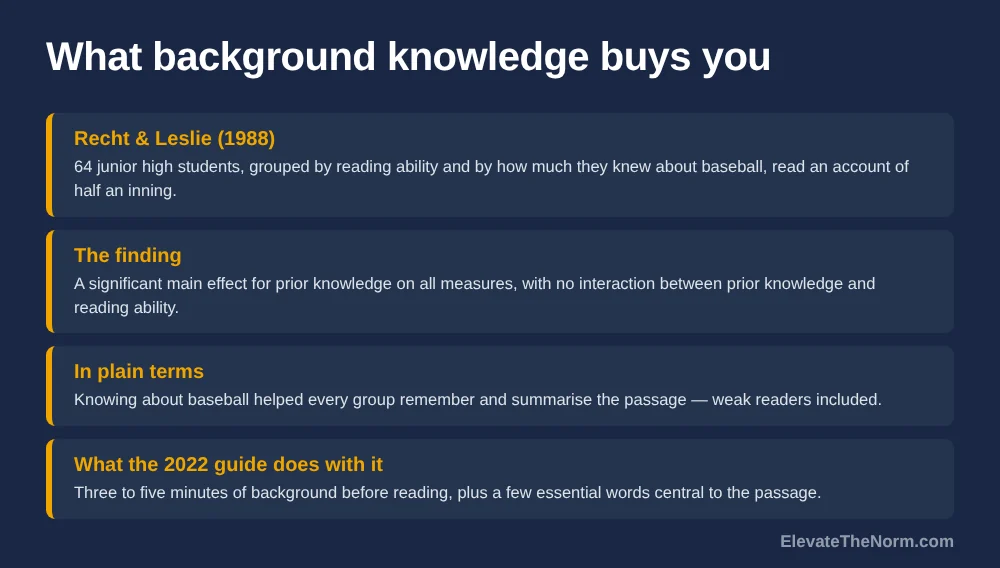
The 2022 guide builds this into its strongest comprehension recommendation. Part A, build world and word knowledge, suggests spending about three to five minutes before reading on background for the topic, using something like an easier text, a short video, or questions about what students already know, plus teaching a few essential words central to the passage.
That’s a short window, and it’s intentional. The point is to give students enough to make sense of the text, not to teach them what the text says before they read it. Two quick ways to do it:
- Have students commit to positions on a few arguable statements before reading with an anticipation guide, then revisit them after.
- Pre-teach the two or three words that unlock the passage, using the approach in vocabulary instruction for grades 6–12.
What are good reading comprehension strategies for middle school?
For grades 6–8, the four parts of the 2022 guide’s comprehension recommendation make a practical core set, because the guide was written for grades 4–9 and describes each one concretely. Here are student-facing versions you can post or print:
- Know before you go. Before reading, what do I already know about this topic? Which words in the title or headings do I need to understand?
- Ask the right kind of question. Is the answer right there in one sentence? Do I have to search across the text? Do I need to combine the text with what I know?
- Get the gist. After each section: Who or what is this about, and what is the most important thing about it? Say it in ten words or fewer.
- Check yourself. Does this make sense? If not, what part lost me? Reread that part, look at a key word, or ask.
Sentence starters for the after-reading reflection the guide describes: “I was confused when…”, “I figured it out by…”, “The most important part was…”, “I still wonder…”.
Middle school students also benefit from the 2008 guide’s discussion recommendation, which emphasizes sustained exchanges over quick question-and-answer and open questions with more than one defensible answer. A structure for getting students talking to each other does more for comprehension than a longer worksheet.
How do content-area teachers use comprehension strategies?
The 2008 guide explicitly calls for vocabulary instruction inside content classes like science and social studies, because specialized vocabulary carries much of a text’s meaning. It recommends choosing words by how important they are to the discipline. Its example is “cytoskeleton” in a 9th-grade biology chapter, a rare word that’s still worth teaching because the content depends on it.
The same logic applies to every strategy. You’re not running a reading class; you’re helping students understand your texts. A content-area version:
- Social studies: gist each paragraph of a primary source, then ask what the author wanted the audience to believe. Questioning works well with sourcing: who wrote this, when, and why?
- Science: pre-teach the two or three terms the lab or article depends on, and use the text’s structure (cause and effect, problem and solution) to find the gist, as the 2022 guide describes.
- Math: comprehension monitoring on word problems. Can I restate what the problem is asking before I start computing?
- English: use stretch text with support, the 2022 guide’s fourth recommendation, rather than defaulting to easier texts for struggling readers.
For short, demanding texts in any subject, close reading combines several of these moves in one lesson, and annotation strategies give students a place to put their gists and questions on the page.
Clay’s take: fewer strategies, taught better
The guides point to a short list, not a long one. If a department wants one shared move, the gist routine is a strong candidate: it’s part of a strongly rated recommendation, it works in every subject, and it takes under a minute per section once students know it. Pair it with a few minutes of background before any unfamiliar topic, and you’ve covered two of the four practices in the 2022 guide’s comprehension recommendation without buying anything.
What I’d avoid is treating a poster of twelve strategies as instruction. The 2008 guide’s point is that strategies have to be explained, modeled, practiced with feedback, and then faded. One strategy taught that way will do more than a dozen that were only named.
Where this evidence base is weaker than it sounds
Two things are worth saying plainly before anyone builds a department policy on the table above. First, the evidence levels attach to whole recommendations, not to the individual strategies sitting inside them. “Determine the gist” carries a Strong label because Recommendation 3 as a whole does, not because somebody isolated gist instruction and tested it. Treat the label as describing the bundle.
Second, the Recht and Leslie finding is smaller than the way it usually gets quoted. It was 64 junior high students reading one passage about half an inning of baseball, and it is a single study from 1988. It does show that topic knowledge helped every reading-ability group, which is the point content teachers should take from it. It does not show that background knowledge substitutes for reading instruction, and it has been stretched that way often enough to be worth flagging. Three to five minutes of context before a hard text is a cheap, well-supported move; it is not a replacement for teaching students how to read the text.
What to do next week
Pick one strategy and run the five-day template on it. One. The most common way this goes wrong is a teacher reading the table above, liking six of the rows, and introducing four strategies in a fortnight, after which students can name all four and use none.
Choose the one your students most obviously cannot do right now. If they finish a passage and cannot tell you what a section was about, teach the gist routine. If they read every word and remember nothing, teach questioning. Model it out loud on day one with your own course text, not a practice passage, because the transfer problem is the whole problem. Then keep using it on ordinary reading for a month without announcing it each time. If you can only do one thing from this article, spend three minutes building background before the next hard text you assign.
Frequently Asked Questions
What are the most effective reading comprehension strategies?
In the federal practice guide on adolescent literacy, explicit vocabulary instruction and direct, explicit comprehension strategy instruction, such as summarizing, questioning, and inferring, carry strong evidence ratings. The 2022 guide for grades 4 to 9 rates a set of comprehension-building practices as strong: building background and word knowledge, asking and answering questions, finding the gist, and monitoring comprehension.
What reading comprehension strategies work for middle school?
A practical core set comes from the 2022 What Works Clearinghouse guide for grades 4 to 9: build background knowledge for a few minutes before reading, teach students different question types, teach a routine for stating the gist of each section, and teach students to check whether the text makes sense. Model each one first, then fade support over time.
Is there a 2016 What Works Clearinghouse guide on reading comprehension for grades 4 to 9?
No. The What Works Clearinghouse list of practice guides shows the 2016 reading guide as Foundational Skills to Support Reading for Understanding in Kindergarten Through 3rd Grade. The guide for grades 4 to 9 is Providing Reading Interventions for Students in Grades 4 to 9, published in 2022. The adolescent literacy guide for grades 5 to 12 was published in 2008.
Does background knowledge affect reading comprehension?
Yes. In Recht and Leslie’s 1988 study of 64 junior high students reading about baseball, prior knowledge had a significant effect on all measures of memory for the text, and that effect did not depend on reading ability. The 2022 federal guide recommends spending a few minutes building background knowledge before students read.
How should comprehension strategies be taught?
Directly and explicitly. The teacher explains the strategy, models it with a think-aloud, gives guided practice with feedback, and then moves students toward independent use, often from small groups to pairs to individual work. Both federal guides also stress keeping the focus on understanding the text rather than on completing the strategy for its own sake.
Can content-area teachers teach reading comprehension?
Yes, and the 2008 adolescent literacy guide calls for it, especially vocabulary instruction in subjects like science and social studies, where specialized words carry much of a text’s meaning. Content teachers can also use the gist routine, question types, and short background-building activities with their own course texts without turning class into a reading lesson.
Does class discussion improve reading comprehension?
The 2008 federal guide rates extended discussion of text meaning and interpretation as having moderate evidence. It recommends sustained exchanges rather than quick question-and-answer, open questions with more than one possible answer, teacher follow-up questions, and a clear task or format for small groups. Discussions do not need to end in agreement to be useful.
Sources
- Kamil, M. L., Borman, G. D., Dole, J., Kral, C. C., Salinger, T., & Torgesen, J. (2008). Improving Adolescent Literacy: Effective Classroom and Intervention Practices (NCEE 2008-4027). National Center for Education Evaluation and Regional Assistance, Institute of Education Sciences. Practice guide page. Used for the five recommendations, their evidence levels, the named strategies, the explicit-instruction sequence, the discussion guidance, and the content-area vocabulary example.
- Vaughn, S., Gersten, R., Dimino, J., Taylor, M. J., Newman-Gonchar, R., Krowka, S., Kieffer, M. J., McKeown, M., Reed, D., Sanchez, M., St. Martin, K., Wexler, J., Morgan, S., Yañez, A., & Jayanthi, M. (2022). Providing Reading Interventions for Students in Grades 4–9 (WWC 2022007). Institute of Education Sciences. Practice guide page. Used for the four recommendations and evidence levels, the four parts of the comprehension recommendation, the three-to-five-minute background guidance, stretch text, and the guide’s intended audience.
- What Works Clearinghouse. (n.d.). Practice Guides: Literacy. Institute of Education Sciences. List of guides. Used to confirm which practice guides exist, their years, and their grade bands.
- Recht, D. R., & Leslie, L. (1988). Effect of prior knowledge on good and poor readers’ memory of text. Journal of Educational Psychology, 80(1). Abstract. Used for the study design and the finding of a main effect of prior knowledge with no interaction with reading ability.