Tag: teaching strategies

  • A List of Formative Assessment Strategies That Work in Real Classrooms

    A List of Formative Assessment Strategies That Work in Real Classrooms

    Formative assessment strategies are the moves a teacher makes to find out what students understand while there is still time to do something about it. Not a quiz average. Not a unit test. A signal you collect during the lesson and act on before the lesson is over. Below is a working list of them — organised by the five strategies the research actually names, then by the point in the period where you would reach for each one.

    One warning before the list: collecting the information is the easy half, and it is the half most lists stop at.

    Key Takeaways

    • There are five key formative assessment strategies, not fifty. Everything else on this page is a technique serving one of them.
    • A technique is only formative if you change something because of it. An exit ticket you never read is a closing routine, not an assessment.
    • The honest effect size is about 0.20, not 0.70. Real, worth doing, not magic.
    • Attaching a grade undercuts the feedback. Comments alone outperformed comments-plus-a-grade in the most-cited study on this.
    • Pick two techniques and run them for a month rather than sampling twenty. The routine is what produces the data, not the novelty.

    What Are Formative Assessment Strategies?

    A formative assessment strategy is any deliberate method for gathering evidence of student understanding during instruction and using that evidence to adjust what happens next. The two halves are equally load-bearing. Gathering evidence you never use is not formative assessment; it is data collection. Adjusting instruction based on a hunch is not formative assessment either; it is guessing.

    The distinction people usually reach for is timing — formative during, summative after — and that is mostly right but slightly off. A unit test can be used formatively if you read it, find that two-thirds of the class missed the same standard, and reteach it. A daily exit ticket is not formative if it goes in a pile. The word describes what you do with the information, not when you collected it.

    What Are the 5 Formative Assessment Strategies?

    The framework almost every other list is downstream of comes from Siobhan Leahy, Christine Lyon, Marnie Thompson and Dylan Wiliam, writing in Educational Leadership in 2005. They identified five core strategies:1
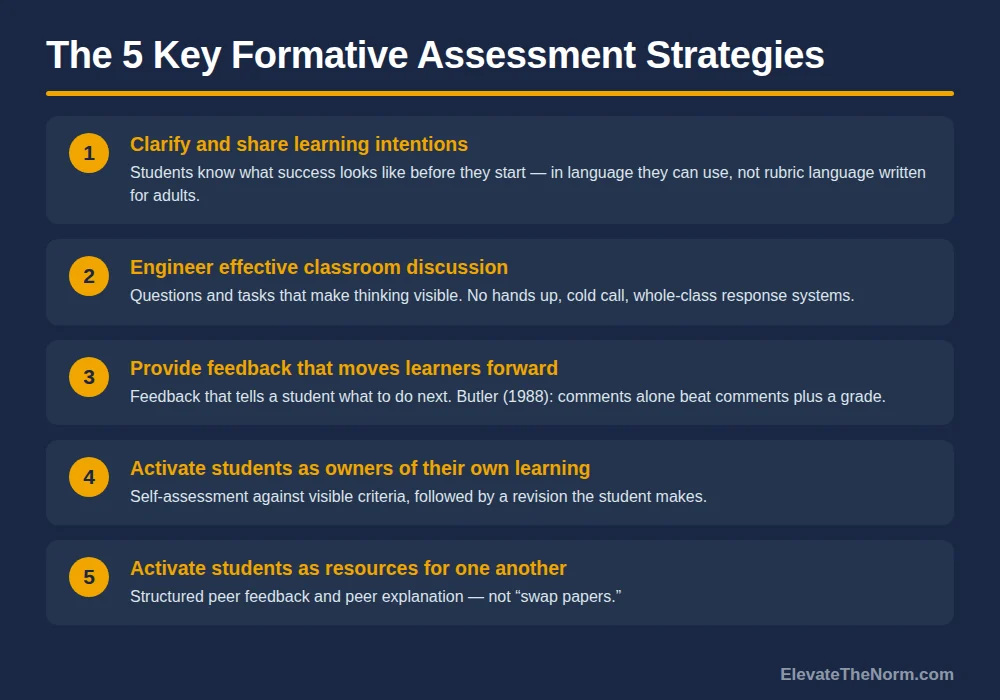
    Numbered graphic listing the five key formative assessment strategies: clarify and share learning intentions, engineer effective classroom discussion, provide feedback that moves learners forward, activate students as owners of their own learning, and activate students as resources for one another
    The five key strategies identified by Leahy, Lyon, Thompson and Wiliam (2005).
    1. Clarifying and sharing learning intentions and criteria for success. Students cannot hit a target they cannot describe.
    2. Engineering effective classroom discussions, questions and tasks that elicit evidence of learning. The key word is engineering — designing the question so that the answer tells you something.
    3. Providing feedback that moves learners forward. Feedback that describes the gap and names the next action.
    4. Activating students as owners of their own learning. Self-assessment and self-monitoring.
    5. Activating students as instructional resources for one another. Structured peer feedback and peer explanation.

    Notice that only the second one is about collecting information. The other four are about what surrounds the collection — whether students know the target, whether the feedback is usable, and whether students can act on it without you. That ratio is the whole point, and it is why a list of twenty exit-ticket variations is not a formative assessment programme.

    A List of Formative Assessment Strategies You Can Use Tomorrow

    These are the techniques, grouped by where they fit in a period. None of them requires technology, a purchase, or a planning period you do not have.
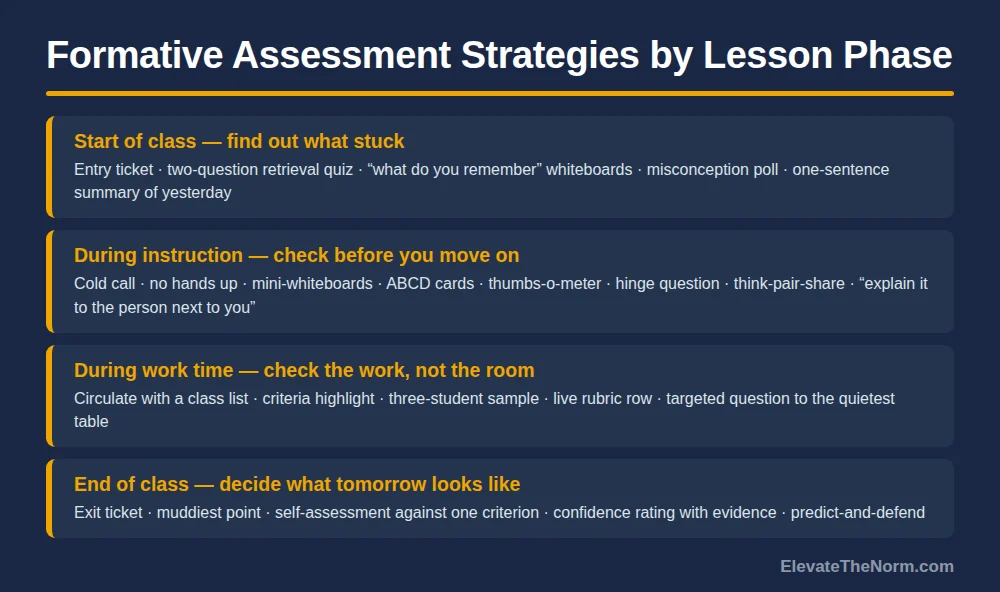
    Reference chart grouping formative assessment techniques by lesson phase: start of class, during instruction, during work time, and end of class, with specific techniques listed under each
    The same techniques, sorted by when in the lesson you would actually reach for them.

    Start of class — find out what survived the night

    • Entry ticket. Two questions on yesterday’s material, answered before anything else happens.
    • Retrieval quiz, ungraded. Three questions, self-scored, no record kept. The point is the retrieval, not the score.
    • Misconception poll. Offer the wrong answer students usually give as one of the options and see how many take it.
    • One-sentence summary of yesterday. Fast, and the vagueness of the sentences tells you as much as the content.

    During instruction — check before you move on

    • Cold call with no hands up. Hands-up sampling tells you what your four most confident students think. Nothing else.
    • Mini-whiteboards. Every student answers, every answer is visible at once, and it takes eight seconds. Still the highest-yield low-tech move available.
    • Hinge question. One multiple-choice question at the pivot point of the lesson, written so each wrong option corresponds to a specific misunderstanding. If more than a quarter of the room misses it, you do not go on.
    • ABCD cards or finger votes. A mini-whiteboard substitute when you have thirty seconds and no markers.
    • Think-pair-share with a required report-out. The report-out is what makes it assessment rather than conversation.
    • Ask a student to explain it to the person beside them. Explanation exposes gaps that recognition hides.

    During work time — assess the work, not the room

    • Circulate with a class list. Tick who you actually looked at. Most of us overestimate this badly.
    • The three-student sample. Read one strong, one middling and one struggling student’s work in the first five minutes. You will know whether the task is landing before you have wasted the period.
    • Criteria highlight. Students mark the sentence or step meeting each criterion. What they cannot highlight is the revision.
    • Live rubric row. Score one row of the rubric, out loud, on a volunteer’s work, on the document camera.

    End of class — decide what tomorrow looks like

    • Exit ticket. One question. One that actually discriminates — not one everybody gets right.
    • Muddiest point. “What is still unclear?” Students are more honest here than on a content question.
    • Self-assessment against one criterion. Not the whole rubric. One row.
    • Confidence rating with evidence. A number plus one sentence defending it. The sentence is the data.

    A note on cold call, because it is easy to do badly

    Cold call is the most effective technique on that list and the one most likely to go wrong. Done carelessly it is a gotcha, and a teenager who has been embarrassed in front of thirty peers will not take a risk in your room again for a long time. Three things make it safe. Ask the question, then pause, then name the student — so everyone has to think, and the named student has had the same processing time as everyone else. Accept “I need a minute” and come back to them, genuinely, so it is not a way out but is also not a trap. And make a wrong answer useful out loud — “that is the answer most people give, and here is why it is tempting” — so being wrong in public is survivable. Students who need more processing time, students still acquiring English, and students with anxiety-related plans all benefit from the pause; so does everyone else.

    The same principle applies to every technique here. A student will only tell you honestly that they do not understand something if doing so is safe. Every formative assessment strategy on this page depends on that, and none of them will work in a room where it is not true.

    If you want these in a printable form rather than rebuilding the list each term, the free formative assessment strategies PDF collects them in a ready-to-copy pack. No email required.

    The Part Most Lists Skip: What You Do With the Information

    Here is the failure I would bet on if I walked into a school that had just done a formative assessment PD day. Teachers will be running exit tickets. Very few will have changed a lesson because of one.
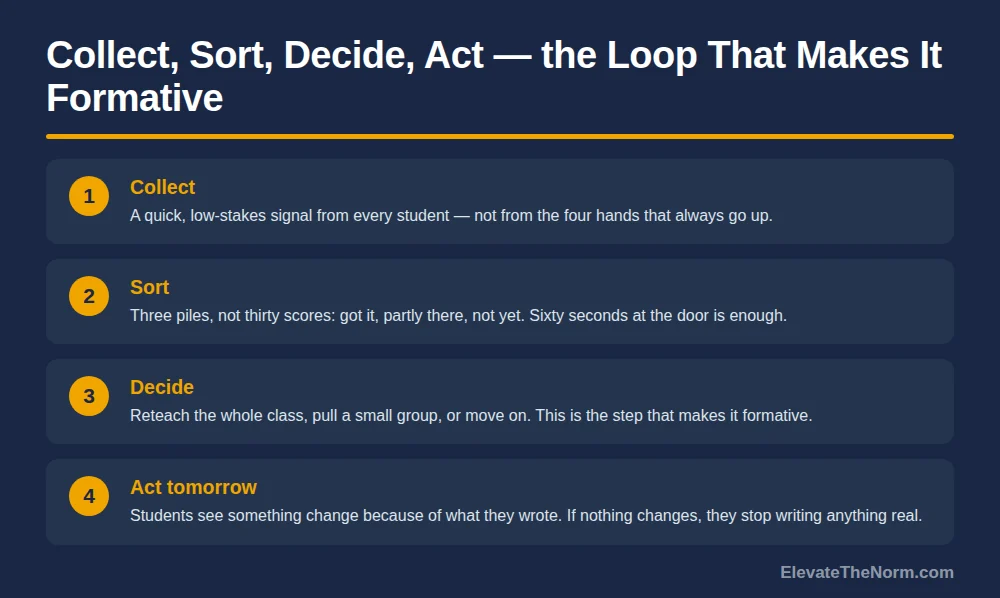
    Four-step process graphic showing the formative assessment response loop: collect a signal from every student, sort responses into three piles, decide whether to reteach or move on, and act on it the next day
    Collecting the information is the easy half. The loop only becomes formative at step three.

    Collect. A signal from every student, not from volunteers. This is the part everyone already does.

    Sort. Three piles, not thirty scores: got it, partly there, not yet. You can do this standing at the door as students leave. Sixty seconds. Resist the urge to record anything.

    Decide. Reteach the whole class, pull a small group tomorrow, or move on. That is the entire decision space, and making it is what converts a technique into formative assessment. If the answer is always “move on,” your question was not discriminating enough to be worth asking.

    Act, visibly. Students need to see something change because of what they wrote. Say it out loud: “Eleven of you missed the second question yesterday, so we are starting there.” A class that never sees its exit tickets change anything will start writing whatever gets them out the door fastest, and they will be right to.

    What the Evidence Honestly Shows

    Formative assessment has a reputation problem of the unusual kind: it is oversold, and the overselling has made careful people suspicious of something that is genuinely worth doing.

    The number you have heard in a staff meeting is probably 0.70. It traces to Paul Black and Dylan Wiliam’s landmark 1998 review, which cited a 1986 meta-analysis by Fuchs and Fuchs reporting a mean effect of 0.70 across 21 studies — rising to 0.92 where teachers systematically reviewed the data and planned a response, against 0.42 where the response was left to teacher judgment.2 That last contrast is the most useful thing in the whole literature for a practising teacher, and it almost never gets quoted. Black and Wiliam themselves attached a caveat that also rarely travels: there is “no guarantee that it will do so irrespective of the context and the particular approach adopted.”2

    Then the correction. Neal Kingston and Brooke Nash screened more than 300 K–12 formative assessment studies and concluded that most had “severely flawed research designs yielding uninterpretable results.” Thirteen were usable. Across those thirteen, the weighted mean effect size was 0.20, median 0.25 — and they published the paper explicitly as a corrective to the 0.70 figure.3 By subject: 0.32 in English language arts, 0.17 in mathematics, 0.09 in science. Professional development and computer-delivered implementations came in around 0.30 and 0.28.

    An effect of 0.20 is not nothing. It is a modest, real gain from a practice that costs no money and adds no grading. But it is not the transformation the 0.70 implies, and the subject variation should make a science department sceptical of a one-size district mandate. If a consultant quotes you 0.70 without mentioning Kingston and Nash, you now know more than they do.

    One more finding worth building policy around. In a study Black and Wiliam highlight, Ruth Butler found students given comments only improved substantially, while students given comments alongside a grade showed a significant decline — the grade appears to crowd out the comment entirely.2 If your formative assessment initiative ends with a number in the gradebook, you may have spent the effort and cancelled the benefit.

    Additional Formative Assessment Strategies for Specific Situations

    When the class is too large to read everything. Sample deliberately rather than comprehensively. Three students per period, rotated, gets you a picture of the whole room across a week without a single extra hour of reading.

    When students will not write anything real. Usually a trust problem, not a compliance one. Make it anonymous for two weeks, act visibly on what comes back, then put names on it.

    When you teach a skills subject rather than a content subject. Watch the process, not the product. A student who arrives at the right answer by a method that will fail next week has not understood it, and only the process shows you that.

    When you need it to survive a substitute or a bad week. Pick the two lowest-effort techniques on this page — an entry ticket and a hinge question — and run only those. A routine that survives a bad week beats a system that collapses in one.

    When students need to own it themselves. That is the fourth strategy on the list above, and it is substantial enough to have its own guide: what student self assessment is and how to introduce it without losing a week of class.

    What Goes Wrong

    Collecting more than you can act on. Four techniques in one period produces a pile of paper and no decisions. Two per week, acted on, beats ten per week filed.

    Questions that do not discriminate. If everyone gets it right, you learned nothing. A good hinge question should split the room.

    Grading it. See Butler, above. The moment it counts, students optimise for the score rather than tell you the truth.

    Mistaking participation for understanding. A lively discussion carried by six students tells you about six students. This is what checking for understanding is for, and it is why every-student-responds techniques beat hands-up every time.

    Making it an initiative. Formative assessment implemented as a compliance requirement — exit tickets collected and audited by an administrator — produces exit tickets and no instructional change. The 0.92-versus-0.42 contrast in the Fuchs data points at teachers systematically reviewing and planning, which is professional judgment, not paperwork.2

    Where This Connects

    Formative assessment only pays off if the grading system it feeds can absorb it. A standards-based grading scale makes that easier, because evidence gathered mid-unit has somewhere to go that is not an average. And the mirror-image practice for the adult in the room is teacher reflection — same loop, same logic, different subject.

    Where to Start

    Do not try to implement a list of formative assessment strategies. Pick two. One at the start of class and one at the end is a reasonable pairing — an entry ticket and an exit ticket, or a hinge question and a muddiest point. Run them for a month without adding anything. Sort the results into three piles and let one decision each week come from that sorting.

    That is a smaller ambition than most professional development sells, and it is the version that is still running in March. The techniques on this page are not the hard part. Changing a lesson because of what a student wrote is the hard part, and it is the only part that makes any of it formative.

    Frequently Asked Questions

    What are the 5 formative assessment strategies?

    Leahy, Lyon, Thompson and Wiliam named five in Educational Leadership in 2005: clarifying and sharing learning intentions and success criteria; engineering classroom discussions, questions and tasks that elicit evidence of learning; providing feedback that moves learners forward; activating students as owners of their own learning; and activating students as instructional resources for one another. Every technique on this page serves one of those five.

    What is the difference between formative and summative assessment?

    Summative assessment measures what a student has learned at the end of something and produces a record. Formative assessment gathers evidence during learning and produces a decision about what to do next. The cleanest test is not timing but consequence: if nothing about your teaching changes because of it, it was not formative, whatever it was called.

    Should formative assessment be graded?

    Generally no. In a study highlighted in Black and Wiliam’s 1998 review, Ruth Butler found students who received comments only improved substantially while students who received the same comments with a grade attached showed a significant decline. The grade appears to crowd out the comment. If credit must be given, give it for completing and acting on the work, not for how correct the first attempt was.

    Is cold call unfair to anxious or quiet students?

    It can be, and how you run it decides. Ask the question first, pause, then name the student, so everyone thinks and the named student gets the same processing time. Accept a request for a moment and genuinely come back. Treat wrong answers as useful information out loud. Handled that way, cold call reaches the students that hands-up questioning silently skips, which is usually the students who most need reaching.

    How many formative assessment strategies should I use in one lesson?

    One or two, and the same one or two for weeks. Four techniques in a period generates a pile of information and no decisions. The routine is what produces usable data, not the variety. Pick an entry point and an exit point, run them for a month, and let one instructional decision each week come out of them.

    How does this work for students with IEPs, 504 plans, or English learners?

    Build in processing time and give more than one way to respond. A pause before naming a student, a written option alongside a verbal one, sentence stems, and mini-whiteboards instead of on-the-spot speaking all widen access without changing the technique. These adjustments help the whole room, which is usually the sign that they are the right ones.

    Why does my child seem to be assessed every single day?

    Because these checks are not tests. Most take under two minutes, almost none are graded, and their purpose is to tell the teacher what to teach tomorrow rather than to judge your child. A student who writes down that they are confused has done the task correctly. If any of it is going into a gradebook, that is a fair question to ask the teacher, because the research suggests it should not be.

    Does formative assessment actually raise test scores?

    Modestly, on the best available evidence. Kingston and Nash screened more than 300 K-12 studies, found only 13 methodologically usable, and reported a weighted mean effect size of 0.20 with a median of 0.25, varying by subject from 0.32 in English language arts to 0.09 in science. That is a real gain from a practice that costs nothing, but it is well short of the 0.70 often quoted in professional development.

    Sources

    1. Leahy, Siobhan, Christine Lyon, Marnie Thompson, and Dylan Wiliam. “Classroom Assessment: Minute by Minute, Day by Day.” Educational Leadership, vol. 63, no. 3, November 2005, pp. 18–24. ERIC EJ745452. https://eric.ed.gov/?id=EJ745452
    2. Black, Paul, and Dylan Wiliam. “Assessment and Classroom Learning.” Assessment in Education: Principles, Policy & Practice, vol. 5, no. 1, 1998, pp. 7–74. (Full text copy hosted by UC Riverside; includes the Fuchs & Fuchs 1986 and Butler 1988 findings discussed above.) https://assess.ucr.edu/sites/default/files/2019-02/blackwiliam_1998.pdf
    3. Kingston, Neal, and Brooke Nash. “Formative Assessment: A Meta-Analysis and a Call for Research.” Educational Measurement: Issues and Practice, vol. 30, no. 4, 2011, pp. 28–37. ERIC EJ951173. https://eric.ed.gov/?id=EJ951173
    4. Andrade, Heidi L. “A Critical Review of Research on Student Self-Assessment.” Frontiers in Education, vol. 4, art. 87, 2019. https://doi.org/10.3389/feduc.2019.00087
    5. Panadero, Ernesto, Anders Jonsson, and Juan Botella. “Effects of self-assessment on self-regulated learning and self-efficacy: Four meta-analyses.” Educational Research Review, vol. 22, 2017, pp. 74–98. https://doi.org/10.1016/j.edurev.2017.08.004

    About Clay Shumate

    Clay Shumate is a certified secondary Social Studies teacher in the public schools of West Alabama, with seven years of classroom experience, a B.A. in History, and an M.Ed. in Secondary Education. He writes about project-based learning, student responsibility, respect, and practical ways to hold young people to a higher standard while giving them room to learn from mistakes. He is a member of the Society of Professional Journalists and writes to its Code of Ethics; this site’s editorial standards and corrections policy are published in full. More about Clay.

  • Classroom Expectations Poster for Middle and High School Students

    Classroom Expectations Poster for Middle and High School Students

    Every classroom has rules posted somewhere. Most of them say things like “Be Respectful,” “Be Responsible,” and “Be Ready” — alliterative, inoffensive, and almost entirely meaningless to a teenager who doesn’t know what those words look like in practice.

    In my seventh year in the classroom, I’ve stopped treating a posted list of slogans as a finished job. Three phrases in block letters, laminated and mounted near the door, give the impression that expectations have been communicated. They haven’t. Teenagers need specifics. They need to know what “respect” looks like at 8:15 on a Monday when they’re exhausted and the assignment makes no sense. They need to know what “ready” looks like when they forgot a pencil and the lesson starts in thirty seconds.

    A classroom expectations poster, done right, is more than decoration. It’s a reference tool — a shared agreement students can point to and that you can point to when a situation arises. It’s the honest answer to “I didn’t know that was a rule,” because it was, and it was visible the whole time.

    This article gives you the full poster text I use, the thinking behind each line, and how to introduce it so students actually read it instead of walking past it for nine months.

    Why Most Classroom Expectations Posters Don’t Work

    The three-slogan poster fails for a predictable reason: vague language does not change vague behavior. When a student acts dismissively toward a classmate and you point to “Be Respectful” on the wall, they will look at it and genuinely not see the connection. That’s not defiance — it’s the natural result of abstract words without concrete definition.

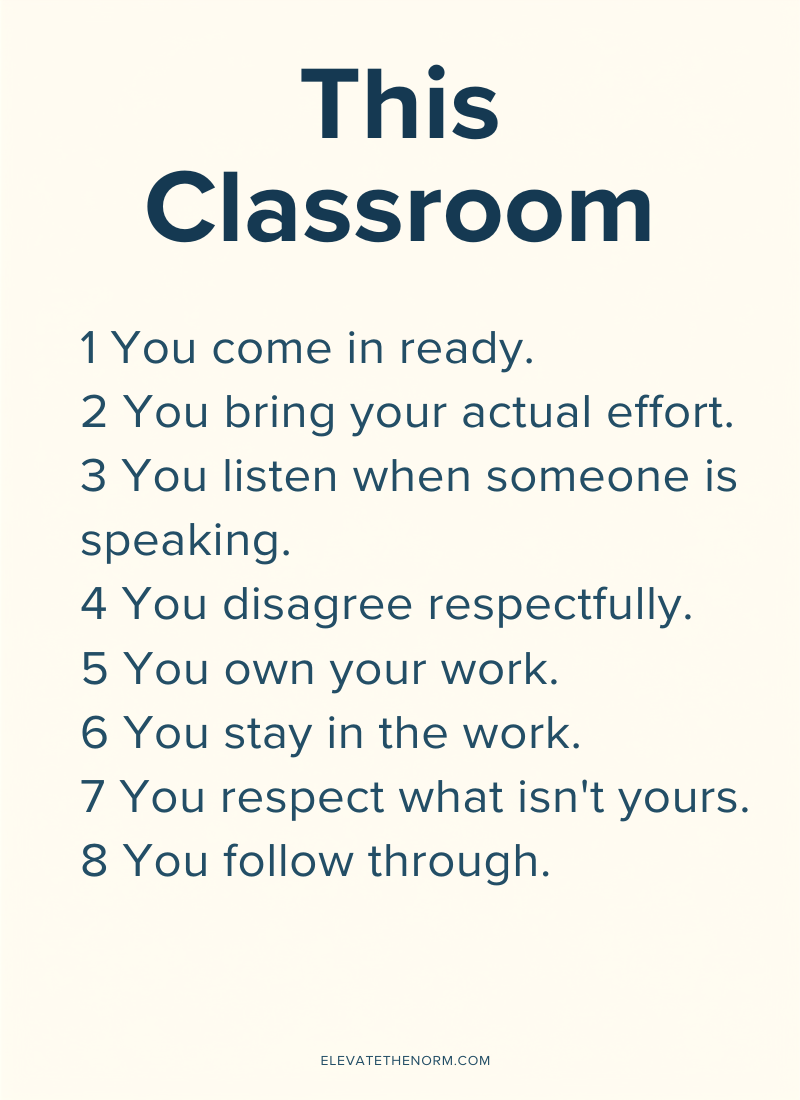
    Example classroom expectations poster showing specific observable behaviors for middle and high school students
    Specificity is what separates a useful expectations poster from a decorative wall hanging.

    The IRIS Center at Vanderbilt University makes a useful distinction in their classroom management research: classroom norms are familiar ways of interacting, while expectations are desired behaviors and outcomes. The difference matters because norms require explicit teaching, not just posting. “Be Respectful” is a norm. “When someone is speaking, you are looking at them and waiting your turn” is an expectation — observable, specific, and something a teacher can actually reference in the moment.

    Research from Education Northwest found that five to ten percent of the variance in student performance is attributable to teacher expectations — not the poster on the wall, but the behavioral expectations teachers communicate, model, and consistently reinforce. That number might sound small, but compounded across a school year for thirty kids, it adds up. The poster is only valuable if it represents what you actually teach and hold students to.

    The secondary-level mistake is slightly different than elementary. High school teachers often skip the poster entirely — “they’re old enough to know how to behave” — or go the opposite direction with a legalistic list of prohibited behaviors. Neither approach works. Students at this age respond to expectations framed as the standards of a serious environment that takes them seriously. They want to know that the rules make sense, not that they’re being controlled.

    What a Classroom Expectations Poster Should Actually Do

    Before writing a single word for your poster, decide what job it’s going to do. A classroom expectations poster for middle and high school students should serve three purposes:

    First, it should define what success looks like in your room. Not what’s prohibited — what’s expected. There’s a meaningful difference. A list of don’ts puts students in a defensive posture. A list of expectations frames the room as a place with standards worth meeting.

    Second, it should be specific enough to reference in real situations. If you cannot point to a line on your poster during a conversation with a student and have them immediately understand why that line applies, the language isn’t specific enough.

    Third, it should treat students as capable of meeting the standards listed. Research consistently shows that students perform closer to the level their teachers genuinely believe they can reach. A poster that assumes low capability — or that feels like it was written for elementary students — communicates something you probably don’t intend.

    The research of Rosenthal and Jacobson, which famously showed that teacher expectations influence student performance even when the expectations are communicated unconsciously through treatment and attention, underlines why the framing of a poster matters. A poster that communicates “here’s what I believe students like you actually need reminding about” sets a different tone than one that says “here are the standards of a serious classroom.”

    The Poster Text: Full Copy for Middle and High School

    Here is the full text I use in my room. This version was written with the specific goal of being direct, respectful, and specific enough to be useful. Copy it, adapt it, and make it yours.

    In This Classroom

    You come in ready.
    Materials in hand, in your seat, working on what’s up when the bell rings. Not almost ready — ready.

    You bring your actual effort.
    Not your best-day effort. Your today effort, whatever that is. Show up and do the work. That’s the standard.

    You listen when someone is speaking.
    Eyes up, phone down, waiting your turn. This applies to me and to your classmates.

    You disagree respectfully.
    If you think something is wrong, you say so — directly, with reasoning. You do not dismiss, ridicule, or roll your eyes.

    You own your work.
    Yours means yours. Mistakes are expected. Excuses are not. If something goes wrong, we figure out what happened and fix it.

    You stay in the work.
    When a task is hard, you stay with it before you ask for help. When you’re lost, you say so. “I don’t get it” is the beginning of learning, not a reason to stop.

    You respect what isn’t yours.
    Desks, supplies, and other people’s belongings are treated accordingly.

    You follow through.
    Deadlines exist. Commitments matter. If something comes up, you talk to me before the due date, not after.

    Download the Classroom Expectations Poster

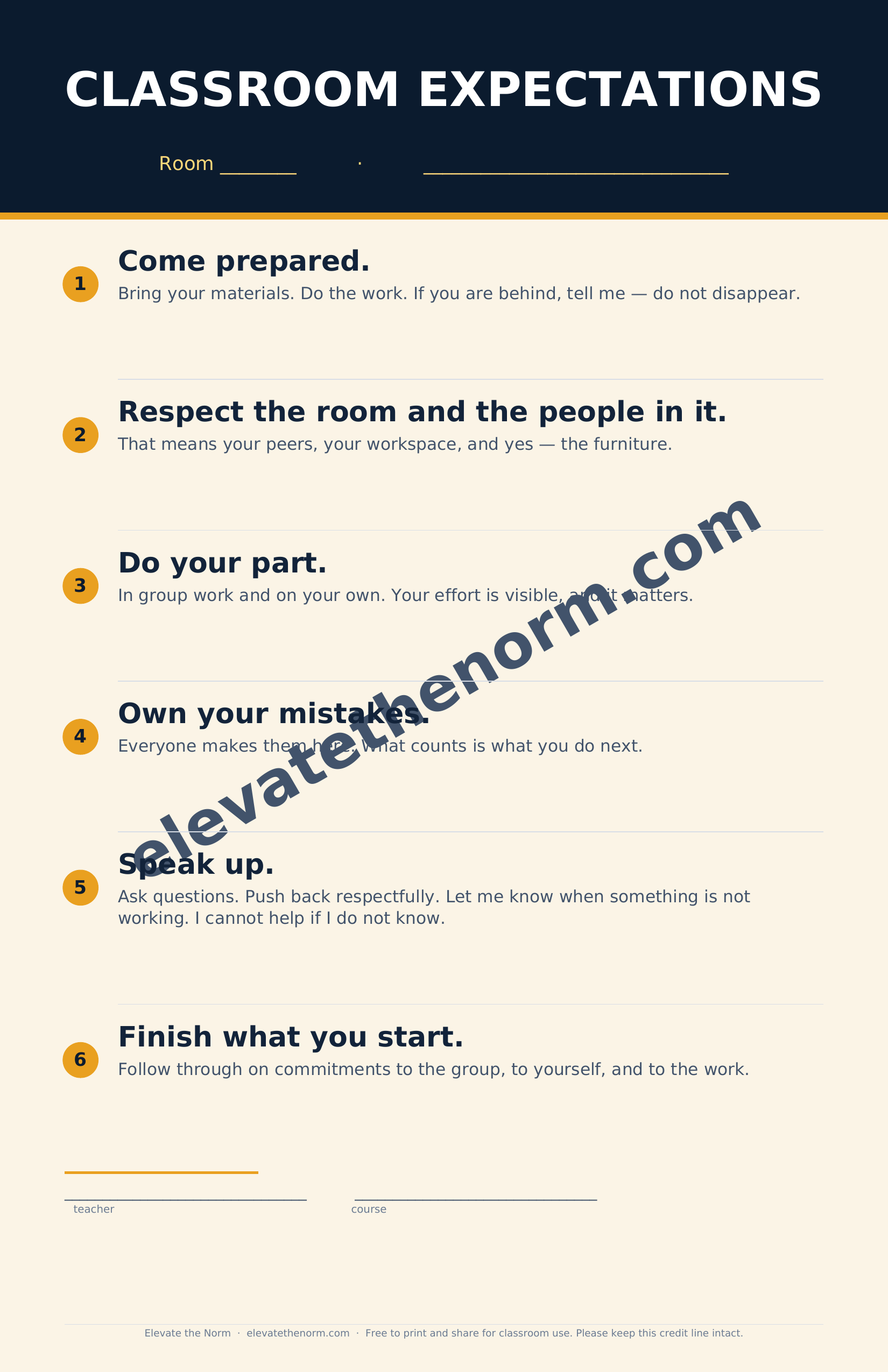
    Here is the finished poster, free and right here, with no email or signup of any kind. Blanks are built in for your room number, your name, and your course. Print the 11×17 for wall mounting where the back row can read it, or the letter size for a desk-level copy. The PNG is there if you would rather drop it into your own layout first.

    Printable classroom expectations poster for grades 6-12 listing six numbered expectations: come prepared, respect the room and the people in it, do your part, own your mistakes, speak up, and finish what you start, with blank lines for room number, teacher, and course
    The full poster, sized for 11×17. Blanks at the top and bottom are for your room number, name, and course.

    Free. No email address required. Free to print and share for classroom use — please keep the credit line intact. More free classroom packs are on the teacher resources page.

    Why These Lines Are Written This Way

    Each line was written to be as direct and specific as possible while treating students as people who can meet the standard.

    “You come in ready” is more specific than “Be Prepared.” It names the three things ready actually means: materials, seat, and working. First-week students who struggle with this aren’t defying you — they don’t know what ready looks like yet. This line tells them.

    “You bring your actual effort” is specifically not a “give 110%” type of statement, which sounds like a motivational poster and lands about as well. Instead, it acknowledges that effort looks different on different days and asks for whatever today’s version is. This matters for students who check out because they think they’re already behind.

    “You listen when someone is speaking” is specific. Eyes up, phone down, waiting your turn. Those are observable behaviors. If a student has eyes on their phone while a classmate presents, that line directly applies. “Be Respectful” does not.

    “You disagree respectfully” is one of the most important lines on the poster — and the one most teachers skip. When students know that disagreement is not only tolerated but expected to happen in a particular way, they’re more likely to engage substantively rather than disengage silently. Related to the principle of student voice and choice, this expectation tells students that their perspective has a place in the room, with conditions.

    “You own your work” addresses academic integrity and personal responsibility without using either phrase. Teenagers understand “mistakes are expected, excuses are not” faster than they understand a policy statement about academic dishonesty. See also: student responsibility in the classroom.

    “You stay in the work” targets the most common avoidance pattern in secondary school: the student who gives up after thirty seconds and announces they’re done. It gives them a two-step response — stay with it first, ask for help second — and frames “I don’t get it” as a learning step rather than a stopping point. This connects directly to developing student autonomy, where students learn to work through challenges before seeking support.

    “You respect what isn’t yours” is brief on purpose. Students this age know what it means. A long explanation implies you don’t trust them to understand basic respect for property.

    “You follow through” names the expectation most teachers dance around with a long late-work policy. Commitments matter. Deadlines exist. Talk to me before, not after. That’s a relationship-based expectation, not a punitive one, and it sets the stage for a student accountability culture rather than one built on consequences alone.

    How to Introduce the Poster on Day One

    Posting the expectations is step one. Teaching them is the actual job. The IRIS Center research makes this explicit: simply displaying rules is insufficient. Students need direct instruction, modeling, opportunity for practice, and feedback throughout the year.

    Teacher introducing the classroom expectations poster on the first day of school to middle school students
    The first day introduction of classroom expectations sets the tone for the entire year.

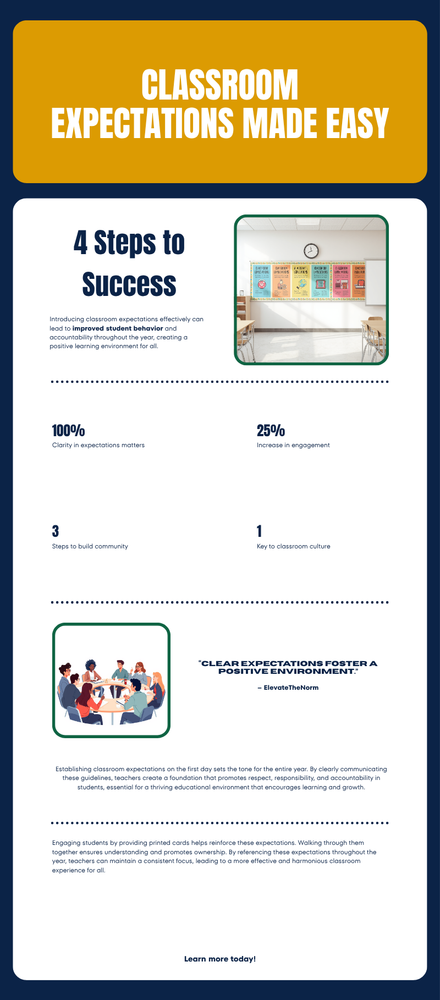
    In my room, on day one, every student gets a printed card — half-sheet size — with the poster text on it. They keep it in their folder or notebook for the first few weeks. Then I walk through each line, one by one, and do two things: explain what it means in practice in our room specifically, and ask students what they think it means.

    This is not a lecture about rules. It’s a conversation about how this room is going to work. I ask: “What would ‘you come in ready’ look like in practice? What might make it harder? What should you do if you need a minute?” The goal is for students to own the expectations, not just receive them.

    The research on high expectations for students consistently shows that the quality of how expectations are communicated matters as much as the expectations themselves. Expectations delivered as a list to be memorized have less impact than expectations discussed, practiced, and genuinely held.

    After the first-day conversation, I reference the poster regularly — not as a threat, but as a natural part of class language. “We’re going to stay in the work here.” “If you disagree, say so with reasoning.” The poster becomes shorthand for a full expectation that students already understand.

    Where to Post It and How to Design It

    Placement matters more than most teachers realize. If the poster is tucked in a corner next to three other posters, it is not functioning as a reference tool — it’s decoration. Put your expectations poster in a location that is:

    • Visible from every seat in the room
    • Large enough to read from the back of the room
    • Not competing with surrounding content for visual attention

    A single-page format works best for a secondary classroom. Font should be readable at a distance — no smaller than 24pt for body text, larger for the title. Design it in a way that fits the aesthetic of your room without making it look childish. A clean, simple design with clear typography communicates professionalism; clip-art borders do not.

    If you use Canva or a similar tool, create the poster in the dimensions for your printer (typically 11×17 for a poster-size sheet) or design it as a digital display if you have a dedicated screen. Watermark it as yours if you’re sharing it externally.

    Consider a smaller companion card — quarter-sheet or half-sheet — that students keep in their folders or journals. The poster is a reference for the room. The card is a personal reference they can access during independent work.

    After Day One: Keeping Expectations Alive

    The most important part of a classroom expectations poster is what happens after you put it up. If you never reference it again, it becomes wallpaper within two weeks. Students are paying attention to what you actually prioritize, not what you display.

    Year-long classroom expectations poster displayed prominently in a secondary classroom for daily student reference
    A year-long classroom expectations reference keeps standards visible and consistent all semester.

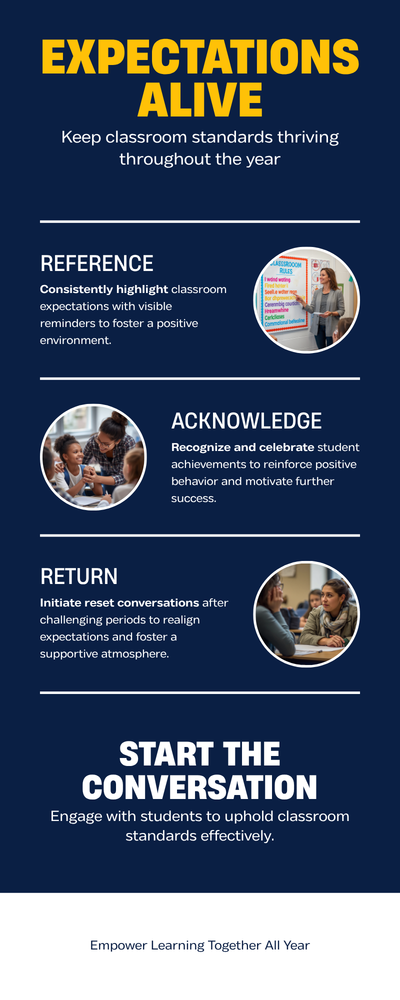
    Three practices that keep expectations functional all year:

    Reference by name. When you redirect a student, name the expectation you’re referencing. “Hey — we’re listening when someone’s speaking.” Not “you’re being disrespectful.” The specific language connects the moment to the poster.

    Acknowledge when expectations are met. This is particularly important with secondary students, who often expect correction but not affirmation. When a student owns a mistake without excuses, name it. “That’s exactly what ‘you own your work’ looks like. I appreciate that.” It reinforces the expectation without being saccharine.

    Return to the poster after a rough stretch. Every classroom hits a rough patch — after a long break, during testing, late spring. When behavior patterns shift, a brief return to the poster is more useful than a lecture. “Let’s check in on where we are as a class. Which of these are we doing well? Which are we slipping on?” That conversation treats students as capable of self-assessing, which supports the student voice and choice culture you’re building.

    The research from TNTP’s 2024 literature review on teacher expectations notes that proactive, consistent, and equitable enforcement of expectations is what produces outcomes — not the initial posting or the first-day conversation. The poster is a starting point. How you use it the rest of the year is the actual work.

    Additionally, consider how positive discipline for teens connects here — expectations, when held consistently without shame or power struggles, build the foundation for students to make better choices because they understand the standard, not because they fear the consequence.

    Frequently Asked Questions

    Should students help create the classroom expectations?

    Student-generated expectations have merit, especially for building buy-in. The practical tradeoff: students will often generate vaguer language than you need (‘be nice’), and you may spend the first class period negotiating rather than establishing a clear standard. A middle path that works well is to give students the poster framework and ask them to discuss and refine what each line means in practice — they help define the specifics without starting from a blank slate. If your classroom culture already supports significant student voice and choice, full co-creation is worth the time.

    What’s the difference between classroom rules and classroom expectations?

    Rules prohibit specific behaviors (‘no phones’). Expectations define what success looks like (‘when someone is speaking, you’re looking at them’). For secondary students, expectations framed in terms of what they should do tend to get better results than a list of don’ts, which puts students in a defensive mental posture from the first day.

    How many expectations should be on the poster?

    Research on classroom norms suggests five to eight is a useful range — enough to cover the major categories of behavior in a learning environment without becoming a list students can’t remember. The poster text above has eight lines. If your context requires different emphasis, cut or adapt rather than pile on.

    Should middle school and high school expectations look different?

    The core expectations are similar, but the delivery and design should shift. Middle school students often benefit from more concrete specifics and visual cues alongside the text. High school students respond better to fewer words and more direct language. The poster text above was written to work across grades 6–12 with minor adjustments in tone depending on how you introduce it.

    What do I do when a student violates an expectation repeatedly?

    The poster is a reference tool, not a consequence system. If a student is repeatedly not meeting an expectation, that’s a conversation — not a pointing-at-the-poster moment. The poster helps you name the expectation clearly; the actual work of changing behavior usually requires a private conversation, some investigation of what’s causing the pattern, and sometimes a connection to the school’s support systems. A student accountability sheet can structure those conversations and help students track their own patterns.

    Is it worth posting expectations in a room where students rotate (secondary, multiple classes)?

    Absolutely — arguably more so than in an elementary setting. When students move from class to class, each teacher’s expectations may be different, and ambiguity around those differences is where a lot of secondary classroom behavior issues actually live. Posting clear expectations makes your room legible to students and reduces the mental load of figuring out how this room is different from last period.

    What’s the right response when a student says the expectations are unfair?

    Take it seriously. Ask them to be specific: which expectation do they think is unfair, and why? You may learn something useful. Sometimes students are naming a real inconsistency in how an expectation is enforced (equity concerns are worth listening to). Sometimes they’re testing to see if you mean it. Either way, a direct, calm conversation — ‘Tell me more about what you’re seeing’ — respects their perspective while making clear the expectations themselves aren’t up for negotiation in the moment.

    Sources

    Brophy, J. (1983). Research on the self-fulfilling prophecy and teacher expectations. Journal of Educational Psychology, 75(5), 631–661.

    Education Northwest. (n.d.). Expectations and student outcomes. https://educationnorthwest.org/sites/default/files/expectations-and-student-outcomes.pdf

    IRIS Center, Peabody College, Vanderbilt University. (n.d.). Establishing classroom norms and expectations. https://iris.peabody.vanderbilt.edu/case-study/establishing-classroom-norms-and-expectations/

    Rosenthal, R., & Jacobson, L. (1968). Pygmalion in the classroom: Teacher expectation and pupils’ intellectual development. Holt, Rinehart and Winston.

    TNTP. (2024). The impacts of teacher expectations on student outcomes: A literature review. https://tntp.org/wp-content/uploads/2024/09/The-Impacts-of-Teacher-Expectations-on-Student-Outcomes-Literature-Review-2024.pdf


    About Clay Shumate

    By Clay Shumate — Clay Shumate is a certified secondary Social Studies teacher in the public schools of West Alabama, with seven years of classroom experience, a B.A. in History, and an M.Ed. in Secondary Education. He writes about project-based learning, student responsibility, respect, and practical ways to hold young people to a higher standard while giving them room to learn from mistakes. He is a member of the Society of Professional Journalists and writes to its Code of Ethics; this site’s editorial standards and corrections policy are published in full.

Teacher Emergency Toolkit — practical resources, real classroom support. Shop on TPT.Teacher Emergency Toolkit — practical resources, real classroom support. Shop on TPT.