By Clay Shumate
Responsibility scenarios for middle school students are short, realistic situations, like a missed deadline, a group member not pulling weight, or a borrowed item broken, that students talk through before deciding what to do. Good scenarios have no obvious right answer, name who is affected, and end with a plan to fix the problem.
Key Takeaways
- Scenarios teach the decision, not the rule. Students practice weighing options and consequences before the real moment arrives.
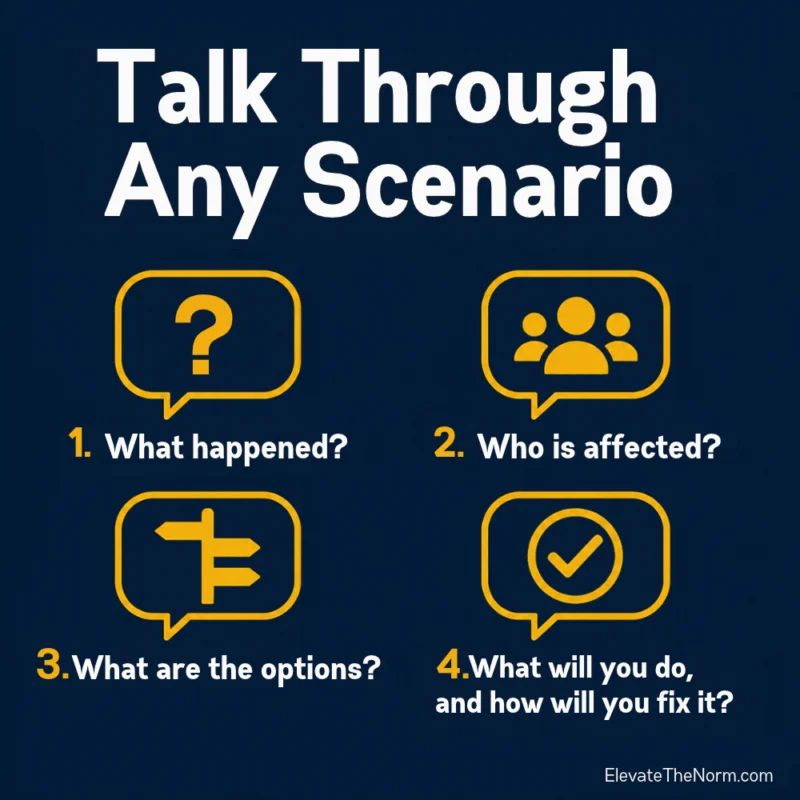
- Use four questions every time. What happened, who is affected, what are the options, and what will you do and how will you fix it.
- Pick situations with a real cost on both sides. If the answer is obvious, students give the answer they think you want and learn nothing.
- Discussion quality matters more than the scenario. A study of secondary moral-discussion programs found change in some classrooms but not others, tied to how many discussions there were and how well the teacher drew out reasoning.
- End with repair, not punishment. Every scenario below asks students how they would fix the damage, because that is what responsibility looks like after a mistake.
What are responsibility scenarios?
Responsibility scenarios are short, true-to-life situations that ask a student what they would do, why, and how they would make things right. They give middle schoolers a low-stakes rehearsal for choices they will face in class, online and at home.
The idea lines up with what CASEL, the organization behind the most widely used social-emotional learning framework, calls responsible decision-making: the ability to make caring and constructive choices about your own behavior and how you treat other people across different situations. A scenario is simply a safe place to practice that before it counts.
What a scenario is not: a worksheet with one correct answer, or a story with a moral pasted on the end. Twelve- and thirteen-year-olds can smell a lecture coming. The scenarios that work are the ones where a reasonable kid could argue either side.
Why use scenarios instead of just teaching the rules?
Rules tell students what not to do. Scenarios make them think through what to do when the rule does not settle it, which is most of real life. They also let students practice owning a mistake before they are standing in one.
There is old but useful research behind the discussion part. Colby, Kohlberg and colleagues ran moral discussion programs in secondary schools, taught by regular social studies teachers, and measured students’ moral reasoning before and after. Some classrooms showed substantial change and some did not. The difference was tied to the number of discussions, the range of reasoning already in the room, and the teacher’s skill at drawing out students’ reasoning.
Two honest caveats. That study measured how students reason about right and wrong, not how they behave, and it is from the 1970s. So treat it as support for one thing only: the conversation is the active ingredient. A scenario read aloud and answered in one word does little. A scenario argued over for ten minutes does more.
How do you run a responsibility scenario in class?
Read the scenario, give students a minute to decide alone, then talk it through with four questions: what happened, who is affected, what are the options, and what will you do and how will you fix it. Ten minutes is enough.
- Read it once, out loud. Project it too, so students who read slowly are not left behind.
- One quiet minute. Everyone writes or decides their answer before anyone speaks, so the first loud voice does not decide for the room.
- Pairs, then the room. Two minutes with a partner, then hear a few answers that disagree.
- Push on the reasoning. Ask “why?” and “who else does that affect?” more than you ask “is that right?”
- Close with the repair. End on what the person would actually do to fix it, not on who was wrong.
Keep it about the characters, never about a real student in the room. If a scenario hits too close to something that just happened in your class, swap it out. The point is rehearsal, not a public trial. If you want longer, hands-on options to pair with these, see our activities for teaching responsibility.
Responsibility scenarios for schoolwork and deadlines
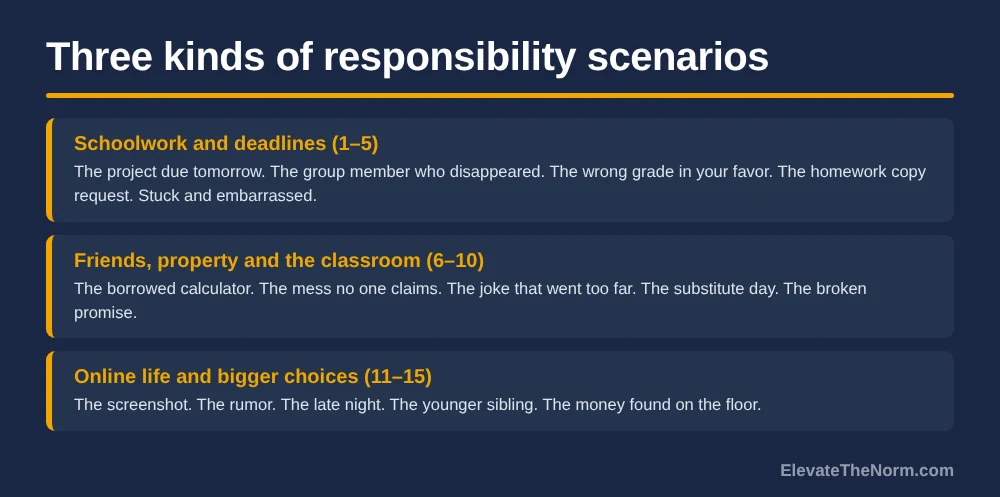
These scenarios cover the responsibility middle schoolers deal with most: deadlines, effort, honesty about work and asking for help. Each one has a real cost on both sides, which is what makes students argue about it.
1. The project due tomorrow
Jordan has known about a project for two weeks and has barely started. It is due tomorrow. Jordan’s friend offers to send a finished version from last year.
- Discuss: What are Jordan’s real options tonight, and what does each one cost?
- What a responsible answer includes: Turning in honest, unfinished work or asking the teacher for help before the deadline, and a plan to start the next project earlier.
2. The group member who disappeared
In a four-person group project, Sam has done almost nothing. The presentation is Friday. The rest of the group is angry and wants to leave Sam’s name off.
- Discuss: What is fair to the group, and what is fair to Sam?
- What a responsible answer includes: Talking to Sam directly first, then to the teacher if nothing changes, and splitting the remaining work so the group is not punished for one person.
3. The wrong grade in your favor
Maya notices the teacher entered a 92 on a quiz where she actually earned a 72. Nobody else would ever know.
- Discuss: Does it matter if nobody finds out?
- What a responsible answer includes: Telling the teacher, because a grade is supposed to say what you can do, and keeping it would mean the next lesson starts from the wrong place.
4. The homework copy request
A classmate asks to copy Diego’s homework every morning before first period. Diego does not want to be the bad guy.
- Discuss: Is letting someone copy helping them?
- What a responsible answer includes: Offering to explain the work instead, and saying no to copying without making it a big public scene.
5. Stuck and embarrassed
Aaliyah has been lost in math for a week. Everyone else seems to get it, and she does not want to look slow.
- Discuss: What happens if she keeps waiting?
- What a responsible answer includes: Asking for help early, privately if that feels safer, because the gap only grows.
Responsibility scenarios for friends, property and the classroom
These scenarios are about other people’s stuff, shared spaces and the small choices that decide whether a classroom works. They are useful early in the year, when a class is still deciding what kind of room it will be.
6. The borrowed calculator
Chris borrowed a classmate’s calculator and dropped it. The screen cracked. The owner has not noticed yet.
- Discuss: Who should speak first, and when?
- What a responsible answer includes: Telling the owner right away and offering a real way to make it right, even if that is only part of the cost.
7. The mess no one claims
At the end of a lab, the table is a mess. Nobody at the table made all of it, and everyone is waiting for someone else to clean up.
- Discuss: Whose job is a shared mess?
- What a responsible answer includes: Pitching in without arguing about who did what, because the next class has to use that table.
8. The joke that went too far
A group laughs when Tyler makes a joke about a classmate’s clothes. Tyler meant it as harmless. The classmate goes quiet for the rest of the period.
- Discuss: Does it matter what Tyler meant?
- What a responsible answer includes: Recognizing the impact, apologizing directly without excuses, and not repeating it.
9. The substitute day
There is a substitute. Half the class decides to switch seats and give fake names. Lena thinks it is funny but also knows the sub will have a hard day.
- Discuss: What does Lena owe the substitute, if anything?
- What a responsible answer includes: Not joining in, and being honest if asked, because respecting an adult you will never see again says more than respecting one who grades you.
10. The broken promise
Marcus promised to bring supplies for his group’s presentation. He forgot. The group has nothing to show.
- Discuss: What does Marcus do in the next five minutes?
- What a responsible answer includes: Owning it immediately, offering what he can do right now, and fixing the problem for next time rather than making excuses.


Responsibility scenarios for online life and bigger choices
These scenarios reach past the classroom into phones, group chats and decisions with real consequences. They tend to produce the best discussions with seventh and eighth graders, because this is where students already make most of their own choices.
11. The screenshot
Someone in a group chat posts an embarrassing photo of a classmate and asks everyone to share it. Priya is in the chat.
- Discuss: Is staying quiet a choice?
- What a responsible answer includes: Not sharing it, saying something or leaving the chat, and telling a trusted adult if the photo keeps spreading.
12. The rumor
Eli hears a rumor about a friend that is probably false. Everyone is already talking about it.
- Discuss: What can one person actually do about a rumor?
- What a responsible answer includes: Not repeating it, checking with the friend directly, and saying “I don’t think that’s true” when it comes up.
13. The late night
Sofia has a test tomorrow and has been gaming since dinner. It is 11 p.m. and she has not studied.
- Discuss: What is the most responsible choice at 11 p.m., and what about next time?
- What a responsible answer includes: Going to sleep rather than cramming all night, then telling herself the truth about why the test went the way it did and planning differently.
14. The younger sibling
Andre is supposed to walk his little brother home every day. Today his friends invite him somewhere after school.
- Discuss: Who is affected if Andre goes?
- What a responsible answer includes: Keeping the commitment or arranging a real replacement in advance, not just hoping it works out.
15. The money found on the floor
Grace finds a $20 bill on the floor of the cafeteria. No name, no one looking for it.
- Discuss: Is it hers now?
- What a responsible answer includes: Turning it in to the office, because someone in the building is probably missing their lunch money.
What happens when responsibility is missing in a classroom?
When responsibility is missing, the work and the cleanup fall on a few people, deadlines stop meaning anything, and trust drains out of the room. Students stop believing that their choices matter, and the teacher ends up enforcing every small thing personally.
Students usually describe it better than adults do. The same four or five kids carry every group project. Shared supplies disappear. Nobody admits to anything, so everybody gets the consequence. That last one is the most corrosive: when one person’s choice becomes the whole class’s punishment, students learn that owning a mistake is pointless.
Scenarios will not fix that on their own. What fixes it is a room where owning a mistake is followed by a fair, predictable consequence and a real chance to repair it, every time. If you want the bigger picture, our guide to teaching responsibility without treating teenagers like children covers the classroom systems, and natural consequences in the classroom covers the consequence side.
How do you keep scenario discussions respectful?
Set three norms before the first scenario: talk about the characters, not classmates; disagree with ideas, not people; and anyone can pass. Then hold to them every time. Middle schoolers will test a norm once to see if you meant it.
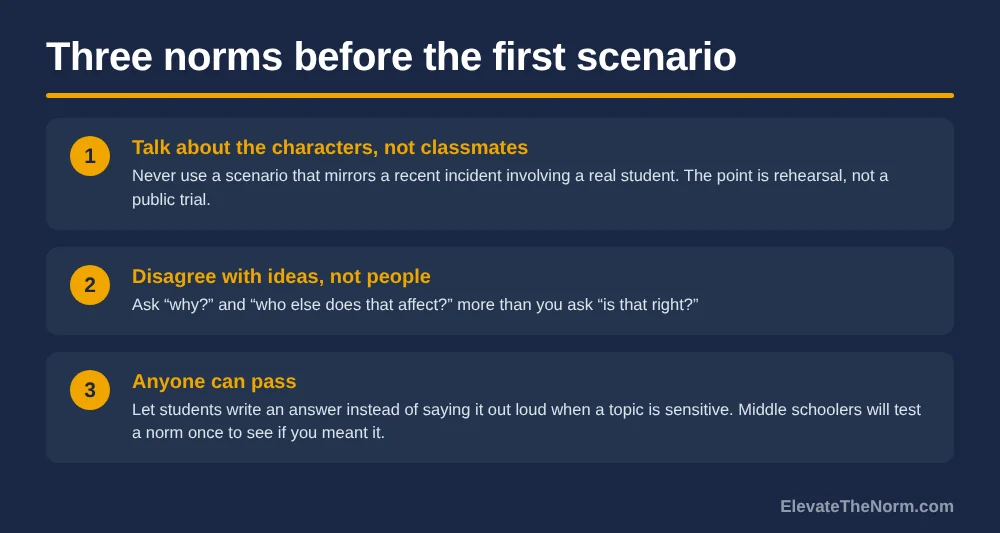
A few more practical moves help. Never use a scenario that mirrors a recent incident involving a real student. Let students write an answer instead of saying it out loud when a topic is sensitive. And if a discussion surfaces something serious, such as a student describing real harm, stop the activity and follow your school’s reporting procedure. A classroom discussion is not the place to handle it.
For families, these scenarios also work at the dinner table. A parent who asks “what would you do?” about a made-up situation often gets a more honest answer than one who asks “what happened at school today?”
How do you know if responsibility scenarios are working?
Look at behavior, not at the discussion. Scenarios are working when students start owning mistakes faster, asking for help before deadlines instead of after, and fixing problems without being told. A great debate with no change in the room means the talk has not transferred yet.
A simple check: keep a short weekly note of how often students self-report a mistake versus how often you catch it. You do not need a formal tracker, though our student accountability sheet works if you want one. If self-reports climb over a few weeks, the scenarios are doing their job.
And when a student does own something real, say so. Not a speech, just a plain “thanks for telling me” and a fair consequence delivered without anger. That moment teaches more about responsibility than every scenario on this page combined.
Frequently Asked Questions
What are responsibility scenarios for middle school students?
They are short, realistic situations, such as a missed deadline, a broken borrowed item or an unfair group project, that students discuss before deciding what they would do. The goal is practice in weighing options and consequences and planning how to fix a mistake, before students face the same choice for real.
How long should a responsibility scenario discussion take?
About ten minutes works well. Read the scenario, give one quiet minute for students to decide alone, two minutes in pairs, and a few minutes as a whole class ending on how the person would repair the situation. That fits as a bell ringer or a closing routine without losing a lesson.
What grade level are these scenarios for?
They are written for grades 6 to 8, but most work in early high school with small changes. The online and bigger-choice scenarios tend to produce the strongest discussions with seventh and eighth graders, because that is where students already make many of their own decisions.
What happens when students lack responsibility in the classroom?
Work and cleanup fall on a few students, deadlines lose meaning, shared supplies disappear and trust drops. When nobody admits mistakes, whole classes get punished for one person, which teaches students that owning a mistake is pointless. Fair, predictable consequences with a chance to repair are what reverse that.
Do scenario discussions actually change behavior?
Not automatically. A study of secondary moral-discussion programs led by social studies teachers found reasoning changed in some classrooms but not others, depending on how often discussions happened and how well the teacher drew out reasoning. That research measured reasoning, not behavior, so watch for real changes such as students self-reporting mistakes.
Should students ever discuss a real classroom incident as a scenario?
No. Keep scenarios about fictional characters and swap out any scenario that mirrors something that just happened with a real student. Turning a recent incident into a class discussion puts that student on trial in front of peers. Handle real incidents privately and through your school's procedures.
Can parents use these scenarios at home?
Yes. Asking what would you do about a made-up situation often gets a more honest answer than asking about the school day directly. Families can use the same four questions: what happened, who is affected, what are the options, and what would you do and how would you fix it.
Sources
- CASEL. What Is the CASEL Framework? and The CASEL 5. casel.org. Source of the definition of responsible decision-making as the ability to make caring and constructive choices about personal behavior and social interactions across diverse situations.
- Colby, A., Kohlberg, L., Fenton, E., Speicher-Dubin, B., & Lieberman, M. (1977). Secondary School Moral Discussion Programmes Led by Social Studies Teachers. Journal of Moral Education, 6(2), 90–111. Library record with abstract. Source of the finding that moral judgment change appeared in some but not all classrooms and was associated with the number of discussions, the range of pre-test reasoning in the class, and teachers’ skill at eliciting reasoning. The abstract, not the full article, was read; the study measured moral reasoning, not behavior.
- All fifteen scenarios on this page are original, fictional situations written for classroom discussion. Any resemblance to real students is unintended.