By Clay Shumate
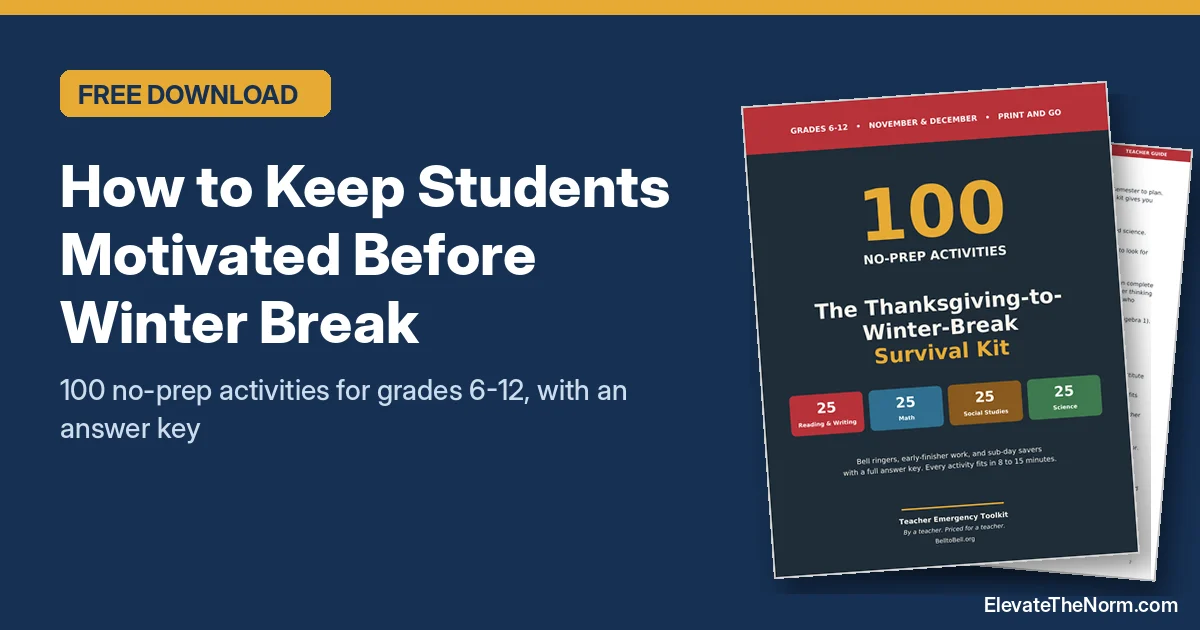
To keep students motivated before winter break, shorten the tasks without lowering the standard, give every task a clear finish line, and keep your routine exactly the same. Plan for absences and broken schedules instead of fighting them. The free download on this page gives you 100 short activities for grades 6-12 that fit that plan.
Key Takeaways
- The slump is real and predictable. Attendance data from several districts shows absences climbing in the days around Thanksgiving and winter break.
- Shorter tasks beat easier tasks. Students will still work hard for ten minutes when they can see the end of it.
- Routine matters more now, not less. When the schedule is unpredictable, your class should not be.
- Plan for the empty seats. Stand-alone lessons mean an absent student misses one task, not the thread of a whole unit.
- The free download does the prep. It holds 100 activities across reading, math, social studies and science, each built to take 8 to 15 minutes.
Why does student motivation drop between Thanksgiving and winter break?
Motivation drops because four things hit at once: more absences, broken schedules, a finish line everyone can see, and plain tiredness. None of them is a character flaw in your students. They are conditions, and conditions can be planned for.
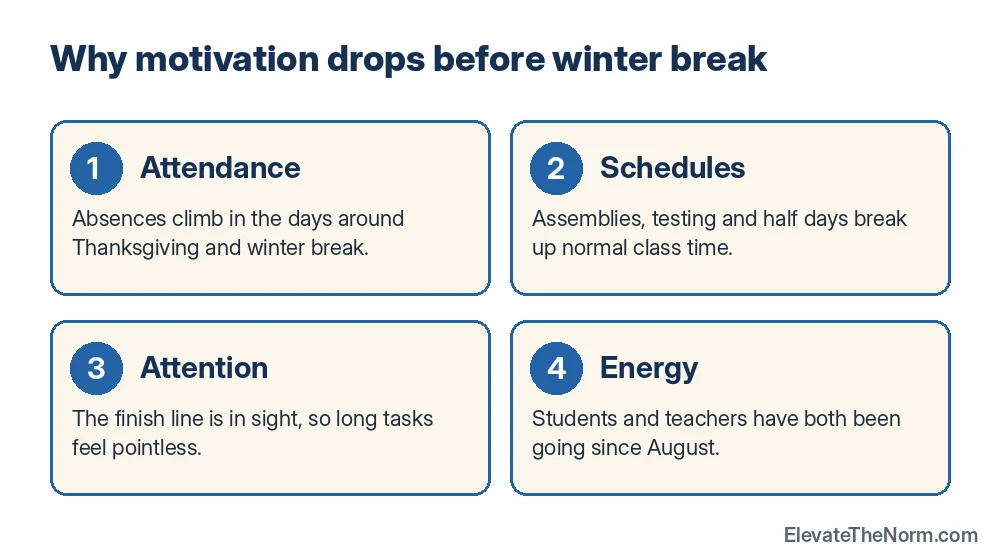
Attendance. Education Week reported on Wayne State University researchers who studied one year of Detroit attendance records and found the most absences on the days just before the Thanksgiving and Christmas breaks, along with the last week of school. An analysis of multi-year attendance data described by EveryDay Labs points the same way: a fall attendance dip around both breaks that was there before the pandemic too.
Schedules. Assemblies, testing windows, concerts and half days cut class time into odd pieces. A lesson that needs three connected days rarely gets them.
Attention. When a long break is two weeks away, a three-week project feels pointless to a fourteen-year-old. That is a reasonable reaction, not laziness.
Energy. Everyone in the building has been going since August, the adults included. One small University of Sheffield study followed 90 teachers across a Christmas break and found that exhaustion had usually not fully cleared by the time school started again. It was a small British sample, so treat it as a signal, not a law. It does fit what most teachers already feel in December.
How do you keep students motivated before winter break?
Use six moves: shorten the task, show the finish line, hold the routine, offer a choice, plan for absences, and save one thing worth showing up for. Each one answers one of the four conditions above.
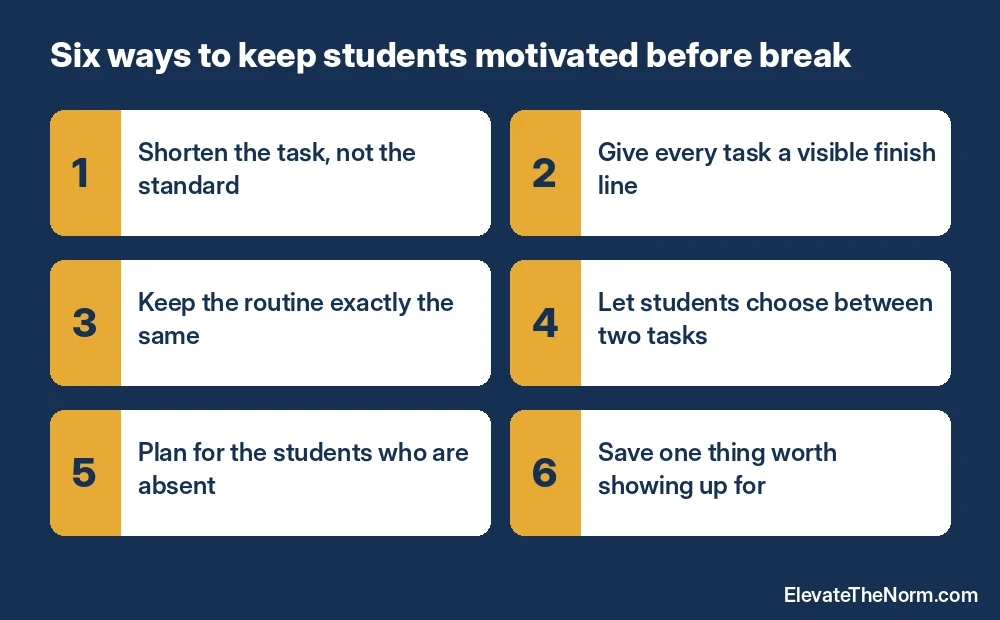
1. Shorten the task, not the standard
Ask for the same quality of thinking in a smaller container. One strong paragraph with evidence is still real writing. Five well-chosen math problems still show who understands. What changes is the length, so a student can start and finish in one sitting.
2. Give every task a visible finish line
Tell students exactly what done looks like before they begin: three questions, ten minutes, one sentence to share. Young adults work harder when they can see the end, the same way the rest of us do. A quick check for understanding at the end closes the loop.
3. Keep the routine exactly the same
Start class the way you always start it. If the bell ringer is on the board in September, it is on the board the day before break. Predictable openings calm a room that has had its schedule rearranged all week. If your routines were never written down, a classroom management plan is the place to fix that before January.
4. Let students choose between two tasks
Put two activities on the board and let each student pick one. Both hit the same skill. The choice costs you nothing and gives students a small piece of control at a time of year when most decisions are made for them. More ideas like this are in our list of student motivation activities.
5. Plan for the students who are absent
Build these weeks from lessons that stand alone. A student who misses Tuesday should be able to walk in Wednesday and take part without a packet of make-up work. That is fair to the student whose family set the travel plans, and it saves you hours of re-teaching.
6. Save one thing worth showing up for
Hold back something students want to be in the room for: a debate, a build challenge, a review game, a presentation day. Tell them when it is. Districts working on attendance use the same idea at a larger scale, planning events that make the final days before a break feel like something a student would not want to miss.


What is in the free download?
The Thanksgiving-to-Winter-Break Survival Kit is a free 39-page PDF with 100 no-prep activities for grades 6-12: 25 reading and writing, 25 math, 25 social studies and history, and 25 science. Each takes about 8 to 15 minutes, and a numbered answer key is at the back.
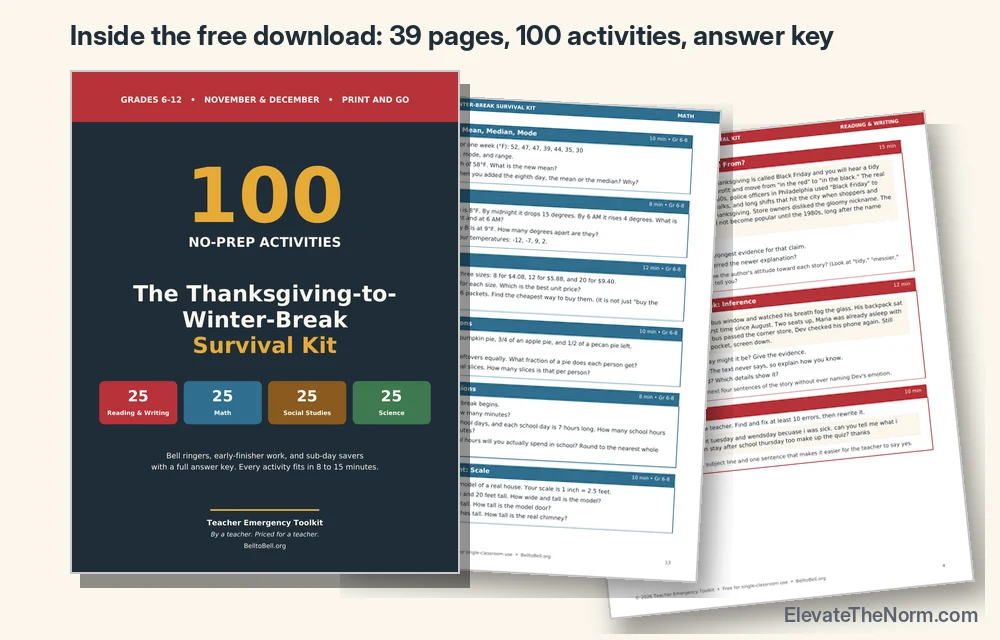
- Built for the six moves above. Every activity is short, has a clear end, and stands alone, so an absent student misses one task and nothing else.
- Works across grades 6-12. Reading, social studies and science activities end with a Level Up prompt for older students. Math sets are labeled by grade band or course.
- Almost no supplies. One activity needs paper, tape and scissors. The rest need a pencil.
- Seasonal without being fluff. Topics include the 1621 harvest feast and its sources, the Montgomery bus boycott, Black Friday percents, why leaves change color and why ice floats.
Use the activities as bell ringers, early-finisher work, sub plans, or filler for the short blocks an assembly leaves behind. The kit is free for one teacher to use in their own classroom.
More free printables are in the ElevateTheNorm resource library, and a new warm-up for every school day goes out through BelltoBell.org.
Should you lower expectations before winter break?
No. Change the size of the work, not what you expect from students. Movie days and free time tell students the learning is over and that showing up is optional, which makes the attendance problem worse.
Students notice when adults stop expecting anything from them, and most of them take it as a judgment. Holding the standard while shrinking the task says something different: the work still matters, and so does the fact that everyone is tired. That is how you treat a young adult. It is also the idea behind teaching responsibility the rest of the year.
There is room for fun. A review game or a class celebration on the last day is a fine thing. The difference is whether it is one planned event students earned, or three weeks of coasting.
How do you handle behavior in the last weeks before break?
Stay consistent. Use the same expectations and the same consequences you used in October, delivered calmly. Late fall is when small exceptions pile up into a different classroom than the one you built.
Keep in mind that a long break is not good news for every student. For some, school is the steadiest place in their week, and the days before a break can bring worry instead of excitement. A student who is short-tempered in mid-December may not be counting down the way the rest of the room is. Private, quiet correction and consequences that fit the behavior serve that student better than a public showdown.
If you want to keep students motivated before winter break, the plan is simple to say and takes discipline to hold: short work, clear endings, the same routine, and one thing worth showing up for.
Frequently Asked Questions
How do you keep students motivated before winter break?
Shorten tasks without lowering the standard, tell students exactly what finished looks like, keep your opening routine the same, offer a choice between two tasks, build lessons that stand alone so absences do less damage, and save one activity students want to be present for.
Why are students less motivated between Thanksgiving and winter break?
Several things happen together. Absences rise around both breaks, schedules are interrupted by assemblies and testing, the break itself makes long assignments feel pointless, and students and teachers are tired after months of school.
What is included in the free download?
The Thanksgiving-to-Winter-Break Survival Kit is a free 39-page PDF with 100 no-prep activities for grades 6-12. It has 25 activities each for reading and writing, math, social studies and history, and science, plus a numbered answer key.
Is the download really free, and do I need to sign up?
Yes, it is free, and the button on this page opens the PDF directly with no sign-up. It is licensed for one teacher to use in their own classroom. Please share the link to this page instead of the file.
Should I start a new unit before winter break?
It is usually better not to start a long unit that depends on students being present every day. Short stand-alone lessons, review, and small projects that finish before the break hold up better when attendance and schedules are unpredictable.
Is it okay to show a movie the day before break?
One planned event is fine, especially if students know it is coming and it connects to what they have learned. The problem is several days of free time, which signals that attendance is optional and can make absences worse.
Can a substitute teacher use these activities?
Yes. Each activity has its directions on the page and the answer key is at the back, so a substitute can hand out three or four activities from your subject and check the work without extra instructions.
Sources
- Education Week. Why Students Take Off the Day After Halloween. edweek.org. Source for the Wayne State University finding on Detroit absences before the Thanksgiving and Christmas breaks. The news report, not the underlying study, was read.
- EveryDay Labs. What the Research Says About Fall Attendance and High Impact Steps to Take Now. everydaylabs.com. Source for the description of a fall attendance dip around Thanksgiving and winter break. EveryDay Labs sells attendance services, and its summary of the American Enterprise Institute study was read, not the study itself.
- University of Sheffield. Teachers’ wellbeing doesn’t fully recover over the Christmas break, study finds. sheffield.ac.uk. Source for the finding on teacher exhaustion. The study followed 90 UK primary and secondary teachers over one Christmas break; the university news release was read, not the journal article.