By Clay Shumate
A 3/4 is 75 percent, which is a C on the common 10-point grading scale. To convert any score, divide the points earned by the points possible, multiply by 100, and match the percent to your school’s scale. So 7/10 is 70 percent (a C), 6/10 is 60 percent (a D), and 14/25 is 56 percent (an F).
Key Takeaways
- Every fraction score becomes a grade in two steps. Divide earned by possible to get a percent, then look the percent up on your school’s grading scale.
- The most-searched scores, on a 10-point scale: 3/4 = 75% (C), 7/10 = 70% (C), 6/10 = 60% (D), 14/25 = 56% (F), 1/4 = 25% (F), 4/8 = 50% (F).
- The scale decides the letter, not the math. The percent never changes. Where the D/F line sits does: the College Board’s own sample chart puts it around 65, and the older seven-point scales put it at 70.
- On a standards-based report card, “3/4” may not be a fraction at all. It can mean a 3 on a 1–4 proficiency scale, and converting that to 75% misreads it.
- Short quizzes swing hard. On a four-question quiz, each question is worth 25 points, so one miss drops a student from an A to a C.
What grade is a 3/4?
A 3/4 is 75 percent. On the common 10-point scale, where a C runs from 70 to 79, that is a C. On a plus/minus scale it usually lands as a C, in the middle of the C band.
The arithmetic is 3 ÷ 4 = 0.75, and 0.75 × 100 = 75. That part never changes. What changes from school to school is which letter 75 earns, so the rest of this page shows you both the math and where the lines usually sit.
Quick score converter
Letter uses the common 10-point scale (A 90+, B 80+, C 70+, D 60+, F below 60). Your school’s scale may differ.
How do you turn any fraction score into a letter grade?
Divide the points earned by the points possible, multiply by 100 to get a percent, then match that percent to the grading scale your school publishes. A 17 out of 20 is 17 ÷ 20 = 0.85, which is 85 percent, which is a B on a 10-point scale.
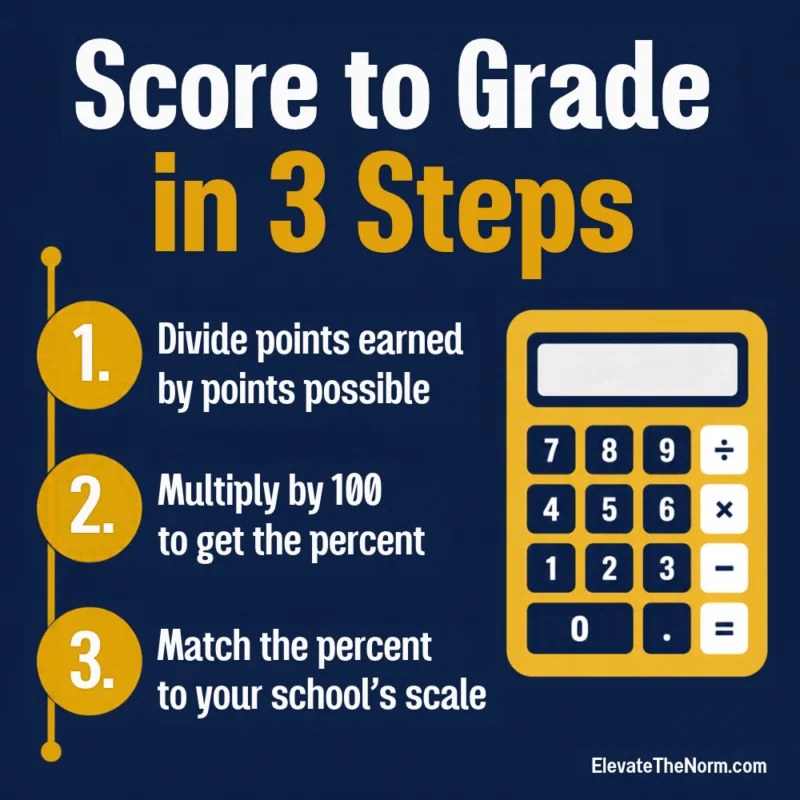
- Divide. Points earned ÷ points possible. A phone calculator is fine.
- Multiply by 100. That turns 0.56 into 56 percent.
- Look it up. Use your school’s published scale. If you do not have it, the 10-point scale below is the most common one in American high schools.
- Round only the way your school rounds. Some gradebooks round 89.5 to 90; some do not. That rule belongs in the syllabus, not in a hallway argument.
One honest warning about step four: a teacher who rounds an 89.5 for one student and not for another has created a fairness problem that no chart can fix. Decide the rounding rule before the first grade posts, then apply it to everyone the same way.
What are the most common fraction scores as letter grades?
These are the scores people search for most often, converted on the common 10-point scale: A 90–100, B 80–89, C 70–79, D 60–69, F below 60. The percent column is exact; the letter column depends on that scale.
| Score | Percent | Letter (10-point) | Why people ask |
|---|---|---|---|
| 3/4 | 75% | C | Four-question quizzes and four-point tasks |
| 7/10 | 70% | C | Ten-question quizzes; sits right on the C line |
| 6/10 | 60% | D | Lowest passing score on a 10-point scale |
| 14/25 | 56% | F | Twenty-five-point assignments |
| 1/4 | 25% | F | One of four correct |
| 2/4 or 4/8 | 50% | F | Half right |
| 14/20 | 70% | C | Twenty-point quizzes |
| 7/8 | 87.5% | B | Eight-question checks |
Two of these deserve a second look. A 7/10 is exactly 70, so it is a C by the thinnest possible margin, and on the older seven-point scale it would have been a D. A 6/10 is exactly 60, the lowest passing score on a 10-point scale and an F on most older scales. If a student is sitting on one of those lines, the scale is doing more work than the score.
Do grading scales disagree about the same percent?
Yes. The percent is fixed, but the cutoffs are not. The College Board’s own sample 4.0 chart shows a D from 66 to 69 and an F below 65, and says plainly that schools use different cutoffs. Older seven-point scales started an A at 93 and failed anything below 70.
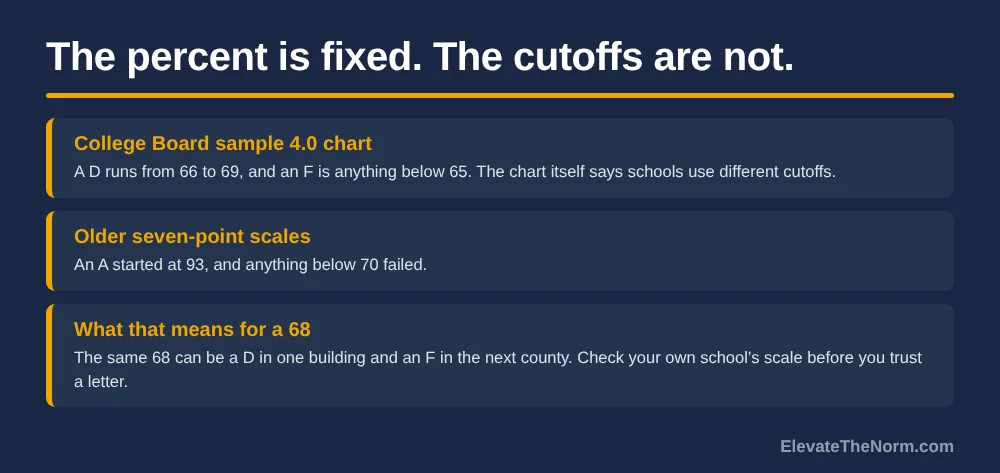
That means the same 68 can be a D in one building and an F in the next county. The College Board’s GPA conversion page describes its chart as one commonly used system and tells students to check with their own school. That is the right advice, and it is why this page gives you the percent first.
If you want the full comparison of the two most common scales, including the five averages where they give different letters, the 10 point grading scale chart and its 7 point comparison lays it out with a free printable.
Is a 3/4 a fraction or a standards-based grade?
It depends on the report card. On a points-based quiz, 3/4 means three of four points, which is 75 percent. On a standards-based report card, a “3 out of 4” usually means a proficiency level, and turning that into 75 percent misreads it.
This is where a lot of family confusion starts. A parent sees a 3 on a 1–4 scale, does the division, and thinks their child is earning a C. On most standards-based scales a 3 is the target, the level that says the student has met the standard. The scale is a set of four descriptions, not a fraction of 100.
If your school uses that kind of scale, the standards-based grading scale 1–4 conversion guide explains what each level means and the different ways schools turn levels into letters for a transcript. Ask the teacher which kind of score you are looking at before you convert anything.


Why does one missed question hurt so much on a short quiz?
Because every question on a short quiz carries a large share of the grade. On a four-question quiz each question is worth 25 percentage points, so one miss turns an A into a C. On a twenty-question quiz one miss costs only 5 points.
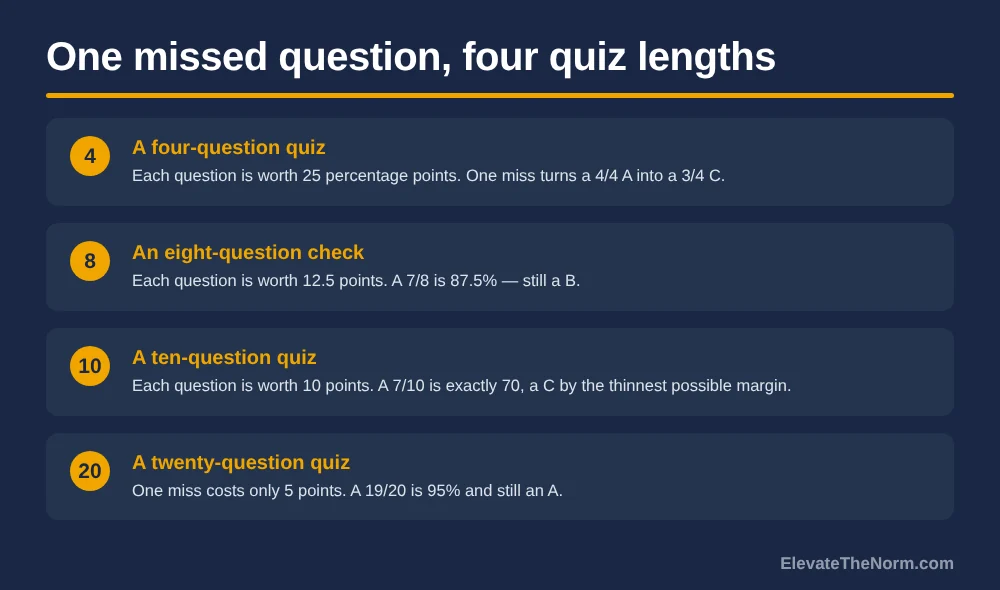
Here is the same idea across the quiz lengths teachers use most. Read across a row and you can see how far a single question moves a student.
Scores out of 4
| Score out of 4 | Percent | Letter (10-point scale) |
|---|---|---|
| 4/4 | 100% | A |
| 3/4 | 75% | C |
| 2/4 | 50% | F |
| 1/4 | 25% | F |
| 0/4 | 0% | F |
Scores out of 5
| Score out of 5 | Percent | Letter (10-point scale) |
|---|---|---|
| 5/5 | 100% | A |
| 4/5 | 80% | B |
| 3/5 | 60% | D |
| 2/5 | 40% | F |
| 1/5 | 20% | F |
| 0/5 | 0% | F |
Scores out of 8
| Score out of 8 | Percent | Letter (10-point scale) |
|---|---|---|
| 8/8 | 100% | A |
| 7/8 | 87.5% | B |
| 6/8 | 75% | C |
| 5/8 | 62.5% | D |
| 4/8 | 50% | F |
| 3/8 | 37.5% | F |
| 2/8 | 25% | F |
| 1/8 | 12.5% | F |
| 0/8 | 0% | F |
Scores out of 10
| Score out of 10 | Percent | Letter (10-point scale) |
|---|---|---|
| 10/10 | 100% | A |
| 9/10 | 90% | A |
| 8/10 | 80% | B |
| 7/10 | 70% | C |
| 6/10 | 60% | D |
| 5/10 | 50% | F |
| 4/10 | 40% | F |
| 3/10 | 30% | F |
| 2/10 | 20% | F |
| 1/10 | 10% | F |
| 0/10 | 0% | F |
Scores out of 20
| Score out of 20 | Percent | Letter (10-point scale) |
|---|---|---|
| 20/20 | 100% | A |
| 19/20 | 95% | A |
| 18/20 | 90% | A |
| 17/20 | 85% | B |
| 16/20 | 80% | B |
| 15/20 | 75% | C |
| 14/20 | 70% | C |
| 13/20 | 65% | D |
| 12/20 | 60% | D |
| 11/20 | 55% | F |
| 10/20 | 50% | F |
| 9/20 | 45% | F |
| 8/20 | 40% | F |
| 7/20 | 35% | F |
| 6/20 | 30% | F |
| 5/20 | 25% | F |
| 4/20 | 20% | F |
| 3/20 | 15% | F |
| 2/20 | 10% | F |
| 1/20 | 5% | F |
| 0/20 | 0% | F |
Scores out of 25
| Score out of 25 | Percent | Letter (10-point scale) |
|---|---|---|
| 25/25 | 100% | A |
| 24/25 | 96% | A |
| 23/25 | 92% | A |
| 22/25 | 88% | B |
| 21/25 | 84% | B |
| 20/25 | 80% | B |
| 19/25 | 76% | C |
| 18/25 | 72% | C |
| 17/25 | 68% | D |
| 16/25 | 64% | D |
| 15/25 | 60% | D |
| 14/25 | 56% | F |
| 13/25 | 52% | F |
| 12/25 | 48% | F |
| 11/25 | 44% | F |
| 10/25 | 40% | F |
| 9/25 | 36% | F |
| 8/25 | 32% | F |
| 7/25 | 28% | F |
| 6/25 | 24% | F |
| 5/25 | 20% | F |
| 4/25 | 16% | F |
| 3/25 | 12% | F |
| 2/25 | 8% | F |
| 1/25 | 4% | F |
| 0/25 | 0% | F |
For teachers, the practical lesson is simple: do not let a four-point quiz carry the same weight in the gradebook as a forty-point test. A short check is a good way to see what students know today. It is a poor way to decide a quarter grade, because the scale is too coarse to tell a student who nearly had it from one who had none of it.
For students, the lesson is the opposite. If a short quiz went badly, ask whether there is a route back, such as test corrections that actually teach the missed skill or a reassessment. Plenty of teachers offer one; fewer students ask.
What should a student do with a grade they think is wrong?
Check the math first, then ask. Divide the points earned by the points possible yourself, confirm which scale your class uses, and if the letter still looks wrong, bring the paper and the numbers to the teacher at a calm moment, not during class.
Most grade errors are entry errors: a score typed into the wrong column, a missing assignment that was turned in, a quiz entered out of 5 instead of 4. Those are easy to fix when you can show the paper. A student who walks up with the paper, the arithmetic and a polite question is treated like the young adult they are. That is a conversation worth having, and most teachers respect it.
Families can do the same thing by email. Keep it to the facts: which assignment, the score on the paper, the score in the gradebook. If the question is bigger than one entry, such as how zeros affect an average or whether a retake is allowed, the school’s written policy is the place to start.
Clay’s take: what this chart cannot tell you
A conversion chart tells you what a score is worth on paper. It cannot tell you whether the score was fair, whether the quiz measured the right thing, or whether one bad day should carry that much weight. Those are judgment calls.
What I would ask of any teacher is simple: publish the scale and the rounding rule before the first grade, keep short quizzes light in the gradebook, and give students a real way back from a bad score. When those three things are true, a chart like this one is just arithmetic. When they are not, no chart will make the grade feel fair to the kid holding the paper.
Frequently Asked Questions
What grade is a 3/4?
A 3/4 is 75 percent. On the common 10-point grading scale, where a C covers 70 to 79, a 75 is a C. If your school uses a different scale, the percent stays the same at 75 but the letter can change, so check the scale printed in your syllabus or student handbook.
What grade is a 7/10?
A 7/10 is 70 percent, which is a C on a 10-point scale, right at the bottom of the C band. On the older seven-point scale, where a C started at 77, a 70 was a D. The percent is fixed at 70; your school's cutoffs decide the letter.
What grade is a 6/10?
A 6/10 is 60 percent. On a 10-point scale that is a D, the lowest passing grade. On scales that draw the failing line at 65 or 70, a 60 is an F. Because 60 sits exactly on a cutoff, it is one of the scores most worth checking against your school's own scale.
What grade is a 14/25?
A 14/25 is 56 percent, because 14 divided by 25 is 0.56. On the common 10-point scale anything below 60 is an F, so a 56 is an F. A 15/25 would be 60 percent, which is a D on that scale, so the line sits one point away.
How do you convert a fraction score into a percent?
Divide the points earned by the points possible, then multiply by 100. For example, 17 out of 20 is 17 divided by 20, which is 0.85, which is 85 percent. Then match the percent to your school's published grading scale to get the letter grade.
Is a 3 out of 4 on a standards-based report card a C?
Usually not. On a standards-based 1 to 4 scale, a 3 typically means the student has met the standard, which is the target level. Those levels are descriptions, not fractions of 100, so dividing 3 by 4 to get 75 percent misreads the score. Ask the teacher which kind of score it is before converting.
Why do different schools give different letters for the same percent?
Schools set their own cutoffs. The common 10-point scale puts the passing line at 60, the College Board's sample chart puts the D/F line around 65, and older seven-point scales failed anything below 70. The percent from your score never changes; only the letter attached to it does.
Sources
- College Board, BigFuture. How to Calculate Your GPA on a 4.0 Scale. bigfuture.collegeboard.org. Source of the sample chart (A 90–100, B 80–89, C 70–79, D 66–69, E/F below 65), its description as one commonly used system, and its statement that schools use different cutoffs.
- Elevate the Norm. 10 Point Grading Scale: The Chart, the Cutoffs, and What It Actually Changes. elevatethenorm.com. Source of the 10-point bands used in the charts on this page and of the seven-point comparison, which that article cites to North Carolina’s state policy and contemporaneous reporting.
- All percent conversions on this page were calculated directly (points earned ÷ points possible × 100, rounded to one decimal place). Letters use the 10-point scale stated above.