By Clay Shumate
Free teacher printables are classroom-ready documents — primary source sets, data tables, reading guides, rubrics, trackers — that you can download and print without paying. For grades 6–12 the best ones come from federal agencies, museums, archives, universities and public media rather than worksheet mills. The hard part is not finding them. The hard part is telling which ones are worth the paper.
Most search traffic for free printables lands in elementary territory: coloring pages, letter tracing, bulletin board sets. This article stays in middle and high school, where the useful material looks completely different. A good secondary printable is usually a document, a data set, a structured protocol or a rubric — not a fill-in-the-blank page. Below are the quality criteria first, then the places that actually have the goods, with links I opened in October 2026.
Key Takeaways
- Judge the task, not the design. A clean-looking page that asks students to copy definitions is worse than an ugly page that asks them to explain something.
- Federal material is usually public domain. U.S. copyright law states that copyright protection is not available for any work of the U.S. Government, which is why National Archives and Library of Congress material is so adaptable.
- Free is not the same as unrestricted. Marketplace downloads typically carry single-classroom licenses and explicit bans on reposting, even when the file cost nothing.
- Worksheets have one strong, narrow use. Retrieval practice and spaced review are the two study techniques rated high utility in the major cognitive-psychology review. Most other worksheet uses are not supported.
- Check the reading level before you print thirty copies. A primary source at a grade 14 reading level is an accessibility decision, not a rigor decision.
- Everything on this site is free and ungated. All 53 printables in our library download directly, with no email, account or sign-up.
What are free teacher printables, really?
They are any document you can print and put in front of students without paying for it, which covers an enormous range of quality. That range is the whole problem. The phrase lumps together a declassified cable from the National Archives and a crossword of vocabulary words, and search engines cannot tell them apart.
For grades 6–12, useful printables tend to fall into five types. Primary and secondary source documents. Data sets, tables and charts students have to interpret. Structured protocols — discussion formats, peer review sheets, lab procedures, project planners. Rubrics and checklists. And practice sets, where the point is repeated retrieval rather than discovery.
Notice what is missing from that list: anything whose main function is to occupy time. That is not a moral judgment about busywork, it is a practical one. Paper that occupies time without producing evidence of thinking gives you nothing to grade honestly and gives students nothing to be proud of.
What is a worksheet actually good for?
A worksheet has one strong use: structured, repeated retrieval of things students need fast and automatic. Vocabulary, formulas, dates, conjugations, equation forms, map features. That use is well supported and worth defending.
The large review by Dunlosky, Rawson, Marsh, Nathan and Willingham rated ten common learning techniques for utility. Only two earned a high rating: practice testing and distributed practice. They write that these “received high utility assessments because they benefit learners of different ages and abilities.” Rereading and highlighting were both rated low utility — highlighting, which students lean on heavily, “does not consistently boost students’ performance.” Summarization and keyword mnemonics also came in low, and elaborative interrogation and self-explanation came in moderate, partly because they “have not been adequately evaluated in educational contexts” (Dunlosky et al., Psychological Science in the Public Interest, 14(1), 4–58, 2013).
That review covers a wide age range and a lot of laboratory work, not only secondary classrooms, so take it as a guide to which direction the evidence points rather than a prescription. But the direction is clear. A printable that functions as a short retrieval quiz, returned to a week later, is doing something the research supports. A printable that asks students to find and highlight the definitions is doing something the research rates poorly.
So: use worksheets for retrieval and spacing. Do not use them to introduce concepts, to substitute for reading, or to fill a Friday. That is the narrow good use, stated plainly.
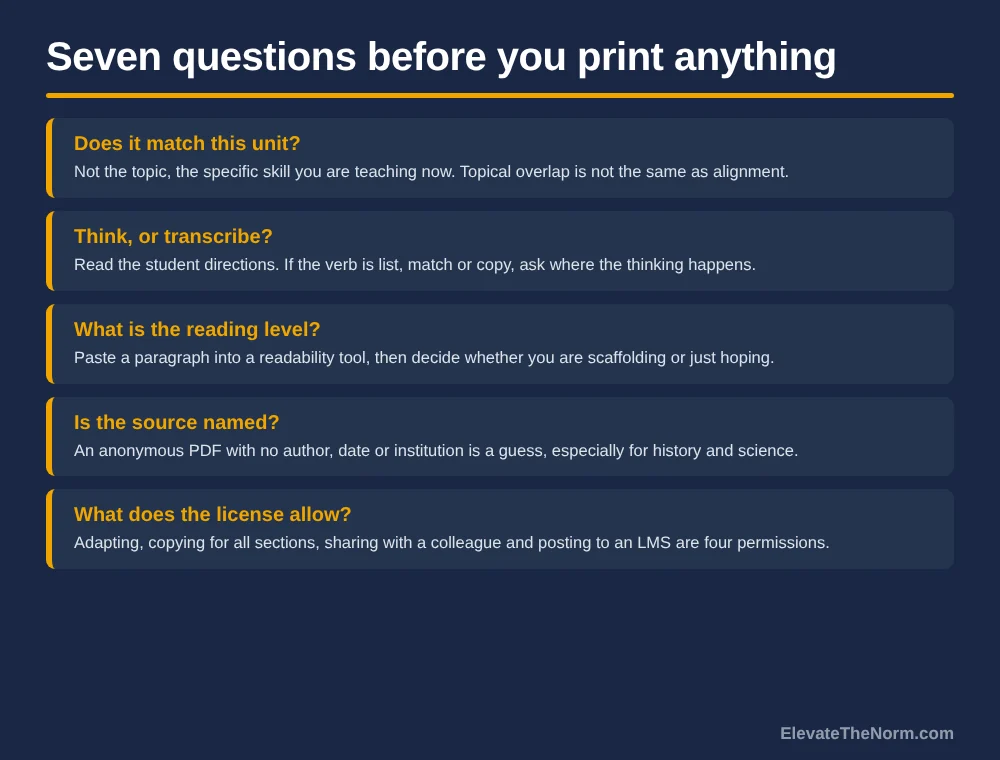
Seven questions to ask before you print
Run any candidate printable through these seven questions. It takes about two minutes and will reject most of what you find.
- Does it match what I am actually teaching? Not the topic — the specific skill or standard in this unit. Topical overlap is not alignment.
- Does it ask students to think, or to transcribe? Read the directions on the student page. If the verb is “list,” “match,” or “copy,” ask what the thinking is.
- What is the reading level, and who gets left out? Paste a paragraph into a readability tool. Then decide whether you are scaffolding the text or just hoping.
- Is the source credible and named? An anonymous PDF with no author, date or institution is a guess. Historical and scientific content from an unnamed source is a particular risk.
- Is it accurate? Spot-check two factual claims. Free content is not peer reviewed, and errors in dates, units and attributions are common.
- What does the license allow? Can you adapt it, copy it for all your sections, share it with a colleague, post it to your LMS? These are four different permissions.
- Does it produce something I can look at? If finished student work would not tell you anything you did not already know, skip it.
Question three deserves one more sentence. A document written for adults in 1863 is not automatically rigorous for a ninth grader; it is simply hard. Either you excerpt it, gloss it, chunk it, and build a scaffold, or you are handing out an obstacle. Checking whether the text landed matters more than the text’s prestige.
What may I legally adapt, copy and share?
Three separate things govern a free file: copyright, the license, and your district’s policy. Free to download tells you nothing about any of them.
The most permissive category is federal government work. Section 105 of U.S. copyright law states that “Copyright protection under this title is not available for any work of the United States Government,” while noting the government may hold copyrights transferred to it (17 U.S.C. § 105). In practice that is why you can crop, excerpt, retype and remix a National Archives document or a federal data table freely. Two cautions: material a federal site hosts may still be owned by someone else, and some agency logos and seals carry separate restrictions.
Openly licensed material is the next tier. OER Commons, which has been curating open materials since 2007, labels resources so you can tell adaptation rights at a glance — the site states that “each resource has one of four conditions of use labels” that “help you quickly distinguish whether a resource can be changed or shared without further permission required” (OER Commons). Read the label. Share-alike and non-commercial conditions are real conditions.
Then there are free files with restrictive licenses, which is most of a teacher marketplace. A free download from Teachers Pay Teachers typically comes with a single-classroom license and explicit instructions not to repost. Browsing the free section, you will find terms like “PLEASE DO NOT POST THIS PRODUCT ANYWHERE. Not on your classroom website, not online for your friends, nowhere” and resources marked “for personal use only” (TPT free resources). Those terms are not unreasonable, but they mean a free file can still be one you may not put in a shared department drive.
Federal sources, and why they are the best starting point
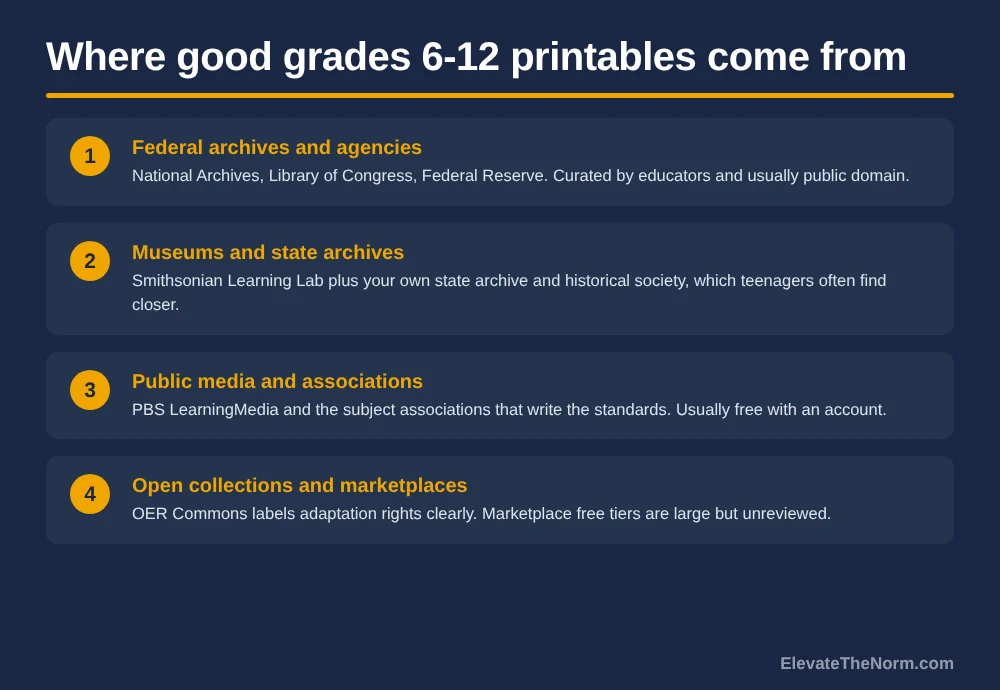
Start with the National Archives and the Library of Congress. These are the two highest-value free sources for secondary social studies, English and anything document-based, and both are built by people who understand classrooms.
DocsTeach, run with support from the National Archives Foundation, offers “thousands of primary sources — letters, photographs, speeches, posters, maps, videos, and other document types — spanning the course of American history.” When I checked in October 2026 the site listed 13,639 primary source documents and 294 activities available without registering, and states plainly: “It’s completely free!” A free account adds more teacher-built activities and lets you build and save your own (DocsTeach).
The Library of Congress publishes classroom materials “Created by teachers for teachers” — primary source sets organized by topic, many with teacher’s guides, covering the Civil War, the American Revolution, the civil rights movement and dozens more (Library of Congress classroom materials).
For economics and personal finance, the Federal Reserve’s education site describes itself as “A FREE platform with economics and personal finance resources for classrooms and communities,” with middle school, high school and college levels, and lessons, readings, modules and infographic posters. Browsing is open; saving resources and getting answer keys requires a free teacher account (Federal Reserve Education).
Museums, libraries and archives
The Smithsonian Learning Lab is the strongest single museum source for grades 6–12. It describes itself as “Free to discover,” holding “millions of Smithsonian digital images, recordings, texts, and videos in history, art and culture, and the sciences” plus “thousands of examples of resources organized and structured for teaching and learning,” with collections filterable by grade band (Smithsonian Learning Lab). Browsing is open; saving and assigning requires an account.
Your state archive and your state historical society are underused. Nearly every state has digitized local newspapers, maps, census records and photographs, and local documents are frequently more interesting to teenagers than national ones. Your county or city public library system often has free database access with a library card, which is a genuinely free resource most teachers never mention to students.
Public media, associations and universities
Public media is reliable but usually gated behind a free account. PBS LearningMedia offers videos, interactives and lesson plans and is free, stating plainly “Register Now It’s free!” — which does mean an account (PBS LearningMedia). That is a reasonable trade, but it is a gate and I am not going to pretend otherwise.
Subject-matter professional associations are the most reliable source of standards-aligned secondary material, because they write the standards. The national councils and associations for English, mathematics, science, social studies and world languages all publish free classroom material alongside their member-only content. Check what is open before paying for membership for that reason alone.
University centers publish free curriculum too, and the quality is usually high because it is tied to research programs. These sources often require a free account, and the material is frequently narrow — one skill, done thoroughly. That is a feature.
A warning about link rot from this same category. When I verified sources for this article in October 2026, the deep links for the National Endowment for the Humanities’ EDSITEment lesson plans — recommended in teacher materials for over two decades — redirected to a single NEH project page rather than the lesson library. Any list of free resources older than about a year will contain dead ends. Open the link before you plan around it.
Teacher marketplaces and their free tiers
Marketplaces have enormous free sections and wildly variable quality, and the filter has to be yours. Teachers Pay Teachers lists hundreds of thousands of free resources across all grades and subjects, and an account is required to download them.
Two honest cautions. First, marketplace material is not reviewed for accuracy or alignment by anyone except the buyer, so questions four and five in the checklist above matter most here. Second, the volume skews heavily elementary, so grade 6–12 searching takes patience and tight filters. When it works, it works well for exactly one thing: a structure someone else already built that you would otherwise spend an evening making.
Our own free teacher printables, and what we charge for
Every printable on this site is free and downloads directly — no email, no account, no sign-up. As of October 2026 the resource library holds 53 free printable PDFs, organized into classroom management, assessment and grading, instruction and discussion, families and conferences, integrity and responsibility, and teacher wellbeing and reflection.
Concretely, that includes seating chart planners, transition cues, formative assessment checks, standards-based grading templates, Socratic seminar protocols, project planners, bell ringers, parent communication logs, student-led conference templates, academic integrity materials and reflection journals. All grades 6–12. All ungated.
We also sell some packaged versions of this material on Teachers Pay Teachers. Those are paid. Stating that plainly is the point: nothing that is free here will ever move behind a purchase, and if you only ever use the free files, that is the intended outcome, not a loss.

Where free printables go wrong in middle and high school
The failure mode is almost always age mismatch dressed up as differentiation. A few patterns to watch for.
- Elementary material relabeled. Clip art, large fonts, one-word answers. Teenagers read this instantly as being talked down to, and they are right.
- Volume substituted for difficulty. Forty problems at the same level is not more rigorous than eight at increasing levels. It is longer.
- The reading level nobody checked. An unexcerpted primary source handed out cold, with no glossary and no chunking.
- Answers in the directions. Graphic organizers so prescriptive that filling them in requires no decisions.
- No visible purpose. If a student asks why they are doing this and the honest answer is “to have something to turn in,” do not print it.
That last one is the test I would apply above all others. Secondary students will do difficult work if the purpose is legible to them, and they will resist easy work whose purpose is not. Treating them as developing young adults means the paper has to be able to justify itself, which is also the argument for giving them real choices inside an assignment rather than more pages of it.
A quick comparison of source types
| Source type | Typical quality | Account needed? | Adaptation rights | Best for |
|---|---|---|---|---|
| Federal agencies and archives | High; curated by educators | Usually no for browsing | Broadest — federal works are not copyrightable under § 105 | Primary sources, data sets, document-based tasks |
| Museums and libraries | High | Browsing open; saving usually requires one | Varies by item; check each | Images, objects, curated collections by grade band |
| Public media | High | Usually yes, free | Classroom use; redistribution restricted | Video-anchored lessons, interactives |
| Professional associations | High, standards-aligned | Mixed; some member-only | Varies; frequently classroom-use only | Standards alignment, assessment design |
| Open education collections | Variable but labeled | Usually no | Explicitly labeled; often adaptable | Full units, textbooks, remixable material |
| Teacher marketplaces | Very variable | Yes, to download | Usually single classroom, no reposting | Ready-made structures and templates |
Free teacher printables: a short plan for this week
Pick the one unit coming up where you are least happy with your materials, and spend forty minutes on free teacher printables for that unit only. General browsing produces a folder you never open. A specific hunt produces something you use on Thursday.
Start at the National Archives or the Library of Congress if the unit is document-based, the Federal Reserve if it is economics, the Smithsonian if it is object- or image-based. Run every candidate through the seven questions, especially reading level and what the task asks students to do. Check the license before you put anything in a shared drive. And if what you need is a protocol, a tracker or a rubric rather than content, start with our free printable library, which downloads directly with no email required.
One more thing worth saying. Hunting for materials is legitimate professional work, and it counts. If you are building a growth goal you will actually revisit or logging hours toward your state’s license renewal requirement, improving your materials is a real place to point that effort — as long as the test stays the same: does this paper produce thinking I can look at?
Sources
- John Dunlosky, Katherine A. Rawson, Elizabeth J. Marsh, Mitchell J. Nathan and Daniel T. Willingham, “Improving Students’ Learning With Effective Learning Techniques,” Psychological Science in the Public Interest, 14(1), 4–58, 2013. Supports the high utility ratings for practice testing and distributed practice and the low ratings for rereading, highlighting and summarization. Caveat: the review spans a wide age range and relies substantially on laboratory studies rather than secondary classrooms; the authors note some techniques are rated moderate precisely because they “have not been adequately evaluated in educational contexts.” https://journals.sagepub.com/doi/10.1177/1529100612453266
- U.S. Copyright Law, Title 17, Section 105, “Subject matter of copyright: United States Government works,” U.S. Copyright Office. Supports the statement that copyright protection is not available for works of the U.S. Government. Caveat: this covers works authored by the federal government, not everything hosted on a federal website, and agency seals and logos may carry separate restrictions. https://www.copyright.gov/title17/92chap1.html
- DocsTeach, National Archives, accessed October 2026. Supports the document and activity counts, the “completely free” statement, and the distinction between browsing without an account and the additional activities a free account adds. https://www.docsteach.org/
- Library of Congress, “Classroom Materials,” accessed October 2026. Supports the description of teacher-built primary source sets with teacher’s guides organized by historical topic. Caveat: the landing page does not itself state grade bands, so check each set. https://www.loc.gov/classroom-materials/
- Smithsonian Learning Lab, accessed October 2026, and Federal Reserve Education, accessed October 2026. Support the quoted descriptions of holdings, the grade-band filtering, the “FREE platform” description, and the statement that a free teacher account is needed to save resources and access answer keys. https://learninglab.si.edu/
- OER Commons, accessed October 2026. Supports the four conditions-of-use labeling system and the 2007 founding date used to describe the collection. https://www.oercommons.org/
- Teachers Pay Teachers, free resources browse page, accessed October 2026. Supports the existence of a large free tier, the requirement to log in to download, and the quoted single-classroom and no-reposting terms that individual sellers attach. Caveat: licensing terms are set per resource by sellers, so read the terms on the specific file rather than assuming. https://www.teacherspayteachers.com/Browse/Price-Range/Free
Frequently Asked Questions
Are worksheets bad for middle and high school students?
No, but they have one narrow good use: structured, repeated retrieval of things students need fast and automatic, revisited after a gap. That use lines up with the only two techniques rated high utility in the major review of learning strategies — practice testing and distributed practice. What is not supported is using a worksheet to introduce a concept, to replace reading, or to fill a period. The question to ask is not whether a page is a worksheet, but whether finished student work on it would tell you something you did not already know.
If a printable is free, can I change it and share it with my department?
Not automatically, and these are separate permissions. Works authored by the U.S. federal government are not protected by copyright, which is why National Archives and Library of Congress material can be cropped, excerpted and remixed freely. Openly licensed material carries explicit labels you should read, including share-alike and non-commercial conditions. Free marketplace downloads usually carry single-classroom licenses and explicit bans on reposting, even though the file cost nothing. Before anything goes into a shared drive or an LMS, read the terms attached to that specific file.
How do I check whether a document is too hard for my students?
Paste a representative paragraph into a readability tool and look at the grade estimate, then make a deliberate decision rather than hoping. A document written for adults in 1863 is not automatically rigorous for a ninth grader; it is simply hard. If you keep it, excerpt it, chunk it, gloss the vocabulary and build a scaffold. If you cannot do that work before Thursday, pick a different text. Handing out an unmodified hard source and calling it rigor mostly produces students who learn that reading is futile.
Why do so many free printable sites skew elementary?
Because that is where the demand volume is, and because elementary material is faster to produce. The practical consequence for secondary teachers is that general searches waste time and you should go to specific institutions instead. Federal archives, museums, the Federal Reserve, professional subject associations and university centers all produce genuinely secondary-level material. On marketplaces, use tight grade and subject filters from the start. And be suspicious of anything with clip art and one-word answer lines, which is usually elementary material relabeled.
Do I have to create an account to get free materials?
It depends on the source, and it is worth knowing before you plan a lesson around something. Browsing the National Archives, Library of Congress, OER Commons and the Smithsonian Learning Lab works without an account, though saving and assigning on the Smithsonian site requires one. PBS LearningMedia and the Federal Reserve both ask you to register for free. Teachers Pay Teachers requires an account even for free downloads. Everything in this site’s own library downloads directly with no email, account or sign-up, which is a deliberate choice.
Is paid material from a marketplace better than free material?
Not reliably. Price is a signal about packaging and the seller’s time, not about accuracy or alignment. Marketplace material of either kind is not reviewed by anyone except the buyer, so a paid file and a free file from the same marketplace deserve the same scrutiny. Where paying can genuinely be worth it is for a complete, coherent structure you would otherwise spend several evenings building. Where it is rarely worth it is for single pages, which free institutional sources usually provide at equal or better quality.
How often do free resource links break?
Often enough that you should open every link before planning around it. While checking sources for this article in October 2026, I found that the deep links for a federal humanities agency’s long-recommended lesson plan library now redirect to a single project page rather than the lessons themselves. That resource had been recommended in teacher materials for over two decades. If a federal site can move out from under its own URLs, any roundup list older than a year will contain dead ends. Download the files you rely on rather than bookmarking them.
How should I decide what to look for in the first place?
Start from a unit, never from a browse. Pick the one upcoming unit where you are least happy with your materials, name the specific gap — a text, a data set, a protocol, a rubric — and spend forty focused minutes on that gap only. General browsing produces a folder of downloads you never open again. A targeted hunt produces something in students’ hands on Thursday. Then run each candidate through the alignment, task, reading level, credibility, accuracy, license and evidence questions before it goes near a copier.