By Clay Shumate · Updated October 24, 2026
Natural consequences are the outcomes that happen on their own when a student makes a choice—without the teacher adding anything. A student who does not study gets a low grade. A student who refuses to participate in group work gets left behind while the group moves forward. Nobody imposed those results. They just happened, because actions have outcomes. Using natural consequences in the classroom means stepping back, when it is safe to do so, and letting reality do the teaching.
That is the short answer. The longer one involves knowing when natural consequences work, when they do not, where teachers confuse them with logical consequences and punishment, and how to use all three honestly without pretending that any single approach solves everything.
Key Takeaways
- Natural consequences happen without teacher intervention. The outcome follows directly from the student’s choice.
- Logical consequences require a teacher to set up a related, respectful, reasonable response. They are different from natural consequences.
- Neither natural nor logical consequences should be disguised punishment—if it involves humiliation, excessive severity, or unrelated penalties, it is punishment regardless of what you call it.
- Natural consequences have limits. They do not work when safety is at risk, when the consequence is too far in the future to matter, or when the student lacks the ability to make a different choice.
- The goal of any consequence in a secondary classroom is learning, not suffering.
What Are Natural Consequences in the Classroom?
Rudolf Dreikurs, the psychiatrist who brought the concept into education, drew a clear line: natural consequences are results that occur without any adult arrangement. The parent or teacher does not create the consequence, does not announce it, and does not have to enforce it. It simply happens (Dreikurs and Soltz, Children: The Challenge, 1964).
In a secondary classroom, natural consequences show up constantly:
- A student who does not prepare for a class discussion has nothing to contribute when their turn comes.
- A student who puts off a long-term project until the last night turns in weak work.
- A student who treats group members badly finds that nobody wants to work with them next time.
Notice what the teacher does in each of these examples: nothing extra. The teacher does not need to add a punishment. Reality handled it.
That is the power of natural consequences—and also their limitation. They only work when the natural outcome is immediate enough, visible enough, and meaningful enough to teach the lesson on its own.
What Is the Difference Between Natural and Logical Consequences?
This is where most of the confusion lives. Teachers use the terms interchangeably, but they are not the same thing.
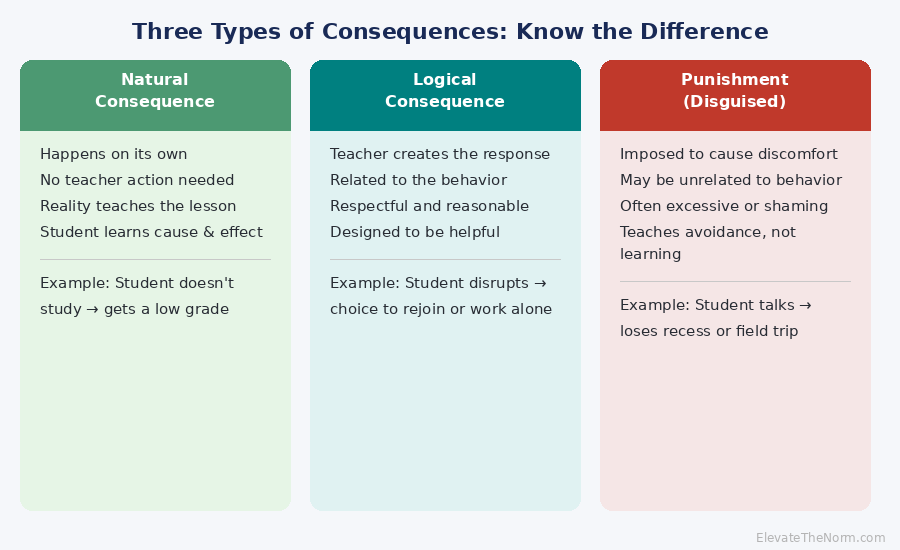
Natural consequences require no adult action. The outcome happens on its own.
Logical consequences require the teacher to create a response that is directly connected to the behavior. The teacher sets it up. The connection is deliberate.
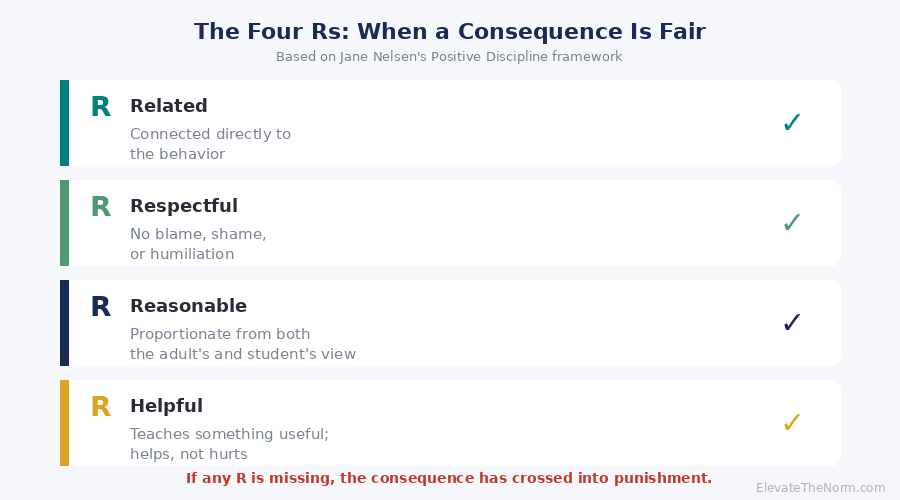
Jane Nelsen, author of Positive Discipline, identifies four criteria that logical consequences must meet to avoid becoming disguised punishment. She calls them the Four Rs: Related, Respectful, Reasonable, and Helpful. If any of the four is missing, the consequence has crossed the line into punishment—even if the teacher does not intend it that way (Nelsen, “Logical Consequences,” Positive Discipline).
Logical Consequences in the Classroom: Examples for Grades 6–12
A logical consequence is a response the teacher chooses because it follows directly from what the student did: fix what you broke, lose the privilege you misused, or step away long enough to reset. Responsive Classroom names exactly those three types: “you break it, you fix it,” loss of privilege, and positive time-out, which it calls “space and time” in middle school. It describes all three as a non-punitive response, and it says anything taken away has to be directly related to the misbehavior (Responsive Classroom, “Three Types of Logical Consequences,” 2023).
Here is what that looks like with teenagers. The last column matters as much as the second one, because it shows where a logical consequence turns into punishment.
| What the student did | Logical consequence | Why it is related | When it becomes punishment |
|---|---|---|---|
| Left the lab station or work area a mess | Resets it before the bell | Fixes the exact thing that was left undone | Adding a lunch detention on top of the reset |
| Used a phone during instruction | Phone goes to a set spot for the rest of the period | Removes the item that was misused, for the time it was misused | Keeping it for a week, or reading what is on it |
| Stayed off task in a seat they chose | Sits in a teacher-chosen seat for the rest of the period and gets to choose again tomorrow | Loses the privilege they misused, and only that one | Losing seat choice for the semester, or being moved in front of everyone with commentary |
| Wrote in or damaged a shared book or supply | Cleans it, or repairs it within reason | You break it, you fix it | Demanding a replacement cost the family cannot afford |
| Said something hurtful to a classmate | A private repair conversation and an agreed way to make it right | Repairs the relationship that was harmed | A forced public apology |
| Was escalating during a discussion | Takes space and time at a reset spot, then rejoins when ready | Gives them a reset without removing them from learning | Getting sent out for the whole period by default |
| Copied a classmate’s homework | Redoes the work under supervision, with help if they need it | Puts back the practice that was skipped | A zero with no chance to show the learning. Your school’s academic integrity process may still apply. |
A one-sentence test before you use one. Say it out loud, starting with “Because you…” For example: “Because you left the station a mess, you’ll reset it before you go.” If the second half does not follow from the first, it is not logical. Run it through Nelsen’s Four Rs above too. A logical consequence that is not Respectful is still punishment.
Two habits keep logical consequences honest. First, decide on them before you need them. A consequence you make up in the moment carries your mood with it, which is why a written response ladder for common problems helps. Second, because the teacher creates a logical consequence, the teacher’s delivery decides how it lands. Say it privately, calmly, and once. Then let the student do it without an audience or a lecture.
When Do Natural Consequences Work in a Secondary Classroom?
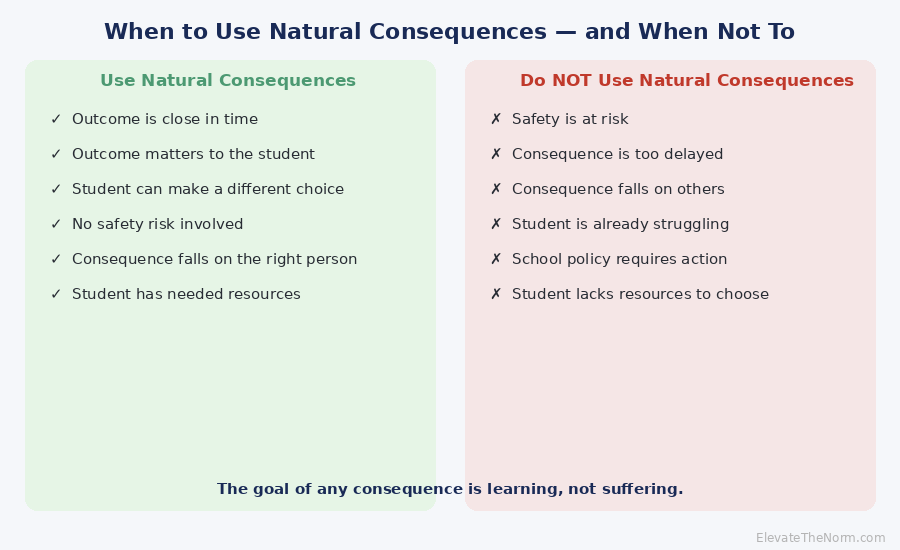
Natural consequences are strongest when three conditions are met:
1. The outcome is close in time. A teenager who puts off studying sees the grade within days. That connection is tight enough to teach. But a student who does not develop study habits in ninth grade may not feel the real consequence until college—and that is too far away to function as a classroom teaching tool.
2. The outcome is meaningful to the student. If a student genuinely does not care about the grade, the natural consequence of not studying has no teaching power. This is not a flaw in the student. It means the teacher needs a different approach—probably a conversation about what the student does care about and whether there is a connection.
3. The student has the ability and resources to make a different choice. This is the most important condition and the one teachers miss most often. A student who does not bring materials because the family cannot afford them is not choosing to be unprepared. A student who does not finish homework because there is no safe, quiet place at home is not choosing to be irresponsible. Letting the natural consequence land in those situations is not teaching. It is punishing poverty or circumstance and calling it accountability.
When Do Natural Consequences Not Work?
There are situations where letting natural consequences play out is wrong, dangerous, or irresponsible. Every teacher needs to recognize these clearly.
Safety is at risk. If a student’s behavior could cause physical harm—to themselves or others—the teacher intervenes immediately. You do not let a student learn from the natural consequences of unsafe lab behavior. You stop it.
The consequence is invisible or delayed. Some choices have consequences that are real but too slow or abstract for an adolescent to feel. Skipping reading assignments, for instance, produces a gradual erosion of comprehension that does not announce itself until weeks later. The natural consequence exists, but it is not effective as a teaching tool because the student cannot draw a line between the choice and the result. My Behavior Reflection Sheets on TPT ask students for reasons, not apologies, and come in two reading levels.
The consequence falls on other people. When a student’s irresponsibility damages the group—a partner who did no work, a lab team missing a component—the natural consequence punishes the students who did their part. That is not fair, and it is not a lesson worth teaching.
The student is already struggling. For a student who is disengaged, anxious, dealing with instability at home, or behind in multiple classes, piling on another failure through natural consequences does not teach resilience. It teaches the student that school is one more place where things do not work out. The teacher’s job at that point is support, not observation.
School policy requires a specific response. Some behaviors—threats, harassment, weapons, substance use—require immediate administrative action regardless of any teacher’s philosophy about consequences. Natural consequences do not override mandatory reporting or school safety protocols.
The Punishment Problem
The biggest risk with consequences—natural or logical—is that they become punishment wearing a better name.
Alfie Kohn has argued for decades that most classroom consequences function as punishment: “Do this or else” dressed in gentler language (Kohn, Punished by Rewards, 1993). Nelsen’s framework offers a useful test. If the consequence triggers resentment, revenge, rebellion, or retreat in the student, it has become punishment—regardless of the teacher’s intention.
Here are three warning signs that a “consequence” is actually punishment:
1. It is not connected to the behavior. A student who talks during instruction loses recess or has a phone taken away. Those responses are not related to the behavior. They are penalties applied to get compliance.
2. It includes humiliation. A student who turns in incomplete work has their name posted on a “missing work” list. The consequence is now about shame, not about the work.
3. It is excessive. A student who is late to class once gets a week of after-school detention. The severity has nothing to do with learning. It is about power — and power is what most “control” techniques quietly optimize for, which is why so few of them hold.
When I notice a student making a choice that is heading toward a natural consequence, I do not broadcast it to the room. I walk over—close range, conversation volume—and say something like, “I can see where this is going. What do you want to do about it?” That is not me rescuing them from the consequence. It is me giving them a chance to redirect before the consequence lands. If they choose not to redirect, the outcome follows. But they had the information and the opportunity.
That is what separating consequences from punishment looks like in practice. The student keeps their dignity. The standard stays in place. The teacher stays close.


A Practical Framework: Choosing the Right Response
Not every situation calls for the same type of response. Here is a framework for deciding:
Step 1: Is anyone at risk? If yes, intervene immediately. Safety overrides every other consideration.
Step 2: Will the natural consequence teach the lesson? Check the three conditions: Is the outcome timely? Does the student care? Can the student actually make a different choice? If all three are yes, step back and let it play out. Stay close enough to debrief afterward.
Step 3: If natural consequences will not work, is there a logical consequence? Apply Nelsen’s Four Rs: Related, Respectful, Reasonable, Helpful. If you cannot make the consequence meet all four criteria, it is probably not a logical consequence—it is a punishment you are trying to justify.
Step 4: If no consequence fits, use a conversation. Sometimes the best response is pulling the student aside and talking through what happened, what they were thinking, and what they want to do next. Not every problem needs a consequence. Some problems need a plan. If you want the exact words for that follow-up talk, my Restorative Conversation Scripts on TPT give you a script for each step.
Step 5: Record and follow through. Whatever approach you choose, do it consistently and follow through. Consequences that change based on the teacher’s mood are not consequences. They are reactions.
What This Looks Like Across Common Classroom Situations
Late work. The natural consequence of late work is a lower grade or missed feedback cycle. But check whether the student had the resources to complete the work on time. If they did, the natural consequence stands. If they did not, a conversation and a revised plan are more honest than a zero. And if the lateness is recurring rather than a one-time lapse, check attendance before you check effort — chronic absenteeism produces exactly this pattern, and it calls for a different response than a motivation problem does.
Phone use during instruction. There is no natural consequence fast enough to teach this lesson. A logical consequence—put the phone away or it goes to a designated spot for the period—is appropriate, as long as it is applied consistently and without a lecture.
Disrespect toward a peer. The natural consequence is social: damaged trust, fewer willing partners. The logical consequence is a teacher-facilitated conversation about what happened and what repair looks like. This is also where school policy may require documentation.
Refusal to work. Before assigning any consequence, ask a question. A student who refuses to work is telling you something—about the task, about their confidence, about something outside the classroom. The consequence should follow only after you understand the refusal.
Group work problems. When one student is not contributing, the natural consequence falls on the group, not the individual. That makes it a poor teaching tool. A logical consequence—a private conversation, a role reassignment, or an individual accountability check—is more appropriate.
Conclusion
Natural consequences are one tool in a larger set. They work best when the outcome is timely, meaningful, and fair—and when the student has the resources to make a different choice. When those conditions are not met, logical consequences, conversations, and plans often do the job better.
The real skill is knowing which tool fits the moment. And the real test is not whether the student suffered the right amount—it is whether they learned something they can use next time. Consequences that teach are worth keeping. Consequences that humiliate are not consequences at all.
Stay close to your students. Handle correction at close range. Give them information and a chance to redirect before the consequence lands. And when the consequence does land, help them understand it—without piling on. And when the harm landed on another person rather than on the student’s own grade, a consequence by itself will not finish the job—that is the point where a structured repair conversation does work a consequence cannot.
What are examples of natural consequences in the classroom?
A student who does not prepare for a class discussion has nothing to contribute when their turn comes. A student who puts off a long-term project until the last night turns in weak work. A student who treats group members badly finds that nobody wants to work with them next time. In each case the teacher adds nothing; the outcome happens on its own.
How can you tell when a consequence has become punishment?
Three warning signs: it is not connected to the behavior, such as losing recess for talking during instruction; it includes humiliation, such as posting names on a missing-work list; or it is excessive, such as a week of detention for one late arrival. Nelsen’s test adds a fourth check: resentment, revenge, rebellion, or retreat in the student.
What is the difference between natural consequences and punishment?
Natural consequences happen without any teacher action—they are the direct result of a student’s choice. Punishment is imposed by an authority figure and may or may not be connected to the behavior. A student who does not study and gets a low grade experienced a natural consequence. A student who does not study and loses a field trip privilege experienced punishment.
What are examples of logical consequences in the classroom?
A logical consequence is connected directly to the behavior. For example, a student who leaves a lab station a mess resets it before the bell. A student who uses a phone during instruction puts it in a set spot for the rest of the period. A student who is off task in a seat they chose moves to a teacher-chosen seat for the period. A student who says something hurtful has a private repair conversation. Each one is related, respectful, reasonable in scale and focused on learning. If it adds an unrelated penalty or embarrasses the student, it has become punishment.
When should a teacher NOT use natural consequences?
Do not rely on natural consequences when safety is at risk, when the consequence is too delayed to be meaningful, when the consequence falls on other students instead of the one who made the choice, when the student lacks the resources or ability to choose differently, or when school policy requires a specific response.
How do I know if a logical consequence has crossed the line into punishment?
Use Jane Nelsen’s Four Rs test. Is the consequence Related to the behavior, Respectful of the student, Reasonable in scale, and Helpful toward learning? If any R is missing—especially respect—it has become punishment. Another signal: if the student responds with resentment, revenge-seeking, rebellion, or withdrawal, the consequence is functioning as punishment regardless of your intent.
Can natural consequences work with students who genuinely do not seem to care?
If a student does not care about the outcome, the natural consequence has no teaching power. That does not mean the student is broken. It means the teacher needs to find out what the student does care about and whether the current work connects to it. Sometimes the answer is a different approach entirely—a conversation, a relationship, a different entry point into the material.
Should I warn a student before a natural consequence happens?
In most cases, yes—briefly and privately. A quick check-in like “I can see where this is going—what do you want to do about it?” gives the student a chance to redirect. You are not rescuing them. You are giving them information and an opportunity. If they choose not to redirect, the outcome follows.
How do natural consequences work alongside school discipline policies?
Natural consequences operate within the classroom space the teacher controls. They do not replace school-level discipline for serious behaviors like threats, harassment, or safety violations. Teachers should know their school’s required responses and follow them. Natural and logical consequences handle the daily, classroom-level situations that make up the vast majority of behavior decisions.
Are natural consequences fair for all students?
Not automatically. If a student cannot make a different choice—because of poverty, disability, trauma, or lack of support—letting the natural consequence land punishes their circumstances, not their decisions. Fairness requires asking whether the student had what they needed to succeed before holding them accountable for the result.
Sources
- Rudolf Dreikurs and Vicki Soltz, Children: The Challenge. Plume, 1964.
- Jane Nelsen, “Logical Consequences.” Positive Discipline. https://www.positivediscipline.com/articles/logical-consequences/
- Alfie Kohn, Punished by Rewards: The Trouble with Gold Stars, Incentive Plans, A’s, Praise, and Other Bribes. Houghton Mifflin, 1993. https://www.alfiekohn.org/punished-rewards/
- Melissa Institute for Violence Prevention and Treatment, “Natural Consequences and Child Development.” 2018.
- Becky Bailey, “The Three Types of Consequences and How to Give Them.” Conscious Discipline. https://consciousdiscipline.com/blog/three-types-of-consequences/
- American SPCC, “What Is Positive Discipline?” https://americanspcc.org/what-is-positive-discipline/
- Helpful Professor, “18 Natural Consequences Examples.” 2026. https://helpfulprofessor.com/natural-consequences-examples/
- Bonfire Leadership Solutions, “Natural Consequences: A Powerful, Evidence-Based Approach to Discipline.” https://bonfireleadershipsolutions.com/blog/natural-consequences/
- Responsive Classroom, “Three Types of Logical Consequences.” July 7, 2023, updated September 18, 2024. Names “you break it, you fix it,” loss of privilege, and positive time-out (“space and time” in middle school). A practitioner organization’s guidance, not a research study. https://www.responsiveclassroom.org/three-types-of-logical-consequences/
About Clay Shumate
Clay Shumate is a certified secondary Social Studies teacher in the public schools of West Alabama, with seven years of classroom experience, a B.A. in History, and an M.Ed. in Secondary Education. He writes about project-based learning, student responsibility, respect, and practical ways to hold young people to a higher standard while giving them room to learn from mistakes. He is a member of the Society of Professional Journalists and writes to its Code of Ethics; this site’s editorial standards and corrections policy are published in full. More about Clay.