By Clay Shumate
A flipped classroom moves direct instruction out of class time, usually to a short video, so class is spent on practice the teacher can watch. Meta-analyses find a small positive effect on achievement, around 0.35 of a standard deviation, but roughly nine out of ten of those studies were run on college students rather than teenagers.
Key Takeaways
- The effect is real and small. van Alten, Phielix, Janssen and Kester (2019) pooled 114 studies and found g = 0.36 on assessed learning, with a 95 percent confidence interval of 0.28 to 0.44. Student satisfaction did not move at all.
- The evidence is about undergraduates. In Låg and Sæle (2019), 239 of 272 learning comparisons came from higher education and 20 from secondary schools. Kapur, Hattie, Grossman and Sinha (2022) reports that 90 percent of the students in its 173 studies were university-based.
- Two moderators are worth more than the headline number. Flipped classes that cut face-to-face time did worse. Flipped classes that added a quiz on the preparation did better. Both come from the same meta-analysis.
- Do not cite one number. A review of 46 flipped-learning meta-analyses found overall effects ranging from 0.19 to 2.29. Whichever figure is on the in-service slide was chosen from a very wide menu.
- The homework-access problem is smaller than it was and still real. Federal data put 5 percent of students in homes with no internet, 7 percent in rural areas, and 12 percent among students below the poverty threshold against 2 percent in high-income families.
What is a flipped classroom?
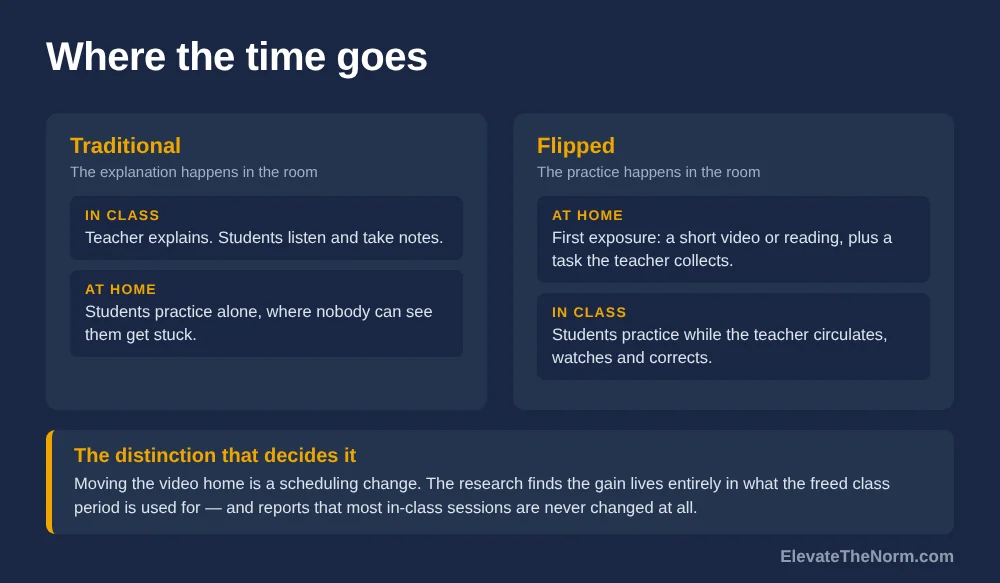
A flipped classroom is an arrangement where first exposure to new material happens before class, usually through a short video or reading, so class time can be used for the work students would otherwise have done alone. The lecture becomes the homework and the homework becomes the lesson.
The formal definition comes from The Flipped Learning Network, which published its four-pillar version in March 2014: flipped learning is an approach “in which direct instruction moves from the group learning space to the individual learning space.” The same organization draws a line that most people skip. “These terms are not interchangeable,” it says. “Flipping a class can, but does not necessarily, lead to Flipped Learning.”
That distinction is the whole argument in one sentence. Recording your lecture and assigning it is a change in scheduling. Whether anything improves depends entirely on what you do with the fifty minutes you just freed up, and the research below says most teachers do not change that part at all. One concrete answer to that question is splitting the period into stations students move through.
Who invented the flipped classroom?
Nobody cleanly. The term is usually credited to Jonathan Bergmann and Aaron Sams, two high school chemistry teachers who began recording lectures around 2007, but the practice predates the name by at least a decade.
a 2020 review of the research traces an earlier line: Lage, Platt and Treglia (2000), three economics professors, described an “inverted classroom” in a peer-reviewed journal in 2000, and Eric Mazur’s peer instruction at Harvard in the 1990s is described as “one of the earliest instances of flipped learning.” That same review calls Bergmann and Sams only “believed to be first,” which is the honest level of confidence. Both of those earlier efforts were with university students.
It matters less than it sounds, but it explains something. A practice named by classroom teachers and evidenced by university professors is going to have a research base that does not match the people using it, and that is exactly what happened.
Does the flipped classroom actually work?
Modestly, on average, in the settings where it has been tested most. The best-powered estimates land around a fifth to a third of a standard deviation on achievement, and shrink further when you correct for the studies that never got published.
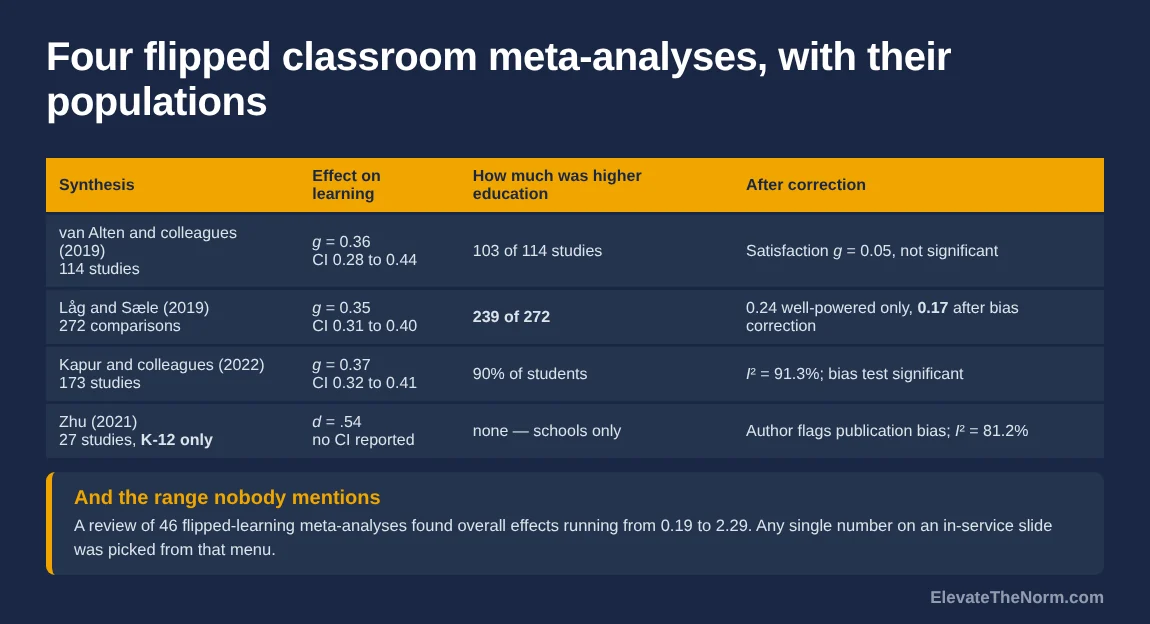
van Alten, Phielix, Janssen and Kester (2019) is the most quoted. Across 114 studies it found g = 0.36 on assessed learning outcomes, 95 percent confidence interval 0.28 to 0.44. Two things in it get left off the slide. Perceived learning was not significant, and student satisfaction came in at g = 0.05 with a confidence interval spanning zero — students did not enjoy it more. The authors call flipping “a promising pedagogical approach when appropriately designed,” which is a careful sentence doing careful work.
Låg and Sæle (2019) is the one to read if you want the number after the air comes out. The headline is g = 0.35 across 272 comparisons. Restrict it to adequately powered studies and it falls to 0.24. Adjust for publication bias and the estimate lands at g = 0.17. Satisfaction ran the same way: a small positive 0.16 that became −0.03 after the same correction. The authors are careful to note that the correction gives “approximate indications,” not a precise number, but the direction is unambiguous.
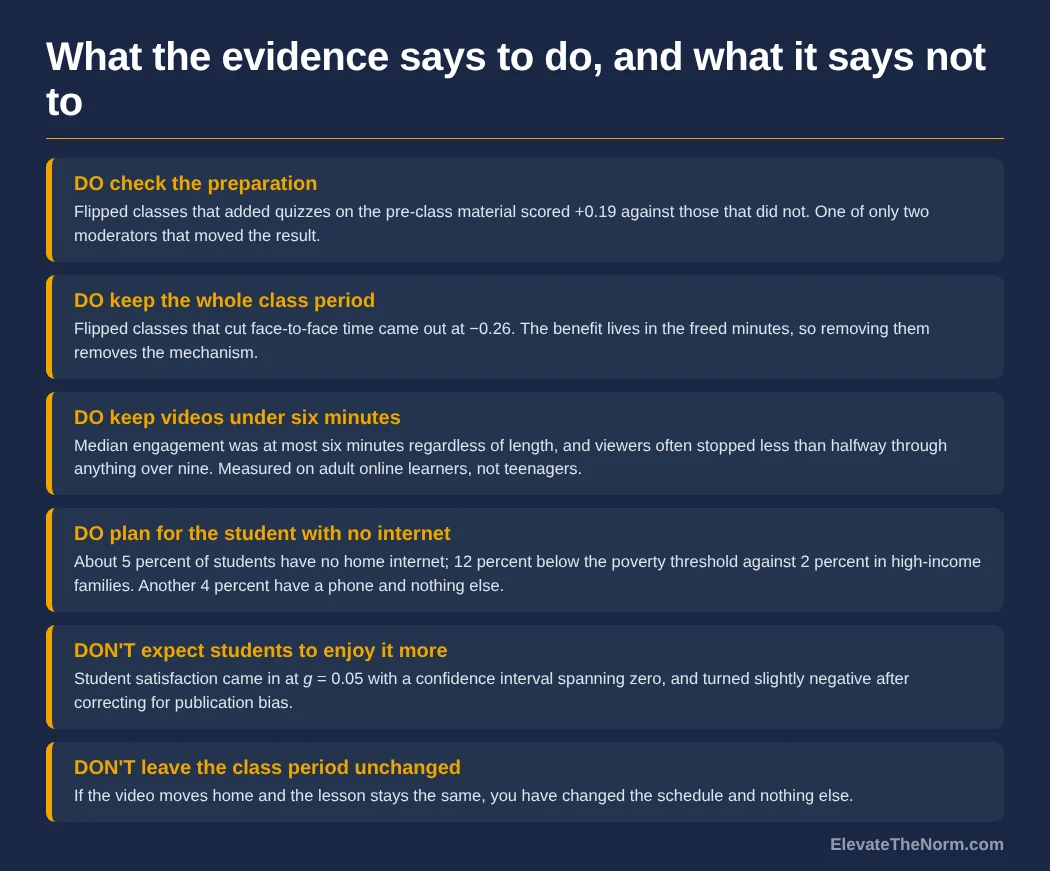
Two findings in van Alten, Phielix, Janssen and Kester (2019) are worth more to a working teacher than any of those effect sizes. Flipped classes where face-to-face time was reduced performed significantly worse, at −0.26. Flipped classes that added quizzes on the pre-class material performed better, at +0.19. In plain terms: if the plan is to flip so the class can meet less often, the evidence says do not. If you flip, check the preparation.
How much of the flipped classroom research is about teenagers?
Very little, and this is the single most important thing to know before quoting any of it in a secondary school. Three independent syntheses put the higher-education share at roughly 85 to 90 percent.
The numbers are specific. In Låg and Sæle (2019), the learning outcomes break down as 239 higher education, 20 secondary, 12 primary and one further education — and the pass-rate analysis, with 45 comparisons, contains zero school studies at all. In van Alten, Phielix, Janssen and Kester (2019), 11 of 114 studies were secondary. Kapur, Hattie, Grossman and Sinha (2022) states that “the majority of students were university-based (90%),” while reporting its effect sizes as 3 percent primary, 42 percent secondary and 55 percent higher education. Those two figures count different things, students versus effect sizes, and the paper gives both.
There is one meta-analysis built only on schools. Zhu (2021) pooled 53 effect sizes from 27 studies of K-12 students and reported a weighted average of d = .54 — larger than any of the higher-education estimates. Before anyone puts that on a slide, the author’s own analysis flags publication bias by funnel plot, trim-and-fill and Egger’s test, and heterogeneity sits at I² = 81.2 percent. Twenty-seven studies with an acknowledged bias problem is better than nothing and is not a settled answer.
One scale distinction belongs with those numbers. Nearly all of this research tests one teacher flipping one course, and almost none of it tests a school flipping everything. A building-wide flip is a different proposition: it multiplies the home-preparation load across every subject a student takes on the same evening, and no student’s evening was studied that way. A district deciding this at scale is making a decision the evidence base does not cover.
Lo and Hew’s review of K-12 flipped classrooms is the other school-specific piece, covering 15 published K-12 studies. Achievement results were neutral or positive against traditional classrooms, and student attitudes were mixed. That is a fair summary of where this sits for grades 6 through 12: probably not harmful, possibly helpful, not proven at the size the enthusiasm implies.
Why do the effect sizes disagree so much?
Because “flipped classroom” describes a schedule rather than a method, and because the syntheses pooling those studies have real methodological problems. The range across the literature is roughly twelvefold.
Kapur, Hattie, Grossman and Sinha (2022) reviewed 46 flipped-learning meta-analyses and reports: “We found the overall effects from 0.19 to 2.29.” Their own meta-analysis of 173 studies landed at g = 0.37, confidence interval 0.32 to 0.41, with I² = 91.27 percent and a statistically significant test for publication bias. An I² above 90 means the studies are not estimating one common effect, and pooling them produces an average of things that are not alike.
Hew, Bai, Dawson and Lo (2021) examined 19 of those meta-analyses, covering more than 495 primary studies, and found six elements “inadequately conducted or reported” across them: searching grey literature, assessing risk of bias, handling non-independent effect sizes, controlling for students’ initial differences, controlling for instructor equivalence, and assessing publication bias. Their conclusion is that positive evidence exists but there is “reason to question how this evidence has been synthesized.” Controlling for prior achievement and for who taught the class are not fine points. They are the two most obvious ways a flipped section could look better without the flipping doing anything.
There is also a content problem underneath the statistics. Kapur, Hattie, Grossman and Sinha (2022) observes that “most in-class sessions are not modified based on the flipped implementation.” If the video moves home and the class period stays the same, the study is measuring a scheduling change. That is roughly what one chemistry teacher told Education Week asked teachers who had tried it more than a decade ago, calling flipping “a time-shifting tool that is grounded in the same didactic, lecture-based philosophy.”
What happens when students don’t watch the video?
You teach the lesson twice, badly, to a split room. This is the failure mode every teacher who has tried it names first, and the evidence points at one specific fix: make the preparation produce something you collect.
The quiz moderator in van Alten, Phielix, Janssen and Kester (2019) is that fix with a number attached: +0.19 for flipped classes that added quizzes on the pre-class material, across 36 of 114 studies. It is the difference between assigning a video and assigning a task. Three or four questions that take two minutes and that you can see before the bell is enough, which is also the difference between a check and a grade in practice.
The honest reports from practitioners are blunter. In Education Week asked teachers who had tried it, an instructional coach described students who “may have been in class, but they weren’t engaged,” and said that for some, “self-paced became no pace,” so teachers had to put deadlines back. Another teacher put it plainly: “Just because you flipped your classroom doesn’t mean your students will watch the videos.”
Tell families what you are doing before they work it out from their kitchen table. From outside, “my child watches videos for homework and does worksheets in class” sounds exactly like a teacher who stopped teaching. Two sentences in a syllabus or an email — the explanation moved home so the practice could happen where I can help — prevents a conversation that is otherwise very hard to have in March.
Two practical consequences follow. Plan the first ten minutes so the room works whether or not everyone prepared — a short recap station, a partner summary, something like earning the first five minutes of the period — rather than opening with a task that assumes compliance. And decide in advance what happens to the student who did not watch it, because that is a policy question, not a mood. If the answer is a zero, you are back to a late work policy you can actually defend and all its problems.
What about students without reliable internet at home?
It is a smaller problem than it was and it is not solved, and the answer depends on which students you teach. Federal data put about 5 percent of students in homes with no internet access at all, rising to 12 percent for students below the poverty threshold.
the federal figures on rural students and the internet give the most useful breakdown for school-age students: roughly 2.4 million students, about 5 percent, lived in homes without internet access. Seven percent of students in rural areas and 11 percent in remote rural areas were without it. Fixed broadband at home reached 82 percent of students overall, 76 percent in rural areas. The poverty gap is the number that should decide your planning: 12 percent of students below the poverty threshold had no home internet against 2 percent of students in high-income families, and among rural students fixed broadband ran 57 percent for low-income families against 82 percent for high-income ones.
A caution about any single figure here. the federal data on children’s home internet access reports 97 percent of 3- to 18-year-olds with home internet in 2021 and 3 percent without — but notes on the same page that a different federal survey put the no-access figure at 12 percent, because the two surveys define internet access differently. Report both or neither. And note that 4 percent had access only through a smartphone, which is access in the survey and not access for watching a ten-minute video and taking notes, something worth holding alongside what the research says about phones in class.
a Pew Research Center survey of teenagers found that 17 percent of teens were at least sometimes unable to finish homework because they lacked reliable computer or internet access, and 35 percent sometimes did homework on a cellphone, rising to 45 percent in households under $30,000. Those figures are from 2018 and pre-date the pandemic push on connectivity, so treat them as the shape of the problem rather than its current size. The practical move is cheap either way: ask the class, on paper, how they would watch something tonight, and build the fallback before you need it.
How long should a flipped classroom video be?
Short. Under six minutes if you can, and never longer than about nine. The most-cited evidence for this comes from online adult learners rather than teenagers, which is worth knowing before you treat it as a law.
Guo, Kim and Rubin (2014) analyzed 862 videos and nearly 6.9 million viewing sessions and found that “video length was by far the most significant indicator of engagement.” Median engagement time was “at most 6 minutes, regardless of total video length,” and students “often make it less than halfway through videos longer than 9 minutes.” The rate at which viewers went on to attempt the associated problems fell steadily with length: 56 percent for the shortest videos, then 48, 43, 41 and 31 percent for the longest. The recommendation is explicit: segment into chunks “ideally less than 6 minutes.”
Prep time is the honest cost, and the one figure available is a 2013 survey of 309 college faculty, in which 75 percent said preparing a flipped class takes more time than a traditional one. That sample was self-selected, from 2013, and made up of college instructors rather than school teachers, so treat it as a direction rather than a measurement. The thing that makes the cost bearable is the one nobody mentions: a six-minute explanation of how to balance an equation does not expire. You pay the recording cost once and spend it every year, which is why flipping your most-repeated lesson is better economics than flipping your most interesting one.
The population caveat is not a technicality. Those were edX learners — self-selected adults with no attendance obligation and nothing at stake if they close the tab — and the measure was voluntary watch time, not learning. Your students have different incentives in both directions. Take the six-minute figure as a sensible default, not a finding about teenagers.
Two other findings from the same study survive translation. Videos made for the purpose beat chopped-up recordings of live lectures, 55 percent against 41 percent on problem attempts, so recording your actual class period is the weakest version of this. And informal, close-up delivery beat studio production, which is good news for anyone recording at a kitchen table. On design, Richard Mayer’s own summary of the multimedia research reports segmenting a lesson into shorter learner-paced parts at a median d of 0.67 across its tests, while two of the moves teachers reach for first come out near zero: putting your on-screen text alongside your own narration sits at 0.10, and showing your face on screen at 0.20. Mayer notes himself that “most of our research has not targeted special populations” and calls for more work in real classrooms.


How do you flip one lesson?
Pick the lesson where you spend the most time talking and the least time watching students work. Flip that one, keep everything else, and judge it on what you could see during the period rather than on whether it felt modern.
- Choose a lesson that is mostly explanation. A procedure, a vocabulary set, a background-knowledge lecture. Do not flip the lesson that depends on discussion — you would be moving the good part home.
- Make the video under six minutes, or find one. Khan Academy says its library is “always free,” and your own three-minute recording beats a polished twelve-minute one. Record for the purpose rather than filming your class period.
- Attach a task that produces something you collect — and subtract the old homework. Three questions, a one-sentence summary, one thing they did not follow. This is the moderator with evidence behind it. But say the swap out loud, because from a desk this reads as an addition: students who used to watch nothing and do problems at home now watch a video, answer questions, and do the problems. If the old assignment does not actually come off the list, you have not flipped anything, you have added a second homework. Edpuzzle’s free plan caps the free plan at 20 saved activities and will embed questions in a video; a paper half-sheet does the same job for nothing.
- Decide the no-access and no-watch plan before you assign it. A transcript on paper, a lunch viewing, or a five-minute recap station at the start. Not every student has watchable internet at home and some are on a phone. Keep the consequence off the gradebook: a student whose wifi failed is not a student who refused, and the two are indistinguishable from the front of the room. Grading that difference means grading household income.
- Read the collected task before the bell and group the room with it. The quiz is only worth the moderator it earned if it changes the next fifty minutes. Three piles — got it, shaky, did not prepare — take two minutes to sort and tell you exactly who to start with. Collecting data you do not act on is the most common way this step gets hollowed out.
- Plan the class period as practice you can see. This is the step that decides whether anything improves. Work in pairs you circulate through, problems you watch them attempt, and real time spent letting students wrestle with something before you rescue them. If the period is still a lecture, you have moved a video and changed nothing.
- Do not shorten the class. The one moderator that came out negative was cutting face-to-face time. The freed minutes belong to practice, not to the calendar.
- Judge it on one question. Did you see more of their thinking than you usually do? If yes, flip the next lesson of that type. If no, the problem is the class period, not the video.
Can you flip a classroom without videos or technology?
Yes, and for many classes it is the better version. Nothing in the definition requires video. It requires that first exposure happen before class, which a reading, a one-page primer or a short problem set does equally well.
The Flipped Learning Network’s own wording is about where direct instruction happens, not what format carries it. A two-page excerpt with four margin questions is a flipped lesson. So is a diagram students annotate before they arrive. Paper also removes the access problem in one move, which is why it is often the right call in a building where home connectivity is uneven.
One thing has changed since most of this research was done, and it argues for paper rather than against preparation. students are already using AI on work you send home, and a take-home task whose output is a paragraph is now a task a chatbot can finish in seconds. A preparation task that asks for a question the student still has, or a prediction they will test in class, is both harder to outsource and more useful to you when the period starts.
Clay’s take
The flipped classroom is a decent idea carrying a reputation it did not earn, and the part worth keeping is not the video.
The genuinely good argument for flipping has nothing to do with technology. It is that watching students practice is the most useful thing a teacher does with a class period, and most schedules spend that period on the thing a recording could do instead. If flipping one lesson gets you from talking for thirty minutes to circulating for thirty, that is a real improvement whether the effect size is 0.17 or 0.54.
What does not hold up is the version sold in an in-service, where a single large number appears on a slide with no mention that nine of ten studies behind it were run on college students who chose to be there. Teenagers at eight in the morning are a different population with different incentives, and a model that depends on unsupervised preparation is a model that depends hardest on the students with the least support at home. That is worth saying out loud before a department commits to it.
So flip selectively and keep the class time. The evidence’s clearest instruction is the one nobody repeats: do not use this to meet less. Everything good about the approach lives in the period you freed up, and if you spend that period the way you spent it before, you have given your students homework and yourself a recording project. The same restraint belongs in the homework policy itself, which holds up better when it sets how often you assign rather than how many minutes it should take.
What to do next
Flip one lesson this month. Not a unit and not a semester — one lesson, the one where you talk the most.
Keep the video under six minutes, attach three questions you actually collect, and write down beforehand what happens for the student with no internet and the student who simply didn’t watch it. Then spend the whole period watching them work, and judge the experiment on whether you saw more of their thinking than usual. That is the only measure that matters here, and it is one you can read the same day.
Frequently Asked Questions
What is the flipped classroom model?
It is an arrangement where first exposure to new material happens before class, usually through a short video or reading, so class time can be spent on practice the teacher can observe. The Flipped Learning Network defines it as direct instruction moving from the group learning space to the individual learning space. Flipping a class does not automatically produce flipped learning.
Does the flipped classroom improve test scores?
On average, a little. The largest meta-analyses report effects around 0.35 of a standard deviation, falling to roughly 0.17 to 0.24 once underpowered studies and publication bias are accounted for. One meta-analysis built only on K-12 students reported a larger average of 0.54, but its own author flags publication bias in that set.
Is the flipped classroom research based on high school students?
Mostly not. Across the major syntheses, roughly 85 to 90 percent of the evidence comes from higher education. One review found 239 of 272 learning comparisons were university-based against 20 from secondary schools, and its pass-rate analysis contained no school studies at all. Quote those numbers with the population attached.
What do you do when students don’t watch the video?
Attach a short task to the preparation that you collect, and plan an opening that works for a split room. Adding quizzes on the pre-class material was one of only two moderators that significantly improved outcomes in a 114-study meta-analysis. Decide in advance what happens for the student who did not prepare, rather than improvising it.
How long should a flipped lesson video be?
Under six minutes where possible, and under nine at most. In an analysis of 862 videos and almost 6.9 million viewing sessions, median engagement was at most six minutes regardless of video length, and viewers often stopped less than halfway through videos over nine minutes. That study measured adult online learners, not teenagers.
Can you flip a classroom without technology?
Yes. The definition concerns where direct instruction happens, not what carries it. A two-page reading with margin questions, an annotated diagram or a short primer all move first exposure before class. Paper also removes the home-internet problem entirely, which matters most in schools where connectivity is uneven.
What are the main drawbacks of a flipped classroom?
Students not preparing, unequal access to devices and internet at home, and the preparation time it costs the teacher. In a survey of 309 college faculty, 75 percent said preparing a flipped class takes more time than a traditional one. The deeper risk is flipping the video but leaving the class period unchanged.
Does flipping let a school reduce class time?
The evidence says the opposite. In a meta-analysis of 114 studies, flipped classes that reduced face-to-face time performed significantly worse than their comparison groups, at an estimate of negative 0.26. The benefit of the model lives in what the freed class time is used for, so removing that time removes the mechanism.
Sources
- Flipped Learning Network (2014). Definition of Flipped Learning. Page. Source of the March 2014 release, the four pillars, and the statement that flipping a class does not necessarily lead to flipped learning. The full definition sentence was read on a separately hosted copy of the network’s handout.
- Hutton, A. (2020). The Efficacy of the Flipped Classroom Technique in Undergraduate Math Education: A Review of the Research. arXiv:2010.11393. Full text. Source of the origin history, including Mazur’s peer instruction and the hedged attribution to Bergmann and Sams. Used as a review describing those earlier works, not as a primary account of them.
- Lage, M. J., Platt, G. J., and Treglia, M. (2000). Inverting the Classroom: A Gateway to Creating an Inclusive Learning Environment. The Journal of Economic Education, 31(1), 30–43. Bibliographic record. Citation verified on a bibliographic record only; the paper itself was not reachable, so no claim about its contents is made here beyond what the review above reports.
- van Alten, D. C. D., Phielix, C., Janssen, J., and Kester, L. (2019). Effects of flipping the classroom on learning outcomes and satisfaction: A meta-analysis. Educational Research Review, 28, 100281. Full text. Source of g = 0.36, the null satisfaction result, the negative class-time moderator and the positive quiz moderator. 114 studies, of which 11 were secondary education.
- Låg, T., and Sæle, R. G. (2019). Does the Flipped Classroom Improve Student Learning and Satisfaction? A Systematic Review and Meta-Analysis. AERA Open, 5(3). Full text. Source of the 0.35, 0.24 and 0.17 progression, the satisfaction reversal, and the education-level table showing 239 of 272 learning comparisons in higher education. The authors describe their bias correction as approximate.
- Zhu, G. (2021). Is flipping effective? A meta-analysis of the effect of flipped instruction on K-12 students’ academic achievement. Educational Technology Research and Development, 69(2), 733–761. Institutional record. The only K-12-only meta-analysis found. Source of d = .54 from 53 effect sizes across 27 studies, the publication-bias flags and I² = 81.2 percent. Read on the author’s university record because the publisher’s page was not reachable; no confidence interval is quoted because none appears there.
- Kapur, M., Hattie, J., Grossman, I., and Sinha, T. (2022). Fail, flip, fix, and feed: Rethinking flipped learning. Frontiers in Education, 7, 956416. Full text. Source of the 0.19 to 2.29 range across 46 meta-analyses, the authors’ own g = 0.37, I² = 91.27 percent, the publication-bias test, the 90 percent university figure and the observation that most in-class sessions are not modified. The paper’s separate comparison of in-class active learning contains an internal inconsistency and is not used here.
- Hew, K. F., Bai, S., Dawson, P., and Lo, C. K. (2021). Meta-analyses of flipped classroom studies: A review of methodology. Educational Research Review, 33, 100393. Institutional record. Source of the 19 meta-analyses, the 495-plus primary studies, the 0.19 to 1.13 cognitive range and the six inadequately handled methodological elements. Read on institutional records; the full text was not reachable.
- Lo, C. K., and Hew, K. F. (2017). A critical review of flipped classroom challenges in K-12 education. Research and Practice in Technology Enhanced Learning, 12. Record. Source of the 15 K-12 publications, the neutral-or-positive achievement finding and the mixed attitudes. Abstract only; the full text was not reachable, so no specific challenge figures are attributed to it.
- National Center for Education Statistics. Rural Students’ Access to the Internet. Indicator. 2019 American Community Survey data on 5- to 17-year-old students. Source of the 5 percent, 7 percent rural, 11 percent remote rural, 82 and 76 percent broadband, and the 12-versus-2 percent poverty gap.
- National Center for Education Statistics. Children’s Internet Access at Home. Indicator. 2021 data on 3- to 18-year-olds. Source of the 97 percent, the 4 percent smartphone-only figure, and the page’s own note that a second federal survey put no-access at 12 percent rather than 3 percent because the surveys define access differently.
- Pew Research Center (2018). Nearly one-in-five teens can’t always finish their homework because of the digital divide. Report. Survey of 743 U.S. teens aged 13 to 17, fielded spring 2018. Source of the 17 percent, 35 percent and 45 percent figures. Pre-pandemic data; no more recent Pew survey on this question was found.
- Ash, K. (2012). Educators Evaluate ‘Flipped Classrooms’. Education Week. Article. Source of the practitioner quotations on students not watching, “self-paced became no pace,” and flipping as a time-shifting tool. Journalism rather than research, and quoted as such.
- Reich, J. (2013). Flipping the New York Times. Education Week opinion. Article. Read for its caveats on the widely circulated schoolwide-flip turnaround story, including that the reported gains were internal markers and that enrollment shifted substantially over the same period. No failure-rate figure from that story is repeated here, because no peer-reviewed evaluation of it was found.
- Faculty Focus (2013). Survey Confirms Growth of the Flipped Classroom. Report. Source of the 75 percent preparation-time figure. 309 higher education faculty, a self-selected 2013 sample whose publisher states the results cannot be projected to the whole population. It is the only quantified preparation-time figure found, and it is not about school teachers.
- Guo, P. J., Kim, J., and Rubin, R. (2014). How Video Production Affects Student Engagement: An Empirical Study of MOOC Videos. Proceedings of Learning at Scale 2014. Full text. Source of the six-minute median, the nine-minute drop-off, the problem-attempt percentages and the purpose-made-versus-recorded comparison. Population: 127,839 edX learners across 862 videos — self-selected adult online learners, and the outcome is voluntary watch time, not learning.
- Mayer, R. E. The Future of Multimedia Learning. Journal of Applied Instructional Design, 11(4). Full text. Source of the median effect sizes by principle, including segmenting at 0.67, redundancy at 0.10 and image at 0.20, and of Mayer’s own statement that most of the research has not targeted special populations. The page gives no publication year and reports one principle’s median differently in two places.
- Edpuzzle. What does Edpuzzle cost? Help center. Source of the free plan’s 20-activity limit. No price is quoted for any paid tier because none appears on the vendor pages that could be read.
- Khan Academy. Does it cost money to use Khan Academy? Help center. Source of the statement that learning at Khan Academy is always free.
- Google. Education editions FAQ. Admin knowledge site. Source of the statement that Education Fundamentals is available at no cost for qualifying institutions. The page does not define qualifying institutions and lists no prices for the paid editions.