By Clay Shumate
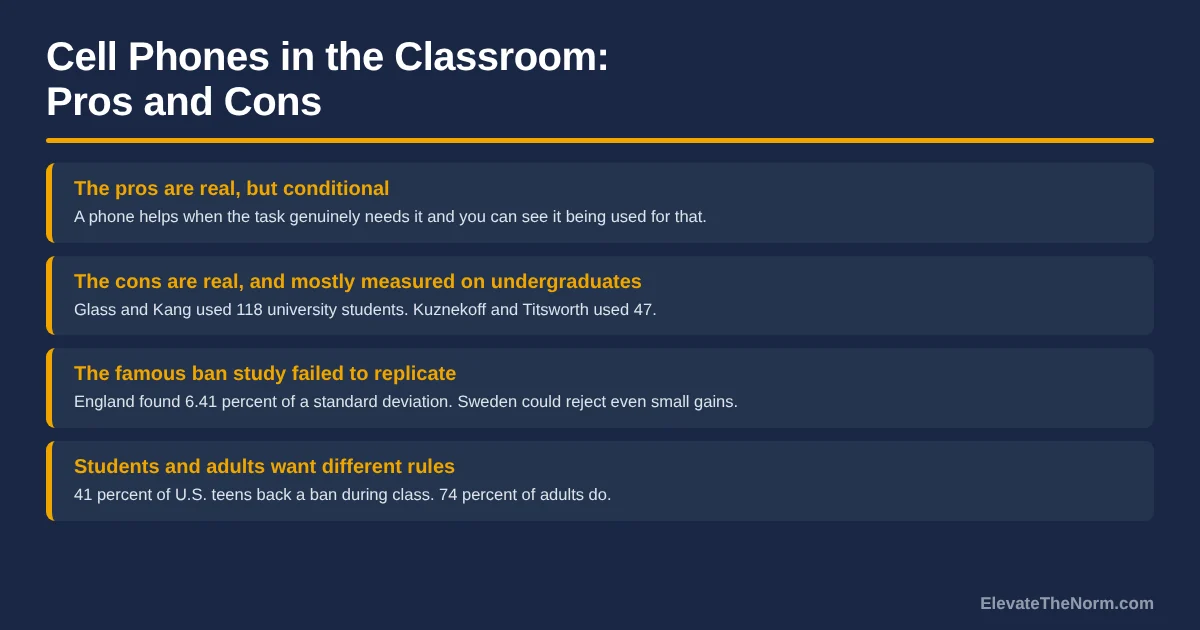
The honest case on cell phones in the classroom pros and cons is this: phones cost attention in measurable ways, and phones are a real tool when a teacher structures the task. The distraction evidence is strong but mostly drawn from college students, and the famous study showing bans raise test scores failed to replicate in Sweden.
Key Takeaways
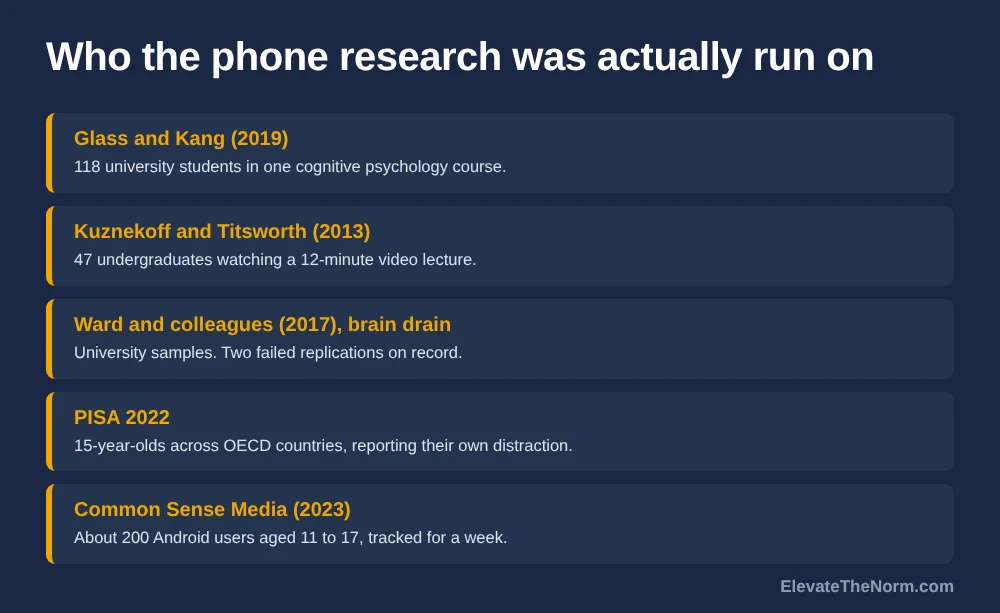
- Most of the headline research on phones and attention was run on university undergraduates, not teenagers. Glass and Kang’s classroom experiment used 118 Rutgers students; Kuznekoff and Titsworth’s used 47.
- Beland and Murphy found that English school phone bans raised test scores by 6.41 percent of a standard deviation, and by 14.23 percent for the lowest-achieving quartile. Kessel, Hardardottir and Tyrefors ran the same design across 1,086 Swedish schools and found nothing.
- PISA 2022 found that 65 percent of students across OECD countries reported being distracted by their own digital devices in at least some math lessons, and students distracted by other students’ devices scored 15 points lower in math.
- Teenagers and adults want different policies. Forty-one percent of U.S. teens support banning phones during class against 74 percent of adults, and only 17 percent of teens support an all-day ban.
- The widely repeated “brain drain” finding, that a phone sitting on the desk drains working memory even when it is off, has two failed replications on record.
A classroom phone policy is a standing rule about where student phones are and when they come out, plus the specific thing the teacher does when the rule gets broken. That second half is the part most policies skip, and it decides whether the first half means anything. What follows is the research on both sides, populations named and failures included, because this argument is unusually full of numbers that fall apart when you open the paper they came from.
What are the pros and cons of cell phones in the classroom?
The main pro is capability: nearly every student carries a camera, dictionary, translator, timer and polling device. The main con is attention cost, and it falls hardest on students who are already struggling. Both are real. Which one wins depends almost entirely on how the task is structured.
Here is the whole argument on one screen. Every row in this table comes from a source linked further down this page.
| What’s at stake | The case for phones | The case against | What actually decides it |
|---|---|---|---|
| Attention | Short, assigned device tasks can be visibly on-task and easy to check | Divided attention lowered end-of-term exam scores by at least 5 percent in Glass and Kang’s classroom experiment, and non-users in the same room did worse too | Whether the phone has a job, and whether you can see it being done |
| Achievement gap | Lower-attaining students are often the ones who need a translator or a read-aloud tool | Beland and Murphy’s gains from banning phones were concentrated in the lowest-achieving quartile, at 14.23 percent of a standard deviation | Whether the student can use the tool without the tool using them |
| Access and equity | 95 percent of U.S. teens have or can access a smartphone; 88 percent have a desktop or laptop | A phone-dependent task still excludes some students, and usually the same ones twice | Whether you have a non-phone route to the same task |
| Assessment | Phone polling gives you a whole-class answer in forty seconds | Glass and Kang found devices made no difference to in-lecture checks and still damaged the exam, so the fast feedback can look fine while retention drops | Whether you are measuring recall now or learning later |
| Accessibility | Text-to-speech, captions, translation and reminders are already on the device the student owns | A blanket ban can quietly strip a tool a student is entitled to use | Whether approved accommodations are written into the policy as exceptions |
| Safety | Families want to reach their child directly | The National Association of School Resource Officers argues phones during a crisis divert students from instructions and can reveal students hiding in silence | Whether the school has a tested way to reach families without the student’s phone |
| Enforcement cost | A clear, narrow rule is cheap to hold | Sixty percent of U.S. high school teachers in schools with a phone policy say enforcement is very or somewhat difficult | Whether you will do the same thing every time, including Friday afternoon |
What does the research actually say about phones and learning?
The strongest classroom evidence is a Rutgers experiment by Arnold Glass and Mengxue Kang. Across one term of their own cognitive psychology course, 118 students had devices banned in half the lectures. Devices made no difference to in-lecture comprehension tests, and lowered end-of-term exam scores by at least 5 percent.
That gap between the two measures is the most useful finding in this whole literature and almost nobody repeats it. A phone did not stop students answering questions about the thing they had just heard. It stopped them remembering it weeks later. If you check for understanding at the end of the period and everything looks fine, your check is not sensitive enough to find this problem. The same gap shows up when reading moves to screens: comprehension in the moment is not a measurement of retention later.
The second finding is the uncomfortable one. Students who chose not to use a device during the device-permitted lectures also performed worse than they did in the device-free lectures, which Glass and Kang read as device use damaging the shared learning environment rather than only the user. One caution, stated plainly: these were 118 university students in one course, and the “first causal classroom evidence” framing came from a Rutgers press release, not an independent review.
Kuznekoff and Titsworth (2013) is the study behind the “a letter grade and a half” line you have probably seen. Forty-seven students watched a twelve-minute video lecture while a survey tool pushed simulated texts at them every thirty or sixty seconds. The high-distraction group wrote down 62 percent less detail and scored about 66 percent against 52 percent on a multiple-choice test. Three things about it are worth knowing before you quote it: the sample was 47 undergraduates, the low-distraction condition produced no significant difference at all, and the paper contradicts itself on the headline figure, describing the gap as “over one full letter grade, or roughly 13 percentage points” in the discussion and “a letter grade and a half” in the abstract.
At scale, PISA 2022 asked students directly. Across OECD countries, 65 percent said they were distracted by their own digital devices in at least some math lessons and 59 percent said they were distracted by other students’ devices, and that second group scored 15 points lower in math than students who said it never or almost never happened. That is a correlation on self-reported distraction, not a causal estimate, and it is still 15 points.
And the one data set here that is genuinely about teenagers rather than college students: Common Sense Media tracked about 200 Android users aged 11 to 17 for a week. More than half received 237 or more notifications a day, roughly 23 percent of them arriving during school hours, and the median participant spent 43 minutes on the phone during the school day. Some spent over six hours.
Do school phone bans raise test scores?
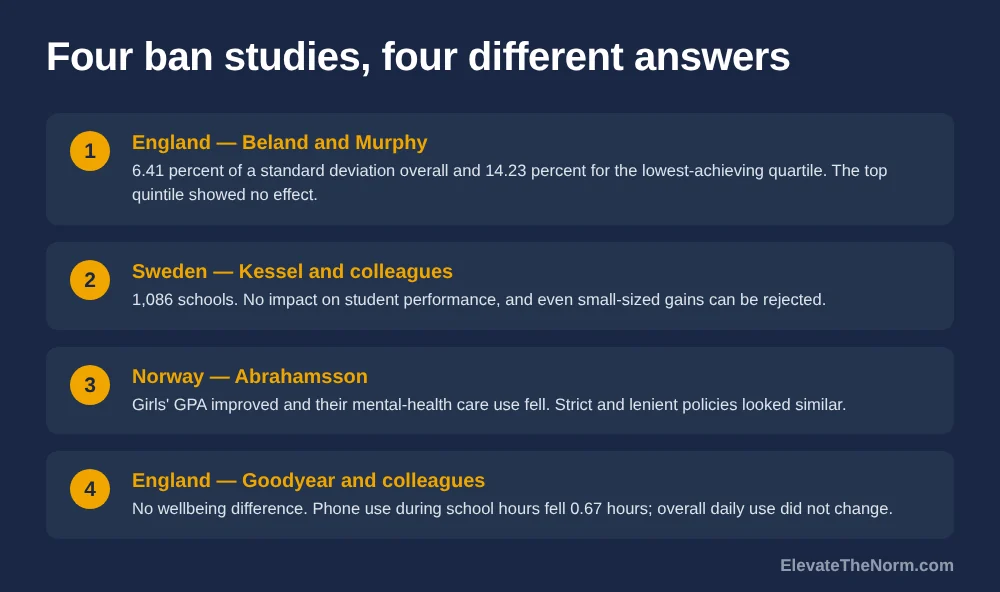
Sometimes, in some countries, for some students, and the most famous result did not replicate. Beland and Murphy found a gain of 6.41 percent of a standard deviation in England. Kessel, Hardardottir and Tyrefors ran essentially the same design in Sweden and reported that they could reject even small gains.
Beland and Murphy’s “Ill Communication” is the paper behind almost every “banning phones raises results by 14 percent” headline. It surveyed high schools in Birmingham, Leicester, London and Manchester, got 91 responses, and used the staggered timing of each school’s own ban as a natural experiment. Average gain: 6.41 percent of a standard deviation. Lowest prior-achievement quartile: 14.23 percent. Those are the two numbers everybody repeats.
Here is what gets left out. The top achievement quintile showed no effect either way. Bans with low reported compliance showed no effect. The age-14 results were smaller and not significant. The 91 schools were a 21 percent response rate, the authors acknowledge that asking headteachers to recall ban dates “is open to recall bias,” and they state outright that they “do not know which individuals owned mobile phones.”
Then Sweden. Kessel, Hardardottir and Tyrefors ran the same staggered difference-in-differences design over Swedish grade 9 outcomes from 1997/98 to 2017/18, with ban status collected for 1,086 schools, a 76 percent response rate from the full national population rather than four cities. Their estimates on merit points ran from −0.034 to −0.042 standard deviations and were mostly insignificant. Their math test estimates were around −0.02 to −0.03 and insignificant. Event-study plots showed no pre-trends and no post-ban effect. Their own summary: “we find no impact of mobile phone bans on student performance and can reject even small-sized gains,” and they conclude the English result “is not transferable to Sweden.” The FORRT replication atlas records this as a failed replication.
Abrahamsson’s Norwegian study (2024) is the strongest recent evidence on the other side, and it is narrower than its coverage suggested. Using administrative data and an event-study design on middle-school ban dates, she found that bans lowered girls’ use of health care for psychological symptoms, improved girls’ GPA, raised their likelihood of entering an academic high school track, and reduced bullying for both genders, with larger effects for girls from low socioeconomic backgrounds. Reading the same paper, Tyler Cowen noted that mental-health outcomes were similar under strict and lenient policies and that diagnoses did not shift after implementation, which is not what you would expect if a ban were doing the heavy lifting.
And the newest study points the other way again. Goodyear and colleagues’ SMART Schools study (2025) surveyed 1,227 adolescents aged 12 to 15 across 30 English secondary schools, 20 with restrictive policies and 10 permissive. Mental wellbeing showed no difference between groups (adjusted mean difference −0.48, 95% CI −2.05 to 1.06, p = 0.62). Restrictive schools did show lower phone use during school hours, by 0.67 hours, and lower social media use during school hours, but no difference in overall daily use. The authors concluded their findings “do not support restrictive policies that prohibit phone use during the school day in their current form.”
That study has been read as proof that bans do not work, and it does not support that either. It is cross-sectional, comparing different schools rather than the same school before and after, and the team’s own project newsletter notes that 45 percent of the “restrictive” schools allowed phones for educational purposes with teacher permission. Twenty partly-restrictive schools against ten permissive ones is a weaker test than the headline implies.
Is the “brain drain” effect real?
Probably weaker than you have heard. Ward, Duke, Gneezy and Bos reported in 2017 that a phone sitting on the desk reduced available working memory. Two later attempts failed to find it: a direct replication by Ruiz Pardo and Minda, and a 302-person study at the University of Bern.
The original travelled fast because it flatters an intuition every teacher already has. Participants whose phones were in another room beat participants whose phones were on the desk, and whether the phone was on or off, face up or face down, made no difference at all. That last detail should have prompted more caution than it did.
The FORRT replication atlas lists two attempts by Ruiz Pardo and Minda, in 2021 as a preprint and in 2022 in Acta Psychologica, and records both as failed, finding no difference between phone-location conditions. A separate Bern team ran 302 participants with a mean age of about 22, half with the phone on the desk and half across the room, and found no overall effect on short-term or prospective memory. The one signal they did find — worse prospective memory with a visible phone among participants low in smartphone dependence — they describe as unexpected and based on limited data.
So do not build a classroom policy on brain drain. Build it on the thing you can actually see, which is what the student is doing with the phone, not what the phone is theoretically doing to the student.
When is a phone the right tool in a grades 6–12 classroom?
When the phone does something the task genuinely needs, and when you can see whether it is being used for that. Sung, Chang and Liu’s meta-analysis of 110 studies found a mean effect size of 0.523 for integrating mobile devices into teaching. The operative word is integrating, not permitting.
That meta-analysis covers 110 experimental and quasi-experimental studies published between 1993 and 2013, which means a large share of it predates the smartphone as teenagers now use it and much of it sits outside grades 6–12. It is good evidence that teacher-designed mobile-device instruction works. It is not evidence that leaving phones on desks works. Those are different interventions and the research only speaks to one of them.
The jobs a phone does genuinely well in a secondary classroom are narrow and worth naming:
- Evidence capture. A photograph of a lab setup, a whiteboard, a build in progress, or a draft at the halfway point. This is the one I would defend hardest, because the alternative is usually nothing.
- Translation and read-aloud. For a multilingual student or a student with a reading accommodation, the device in their pocket is often better than anything the building owns.
- A timer that students control. Handing a group its own clock changes who is responsible for the pace, which is the whole point of giving students real autonomy without losing the room.
- Whole-class retrieval checks. Forty seconds to see every answer in the room. Just remember Glass and Kang: a clean in-the-moment check is not proof of retention.
On access the numbers are better than people assume and still not universal. Pew surveyed 1,391 U.S. teens in late 2024 and found 95 percent have or can access a smartphone and 88 percent a desktop or laptop. A phone-dependent task reaches nearly everybody, “nearly” is doing real work in that sentence, and the students it misses are usually the ones a second problem already landed on. Build the non-phone route first and the phone route as the faster option.
Worth noting who makes this point: Beland and Murphy themselves. At the end of the paper most often used to argue for bans, they write that their findings “do not discount the possibility that mobile phones could be a useful learning tool if their use is properly structured.”
What do teachers and students actually say they want?
They disagree, and not where you would guess. Pew found that 72 percent of U.S. high school teachers call cellphone distraction a major problem in their classroom, while only 41 percent of teens support banning phones during class and just 17 percent support an all-day ban.
Pew’s fall 2023 survey of U.S. public K–12 teachers found the problem is almost entirely a secondary-school problem: 72 percent of high school teachers called distraction a major problem, against 33 percent of middle school teachers and 6 percent of elementary teachers. Eighty-two percent of K–12 teachers said their school or district has a cellphone policy, 71 percent among high school teachers, and 60 percent of high school teachers in schools with a policy said enforcing it is very or somewhat difficult.
On the student side, Pew surveyed 1,458 U.S. teens aged 13 to 17 between September 25 and October 9, 2025. Forty-one percent supported a ban during class, 51 percent opposed it, and 9 percent were unsure. For an all-day ban, 17 percent supported and 73 percent opposed. The comparable adult figures from June 2025 were 74 percent and 44 percent.
The teen numbers are the ones I find most useful, and the gap between 41 and 17 is the reason. Students are not mainly defending a right to scroll during a lesson. They are defending lunch, the hallway and the bus. That is a negotiable position rather than a discipline problem, and treating it as one is both the respectful move and the accurate one. Read a policy aloud as “you cannot handle this” and you get the fight that framing earns. Read it as “during the lesson the phone has no job, and here is when it does” and you are describing a schedule, which teenagers accept constantly.


What about emergencies? Don’t students need phones for safety?
School safety professionals argue close to the opposite. The National Association of School Resource Officers came out for bell-to-bell bans in October 2025, arguing that phones during a crisis divert students from instructions, that screen light and sound can reveal students hiding, and that parent surges block responders.
NASRO’s statement also names network strain during an incident and the risk of law enforcement mistaking an arriving parent for an assailant, and on ordinary days it argues phone access fuels social media conflict and makes fights easier to arrange. It asks schools to create and test emergency communication plans that get official information to families early.
Say clearly what that is and is not. It is a professional association’s position statement, not a study. There is no trial of student phone access during school emergencies and there is not going to be one. But it is the most relevant expert judgment on the record, it comes from the people who run the drills, and it runs directly against the intuition most parents and most students start from. A phone policy that does not say how a parent reaches their child in a real emergency deserves every objection it gets, so write that part down.
One distinction worth holding onto before a district-level conversation: a system-wide ban and a classroom rule are not the same decision and they do not rest on the same evidence. A district ban rests on the ban literature above, which disagrees with itself across England, Sweden, Norway and England again. A classroom rule rests on what a teacher can see and hold in one room, which is better supported and much cheaper to reverse. Decide the second one regardless of how the first one goes.
Policy is moving fast underneath all of this. A policy review of all 50 states and the District of Columbia led by Y. Tony Yang of George Washington University, published in JAMA Pediatrics and summarized by Deseret News, which is the version I read rather than the paper, counted 42 states with statewide restrictions: 32 banning phones during instructional time, 15 of those bell-to-bell, and the rest requiring or encouraging district-level policies.
Where does the evidence run out?
In five specific places, and they matter more than any number above. If someone tells you the phone question is settled, one of these is what they are stepping over.
- There is no randomized trial of phone policy in a U.S. secondary school. Every estimate above is either a natural experiment on school-level policy dates or a correlation. Both are real evidence and neither is a trial.
- Nearly all the mechanism research is on undergraduates. Glass and Kang used 118 university students, Kuznekoff and Titsworth 47, and the brain-drain literature and its replications are university samples throughout. A nineteen-year-old in an elective lecture is not a fourteen-year-old in a required course.
- Ban studies measure policy, not behavior. Beland and Murphy state they do not know which individual students owned phones. A school-level ban date is a blunt instrument standing in for what actually happened in the rooms.
- The mental-health question is genuinely open. Abrahamsson found gains for girls, Goodyear found no wellbeing difference, and the honest reading of both together is that we do not know.
- Nothing in this literature tells you what to do at 10:14 on a Tuesday with one student and one phone. Classroom-level enforcement is where every policy in the world succeeds or fails, and it is almost entirely unstudied. That is the gap that matters most to a teacher and the one the research is quietest about.
How do I write a phone policy my room can actually hold?
Write a rule you will enforce every single time, name where the phone goes, name exactly what you will do when it comes out, and then do that thing without a speech. A rule you hold on Tuesday and ignore on Friday teaches the room that your word is weather.
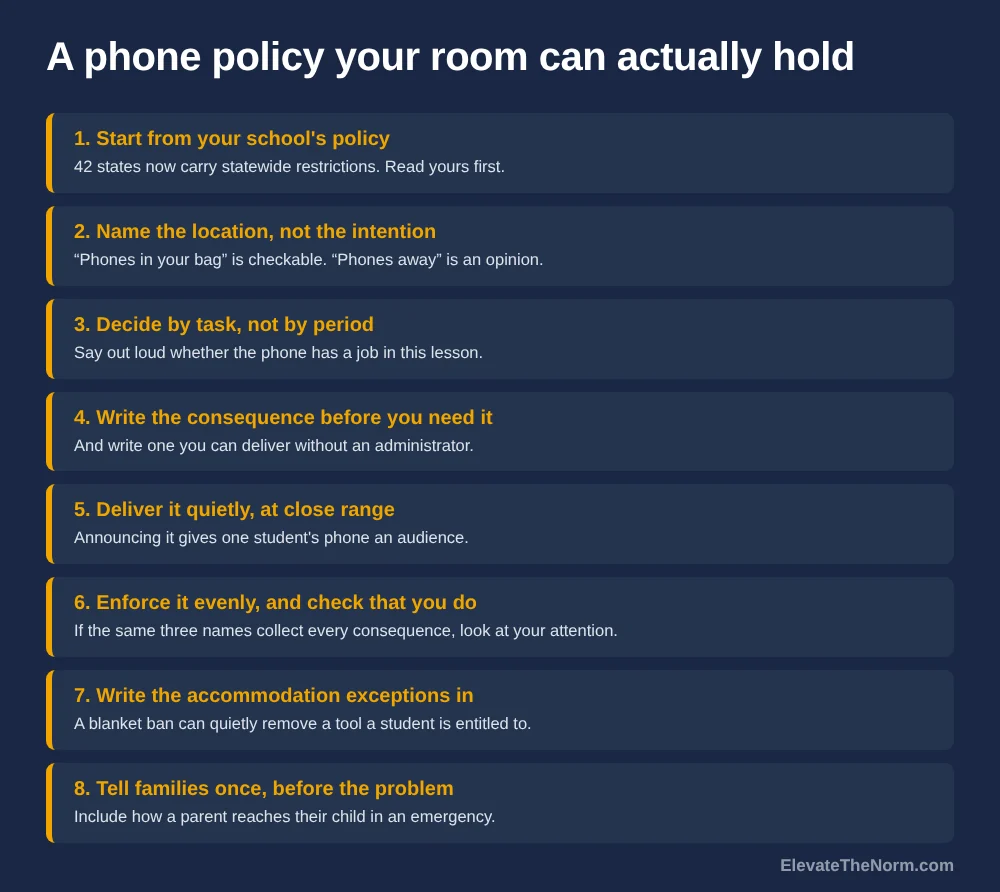
- Start from your school’s policy, not your own. With 42 states now carrying statewide restrictions, there is a decent chance the decision is already partly made for you, and a classroom rule that contradicts board policy will not survive its first parent email. Read it before you write anything.
- Name the location, not the intention. “Phones in your bag” is checkable from across the room. “Phones away” is an opinion. Pick the version a substitute could enforce without asking you.
- Decide by task, not by period. Say out loud, at the start, whether the phone has a job in this lesson. “No phones today” and “phones out for the next six minutes to photograph your build” are both easy sentences. The hard one is silence. Give them the reason once, and make it the real one: the research says the damage shows up on the unit test, not on today’s exit ticket. Teenagers will argue with “because I said so” forever and rarely argue with a finding.
- Write the consequence before you need it, and write one you can deliver alone. If your plan requires an administrator to come to your room, it is not a plan. Do not take a student’s phone into your own possession unless school policy explicitly authorizes it, and never look through one; that is somebody’s property and the dispute it starts is worse than the phone. Write a consequence that does not depend on the student handing anything over in the moment, because sometimes they will not, and a rule that collapses on refusal was never a rule.
- Deliver it quietly, at close range. A redirect handled at the student’s shoulder, not announced to the room, is the single cheapest classroom move there is, and it is the same one I use for every other redirect. Announcing it turns one student’s phone into a performance with an audience, and now you have two problems. The longer version of this is in the techniques that actually hold a room.
- Enforce it evenly, and check that you do. Whoever you notice first is not necessarily whoever is on their phone most. If the same three names collect every consequence, the problem may be your attention pattern rather than their behavior.
- Write the accommodation exceptions in, explicitly. If a student has an approved tool on that device, a blanket ban that quietly removes it is a problem with a paper trail. Name the exception in the policy so nobody has to argue for it in front of the class.
- Tell families once, in the words you will actually use, before anybody gets a phone call. Include how they reach their child in an emergency. This is the same principle as getting a tardy policy to hold: the message that lands is the one that arrived before the problem.
Two notes for the teacher reading this in March rather than August. Changing a phone rule mid-year is harder than setting one, and the only version that works is announcing the change, giving a date, and starting clean on that date rather than quietly tightening. And Pew’s 60 percent is not a judgment on you: most high school teachers with a policy find it difficult to enforce, so plan for the days you lose one instead of treating those days as proof the system failed.
If any of that sounds thin, that is deliberate. Here is my actual position, stated plainly: I do not have a phone system to sell you, and I am not going to invent one. What I have is the thing that makes every classroom rule work, which is that respecting students is easy and the mechanism is standing by your word. You do exactly what you said you would do, every time, including the times it is inconvenient. The rooms that lose the phone war mostly lose it to inconsistency and escalation rather than to the phones, which is a point this site has already made in its framework for teaching classroom expectations and is worth repeating here.
Two more things from the same place. A phone rule is one expectation among a handful, not the identity of your classroom, and short lists beat long ones — the whole argument behind keeping a middle school rule list to six. And if a student’s phone use has genuinely wrecked their grade, I would look at the planning before I looked at the student. A kid cannot fall off a cliff you did not build.
For a coach or an administrator watching this, the observable is not the policy. It is the ten seconds after the phone appears — how long the teacher takes to notice, and how loud the response is. Latency and volume are both countable from the back of the room, both coachable, and both cheap to practice. They are also the only part of this whole literature a teacher fully controls.
Frequently Asked Questions
Do cell phones actually lower student grades?
The best classroom evidence says yes, but not where teachers usually look. Glass and Kang found devices made no difference to in-lecture comprehension checks and still lowered end-of-term exam scores by at least 5 percent, about half a grade. The damage showed up in retention weeks later, not in the lesson. Note the population: 118 university students, not teenagers.
Should cell phones be banned in schools?
The research does not settle it. Beland and Murphy found English bans raised scores by 6.41 percent of a standard deviation, but Kessel and colleagues ran the same design across 1,086 Swedish schools and could reject even small gains. Abrahamsson found gains for girls in Norway; Goodyear and colleagues found no wellbeing difference in England. Anyone telling you it is settled is skipping one of those.
What is the best cell phone policy for a high school classroom?
The one you enforce identically every time. Name where the phone goes in checkable terms, say at the start of each lesson whether the phone has a job, write a consequence you can deliver without calling an administrator, and deliver it quietly at the student’s shoulder rather than announcing it. Consistency does more work than severity.
Do phone bans improve student mental health?
The evidence genuinely conflicts. Abrahamsson’s Norwegian study found reduced use of health care for psychological symptoms among girls after bans, especially girls from low-income backgrounds. Goodyear and colleagues’ 2025 study of 1,227 English adolescents found no difference in mental wellbeing between restrictive and permissive schools. Both are serious studies. The honest answer is that nobody knows yet.
Can a classroom phone ban conflict with a student’s accommodations?
Yes, and quietly. Text-to-speech, translation, captioning and reminder tools often live on the student’s own phone, so a blanket rule can remove something a student is entitled to use without anyone deciding to remove it. Write the exceptions into the policy explicitly so no student has to argue for an accommodation in front of the class.
What should a phone policy say about emergencies?
It should say how a parent reaches their child, through the school rather than the student. The National Association of School Resource Officers supports bell-to-bell bans partly because phones during a crisis divert students from instructions, screen light and sound can reveal students hiding, and mass messaging home produces parent traffic that delays responders. A policy silent on this earns every objection it gets.
Are phones worth using as a learning tool at all?
For narrow jobs, yes. Photographing evidence of work in progress, translation and read-aloud support, a timer a group controls, and fast whole-class retrieval checks are all things a phone does better than anything else in most rooms. Sung, Chang and Liu’s meta-analysis of 110 studies found a mean effect of 0.523 for integrating mobile devices into teaching. Integrating, not permitting.
Sources
- Beland, L.-P., & Murphy, R. (2015). Ill Communication: Technology, Distraction & Student Performance. Centre for Economic Performance Discussion Paper 1350, London School of Economics. Published in Labour Economics (2016).
- Kessel, D., Hardardottir, H. L., & Tyrefors, B. (2019/2020). The Impact of Banning Mobile Phones in Swedish Secondary Schools. IFN Working Paper No. 1288. Published in Economics of Education Review (2020).
- FORRT Replication Atlas. Replication record for Beland & Murphy (2016) and replication record for Ward et al. (2017).
- Abrahamsson, S. (2024). Smartphone Bans, Student Outcomes and Mental Health. Discussion Paper 1/2024, Norwegian School of Economics.
- Cowen, T. (2024). Did Norwegian schools actually ban cell phones? Marginal Revolution. A commentary, cited as the source of the caveat on Abrahamsson’s results.
- Goodyear, V., et al. (2025). School phone policies and their association with mental wellbeing, phone use, and social media use (SMART Schools): a cross-sectional observational study. The Lancet Regional Health — Europe.
- University of Birmingham. SMART Schools study newsletter, issue 2. Source of the detail that 45 percent of restrictive schools permitted educational phone use.
- Glass, A. L., & Kang, M. (2019). Dividing attention in the classroom reduces exam performance. Educational Psychology, 39(3). Figures as reported in Rutgers University’s summary of the study, which is the version read for this article.
- Kuznekoff, J. H., & Titsworth, S. (2013). The impact of mobile phone usage on student learning. Communication Education, 62(3), 233–252.
- Ward, A. F., Duke, K., Gneezy, A., & Bos, M. W. (2017). Brain drain: The mere presence of one’s own smartphone reduces available cognitive capacity. Journal of the Association for Consumer Research, 2(2). Replication discussion via the British Psychological Society’s Research Digest, which is the summary read for the Bern replication.
- Sung, Y.-T., Chang, K.-E., & Liu, T.-C. (2016). The effects of integrating mobile devices with teaching and learning on students’ learning performance: A meta-analysis and research synthesis. Computers & Education, 94, 252–275.
- OECD (2023). PISA 2022 results. Distraction figures as reported in Education Week‘s coverage, republished by Government Technology, which is the version read for this article.
- Common Sense Media (2023). Constant Companion: A Week in the Life of a Young Person’s Smartphone Use.
- Pew Research Center (2024). 72% of U.S. high school teachers say cellphone distraction is a major problem in the classroom.
- Pew Research Center (2026). About 4 in 10 teens support cellphone bans in classrooms; fewer back all-day restrictions.
- Pew Research Center (2024). Teens, Social Media and Technology 2024, topline questionnaire.
- National Association of School Resource Officers (2025). Students safer without cell phones during school emergencies.
- Yang, Y. T., et al. JAMA Pediatrics review of statewide K–12 cellphone policies, as summarized by Deseret News, which is the version read for this article.