Tag: academic integrity

  • The Academic Integrity Email: What to Write, and What to Leave Out

    The Academic Integrity Email: What to Write, and What to Leave Out

    An academic integrity email is a record. That is the first thing to understand about it, and it changes almost everything about how it should be written — because under federal law a written communication that is directly related to a student and kept by the school can become part of that student’s education record, which a parent has the right to read.

    So the question is not what you feel like writing at 9pm with a plagiarised essay open in another tab. The question is what you would be comfortable reading aloud, months later, in a meeting with the student, both parents and an assistant principal.

    Three emails usually have to be written: one to the student, one to the family, one to whoever handles this in your building. They have different jobs and should not contain the same paragraph. Below is what goes in each, worded out, along with the five sentences that cause most of the trouble.

    Key Takeaways

    • Write observations, not verdicts. “Three paragraphs match a source that is not cited” is a fact. “You plagiarised this” is a conclusion you may not be the one authorised to reach.
    • Assume a parent will read it. FERPA gives parents of K–12 students the right to inspect their child’s education records, and schools must respond within 45 days.
    • Talk to the student before you email anyone else whenever the timetable allows. An email that arrives home before the student has been asked what happened turns a fixable situation into an ambush.
    • Specific beats gentle. In a high-school field experiment, messages to parents about what a student needed to improve outperformed messages about what they were doing well.
    • Never put another student’s name in it. Two students, two separate emails, no cross-references.
    • Say what happens next and when. Most of the panic in these situations is uncertainty, not consequence.
    • Do not send it angry. The pause costs nothing and prevents the sentence you cannot unsend.

    Free Download · Printable PDF

    Academic Integrity Email Templates

    All three emails from this article — student, family, administrator — as copy-and-adapt templates, plus the phrase-swap table and a pre-send checklist.

    Download the free PDF

    Free. No email address required. Designed for grades 6–12. The full response process is on the academic integrity response page.

    Before You Write Anything: What an Email Actually Is

    Teachers tend to treat email as conversation. It is closer to filing.

    Two-column list of what belongs in an academic integrity email and what should stay out
    The left column is defensible months later. The right column is what gets quoted back to you.

    The U.S. Department of Education’s guidance defines an education record as one that is “directly related to a student” and maintained by the school. Parents of K–12 students have the right to inspect those records, and a school must comply “within a reasonable period of time, but not more than 45 days after receipt of a request.” Whether any particular email meets that bar depends on how your district stores and treats it — which is a question for your administrator, not for a blog. The practical takeaway does not depend on the edge cases: write every one of these as though it will be read by the family, because it may be.

    The same guidance is why the other rule exists. Sharing personally identifiable information from a student’s record with a third party generally requires written consent from the parent or eligible student. A second student’s name in an email to the first student’s parents is the most common way a teacher creates a problem that is genuinely larger than the cheating was.

    One more framing point before the templates. You are almost never the person who decides that a violation occurred — your handbook names that person, and it is usually not you. What you are qualified to write is what you observed. Keeping to that is not timidity. It is the thing that makes the email survive.

    It also assumes the line was clear in the first place. A good share of what lands in these emails is not defiance but a student guessing at a boundary nobody wrote down — which is why what academic honesty actually means in grades 6–12 is worth settling before an incident rather than during one, and why the worked examples of where the line falls are more use to a class than a policy paragraph. If you find yourself writing the same email four times a term, the assignment design is the thing to look at, not the students.

    The Email to the Student

    Send this one first, and keep it short. Its only job is to get the student into a conversation without pre-judging the outcome.
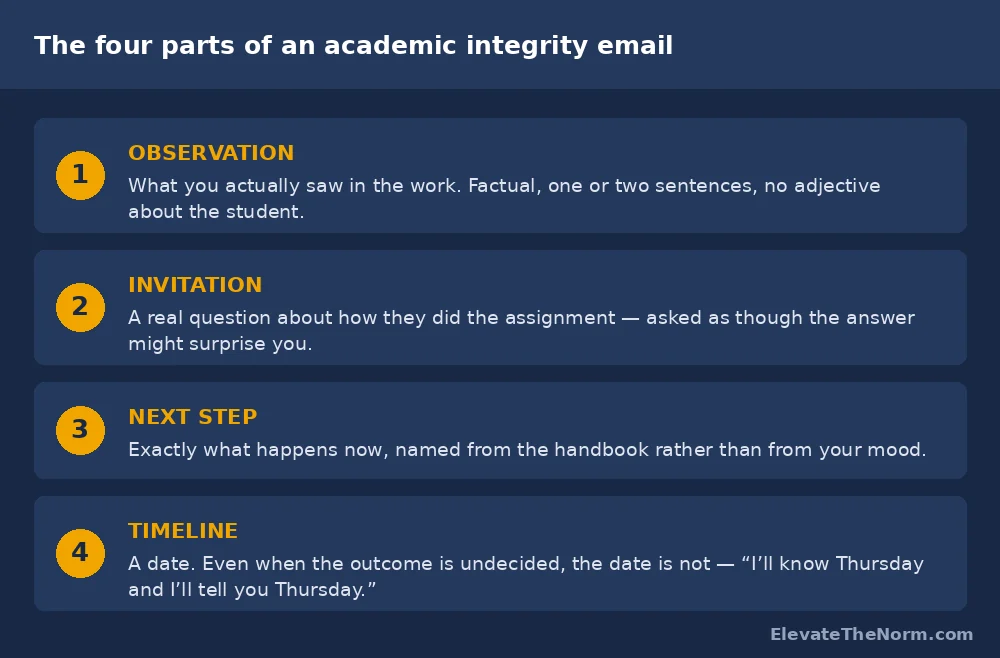
    Four-part structure of an academic integrity email: observation, invitation, next step, timeline
    Observation, invitation, next step, timeline. Everything else is optional.

    The University of California San Diego’s academic integrity office frames this conversation around what it calls clarity, compassion and candor, and its recommended opening is an observation rather than a charge — some version of I have some concerns about your recent assignment; specifically, it appears that you may have… followed by an open question about how the student did the work. Their guidance is written for a university, where the student is an adult and no parent is in the loop. In grades 6–12 the structure transfers; the surrounding obligations do not, which is why there are two more emails below.

    Template · to the student

    Subject: Your [assignment name] — quick conversation Tuesday

    Hi [Name],

    I’m reading through the [assignment] and I have a question about yours. [One sentence of plain observation — e.g. “Three of the paragraphs closely match a source that isn’t in your citations,” or “Two of the sources listed don’t appear to exist.”]

    Before I do anything else I want to hear how you put it together. Come see me during [specific time], or tell me a time that works.

    I’m not assuming anything yet. I do need to understand it.

    [Your name]

    Note what is absent. No adjective about the student. No mention of the handbook, the consequence, or the word cheating. No parent copied in. A thirteen-year-old who reads that email is anxious, which is unavoidable, but they are not cornered, and they can still tell you the truth without it being a confession.

    Give a specific time rather than “come see me.” A vague summons is worse than a direct one, because the student spends two days constructing the worst version of it.

    The Email to the Parent or Guardian

    This goes after you have spoken to the student, not before, unless your policy explicitly requires otherwise. Its job is to inform accurately and to say what happens next.

    There is decent evidence that the specific, improvement-focused version of a message home does more than the softened one. Kraft and Rogers ran a field experiment in a high-school credit recovery programme, sending parents weekly one-sentence individualised messages from teachers. The share of students failing to earn course credit fell from 15.8 percent to 9.3 percent, and the messages emphasising what students could improve produced larger effects than the messages about what they were doing well.

    Read the limits before borrowing the conclusion. That was a credit-recovery setting with students already at risk, the gain came mainly from students not dropping out rather than from better grades, and the messages were about ordinary progress, not integrity violations. It is not evidence that a blunt email about cheating improves anything. What it reasonably supports is the narrower claim: parents respond to specific information about a problem, and vagueness is not kindness.

    Template · to the parent or guardian

    Subject: [Student name] — [assignment], and what happens next

    Dear [Name],

    I’m writing about [student]’s [assignment], submitted [date]. [One or two sentences of observation — the same factual sentence you sent the student.]

    I spoke with [student] on [date]. [One sentence on what they said, neutrally reported.]

    Under our [handbook section / department policy], the next step is [exact next step]. That will happen by [date]. [If a grade is affected, say precisely how. If it is not yet decided, say that instead.]

    I want to be straightforward with you about two things. The first is that this is being handled as a teaching situation, not a character judgement. The second is that [student] is not in any trouble they cannot come back from — the repair is defined and it is finite.

    I’m glad to talk. [Phone/time].

    [Your name]

    The paragraph most teachers omit is the third one, and it is the one families actually need. Parents are rarely angry about the report. They are angry about not knowing what it means, what it does to a grade, and whether it follows their child around. Say all three.

    If your school is going to notify them anyway, you want to be the first message they read. A family who hears it from an automated referral before they hear it from you will spend the whole meeting recovering from that.

    And tell the student what is going home before it goes. Not for approval — you are sending it either way — but so they are not blindsided at the dinner table by a document they have never seen. One sentence covers it: I’m emailing your mum this afternoon, here is what it says. A teenager who knows what is coming can walk into that conversation as a participant. One who does not walks into an ambush arranged by an adult who had already decided to be fair to them. Being fair without being transparent still feels, from the inside, like being handled.

    It helps enormously if this is not the first message that family has had from you all year. A parent whose only contact from a teacher is bad news reads every email as bad news, which is one practical argument for keeping some kind of routine family contact going when nothing is wrong.

    Two practical notes. Email is not universal access — some families do not read English comfortably, some do not use email at all, and many districts route family contact through the student information system rather than your inbox. Use whatever channel actually reaches them, and make sure a written record exists afterwards either way. And if the student has an IEP or 504 plan, bring the case manager in before you send anything, because procedural protections may apply to how a discipline matter is handled.

    The Email to an Administrator

    Shortest of the three, and the one that most often gets over-written. An administrator needs the facts, the artefacts and what you are asking for — not your interpretation.

    Template · to an administrator

    Subject: Possible integrity issue — [student], [class, period]

    [Name],

    Reporting under [handbook section].

    What I observed: [Factual, one to three sentences.]

    Evidence attached: [The submission, the source, the comparison, the timestamp — whatever you actually have.]

    Student conversation: [Date, and what they said, neutrally reported.]

    Family contact: [Date and method, or “not yet — advise.”]

    What I’m asking: [Guidance / formal referral / confirmation that my planned response is correct.]

    [Your name]

    Write this one before you are asked for it rather than after. The version composed a fortnight later from memory is weaker, and by then the timestamps you would have wanted are gone.

    Five Sentences That Cause Problems

    Every one of these appears in real teacher emails, and every one creates work later.
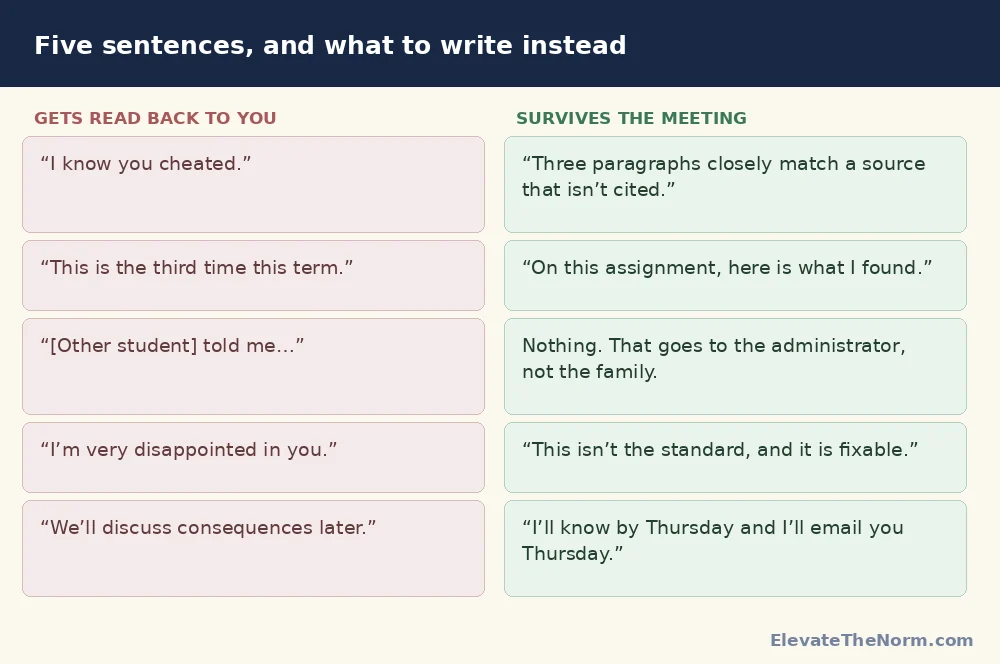
    Table of five problematic email sentences and better alternatives
    The left column is the version that gets read back to you in a meeting.

    “I know you cheated.” You know what you observed. Certainty you cannot evidence is the fastest route to a retraction, and if you are wrong even once the student is owed an apology you will find hard to write.

    “This is the third time this has happened in this class.” True, probably, and it tells a parent their child is being read against a pattern of other people’s behaviour. It also edges toward other students’ records.

    “[Other student] told me…” Never. Name no one. If another student’s account matters, it goes to the administrator, not into an email to a family.

    “I’m very disappointed in you.” It reads as a character verdict, and it is the sentence teenagers remember for years. You can hold the standard without grading the person; that distinction is the whole of what makes a repair possible.

    “We’ll discuss consequences later.” Later is the cruellest word in the email. Give a date even if you cannot give an outcome: I’ll know by Thursday and I’ll tell you Thursday.

    The Pause Before You Send

    I have a rough count I use before responding to anything in the room — somewhere around fifteen, though it is an average rather than a rule and it moves with the day, the class and the student. It is not a technique so much as a refusal to answer at the speed of my first reaction.

    Email deserves a longer version of the same thing, because the medium removes every correction a conversation gives you. There is no face telling you the sentence landed badly. There is no chance to say that came out wrong. And unlike a spoken word, it is still there in March.

    So the one habit worth building: write the integrity email, then do not send it. Leave it until the next morning and read it once more. The version you would have sent the night before is almost always half a degree sharper than the situation needed, and that half degree is what the family remembers.

    Nothing is lost by the delay. There is no academic integrity situation that gets worse overnight, and a good many of them look different once you have slept.

    When you do not have time for all three

    Three emails and a conversation is the complete version, and on a Tuesday with two duties and a deadline you will not have it. Here is what compresses without damage.

    • The student email never gets cut. It is six sentences and it is the one that keeps the situation recoverable.
    • The student conversation can be two minutes at a desk rather than a scheduled meeting, as long as it is out of earshot of the room.
    • The administrator email can wait a day in most cases — but write the facts down the same day, even as a note to yourself, because that is the part memory ruins.
    • The family email is the one to do properly. If something has to slip to tomorrow, slip this one and send it well rather than sending it fast.

    Before you go: grab the free Academic Integrity Email Templates (PDF) — ElevateTheNorm.com branded, printable, no email required.

    Frequently Asked Questions

    What should an academic integrity email say?

    Four things, in this order: the observation, an invitation to explain, the next step, and a date. The observation is factual — what you saw in the work, not what you concluded about the student. The invitation is a real question about how they did the assignment. The next step is whatever your handbook actually requires. The date matters more than teachers expect, because most of the distress in these situations is uncertainty rather than consequence. Anything beyond those four things is usually you managing your own feelings in a document that will outlive them.

    Should I email the parents before or after talking to the student?

    After, unless your policy says otherwise. An email that reaches home before the student has been asked what happened removes their chance to explain and converts a fixable problem into an ambush — and a meaningful share of suspected violations turn out to be a misunderstood instruction, a citation done badly, or a permission the student genuinely believed they had. Talk first, then write the family a message that includes what the student said.

    Can I say a student cheated in an email?

    Be careful, and check who in your building is actually authorised to make that determination — in most handbooks it is not the classroom teacher. What you can always write is what you observed: matching text, sources that do not exist, two identical submissions, a timestamp that does not fit. Observations survive scrutiny. Conclusions you are not empowered to reach create a retraction problem if any part of the picture turns out to be different.

    Is a teacher’s email about a student part of their school record?

    It can be. The U.S. Department of Education defines an education record as one directly related to a student and maintained by the school, and parents of K–12 students have the right to inspect those records, with schools required to respond within 45 days. Whether a specific email qualifies depends on how your district stores and treats it, which is a question for your administrator rather than an article. The safe working assumption is that anything you put in writing about a student may be read by that student’s family.

    Can I mention another student in the email?

    No. Two students means two separate emails with no cross-references, no names, and no “and the other student involved.” Beyond the practical fairness problem, disclosing personally identifiable information from one student’s record to another family generally requires written consent. If another student’s account is part of what you observed, that belongs in your report to the administrator.

    What if I send the email and then find out I was wrong?

    Correct it in writing, quickly, to everyone who received the original, and do it without hedging. This is precisely why the observation-not-verdict rule earns its keep — “three paragraphs matched an uncited source” is a fact that stays true even when the explanation turns out to be innocent, so the correction is a clarification rather than a retraction. If you did accuse, apologise plainly to the student, including in front of anyone who saw the accusation.

    How formal should the email to the student be?

    Less formal than the one to the parent, and much shorter. You are trying to start a conversation, not open a file. Six sentences is plenty. Formality reads as escalation to a teenager, and the more official the email sounds, the more likely they are to arrive with a rehearsed story rather than an honest one.

    Sources

    • U.S. Department of Education, Student Privacy Policy Office. FERPA frequently asked questions. Read the guidance — source for the definition of an education record (directly related to a student and maintained by the institution), the parental right of inspection, the 45-day response requirement, and the written-consent rule for third-party disclosure. General federal guidance; it does not rule on any particular email, and district policy and state law both apply on top of it.
    • Academic Integrity Office, University of California San Diego. How to talk to a student suspected of cheating. Read the guidance — source for the clarity/compassion/candor framing and for opening with an observation rather than an accusation. Written for a university, where students are adults and families are not involved; the conversational structure transfers to grades 6–12 but the notification obligations do not.
    • Kraft, M. A., & Rogers, T. (2015). The underutilized potential of teacher-to-parent communication: Evidence from a field experiment. Economics of Education Review, 47, 49–63. Read the record — weekly one-sentence individualised messages to parents in a high-school credit recovery programme; students failing to earn credit fell from 15.8% to 9.3%, driven by reduced dropout rather than improved grades, with improvement-focused messages outperforming praise-focused ones. Not a study of integrity communication — cited here only for the narrower finding that specific information outperforms vague reassurance.

    Every link above was checked on September 17, 2026. This article is not legal advice and does not interpret any district’s policy. Where federal guidance and your handbook appear to disagree, ask your administrator before you send anything.
    About Clay Shumate

    By Clay Shumate — Clay Shumate is a certified secondary Social Studies teacher in the public schools of West Alabama, now in his seventh year in the classroom, with a B.A. in History and an M.Ed. in Secondary Education. He writes about project-based learning, student responsibility, respect, and practical ways to hold young people to a higher standard while giving them room to learn from mistakes. He is a member of the Society of Professional Journalists and writes to its Code of Ethics; this site’s editorial standards and corrections policy are published in full.

  • Academic Honesty Examples: 18 Real Situations From a Secondary Classroom

    Academic Honesty Examples: 18 Real Situations From a Secondary Classroom

    Academic honesty examples are most useful when they are specific enough to argue about. “Do not cheat” settles nothing. “Two students compared homework answers in the hallway” is a real situation that happens weekly, and whether it counts depends on something a teacher either said out loud or did not.

    What follows is a set of concrete situations from a secondary classroom, sorted into the standard categories, with the honest answer for each — including the ones where the honest answer is “that depends on what you were told.”

    One thing to note before starting. Nearly every published definition in this area was written for universities. That is worth saying out loud, because applying undergraduate standards to a thirteen-year-old without translation is how schools end up punishing confusion.

    Key Takeaways

    • Six categories cover almost everything: cheating, plagiarism, falsification, fabrication, multiple submission and complicity.
    • Fabrication is the least understood. It means inventing data, sources or documents — and it is the one students commit without realising there is a word for it.
    • Several common situations genuinely depend on what you said. If you never specified, the student was guessing, and that is on the adult.
    • Reusing your own old work is usually a violation. Almost no secondary student knows this.
    • AI sits inside the existing categories. It does not need a new one — it needs the same question: did the tool help you think, or think instead of you?
    • Repair has to have an end. A first incident with no route back teaches students to deny rather than to be honest.

    Free Download · 3-page PDF

    Academic Honesty Scenario Cards

    All 18 situations from this article as cut-out cards, plus a 20-minute discussion guide, an “allowed help” assignment template and a teacher answer key.

    Download the free PDF

    Free. No email address required. Designed for grades 6–12. Browse every printable in Your Free Library.

    The Six Categories, in Plain Language

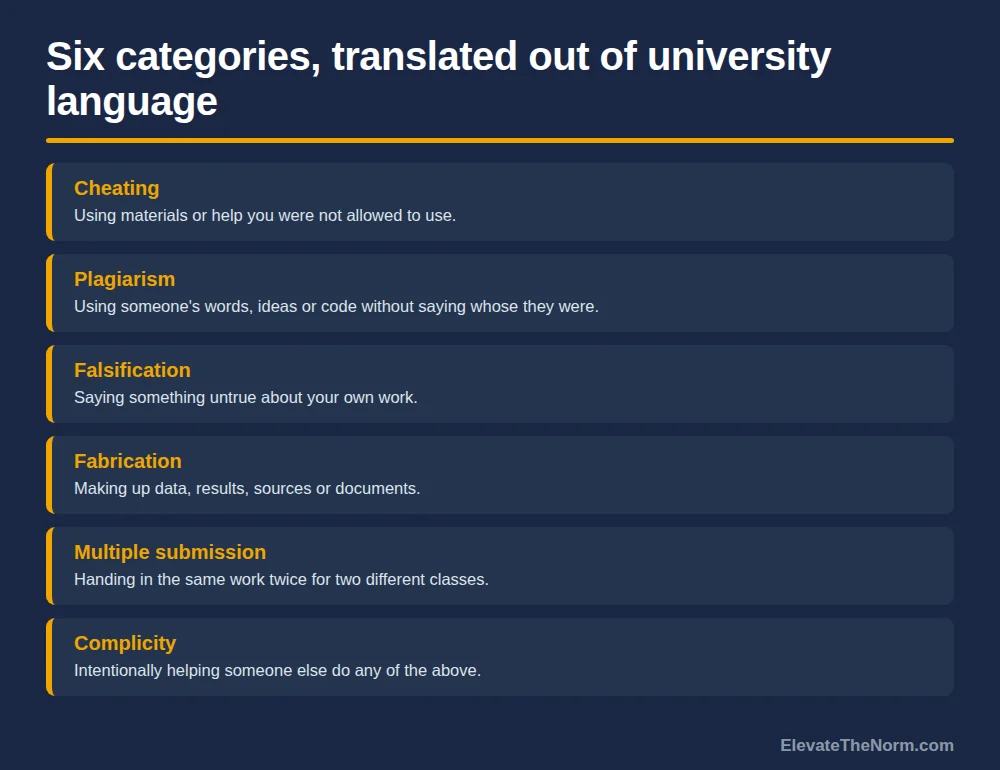
    Virginia Tech’s Office of Undergraduate Academic Integrity defines seven categories of academic misconduct, six of which map cleanly onto secondary work. The wording below is translated; the categories are theirs.

    Six categories of academic misconduct translated into plain language: cheating, plagiarism, falsification, fabrication, multiple submission and complicity
    The standard categories come from universities. This is the grades 6-12 translation.
    • Cheating. Using materials, notes, devices or help you were not permitted to use.
    • Plagiarism. Using someone’s words, ideas, structure or code without saying whose they were — including inadequate paraphrasing.
    • Falsification. Saying something untrue about your own work, verbally or in writing.
    • Fabrication. Making up data, results, sources or documents and presenting them as real.
    • Multiple submission. Handing in substantial portions of work already submitted for credit elsewhere, without permission.
    • Complicity. Intentionally helping someone else do any of the above.

    Two of these will be new to most students. Multiple submission is almost never explained in secondary school, and plenty of students reasonably assume their own work is theirs to reuse. Complicity surprises them even more — the student who let a friend photograph their worksheet usually thinks of themselves as the helpful one, not as a participant.

    What Is Fabrication in Academic Integrity?

    Fabrication is the unauthorised creation or reporting of information — inventing something and presenting it as real. Northern Illinois University’s tutorial pairs it with falsification and gives a list of concrete examples, several of which map directly onto secondary work:

    • Generating data artificially instead of collecting it from an actual experiment.
    • Altering data, documents, images, music or artwork without authorisation.
    • Removing results that do not fit, from a report or presentation.
    • Misrepresenting data through misleading scales or axes on a chart.
    • Inventing sources of information.
    • Impersonating another person to complete academic work, or using their login.

    The two that come up constantly in grades 6–12 are inventing a source and quietly dropping the data point that ruined the graph. Neither feels like cheating to the student doing it. The first feels like filling in a form; the second feels like tidying.

    That is why fabrication is worth teaching by name. A student who has never heard the word will not recognise themselves in it, and “I made up a source” is a sentence most fourteen-year-olds would be genuinely shocked to hear described as academic misconduct.

    Eighteen Situations, and What Each One Is

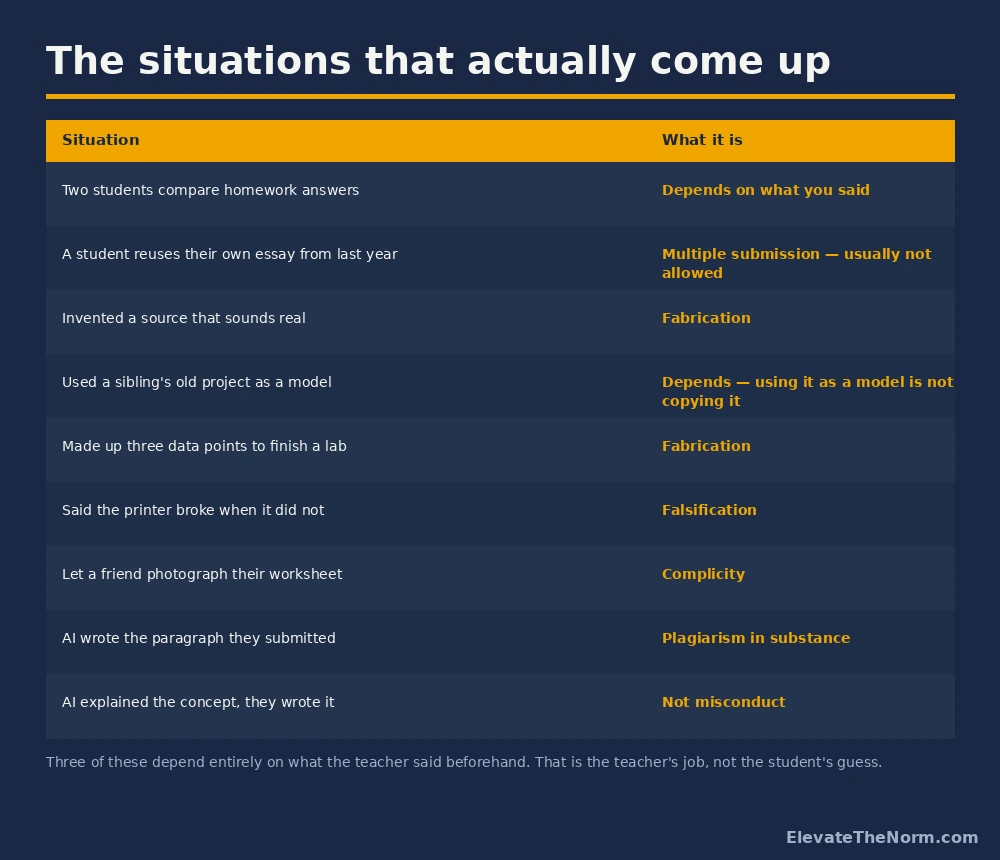
    Sorted by category. The verdicts assume no specific instruction was given, which is exactly the condition that causes most of the trouble.

    Table of nine common classroom situations with a verdict for each, including AI use, reused essays and invented sources
    Three of these depend entirely on what the teacher said beforehand.

    Clearly over the line

    • Copying a classmate’s answers during a test. Cheating.
    • Submitting a paragraph an AI tool wrote as their own writing. Plagiarism in substance, whatever the tool.
    • Inventing a source that sounds plausible to fill a citation requirement. Fabrication.
    • Adding three data points to finish a lab that ran out of time. Fabrication.
    • Telling a teacher the printer broke when it did not. Falsification.
    • Photographing a completed worksheet and sending it to four people. Complicity.
    • Logging into another student’s account to submit work. Fabrication, by NIU’s definition, and probably worse under school policy.
    • Paraphrasing a whole article closely without citing it. Plagiarism, even with every word changed.

    Usually a violation, and usually a surprise to the student

    • Reusing their own essay from a previous course. Multiple submission.
    • Submitting the same project to two teachers in the same term. Multiple submission.
    • Letting a friend copy homework “just this once.” Complicity.
    • Dropping the result that ruined the trend line. Fabrication by omission.
    • Using a translation tool to write an assignment in a language class. Depends heavily on the subject — and it is the teacher’s job to say.

    Depends entirely on what was said

    • Two students comparing homework answers before class.
    • Working through practice problems together and arriving at the same method.
    • Asking an AI tool to explain a concept, then writing the answer themselves. Not misconduct in most framings.
    • Using a sibling’s old project as a model for structure. Using it as a model is not copying it.
    • Getting a parent to proofread. Nearly always fine, and nearly never stated.

    That last group is the important one. Five situations, all common, all resolved by one sentence at the top of the assignment. A school with a strict policy and no per-task instruction has built a system where students are punished for guessing wrong about something nobody told them — which is the pattern described in more detail in what academic honesty actually means in grades 6–12.

    The Repair Conversation

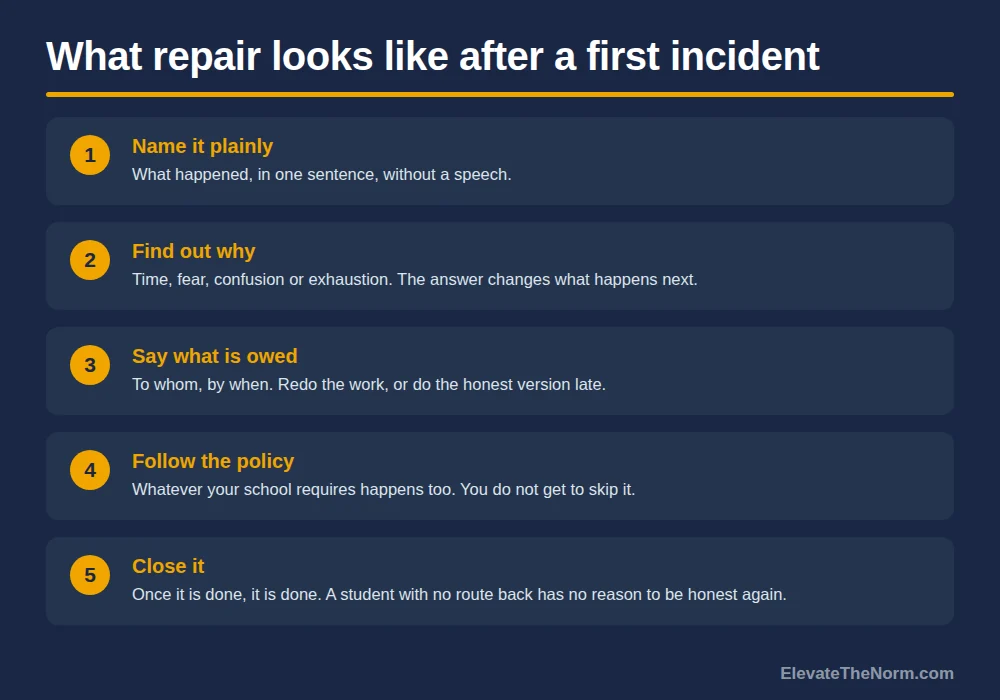
    When a student has done something that damaged trust, the conversation I have is about what is owed: to whom, and by when. Not a speech about character. A short, specific account of what needs to happen for this to be finished.

    Five steps for handling a first academic honesty incident: name it, find out why, say what is owed, follow the policy, close it
    A student with no route back has no reason to be honest again.

    That framing does most of the work in an academic honesty incident, because it separates two things schools routinely merge. There is what the school’s policy requires, which happens regardless and which you do not get to skip. And there is what the student owes — usually redoing the work honestly, sometimes telling someone what happened, occasionally apologising to a classmate whose work they used.

    The second part is the part that teaches anything. A consequence imposed on a student is something that happens to them. A debt they pay is something they do.

    And it has to end. If the answer to “when is this finished” is never, a student learns that honesty has no upside and denial has no downside. That is not a soft observation — it is the incentive structure you have built, and teenagers read incentive structures accurately.

    Using These Examples With a Class

    The list above works far better as a discussion than as a handout. Twenty minutes, once, early in the year.

    1. Give them the ambiguous ones first. Start with comparing homework answers, not with copying a test. The interesting conversation is in the grey zone and starting at the obvious end wastes it.
    2. Let them disagree. Students argue about these with real energy, and the arguments surface exactly the assumptions you need to correct.
    3. Make them state the rule they are using. “Why is that one different from the last one?” gets you further than telling them.
    4. Then give your answers. Including, honestly, the ones where your answer differs from the teacher down the hall.
    5. End with the per-assignment habit. Tell them you will state what help is allowed on each task, and that asking is always fine.

    The point is not compliance. It is that a student who has argued about where the line falls will notice when they are near it, and a student who has only been told the rules will not.

    What to Do Next

    Take the five “depends on what was said” situations and decide your actual answer for each. Not the school’s official position — yours, for your subject, on an ordinary assignment. Then say them out loud to your classes this week.

    Most academic honesty problems in a secondary classroom are not students deciding to cheat. They are students guessing, in a building where six teachers want six different things and nobody has written any of it down. If a violation does occur and needs a formal response, a consistent process for responding to it keeps that fair too.

    The note home is the part most of us write badly under pressure. There is a plainer way to write that message to a family that keeps a fixable mistake from turning into a standoff.

    Before you go: grab the free Academic Honesty Scenario Cards (PDF) — ElevateTheNorm.com branded, printable, no email required.

    Frequently Asked Questions

    What is fabrication in academic integrity?

    Fabrication is inventing information and presenting it as real — making up data, results, sources or documents. The examples that come up most in secondary school are inventing a citation that sounds plausible and quietly removing the data point that ruined a graph. Neither feels like cheating to the student doing it, which is exactly why the word is worth teaching. Falsification is its close relative: saying something untrue about your own work, such as claiming a file was submitted when it was not.

    Is reusing my own work really a violation?

    In most policies, yes, and it catches students completely off guard. Multiple submission means handing in substantial portions of work already submitted for credit somewhere else without permission. Students reasonably assume their own work belongs to them, and nobody explains otherwise. The practical answer is that it is nearly always allowed if you ask first, so the rule teachers should state is “ask me, and the answer is usually yes.”

    Is using AI an academic honesty violation?

    It depends what it replaced, and it fits inside the existing categories rather than needing a new one. Asking a tool to explain a concept and then writing the answer yourself is not misconduct in most framings. Submitting text the tool produced as your own writing is plagiarism in substance whatever the source. The test that works across tools is whether it helped you think or thought instead of you — and the part that actually prevents problems is a teacher stating which they mean on each assignment.

    Is letting someone copy my homework really as bad as copying?

    Policies generally treat it as its own category — complicity, meaning intentionally helping someone commit misconduct. Students almost never see it that way; the one who shared usually feels like the generous party rather than a participant. It is worth naming explicitly, because a student who would never copy will hand their work over without a second thought.

    What if two teachers in my school have different rules?

    That is extremely common and it is the source of a large share of honest mistakes. Students moving through six classrooms are running six different rule sets, none of which they chose. The fix is not a school-wide policy document that nobody reads — it is each teacher stating what help is allowed on each assignment. One line at the top of the task removes most of the ambiguity that generates violations.

    How should a first incident be handled?

    Privately, quickly, and with a defined end. Name what happened in one sentence, find out why — time, fear, confusion and exhaustion are the usual answers — and say what is owed and by when. Follow whatever your school’s policy requires, because that is not optional. Then close it. An incident with no route back teaches a student that honesty carries a cost and denial does not.

    Should students be taught these categories by name?

    Yes, and in plain language rather than the university wording they were written in. A student who has never heard the word fabrication will not recognise their own invented citation in it. The version that works is short, concrete, and argued about rather than handed out — twenty minutes of disagreement about the grey-zone situations does more than a signed policy sheet ever will.

    Sources

    • Office of Undergraduate Academic Integrity, Virginia Tech. Definitions of academic misconduct. Read the definitions — the source for the categories used above. These are university definitions; the plain-language wording in this article is a translation for grades 6–12, not a quotation.
    • Northern Illinois University. Student tutorial: Fabrication or falsification. Read the tutorial — the source for the fabrication definition and the concrete examples list.
    • International Center for Academic Integrity. Facts and statistics. Read the page — context for how common these behaviours are among high school students.

    Every link above was checked on September 12, 2026. Where a definition was written for a university audience, this article says so rather than presenting it as a secondary-school standard.


    About Clay Shumate

    By Clay Shumate — Clay Shumate is a certified secondary Social Studies teacher in the public schools of West Alabama, now in his seventh year in the classroom, with a B.A. in History and an M.Ed. in Secondary Education. He writes about project-based learning, student responsibility, respect, and practical ways to hold young people to a higher standard while giving them room to learn from mistakes. He is a member of the Society of Professional Journalists and writes to its Code of Ethics; this site’s editorial standards and corrections policy are published in full.

  • What Is Academic Honesty? A Plain-Language Guide for Grades 6–12

    What Is Academic Honesty? A Plain-Language Guide for Grades 6–12

    Academic honesty means the work you hand in represents what you actually did and actually understand, and that anyone whose thinking you used gets credited. That is the whole definition. What makes it hard in grades 6–12 is not that students disagree with it — most of them do not — but that nobody has ever told them precisely where the line falls, and it moves between classrooms.

    Schools tend to treat academic honesty as a rule to be enforced. It works far better as a thing to be taught, because the evidence on why students cheat points almost entirely at pressure, confusion and exhaustion rather than at character.

    This guide is written for middle and high school, not for universities, and it takes the AI question seriously without pretending the world started in 2023.

    Key Takeaways

    • Cheating is near-universal and long predates AI. McCabe’s surveys of more than 70,000 high school students found 64 percent admitted cheating on a test and 95 percent admitted some form of it.
    • ChatGPT did not change the numbers. Stanford researchers surveying 40 high schools found rates held at 60–70 percent — the same as the year before ChatGPT existed.
    • The causes are mundane. Time, fear, disengagement, exhaustion, and genuinely not knowing where the line is.
    • Integrity has six named values — honesty, trust, fairness, respect, responsibility and courage. Courage is the one schools leave out.
    • Teach the line explicitly, per assignment. “Ask me” has to be a real, safe option or students will guess.
    • A policy nobody can recite is not a policy. If your students cannot state the rule for your class, you do not have one.

    What Is Academic Honesty?

    Academic honesty is the practice of representing your own work accurately and crediting the work of others. Academic integrity is the broader commitment that makes it possible — the set of values a school and its students agree to hold, including when holding them is inconvenient.

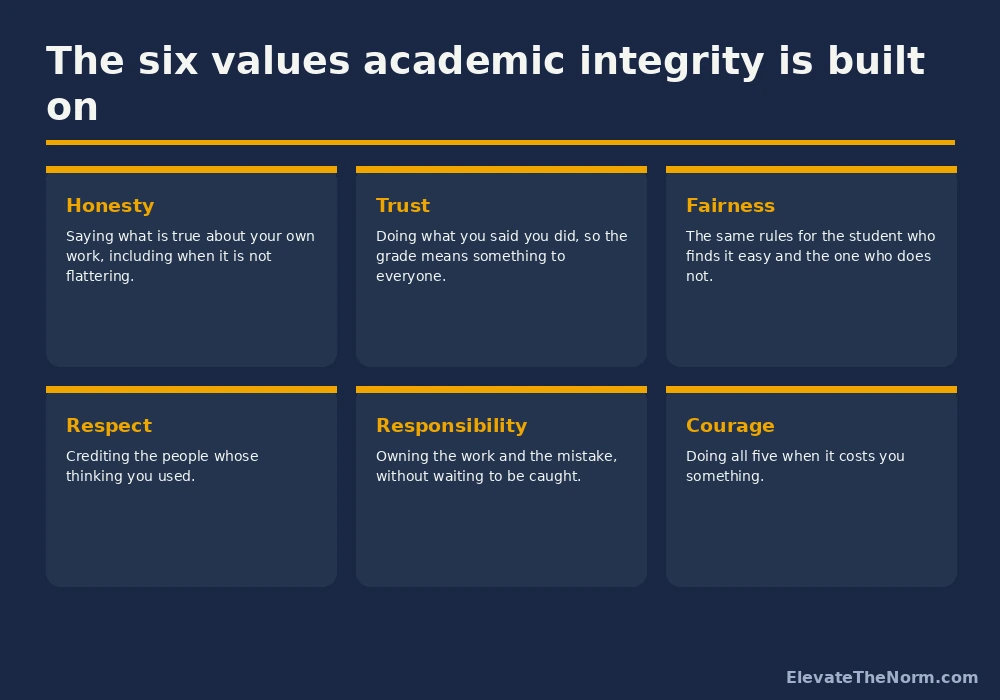
    Six values of academic integrity: honesty, trust, fairness, respect, responsibility and courage, each with a short definition
    The International Center for Academic Integrity names six. Courage is the one schools skip.

    The International Center for Academic Integrity defines integrity as a commitment, even in the face of adversity, to six fundamental values: honesty, trust, fairness, respect, responsibility and courage.

    Five of those six get printed in handbooks. The sixth rarely does, and it is the one that actually costs a teenager something. Courage is what a student needs to hand in an unfinished assignment rather than a copied finished one, in a building where the finished one is safer. If your academic honesty policy demands courage from students without offering them a survivable way to be honest, you have written a rule that punishes the value you claim to want.

    That is a design problem, not a student problem, and it is fixable.

    How Common Is Cheating, Really?

    Common enough that any policy assuming otherwise is fiction. The International Center for Academic Integrity reports Donald McCabe’s surveys of more than 70,000 high school students across two dozen schools: 64 percent admitted cheating on a test, 58 percent admitted plagiarism, and 95 percent admitted participating in some form of cheating.

    Sit with that last number before designing a consequence ladder around it. A policy built on the idea that cheating is what a few dishonest students do is a policy built on a false premise.

    What AI did and did not change

    The expected answer was that generative AI would send those numbers up. It did not.

    Denise Pope and Victor Lee of Stanford’s Graduate School of Education surveyed students across 40 high schools in autumn 2023 and found cheating rates essentially unchanged, at 60 to 70 percent — the same range as autumn 2022, before ChatGPT was widely available. Pope said she had expected higher numbers and was surprised. Lee reported that students found the output underwhelming: “It just sounds very sterile and vanilla to them.”

    Pope’s summary of the cause is the sentence worth pinning above a department meeting: when students do cheat, it is typically for reasons that have very little to do with their access to technology.

    This is a survey of self-reported behaviour at one point in time, so it is a snapshot rather than a settled law, and the tools have kept changing since. But it is the best evidence available on the specific question everyone was asking, and it points away from detection software and toward assignment design.

    Why Students Actually Cheat

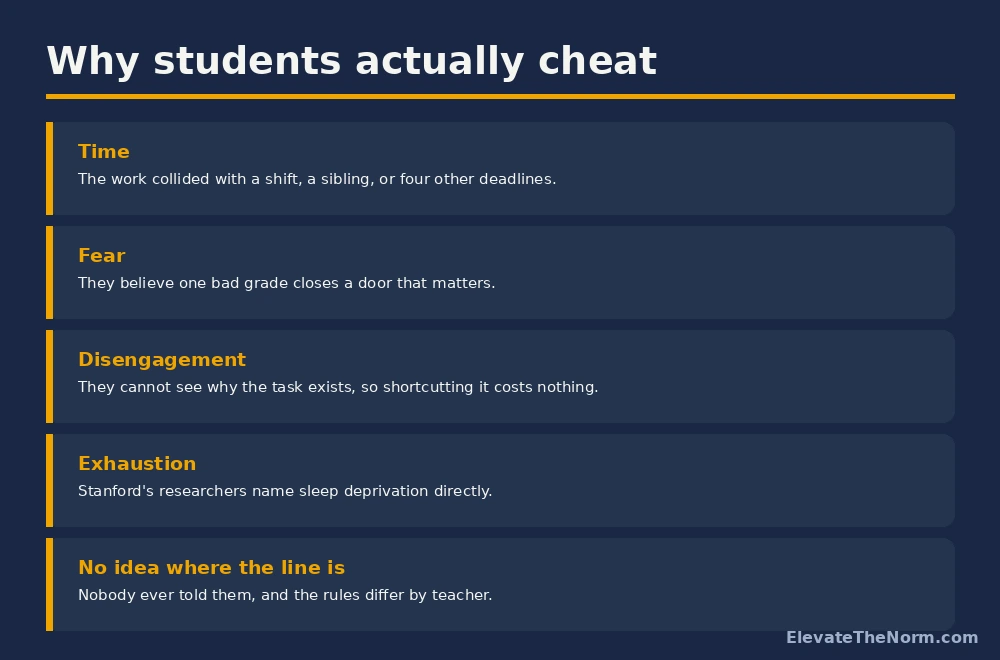
    Five reasons cover almost all of it, and only one of them is about wanting to get away with something.

    Five reasons students cheat: time, fear, disengagement, exhaustion and not knowing where the line is
    Stanford’s researchers found the reasons had very little to do with access to technology.

    Pope named disengagement, feeling undervalued and sleep deprivation among the drivers. Add time pressure and simple confusion about the rules and you have the set.

    Notice what this means practically. Four of the five are things a teacher has some control over. Assignment design, deadline stacking, whether a single grade is allowed to feel catastrophic, and whether the rules were ever stated — those are adult decisions. The fifth, exhaustion, is largely outside your control, but knowing it is in the mix should change how you read a 2 a.m. submission.

    None of this means the behaviour is acceptable or that consequences disappear. It means a school that responds to cheating only with detection and punishment is treating the symptom, and the numbers above suggest how well that has worked so far.

    Where the Line Actually Falls

    Most students are not choosing to cheat. They are guessing, because the same action is encouraged in one room and punished in the next, and nobody has written it down.

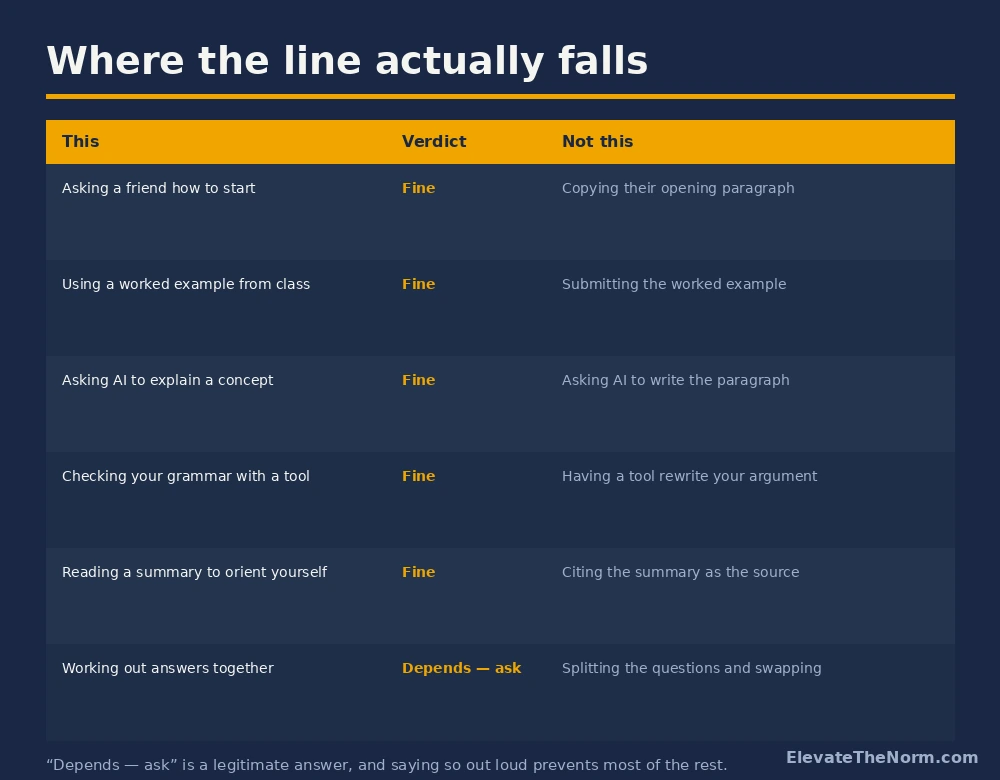
    Table showing acceptable and unacceptable versions of six common study situations, including AI use and group work
    Most students are not choosing to cheat. They are guessing where the line is.

    The useful principle underneath the table: help with your thinking is fine, substitution for your thinking is not. A friend explaining how to start, a worked example, a tool that explains a concept — all of those leave the thinking with the student. A copied paragraph, a rewritten argument, a split-and-swap worksheet do not.

    That principle handles AI without needing a separate AI policy. “Did the tool help you think, or did it think instead of you?” is answerable by a thirteen-year-old, and it will still be answerable when whatever replaces today’s tools arrives.

    The row marked “depends — ask” matters as much as the clear ones. Collaboration is genuinely ambiguous, it varies by assignment, and students need a safe way to check. If asking gets a student a suspicious look, they will stop asking and start guessing, and you have chosen the worse outcome.

    If you want the longer version of that table, eighteen real situations sorted by category works through the ones that come up weekly — reused essays, invented sources, shared worksheets — including what fabrication actually means and the five that depend entirely on what you said beforehand.

    How to Teach It Instead of Just Enforcing It

    Six moves, none of which require a new school-wide policy.

    1. State the rule per assignment, not per year. One line at the top of the task: what help is allowed here. It takes ten seconds and removes most of the guessing.
    2. Make “ask me” genuinely safe. Answer the question plainly, without an eyebrow. A student checking the line is doing exactly what you asked for.
    3. Teach citation as crediting people, not as formatting. Middle schoolers grasp “say whose idea it was” long before they grasp a style guide.
    4. Stop stacking deadlines. Look at what else your students have due that week. Time pressure is a cause, and it is partly yours.
    5. Design tasks that are harder to substitute. Work grounded in this class, this discussion, this local question is difficult to outsource and more interesting anyway.
    6. Separate the honesty conversation from the grade conversation. A student who admits copying and gets both a zero and a referral has learned that honesty is the expensive option.

    The last one is where most policies quietly fail, and it connects directly to whether a student has a route back after a mistake. If there is no survivable path, the rational move for a frightened fifteen-year-old is to deny it.

    What Academic Honesty Is Not

    • It is not a detection problem. Detection tools produce false positives, fall hardest on students who write unusually, and do nothing about the five causes above.
    • It is not a character verdict. With 95 percent of students admitting some form of it, treating an incident as evidence of a bad kid is statistically indefensible.
    • It is not the same conversation as a school discipline referral. Some incidents require formal procedures. Most do not, and running everything through the formal route guarantees students stop telling you the truth.
    • It is not a university policy shrunk down. Thirteen-year-olds are still learning what counts as their own idea. Expecting undergraduate judgment from them and then punishing its absence is unfair.
    • It is not solved by banning tools. The Stanford numbers are the argument: rates did not move when the tools arrived, and they will not move when the next ones do.

    What to Do Next

    Pick your next assignment and write one line at the top stating exactly what help is allowed on it. Say it out loud when you set the task, and say that asking is fine. That single habit removes more academic dishonesty than any detection tool available to a secondary teacher, because it removes the guessing that produces most of it.

    Then look at what happens in your room when a student is caught. If the honest route costs them more than the dishonest one, fix that before you fix anything else. When a violation does need a formal response, having a consistent process for responding to an academic integrity violation keeps it fair and keeps it out of the realm of mood.

    The message home is part of that process. Deciding what belongs in the email to a family and what to leave out usually sets the tone for everything that follows it.

    Frequently Asked Questions

    What is the difference between academic honesty and academic integrity?

    Academic honesty is the behaviour — your work represents what you actually did, and you credit the people whose thinking you used. Academic integrity is the wider commitment that makes the behaviour possible, which the International Center for Academic Integrity frames as six values: honesty, trust, fairness, respect, responsibility and courage. In practice, honesty is what a student does on a Tuesday and integrity is the culture that makes doing it survivable.

    Is using AI cheating?

    It depends entirely on what it replaced. The workable test is whether the tool helped you think or thought instead of you. Asking a model to explain a concept you did not follow in class is help. Asking it to produce the paragraph you were assigned to write is substitution. That distinction handles the tools we have now and the ones arriving next, which is why it is better than a rule naming specific products. The essential part is stating which you mean on each assignment rather than leaving students to guess.

    Did AI make cheating worse in high schools?

    The best evidence available says no. Stanford researchers surveying 40 high schools in autumn 2023 found cheating rates of 60–70 percent, essentially unchanged from autumn 2022 before ChatGPT was widely used. That is self-reported survey data at one point in time rather than a settled finding, and the tools keep changing. But it is a strong signal that the drivers are pressure and disengagement rather than opportunity.

    How should a teacher respond the first time a student is caught?

    Privately, quickly, and with the conversation separated from the penalty. Find out what actually happened — a copied paragraph at midnight and a smuggled answer key are different situations with different causes. Follow whatever your school’s policy requires, because you do not get to skip that, but do not let the formal process be the whole response. A student who is never asked why will learn only to be more careful next time.

    Should a first offence go on a permanent record?

    That is a school policy question rather than a teacher one, and the answer will be set above you. What is worth arguing for internally is proportionality. A system where a thirteen-year-old’s first misunderstanding of collaboration rules carries the same permanent weight as deliberate, repeated fraud will make students and families fight every accusation, which costs everyone more than it saves.

    How do I teach citation to students who find it pointless?

    Drop the style guide at first and teach it as crediting a person. “Whose idea was this, and did you say so?” is the whole concept, and middle schoolers get it immediately because they already care intensely about who gets credit for things. Formatting is a separate, smaller skill you can layer on afterwards. Starting with the punctuation is why so many students think citation is an arbitrary hoop.

    What if the whole class is doing it?

    Then treat it as a design problem, because it is one. Widespread copying on a particular task usually means the task was too long for the time given, too disconnected from anything that happened in class, or too easy to substitute. Change the assignment before escalating the enforcement. Punishing thirty students for a structural problem is both unjust and ineffective.

    Sources

    • International Center for Academic Integrity. Facts and statistics. Read the page — the source for Donald McCabe’s high school survey figures (more than 70,000 students; 64 percent cheating on a test, 58 percent plagiarism, 95 percent some form). ICAI attributes the high school figures to McCabe’s work rather than to a single dated publication.
    • International Center for Academic Integrity. The fundamental values of academic integrity. Read the page — honesty, trust, fairness, respect, responsibility and courage.
    • Bay, J. (2024, February 6). High school cheating increase from ChatGPT? Research finds not so much. The 74. Read the article — reporting on Denise Pope and Victor Lee’s Stanford Graduate School of Education survey across 40 high schools. The Stanford survey itself was not read directly; this article is the source for the figures and quotations given above.

    Every link above was checked on September 12, 2026. Where a finding is reported through journalism rather than read in the original study, the text says so.


    About Clay Shumate

    By Clay Shumate — Clay Shumate is a certified secondary Social Studies teacher in the public schools of West Alabama, now in his seventh year in the classroom, with a B.A. in History and an M.Ed. in Secondary Education. He writes about project-based learning, student responsibility, respect, and practical ways to hold young people to a higher standard while giving them room to learn from mistakes. He is a member of the Society of Professional Journalists and writes to its Code of Ethics; this site’s editorial standards and corrections policy are published in full.

Teacher Emergency Toolkit — practical resources, real classroom support. Shop on TPT.Teacher Emergency Toolkit — practical resources, real classroom support. Shop on TPT.