
Academic honesty means the work you hand in represents what you actually did and actually understand, and that anyone whose thinking you used gets credited. That is the whole definition. What makes it hard in grades 6–12 is not that students disagree with it — most of them do not — but that nobody has ever told them precisely where the line falls, and it moves between classrooms.
Schools tend to treat academic honesty as a rule to be enforced. It works far better as a thing to be taught, because the evidence on why students cheat points almost entirely at pressure, confusion and exhaustion rather than at character.
This guide is written for middle and high school, not for universities, and it takes the AI question seriously without pretending the world started in 2023.
Key Takeaways
- Cheating is near-universal and long predates AI. McCabe’s surveys of more than 70,000 high school students found 64 percent admitted cheating on a test and 95 percent admitted some form of it.
- ChatGPT did not change the numbers. Stanford researchers surveying 40 high schools found rates held at 60–70 percent — the same as the year before ChatGPT existed.
- The causes are mundane. Time, fear, disengagement, exhaustion, and genuinely not knowing where the line is.
- Integrity has six named values — honesty, trust, fairness, respect, responsibility and courage. Courage is the one schools leave out.
- Teach the line explicitly, per assignment. “Ask me” has to be a real, safe option or students will guess.
- A policy nobody can recite is not a policy. If your students cannot state the rule for your class, you do not have one.
What Is Academic Honesty?
Academic honesty is the practice of representing your own work accurately and crediting the work of others. Academic integrity is the broader commitment that makes it possible — the set of values a school and its students agree to hold, including when holding them is inconvenient.
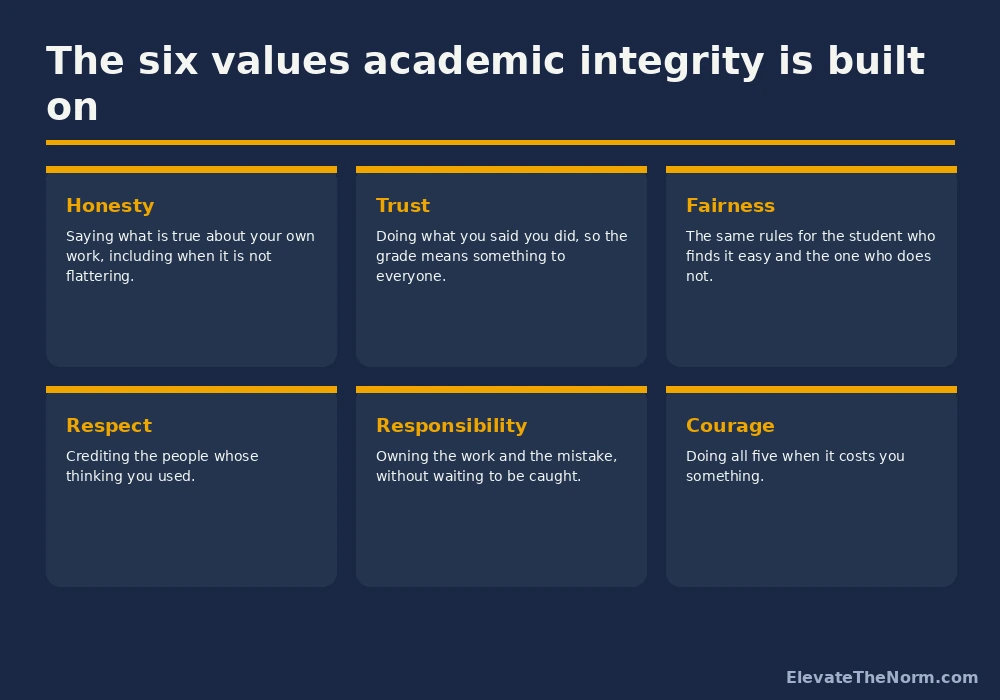
The International Center for Academic Integrity defines integrity as a commitment, even in the face of adversity, to six fundamental values: honesty, trust, fairness, respect, responsibility and courage.
Five of those six get printed in handbooks. The sixth rarely does, and it is the one that actually costs a teenager something. Courage is what a student needs to hand in an unfinished assignment rather than a copied finished one, in a building where the finished one is safer. If your academic honesty policy demands courage from students without offering them a survivable way to be honest, you have written a rule that punishes the value you claim to want.
That is a design problem, not a student problem, and it is fixable.
How Common Is Cheating, Really?
Common enough that any policy assuming otherwise is fiction. The International Center for Academic Integrity reports Donald McCabe’s surveys of more than 70,000 high school students across two dozen schools: 64 percent admitted cheating on a test, 58 percent admitted plagiarism, and 95 percent admitted participating in some form of cheating.
Sit with that last number before designing a consequence ladder around it. A policy built on the idea that cheating is what a few dishonest students do is a policy built on a false premise.
What AI did and did not change
The expected answer was that generative AI would send those numbers up. It did not.
Denise Pope and Victor Lee of Stanford’s Graduate School of Education surveyed students across 40 high schools in autumn 2023 and found cheating rates essentially unchanged, at 60 to 70 percent — the same range as autumn 2022, before ChatGPT was widely available. Pope said she had expected higher numbers and was surprised. Lee reported that students found the output underwhelming: “It just sounds very sterile and vanilla to them.”
Pope’s summary of the cause is the sentence worth pinning above a department meeting: when students do cheat, it is typically for reasons that have very little to do with their access to technology.
This is a survey of self-reported behaviour at one point in time, so it is a snapshot rather than a settled law, and the tools have kept changing since. But it is the best evidence available on the specific question everyone was asking, and it points away from detection software and toward assignment design.
Why Students Actually Cheat
Five reasons cover almost all of it, and only one of them is about wanting to get away with something.
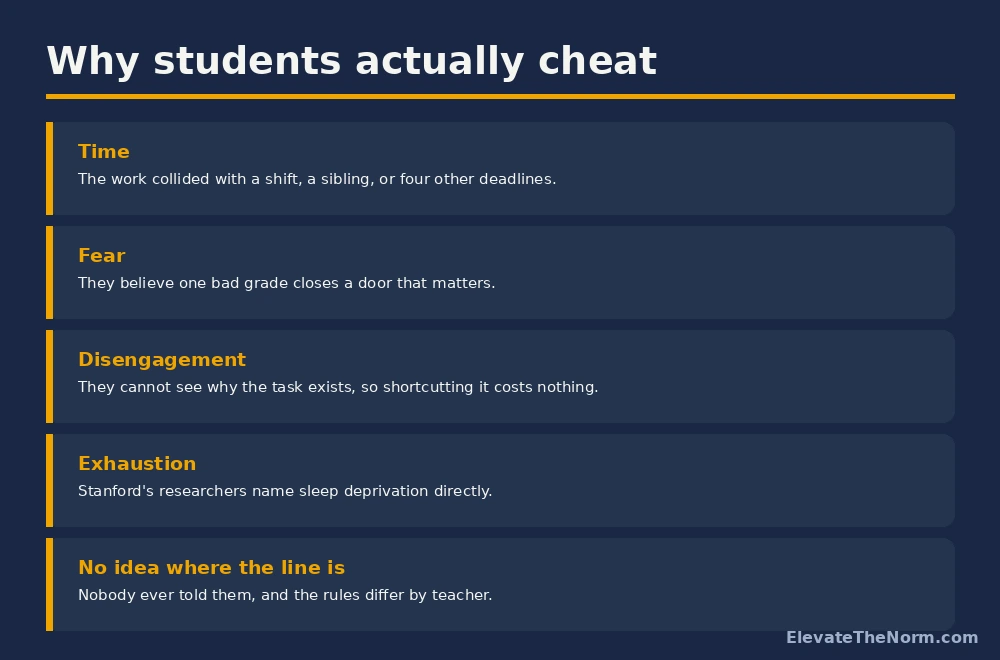
Pope named disengagement, feeling undervalued and sleep deprivation among the drivers. Add time pressure and simple confusion about the rules and you have the set.
Notice what this means practically. Four of the five are things a teacher has some control over. Assignment design, deadline stacking, whether a single grade is allowed to feel catastrophic, and whether the rules were ever stated — those are adult decisions. The fifth, exhaustion, is largely outside your control, but knowing it is in the mix should change how you read a 2 a.m. submission.
None of this means the behaviour is acceptable or that consequences disappear. It means a school that responds to cheating only with detection and punishment is treating the symptom, and the numbers above suggest how well that has worked so far.
Where the Line Actually Falls
Most students are not choosing to cheat. They are guessing, because the same action is encouraged in one room and punished in the next, and nobody has written it down.
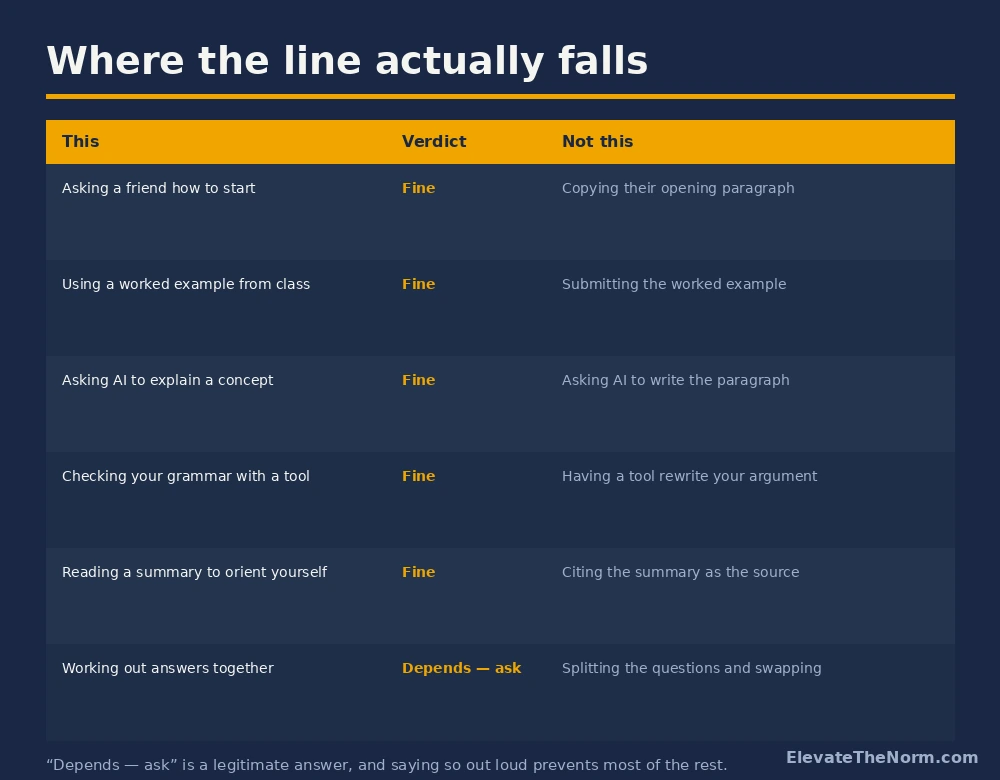
The useful principle underneath the table: help with your thinking is fine, substitution for your thinking is not. A friend explaining how to start, a worked example, a tool that explains a concept — all of those leave the thinking with the student. A copied paragraph, a rewritten argument, a split-and-swap worksheet do not.
That principle handles AI without needing a separate AI policy. “Did the tool help you think, or did it think instead of you?” is answerable by a thirteen-year-old, and it will still be answerable when whatever replaces today’s tools arrives.
The row marked “depends — ask” matters as much as the clear ones. Collaboration is genuinely ambiguous, it varies by assignment, and students need a safe way to check. If asking gets a student a suspicious look, they will stop asking and start guessing, and you have chosen the worse outcome.
If you want the longer version of that table, eighteen real situations sorted by category works through the ones that come up weekly — reused essays, invented sources, shared worksheets — including what fabrication actually means and the five that depend entirely on what you said beforehand.

How to Teach It Instead of Just Enforcing It
Six moves, none of which require a new school-wide policy.
- State the rule per assignment, not per year. One line at the top of the task: what help is allowed here. It takes ten seconds and removes most of the guessing.
- Make “ask me” genuinely safe. Answer the question plainly, without an eyebrow. A student checking the line is doing exactly what you asked for.
- Teach citation as crediting people, not as formatting. Middle schoolers grasp “say whose idea it was” long before they grasp a style guide.
- Stop stacking deadlines. Look at what else your students have due that week. Time pressure is a cause, and it is partly yours.
- Design tasks that are harder to substitute. Work grounded in this class, this discussion, this local question is difficult to outsource and more interesting anyway.
- Separate the honesty conversation from the grade conversation. A student who admits copying and gets both a zero and a referral has learned that honesty is the expensive option.
The last one is where most policies quietly fail, and it connects directly to whether a student has a route back after a mistake. If there is no survivable path, the rational move for a frightened fifteen-year-old is to deny it.
What Academic Honesty Is Not
- It is not a detection problem. Detection tools produce false positives, fall hardest on students who write unusually, and do nothing about the five causes above.
- It is not a character verdict. With 95 percent of students admitting some form of it, treating an incident as evidence of a bad kid is statistically indefensible.
- It is not the same conversation as a school discipline referral. Some incidents require formal procedures. Most do not, and running everything through the formal route guarantees students stop telling you the truth.
- It is not a university policy shrunk down. Thirteen-year-olds are still learning what counts as their own idea. Expecting undergraduate judgment from them and then punishing its absence is unfair.
- It is not solved by banning tools. The Stanford numbers are the argument: rates did not move when the tools arrived, and they will not move when the next ones do.
What to Do Next
Pick your next assignment and write one line at the top stating exactly what help is allowed on it. Say it out loud when you set the task, and say that asking is fine. That single habit removes more academic dishonesty than any detection tool available to a secondary teacher, because it removes the guessing that produces most of it.
Then look at what happens in your room when a student is caught. If the honest route costs them more than the dishonest one, fix that before you fix anything else. When a violation does need a formal response, having a consistent process for responding to an academic integrity violation keeps it fair and keeps it out of the realm of mood.
The message home is part of that process. Deciding what belongs in the email to a family and what to leave out usually sets the tone for everything that follows it.
Frequently Asked Questions
What is the difference between academic honesty and academic integrity?
Academic honesty is the behaviour — your work represents what you actually did, and you credit the people whose thinking you used. Academic integrity is the wider commitment that makes the behaviour possible, which the International Center for Academic Integrity frames as six values: honesty, trust, fairness, respect, responsibility and courage. In practice, honesty is what a student does on a Tuesday and integrity is the culture that makes doing it survivable.
Is using AI cheating?
It depends entirely on what it replaced. The workable test is whether the tool helped you think or thought instead of you. Asking a model to explain a concept you did not follow in class is help. Asking it to produce the paragraph you were assigned to write is substitution. That distinction handles the tools we have now and the ones arriving next, which is why it is better than a rule naming specific products. The essential part is stating which you mean on each assignment rather than leaving students to guess.
Did AI make cheating worse in high schools?
The best evidence available says no. Stanford researchers surveying 40 high schools in autumn 2023 found cheating rates of 60–70 percent, essentially unchanged from autumn 2022 before ChatGPT was widely used. That is self-reported survey data at one point in time rather than a settled finding, and the tools keep changing. But it is a strong signal that the drivers are pressure and disengagement rather than opportunity.
How should a teacher respond the first time a student is caught?
Privately, quickly, and with the conversation separated from the penalty. Find out what actually happened — a copied paragraph at midnight and a smuggled answer key are different situations with different causes. Follow whatever your school’s policy requires, because you do not get to skip that, but do not let the formal process be the whole response. A student who is never asked why will learn only to be more careful next time.
Should a first offence go on a permanent record?
That is a school policy question rather than a teacher one, and the answer will be set above you. What is worth arguing for internally is proportionality. A system where a thirteen-year-old’s first misunderstanding of collaboration rules carries the same permanent weight as deliberate, repeated fraud will make students and families fight every accusation, which costs everyone more than it saves.
How do I teach citation to students who find it pointless?
Drop the style guide at first and teach it as crediting a person. “Whose idea was this, and did you say so?” is the whole concept, and middle schoolers get it immediately because they already care intensely about who gets credit for things. Formatting is a separate, smaller skill you can layer on afterwards. Starting with the punctuation is why so many students think citation is an arbitrary hoop.
What if the whole class is doing it?
Then treat it as a design problem, because it is one. Widespread copying on a particular task usually means the task was too long for the time given, too disconnected from anything that happened in class, or too easy to substitute. Change the assignment before escalating the enforcement. Punishing thirty students for a structural problem is both unjust and ineffective.
Sources
- International Center for Academic Integrity. Facts and statistics. Read the page — the source for Donald McCabe’s high school survey figures (more than 70,000 students; 64 percent cheating on a test, 58 percent plagiarism, 95 percent some form). ICAI attributes the high school figures to McCabe’s work rather than to a single dated publication.
- International Center for Academic Integrity. The fundamental values of academic integrity. Read the page — honesty, trust, fairness, respect, responsibility and courage.
- Bay, J. (2024, February 6). High school cheating increase from ChatGPT? Research finds not so much. The 74. Read the article — reporting on Denise Pope and Victor Lee’s Stanford Graduate School of Education survey across 40 high schools. The Stanford survey itself was not read directly; this article is the source for the figures and quotations given above.
Every link above was checked on September 12, 2026. Where a finding is reported through journalism rather than read in the original study, the text says so.