By Clay Shumate
An academic integrity email should state what you saw in the work, not a verdict, invite the student to explain, name the next step under your policy, and give a date. Email the student first, the family after you’ve talked with the student, and the administrator with the evidence attached. Write each one as if the family will read it.
An academic integrity email is a written message a teacher sends to a student, a family or an administrator about suspected cheating, plagiarism or unauthorized help. It’s also a record. Under federal law, a record that’s directly related to a student and kept by the school is part of that student’s education record, and a parent has the right to read it. That changes almost everything about how the email should be written.
So the question isn’t what you feel like writing at 9 p.m. with a plagiarized essay open in another tab. It’s what you’d be comfortable reading aloud, months later, in a meeting with the student, both parents and an assistant principal.
Three emails usually have to be written: one to the student, one to the family, one to whoever handles this in your building. They have different jobs and shouldn’t contain the same paragraph. Below is what goes in each, worded out, along with the five sentences that cause most of the trouble.
Key Takeaways
- Write observations, not verdicts. “Three paragraphs match a source that isn’t cited” is a fact. “You plagiarized this” is a conclusion the classroom teacher often isn’t the one authorized to reach.
- Assume a parent will read an academic integrity email. FERPA gives parents of K–12 students the right to inspect their child’s education records, and schools must respond within 45 days.
- Talk to the student before emailing the family whenever the timeline allows, so the student gets a chance to explain before anything goes home.
- Never name another student in an academic integrity email. Two students means two separate emails, with no cross-references.
- Give a date for the next step, even when the outcome isn’t decided yet. Uncertainty, more than the consequence, is what families and students struggle with.
Free Download · Printable PDF
Academic Integrity Email Templates
All three emails from this article — student, family, administrator — as copy-and-adapt templates, plus the phrase-swap table and a pre-send checklist.
Free. No email address required. Designed for grades 6–12. The full response process is on the academic integrity response page.
Is an Academic Integrity Email Part of a Student’s Record?
An academic integrity email can become part of a student’s education record when the school keeps it, which means the student’s parents may have the right to read it. Teachers tend to treat email as conversation. It’s closer to filing.

The U.S. Department of Education’s guidance defines an education record as one that is “directly related to a student” and maintained by the school. Parents of K–12 students have the right to inspect those records, and a school must comply “within a reasonable period of time, but not more than 45 days after receipt of a request.” Whether a particular email meets that bar depends on how your district stores and treats it, and that’s a question for your administrator, not a blog. The practical takeaway doesn’t depend on the edge cases: write every one of these as though it will be read by the family, because it may be.
The same rules are why the other habit exists. FERPA’s regulations require a parent or eligible student to give signed and dated written consent before a school discloses personally identifiable information from education records, with listed exceptions. A second student’s name in an email to the first student’s parents is the most common way a teacher creates a problem that is genuinely larger than the cheating was.
One more framing point before the templates. The classroom teacher usually isn’t the person who decides that a violation occurred. Your handbook names that person, and it’s often someone else. What you’re qualified to write is what you observed. Keeping to that isn’t timidity. It’s what makes the email survive.
It also assumes the line was clear in the first place. Some of what lands in these emails isn’t defiance but a student guessing at a boundary nobody wrote down. That’s why a definition students can repeat back to you is worth settling before an incident rather than during one, and why the worked examples of where the line falls are more use to a class than a policy paragraph. If you find yourself writing the same email four times a term, the assignment design is the thing to look at, not the students.
| When to send it | Its job | What it must include | |
|---|---|---|---|
| To the student | First | Start a conversation without pre-judging the outcome | One factual observation and a specific time to meet |
| To the parent or guardian | After you have spoken with the student | Inform accurately and say what happens next | The observation, what the student said, the next step, a date, and any effect on the grade |
| To an administrator | Before you are asked for it | Hand over facts and evidence, not interpretation | What you observed, the evidence, the student conversation, family contact, and what you are asking for |
What Should an Academic Integrity Email to a Student Say?
An academic integrity email to a student should be short: one factual observation, an invitation to explain, and a specific time to meet. Send it first. Its only job is to get the student into a conversation without prejudging the outcome. I use my Restorative Conversation Scripts on TPT for the follow-up so the student does most of the talking.
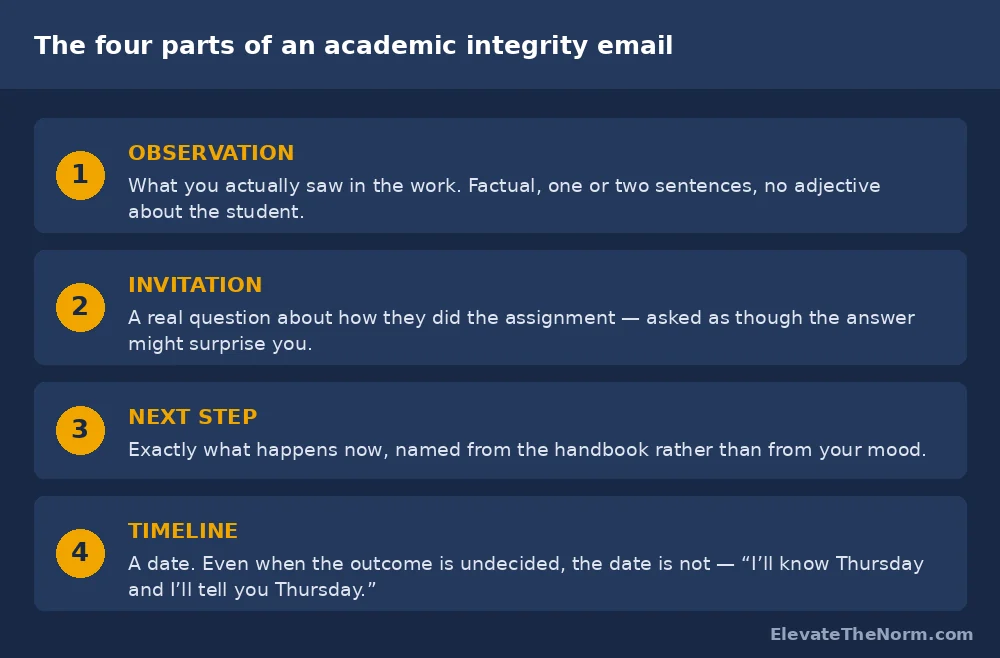
The University of California San Diego’s academic integrity office frames this conversation around what it calls clarity, compassion and candor, and its example opening is an observation rather than a charge: I have some concerns about your recent [paper or exam], specifically it appears that you may have… followed by an open question about the student’s process for completing the work. UCSD’s guidance is written for a university, where the student is an adult and no parent is in the loop. In grades 6–12 the structure transfers; the surrounding obligations don’t, which is why there are two more emails below.
Template · to the student
Subject: Your [assignment name] — quick conversation Tuesday
Hi [Name],
I’m reading through the [assignment] and I have a question about yours. [One sentence of plain observation — e.g. “Three of the paragraphs closely match a source that isn’t in your citations,” or “Two of the sources listed don’t appear to exist.”]
Before I do anything else I want to hear how you put it together. Come see me during [specific time], or tell me a time that works.
I’m not assuming anything yet. I do need to understand it.
[Your name]
Note what’s absent. No adjective about the student. No mention of the handbook, the consequence, or the word cheating. No parent copied in. A thirteen-year-old who reads that email is anxious, which is unavoidable, but they aren’t cornered, and they can still tell you the truth without it being a confession.
Give a specific time rather than “come see me.” A vague summons is worse than a direct one, because the student spends two days constructing the worst version of it.
How Do You Email Parents About an Academic Integrity Issue?
Email parents about an academic integrity issue after you’ve talked with the student, unless your policy says otherwise. The family email reports the observation, what the student said, the next step, a date and any effect on the grade. If you haven’t settled what happens next, decide what should actually follow a confirmed violation before you write the email.
There is decent evidence that the specific, improvement-focused version of a message home does more than the softened one. Kraft and Rogers ran a field experiment in a high school credit recovery program, sending parents weekly one-sentence individualized messages from teachers. The share of students failing to earn course credit fell from 15.8 percent to 9.3 percent, and the messages emphasizing what students could improve produced larger effects than the messages about what they were doing well.
Read the limits before borrowing the conclusion. That was a credit-recovery setting with students already at risk, the gain came mainly from preventing dropouts rather than from better grades, and the messages were about ordinary progress, not integrity violations. It isn’t evidence that a blunt email about cheating improves anything. What it reasonably supports is the narrower claim: parents respond to specific information about a problem, and vagueness is not kindness.
Template · to the parent or guardian
Subject: [Student name] — [assignment], and what happens next
Dear [Name],
I’m writing about [student]’s [assignment], submitted [date]. [One or two sentences of observation — the same factual sentence you sent the student.]
I spoke with [student] on [date]. [One sentence on what they said, neutrally reported.]
Under our [handbook section / department policy], the next step is [exact next step]. That will happen by [date]. [If a grade is affected, say precisely how. If it is not yet decided, say that instead.]
I want to be straightforward with you about two things. The first is that this is being handled as a teaching situation, not a character judgment. The second is that [student] is not in any trouble they cannot come back from — the repair is defined and it is finite.
I’m glad to talk. [Phone/time].
[Your name]
The paragraph most teachers omit is the third one, and it is the one families actually need. Parents are rarely angry about the report. They’re angry about not knowing what it means, what it does to a grade, and whether it follows their child around. Say all three.
If your school is going to notify them anyway, you want to be the first message they read. A family who hears it from an automated referral before they hear it from you will spend the whole meeting recovering from that.
And tell the student what is going home before it goes. Not for approval — you are sending it either way — but so they are not blindsided at the dinner table by a document they have never seen. One sentence covers it: I’m emailing your mom this afternoon; here’s what it says. A teenager who knows what is coming can walk into that conversation as a participant. One who doesn’t walks into an ambush arranged by an adult who had already decided to be fair to them. Being fair without being transparent still feels, from the inside, like being handled.
It helps enormously if this is not the first message that family has had from you all year. A parent whose only contact from a teacher is bad news reads every email as bad news, which is one practical argument for keeping some kind of routine family contact going when nothing is wrong.
Two practical notes. Email isn’t universal access. Some families don’t read English comfortably, some don’t use email at all, and many districts route family contact through the student information system rather than your inbox. Use whatever channel actually reaches them, and make sure a written record exists afterwards either way. And if the student has an IEP or 504 plan, bring the case manager in before you send anything, because procedural protections may apply to how a discipline matter is handled. If you need the paperwork to keep up, my Behavior Documentation Forms on TPT have ABC data sheets and MTSS logs ready to go.


What Should an Academic Integrity Email to an Administrator Include?
An academic integrity email to an administrator should include what you observed, the evidence attached, the student conversation, any family contact, and what you’re asking for. It’s the shortest of the three emails and the one most often over-written. Leave your interpretation out.
Template · to an administrator
Subject: Possible integrity issue — [student], [class, period]
[Name],
Reporting under [handbook section].
What I observed: [Factual, one to three sentences.]
Evidence attached: [The submission, the source, the comparison, the timestamp — whatever you actually have.]
Student conversation: [Date, and what they said, neutrally reported.]
Family contact: [Date and method, or “not yet — advise.”]
What I’m asking: [Guidance / formal referral / confirmation that my planned response is correct.]
[Your name]
Write this one before you are asked for it rather than after. The version written two weeks later from memory is weaker, and by then the timestamps you would have wanted are gone.
What Should You Not Say in an Academic Integrity Email?
Leave out verdicts you can’t prove, other students’ names, comparisons to other students, judgments about character, and vague promises about consequences. Each of the five sentences below creates work later.
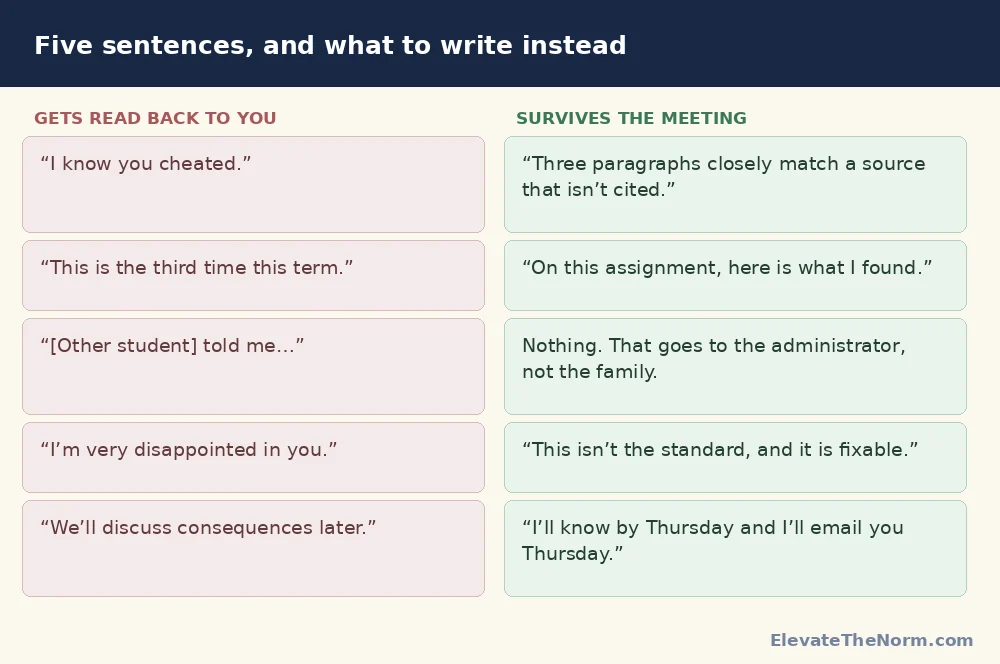
“I know you cheated.” You know what you observed. Certainty you can’t back with evidence is the fastest route to a retraction, and if you are wrong even once the student is owed an apology you will find hard to write.
“This is the third time this has happened in this class.” True, probably, and it tells a parent their child is being read against a pattern of other people’s behavior. It also edges toward other students’ records.
“[Other student] told me…” Never. Name no one. If another student’s account matters, it goes to the administrator, not into an email to a family.
“I’m very disappointed in you.” It reads as a character verdict, and it is the sentence teenagers remember for years. You can hold the standard without grading the person; that distinction is the whole of what makes a repair possible.
“We’ll discuss consequences later.” Later is the cruelest word in the email. Give a date even if you can’t give an outcome: I’ll know by Thursday and I’ll tell you Thursday.
Should You Wait Before Sending an Academic Integrity Email?
Yes. Write the academic integrity email, then wait until the next morning and reread it before you send it. No integrity situation gets worse overnight, and the version written in the moment is usually sharper than it needs to be.
Clay’s take: I have a rough count I use before responding to anything in the room — somewhere around fifteen, though it is an average rather than a rule and it moves with the day, the class and the student. It isn’t a technique so much as a refusal to answer at the speed of my first reaction.
Email deserves a longer version of the same thing, because the medium removes every correction a conversation gives you. There is no face telling you the sentence landed badly. There is no chance to say that came out wrong. And unlike a spoken word, it is still there in March.
So the one habit worth building is the overnight wait. The version you would have sent the night before is almost always half a degree sharper than the situation needed, and that half degree is what the family remembers.
The cheapest version of this email is the one you never have to write, and on test days that mostly comes down to the paper itself. Every course at Mid-Terms.org ships with a Form A and a Form B, and the Midterm Maker will build up to four scrambled versions (A–D) with matching keys, which makes a glance at the next desk a lot less useful.
What if you don’t have time to write all three emails?
When time is short, never cut the student email, keep the conversation brief and private, write the facts down the same day, and give the family email an extra day rather than sending it fast. Three emails and a conversation is the complete version, and on a day with two duties and a deadline you won’t have it. Here’s what compresses without damage.
- The student email never gets cut. It is six sentences and it is the one that keeps the situation recoverable.
- The student conversation can be two minutes at a desk rather than a scheduled meeting, as long as it’s out of earshot of the room.
- The administrator email can wait a day in most cases — but write the facts down the same day, even as a note to yourself, because that is the part memory ruins.
- The family email is the one to do properly. If something has to slip to tomorrow, slip this one and send it well rather than sending it fast.
Before you go: grab the free Academic Integrity Email Templates (PDF) — ElevateTheNorm.com branded, printable, no email required.
Frequently Asked Questions
What should an academic integrity email say?
An academic integrity email should say four things, in this order: what you observed in the work, an invitation to explain, the next step your handbook requires, and a date. The observation is factual, such as matching text or a source that doesn’t exist, not a conclusion about the student. The date matters more than teachers expect, because uncertainty is what students and families struggle with most.
Should I email the parents before or after talking to the student?
Email the parents after talking to the student, unless your school’s policy says otherwise. A message that reaches home before the student has been asked what happened removes their chance to explain, and some suspected violations turn out to be a misread instruction or a badly done citation. Talk first, then write the family a message that includes what the student said.
Can a teacher say a student cheated in an email?
A teacher should be careful about writing that a student cheated, because in many handbooks the classroom teacher isn’t the person authorized to make that call. What a teacher can always write is what they observed: matching text, sources that don’t exist, two identical submissions, a timestamp that doesn’t fit. Observations hold up under scrutiny. A conclusion that turns out wrong needs a retraction.
Is a teacher’s email about a student part of their school record?
A teacher’s email about a student can be part of the education record. The U.S. Department of Education defines education records as records directly related to a student and maintained by the school, and parents of K–12 students can inspect them, with schools required to respond within 45 days. Whether a specific email counts depends on how your district stores it, so ask your administrator.
Can I mention another student in an academic integrity email?
No. When two students are involved, write two separate emails with no names and no cross-references. Under FERPA’s regulations, disclosing personally identifiable information from one student’s education records generally requires signed, written consent from the parent or eligible student. If another student’s account is part of what you observed, put it in your report to the administrator instead.
What if I send an academic integrity email and then find out I was wrong?
Correct the academic integrity email in writing, quickly, to everyone who got the original, and don’t hedge. That’s why the observation-not-verdict rule matters: “three paragraphs matched an uncited source” stays true even when the explanation is innocent, so the correction is a clarification. If you did accuse the student, apologize plainly, including in front of anyone who saw the accusation.
What if the student has an IEP or 504 plan?
When a student with an IEP or 504 plan is involved in an academic integrity issue, bring the case manager in before you send any email. Procedural protections may apply to how a discipline matter is handled, and the case manager knows what the plan requires. Use the same observation-first emails, but let the case manager confirm the next step and timeline before the family hears them.
What should a student do after receiving an academic integrity email?
A student who gets an academic integrity email should reply and show up at the time offered. A well-written integrity email is an invitation to explain how the work was put together, not a final decision. Come ready to walk through how you did the assignment and where your sources came from. Telling the truth early keeps the situation recoverable, and the repair is usually defined and finite.
Sources
- U.S. Department of Education, Student Privacy Policy Office. FERPA frequently asked questions. Read the guidance — source for the definition of an education record (directly related to a student and maintained by the institution), the parental right of inspection, the 45-day response requirement, and the signed-and-dated consent requirement. General federal guidance; it does not rule on any particular email, and district policy and state law both apply on top of it.
- U.S. Department of Education, Student Privacy Policy Office. Family Educational Rights and Privacy Act regulations (34 CFR Part 99). Read the regulations — source for §99.30(a), the signed and dated written-consent requirement before personally identifiable information from education records is disclosed, subject to the exceptions in §99.31, and §99.10(b), the 45-day access rule.
- Academic Integrity Office, University of California San Diego. How to talk to a student suspected of cheating. Read the guidance — source for the Clarity, Compassion, and Candor framing and for opening with an observation rather than an accusation. Written for a university, where students are adults and families are not involved; the conversational structure transfers to grades 6–12 but the notification obligations do not.
- Kraft, M. A., & Rogers, T. (2015). The underutilized potential of teacher-to-parent communication: Evidence from a field experiment. Economics of Education Review, 47, 49–63. Read the record — weekly one-sentence individualized messages to parents in a high school credit recovery program; students failing to earn credit fell from 15.8% to 9.3%, driven mainly by preventing dropouts rather than reducing failure, with improvement-focused messages outperforming praise-focused ones. Not a study of integrity communication — cited here only for the narrower finding that specific information outperforms vague reassurance.
This article isn’t legal advice and doesn’t interpret any district’s policy. Where federal guidance and your handbook appear to disagree, ask your administrator before you send anything.