Classroom transition songs are tracks of a fixed, known length used as the signal and the timer for a movement in the room — pack up, move to groups, come back. In grades 6–12 they work for one reason: a track students can hear the end of is a countdown that needs no enforcement. What does not work is anything that sounds like it was chosen for a Year 2 classroom.
Almost everything written about this topic is written for elementary. The songs have lyrics instructing children to line up. Bringing that into a secondary room will get exactly the response it deserves.
The underlying mechanism, though, transfers fine. It just needs choosing properly.
Key Takeaways
- The track is the timer. Its length is the whole point, which means it has to be the same track every time.
- Teenagers respond to music in class better than they will admit. A study of 15–19 year olds found significant gains in mood, motivation and concentration from five minutes of self-chosen music before lessons.
- Read that study’s limits. Self-reported, 48 students, no control activity, and the authors list six caveats themselves.
- Music is one cue among six, and usually not the one you need most. A single spoken word does more work.
- Five seconds is the benchmark for a class responding to an attention signal.
- Lyrics get heard. Check a track the way you would check anything else you play to thirty students.
Free Download · Printable PDF
Classroom Transitions Toolkit
Plan your transitions, pick a cue, and time the result in week one and week four — the printable version of the process in this article.
Free. No email address required. Designed for grades 6–12. See what is inside on the classroom transitions examples page.
Why Music Works as a Transition Signal
Because it removes you from the enforcement. A spoken instruction has to be repeated, and repeating it is how a teacher ends up raising their voice. A track that is ninety seconds long is a fact about the world — students can hear how much is left, and nobody has to be told.
There is also reasonable evidence that music in a secondary classroom is welcome rather than merely tolerated — which is the thing most teachers doubt.
Vigl and colleagues ran a two-week within-subjects study in a Finnish high school: one week without classroom music, one week with five minutes of self-selected music before each class. Across 48 students aged 15 to 19 they found statistically significant improvements in mood, motivation, concentration and learning, with strong effect sizes for mood and motivation. Around 61 percent of students wanted music in all or most lessons.
The authors are unusually candid about the limits, and they matter. Every outcome was self-reported — nobody measured actual test performance or retention. The final sample of 48 was below their own power target of 106. There was no control activity, so the gains cannot be attributed to music specifically rather than to having any pleasant five-minute break. Students self-selected into the study, which invites demand effects.
So: good evidence that teenagers like it and report feeling better and more focused. Not evidence that it makes them learn more. That is enough to justify using it as a transition cue, and not enough to justify a claim about achievement.
Worth noting what students said it gave them, because it is not what you would guess. Fourteen of them described it as a new routine and a break between lessons. The value was partly the predictability, which is the same reason a transition signal works at all.
How to Choose a Track for a Secondary Room
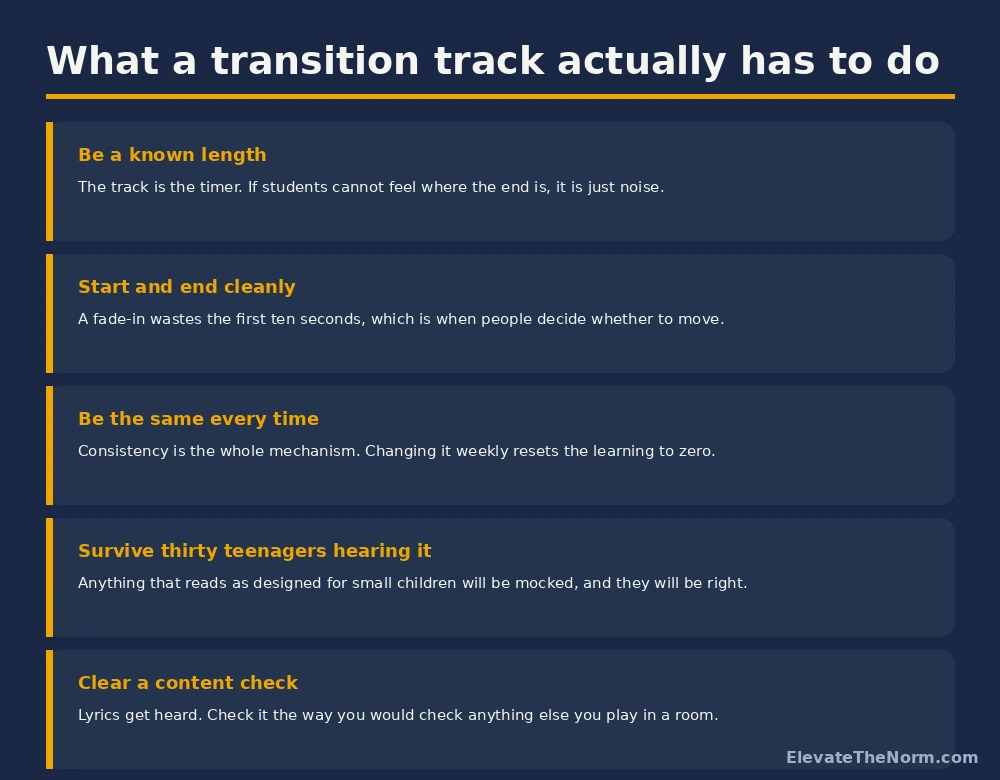
Five requirements, and the first one is the only non-negotiable.
Known length. Ninety seconds for a quick move, three minutes for packing up and a closing task. Cut the track to length yourself if you need to. If students cannot feel where the end is, you have background music rather than a signal.
Clean start and end. A long fade-in wastes the first ten seconds, which is exactly when people decide whether this is happening.
The same track, every time. This is the mechanism. A different song each week is a pleasant thing that teaches nothing.
Credible with teenagers. Instrumental works well — film scores, video game soundtracks, anything with momentum and no words to parse. Television theme tunes are a popular choice and they do have a real advantage: most are written to a fixed short length, and the recognition itself is part of the signal. The failure mode is picking something so old that nobody recognises it, at which point you have simply chosen a strange piece of music.
Content-checked. Lyrics get heard, including by the student who tells a parent about them. Check a track the way you would check anything else you put in front of thirty students, and be aware that a clean radio edit is not the same as a clean song.
One more, which is practical rather than pedagogical: whatever you play needs to be something you are permitted to play in your building, on equipment that works, without a login that fails on a Tuesday. A cue that depends on a streaming service loading is a cue that will fail publicly.
Music Is One Cue Among Six
Worth saying plainly, because the search for the perfect transition song is usually a distraction from a cheaper fix.
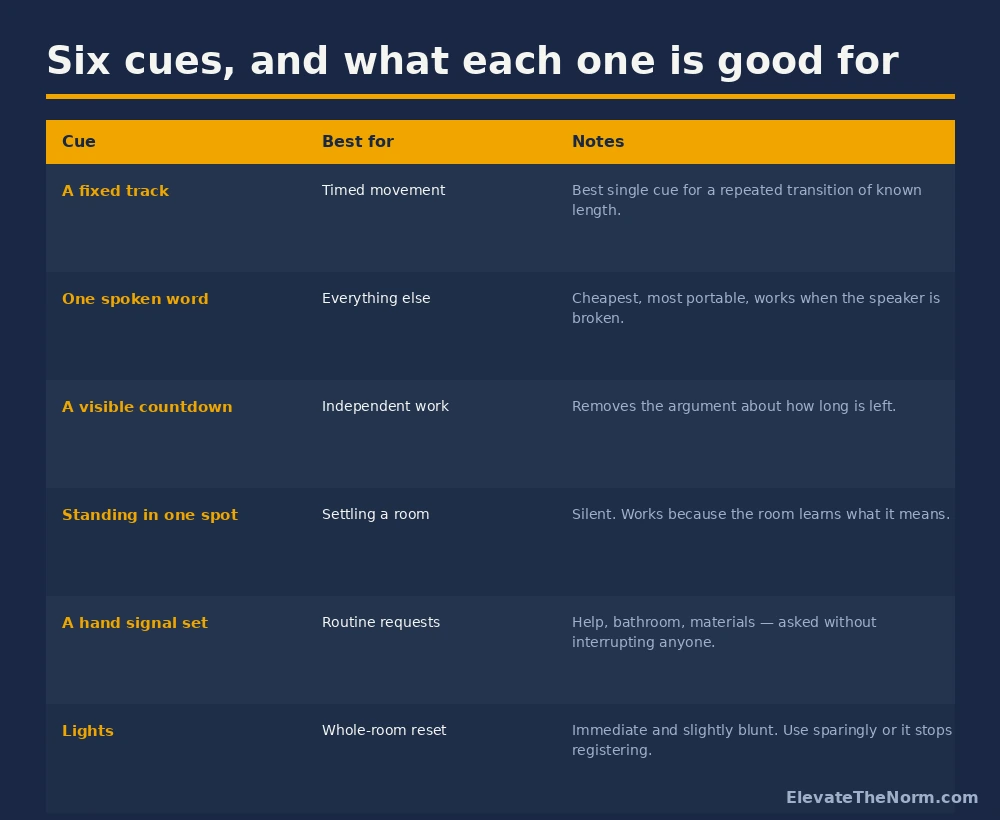
A single consistent spoken word does more work than any track, costs nothing, and cannot be broken by a dead speaker. Music earns its place specifically where the transition is repeated, has a known duration, and benefits from everyone being able to hear the clock.
Lights deserve one caution. Flicking the lights is immediate and slightly blunt, and using it often enough that students stop noticing is easy. It also lands badly for some students — an abrupt sensory change is not neutral for everyone in the room.
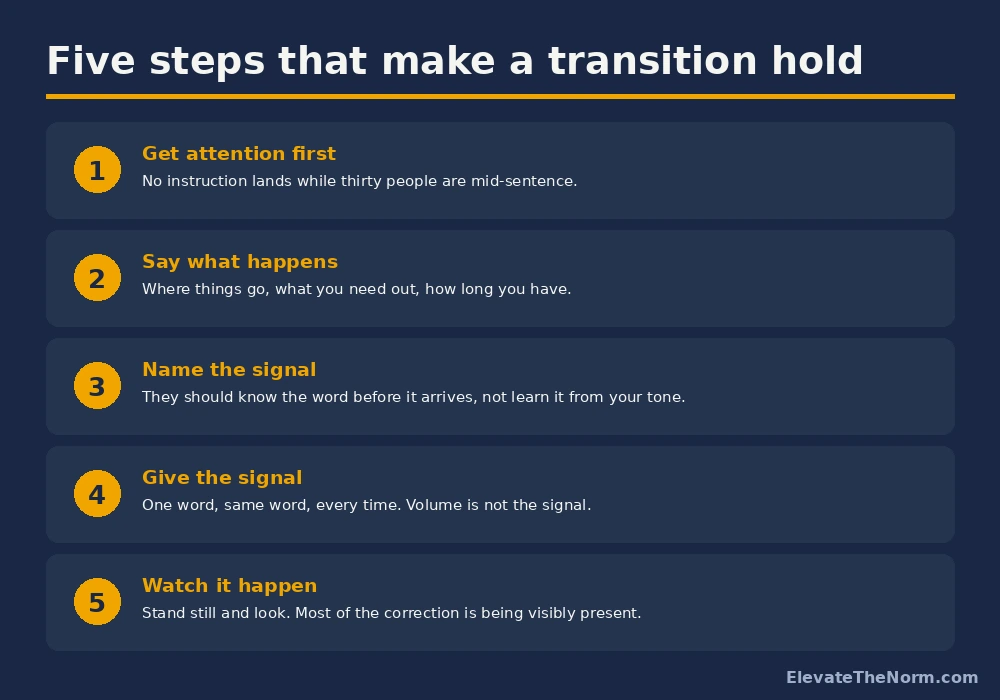
All of these sit inside the broader work of running transitions properly. The cue is step four of five, and no cue rescues a transition where the instructions were given while people were already moving.
Teenagers Want More Than They Will Admit
My students voted on getting a class pet. They wanted one.
That surprises people who do not teach high school. It stopped surprising me a while ago. High school students want the small things — the pet, the cheap prizes, the recognition. They just may not show it on the outside, and a teacher who reads the flat expression as the actual opinion will strip every one of those things out of the room and then wonder why it feels dead.
Transition music is squarely in that category. A fifteen-year-old is not going to tell you the song is good. Some of them will make a point of telling you it is bad. Watch what happens when you forget to play it, which is the only reliable measurement available — and notice that in the Finnish study, the thing students named most often was not the music but the routine it created.
So do not poll the class on whether to keep it during week one. You will get the answer the room feels obliged to give. Run it for a month and judge it on whether the transition got shorter.
Teaching the Signal So It Lands in Five Seconds
Classroom Check-Up, a project funded through the US Department of Education’s Institute of Education Sciences, sets a concrete benchmark: students should respond to an attention signal within five seconds. That is a usable number, and it turns an argument about whether the class is “being difficult” into a measurement.
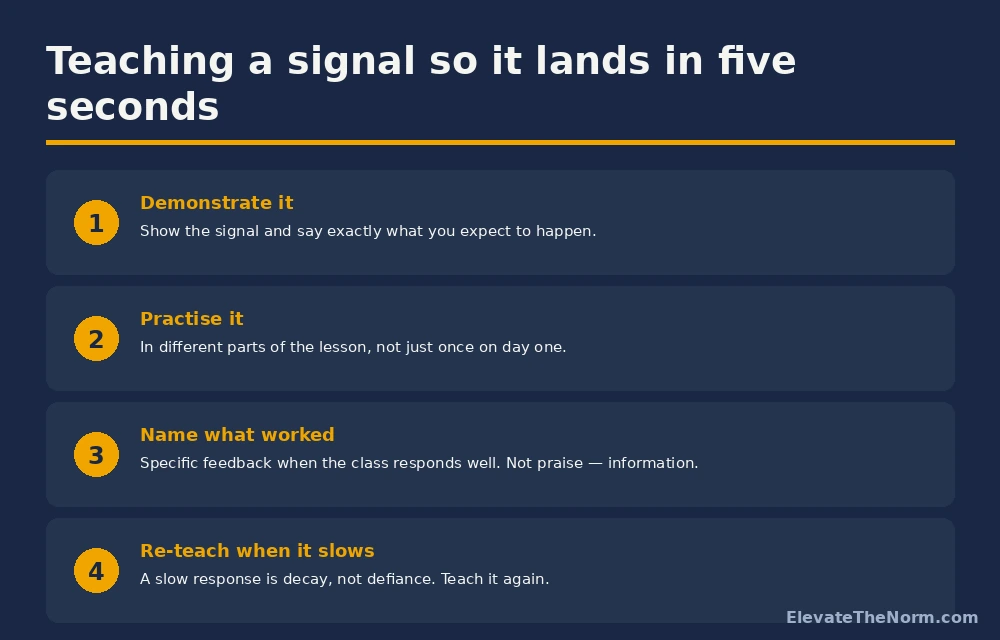
Their implementation sequence is demonstrate, practise across different parts of the day, give specific feedback when students respond correctly, and re-teach when the response slows. They also note a signal should work without the teacher needing to be in a particular spot — which quietly rules out several popular options that depend on you standing at the front.
Two adaptations for older students. Their examples lean young — rhythmic clapping, counting phrases — and a call-and-response chant will not survive a Year 10 room. Use the structure and change the signal. And “specific feedback” should mean information rather than praise: that took about four seconds, which is where we want it lands with teenagers in a way that well done everyone does not.
When the response slows in November, that is decay rather than defiance, and the fix is the same as for any other routine that needs re-teaching.
Where This Goes Wrong
- An elementary song in a secondary room. The most common failure and the most deserved. If the lyrics instruct students to tidy up, it is the wrong track.
- A different song every week. Pleasant, and it teaches nothing. Consistency is the mechanism.
- Music as background rather than signal. Playing something during work is a different decision with different evidence behind it. Do not confuse the two.
- Volume creep. If the track has to get louder to be heard over the room, the cue has already failed.
- Depending on a login. A signal that requires a streaming service to load will fail publicly, and the class will remember.
- Asking the class whether they like it. You will get the answer the room feels obliged to give. Measure the transition instead.
What to Do Next
Pick one repeated transition — packing up is usually the best candidate, because it has a natural length and it is where the most time leaks. Choose one instrumental track, cut it to the length you actually want, and use the same one every day for a month without discussing it.
Time the transition in week one and again in week four. That number is the only review this needs. If it has not moved, the problem is almost certainly upstream in how the instruction is given, not in the song.
Before you go: grab the free Classroom Transitions Toolkit (PDF) — ElevateTheNorm.com branded, printable, no email required.
Frequently Asked Questions
Will high school students actually tolerate transition music?
More readily than most teachers expect, though few of them will say so. A Finnish study of students aged 15 to 19 found significant self-reported gains in mood, motivation and concentration from five minutes of music before lessons, and around 61 percent wanted it in all or most classes. In my experience the flat expression is not the actual opinion — teenagers want the small things and simply do not advertise it. The reliable test is what happens the day you forget to play it.
What kind of song works for classroom transitions in secondary?
Instrumental, recognisable, and a known length. Film scores and video game soundtracks work well because they carry momentum without lyrics to parse. Television theme tunes are popular for a real reason — most are written to a fixed short length and the recognition is itself part of the signal — but pick something current enough that the room actually knows it. What fails is anything written to instruct young children, which will be mocked, fairly.
How long should a transition song be?
Match it to the job rather than to the track. Ninety seconds for moving into groups, two to three minutes for packing up plus a closing task. Cut the audio to the length you want instead of picking a song and accepting its running time — the length is the entire function, so it should be a decision rather than a coincidence.
Does background music help students learn?
That is a different question from using music as a transition signal, and the evidence is far weaker than the internet suggests. The Finnish study measured self-reported mood, motivation, concentration and learning, not test performance, and had no control activity — so the gains cannot be attributed specifically to music rather than to any pleasant break. Using a track as a timed signal is well founded. Claiming background music raises achievement is not.
How fast should a class respond to a signal?
Within five seconds, which is the benchmark Classroom Check-Up uses. It is worth actually timing rather than judging by feel. A class at eight or ten seconds is not defying you — the signal has decayed and needs re-teaching, which takes about two minutes and works far better than expressing frustration about it.
What if I cannot play music in my room?
Use a single consistent spoken word and a visible countdown, and you lose very little. Music is one cue among six and rarely the one doing the most work. The spoken word is cheaper, more portable, survives broken equipment, and does not depend on anything loading. If your transitions are poor, the cue is unlikely to be the reason.
Is flicking the lights a good signal?
It is immediate and it works, but use it sparingly. It is blunt enough that frequent use stops registering, and an abrupt sensory change is genuinely unpleasant for some students in a way a sound is not. Reserve it for a whole-room reset rather than making it your standard transition cue.
Sources
- Vigl, J., Ojell-Järventausta, M., Sipola, H., & Saarikallio, S. (2023). Melody for the mind: Enhancing mood, motivation, concentration, and learning through music listening in the classroom. Music & Science, 6. Read the study — 48 Finnish students aged 15–19, within-subjects across two weeks. All outcomes self-reported; no control activity; final sample below the authors’ own power target. Their stated limitations are summarised in the text above.
- Classroom Check-Up. Using an attention signal. Funded by the U.S. Department of Education, Institute of Education Sciences. Read the guidance — the source for the five-second response benchmark and the four-step teaching sequence. The page cites Reinke, Herman and Sprick (2011) and Sprick (2009) and reports no quantitative data of its own.
Every link above was checked on September 12, 2026. This page deliberately recommends no specific songs by title, because a track that is recognisable to students this year may mean nothing to them in three.