Classroom routines and procedures are the taught, repeated ways a room handles its ordinary business — entering, getting materials, asking for help, moving between tasks, handing work in, leaving. In grades 6–12 they are worth explicit teaching for one reason: every minute a class spends negotiating a procedure is a minute nobody is learning anything, and there are a lot of those minutes.
The word “taught” is doing the work in that sentence. Most secondary teachers have a set of procedures. Far fewer have taught them the way they would teach content — named, demonstrated, practised, and re-taught weeks later when they slip.
This is the part of classroom management with the most evidence behind it and the least glamour attached to it.
Key Takeaways
- Structure is one of five evidence-based features of classroom management identified in the standard review of this literature — alongside explicitly teaching and reviewing expectations.
- Routines are held with reminders, not consequences. If forgetting a pencil costs a mark, you have a discipline system, not a routine.
- Teach them like content. Name it, show it, practise it, remind it. The practice step is the one everybody skips.
- Re-teach at the start of every term, not just in August. Routines decay. Planning for the decay is cheaper than reacting to it.
- Twelve routines cover most secondary rooms. More than that and nobody remembers them, including you.
- Be honest about the evidence. About half the studies in the main review are more than twenty years old, and the authors say they do not know how these practices should vary by school level.
What Classroom Routines and Procedures Actually Are
A procedure is how something gets done. A routine is that procedure once it has been practised enough that nobody thinks about it. The gap between the two is entirely teaching time, and the mistake is assuming teenagers skip that gap because they are old enough to have worked it out.
They have worked something out. They have worked out what the previous four teachers wanted, and those four all wanted different things. A fourteen-year-old moving through six rooms a day is running six different operating systems. Assuming they will intuit yours is not high expectations — it is just an unwritten test.
This is also why routines are not the same thing as rules. Rules say what is forbidden. Routines say what happens. A room with clear classroom expectations and no routines will still lose ten minutes a period to logistics.
What the Research Supports
The standard reference is Simonsen, Fairbanks, Briesch, Myers and Sugai’s review in Education and Treatment of Children, which screened the literature for practices meeting a real evidentiary bar — sound design, empirical validation, clear procedures, replication across sites, and evidence of sustainability — and identified twenty practices across five critical features.
Two of those five features are what this article is about: maximise structure, and post, teach, review, monitor and reinforce expectations. Not post. Post and teach and review and monitor. The verbs are the finding.
Parsonson’s review in Kairaranga lands in the same place from the behaviour-analysis side, listing clear consistently applied rules and predictable routines among the antecedent strategies that reduce disruption — the ones that work by preventing the problem rather than responding to it. The same paper reports that teacher greetings and brief small talk raised on-task behaviour from around 45 percent to around 75 percent, which is a striking figure for something that costs nothing and takes place before the lesson starts.
The caveats, stated by the authors themselves
Simonsen and colleagues note that roughly half the studies in their review were conducted twenty or more years ago, and that the literature does not tell us how these practices should be adjusted across school levels, ability levels or demographic contexts. That last gap is the one that matters here: this is a grades 6–12 site, and the evidence base does not cleanly separate a seventh grader from a second grader.
So the honest position is that structure and explicitly taught expectations are about as well supported as anything in classroom management, and that the specific shape they should take in a secondary room is professional judgment rather than settled science.
Twelve Classroom Routines Worth Teaching
Twelve is not a target to hit. It is roughly what a secondary room actually needs, and going much past it means nobody remembers any of them, including you.
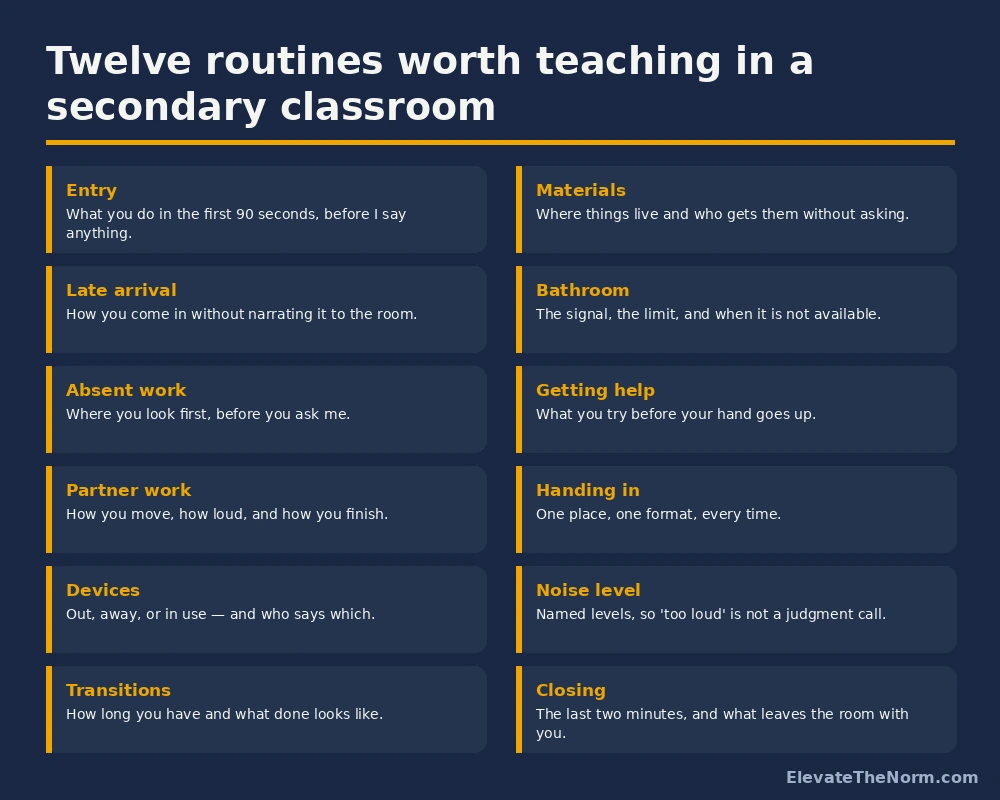
The Indiana classroom management primer for middle and secondary teachers, written by Mary Ellen Adams and Pamela Ray, names a similar core: arriving, submitting work, group work, restroom, getting supplies, and getting help from the teacher. Their instruction is to put routines in writing and teach them, at the start of each term, with periodic review.
Three on the list above are worth singling out because secondary teachers most often leave them implicit.
Getting help. “What do you try before your hand goes up?” If you have never answered that out loud, half your class is waiting for you and the other half has given up. Name two or three moves — check the board, ask your partner, look at the example — and the queue at your desk halves.
Late arrival. A student who is late is already having a worse day than you are. A taught routine — come in, sit down, catch up from the board, see me at the end if it matters — removes the performance entirely. Without one, every late arrival becomes a small public event.
Noise level. “Too loud” is a judgment you are making that students cannot predict. Named levels — silent, partner voice, group voice — turn an argument into a correction that takes one word.
The routine that pays back fastest is not on that list as a single item, because it runs through several of them. Classroom transitions — into the room, into group work, back out of it, and out of the door — are where the measured time actually goes, and they are worth scripting before anything else here. If you want the signal itself to carry the timing rather than your voice, a transition track students can hear is the cheapest version of that.
How to Teach a Routine So It Actually Holds
Four moves, in order. It takes about six or seven minutes per routine the first time and almost nothing afterwards.
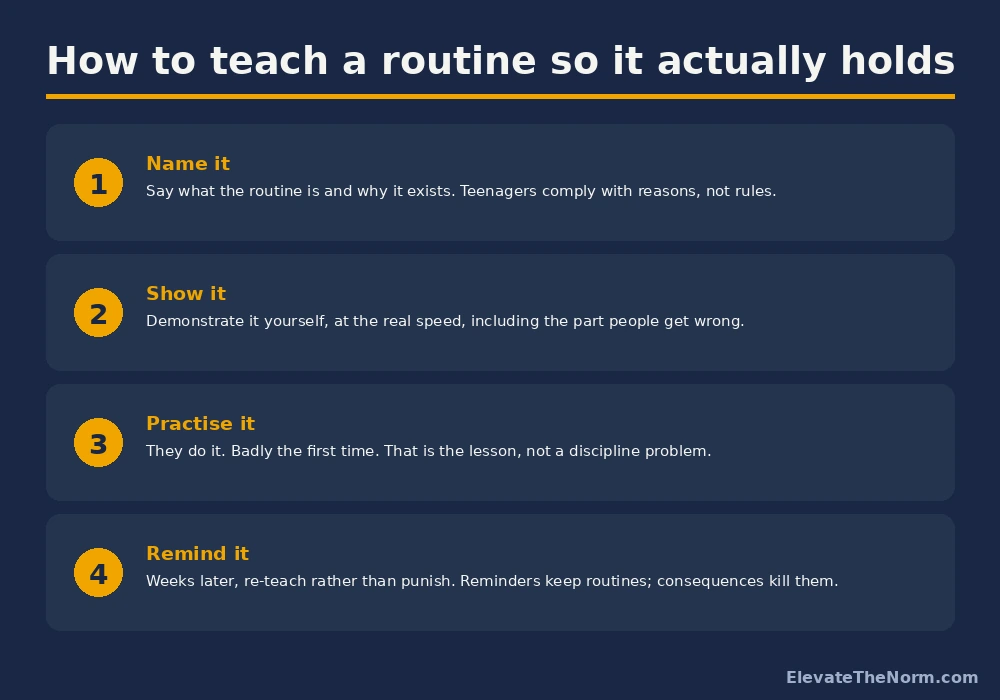
Name it, with the reason. Teenagers comply with reasons far more reliably than with rules. “We hand in to one tray so that nobody’s work goes missing and I am not carrying six piles” takes four seconds and buys you the rest of the year.
Show it. Do it yourself, at real speed, including the bit people get wrong. Demonstrating the failure mode is more useful than demonstrating the ideal.
Practise it. They do it. It will be bad the first time — that is the lesson working, not a behaviour problem. This is the step that separates a room where routines hold from a room where they were announced once in August.
Remind it. Six weeks later it will have decayed. Re-teach it to the whole class rather than correcting individuals, because individual correction turns a decayed routine into a story about particular students.
Reminders Hold Routines. Consequences Do Something Else.
This is the single most useful distinction in the article, and the Indiana primer states it directly: routines are enforced through reminders rather than consequences. Their example is the pencil — keep loaners rather than punishing the student who forgot one.
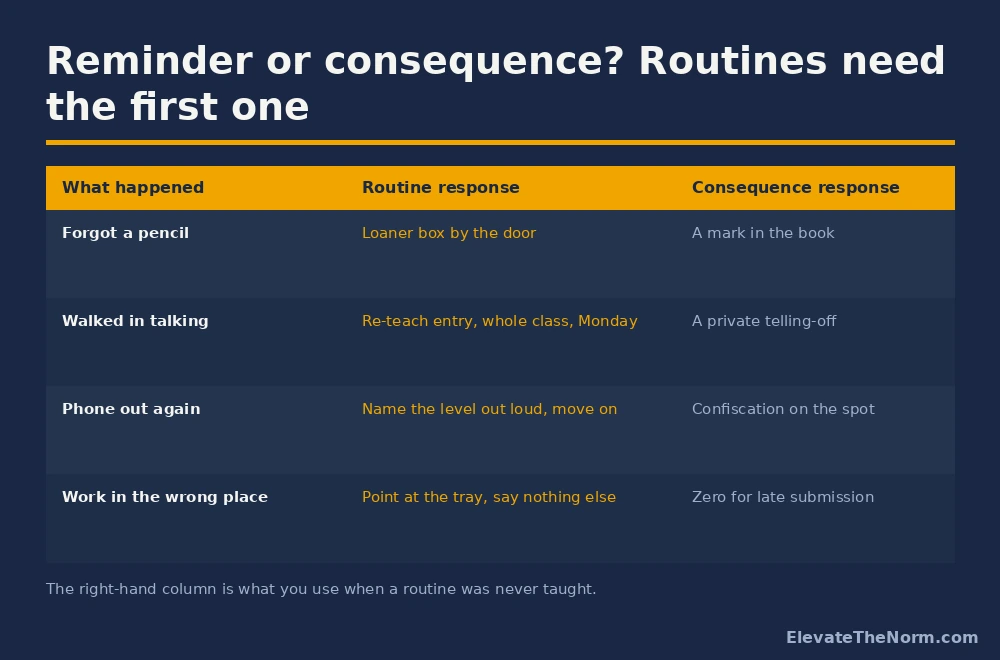
The reason is practical rather than soft. A consequence attached to a routine failure teaches students that the routine is a trap, and their attention moves from doing the thing to avoiding the penalty. A reminder keeps the routine a piece of housekeeping, which is what it is.
Consequences are still real and still necessary — for choices, for harm, for repeated refusal after the routine has genuinely been taught. That is a different system, and it is worth keeping the two apart deliberately. Consequences that teach rather than humiliate are a separate piece of work from a room that runs smoothly.
The test: if your response to a routine failure would feel strange applied to the whole class at once, it is a consequence and it does not belong here.

The Routine That Does the Most Work in My Room
Working next to somebody is the resting state of my classroom, not a reward I hand out on a Friday. The tables are pushed together in pairs and fours and they stay that way, which means partner work needs no setup, no announcement and no transition.
That is a routine decision disguised as a furniture decision. When collaboration is the default, the only thing that ever needs announcing is silence — and silence is easy to ask for and easy to get. When rows are the default, every piece of partner work costs you ninety seconds of scraping chairs, and you start quietly avoiding it.
The other half of it is telling them the plan for the day down to the minute, on the board, before anything starts. Those times are a budget and a promise rather than a script — when I miss them I say so out loud and give the reason, which is the part that keeps it honest. A room that knows what is coming and roughly how long it has does not need most of the routines on that list of twelve enforced at all. They just happen.
When to Establish Classroom Routines
The first week, obviously. Less obviously: the first week of every term, and the week after any long break.
Adams and Ray put it as teaching routines at the start of each term with periodic review throughout, and that is the right cadence. Routines decay — not because students are testing you, but because six weeks is long enough to forget which of six teachers wanted which thing.
Three moments worth putting in your calendar now:
- Week one of the year. Teach four or five routines properly rather than twelve badly. Entry, materials, getting help, handing in. The rest can wait.
- Week one of each new term. Re-teach, do not re-announce. Fifteen minutes, whole class, no reference to anyone’s behaviour.
- The day back after a long break. Assume everything has decayed and plan for it, and the day costs you nothing instead of costing you a week.
If you want the printable version to plan from, the free classroom routines and procedures checklist lists them with space to write your own wording, no email required.
Where Routines Break Down in Secondary Classrooms
- Announced but never practised. The most common failure by a distance. Saying it once is not teaching it.
- Too many at once. Twelve routines in week one is twelve routines nobody retains. Four, properly, beats twelve badly.
- Enforced with consequences. Turns housekeeping into a discipline system and makes the room adversarial over pencils.
- Never re-taught. Then the November version gets treated as defiance rather than decay.
- Inconsistent from the adult. If the tray is the routine, it is the routine on the day you are tired too.
- Unexplained. A routine without a reason reads to a teenager as arbitrary, and they are not wrong.
What to Do Next
Pick the single routine costing you the most time right now — for most secondary teachers it is entry or getting help — and teach it properly this week. Name it with the reason, demonstrate it including the failure mode, have the class practise it, and put a reminder in your calendar for six weeks out. If the routine you need is the one that governs reading on a screen rather than on paper, the twenty-minute digital reading routine is already scripted minute by minute and can be taught the same four ways.
One routine, taught properly, will buy back more minutes than a list of twelve announced on the first day and never mentioned again. Then do the next one next month. This is slow work, and it is the kind that compounds.
Frequently Asked Questions
What is the difference between a classroom routine and a classroom rule?
A rule says what is not allowed. A routine says how something gets done. “No phones out” is a rule; “phones go face down in the top corner of the table unless I say otherwise” is a routine. Rules need enforcement, routines need teaching and reminders. Most secondary rooms have plenty of rules and not enough routines, which is why so much time goes on logistics.
How many routines should I actually teach?
Four or five properly in the first week, building to around a dozen over the term. Twelve announced on day one is twelve nobody remembers. Start with the ones costing you the most time — usually entry, materials, getting help, and handing work in — and add the rest as they become necessary.
Isn’t this a bit young for high school students?
The content is not young; the assumption that teenagers already know your procedures is just untested. A student moving through six rooms a day is running six different systems, none of which they chose. Teaching yours explicitly is not treating them like children — it is removing a guessing game. What would be condescending is the tone, not the practice, so teach them the way you would teach anything else to an adult: name it, give the reason, move on.
What do I do when a routine stops working in November?
Re-teach it to the whole class, without reference to anyone in particular. Routines decay on a predictable schedule and November is right on it. Treating decay as defiance is the most common way a functioning routine turns into a behaviour problem. Fifteen minutes of whole-class re-teaching costs less than a term of individual corrections.
Should students help decide the routines?
For some of them, yes, and it works better in secondary than people expect. Noise levels, how partner work ends, and what counts as a reasonable bathroom signal are all genuinely negotiable and students will hold a standard they helped set. Safety procedures, anything your school mandates, and anything involving how work is recorded are not negotiable, and pretending otherwise creates a problem later.
How do routines work if I share a room or teach on a cart?
Focus on the routines that live in people rather than furniture — entry, getting help, handing in, noise levels, closing. Anything depending on a fixed physical setup will not survive a shared room, so do not build your system on it. Write your core routines on something portable and post it in the same place every period; the consistency of the location matters more than the location itself.
Do routines actually improve learning, or just behaviour?
Honestly, the direct evidence is about behaviour and time on task rather than achievement. The reviews that support structure and explicitly taught expectations measure disruption, on-task behaviour and engagement. The learning argument is an inference: time not spent on logistics is time available for instruction. That inference is reasonable, and it is not the same thing as a study showing routines raise test scores.
Routines are also what a stranger inherits. A procedure that is obvious to your students is invisible to someone covering the class, which is why running a room that isn’t yours depends so much on what the regular teacher wrote down.
Sources
- Simonsen, B., Fairbanks, S., Briesch, A., Myers, D., & Sugai, G. (2008). Evidence-based practices in classroom management: Considerations for research to practice. Education and Treatment of Children, 31(3), 351–380. Full text (PDF) — the source for the five critical features, and for the authors’ own caution that about half the reviewed studies are twenty or more years old.
- Parsonson, B. S. (2012). Evidence-based classroom behaviour management strategies. Kairaranga, 13(1), 16–23. Full text (PDF) — the source for predictable routines as an antecedent strategy and for the greeting figures, which Parsonson reports from other studies rather than testing directly.
- Adams, M. E., & Ray, P. (2016). A classroom management primer for middle and secondary school teachers. Indiana Commission for Higher Education. Read the primer (PDF) — the source for teaching routines at the start of each term and for enforcing them through reminders rather than consequences.
Every link above was checked on September 12, 2026. Where a figure is reported by a review rather than measured in it, the text says so.