The Elevate Blog banner: Real Classrooms. Practical Ideas. Higher Expectations. Three students climb a rocky ridge at sunrise, each pulling the next one up, toward a teacher reaching down to help.

Tag: effect size

  • Formal vs Informal Formative Assessment: What Actually Separates Them

    Formal vs Informal Formative Assessment: What Actually Separates Them

    By Clay Shumate

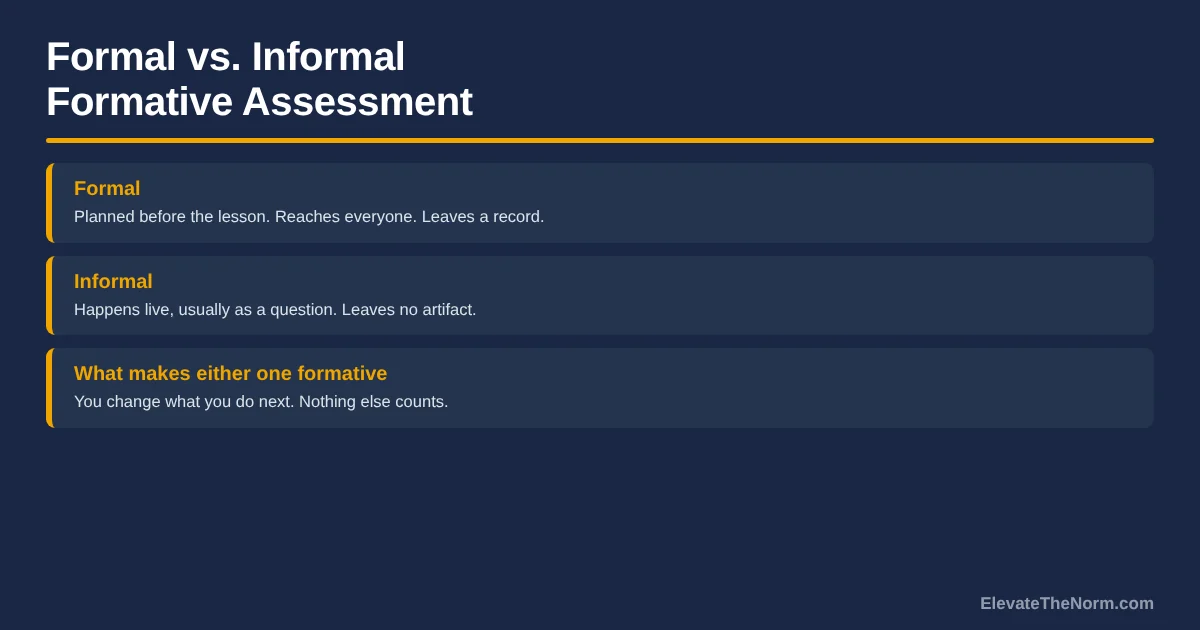
    Formal formative assessment is planned before the lesson and produces a record you can look at later — an exit ticket, a quiz, an embedded prompt. Informal formative assessment happens in the moment, usually through questioning, and leaves no artifact. Both are formative only if you actually change what you do next.

    Key Takeaways

    • The difference between formal and informal formative assessment is planning and evidence, not rigor: formal checks are designed ahead of time and leave a record, informal checks happen live and do not.
    • Informal questioning is the most common form of formative assessment in classrooms, which means most teachers are already doing the harder one badly rather than not doing it at all.
    • Ruiz-Primo and Furtak’s ESRU model — elicit, student responds, recognize, use — is the clearest test of whether an informal check was real. Most classroom questioning stops at the second step.
    • The famous 0.4 to 0.7 effect size for formative assessment is not well supported. A 2011 meta-analysis found a weighted mean of 0.20 across 42 effect sizes, and a 2012 critique argued even that number is unreliable.
    • Formal and informal are not a clean binary. WestEd lists informal-versus-formal as just one of fourteen dimensions along which formative assessments vary.

    Every district PD session on formative assessment eventually reaches the slide that says “formal vs. informal,” and the slide is almost always wrong. It usually implies formal means serious and informal means casual, which leaves teachers thinking the real work is the exit ticket and the questioning is just talking.

    It is the other way around more often than not. The informal version is harder to do well, happens hundreds of times a day, and is the one nobody ever gets coached on. This article explains what the distinction actually is, what the research says about each, and when to use which. If you want the strategies themselves rather than the categories, the full list of formative assessment strategies is the better starting point.

    What is the difference between formal and informal formative assessment?

    Formal formative assessment is planned in advance, given to everyone at a set point, and produces something you can look at after the bell. Informal formative assessment is unplanned, happens inside instruction — usually as a question — and produces only what you noticed at the time. Both are formative because of what you do with the information, not because of the format.

    That last clause is the one people skip. Formative assessment is defined by purpose, not by instrument. Black and Wiliam’s 1998 definition, still the one most researchers use, covers activities that “provide information to be used as feedback to modify the teaching and learning activities.” A quiz you collect, grade, and never act on is not formative. A question you ask and genuinely respond to is.

    WestEd’s review of the research makes the same point and then complicates it usefully: formal and informal are not two boxes but a spectrum, and the report lists informal-versus-formal as only one of fourteen dimensions along which formative assessments vary — alongside spontaneous versus planned and curriculum-embedded versus stand-alone. Those dimensions overlap but they are not the same axis. A question can be planned in advance and still leave no record. An exit ticket can be invented on the spot.
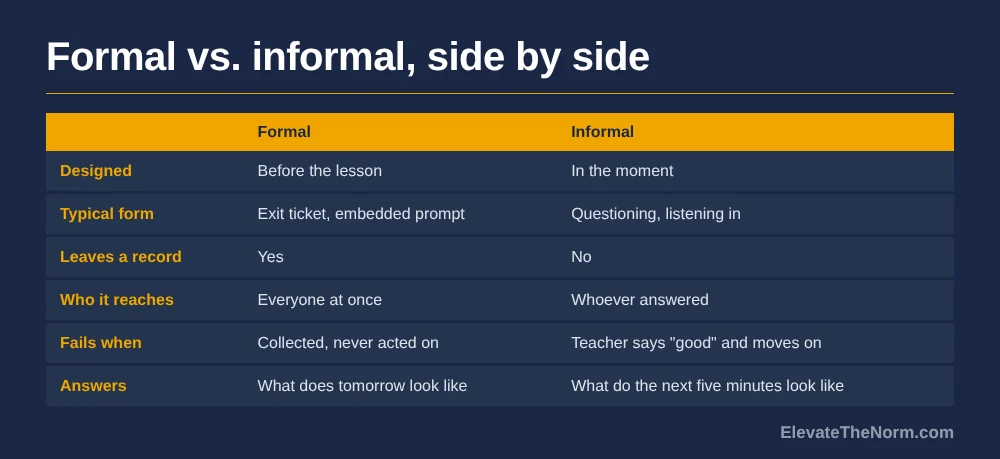
    Comparison table of formal and informal formative assessment across six rows: when it is designed, typical form, whether it leaves a record, who it reaches, how it fails, and which question it answers.
    Formal and informal formative assessment compared across six dimensions.
    Formal formative assessmentInformal formative assessment
    When it is designedBefore the lessonIn the moment, usually inside a discussion
    Typical formsExit ticket, embedded written prompt, ungraded quiz, hinge question on a slide, whiteboard checkQuestioning, listening in on group work, reading over a shoulder, a follow-up probe
    Leaves a record?Yes — you can sort it, re-read it, bring it to a PLCNo, unless you write something down
    Who it reachesEveryone, at onceWhoever answered, which is rarely everyone
    Main failure modeCollected and never acted on; becomes a gradeTeacher hears the answer, says “good,” and moves on
    Cost per usePlanning time up front, review time afterAlmost no prep; high cognitive load during the lesson
    Best forDeciding what tomorrow looks like; evidence you can show someoneDeciding what the next five minutes look like
    Grade it?NoNot possible, and that is a feature
    Formal and informal formative assessment compared on the dimensions that change what a teacher does.

    What counts as informal formative assessment?

    Questioning, mostly. WestEd calls informal questioning the most common form of formative assessment there is. It also includes listening to a group argue, reading over a shoulder during work time, and the follow-up probe you ask when an answer sounds memorized.

    The useful research here comes from Maria Araceli Ruiz-Primo and Erin Furtak, who studied three middle school science teachers working through a physical science unit on buoyancy and built a model called the ESRU cycle. It has four steps: the teacher Elicits a response, the Student responds, the teacher Recognizes what the response actually revealed, and the teacher Uses it to do something different.

    That fourth step is where almost all classroom questioning dies. A teacher asks, a student answers, the teacher says “right” and keeps going. That is an E and an S. Nothing was assessed. The ESRU model is valuable precisely because it makes the gap visible: in Ruiz-Primo and Furtak’s study, the teacher who more often completed full cycles had students who performed better on an embedded assessment than the students of the other two teachers.

    Be careful how much weight you put on that result. It is three teachers, in middle school science, in one unit, with no control group — a point later raised by Derek Briggs and colleagues when they reviewed how this literature gets synthesized. It is a good model and a small study. Treat the ESRU cycle as a coaching lens, not as proof of an effect size.
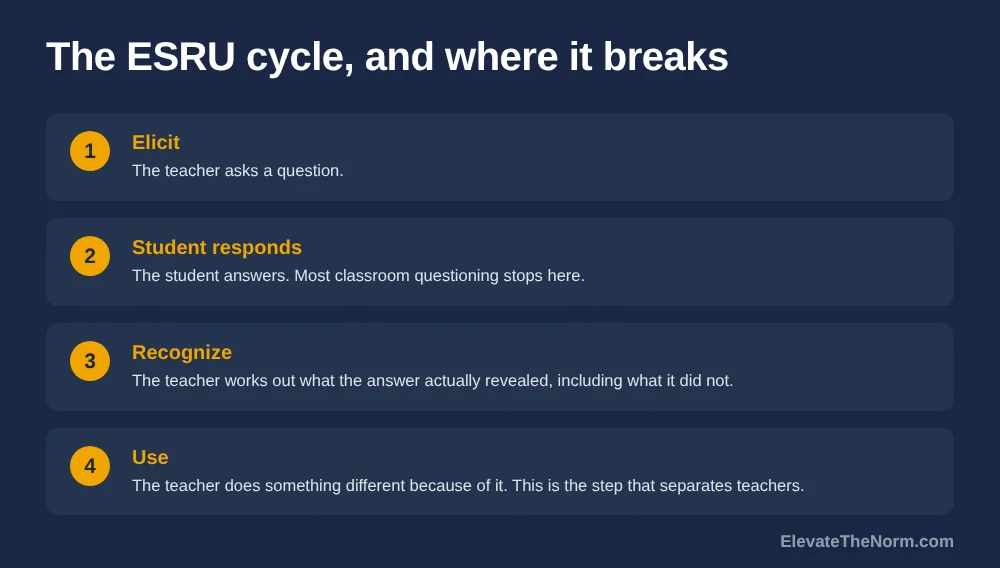
    The four steps of the ESRU cycle for informal formative assessment: elicit, student responds, recognize what the answer revealed, and use it to do something different. Most classroom questioning stops at the second step.
    The ESRU cycle, and the step where most questioning stops.

    What counts as formal formative assessment?

    Anything written and planned that you designed to show whether the class is ready to move on — and that you do not grade. Exit tickets, embedded written prompts, whiteboard checks, hinge questions, ungraded quizzes. Each sits at a point in the unit where you need a decision, and each is built before the lesson rather than improvised in it.

    What makes these formal is not that they are written. It is that you decided in advance what you needed to know and built an instrument to find out. WestEd describes these as embedded prompts, often requiring a written response, placed at key points in instruction to identify next steps. The planning is the point: a question you wrote yesterday is almost always a better question than one you improvise at 10:42.

    The failure mode is equally specific. A formal check becomes a small summative test the moment it enters the gradebook, and students respond accordingly — they protect the score instead of showing you the confusion. If you want the evidence to be honest, the check cannot count. That is also the argument running through our piece on what standards-based grading actually fixes.

    Is formal formative assessment the same thing as summative assessment?

    No, and this is the confusion that wrecks the whole topic. Formal and informal describe how a check is built. Formative and summative describe what the result is for. They are two separate axes, which means a written test can be formal and formative, formal and summative, or — most commonly in real schools — formal, labeled formative, and used summatively.

    Run the four combinations and the distinction gets concrete. A planned exit ticket you sort and act on is formal and formative. A unit test that decides a grade is formal and summative. A follow-up question that changes your next sentence is informal and formative. And a teacher mentally marking a student as “one of the weak ones” based on an offhand answer is informal and summative, which is the one nobody names and the one that does the most damage.

    That fourth box deserves a sentence of its own. An informal check that quietly hardens into a judgment about a student is not assessment at all; it is a prediction, and teenagers notice being predicted. If an informal check does not change what you do, it should not change what you think about who the student is either.

    The practical test for any check, formal or informal: name the decision it feeds. If the only answer is “it shows me where they are,” it is going in a gradebook or a drawer, not into instruction.

    Which one works better?

    No study answers that cleanly, and anyone who tells you otherwise is extrapolating. The honest position is that the evidence base for formative assessment as a whole is thinner than its reputation, and it has almost never been broken out by formal versus informal.

    Start with the number everybody quotes. Black and Wiliam reported in 1998 that “typical effect sizes of the formative assessment experiments were between 0.4 and 0.7,” drawing on 250 sources. That range is on a thousand PD slides.

    It did not hold up. Neal Kingston and Brooke Nash reviewed more than 300 K–12 studies in 2011 and found that only 13 reported enough information to calculate an effect size. From 42 independent effect sizes they got a median of 0.25 and a weighted mean of 0.20 — a third of the low end of the famous range. By subject: English language arts 0.32, mathematics 0.17, science 0.09.

    And then the correction got corrected. In 2012 Derek Briggs, Maria Araceli Ruiz-Primo, Erin Furtak, Lorrie Shepard and Yue Yin argued that the 0.20 figure is not reliable either: the search was not replicable, studies meeting the criteria were excluded while one without a control group was included, and effect sizes calculated with and without pretest data are not comparable. In one study they recalculated, the mean shifted from −0.32 to −0.14 depending on the formula. Their conclusion is the one worth carrying: a different sample of studies could produce an average substantially higher or lower, so considerable uncertainty remains.

    What that means for a Tuesday: formative assessment is a reasonable bet with an unreliable price tag. Do not choose between formal and informal on the strength of an effect size, because there is no credible effect size for either one separately.

    When should you use which?

    Match the check to the decision you are about to make. Informal checks tell you what to do in the next five minutes. Formal checks tell you what tomorrow looks like. If you are not about to make either decision, you are collecting data for no one.

    • Mid-explanation, something feels off. Informal. Stop, ask one student to say the last step back in their own words, then probe the part they skipped. You need an answer in ten seconds, not a record.
    • Deciding whether to move to the next lesson. Formal. You need everyone, not the four hands that go up. Three questions on the way out is enough.
    • Group work is running and you cannot tell who is doing the thinking. Informal. Listen without intervening for ninety seconds per group; you learn more than any written check will tell you.
    • A misconception you have seen every year. Formal, and planned months ago. Write the prompt that exposes it and put it in the unit at the point it usually appears.
    • You have to explain a reteach decision to a coach, a parent, or a PLC. Formal. “It felt shaky” is not evidence. Sixty-one exit tickets is.

    How do you run both in one week with 150 students?

    Run informal checks constantly and formal checks twice a week, and read the formal ones in a sort rather than a grade. The whole system should cost you under thirty minutes of out-of-class time per week, or it will not survive October.

    1. Pick one informal habit to improve, not five. The highest-value one is the U in ESRU: after a student answers, do something with it out loud. “So if that’s true, what happens when…” Thirty seconds, no prep, and it is the step the research says separates teachers.
    2. Write two formal checks when you plan the unit, not the night before. Place them at the two points where students have historically gotten lost. Three questions each, maximum.
    3. Sort, do not grade. Three piles: got it, partial, not yet. Count the piles. That takes about eight minutes for 150 papers and it is the only number you need.
    4. Change one thing tomorrow because of the piles. Reteach the partials in a ten-minute opener, or pull the “not yet” group while everyone else starts. If nothing changes, stop running the check.
    5. Tell students what the pile meant. Not a score — the actual gap. A check students cannot see the result of teaches them that checks are for the teacher.
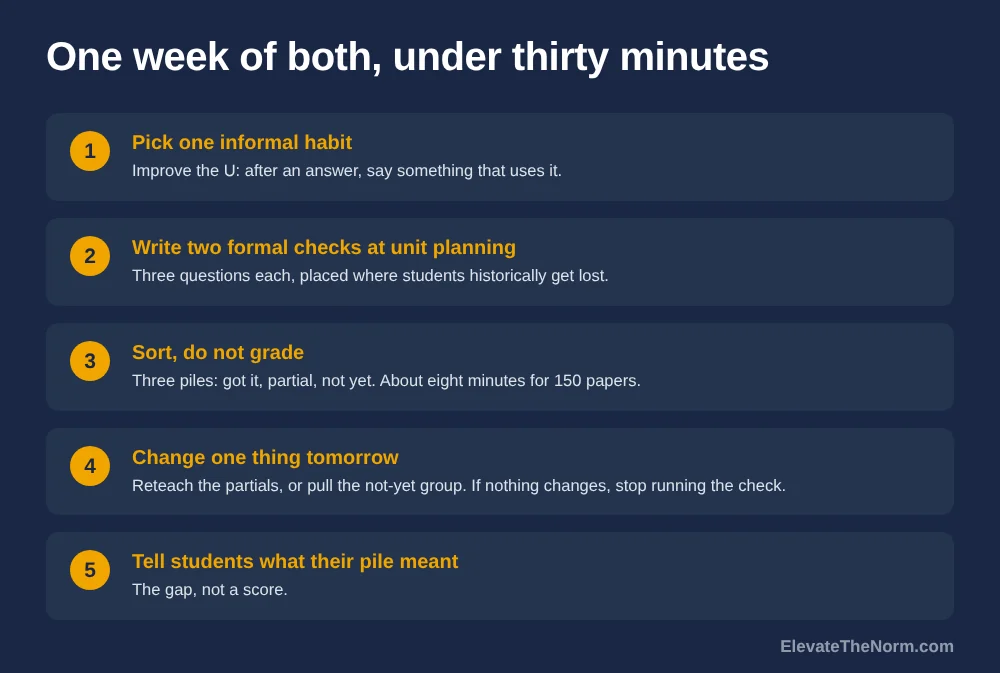
    Five steps for running both formal and informal formative assessment in one week in under thirty minutes: improve one informal habit, write two formal checks during unit planning, sort rather than grade, change one thing tomorrow, and tell students what their pile meant.
    A week of both, for under thirty minutes of out-of-class time.

    Subject-specific versions of step two are worth stealing rather than inventing: there are worked examples for reading, writing and science, and a free printable set if you would rather not build from scratch.

    What does good informal formative assessment look like to an observer?

    It looks like the teacher changing course. An observer cannot see a formative check directly, because the evidence is a decision rather than a document. What they should watch for is the gap between what the lesson plan said and what the teacher actually did after a student spoke.

    Four things worth looking for, whether you are being observed or doing the observing:

    • Follow-up questions outnumber new questions. A room where every question goes to a different student is a room where nothing is being probed.
    • Wrong answers get used rather than corrected. “Say more about that” after a wrong answer is the single clearest sign the teacher is assessing rather than quizzing.
    • The plan visibly bends. Something got cut, repeated, or reordered during the period.
    • Being wrong is survivable. If the only students answering are the ones who are sure, the informal check is sampling the wrong population and the data is worthless.

    That last point is not a soft one. An informal check only works if students will show you a half-formed idea, and they will only do that if the room is safe for it — which is why respect that goes both ways is an assessment issue before it is a culture issue.

    What should a school actually invest in?

    Coaching on the informal side and time to build the formal side — in that order, and neither of them is a purchase. The most common district response to formative assessment is to buy a platform or mandate a template, and both of those produce compliance rather than instruction.

    Three things that cost staffing rather than software:

    1. Someone scripting questioning with teachers. A coach sitting in for twenty minutes and transcribing the question-and-answer sequence is the only feedback that improves informal checks. There is no template for the U in ESRU.
    2. Unit planning time that includes writing the two checks. If the checks are written during planning, they land at the right points and cost nothing in-week. If they are written the night before, they will be generic and they will stop in October.
    3. A rule that formative checks do not enter the gradebook. This is free, it is the single biggest determinant of whether the evidence is honest, and it has to come from leadership because an individual teacher who stops grading checks looks like they are lowering the standard.

    One caution on the evidence, since this is where a district asks for it. The strongest study design in this area is Decristan and colleagues’ cluster-randomized trial of embedded formative assessment, and it found that the assessment and general classroom process quality — cognitive activation, supportive climate, classroom management — interacted. The practice did not work on its own; it worked in rooms that were already running well. That sample was elementary science, so a secondary leader is reasoning by analogy. But the implication travels: a formative assessment rollout in a building where classroom management is the real problem is solving the second problem first.

    Clay’s take: the informal one is the one nobody coaches

    Districts invest in the formal side because it produces artifacts, and artifacts are what you can put in a binder. So teachers get templates, exit ticket banks, and a data meeting. Nobody sits in the back of a room and says, “you asked eleven questions this period and used the answer to two of them.”

    That is backwards, and it is backwards for a reason worth naming: the informal version is the one that respects students as thinkers. A written check asks a teenager to produce the right answer. A real follow-up question asks them to explain their reasoning to an adult who is actually listening, and then does something visible with what they said. Teenagers can tell the difference between those two experiences instantly.

    The other thing I would say to an administrator: do not mandate a daily exit ticket. You will get 180 pieces of paper a year per teacher and no change in instruction, because the mandate produces the artifact and the artifact is not the thing. Ask instead what got retaught last week and why. If the answer is specific, the assessment is working regardless of what format it took.

    What should you do next?

    Count your U’s for one period. Teach normally, and afterward mark how many times a student answer actually changed what you said next. Most teachers find the number is one or two, and most are surprised by that. It is the cheapest diagnostic in this whole article and it does not require a template.

    Then add exactly one formal check to next week’s plan, sort it into three piles, and change one thing because of it. If you want strategies to fill that slot, go to the main strategies list; if you are assessing a project rather than a lesson, assessment for project-based learning covers the version where there is no unit test at the end.

    Frequently Asked Questions

    What is the difference between formal and informal formative assessment?

    Formal formative assessment is planned before the lesson, given to the whole class, and leaves a record you can review later – an exit ticket or an embedded written prompt. Informal formative assessment happens live inside instruction, usually through questioning, and leaves no artifact. Both are formative only if the teacher changes something as a result.

    Is a quiz a formal or an informal formative assessment?

    A quiz is formal, because it is planned in advance and produces a record. Whether it is formative depends on what happens next. If the score goes in the gradebook and nothing is retaught, it functioned as a small summative test. If you sort the results and change tomorrow’s lesson, it was formative, regardless of the name on it.

    Which is more effective, formal or informal formative assessment?

    No credible study separates them. Formative assessment as a whole has a contested evidence base: the often-quoted 0.4 to 0.7 range from 1998 was revised to a weighted mean of 0.20 in a 2011 meta-analysis, and a 2012 critique argued even 0.20 is unreliable. Choose based on the decision you need to make, not on an effect size.

    What is the ESRU cycle?

    ESRU stands for elicit, student responds, recognize, use. Ruiz-Primo and Furtak proposed it in 2007 to describe informal formative assessment: the teacher asks, the student answers, the teacher recognizes what the answer revealed, and the teacher uses it. Most classroom questioning stops after the student answers, which means no assessment actually happened.

    Should formative assessments be graded?

    No. The moment a check counts, students protect the score instead of showing you what they do not understand, and the evidence you get back is worse. Sort the responses into got it, partial and not yet, tell students what their pile meant, and keep the gradebook out of it. The point is a teaching decision, not a number.

    How many formal formative assessments should I run per week?

    Two is enough for most secondary courses, placed at the points in a unit where students historically get lost. Three questions each. If you are running one every day and never changing instruction because of them, you have added paperwork rather than assessment. The weekly cost should stay under thirty minutes of out-of-class time.

    Does informal formative assessment work with a class that will not talk?

    Only if you fix the talking first, because informal checks sample whoever answers. In a quiet room the four confident students become your data, which tells you almost nothing about the other twenty-six. Use written formal checks as the backbone until wrong answers are survivable, then shift weight back toward questioning.

    Sources

    About Clay Shumate

    Clay Shumate is a certified secondary Social Studies teacher in the public schools of West Alabama, with seven years of classroom experience, a B.A. in History, and an M.Ed. in Secondary Education. He writes about project-based learning, student responsibility, respect, and practical ways to hold young people to a higher standard while giving them room to learn from mistakes. He is a member of the Society of Professional Journalists and writes to its Code of Ethics; this site’s editorial standards and corrections policy are published in full. More about Clay.

  • Collective Teacher Efficacy: What the 1.57 Effect Size Actually Means

    Collective Teacher Efficacy: What the 1.57 Effect Size Actually Means

    By Clay Shumate

    Collective teacher efficacy is the shared belief among a staff that, working together, they can move student learning — and it carries the largest effect size in John Hattie’s rankings, 1.57. That number is real, it is correlational, and it is almost certainly too large to mean what your next professional development day will tell you it means.

    Both halves of that sentence matter. Below is where 1.57 came from, why the researcher who published it alongside Hattie thinks numbers like it get misread, and what a secondary department can actually do with the idea once the slide deck is over.

    Key Takeaways

    • Collective teacher efficacy is a belief about the group, not about you. Not “I can teach this kid” — “we can teach these kids.” That distinction is the whole construct.
    • The 1.57 figure is correlational. It describes schools where staff belief and student achievement travel together. It does not establish which one moved first, and the honest answer is that success probably builds belief at least as much as belief builds success.
    • The same journal published the rebuttal. Matthew Kraft, writing with Hattie in Educational Leadership, calls effect size “a misleading term” and reports that only 13 percent of nearly 2,000 effect sizes from randomized trials reached 0.40 at all.
    • A big effect size is not a plan. Nothing about 1.57 tells you what to do Monday, which is why it shows up on so many slides and changes so few schools.
    • What the research does name is conditions — evidence that the work is landing, structures where teachers actually talk, and enough safety that a teacher can say “that lesson did not work” out loud.
    • The cheapest version of this is one conversation. Ask a colleague how they teach the thing you teach badly. That is the whole mechanism, and it does not require a framework.

    Free Download · PDF

    The Effect Size Sanity Check

    Five questions to run any effect size through before it reaches a slide or a board packet — plus Hattie’s hinge point set beside Kraft’s causal benchmarks, the 1.57 figure worked all the way through, and a blank sheet for the next number somebody hands you.

    Download the free PDF

    Free. No email address required. Designed for grades 6–12. Browse every printable in Your Free Library.

    What Is Collective Teacher Efficacy?

    It is the shared belief among the teachers in a building that their combined effort can move student learning, including for the students who are hardest to move. The unit is the group. That is what separates it from ordinary teacher confidence.

    The difference sounds academic until you hear it in a hallway. “I can get through to that kid” is individual efficacy. “The kids who come to us behind, leave us less behind” is collective. The second one is a claim about what a staff can do together, and it is the kind of sentence you either hear in a building or you do not.

    You can hear the absence of it just as clearly. A department where the honest summary is “there is only so much we can do with these kids” has low collective efficacy, and everybody in it knows, and nobody says it in those words.

    Two things are worth naming before the numbers. Collective efficacy is measured by asking teachers what they believe, usually on a survey. And the outcome it is correlated with is student achievement, usually on a test. Both of those are real measurements and both have the obvious limits of a survey and a test.

    Where Does the 1.57 Effect Size Come From?

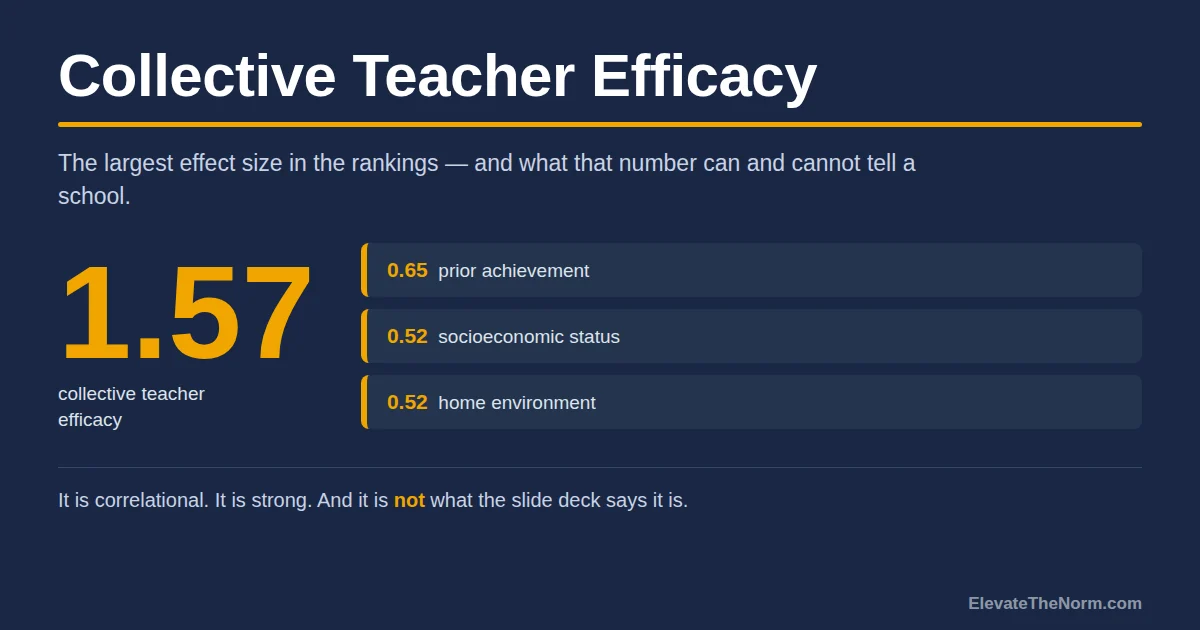
    From Donohoo, Hattie and Eells, writing in ASCD’s Educational Leadership in March 2018. They place collective teacher efficacy at an effect size of 1.57, and they compare it directly against three things schools usually treat as fixed.

    Here is the comparison as they present it:

    • Collective teacher efficacy — 1.57
    • Prior achievement — 0.65
    • Socioeconomic status — 0.52
    • Home environment — 0.52

    Their framing is that collective efficacy is “greater than three times more powerful and predictive of student achievement than socioeconomic status,” and more than double the effect of prior achievement. You can see why it travels. It is a research finding that says the thing schools control matters more than the things they do not, and every educator in the room wants that to be true. I want it to be true.

    One caution about that comparison before anyone puts it in a board packet. “Beats socioeconomic status three times over” is one short step from “poverty is not the problem, attitude is,” and that step gets taken in rooms where budgets are decided. The study does not support it. Comparing a belief measured by survey against a demographic measured by household income tells you those two numbers relate differently to test scores — not that one can be swapped for the other. A staff with tremendous collective efficacy and no counselor is still a staff with no counselor.

    That is exactly why the number deserves a harder look than it usually gets.

    Why the 1.57 Is Almost Certainly Too Big

    Because effect sizes drawn from correlational research are inflated relative to effect sizes drawn from experiments, and 1.57 is the correlational kind. The clearest statement of this problem was published by ASCD too, three years later, with Hattie himself on the byline.

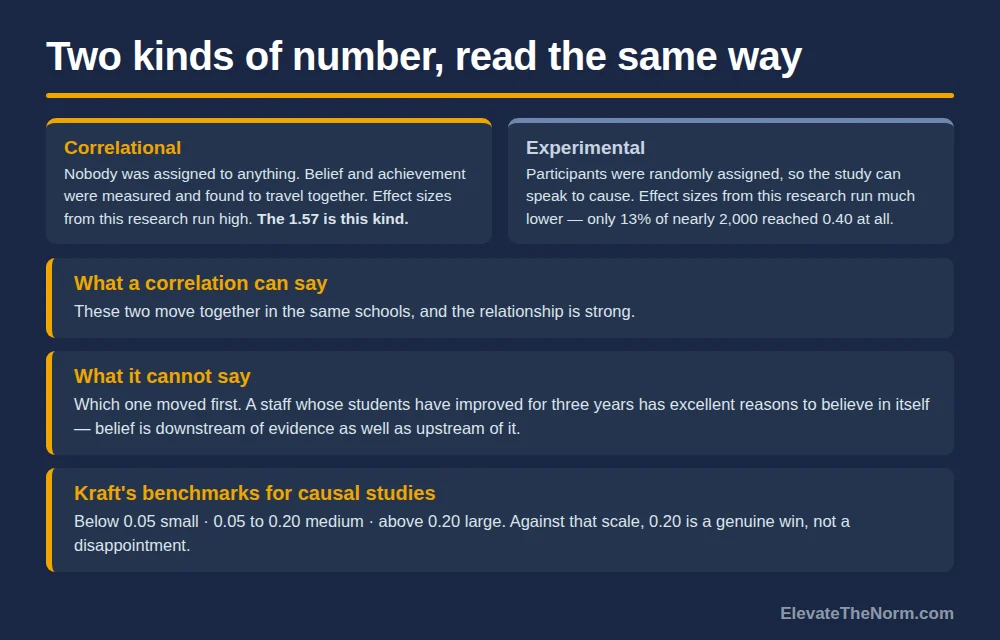
    Two-column comparison of correlational and experimental research, noting that only 13 percent of nearly 2,000 randomized-trial effect sizes reached 0.40
    A correlation says two things travel together. It does not say which one moved first.

    In that 2021 piece, Brown University economist Matthew Kraft argues that “effect size is such a misleading term,” because an effect size “tells us nothing about whether the underlying relationship represents cause and effect or a simple correlation.” It is a translation of a relationship onto a common scale. It is not a measure of whether one thing caused the other.

    Kraft goes further, and this is the part that should change how you read every effect size you are shown. Looking at nearly 2,000 effect sizes from randomized controlled trials — studies built to establish cause — he found that only 13 percent reached 0.40 or larger. Hattie’s widely quoted 0.40 “hinge point,” the line above which an intervention is supposedly worth having, sits near the top of what carefully controlled education research actually produces.

    So Kraft proposes different benchmarks for causal studies: below 0.05 is small, 0.05 to 0.20 is medium, and above 0.20 is large. Against that scale, an effect size of 0.20 is not a disappointment. It is a genuine win.

    Hattie’s reply in the same article is fair and worth stating: 0.40 was always an average across all the studies in his database, offered as a starting point for a conversation rather than a universal pass mark. That is a reasonable defense of what he wrote. It is not much of a defense of how the number gets used in a faculty meeting.

    The specific problem with 1.57 is direction. Schools where teachers believe they can collectively succeed also tend to post higher achievement. Nothing in a correlation tells you which came first — and the common-sense reading runs at least partly backwards. A staff whose students have been improving for three years has excellent reasons to believe in itself. Belief is downstream of evidence, not only upstream of it.

    The honest version of the claim is smaller and still worth having: collective efficacy and achievement travel together, the relationship is strong, and the arrow probably runs both directions. That is defensible. “Believe harder as a staff and test scores follow” is not.

    This is not a new standard for this site. We ran the same check on formative assessment’s headline numbers, where a widely repeated 0.4 to 0.7 range comes from a 1998 review and a later meta-analysis landed nearer 0.20.

    Does That Mean Collective Efficacy Doesn’t Matter?

    No. It means it is a condition, not an intervention. Those are different things and schools keep buying the second when the research describes the first.

    An intervention is something you do to a class on Tuesday. A condition is the state of the building that determines whether Tuesday’s thing has a chance. Collective efficacy is the second kind. You cannot run it in fourth period. You also cannot run much of anything well without it.

    Which is why “we are going to build collective teacher efficacy this year” is a sentence that means nothing on its own. It is like announcing that the department will have good morale. The belief is the readout, not the lever.

    That has a direct purchasing consequence, and it is the one a district leader should take from this. You cannot buy a readout. A program promising to raise collective teacher efficacy is selling you the dial rather than the engine — the same substitution that turns teacher appreciation week into a catered lunch instead of the conditions staff actually asked for — and the survey score will move whether or not anything underneath it did. The spend that actually maps to the research is duller and harder to put in a press release: protected common time, and the data work required to show a staff whether last year’s push moved anything.

    What Actually Builds Collective Efficacy?

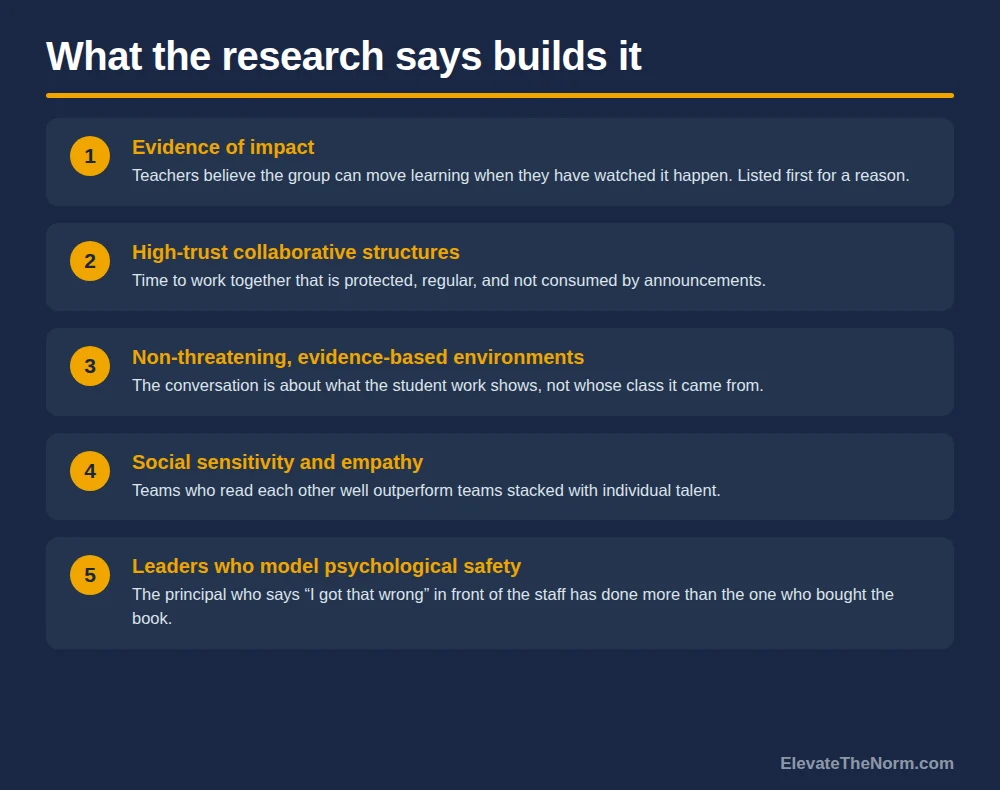
    Evidence that the work is landing, structures where teachers genuinely talk, and enough safety to say “that did not work” out loud. Donohoo, Hattie and Eells name a set of enabling conditions, and none of them is a belief you can adopt by deciding to.

    Numbered list of five enabling conditions for collective teacher efficacy: evidence of impact, high-trust collaborative structures, non-threatening evidence-based environments, social sensitivity and empathy, and leaders who model psychological safety
    Four of the five belong to whoever controls the schedule and the tone.

    The conditions they list:

    • Evidence of impact on student outcomes. Teachers believe the group can move learning when they have watched the group move learning. This is first for a reason, and it is the one that explains the direction problem above.
    • High-trust collaborative structures. Time to work together that is protected, regular, and not consumed by announcements.
    • Non-threatening, evidence-based environments. The conversation is about what the student work shows, not about whose class it came from.
    • Social sensitivity and empathy among team members. Teams where people read each other well outperform teams stacked with individual talent.
    • Leaders who model psychological safety. The principal who says “I got that wrong” in front of the staff has done more for this than the principal who buys the book.

    Read that list again and notice what is not on it. No slogan. No banner. No survey. Four of the five are structural and belong to whoever controls the schedule and the tone, which in most buildings is not the classroom teacher.

    None of those four is free, and a protected common period is the most expensive thing on the list — it is a master-schedule decision that costs staffing, and pretending otherwise is how this advice gets dismissed by the person who builds the schedule.

    That is not a reason for a teacher to disengage. It is a reason to be precise about the ask. If your department wants this, the request is not “more collaboration.” It is a protected common period, an agenda that is about student work, and an administrator who does not treat a failed lesson as a performance problem. Those are three specific things an administrator can say yes or no to — which is the same reason a specific, answerable ask beats a general one every time.

    The Effect Size Sanity Check

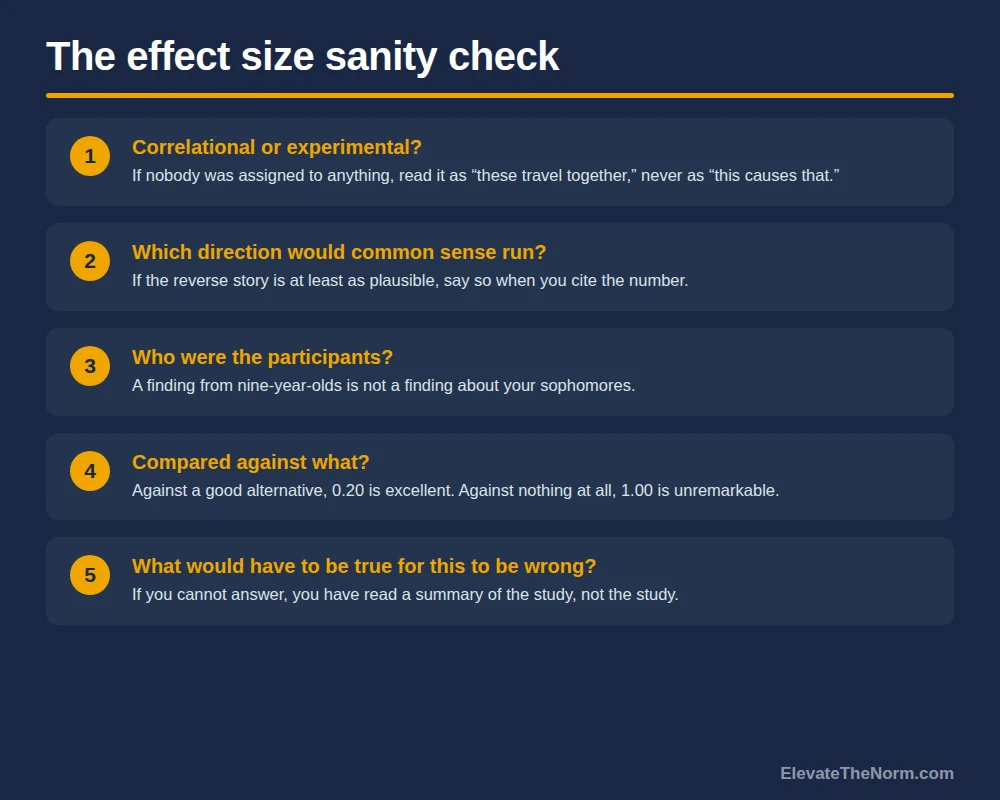
    Five questions to run any effect size through before you repeat it. None of them requires statistics training, and together they catch most of what goes wrong between a study and a slide. It is the same scepticism worth bringing to any claim made for a professional development program.

    Numbered list of five questions to ask about any effect size: correlational or experimental, which direction common sense would run, who the participants were, what it was compared against, and what would have to be true for it to be wrong
    1. Correlational or experimental? If nobody was assigned to anything, the number describes a relationship, not a result. Read it as “these travel together,” never as “this causes that.”
    2. Which direction would common sense run? Ask it out loud. If the reverse story is at least as plausible — success building belief rather than belief building success — say so when you cite the number.
    3. Who were the participants? A finding from nine-year-olds is not a finding about your sophomores. This one disqualifies more education research than any other question on the list.
    4. Compared against what? An effect size is always a comparison. Against a good alternative, 0.20 is excellent. Against nothing at all, 1.00 is unremarkable.
    5. What would have to be true for this to be wrong? If you cannot answer, you have not finished reading the study — you have finished reading a summary of it.

    Run the 1.57 through those five. It fails the first, wobbles on the second, passes the third, and the fourth and fifth are rarely asked at all. That does not make it worthless. It makes it a strong correlation reported honestly, which is a perfectly respectable thing for a number to be.

    What Kills Collective Efficacy Faster Than Anything Else

    Being asked to collaborate while being evaluated on the result. Every other failure mode on this list is a version of that one.

    • Data meetings that are really accountability meetings. The moment a common assessment becomes evidence about the teacher rather than evidence about the learning, honest conversation ends and everyone brings their best class.
    • Collaboration time that gets eaten. A protected period consumed by announcements three weeks running teaches the staff exactly what the period is worth.
    • Mandated agendas. A team handed its problem of practice is a team doing compliance. The problem has to be one the teachers actually have.
    • Treating a failed lesson as a performance issue. One instance of this and nobody in the building admits to a failed lesson again. This is the single most expensive thing an administrator can do here.
    • Celebrating belief instead of evidence. Posters about believing in kids, in a building where nobody can show whether last year’s reading push worked, produce cynicism rather than efficacy.

    What This Looks Like in a Grades 6–12 Department

    Small, specific, and about a unit you are both teaching. The research operates at the level of a building. The version a teacher can start does not.

    The cheapest possible version is one conversation. Pick the thing you teach worst — everyone has one, and if you cannot name yours you have not thought about it hard enough — and ask a colleague who teaches it better how they run it. That is it. That is the mechanism the whole construct is describing, stripped of the vocabulary.

    I would not have written that sentence in my first year. I learned a review format from another teacher on my hall, and the only reason I learned it is that he noticed I was short on ways to review and offered. Keeping your ears open and your mouth closed sometimes pays off. Keeping your ears open and asking questions pays off more, and it is faster.

    The next version up is a shared artifact. Two teachers, one common assessment or one set of student work, one question: what did students do here that we did not expect? Not “how did your class do.” What did the work show. The best department-level version of this I have been part of started with an instructional coach, not an administrator, which is worth saying plainly — a coach is a partner in this, not an evaluator.

    Three things make a two-person version work where a mandated team often does not:

    • You picked the problem. Not the school improvement plan.
    • The evidence is student work, not scores. Work can be looked at together without anyone being graded — and it rarely needs a name on it. Take the name off when the name is not the point.
    • It repeats. Once is a chat. Every two weeks for a semester is a practice, and the same frequency argument runs under every structure worth building — the first run is about the structure, and only the fourth or fifth is about the content. A signal that took six weeks of holding the line before it worked is the same lesson one classroom down.

    None of this needs permission, a budget, or a framework. It needs one colleague and a recurring thirty minutes, which is also roughly what an honest reflection practice costs.

    What Do Students Experience When a Staff Has This?

    Consistency — and they notice its absence long before any adult names it. This is the part of the research that never makes the slide, and it is the part that matters most on a site about treating teenagers as developing young adults.

    A student moving through six classrooms in a day is running an experiment on whether the adults in that building talk to each other. When late work means three different things in three rooms, when one teacher’s “prepared” is another’s bare minimum, when nobody can tell them why the rule changed at the door — that is what low collective efficacy feels like from a desk. Students do not have the vocabulary for it. They describe it as the school not making sense, and they are describing it accurately.

    The reverse is just as visible. In a building where teachers genuinely work together, a student gets the same answer twice, and the second teacher already knows what the first one tried. Teenagers read that instantly, and they read it as being taken seriously. It is the difference between a set of adults and a staff.

    Worth saying plainly: none of that requires students to be told about collective efficacy, and no fourteen-year-old should sit through a presentation about it. They will judge the staff by whether the answers match.

    What to Do Next

    If you are a teacher: name the unit you teach worst, find the person who teaches it better, and ask them this week. One conversation. You do not need to call it anything — and if you are early enough in the job that asking feels like admitting something, that is exactly backwards.

    If you lead a department or a building: stop asking for belief and start supplying the two things it grows from — evidence that the work is landing, and a room where a teacher can say a lesson failed without it costing them. Protect the common period, put student work on the table instead of a spreadsheet, and go first when something does not work.

    And if somebody puts 1.57 on a slide in front of your staff, the useful question is not whether the number is right. It is the one that follows: what would we have to see in our own students’ work to believe it about us? That question has an answer, and chasing it is the actual work.

    Before you go: grab the free The Effect Size Sanity Check (PDF) — ElevateTheNorm.com branded, printable, no email required.

    Frequently Asked Questions

    What is collective teacher efficacy?

    It is the shared belief among the teachers in a school that, working together, they can move student learning — including for the students who are hardest to reach. The unit is the group, which is what separates it from individual teacher confidence. “I can get through to that student” is individual efficacy; “students who arrive behind leave us less behind” is collective.

    What is the effect size of collective teacher efficacy?

    Donohoo, Hattie and Eells put it at 1.57 in ASCD’s Educational Leadership in March 2018, compared against 0.65 for prior achievement and 0.52 for both socioeconomic status and home environment. That figure is correlational, which matters a great deal for how it should be read — it describes belief and achievement travelling together, not belief causing achievement.

    Is the 1.57 effect size reliable?

    It is a real figure from real studies, and it is almost certainly larger than any causal effect would be. Effect sizes from correlational research run higher than those from randomized trials. Writing in the same journal in 2021, Matthew Kraft found that only 13 percent of nearly 2,000 effect sizes from randomized controlled trials reached 0.40 at all. A correlational 1.57 and an experimental 0.20 are not the same kind of number and should not be compared as though they were.

    Does collective teacher efficacy cause higher achievement, or the other way around?

    Nobody can answer that from a correlation, and the reverse story is at least as plausible. A staff whose students have improved for three running years has excellent evidence for believing in itself. That is probably why “evidence of impact on student outcomes” is the first enabling condition the researchers list — belief appears to be downstream of results as much as upstream of them. The defensible claim is that the two reinforce each other.

    What actually builds collective teacher efficacy?

    Five conditions, per Donohoo, Hattie and Eells: evidence that the work is moving student outcomes, high-trust collaborative structures, non-threatening evidence-based environments, social sensitivity among team members, and leaders who model psychological safety. Four of the five are structural, which means they belong to whoever controls the schedule and the tone rather than to an individual teacher.

    Can one teacher do anything about this, or is it an administrator’s job?

    Most of the conditions are structural, but the smallest working version needs no permission: pick the unit you teach worst, find a colleague who teaches it better, and ask them how they run it. Add a shared piece of student work and a recurring thirty minutes and you have a two-person version of the whole thing. What a teacher should not do is carry the structural part alone — that is a specific, answerable request to make of an administrator.

    Why does collective efficacy work fail in so many schools?

    Usually because staff are asked to collaborate openly while being evaluated on what the collaboration reveals. Once a common assessment becomes evidence about the teacher rather than about the learning, everyone brings their best class and the honest conversation stops. Collaboration time that gets eaten by announcements, mandated problems of practice nobody actually has, and treating a failed lesson as a performance issue all do the same damage.

    What is Hattie’s 0.40 hinge point and should I use it?

    It is the line in Hattie’s rankings above which an influence is said to be worth having, and it was calculated as an average across his whole database. Use it carefully. Kraft’s analysis suggests 0.40 sits near the top of what well-controlled education research produces, and he proposes separate benchmarks for causal studies: below 0.05 small, 0.05 to 0.20 medium, above 0.20 large. Hattie’s own reply is that 0.40 was meant as a starting point for discussion rather than a pass mark, which is a fair description of what he wrote and a poor description of how it usually gets used.

    Sources

    1. Donohoo, J., Hattie, J., & Eells, R. (2018). “The Power of Collective Efficacy.” Educational Leadership, 75(6). Source of the 1.57 effect size and the comparison figures for prior achievement (0.65), socioeconomic status (0.52) and home environment (0.52), and of the five enabling conditions. https://www.ascd.org/el/articles/the-power-of-collective-efficacy
    2. Kraft, M. A., & Hattie, J. (2021). “Interpreting Education Research and Effect Sizes.” Educational Leadership. Kraft: effect size is “such a misleading term” and “tells us nothing about whether the underlying relationship represents cause and effect or a simple correlation”; only 13 percent of nearly 2,000 effect sizes from randomized controlled trials reached 0.40; proposed causal benchmarks of <0.05 small, 0.05–0.20 medium, >0.20 large. Hattie’s reply that 0.40 is an average and a starting point appears in the same article. https://www.ascd.org/el/articles/interpreting-education-research-and-effect-sizes

    A note on what is not cited here. Learning Forward’s 2015 article on collaborative expertise is frequently recommended alongside this topic; it sits behind a membership wall and could not be read, so it is not cited. The 1.57 figure is reported as its authors report it, and the limits described in this article are the limits its own co-author published three years later — not an outside attack on it.


    About Clay Shumate

    Clay Shumate is a certified secondary Social Studies teacher in the public schools of West Alabama, with seven years of classroom experience, a B.A. in History, and an M.Ed. in Secondary Education. He writes about project-based learning, student responsibility, respect, and practical ways to hold young people to a higher standard while giving them room to learn from mistakes. He is a member of the Society of Professional Journalists and writes to its Code of Ethics; this site’s editorial standards and corrections policy are published in full. More about Clay.

Teacher Emergency Toolkit — practical resources, real classroom support. Shop on TPT.Teacher Emergency Toolkit — practical resources, real classroom support. Shop on TPT.