By Clay Shumate
Why are classroom expectations important? Because a room without them runs on guesswork, and guesswork is unfair to the student who can’t read your mood on a given day. Clear, taught expectations tell a class exactly what the room requires and what it promises back — protected instructional time, predictable fairness, and a real path toward independence.
Key Takeaways
- Clear expectations reduce discipline problems and protect instructional time — Marzano’s research found teachers with strong management practices and high-quality relationships had 31 percent fewer discipline issues over a full year.
- Expectations are not rules posted on a wall. They are behaviors you teach, model, practice, and revisit — the same way you teach content.
- Adolescents respond better to expectations they understand the reasoning behind. Stating a standard without explaining why it exists invites testing.
- Consistency matters more than severity. A predictable room where small things are addressed early is calmer than a room where nothing happens until someone explodes.
- Expectations must go both ways. If students are expected to be prepared, on time, and respectful, the adult in the room owes them the same.
What Classroom Expectations Actually Are
Classroom expectations are the specific, observable behaviors that define how a learning environment operates. They cover how students enter the room, how they participate, how they treat each other, how they handle materials, what happens when they finish early, and what happens when they need help.
That is different from rules. Rules tell students what not to do. Expectations tell them what to do instead — and the research consistently favors the second approach. Positively stated expectations (“Be prepared with your materials before the bell”) give students a target to hit rather than a minefield to avoid. If you are building a complete set of classroom expectations for the first time, starting with positively stated behaviors is the most important decision you will make.
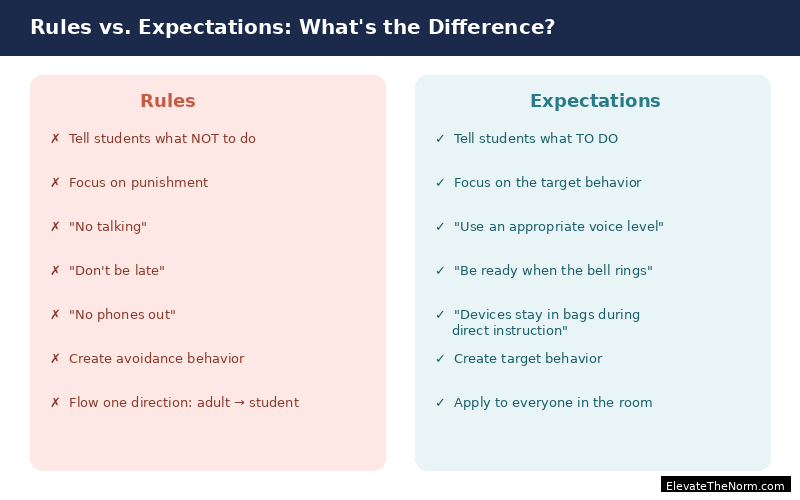
The distinction matters more than it sounds. “No talking” is a rule. “Use a voice level appropriate to the activity” is an expectation. The first one creates a room where students are trying not to get caught. The second creates a room where students are making judgments about what the moment requires — and that judgment is a skill worth developing.
Why Expectations Change Everything in a Secondary Classroom
They Protect Instructional Time
Research from the IRIS Center at Vanderbilt University is direct about this: teachers who establish and maintain clear norms for behavior spend more time teaching because less time goes to discipline (Brophy, 2000). Every minute spent restating a procedure that was never taught properly is a minute taken from the content students came to learn.
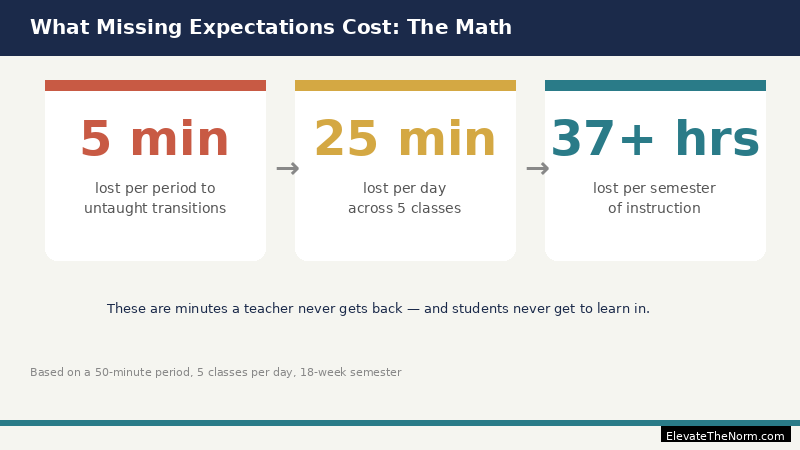
In a secondary classroom with 50-minute periods — or in some cases, 90-minute blocks — lost minutes compound fast. If a teacher loses five minutes every period to transitions that were never practiced, that is 25 minutes a day across five classes. Over a semester, that is roughly 2,250 minutes — more than 37 hours of instruction gone.
They Reduce Anxiety and Guesswork
This is the part most teachers underestimate. Adolescents are performing a complicated identity negotiation every period of every day. They are testing who they are, what their peers think of them, how much authority to accept, and how much risk to take. A room with clear expectations removes one variable from that equation: they do not have to guess what the teacher wants.
The Australian Education Research Organisation reviewed the evidence and found that when behavioral standards are transparent, “students feel more secure because they know where they stand” (DeNobile, 2021). Security does not mean softness. It means the room is predictable — and predictable rooms are calmer rooms.
They Make Fairness Visible
One of the fastest ways to lose a teenager’s trust is to enforce something they did not know existed. When expectations are public, taught, and consistent, a correction becomes a reference to a shared agreement rather than a personal attack. “We said prepared means materials out before the bell — grab your notebook” is a different conversation than “Why aren’t you ready?”
The first version holds the standard. The second version questions the student. Adolescents can feel the difference, and they respond accordingly. This same principle applies to how teachers handle respect in the classroom — fairness is not about treating every moment identically, but about making every standard visible and every correction consistent.
They Build Independence Over Time
Here is what gets overlooked: clear expectations are not about control. They are a scaffold. When students know the procedures, they stop relying on the teacher to direct every transition, every material distribution, and every shift between activities. They run the routines themselves — and that frees the teacher to do the work that actually requires a human being: circulating, checking understanding, pulling small groups, and responding to what students need in real time.
I spend most of my class period moving between groups, sitting down with students at the whiteboard table I built in the corner of my room. That table is the best seat in the house — low lamp, a rug, better chairs. Students ask to come there. But the only reason I can spend my time that way is because the rest of the room is running on expectations we practiced until they became automatic. If I had to stand at the front managing every transition, that table would just be furniture.
How to Teach Expectations (Not Just State Them)
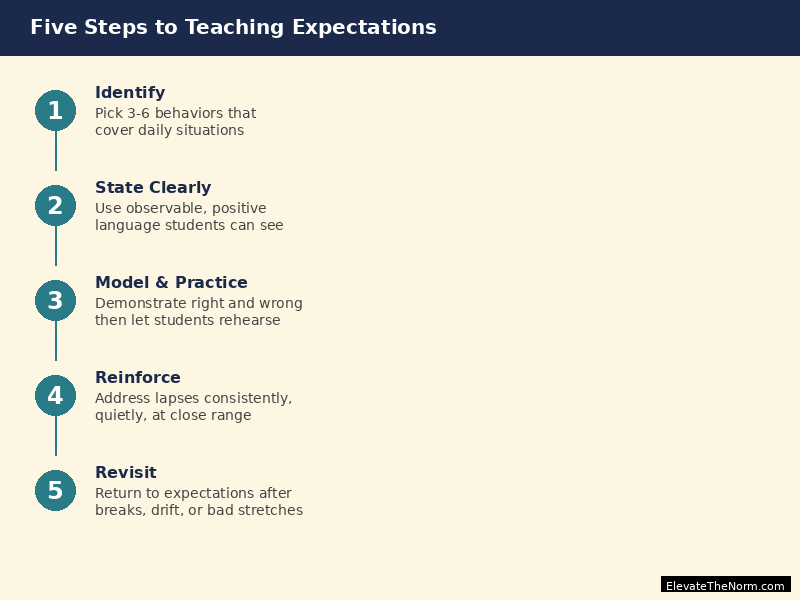
Posting expectations on a wall is step one of a five-step process. Stopping there is the most common mistake secondary teachers make — and it is the reason so many give up on expectations by October. If you have already created a classroom expectations poster, that visual is useful — but it is the beginning of the work, not the end of it. A free Classroom Norms Poster Set on TPT gives you something to point to once the class agrees on what the standard is.
Step 1: Identify the Behaviors That Matter Most
You cannot have 30 expectations. You can have five or six — the ones that cover the situations your students encounter every day. Start with the moments that consistently cause problems: entering the room, transitions between activities, asking for help, working with a partner, and what to do when you finish early.
Step 2: State Them in Observable Language
An expectation is only useful if you can see whether someone is meeting it. “Be respectful” is not observable. “Listen without interrupting when someone is speaking to the class” is. “Be responsible” is not observable. “Turn in your work by the deadline or communicate with me before it passes” is.
The IRIS Center recommends keeping rules few, universal, and positively stated — then linking specific procedures to each one (IRIS Center, 2003). A general expectation like “Be prepared” needs concrete procedures attached: what “prepared” looks like in this room, by this bell, for this type of activity.
Step 3: Model and Practice
This is where secondary teachers get uncomfortable. Modeling expectations feels elementary — and most of us skipped it. But the research is clear: students perform better when expectations are explicitly taught through demonstration, not merely announced (Archer & Hughes, 2011).
Model what a good transition looks like. Model what asking for help looks like. Model the wrong way, too, if you can do it with humor and not sarcasm — so students see the contrast. Then let them practice. The first three days of the year are not lost instruction. They are the most important instruction you will give all year. This is especially critical if you are in your first years and still working out classroom management as a new teacher.
Step 4: Reinforce Consistently, Not Loudly
Marzano’s meta-analysis found that the quality of teacher-student relationships was the most important variable in effective classroom management — teachers with strong relationships and clear expectations had 31 percent fewer discipline problems across the year (Marzano et al., 2003). That finding matters because it means enforcement does not require volume. It requires consistency and connection.
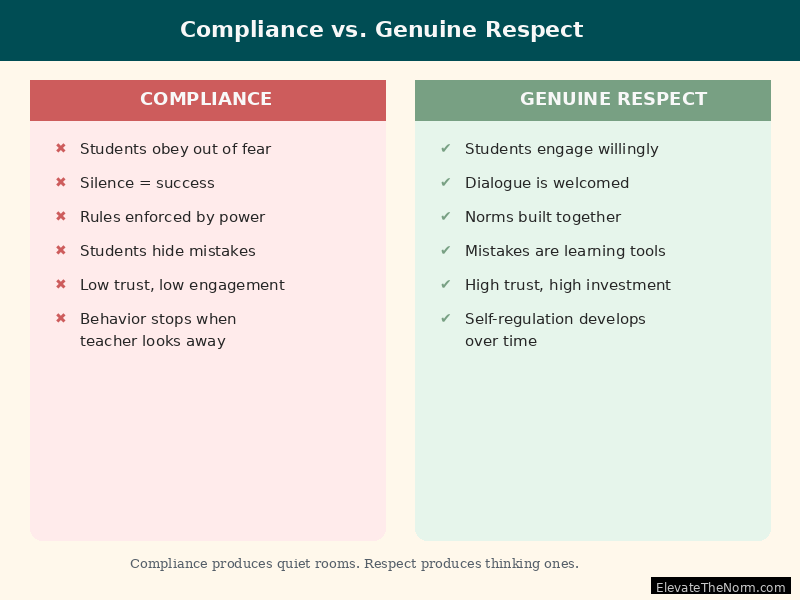
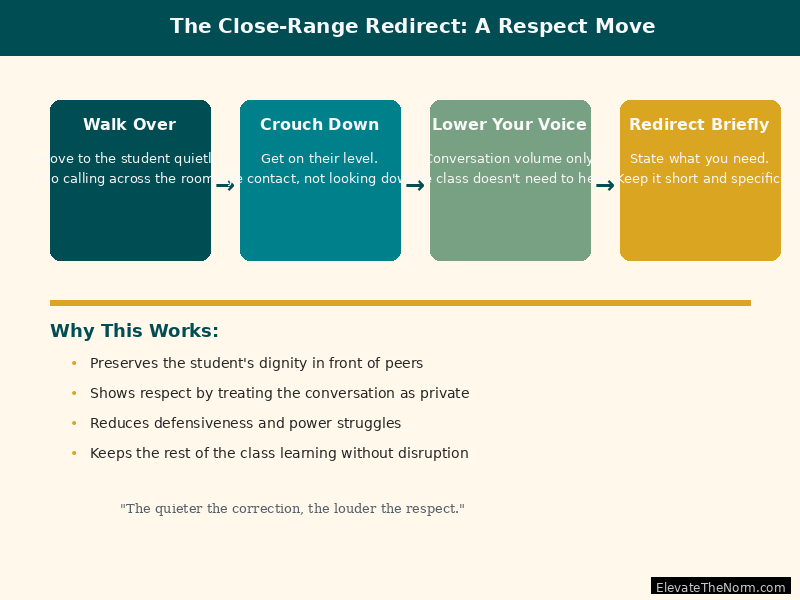
When a student does not meet an expectation, address it immediately, briefly, and at close range. A quiet redirect while you are already circulating — “Materials out, please” — costs less social capital than a public correction from across the room. And it preserves the relationship that makes the expectation stick. Strong relationships with students are not a separate initiative from classroom management — they are the mechanism that makes management work.
Step 5: Revisit and Adjust
Expectations are not a September activity. They need to be revisited after breaks, after schedule changes, after a stretch of bad days, and after you realize one of your expectations was unreasonable in the first place. Acknowledging that an expectation needs adjusting is not weakness. It is modeling exactly the kind of honest self-assessment you want from students.
What Happens When Expectations Are Missing
The consequences of vague or absent expectations are not dramatic. They are gradual — and that is what makes them dangerous.
Without clear expectations, teachers tend to rely on reactive discipline: waiting for something to go wrong and then responding. That pattern creates an exhausting cycle. The teacher feels like they are constantly putting out fires. The students feel like the rules change depending on the teacher’s mood. Both sides get frustrated, and the relationship erodes. That fire-fighting cycle is one of the most reliable routes into exhaustion, and most of what prevents it is structural rather than a matter of willpower.
Research on teacher expectations confirms this pattern. A 2024 narrative review published in the Journal of the Royal Society of New Zealand found that teachers’ expectations significantly influence student outcomes, and that inconsistent or unclear expectations disproportionately affect students from marginalized backgrounds (Rubie-Davies et al., 2024). Students who already face barriers outside of school should not have to decode a second set of hidden expectations inside it.
For a practical look at what those belief-driven expectations actually require—the specific moves, language, and mindset that separate genuine high expectations from surface-level optimism—see holding students to high expectations in secondary classrooms.
Expectations Go Both Ways
This is the part that separates a set of classroom expectations from a set of classroom rules. Rules flow in one direction — from the teacher to the student. Expectations, done well, apply to everyone in the room.
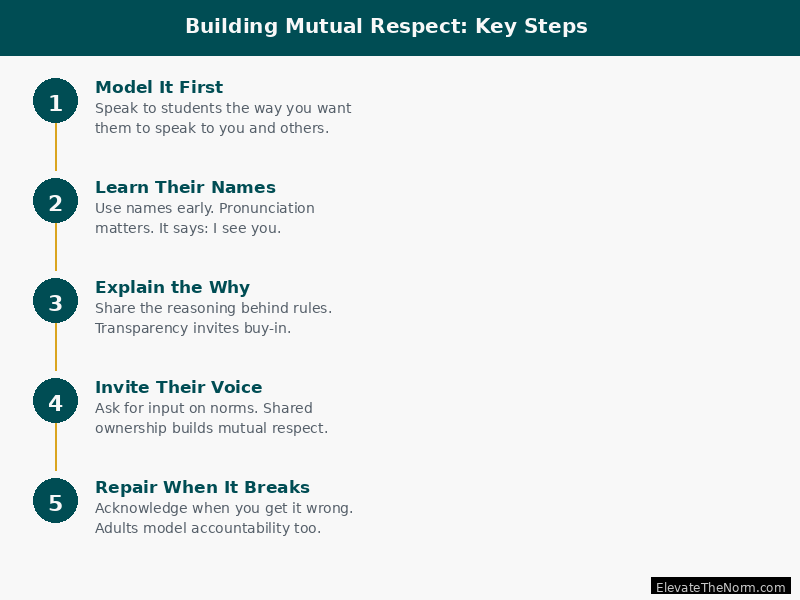
If students are expected to arrive on time, the teacher starts on time. If students are expected to be prepared, the teacher has the plan posted and the materials ready. If students are expected to listen without interrupting, the teacher does the same when a student is speaking.
That does not mean teachers and students hold identical authority. They do not. But mutual respect for each other’s time, effort, and presence is what turns expectations from a behavior-management tool into a culture.
Three Things Your Expectations Cannot Decide for You
No classroom expectations list exists in isolation. Before you finalize yours, account for these:
Your school’s behavior framework comes first. If your building uses PBIS, a schoolwide behavior matrix, or a restorative practices model, your classroom expectations must align with it — not contradict it. A classroom expectation that conflicts with the schoolwide framework confuses students who are trying to follow both, and it puts you in an awkward position with administrators when a situation escalates beyond your room.
IEPs and 504 plans take legal precedence. A student’s documented behavior intervention plan overrides your classroom expectations for that student. This is not optional, and it is not a weakening of your standards. It is the law. Consult with the special education team before the year starts and whenever a new student with a plan enters your class.
Families should know what you expect in week one. Send your expectations home — in writing, not just verbally through students. A parent who understands what the room requires can support it. A parent who discovers your expectations only when their child gets a consequence feels blindsided, and that damages a relationship you may need later.
A Practical Starting Point
If you are starting from scratch — or starting over — here is what works:
Pick three to five expectations that cover the broadest range of daily situations. State each one in observable, positive language. On the first day, explain each one, model it, let students practice it, and explain why it exists. Then hold it — every day, every period, for every student — without exceptions that are not also explained publicly.
It is not complicated. But it is relentless, and the relentlessness is the point. Students do not learn expectations from a poster. They learn them from a teacher who means what they say and says it every single day until the room runs on its own. The same principle applies to teaching student responsibility — it is a daily practice, not a one-time conversation.
How many expectations should a secondary classroom have?
Three to six. More than that and students cannot remember them, teachers cannot enforce them consistently, and the list starts contradicting itself. Each expectation should be broad enough to cover multiple situations but specific enough to be observable. If you need more than six, you probably need better procedures underneath fewer expectations.
Are classroom expectations the same as classroom rules?
Not exactly. Rules typically tell students what they cannot do and carry stated consequences. Expectations tell students what the room requires and are stated positively — what to do, not what to avoid. In practice, many teachers use a small set of expectations supported by procedures, with consequences understood but not the headline. The research favors positively stated expectations because they give students a behavior to perform, not just a behavior to suppress.
When should expectations be introduced — the first day or after content starts?
The first day. Marzano’s research and the IRIS Center’s synthesis both agree: explicitly teaching expectations during the first days of school produces better outcomes than announcing rules and moving to content. Time spent modeling, practicing, and discussing expectations in week one saves far more time than it costs over the remaining weeks of the semester.
Do expectations work with students who have behavioral challenges?
Clear expectations help every student, but they are especially important for students with behavioral challenges, including those with IEPs or 504 plans. Predictability reduces anxiety, and publicly stated expectations prevent the perception that consequences are personal or arbitrary. That said, individual behavior plans required by an IEP or 504 take legal precedence over classroom expectations — always follow the documented plan and consult with the special education team.
How do you handle a student who refuses to follow expectations?
Start with a private, calm conversation — not a public confrontation. Ask what happened. Restate the expectation. Give the student a clear path to meet it. If the behavior continues, follow your escalation process and document. Never abandon the expectation itself because one student resists it. The other 25 students are watching to see whether the standard is real.
Should students help create classroom expectations?
Research supports involving students in the process when it is genuine — not performative. A class discussion about why an expectation exists and what it should look like increases buy-in, especially with adolescents who need to understand the reasoning behind a standard. What does not work is asking students to create the expectations entirely and then overriding them when you do not like the result. If you ask for input, use it.
Do expectations need to be revisited after the first week?
Yes — after every long break, after a schedule change, after a substitute teacher, and after any stretch where the room has drifted. Expectations are not a contract signed and filed. They are a practice maintained through repetition and honest conversation about what is working and what is not.
Sources
- Archer, A. L., & Hughes, C. A. (2011). Explicit Instruction: Effective and Efficient Teaching. Guilford Press.
- Brophy, J. (2000). Teaching. International Academy of Education / International Bureau of Education (Educational Practices Series No. 1). https://www.iaoed.org/downloads/prac01e.pdf
- DeNobile, J. (2021). “The Role of School Expectations and Belonging.” In Student Wellbeing: Theory and Practice. Springer.
- IRIS Center. (2003). Establishing Classroom Norms and Expectations. Peabody College, Vanderbilt University. https://iris.peabody.vanderbilt.edu/case-study/establishing-classroom-norms-and-expectations/
- Marzano, R. J., Marzano, J. S., & Pickering, D. J. (2003). Classroom Management That Works: Research-Based Strategies for Every Teacher. ASCD. https://www.ascd.org/el/articles/the-key-to-classroom-management
- Rubie-Davies, C. M., et al. (2024). “The Powerful Impact of Teacher Expectations: A Narrative Review.” Journal of the Royal Society of New Zealand, 55(1). https://pmc.ncbi.nlm.nih.gov/articles/PMC11639072/
About Clay Shumate
Clay Shumate is a certified secondary Social Studies teacher in the public schools of West Alabama, with seven years of classroom experience, a B.A. in History, and an M.Ed. in Secondary Education. He writes about project-based learning, student responsibility, respect, and practical ways to hold young people to a higher standard while giving them room to learn from mistakes. He is a member of the Society of Professional Journalists and writes to its Code of Ethics; this site’s editorial standards and corrections policy are published in full. More about Clay.