By Clay Shumate
Good classroom rules for middle schoolers are few, short, and written as actions: five or six rules covering preparation, respect, listening, directions, honest work, and technology. Teach each one with examples and practice during the first weeks, then follow through the same way every time a rule gets broken.
Sixth, seventh, and eighth graders will test whether your rules are real. A long list posted on day one and never mentioned again tells them they aren’t. A short list you model, rehearse, and enforce calmly tells them they are.
This guide sticks to the rules themselves: how many, how to word them, how to teach them, and what to do when they’re broken. For the bigger picture on setting the tone of your room, see classroom expectations, and for sample wording across grade levels, see these examples of classroom expectations.
How Many Classroom Rules Should a Middle School Class Have?
Five or six is plenty. Every rule you post is a rule you have to enforce in every period, every day. If you can’t name a rule from memory in the middle of a lesson, students won’t remember it either.
Rules set the standard. Procedures (how to enter, turn in work, borrow a pencil) explain how students meet it. If your list keeps growing, most of the new items are probably procedures, and they belong in your classroom routines and procedures instead.
Six Classroom Rules for Middle Schoolers (With Wording That Works)
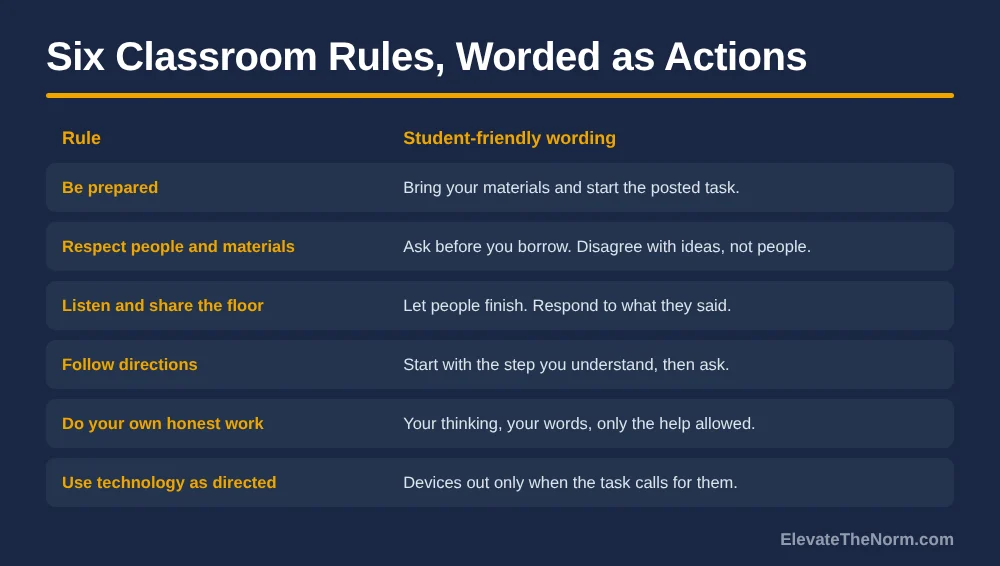
Write each rule as something a student can see themselves doing. “Be respectful” is a value. “Disagree with the idea, not the person” is something a seventh grader can actually do.
| Rule | Student-friendly wording | What it looks like |
|---|---|---|
| Be prepared | Bring your materials and start the posted task. | Seated, notebook open, bell ringer started |
| Respect people and materials | Ask before you borrow. Disagree with ideas, not people. | Pathways clear, supplies returned, no personal digs |
| Listen and share the floor | Let people finish. Respond to what they said. | Paraphrasing a partner before adding a point |
| Follow directions | Start with the step you understand, then ask. | Using the help signal instead of sitting idle |
| Do your own honest work | Your thinking, your words, only the help allowed. | Credited sources, individual parts of group work |
| Use technology as directed | Devices out only when the task calls for them. | Phones in the agreed spot, only assigned apps open |
Be Prepared to Start Learning
Define preparation through things students control. Put the first task on the board before the bell so starting doesn’t require you. Keep a quiet supply station so a kid without a pencil can still get to work without announcing it to the room.
Respect People, Personal Space, and Materials
Make respect in the classroom concrete: words, belongings, and space. Include disagreement in your examples. In a World History discussion, students can challenge an interpretation with evidence and still leave a classmate’s intelligence out of it. Respect goes both ways, so model the same standard when you correct someone.
Listen Actively and Share Speaking Time
Listening shows up as letting someone finish and responding to their idea, not as perfect stillness. Tell students how turns work for each activity: raised hands for whole-class discussion, assigned turns for partner work. For the student who talks constantly, try “You’ve shared your idea. Get your partner’s thinking before adding another.”
Follow Directions and Ask for Clarification
Pair the rule with a way to ask for help. Post the steps, explain the first one, and have a couple of students say back what they’re doing before you release the class. If a whole period stalls on a task, check your directions before calling it defiance.
Contribute Your Own Honest Work
Middle schoolers genuinely don’t know where “helping a friend” ends and copying begins. Tell them, per assignment, whether comparing answers, outside help, or AI tools are allowed. In group work, require an individual piece so student responsibility doesn’t disappear into a shared slideshow.
Use Phones and Classroom Technology as Directed
Say where phones go, when devices come out, and which apps fit the task. Line the rule up with school policy and any medical or assistive needs. Permission to use a laptop for research isn’t permission to message or play games, so say that out loud. Before you write that rule, it is worth reading the pros and cons of cell phones in the classroom, and what the ban studies actually show.
How Do You Teach Classroom Rules in the First Weeks?
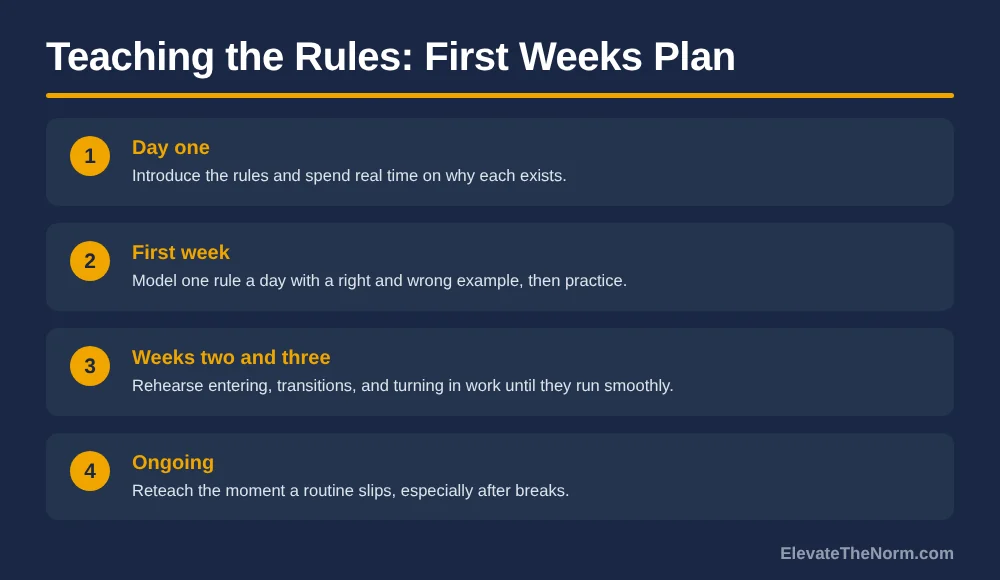
Posting rules isn’t teaching them. Plan the first two to three weeks as if the rules were a unit.
- Day one: introduce the rules, and spend real time on why each exists.
- First week: model one rule a day, show a right and wrong example, and have students practice it with actual class content.
- Weeks two and three: rehearse the procedures behind the rules (entering, transitions, turning in work) until they run without you narrating.
- Ongoing: reteach the moment a routine slips, especially after long weekends and breaks.
Keep rehearsals short. Practice a materials transition with the materials you’re about to use, then start the lesson. For new teacher classroom management, writing these rehearsals directly into your lesson plans keeps them from getting skipped when the content feels urgent.
With roughly 150 students across five or six periods, I track which classes need reteaching and which step is the problem. Third period might be fine on entry and a mess on packing up. Reteach that step, not the whole list.
Let Students Shape the Examples, Not the Boundaries
Ask students what helps them focus and what makes group work fair, and use their answers in your examples or on a classroom expectations poster. Be clear about what’s not up for a vote: safety, accommodations, academic honesty, and school policy. A small real choice, like which partner turn-taking routine to try, builds more buy-in than a big fake one.


How Do You Reinforce Rules Without Only Rewarding Perfect Kids?
Recognize specific actions, and judge longer-term awards on consistency and growth. “You asked your partner to explain the evidence before disagreeing” tells a student exactly what to repeat.
Elevate uses three recognition tiers: Immediate Recognition, Student of the Week, and Student of the Month. I run Student of the Week in all my classes, and it’s judged on self-improvement and consistency, not perfection, because nobody’s perfect. A winner might be the student who’s on time every day, participates, and does every bell ringer. The whole program costs me about $81 a year, out of my own pocket.
For class-wide habits, a class-vs-class competition like 3-2-1-Done works well once the routine is taught. Each class starts the week at zero and earns points for getting quiet on the countdown, losing a point for every second past “done.” The weekly winner gets a small snack, a drink, and 15-20 minutes of their own time at a low murmur. More ideas live in these whole-class rewards.
What Happens When a Middle Schooler Breaks a Rule?
Follow-through is the whole game. Positive reinforcement only works once students know your kindness isn’t weakness, and they learn that by watching you do exactly what you said you’d do.
Redirect Calmly, Then Move to Remediation
For low-level stuff, start with a quiet reminder that names the next action: “Open your notebook to the question on the board.” I’ll tell a class to quiet down up to three times before I move to remediation. If it keeps happening with one student, have a private conversation and ask what’s getting in the way. It might be a confusing task, missing materials, or a conflict from the hallway.
Don’t take the bait when a student says something to get a reaction. Staying neutral shows confidence, and with seventh and eighth graders a little light humor can defuse it too. A kid isn’t born “hard.” When a student shows up tough, that’s a reason to look for the cause, not a label.
Keep Consequences Predictable
Explain your classroom consequences before you need them, and match the response to the behavior. Misusing shared materials might mean supervised access and cleaning up the workspace. Repeated problems call for documentation and a call home. Follow IEPs, behavior plans, and accommodations every time. Serious discipline belongs with administration, not with you alone.
Repair and Restart
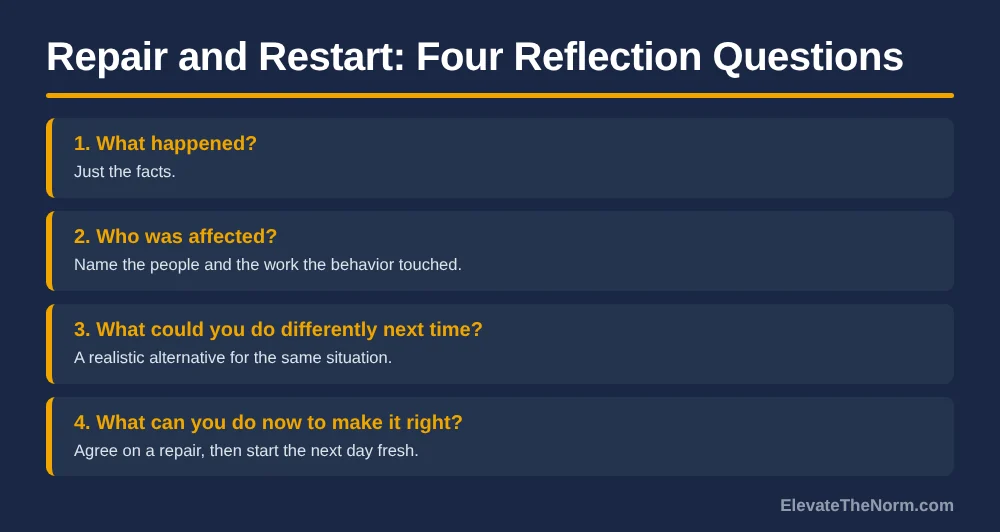
Once a student is calm, a short reflection helps:
- What happened, just the facts?
- Who was affected?
- What could you do differently next time?
- What can you do now to make it right?
Agree on a realistic repair, explain exactly where they go and what they do next, and start the next day fresh. For more on this approach, see restorative practices in schools.
Frequently Asked Questions
How many rules should a middle school classroom have?
Five or six. That’s enough to cover preparation, respect, listening, directions, honest work, and technology, and few enough that you can enforce all of them consistently in every period.
Should middle schoolers help write the classroom rules?
Let them shape the examples and wording, but keep the boundaries yours. Student input on what respect or fair group work looks like builds buy-in. Safety, accommodations, and school policy aren’t up for a vote.
How long does it take students to learn classroom rules?
Plan on two to three weeks of steady modeling and practice, with reteaching after breaks. Some groups catch on faster and some take noticeably longer. Consistency matters more than speed.
What should I do when a student keeps breaking the same rule?
Move from quick reminders to a private conversation about what’s getting in the way, then apply the consequence you already explained. Document what you see, contact home, and bring in administration for serious or repeated misconduct.
Keep the List Short and the Follow-Through Steady
Pick your six rules, word them as actions, and spend the first weeks teaching them like content. Then do what you said you’d do, every time, in every period. That consistency is what makes a short list work.
Want printable support for the first weeks? The free Elevate the Norm resource library has classroom tools built for grades 6-12. Free to download, no email required.