

By Clay Shumate
The best-value PBL bundles for middle school teachers are free: the PBLWorks project library (70+ units with a free account) and Elevate the Norm’s 10 free grades 7–12 history packets. Among paid options, well-reviewed Teachers Pay Teachers bundles for grades 6–8 run about $2.50 to $3.50 per project. Check ratings, grade band and rubric before you buy.
Key Takeaways
- Free PBL libraries, such as PBLWorks’ 70+ project units and Elevate the Norm’s 10 history packets, cost middle school teachers nothing per project.
- Well-reviewed paid PBL bundles for grades 6–8 on Teachers Pay Teachers work out to roughly $2.50 to $3.50 per project.
- Cost per usable project-week, not the bundle’s sticker price, is the fairest way to compare PBL bundles.
- Middle school PBL bundles on Teachers Pay Teachers skew heavily toward math, so social studies and ELA teachers get more value from free unit libraries.
- One well-run project per grading period is realistic, so a 4- or 5-project bundle can cover a middle school year.
This page is about money and grades 6–8 specifically. If you want the broader list of well-known kits across all grades, including Defined Learning and LEGO Education, see our guide to the best project-based learning kits to buy. Here, we do the math.
How should a middle school teacher measure PBL value?
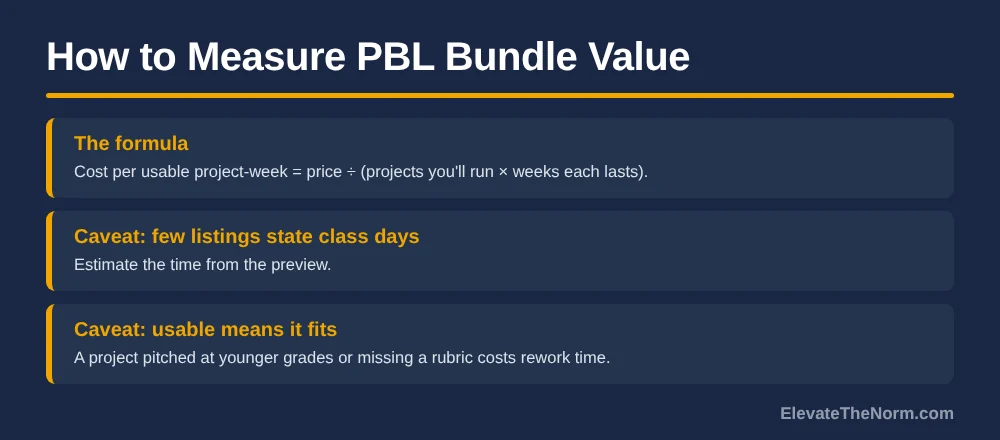
Middle school teachers should measure PBL value as cost per usable project-week, not cost per bundle or pages per dollar. Cost per usable project-week is a bundle’s price divided by the number of project-weeks you’ll actually teach from it.
A bundle’s sticker price tells you very little. A $5 project you run for a full week can be better value than a $65 bundle you only half use. Here’s the formula we use:
Cost per usable project-week = price ÷ (number of projects you’ll actually run × weeks each one lasts)
Two honest caveats. First, most TPT listings we checked don’t say how many class days a project takes, so you’ll have to estimate from the preview. Second, “usable” matters: a project pitched at 4th and 5th graders, or one with no rubric, may cost you hours of rework, and your time isn’t free. For planning, the table below assumes each project fills about one week. Adjust for your schedule.
Which PBL bundles give middle school teachers the best value?
Free PBL libraries give middle school teachers the best value on cost, and mid-priced Teachers Pay Teachers bundles with many ratings give the best value among paid options. Clark Creative Math’s 12-project Pre-Algebra bundle, at $2.50 per project with 144 ratings, is the strongest paid example in the table below.
| Resource | Grades listed | Price | Projects | Cost per project | Ratings | Rubric mentioned? |
|---|---|---|---|---|---|---|
| PBLWorks project library | K–12 | Free | 70+ | $0 | n/a | Rubric templates available |
| Elevate the Norm history packets | 7–12 | Free | 10 | $0 | n/a | Yes, free PBL rubric |
| Pre-Algebra Math Project Bundle 1 (Clark Creative Math) | 5–12 | $30.00 | 12 | $2.50 | 4.9 (144) | Not mentioned |
| Real World Math Project Bundle (Amy Hearne) | 6–9 | $16.75 sale | 5 | $3.35 | 4.9 (37) | “When necessary” |
| 6th–8th Grade Math Project Bundle (Math Down Under) | 6–8 | $65.00 | 20+ | Under $3.25 | 5.0 (9) | Not mentioned |
| 45 PBL Math & Art Projects (Inspire Math Matematyka) | 5–8 | $82.30 | 45 | $1.83 | 5.0 (2) | Not mentioned |
| 6th Grade Math Review Project (Lindsay Gould) | 6–8 | $5.00 | 1 | $5.00 | 4.9 (789) | Not mentioned |
| PBL MEGA Bundle (Digital Divide and Conquer) | 3–7 | $74.95 sale | 14 | $5.35 | 4.9 (170) | Yes |
| Setting the Standard for PBL (book) | All | $27.95 | Teaches design | n/a | n/a | n/a |
Cost per project is simple division of the listed price by the listed project count. Prices and ratings come from each listing linked in the table; TPT sale prices change often, so check before you buy.
Is free project-based learning good enough for middle school, or should teachers pay?
Free project-based learning material is good enough for most middle school teachers to start with. Paying makes sense only to fill a specific gap, such as a ready-to-print math project you need quickly.
The PBLWorks library is built around its Gold Standard design elements, including a challenging question, critique and revision, and a public product. That’s the backbone a lot of paid bundles skip. The trade-off is time: free units usually need more adapting than a ready-to-print TPT product.
Paying makes sense when you need something specific and fast, like a fractions project the week before a unit test. One pattern we noticed: middle school PBL bundles on TPT skew heavily toward math. Social studies and ELA teachers will find more value in free unit libraries, including our social studies PBL guide and project ideas.
Are school-licensed PBL platforms and STEM kits good value for middle school?
School-licensed PBL platforms and STEM kits can be good value for a school or district, but rarely for one middle school teacher’s own classroom budget.
Defined Learning, a K–12 career-connected project platform, is sold to schools and districts by custom quote, so there’s no per-teacher price to compare. Its summer learning option was listed at $5 per student. Hardware is a different scale entirely: LEGO Education’s grades 6–8 Science kit is $499 and serves up to four students, so equipping a class of 28 would take seven kits, or about $3,500 by our math. That’s a department or grant purchase, not a classroom-budget one. If your school already owns either, use it; otherwise the free and low-cost options above stretch further.
What are the red flags in cheap PBL bundles?
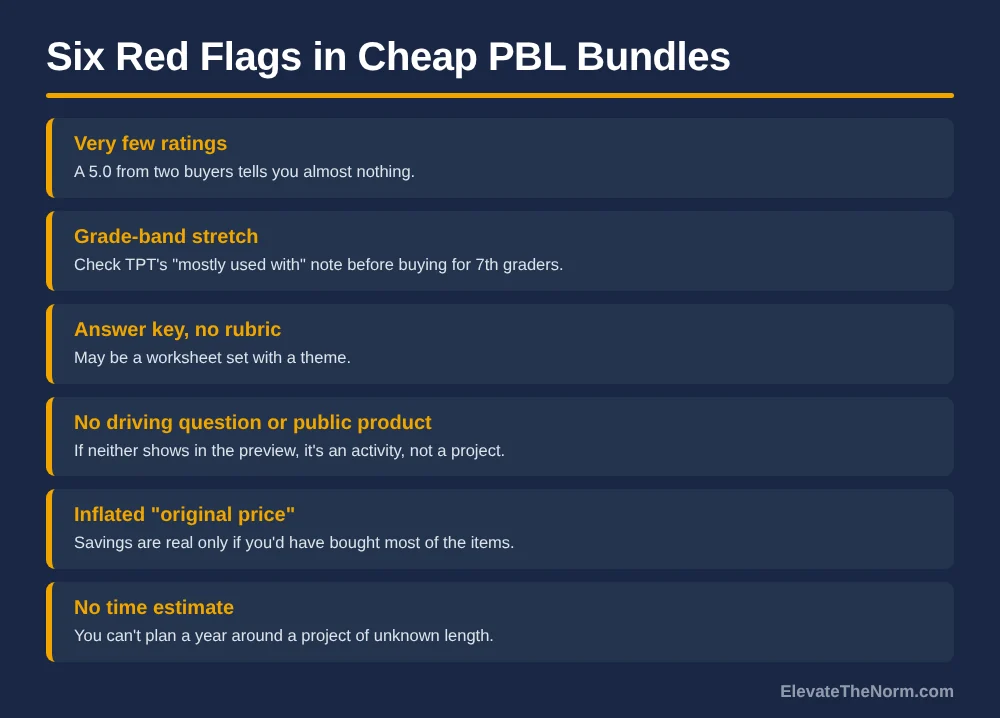
The red flags in cheap PBL bundles are few ratings, a grade band that skews younger, an answer key with no rubric, no driving question or public product, an inflated original price, and no time estimate. A low price per project means nothing if the projects don’t fit your students or can’t be graded fairly.
- Very few ratings. A 5.0 from two buyers tells you almost nothing. The 45-project bundle above is the cheapest per project, but it has only two ratings. Compare that with 789 reviews on a single $5 project.
- Grade-band stretch. A listing that says “3rd–7th” may be mostly used in younger grades. TPT shows a “mostly used with” note; the MEGA Bundle above says mostly 4th and 5th. Check it before buying for 7th graders.
- Answer key, no rubric. If a “project” ships with an answer key but no rubric, it may be a worksheet set with a theme. PBL work rarely has one right answer.
- No driving question or public product. If neither shows up in the preview, it’s an activity, not a project. Our driving question examples show what to look for.
- Inflated “original price.” Bundle discounts are calculated against the sum of individual items. The savings are real only if you’d have bought most of them.
- No time estimate. If you can’t tell whether a project is two days or two weeks, you can’t plan your year around it.
How can you stretch one PBL bundle across a full school year?
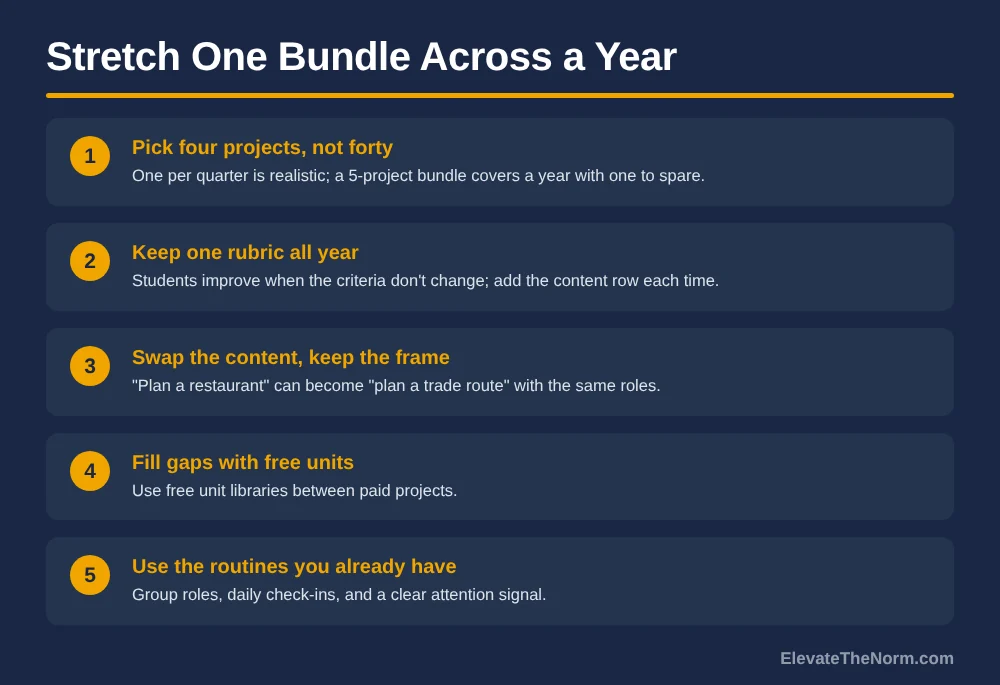
One PBL bundle can cover a full middle school year if you run one solid project per grading period and reuse the same structure and rubric instead of buying more content.
- Pick four projects, not forty. One per quarter is realistic for most middle school schedules. A 5-project bundle can cover a year with one to spare.
- Keep one rubric all year. Students get better when the criteria don’t change. Use our free editable PBL rubric or the presentation rubric and add the content row each time.
- Swap the content, keep the frame. A “plan a restaurant” math project can become “plan a trade route” in social studies with the same roles, checkpoints, and final pitch.
- Fill gaps with free units. Use PBLWorks or our history unit packets between paid projects.
- Use the routines you already have. Projects run on classroom routines: group roles, daily check-ins, and a clear signal to get attention back.
Our 7 steps of project-based learning walks through turning any bundle into a full project.
Clay’s take: As a grades 6–12 teacher, I’d spend nothing until the free libraries come up short. Then buy one well-reviewed bundle for that specific gap and run it with the same rubric all year. That’s a judgment on the numbers on this page, not a product test.
Where does Elevate the Norm fit among PBL bundles for middle school?
Elevate the Norm’s PBL materials are free and aimed at grades 6–12, mainly social studies, so they cost middle school teachers nothing per project. They’re this site’s own work, written by a certified secondary social studies teacher, and they haven’t been independently evaluated. Everything on our resources page is free with no email gate. The same teacher sells paid bundles on TPT, including a Grading & Assessment bundle with single-point rubrics, through the Teacher Emergency Toolkit store; we’ve left those out of the value table because we can’t rate our own products fairly. Elevate the Norm is also a grades 6–12 classroom culture approach, covered in our classroom culture frameworks Q&A.
Frequently Asked Questions
What is the best-value PBL bundle for middle school?
The best-value PBL resources for middle school are free: the PBLWorks project library, with 70+ units on a free account, and Elevate the Norm’s 10 free grades 7–12 history packets. Among paid Teachers Pay Teachers bundles, Clark Creative Math’s 12-project Pre-Algebra bundle works out to about $2.50 per project and carries 144 ratings, which makes it the strongest paid value on this page.
How much should a middle school PBL bundle cost?
Well-reviewed grades 6–8 PBL bundles on Teachers Pay Teachers cost roughly $2.50 to $3.50 per project, and the full range on this page runs from about $1.83 to $5.35. Judge a bundle by its cost per project you’ll actually run, not its total price, because a large bundle you only half use is poor value however cheap each project looks.
Are cheap PBL bundles on Teachers Pay Teachers worth it?
Some cheap PBL bundles on Teachers Pay Teachers are worth it and some aren’t. Before buying, check how many ratings the bundle has, which grades it is mostly used with, whether a rubric is included, and whether each project has a driving question and a final product for an audience. A bundle missing those is often a themed worksheet set rather than real project work.
How many PBL projects should a middle school teacher run per year?
One well-run project per grading period is realistic for most middle school schedules, which means about four projects a year. A 4- or 5-project PBL bundle can therefore cover a full year, especially if the teacher reuses the same rubric and project structure and fills any gaps with free units from PBLWorks or Elevate the Norm’s history packets.
Is there a free PBL rubric for middle school?
Yes. Elevate the Norm offers a free, editable grades 6–12 PBL rubric that grades each student’s own understanding, plus a free presentation rubric, with no email required. PBLWorks also offers rubric templates with a free account. A free rubric matters because most paid middle school PBL bundles on Teachers Pay Teachers don’t mention including one.
Should a school buy a PBL platform or use free PBL units?
Most schools should start with free PBL units and buy a platform only when there’s a clear gap and budget. Defined Learning, a K–12 project platform, is sold to schools by custom quote. LEGO Education’s grades 6–8 Science kit costs $499 for up to four students, so a class of 28 would need about $3,500 in kits. Those are department or grant purchases.
Do middle school PBL bundles work for social studies and ELA teachers?
Middle school PBL bundles on Teachers Pay Teachers skew heavily toward math, so social studies and ELA teachers usually find better value in free unit libraries. PBLWorks’ project library and Elevate the Norm’s history packets, social studies PBL guide and project ideas cover those subjects, and a math project’s roles, checkpoints and final pitch can be reused with new content.
Why keep the same PBL rubric for every project all year?
Keeping the same PBL rubric all year helps middle school students improve, because the criteria don’t change from one project to the next and students learn exactly what strong work looks like. Teachers add one content row for each new project. It also saves time, since a single rubric can carry four bundle projects instead of four different grading systems.
Sources
- PBLWorks — resources overview and project library
- PBLWorks — Gold Standard PBL design elements
- PBLWorks store — Setting the Standard for Project Based Learning
- Teachers Pay Teachers — Pre-Algebra Math Project Bundle 1 (Clark Creative Math)
- Teachers Pay Teachers — Real World Math Project Bundle (Amy Hearne)
- Teachers Pay Teachers — 6th–8th Grade Math Project Bundle (Math Down Under)
- Teachers Pay Teachers — 45 PBL Math & Art Projects (Inspire Math Matematyka)
- Teachers Pay Teachers — 6th Grade Math Review Project (Lindsay Gould)
- Teachers Pay Teachers — PBL MEGA Bundle (Digital Divide and Conquer)
- Defined Learning — frequently asked questions
- LEGO Education — Science announcement
How is this page kept accurate?
This page is kept accurate by linking every price, project count and rating to the listing it came from and showing the cost-per-project arithmetic in the open. Sale prices change often, so confirm before buying. No seller paid to be included. See our editorial standards and corrections policy.

