By Clay Shumate
A driving question is the engine of a PBL unit. It sets the direction, gives students a reason to care, and holds the work together across days or weeks of instruction. But a weak driving question quietly undermines everything — it either shuts down thinking before it starts or lets students coast without ever engaging the standards you need them to master.
Below are real driving-question examples organized by subject area, an explanation of what makes each one work, a side-by-side look at weak versions of the same questions, and a five-step revision formula you can use to strengthen any driving question you write from scratch. Each of these classroom-tested history projects is built around one, if you want to see finished questions inside a full unit.
What a Strong Driving Question Actually Does
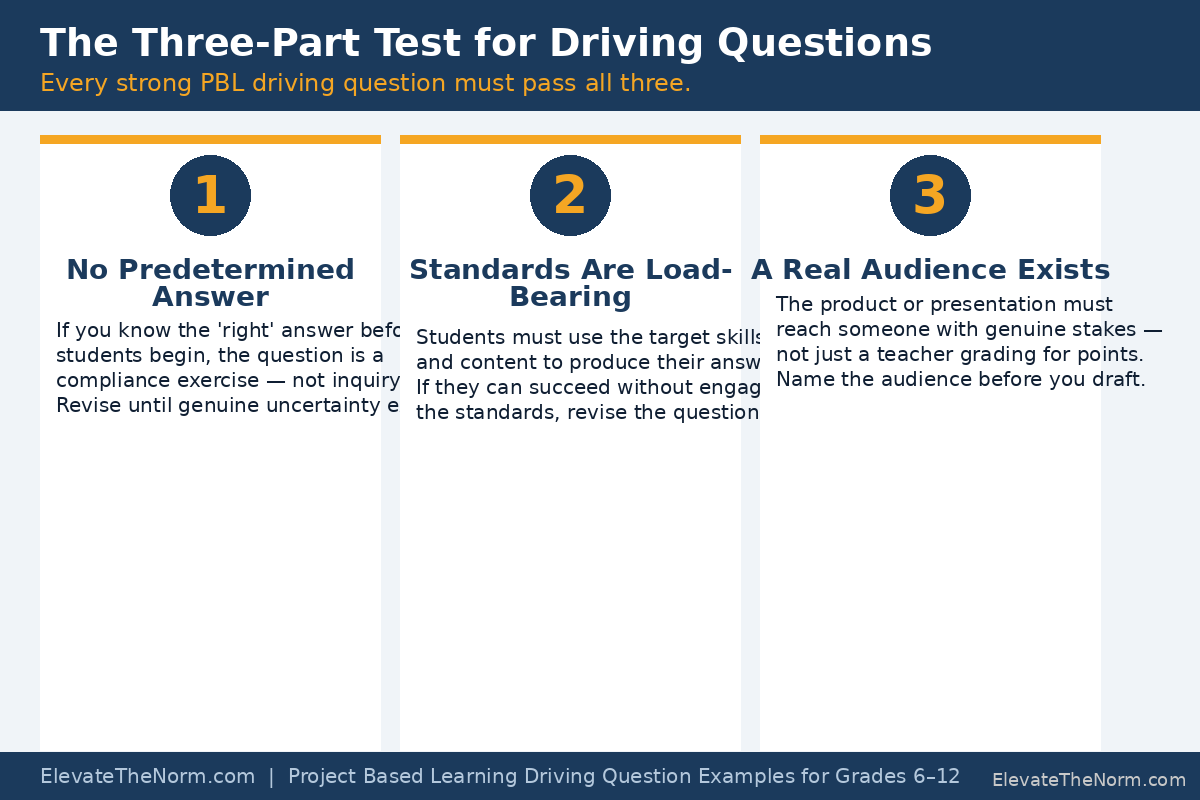
Before the examples, a working definition of project based learning: a driving question frames an authentic problem that has no single correct answer, requires students to use the skills and content of the unit to investigate it, and produces a product or presentation that addresses a real audience. That’s the three-part test. If a question can be answered by a quick internet search, it fails the first part. If students can answer it without demonstrating the standards, it fails the second. If the work disappears into a folder never read by anyone, it fails the third. That third test is the whole of what makes a task authentic rather than merely well-designed.
Strong Driving Question Examples by Subject
Science
Strong: “How healthy is our watershed, and what should our community do about what we find?”
Why it works: Students have to collect and analyze real water-quality data (science practices), interpret findings against state standards (content knowledge), and communicate recommendations to an audience who can actually act on them — the city water board, a local environmental group, or the school board. The question doesn’t tell students what they’ll find. It invites genuine investigation.
Strong: “Is our school’s energy use sustainable, and what’s one change we could make that would actually matter?”
Why it works: Local and bounded. Students aren’t solving climate change — they’re solving one building’s energy footprint. The second clause (“that would actually matter”) forces quantitative thinking: students have to calculate actual impact, not just list recycling tips. The audience is the school administration, which gives the work stakes.
Social Studies and History
Strong: “What should the city council do about rising housing costs in our community?”
Why it works: It connects economics, civics, and local government in one question. Multiple defensible positions exist — zoning reform, rent stabilization, housing vouchers, market incentives — and students have to evaluate evidence for each. The audience is real: city council members, local journalists, or community advocates. Students present policy recommendations rather than five-paragraph essays. For social studies teachers, my Social Studies Teacher Toolkit Bundle on TPT gives you a head start on the materials.
Strong: “What would you tell a younger student who thinks the civil rights movement is history and doesn’t affect them today?”
Why it works: The audience (a younger student) is concrete. The question requires students to synthesize historical knowledge with present-day evidence — the harder cognitive move. It also demands a choice about emphasis: what do you lead with? Why? That’s persuasion, historical thinking, and communication in one question. And it treats the student as someone with something worth saying, not just someone absorbing information.
Mathematics
Strong: “Is our school’s cell phone policy working, and what does the data say?”
Why it works: Students care deeply about this topic. They design a survey (statistics), collect and organize data (data analysis), calculate measures of center and variability (content), visualize findings (data representation), and present a recommendation to administration. Every step is grounded in mathematics content, but the reason to do the math is built in from the start.
Strong: “If our school had to cut its budget by 15 percent, what would you recommend — and can you show your math?”
Why it works: Proportional reasoning, budgeting, percentages, and data interpretation all appear naturally. The final clause (“can you show your math?”) builds in the accountability piece. Students have to justify their reasoning quantitatively, not just state an opinion. Presenting to a mock school board raises the stakes further.
English Language Arts
Strong: “What story from our community deserves to be told, and how will you tell it?”
Why it works: Narrative writing, interview skills, audience awareness, and editing all emerge naturally from this question. Students interview community members, identify a story angle, draft and revise, and publish — to the school paper, a community website, or a class literary magazine. The question respects student judgment: they decide what deserves to be told. This connects to student voice and choice in the classroom: when students help shape the inquiry, the work carries more weight.
Strong: “How do you write an argument that someone who disagrees with you would actually take seriously?”
Why it works: The built-in challenge — not just “write an argument” but “write one your opposition would respect” — forces students to engage with counterargument and evidence quality from the beginning of the unit, not as an afterthought. It also develops intellectual humility, which is a real skill worth teaching.
Weak Driving Questions — and Why They Fail
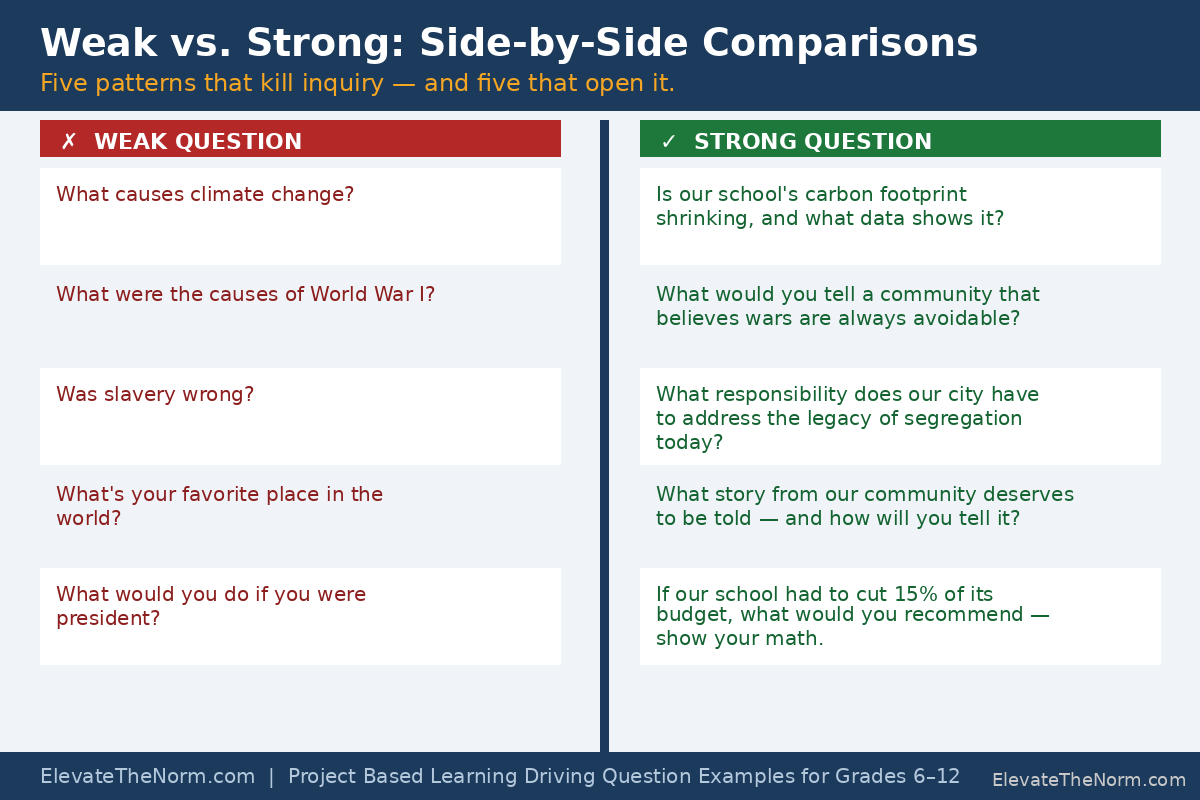
Weak driving questions fall into five predictable patterns. Each shuts down inquiry in a different way.
Too broad: “How does climate change affect the environment?”
This is a research prompt, not a driving question. The answer is available in every textbook. It has no local angle, no audience, no student voice, and no product that could matter. Students fill out a graphic organizer and move on. No genuine inquiry required.
Easily Googled: “What were the causes of World War I?”
A student can retrieve a correct answer in under 30 seconds. There’s no reason to sustain inquiry over multiple days. This is a comprehension check question elevated to a project title.
Leading: “Was slavery wrong?”
There is only one acceptable answer in a school setting. Students know it before they begin. No investigation is required, no evidence is weighed, and no thinking happens. A question with only one permissible answer is a compliance exercise.
Disconnected from standards: “What’s your favorite place in the world and why?”
Engaging and personal — and completely untethered to any specific learning target. Without a clear standards connection, this type of question produces enjoyable work that doesn’t move students forward academically. The project feels good but doesn’t teach the things it was supposed to teach.
Fake: “What would you do if you were president for a day?”
The hypothetical framing removes all real stakes. Students know the audience is imaginary, the recommendations won’t be read by anyone with authority, and the “project” is really a creative-writing exercise. There’s no investigation because there’s no real problem to solve.
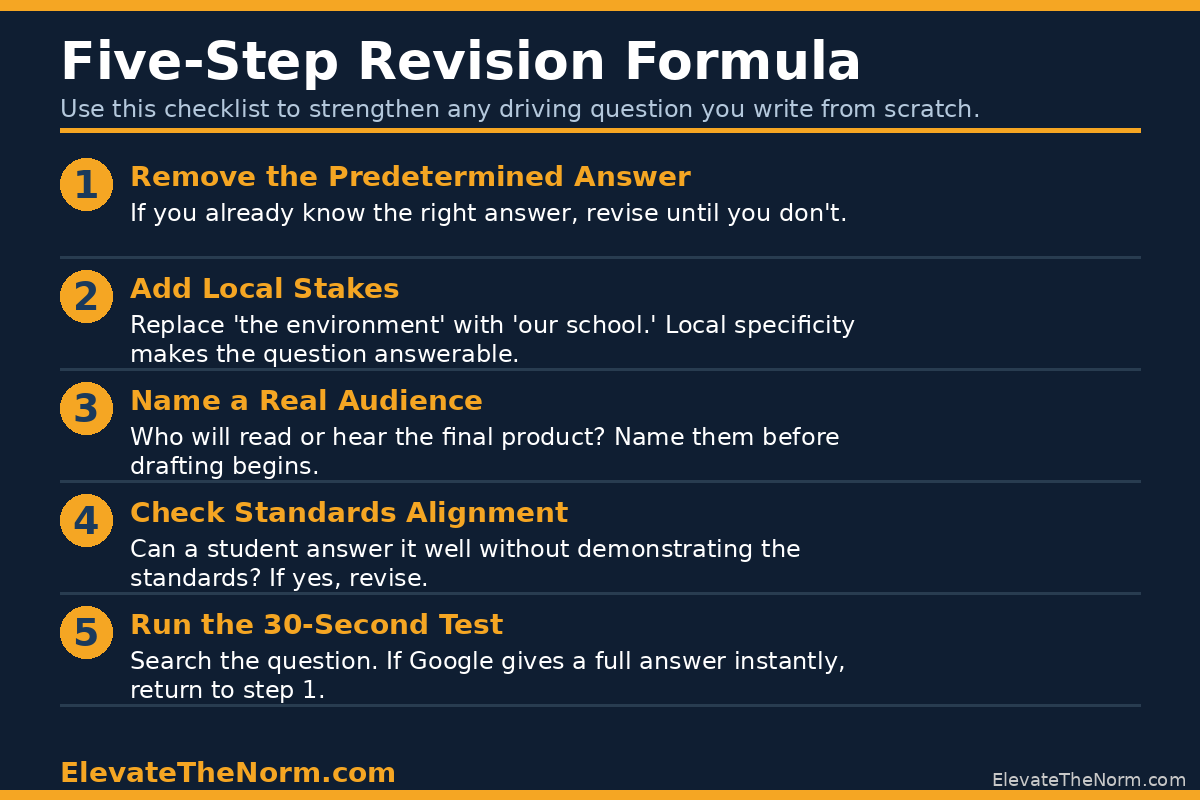
A Five-Step Revision Formula
Take any driving question you’ve already written and run it through these five checks in order.
Step 1 — Remove the predetermined answer. If you already know the “right” answer before students begin, revise until you don’t. The question should produce genuine uncertainty about what the best response is.
Step 2 — Add local stakes. Replace “the environment” with “our watershed.” Replace “students” with “students at this school.” Local specificity makes the question answerable in a bounded way and gives students real data to work with.
Step 3 — Name a real audience. Who will actually read, watch, or hear the product? The school board, a local nonprofit, a city council member, the principal, a community newspaper? A named audience changes how seriously students take their work.
Step 4 — Check the standards connection. List the specific standards or learning targets the unit is supposed to address. Ask: “Could a student answer this driving question satisfactorily without demonstrating those standards?” If yes, revise the question until the content is load-bearing.
Step 5 — Run the 30-second test. Type the question into a search engine. If the first result gives a complete, usable answer, the question isn’t driving anything. Return to Step 1.
A note from the classroom: I’ve found that the weakest driving questions are usually the first ones teachers write — and the best ones come after two or three revisions. One way I’ve improved my own practice is to circulate during project work and listen to what students are actually debating with each other. When a group is genuinely arguing about which recommendation to make, I know the question is working. When they’re just dividing up a graphic organizer, something is wrong upstream — usually the driving question itself.
Frequently Asked Questions
What makes a driving question different from a regular essay prompt?
A regular essay prompt has a correct answer the teacher already knows — it’s an assessment disguised as an assignment. A driving question doesn’t have a predetermined right answer. It opens genuine inquiry: multiple defensible positions, real uncertainty, and a reason to care about the outcome. Students build knowledge to answer it rather than answer it to display knowledge.
How specific should a driving question be?
Specific enough that students know what subject, setting, or audience they’re working with — but open enough that the answer requires real thinking. “How should our school reduce food waste in the cafeteria?” is specific (our school, our cafeteria) and open (many possible answers, each requiring investigation). “What is food waste?” is too broad. “Should we compost?” is too closed.
Can students help create the driving question?
Yes, and when they do, engagement goes up noticeably. One approach: give students a problem space and a standards target, then have them brainstorm questions they genuinely want to answer. The teacher narrows the list using the revision formula — removing questions that can be Googled, adding a real audience, and checking for standards alignment. The final question is often stronger when students have a hand in it.
What if students can’t connect to the driving question?
Usually that means the question lacks local stakes or a real audience. “How should our city handle rising housing costs?” lands differently for a class of students who have moved twice in three years than it does for a class with stable housing. Launching with a guest speaker, a local news clip, or a brief student-led discussion about their own experience before revealing the driving question dramatically improves buy-in.
Do I need a driving question for every project?
Not necessarily. Short, skill-building projects — a single-period lab, a one-day design challenge — can work without a formal driving question. Driving questions pay the most dividends in multi-day or multi-week projects where students need a reason to keep pushing when the work gets hard. If a project will run more than three class periods, a strong driving question is worth the 20 minutes it takes to craft one.
Is a driving question the same as an essential question?
They overlap but aren’t identical. Essential questions (a term from Understanding by Design) are often philosophical, transferable across units, and may never be fully answered — they’re meant to recur throughout a course. Driving questions are project-specific: they anchor one project, demand a product or presentation, and get answered by the end of the unit. Think of essential questions as the long arc and driving questions as the specific mission.
How do I know if a driving question is connected to standards?
Run the backward-design check: list the specific standards (or learning targets) the project must address. Then ask whether answering the driving question requires students to actually use those skills and concepts — not just mention them. If a student could produce a satisfactory answer to your driving question without ever demonstrating the standard, the question isn’t doing its job. Revise until the connection is tight.
For a full look at how driving questions fit into the complete PBL cycle, see the seven steps of project based learning — the driving question is Step 1, but what happens in Steps 2 through 7 determines whether it does its job. For project ideas organized by subject and grade level, the project based learning ideas collection shows how driving questions look in finished form across fifty real units.
Sources
- Buck Institute for Education. (2019). Gold Standard PBL: Essential Project Design Elements. PBLWorks. https://www.pblworks.org/what-is-pbl/gold-standard-project-design
- Krajcik, J. S., & Shin, N. (2014). Project-based learning. In R. K. Sawyer (Ed.), The Cambridge Handbook of the Learning Sciences (2nd ed., pp. 275–297). Cambridge University Press.
- Larmer, J., Mergendoller, J., & Boss, S. (2015). Setting the Standard for Project Based Learning. ASCD.
- McTighe, J., & Wiggins, G. (2013). Essential Questions: Opening Doors to Student Understanding. ASCD.
- Mergendoller, J. R., Maxwell, N. L., & Bellisimo, Y. (2006). The effectiveness of problem-based instruction: A comparative study of instructional methods and student characteristics. Interdisciplinary Journal of Problem-Based Learning, 1(2), 49–69. https://doi.org/10.7771/1541-5015.1026
About Clay Shumate
Clay Shumate is a certified secondary Social Studies teacher in the public schools of West Alabama, with seven years of classroom experience, a B.A. in History, and an M.Ed. in Secondary Education. He writes about project-based learning, student responsibility, respect, and practical ways to hold young people to a higher standard while giving them room to learn from mistakes. He is a member of the Society of Professional Journalists and writes to its Code of Ethics; this site’s editorial standards and corrections policy are published in full. More about Clay.