

By Clay Shumate
The best project-based learning kits to buy depend on who’s paying. PBLWorks’ project library is free with an account, Teachers Pay Teachers bundles suit one teacher on a small budget, Defined Learning suits schools buying at scale, and LEGO Education Science kits suit hands-on STEM. Any good kit has a driving question, public product, rubric and scaffolds.
Key Takeaways
- PBLWorks, the nonprofit formerly known as the Buck Institute for Education, offers a library of 70+ standards-aligned project units free with a MyPBLWorks account.
- A real project-based learning kit includes a driving question, a public product, a rubric that grades each student, and scaffolds with a mid-project checkpoint; without those, it’s an activity pack.
- Teachers Pay Teachers project bundles checked for this guide ran roughly $3 to $95, and their star ratings measure buyer satisfaction, not student learning.
- LEGO Education Science kits cost $329 to $499 per kit and serve up to four students, but they’re structured lessons, not full PBL units.
- Defined Learning sells career-connected project tasks to schools and districts by custom quote, with no individual teacher pricing listed.
“Top-rated” is slippery in this category. Most PBL resources aren’t reviewed by any independent body, and star ratings on teacher marketplaces measure whether buyers were happy, not whether students learned. So this guide lists options we could verify, says what each one is good at, and gives you a checklist to judge any kit yourself. If you teach grades 6–8 and care most about cost, read our companion piece on the best-value PBL bundles for middle school, which does the per-project math.
What makes a project-based learning kit actually good?
A good project-based learning kit includes the parts that make PBL work: a driving question, a public product, a rubric that grades each student, and scaffolds. A kit missing those parts is an activity pack, not PBL.
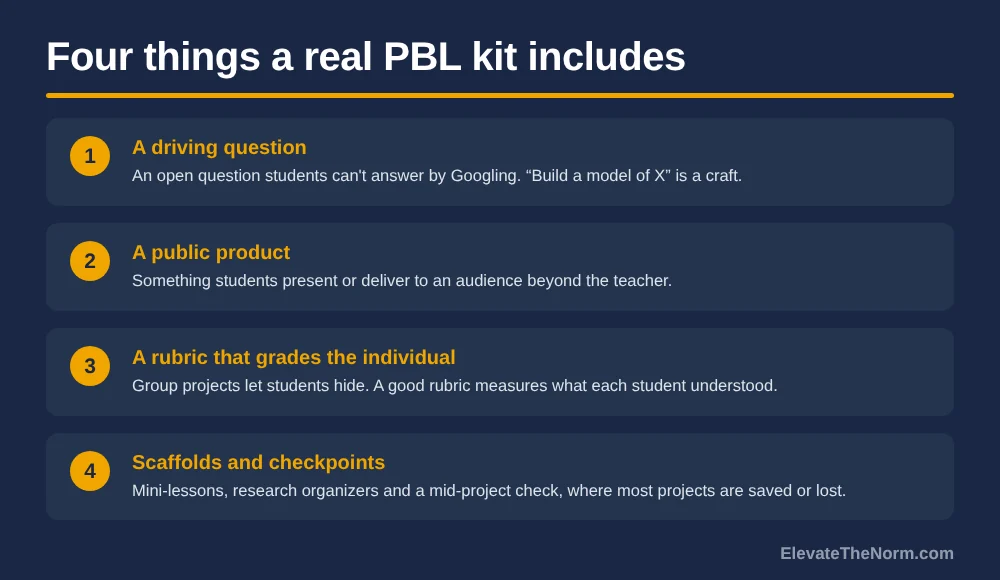
PBLWorks, the nonprofit formerly known as the Buck Institute for Education, defines seven essential project design elements: a challenging problem or question, sustained inquiry, authenticity, student voice and choice, reflection, critique and revision, and a public product. That’s a useful yardstick. In practice, check for these four things before you pay:
- A driving question. An open question students can’t answer by Googling. If the kit just says “build a model of X,” it’s a craft. See our driving question examples.
- A public product. Something students present or deliver to an audience beyond the teacher.
- A rubric that grades the individual. Group projects let students hide. A good rubric measures what each student understood. Our free editable PBL rubric is built for that.
- Scaffolds and checkpoints. Mini-lessons, research organizers, and a mid-project check. That middle checkpoint is where most projects are saved or lost.
Many listings don’t say whether they include a rubric or a driving question. If the product page is silent, assume it doesn’t, or ask the seller before buying.
What are the top-rated PBL resources and kits to buy?
The top-rated project-based learning resources to buy are PBLWorks, Defined Learning, highly rated Teachers Pay Teachers bundles and LEGO Education Science kits, with Edutopia and Elevate the Norm as free options. Each one is compared below on grades, cost, best use and main drawback.
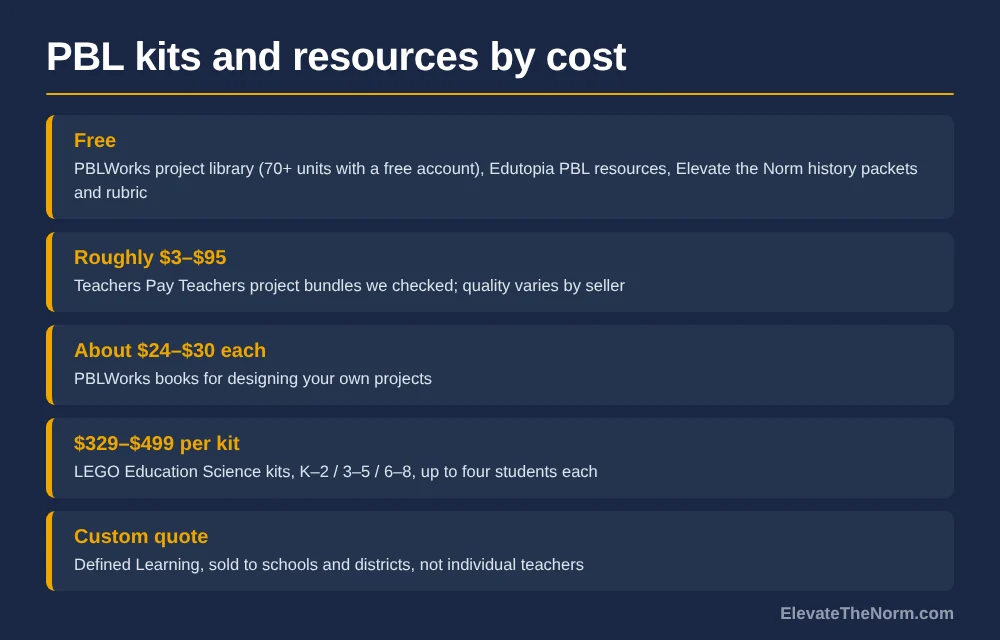
| Resource | Grades | Cost | Best for | Watch out for |
|---|---|---|---|---|
| PBLWorks project library | K–12 | Free account | Standards-aligned units built on Gold Standard PBL | You’ll still adapt units to your schedule and standards |
| PBLWorks books | K–12 (some K–5 specific) | About $24–$30 each | Learning to design your own projects | A book, not ready-to-teach materials |
| Defined Learning | K–12 | Custom quote for schools/districts | Career-connected performance tasks at scale | No individual teacher pricing listed |
| Teachers Pay Teachers bundles | Varies by seller | Roughly $3–$95 for the items we checked | Quick, subject-specific projects | Quality varies; many listings don’t mention rubrics |
| LEGO Education Science kits | K–8 | $329–$499 per kit (up to 4 students) | Hands-on STEM builds with lessons | Structured lessons, not full PBL units |
| Edutopia PBL resources | K–12 | Free | Videos, case studies, research | A resource guide, not a curriculum |
| Elevate the Norm history packets and rubric | 7–12 | Free, no email gate | Social studies projects with driving questions | History only; this site’s own resources |
PBLWorks
PBLWorks is the closest thing PBL has to a standard-setter. A free MyPBLWorks account opens its project library of 70+ standards-aligned units, searchable by subject and grade, along with rubric templates, strategy guides, and planning tools. Its store sells books such as Setting the Standard for Project Based Learning ($27.95, published with ASCD) and PBL in the Elementary Grades (K–5, $29.95 regular, $23.95 on sale when we checked). Paid online workshops and school services are available too, but PBLWorks doesn’t post their prices.
There’s also research tied to PBLWorks’ approach. A randomized study of the Knowledge in Action curriculum in AP U.S. Government and AP Environmental Science found students were about 8 percentage points more likely to score 3 or higher on the AP exam in the first year. That’s one curriculum in two courses, so don’t stretch it into a claim about every kit.
Defined Learning
Defined Learning is a K–12 platform of career-connected project tasks, each framed around a real job scenario, with rubrics and student materials. It’s grounded in Understanding by Design. It’s sold through school and district partnerships with custom quotes, so it’s a good fit for a school buying for many teachers, not one teacher with a classroom budget. A summer learning option is listed at $5 per student.
Teachers Pay Teachers project bundles
TPT is where most individual teachers actually buy projects. Some highly rated examples we checked:
- Project Based Learning MEGA Bundle by Digital Divide and Conquer: 14 projects, grades 3–7, $74.95 on sale, 4.9 stars from 170 ratings, rubric included.
- 6th Grade Math Review Project by Beyond the Worksheet with Lindsay Gould: a restaurant-themed team project, $5, 4.9 stars from 789 reviews.
- High School Chemistry: Case Files (PBL) Bundle by The Wasp Whisperer: 14 story-lined units for grades 10–12, listed as a full year, $93.06, 4.8 stars from 133 ratings.
TPT’s strength is range and price. Its weakness is consistency: you’re buying from individual teachers, and listings vary in how clearly they describe rubrics, timelines, and driving questions. Preview files before buying.
LEGO Education
If you want physical STEM materials, LEGO Education’s Science kits come in K–2 ($329), 3–5 ($399), and 6–8 ($499) versions, each serving up to four students with about 40 lessons per kit. Note that LEGO’s older SPIKE Essential has been retired, so be careful with older recommendation lists. These kits are excellent for building and testing, but they’re structured lessons. To turn one into true PBL, you’d add a driving question and a public product yourself.
Free options: Edutopia and Elevate the Norm
Edutopia, from the George Lucas Educational Foundation, keeps a free PBL resource guide with case study videos from elementary through high school. On this site, History Project Ideas has 10 free classroom-tested unit packets for grades 7–12, each with a driving question, timeline, student product, and notes on where it goes wrong. Pair them with the free PBL rubric and the presentation rubric.
Should you buy a kit or build your own project?
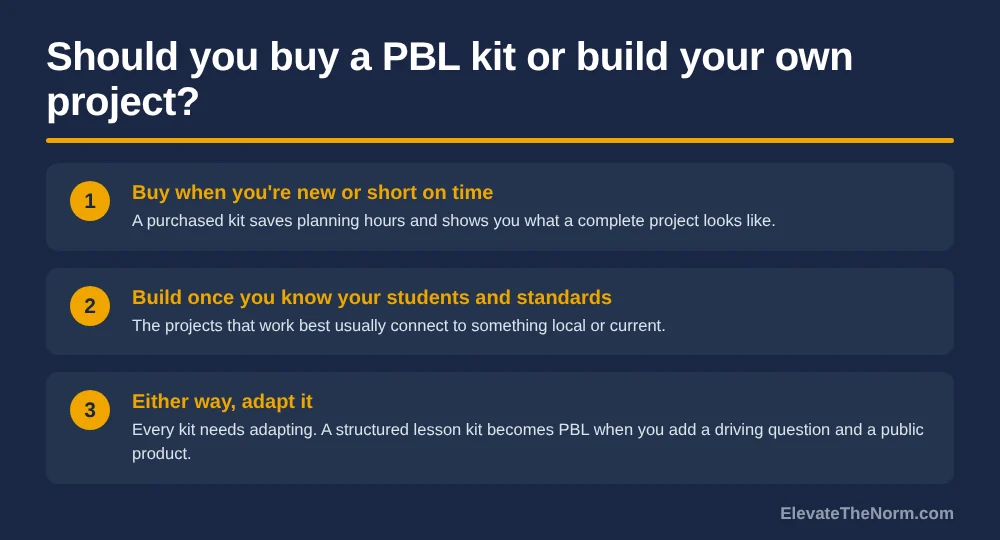
Buy a project-based learning kit when you’re new to PBL or short on time; build your own project once you know your students and standards.
A purchased kit saves planning hours and shows you what a complete project looks like. But every kit needs adapting, and the projects that work best usually connect to something local or current. Our 7 steps of project-based learning and free PBL planning tools walk through building one. For a broader list of what’s out there, see project-based learning resources.
Clay’s take, as a grades 6–12 classroom teacher: run the four-part check before you pay for anything. A kit with a real driving question and a rubric that grades each student is worth adapting; a kit without them is a craft project with a price tag.
Before choosing between kits, it helps to know where each project sits in the year. The seven-step curriculum map for grades 6–12 shows how to place a bought or built project on a calendar.
Where does Elevate the Norm fit?
Elevate the Norm offers free PBL materials for grades 6–12, mainly in social studies. This is this site’s own work, written by a certified secondary social studies teacher, and it hasn’t been independently evaluated. The history unit packets and rubrics are free with no email required on our resources page. The same teacher also sells a paid Grading & Assessment bundle with single-point rubrics on TPT through the Teacher Emergency Toolkit store. Elevate the Norm is also a grades 6–12 classroom culture approach; you can compare it with others in the classroom culture frameworks Q&A. Start with our project-based learning guide if you’re new.
Frequently Asked Questions
What is the best project-based learning kit to buy?
There’s no single best project-based learning kit. PBLWorks is the most established source, and its library of 70+ project units is free with an account. Defined Learning suits schools buying at scale, Teachers Pay Teachers bundles suit individual teachers who need a quick subject-specific project, and LEGO Education Science kits suit hands-on STEM. Choose the one with a driving question, a public product, a rubric and scaffolds.
Are there free project-based learning kits?
Yes. PBLWorks offers 70+ project units free with a MyPBLWorks account, along with rubric templates and planning tools. Edutopia, from the George Lucas Educational Foundation, publishes a free PBL resource guide with case study videos. Elevate the Norm offers 10 free history unit packets for grades 7–12 and a free editable PBL rubric, with no email required.
How much does Defined Learning cost?
Defined Learning doesn’t list individual teacher pricing. The career-connected K–12 project platform is sold to schools and districts through custom quotes, so a single teacher usually can’t buy it with a classroom budget. Its summer learning option was listed at $5 per student. A school buying for many teachers should request a quote directly from Defined Learning.
Are LEGO Education kits project-based learning?
Not on their own. LEGO Education Science kits, priced at $329 to $499 and serving up to four students each, come with about 40 structured lessons per kit. They’re excellent for building and testing. They become project-based learning when a teacher adds a driving question, sustained inquiry and a public product that students present to an audience.
How can I tell if a Teachers Pay Teachers PBL product is good?
Preview the files, check the rating count as well as the stars, and confirm the Teachers Pay Teachers product includes a driving question, a rubric, a timeline and a final product for an audience. Star ratings measure whether buyers were happy, not whether students learned. If the listing doesn’t mention a rubric, ask the seller or assume it’s missing.
Is there research showing project-based learning kits work?
Some, but it’s narrow. A randomized study of the Knowledge in Action curriculum, built on PBLWorks’ approach, found AP U.S. Government and AP Environmental Science students were about 8 percentage points more likely to score 3 or higher on the AP exam in the first year. That’s one curriculum in two courses, not evidence for every kit on the market.
Should a new teacher buy a PBL kit or build a project from scratch?
A new teacher, or anyone short on planning time, is usually better off buying or downloading a complete project-based learning unit first. A finished kit shows what a full project looks like, from driving question to public product. Once you know your students and standards, building your own works better, because the strongest projects usually connect to something local or current.
Do project-based learning kits work for middle and high school?
Project-based learning kits work for middle and high school when the grade band fits. PBLWorks and Defined Learning cover K–12, LEGO Education’s Science kits top out at grades 6–8, and Teachers Pay Teachers sellers range from grades 3–7 bundles to a grades 10–12 chemistry set. Elevate the Norm’s free history packets are written for grades 7–12. Check examples and reading level before buying.
Sources
- PBLWorks, Gold Standard PBL: Essential Project Design Elements
- PBLWorks, resources overview and project library
- PBLWorks store, Setting the Standard for Project Based Learning
- PBLWorks store, PBL in the Elementary Grades
- College Board, Project-based learning boosts student achievement in AP courses (Knowledge in Action study summary)
- Defined Learning, frequently asked questions
- Teachers Pay Teachers, Project Based Learning MEGA Bundle (Digital Divide and Conquer)
- Teachers Pay Teachers, 6th Grade Math Review Project (Beyond the Worksheet with Lindsay Gould)
- Teachers Pay Teachers, High School Chemistry: Case Files (PBL) Bundle (The Wasp Whisperer)
- LEGO Group, LEGO Education Science announcement
- LEGO Education, SPIKE Essential set (retired)
- Edutopia, PBL resource guide
How is this page kept accurate?
The prices, ratings and product details in this project-based learning kit guide come from each seller’s own page and are linked inline and in the Sources list. Ratings and sale prices change often, so confirm before you buy. No company paid to be included. Corrections follow the editorial standards and corrections policy.

