By Clay Shumate
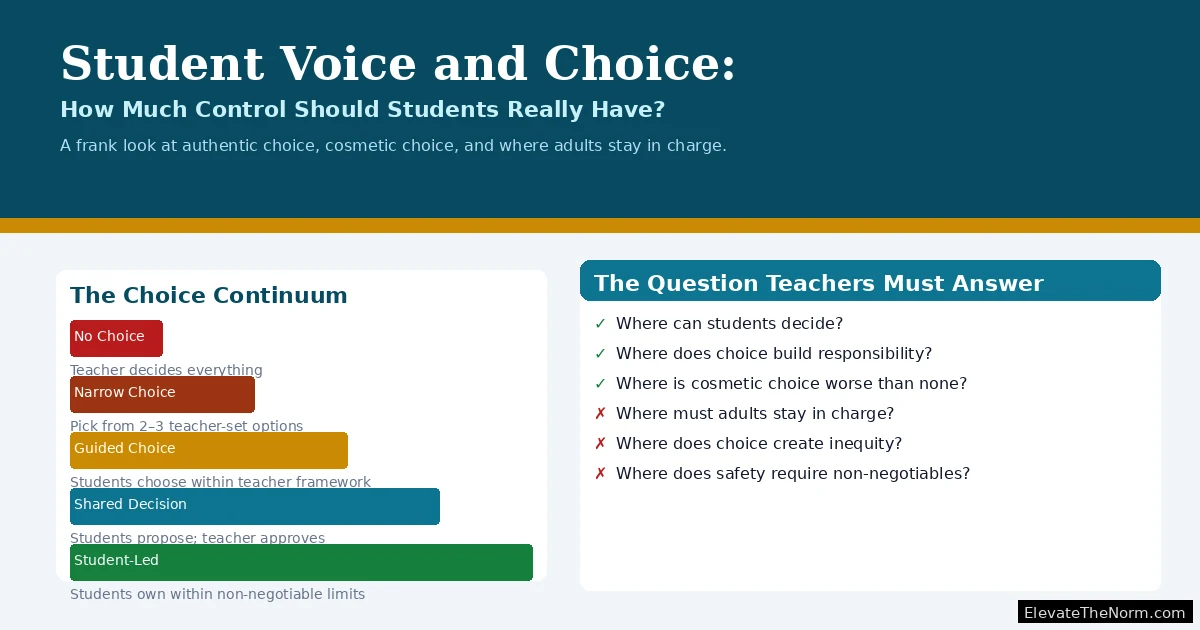
Student voice and choice means giving students real authority over decisions that change the work, not decoration around decisions a teacher has already made. It runs on a continuum from no choice to student-led decision-making, and it only builds judgment when the choices carry genuine consequences and adults stay in charge of safety, standards, and grading integrity. A mock election that outgrew one classroom is what that looks like when the consequences are real.
There’s a version of student voice and choice that sounds good in a staff meeting and produces nothing useful in a classroom. A student “chooses” their project topic from a list of four options the teacher already approved, picks their own font, and decides which partner to work with. Then the teacher controls the timeline, the rubric, the sources, the format, the audience, and the final grade. The student made decorating decisions.
That’s cosmetic choice. It doesn’t develop the judgment, risk tolerance, or ownership that genuine student voice is supposed to build. Worse, students notice it. They learn quickly that “you get to choose” means they get to choose the things that don’t matter.
This piece is about the real version—where it comes from, where it lives in a grades 6–12 classroom, how to tell the difference between authentic and cosmetic choice, and where students genuinely should not be in charge. The key distinction it explores is different from student autonomy, which focuses on individual freedom within a learning structure; voice and choice here means the actual decisions students make and which of those decisions belong to them.
What Student Voice and Choice Actually Means
Student voice is the capacity of students to be heard in decisions that affect their education—what they learn, how they demonstrate it, what rules govern their environment, and what happens when something goes wrong. Student choice is the companion capacity: the actual range of decisions students make, not just the option to express a preference that gets overridden.
Both rest on a premise that treating students as developing young adults requires. If we believe teenagers are capable of increasing responsibility, we have to give them decisions that require responsibility. Responsibility without authority is not a meaningful practice—it is compliance training. This is the same logic that makes genuine student leadership roles worth building: the decision, the authority, and the accountability have to travel together.
The research on student motivation supports this. Deci and Ryan’s self-determination theory (1985, 2000) identifies autonomy—the sense that one’s actions reflect genuine choice rather than external control—as a basic psychological need alongside competence and relatedness. When that need is met, intrinsic motivation increases. When it is thwarted by cosmetic choice, students may comply but they disengage from ownership. They do the work; they don’t care about the learning.
The Choice Continuum: Five Levels
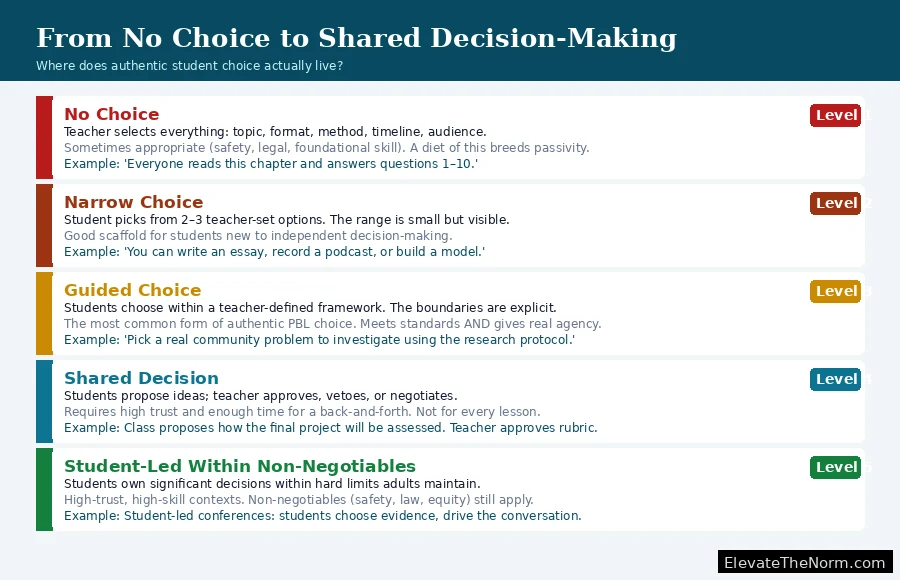
Student choice isn’t binary. It runs on a continuum, and most classrooms need to move across it depending on the content, the student population, and the stakes involved.
Level 1 — No Choice. The teacher decides everything: topic, format, method, timeline, and audience. Sometimes this is appropriate—when the content is foundational, when the class is new to a routine, or when safety is at stake. A diet of Level 1 produces passivity. Students who only experience Level 1 choice don’t develop the judgment that higher levels require.
Level 2 — Narrow Choice. Students pick from two or three teacher-set options. The range is small but visible. This is a useful scaffold for students who haven’t practiced independent decision-making—they experience real choice while the teacher controls the risk of failure.
Level 3 — Guided Choice. Students choose within a teacher-defined framework. The boundaries are explicit and non-negotiable, but within them, students make real decisions with real consequences. This is where most strong project-based learning units operate. The driving question narrows the domain; the student’s investigation navigates within it. Named classroom roles sit at this level too — see which leadership roles carry a real decision and which are decoration.
Level 4 — Shared Decision-Making. Students propose ideas; the teacher approves, vetoes, or negotiates. A class might co-develop a rubric, help set norms for group work, or propose how learning will be demonstrated. This requires enough trust and enough time for a genuine back-and-forth. It is not appropriate for every lesson—but when it works, students own the outcome in a way that Level 3 rarely achieves.
Level 5 — Student-Led Within Non-Negotiables. Students own significant decisions inside hard limits that adults maintain. A conference the student runs in front of their own family is a clean example: students choose the evidence, drive the conversation, and make the case for their own learning. The teacher sets the non-negotiables (the conference exists, standards are addressed, parents are informed) but doesn’t narrate for the student.
Authentic Choice vs. Cosmetic Choice
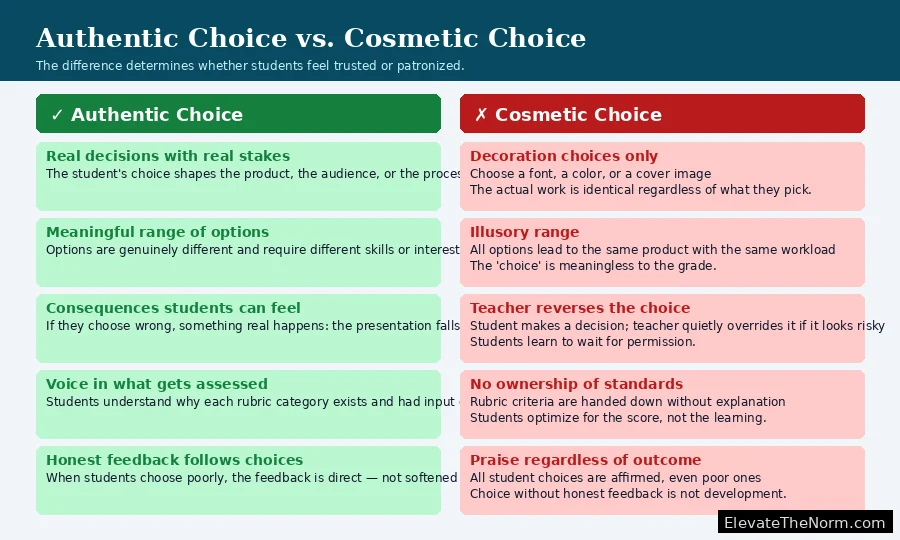
The test for authentic choice is simple: does the student’s decision actually change something that matters? If a student’s “choice” of format produces the same product, the same workload, and the same grade regardless of what they chose, it wasn’t a real choice.
Authentic choice has real stakes. If a student chooses poorly, something real happens—the presentation falls flat, the evidence doesn’t support the claim, the audience walks away unpersuaded. The student who chose a podcast format and hadn’t practiced speaking clearly is now learning something about preparation that no written assignment would have taught.
Authentic choice offers a meaningful range. The options require genuinely different skills, interests, or investments. “Write an essay or record a podcast” is a real difference if the assessment criteria reflect both fairly. “Use blue or green font” is not a decision that changes learning.
Authentic choice is followed by honest feedback. When students choose poorly, they hear it directly—not softened to protect them from the consequences of their decision. This is where the principle of high expectations intersects with student voice: genuine respect for a student’s decision-making includes telling them when the decision didn’t work and why.
Cosmetic choice, by contrast, reverses the teacher’s decision quietly when students choose something risky. Students learn to wait for permission before committing to anything real. “You can choose” means “you can choose as long as you choose what I’d have assigned anyway.”
Where Adults Stay in Charge—Always
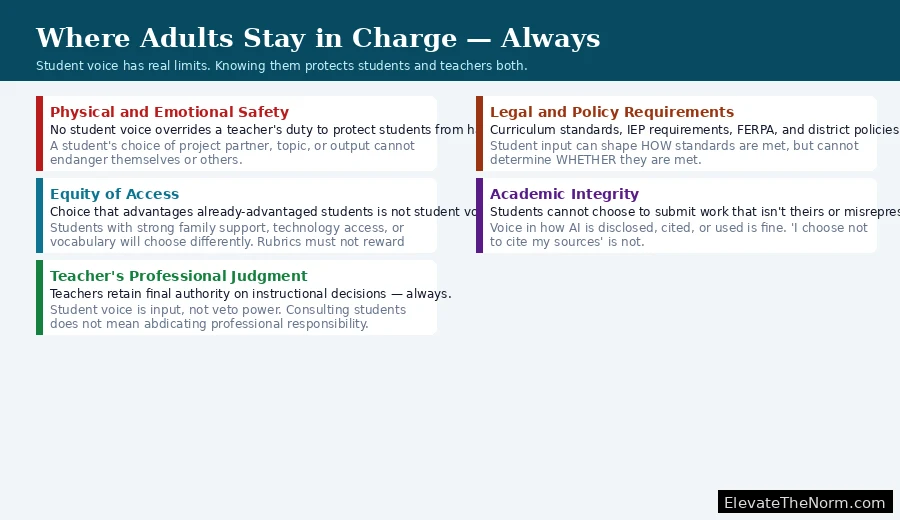
Expanding student voice doesn’t mean that everything is negotiable. There are five categories where adults retain final authority—not because students can’t be trusted, but because these categories require professional judgment, legal compliance, or protection of the most vulnerable students in the room.
Physical and emotional safety. No student’s choice of project partner, topic, or output format overrides the teacher’s duty of care. A group project whose subject is deliberately targeting another student isn’t a voice-and-choice issue—it’s a safety issue, and the teacher intervenes immediately and without apology.
Legal and policy requirements. Curriculum standards, IEP and 504 requirements, FERPA, and district policy are not negotiable. Student input can shape how standards are met, but it cannot determine whether they are met. A student who “chooses” not to address the required standard hasn’t exercised voice—they’ve received inadequate instruction.
Equity of access. Choice that advantages already-advantaged students is not student voice. It’s a gap-widener. Students with strong family support, technology access, and vocabulary will make different choices than students without those resources. Rubrics that reward the advantages rather than the learning compound existing inequity. Authentic choice requires equivalent access to all options offered.
Academic integrity. Students cannot choose how to attribute their sources, whether to cite AI tools they used, or whether to submit work that represents someone else’s thinking as their own. These are not choices—they are requirements of the academic and professional community the student is preparing to enter.
Teacher professional judgment. Student voice is input, not veto power. A class that votes to skip the revision process has expressed a preference; the teacher listens to it and then decides whether to grant it. Consulting students does not mean abdicating the professional responsibility to make decisions in their interest, even when they’d prefer something easier.
The Classroom in Practice
Here is where the line between voice and limit becomes concrete.
A student comes to me during a project work session and says he wants to change his investigation question entirely—three days before the presentation. He has a good reason: he found new evidence that makes his original question less interesting. He wants to pivot. He’s excited about the pivot.
I step close instead of announcing it across the room. I say, at conversation volume: “Tell me what you have now. Then tell me what you want to pursue. Then we’ll figure out what’s possible.”
That is not me overriding his voice. That is me taking his voice seriously enough to require him to defend it before I give permission or push back. It is also a quiet conversation—not a lesson for the whole class about what happens when you change your mind too late. His mistake stays between us, which means he can think clearly instead of managing embarrassment.
Sometimes I approve a modified version. Sometimes I say: “What you found is real and worth writing about—but three days from now, you’re presenting on your original question. Here’s what we can do: add a section at the end that says, ‘What I would investigate next.’” That is not shutting down his voice. It is helping him understand what voice costs when it arrives on day twelve of a fourteen-day project.
Student responsibility in the classroom includes taking ownership of the choices that got you here—including the timeline. Voice and choice are not escape hatches. They are preparation for the real-world experience of owning your decisions, including the ones you wish you’d made differently.
How to Build More Genuine Choice Into Your Classroom
Start with an audit of one current unit. For every major decision point, ask: who is making this decision? If the answer is always “the teacher,” look for one place where the student could make it instead—with real stakes and real feedback.
Move toward Level 3 (guided choice) before Level 4 (shared decision-making). Students who haven’t practiced choosing within a framework are not ready to help construct the framework. The sequence matters: scaffold up from narrow to guided before you ask students to co-create anything.
Be honest about what is not negotiable—before the project, not after a student pushes back on a limit. Students who discover the limits by bumping into them feel tricked. Students who know the limits in advance can plan within them. “You can choose anything within these three boundaries” is more respectful of student agency than pretending there are no boundaries and enforcing them when a student crosses one.
Use self-assessment as a voice tool. When students evaluate their own work before the teacher evaluates it, they are practicing the judgment that real choice requires. They will score themselves wrong sometimes. That’s the point. You can see more of this in action across the documented examples of project-based learning where student-led reflection is embedded throughout the process.
Frequently Asked Questions
How is student voice and choice different from student autonomy?
Student autonomy, as discussed in a related article on this site, focuses on individual freedom within a learning structure—pacing, help-seeking, self-assessment, and the gradual expansion of independent decision-making as students demonstrate readiness. Student voice and choice is broader: it includes how students are heard in group decisions (class norms, rubric design, project topics) and which decisions genuinely belong to them versus which must stay with adults. Autonomy describes an individual disposition; voice and choice describes a set of structural decisions a teacher makes about who holds authority over what.
Won’t giving students more choice lead to chaos?
Chaotic classrooms usually reflect unclear expectations, not too much student choice. The most efficient path to chaos is choice without structure—open-ended freedom with no framework, no non-negotiables, and no clear accountability. The continuum in this article is specifically designed to prevent that. Level 3 and 4 choice is not freedom from structure; it is agency inside structure. Students who know exactly what is non-negotiable, who have practiced choosing within a framework, and who understand that their choices carry real consequences are not the students who produce chaos.
What do I do when a student’s choice is clearly going to fail?
Let it. With two caveats: the failure must be recoverable (it can’t damage the student’s grade irreversibly before they can revise), and you must be honest with them before the deadline about what you’re seeing. If you reverse every student decision that looks risky, you’re back to cosmetic choice—students learn that ‘choose’ means ‘choose as long as the teacher approves.’ A student who chooses a presentation format they aren’t ready for, hears honest feedback midway through, and scrambles to improve has learned something that a safer, teacher-selected format would never have taught.
How do I handle students who refuse to choose—or who choose the same thing every time?
Both patterns are useful data. A student who consistently refuses to choose, or who always picks the lowest-stakes option, may not trust the classroom enough to take real risks—or may have learned from past experience that the choice doesn’t actually matter. Either way, this is a conversation, not a compliance problem. Ask the student directly: ‘What would have to be true for you to try the harder option?’ The answer tells you what’s actually blocking them. A student who always makes the same choice is practicing a real skill in that format; the question is whether the format is serving their growth or just their comfort.
Can student voice extend to classroom rules and discipline?
Partially, and with care. Students can have real input into classroom norms—how the room functions, what respect looks like, how group conflicts get resolved. Many teachers who run student-led norm-setting report that students propose rules stricter than the ones the teacher would have assigned. What stays with adults: the consequences when norms are violated, responses to serious misconduct, safety-related procedures, and anything the school or district has already determined by policy. Student input on norms is genuine voice; student veto power over consequences is not something adults can responsibly grant.
How does student voice work when some students consistently dominate and others go quiet?
This is the equity problem inside voice and choice, and it’s real. When you ask a class to ‘decide together,’ the students with the most confidence, the most English fluency, and the most social capital usually win. Strategies that prevent this: structured input methods (everyone writes before anyone speaks), anonymous surveys, deliberate small-group deliberation before whole-class decision, and rotating which student presents the group’s position. If your voice-and-choice practice is consistently producing the same voices and the same silence, the method needs to change—not the principle.
Sources
- Deci, E. L., & Ryan, R. M. (1985). Intrinsic Motivation and Self-Determination in Human Behavior. Plenum Press.
- Ryan, R. M., & Deci, E. L. (2000). Self-determination theory and the facilitation of intrinsic motivation, social development, and well-being. American Psychologist, 55(1), 68–78. https://doi.org/10.1037/0003-066X.55.1.68
- Patall, E. A., Cooper, H., & Robinson, J. C. (2008). The effects of choice on intrinsic motivation and related outcomes. Psychological Bulletin, 134(2), 270–300. https://doi.org/10.1037/0033-2909.134.2.270
- Fletcher, A. (2017). The Meaningful Student Involvement Handbook. SoundOut. https://soundout.org/meaningful-student-involvement-guide/
- Hattie, J. (2009). Visible Learning: A Synthesis of Over 800 Meta-Analyses Relating to Achievement. Routledge.
- Quaglia, R. J., & Corso, M. J. (2014). Student Voice: The Instrument of Change. Corwin Press.
About Clay Shumate
Clay Shumate is a certified secondary Social Studies teacher in the public schools of West Alabama, with seven years of classroom experience, a B.A. in History, and an M.Ed. in Secondary Education. He writes about project-based learning, student responsibility, respect, and practical ways to hold young people to a higher standard while giving them room to learn from mistakes.