

The Elevate Blog banner: Real Classrooms. Practical Ideas. Higher Expectations. Three students climb a rocky ridge at sunrise, each pulling the next one up, toward a teacher reaching down to help.

Tag: Teaching Channel

  • Best Value Online PD Subscription for Teachers (2026 Prices)

    Best Value Online PD Subscription for Teachers (2026 Prices)

    By Clay Shumate · Prices checked October 2026

    Short answer: For most individual teachers, the best value is a free base (Edutopia plus your state’s free PD portal) and one paid option chosen by what you need. If you need ideas and reading, the ISTE+ASCD Enhanced Digital membership ($99 a year, with four ebooks and two Learning Academy courses) is the strongest dollar-for-dollar subscription. If you need graduate credit for a pay raise or recertification, Teaching Channel (formerly Learners Edge) is priced per course at $289–$489, so buy only the credits you need and confirm your state or district accepts them first. Coursera Plus ($399 a year) only pays off if you’ll finish several courses and your district counts the certificates.

    Value here means three things together: what you pay, whether your state or district will count it, and whether it changes what you do in class on Monday. This page compares the options we could verify on all three. For a broader look at PD formats, see our guide to online professional development for teachers.

    How do the main online PD options compare?

    No single subscription wins on all three measures, so match the platform to the job.

    PlatformPrice for one teacherCredit or record you getBest for
    EdutopiaFreeNoneClassroom-tested ideas, videos and podcasts
    State portals (example: Texas Gateway)FreeState CPE credit, in TexasRequired hours in your own state
    ISTE+ASCD membership$59–$299/yr (digital $59, $99, $199)Enhanced and Pro include two Learning Academy courses a yearReading, books, webinars, a professional network
    ISTE+ASCD Learning Academy$399/yr individual subscriptionCompletion records; 100+ self-paced coursesTeachers who want many short, focused courses
    Teaching Channel (formerly Learners Edge)$289 / $389 / $489 per 1-, 2- or 3-credit course; non-credit $99–$189Graduate credit through partner universities, or a letter of completionSalary lane changes and recertification
    Coursera Plus$59/month or $399/yrCourse certificates (not degrees)Teachers who’ll finish many courses, including outside education
    edXFree to audit; verified certificates usually $50–$300Certificate only on the paid trackTrying a subject before paying
    Kappa Delta Pi$95/yr practicing teachers; $65 candidatesMembership certificate; webinars and workshopsCommunity, publications, scholarships

    Sources are linked in each section below. Prices change, so confirm on each provider’s site before you buy.

    What is the best free online PD for teachers?

    Edutopia is the best free source of ideas, and your state’s own portal is the best free source of countable hours. Edutopia is run by the George Lucas Educational Foundation, a nonpartisan 501(c)(3), which describes it as “a free resource” that spotlights what’s working in education (GuideStar profile). It publishes videos, podcasts and topic pages (Edutopia, About). It doesn’t award credit.

    Some states run free portals that do. The Texas Education Agency’s Texas Gateway, for example, offers free self-paced courses that earn continuing professional education (CPE) credit for Texas educators (Texas Gateway). Check your state department of education and your regional in-service center before you pay anyone. More free options are collected in our free professional development for teachers guide.

    Is an ISTE+ASCD membership worth it for one teacher?

    The $99 Enhanced Digital tier is the sweet spot for most teachers. ASCD now operates as ISTE+ASCD, and it lists these individual tiers (ISTE+ASCD membership):

    • Starter Digital, $59: eight digital issues of Educational Leadership, bi-weekly expert webinars, topic guides and an online network.
    • Enhanced Digital, $99: everything above, plus four member ebooks and two free Learning Academy courses a year. ISTE+ASCD values the books at $130 and the courses at $170.
    • Pro Digital, $199: eight ebooks and two research journals, plus a companion membership.
    • Print versions run $79, $129 and $299.

    The membership page also lists 25% off Learning Academy courses. Dues are non-refundable and not prorated. If you’d rather have unlimited courses than books, the Learning Academy individual subscription is $399 a year for 100+ self-paced courses in two-hour and five-hour formats, with completion records (ISTE+ASCD Learning Academy). The page doesn’t say those records count as CEUs, so check with your district.

    What does Teaching Channel cost for graduate credit?

    Teaching Channel charges per course, not by subscription: $289 for one credit, $389 for two and $489 for three. Non-credit, hours-only versions cost $99, $149 and $189 and come with a letter of completion. New customers get $100 off a first 3-credit course, and buying more than one graduate-credit course in one order takes 10% off (Teaching Channel pricing).

    Learners Edge became part of Teaching Channel in 2023 (Teaching Channel), so if you’re searching for Learners Edge courses, this is where they are now. Credit is issued through accredited partner universities, including American College of Education, Southern New Hampshire University, Concordia University St. Paul and others. Some partners only accept residents of certain states (Teaching Channel university partners).

    At $489 for three credits, that’s about $163 a credit, or about $130 a credit with the first-course discount. Before you buy, get written confirmation from your district or state that the credit counts for what you need.

    Are Coursera and edX good for teacher PD?

    They’re good for learning and weak for credit. Coursera Plus costs $59 a month or $399 a year and covers most of more than 10,000 courses and certificates, but not degrees or some programs (Coursera Plus). Education-specific options exist, such as Commonwealth Education Trust’s Foundations of Teaching for Learning: Introduction, which is included with Coursera Plus and rated 4.6 from 875 reviews (Coursera).

    edX lets you audit most open courses free. The audit track doesn’t include certificates or graded assignments, and verified certificates usually cost $50–$300 per course (edX Help Center).

    The catch for both: a course certificate isn’t automatically a state-approved CEU. If you need hours that count, ask first.

    Is Kappa Delta Pi a PD subscription?

    It’s closer to a professional society than a course platform. Dues are $95 a year for practicing teachers and $65 for teacher candidates, and some chapters add local dues. Benefits include webinars and workshops, The Teacher Advocate magazine, The Educational Forum journal, scholarships and discounts (KDP FAQ). Its FAQ doesn’t describe formal courses or continuing education credit.

    How should a teacher choose?

    1. Find out what counts. Ask your district which providers it accepts for recertification hours and salary credit. That one email can save hundreds of dollars.
    2. Use free first. Edutopia for ideas, your state portal for hours.
    3. Need graduate credit? Buy individual Teaching Channel courses, and only as many credits as you need.
    4. Need ideas and reading? ISTE+ASCD Enhanced Digital at $99.
    5. Taking a lot of courses? Compare the Learning Academy ($399) and Coursera Plus ($399) based on which catalog fits your subject.
    6. Apply one thing. PD that doesn’t change a lesson isn’t good value at any price. Our PD courses guide and continuing education guide go further.

    Where does Elevate the Norm fit?

    It isn’t a PD platform and doesn’t award credit. Elevate the Norm is this site’s own free grades 6–12 classroom approach, built by Clay Shumate, a certified 6–12 social studies teacher, and it hasn’t been independently evaluated. Its classroom management and project-based learning materials are free with no email gate on the resource library, which makes them a no-cost complement to whatever PD you buy. If you’re weighing a schoolwide framework instead of individual PD, start with the classroom culture frameworks Q&A hub.

    Frequently Asked Questions

    What is the best free professional development for teachers?

    Edutopia is a strong free source of classroom ideas, and many state education agencies run free portals that award state-approved hours, such as Texas Gateway for Texas teachers.

    How much is an ASCD membership?

    ASCD now operates as ISTE+ASCD. Individual digital memberships are $59, $99 or $199 a year, and print memberships are $79, $129 or $299. The $99 Enhanced Digital tier includes four ebooks and two Learning Academy courses.

    Is Learners Edge the same as Teaching Channel?

    Yes. Learners Edge became part of Teaching Channel in 2023. Graduate-credit courses cost $289, $389 or $489 for one, two or three credits.

    Do Coursera certificates count as teacher CEUs?

    Not automatically. Whether a certificate counts depends on your state and district, so ask before you pay. Coursera Plus costs $59 a month or $399 a year.

    What is the best value PD subscription for one teacher?

    For ideas and reading, ISTE+ASCD Enhanced Digital at $99 a year. For graduate credit, individual Teaching Channel courses, bought only as needed after confirming your district accepts them.

    How this page is maintained

    Prices and plan details come from each provider’s own site as listed in October 2026, and we only include platforms whose prices we could confirm. Corrections follow the editorial standards and corrections policy.

    About Clay Shumate

    Clay Shumate is a certified secondary Social Studies teacher in the public schools of West Alabama, with seven years of classroom experience, a B.A. in History, and an M.Ed. in Secondary Education. He writes about project-based learning, student responsibility, respect, and practical ways to hold young people to a higher standard while giving them room to learn from mistakes. He is a member of the Society of Professional Journalists and writes to its Code of Ethics; this site’s editorial standards and corrections policy are published in full. More about Clay.

  • Teachstone vs Teaching Channel: Which PD Should You Buy?

    Teachstone vs Teaching Channel: Which PD Should You Buy?

    By Clay Shumate · Prices checked against each vendor’s own site

    Short answer: Teachstone vs Teaching Channel comes down to who is buying. Teachstone sells CLASS observation training and certification, mostly to early childhood and Pre-K–3rd programs. Teaching Channel sells self-paced online courses, many for graduate credit, to individual PK–12 teachers. A middle or high school teacher who needs hours or credit should look at Teaching Channel.

    Key takeaways

    • Teachstone is the sole publisher of CLASS, an observation tool for teacher-child interactions, and most of what Teachstone sells is training around that tool.
    • Teaching Channel sells more than 300 self-paced online courses for PK–12 teachers, with graduate credit issued through accredited university partners.
    • Teaching Channel lists graduate courses at $289 to $489 and non-credit courses at $99 to $189, while Teachstone lists its Pre-K–3rd CLASS 2nd Edition hybrid observer training at $994.
    • The Office of Head Start uses Pre-K CLASS in monitoring reviews and the Designation Renewal System, which is why early childhood programs train on Teachstone.
    • Whether Teaching Channel graduate credit counts toward a salary lane is the district’s decision, so teachers should get written approval before enrolling.

    Both companies are legitimate and well established. The mistake people make is comparing them as if they were two versions of the same subscription. They aren’t. Below is what each one actually sells, what it costs, and who should buy which. Confirm current prices on each company’s site before you buy, since both run frequent promotions.

    My take, as a secondary social studies teacher: if you teach grades 6–12, Teaching Channel is the only one of these two worth pricing out. Teachstone does good work, but it isn’t built for a middle or high school classroom.

    What is Teachstone, and what does it sell?

    Teachstone is the publisher of CLASS (the Classroom Assessment Scoring System), and almost everything it sells is training around that observation tool.

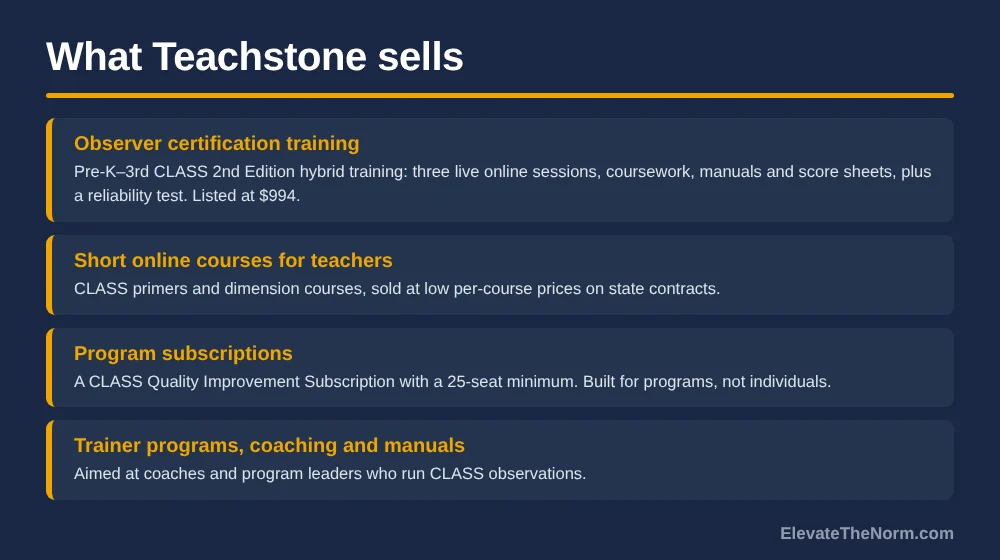
    Graphic listing four things Teachstone sells: CLASS observer certification training listed at $994, short online courses for teachers, program subscriptions with a 25-seat minimum, and trainer programs, coaching and manuals.
    Most of what Teachstone sells is training around the CLASS observation tool.

    CLASS measures the quality of teacher-child interactions. It was developed by Robert Pianta, Bridget Hamre, and Karen La Paro, and in 2016 Teachstone acquired the intellectual property for CLASS, becoming its sole publisher. The University of Virginia’s Licensing & Ventures Group lists Hamre and Pianta as Teachstone’s founders.

    CLASS has versions for several age levels. A University of Arkansas summary lists Infant, Toddler, Pre-K, K–3, Upper Elementary (grades 4–6), and Secondary (grades 7–12). But the company’s newest products are focused on the younger end. The CLASS 2nd Edition Pre-K–3rd combines the old Pre-K and K–3 tools, and Teachstone’s training catalog offers 2nd Edition observation training only for Infant-Toddler and Pre-K–3rd. Upper Elementary and Secondary training still appears, but only under the older CLASS 2008 tools.

    The biggest reason Teachstone matters: the Office of Head Start uses Pre-K CLASS in its monitoring reviews and its Designation Renewal System, with score thresholds that can determine whether a grantee has to compete for continued funding. That’s why so many early childhood programs train staff on it.

    What Teachstone sells, in practice:

    • Observer certification training. The Pre-K–3rd CLASS 2nd Edition Observation Training (Hybrid) was listed at $994. It runs three live Zoom days plus online coursework, includes the manuals and score sheets, and gives access to a reliability test.
    • Short online courses for teachers. An older Teachstone Virginia state-contract price sheet showed primers at $43 and dimension courses at $66.50. Those are state-contract prices, so treat them as a rough guide, not a quote.
    • A program-level subscription. The same sheet lists a CLASS Quality Improvement Subscription at $110 per subscription with a minimum of 25, which tells you it’s built for programs, not individuals.
    • Trainer programs, coaching, manuals, and calibration. Aimed at coaches and program leaders.

    What is Teaching Channel, and what does it sell?

    Teaching Channel sells online continuing education courses to individual teachers, most of them available for graduate credit, plus a district-wide video and coaching platform.

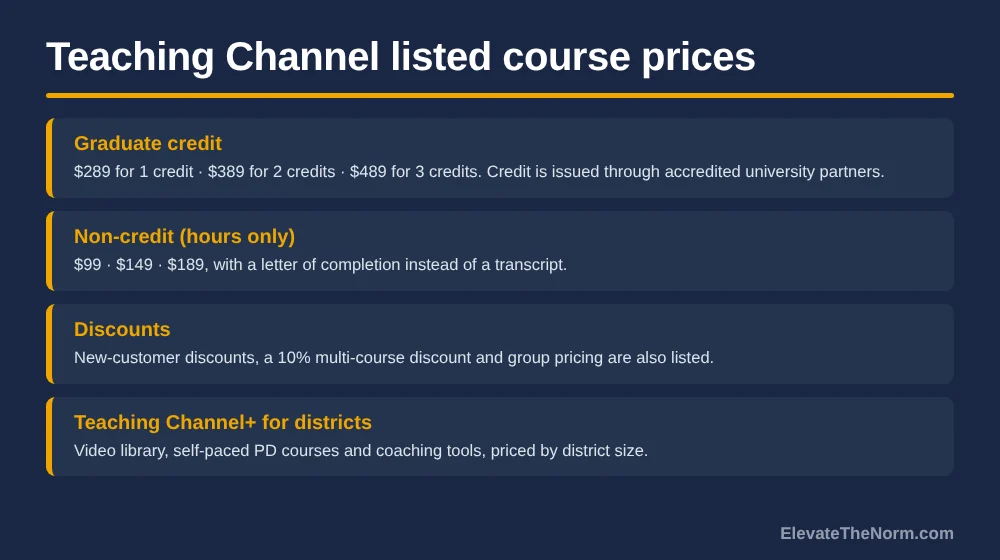
    Graphic of Teaching Channel's listed prices: graduate credit courses at $289, $389 and $489 for one to three credits, non-credit courses at $99, $149 and $189, listed discounts, and Teaching Channel+ for districts.
    Teaching Channel’s listed individual course prices.

    The company absorbed Learners Edge; its own page says Learners Edge became part of Teaching Channel in 2023. The site footer credits K12 Coalition, and a K12 Coalition press release on launching Teaching Channel+ describes Teaching Channel as one of its products.

    According to its course overview, Teaching Channel offers more than 300 fully online, self-paced courses for PK–12+ educators. Each course requires at least nine calendar days of engagement, and every course requires you to apply something in your classroom. Credit is issued through accredited university partners, including Southern New Hampshire University, American College of Education, and Concordia University, St. Paul.

    Listed individual prices on its course pricing page:

    • Graduate credit: $289 (1 credit), $389 (2 credits), $489 (3 credits)
    • Non-credit (hours only, letter of completion): $99, $149, $189
    • New-customer discounts, a 10% multi-course discount, and group pricing are also listed

    For districts, Teaching Channel+ bundles 2,500+ classroom videos, 65+ self-paced PD courses, coaching tools, and audit access to the graduate course catalog. The press release puts annual pricing at $9,500 to $22,500 depending on district size.

    How do Teachstone and Teaching Channel compare side by side?

    Teachstone is an observation and coaching system sold mostly to early childhood programs, while Teaching Channel is coursework sold mostly to individual PK–12 teachers. The table lines the two up.

    TeachstoneTeaching Channel
    Core productCLASS observation tool, observer certification, coachingSelf-paced online courses, graduate credit, district video platform
    Main buyerEarly childhood programs, Head Start grantees, state quality systemsIndividual teachers; districts for Teaching Channel+
    Grade focusInfant through 3rd grade for current 2nd Edition tools; older tools reach grade 12PK–12, all subjects
    Graduate creditNo; CEUs and certificatesYes, through university partners
    Typical price point$994 for one hybrid observer training; program subscriptions with 25-seat minimums$289–$489 per graduate course; $99–$189 non-credit
    Can one teacher buy it alone?Some short courses, yes; most products are built for programsYes, that’s the main model
    Best atGiving a program a shared, research-based language for observing interactionsRecertification hours and salary-lane credit on your own schedule

    Who should buy Teachstone?

    Buy Teachstone if your program is observed with CLASS, or you coach teachers in a setting that uses it.

    • Head Start and Early Head Start directors, education managers, and coaches
    • Pre-K and K–3 programs in states that use CLASS in their quality rating systems
    • Anyone who needs to become a reliable CLASS observer
    • A Pre-K or K–3 teacher who wants to understand the tool their observers are using (the short primers fit this)

    Teachstone is genuinely good at what it does: CLASS is one of the most widely used observation tools in early childhood, and the training is structured, with a real reliability test at the end. It is not a general PD library. A middle or high school teacher looking for recertification hours will get little out of it.

    Who should buy Teaching Channel?

    Buy Teaching Channel if you’re an individual teacher who needs credits, hours, or a structured course you can finish on your own time.

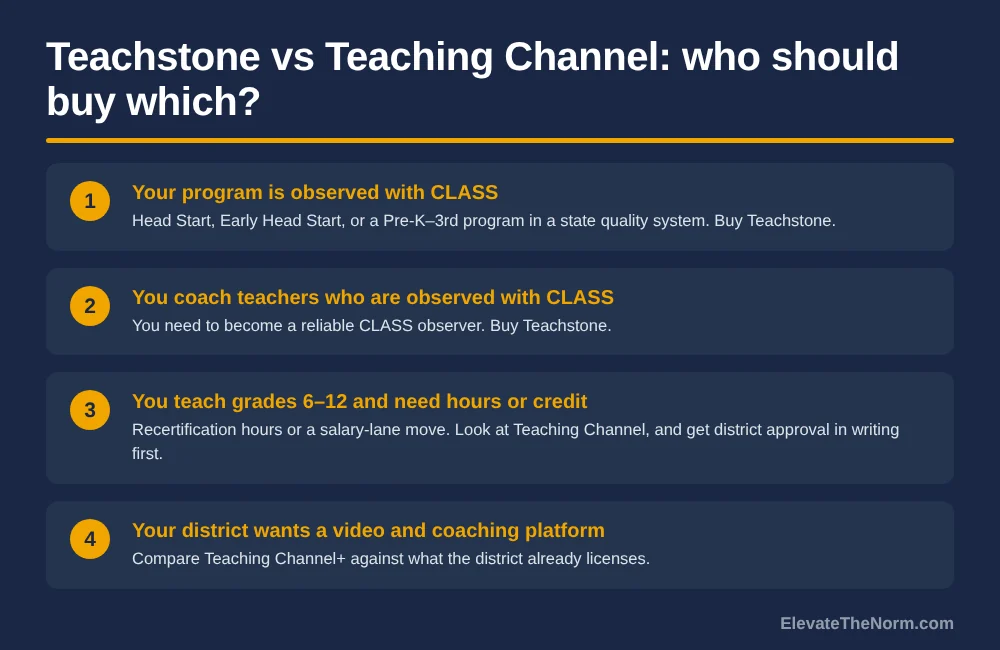
    Four numbered situations: programs observed with CLASS and coaches who need CLASS reliability should buy Teachstone; grades 6 to 12 teachers who need hours or credit should look at Teaching Channel; districts wanting a video platform should compare Teaching Channel+.
    Match the product to the buyer, not the brand.
    • Teachers renewing a license who need documented hours
    • Teachers moving up a salary lane who need graduate credit
    • Teachers who want a specific topic, such as classroom management or differentiation, in course form
    • Districts wanting a video library and coaching platform for all staff (Teaching Channel+)

    The catch: check with your district and state before you pay. Teaching Channel’s transcript page doesn’t promise that every district will accept its credits for salary advancement, and that decision belongs to your district, not the vendor. Get approval in writing first.

    What are the alternatives to both?

    If neither Teachstone nor Teaching Channel fits, start with free professional development and whatever platform your district already licenses.

    One honest caution from the research: short PD rarely shows measurable effects on students. Our overview of teacher professional development walks through what the studies actually found. Buy courses for the credential or the specific skill, not because a course promises to transform your classroom.

    Where does Elevate the Norm fit?

    Elevate the Norm isn’t a PD subscription and doesn’t compete with either company. It’s this site’s own free, grades 6–12 positive-reinforcement classroom approach, built by a certified secondary social studies teacher. It hasn’t been independently evaluated. If what you really want is a classroom culture system rather than credit hours, compare the options in our classroom culture frameworks Q&A. All of our classroom resources are free with no email required.

    How is this page kept accurate?

    Every price and product detail on this page is checked against the vendors’ own sites or official sources and linked inline. Prices change often, so confirm before you buy. Neither company paid for or reviewed this page. See our editorial standards and corrections policy.
    Sources

    1. Teachstone, press release on acquiring the CLASS intellectual property
    2. University of Virginia Licensing & Ventures Group, Teachstone Training
    3. University of Arkansas, CLASS age levels summary (PDF)
    4. Teachstone, CLASS 2nd Edition Pre-K–3rd
    5. Teachstone store, CLASS training catalog
    6. Teachstone store, Pre-K–3rd CLASS 2nd Edition Observation Training (Hybrid)
    7. Teachstone, Virginia state-contract price sheet (PDF)
    8. Office of Head Start, Use of CLASS in Head Start programs
    9. Teaching Channel, Learners Edge is now Teaching Channel
    10. K12 Coalition press release via EWA, launch of Teaching Channel+
    11. Teaching Channel, About our courses
    12. Teaching Channel, University partners and transcripts
    13. Teaching Channel, Payment options and course pricing
    14. Edutopia, project-based learning resources

    Frequently Asked Questions

    Is Teachstone or Teaching Channel better for a high school teacher?

    Teaching Channel is the better fit for a high school teacher. Its self-paced online courses cover PK–12 and can be taken for graduate credit or for hours only. Teachstone’s current products center on CLASS observation for early childhood and Pre-K–3rd programs, so a high school teacher looking for recertification hours or salary-lane credit gets little from it.

    How much does Teaching Channel cost?

    Teaching Channel’s pricing page lists graduate-credit courses at $289 for 1 credit, $389 for 2 credits and $489 for 3 credits. Non-credit courses, which give hours and a letter of completion, cost $99, $149 or $189. The page also lists new-customer, multi-course and group discounts, so confirm the current price before you buy.

    How much does Teachstone CLASS training cost?

    Teachstone lists its Pre-K–3rd CLASS 2nd Edition Observation Training (Hybrid) at $994. That price covers three live online sessions, required online coursework, the manuals and score sheets, and access to the observer certification test. Shorter online courses and program subscriptions cost less per person, but most Teachstone products are sold to programs rather than individual teachers.

    Who owns Teaching Channel now?

    Teaching Channel is a K12 Coalition product, according to the Teaching Channel site footer and a K12 Coalition press release announcing Teaching Channel+. Learners Edge, a longtime provider of online continuing education courses for teachers, became part of Teaching Channel in 2023, so former Learners Edge courses now sit under the Teaching Channel name.

    Does Head Start require CLASS?

    The Office of Head Start uses the Pre-K CLASS tool in its monitoring reviews, as the Head Start Act requires, and applies it in the Designation Renewal System. Grantees whose average CLASS scores fall below a competitive threshold in any domain must compete for continued funding, which is why many Head Start programs train their staff on CLASS.

    Will my district accept Teaching Channel graduate credits?

    Acceptance of Teaching Channel graduate credit depends on your district and your state. Teaching Channel issues credit through accredited university partners such as Southern New Hampshire University, American College of Education and Concordia University, St. Paul, but whether that credit counts for salary advancement is the district’s decision. Get written approval before you enroll.

    Does Teachstone offer CLASS for middle and high school?

    CLASS has a Secondary version for grades 7–12 and an Upper Elementary version for grades 4–6, but Teachstone’s training catalog lists those only under the older CLASS 2008 tools. Current CLASS 2nd Edition observation training covers Infant-Toddler and Pre-K–3rd. A middle or high school team can still train on Secondary CLASS, just not on the newest edition.

    Can I get graduate credit from Teachstone?

    Teachstone does not sell graduate credit. Its observer trainings award a certificate of completion with CEUs, and passing the reliability test makes you a certified CLASS observer. Teachers who need graduate credit for a salary lane usually look at a course provider such as Teaching Channel, which issues credit through accredited university partners.


    About Clay Shumate

    Clay Shumate is a certified secondary Social Studies teacher in the public schools of West Alabama, with seven years of classroom experience, a B.A. in History, and an M.Ed. in Secondary Education. He writes about project-based learning, student responsibility, respect, and practical ways to hold young people to a higher standard while giving them room to learn from mistakes. He is a member of the Society of Professional Journalists and writes to its Code of Ethics; this site’s editorial standards and corrections policy are published in full. More about Clay.

Teacher Emergency Toolkit — practical resources, real classroom support. Shop on TPT.Teacher Emergency Toolkit — practical resources, real classroom support. Shop on TPT.

