By Clay Shumate
Online professional development for teachers is any structured course, workshop or cohort delivered over the internet rather than in a room. The format is not the problem people assume it is — the few head-to-head studies find outcomes roughly comparable to in-person delivery. The real differences are who is sitting next to you, who notices if you quit, and whether anybody checks that you tried it.
This is not an article about how to judge a course in general. That one is separate. This is about what specifically changes when the course moves onto a screen: what the evidence does and does not support, which design choices matter, and how to keep an asynchronous course from dying quietly in a browser tab.
Key Takeaways
- Head-to-head comparisons are rare, and the ones that exist mostly find no meaningful difference. The honest summary is not “online works just as well” but “online has not been shown to work worse, on a thin evidence base.”
- Much of the comparative research predates 2020, which means it describes a world where online PD was a deliberate choice rather than a mass default.
- Cohorts beat solo self-pacing. A 2025 meta-analysis of more than 100 studies found online PD where several teachers participated together and at the same time had particularly strong effects.
- Completion is the format’s real weakness. Across 221 MOOCs the median completion rate was 12.6 percent, and the first two weeks decide most of it.
- Online wins on access. For a singleton teacher, a small school or a rural district, online PD is often the only subject-specific option that exists.
- Online loses on accountability. Nobody is in the doorway asking whether you used the thing, so you have to build that yourself before you start.
Is online professional development for teachers as effective as in person?
On the available evidence, roughly comparable — but the evidence base is thin, mixed and older than most people assume. Three studies are worth knowing specifically.
The largest recent synthesis is a 2025 meta-analysis in Computers & Education by Fatlinda Morina, Tim Fütterer, Nicolas Hübner, Steffen Zitzmann and Christian Fischer, covering more than 100 studies of working teachers in grades 1 through 12 and their students. It found positive effects on both teachers and students, with the effects on teachers themselves larger than those on student outcomes. The feature that stood out was collaboration: according to the authors’ own summary of the work, online courses “in which several teachers were able to participate together and simultaneously had a particularly strong impact” (institutional summary of Morina et al., 2025, published by the authors’ research network). That is a summary, not the paper, which sits behind a paywall; I am naming it as such.
For a direct comparison, a 2017 study by David Webb, Hilarie Nickerson and Jeffrey Bush looked at computer science PD delivered online or blended versus face to face, covering 75 teachers and survey responses from 4,832 K-12 students collected between 2014 and 2016. With one exception, they found no negative student outcomes for teachers who took the online version; students of face-to-face participants reported more interest in making games at home on their own, which was the only statistically significant edge either way (Webb, Nickerson & Bush, SIGCSE 2017).
Earlier, a research team led by Barry Fishman compared 48 hours of face-to-face workshops against self-paced online coursework covering the same high school environmental science curriculum. Both groups came out with increased confidence, taught the materials as the designers intended, and their students learned comparable amounts. The detail I find most useful: online participants spent anywhere from 3 to 52 hours on the same material and still reached similar results (reported by Education Week, June 2013). Fishman’s own caution in that coverage is the one to keep: “There are no shortcuts in professional development.” His online condition was not a video library. It was structured coursework with facilitator contact and physical materials.
Why is the evidence thinner than it looks?
Because almost nobody runs the study that would settle it. Randomized comparisons of PD delivery models are, as Learning Forward’s René Islas put it in that same 2013 coverage, “few and far between.”
Three specific problems with the literature you should know before anyone quotes it at you:
- Timing. A large share of the head-to-head work was done before 2020. Teachers’ baseline comfort with video platforms, and the share of PD delivered online, changed enormously after that. Old studies compared a novelty against the default. That is not the choice you are making now.
- What “online” means. The label covers a facilitated eight-week cohort with assignments and a recorded webinar you half-watch while grading. Lumping those together produces averages that describe nothing.
- Outcome drift. Many studies measure teacher satisfaction or self-reported confidence, which are easier to collect and much weaker than measured knowledge or student learning. When a provider cites research, check which of those it measured.
None of that means the format is suspect. It means the confident claims on both sides are overreaching, and the sensible stance is that delivery matters less than design — which is roughly what the comparison studies keep finding.
Synchronous or asynchronous: which should you pick?
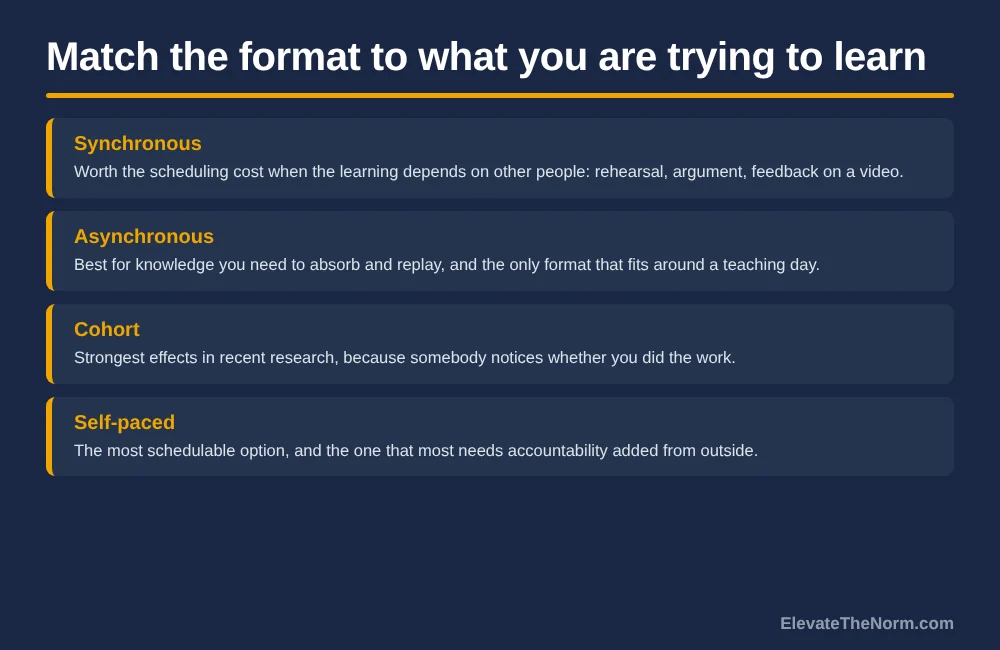
Synchronous for anything requiring rehearsal, discussion or discomfort. Asynchronous for anything requiring knowledge, reading or repetition.
Synchronous sessions earn their scheduling cost when the learning depends on other people being there: role-playing a conversation with a family, arguing about where a student’s reasoning broke down, watching somebody else’s lesson video and having to say something about it. You cannot get that from a recording, because the thing being learned is the exchange.
Asynchronous works well for the parts you need to absorb rather than negotiate: subject content you do not know well enough, a research base, a worked example you need to pause and rewind. It is also the only format that respects the fact that teachers are not free between 8:00 and 3:30.
The mixed version is usually the best buy: asynchronous content, synchronous practice. If a course is entirely synchronous, you are paying for scheduling you may not be able to keep. If it is entirely asynchronous with no live component at all, assume you will have to manufacture the discussion yourself.
Self-paced or cohort?
Cohort, if the option exists and the schedule is survivable. This is the one place the recent evidence points somewhere fairly clearly.
The 2025 meta-analysis found the strongest effects where teachers participated together and at the same time, and the authors concluded that effective online training “requires time and space for collaborative activities.” That lines up with what we know from outside the online literature: Matthew Kraft, David Blazar and Dylan Hogan’s meta-analysis of 60 causal studies found teacher coaching produced effects of 0.49 standard deviations on instruction and 0.18 on student achievement, with effects shrinking as programs scaled (Kraft, Blazar & Hogan, 2018). What coaching and cohorts share is a person who notices.
Self-paced has one genuine advantage worth naming: it is the only format that fits around a teaching schedule without negotiation. If a cohort meets Tuesdays at 4:15 and you coach, tutor or have your own kids at 4:15, the cohort is not a better option for you. It is a better option in general. Pick self-paced and then build in the accountability the format left out.
What are the completion rates for online courses?
Low, and the format is a large part of why. Katy Jordan’s 2015 analysis in the International Review of Research in Open and Distributed Learning collected enrollment and completion data for 221 massive open online courses and found completion rates ranging from 0.7 percent to 52.1 percent, with a median of 12.6 percent. Longer courses had lower completion. The first and second weeks were decisive for engagement (Jordan, 2015).
Name the population before you use that number: those are open MOOCs with general audiences, mostly free, with no employer attached. A paid, facilitated PD course with a district behind it is a different animal, and you should not expect 12 percent.
Teachers do look better than average in that world. An analysis of four years of open online courses run by two large research universities on the edX platform — 290 courses, 4.5 million participants, 245,000 certificates — was reported by Education Week to show that 32 percent of participants said they work or had worked as teachers, and that 16 percent of teachers earned a certificate, twice the rate of the average participant (Education Week on Chuang & Ho, 2017). The underlying report is Chuang and Ho’s Year 4 report. Twice a bad rate is still 16 percent.
Here is the part I would actually act on. If the first two weeks decide it, then the first two weeks are where you should put your effort, not the middle. Clear the first two modules fast, even sloppily, and your odds change.
What does online PD do better than a workshop?
Access, mostly, and that is not a small thing — it is an equity issue.
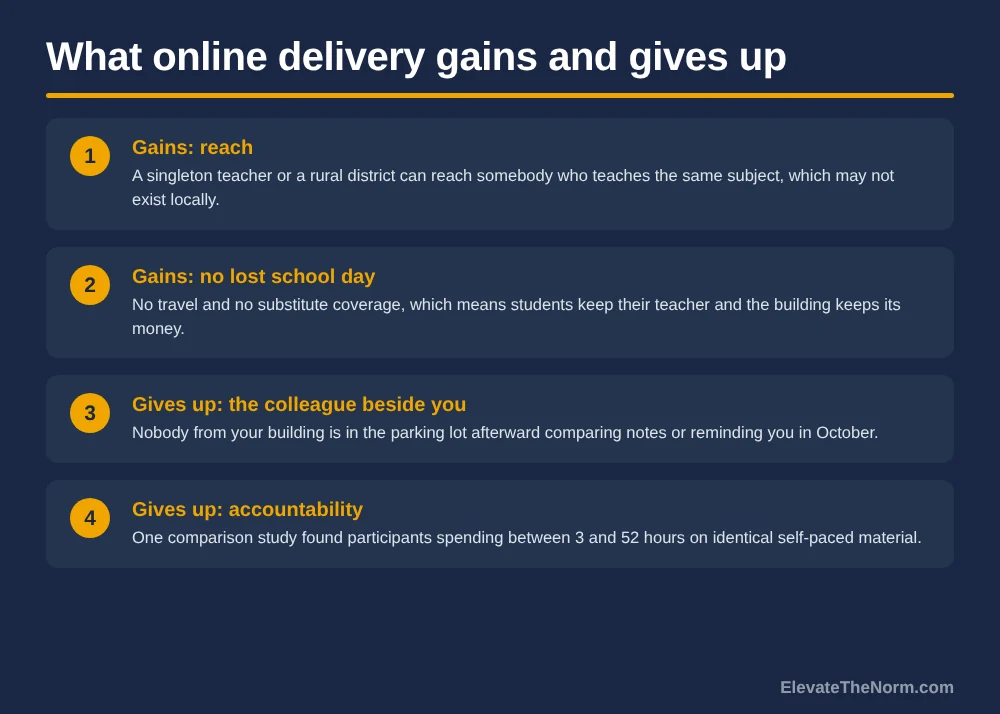
Consider who actually benefits. The only chemistry teacher in a small high school has no department to collaborate with and no local workshop aimed at her. A teacher in a rural district may be a three-hour drive from the nearest content-specific institute, with no substitute available to cover the day. A teacher in a small school system has whatever the system can afford to bring in, which may be one consultant for all content areas. Online delivery is frequently the only way those teachers reach somebody who teaches what they teach.
Other real advantages:
- Replay. You can rewatch the part you did not follow. In a workshop, the moment is gone.
- No travel or sub coverage. Which means no lost instructional day for your students, and no cost to the building.
- Scheduling around a teaching day. Asynchronous content can be done at 5:30 in the morning, which is when some of us are actually sharp.
- Materials that stay. Transcripts, slides and readings remain available when you teach the unit again in February.
- Reach across districts. A cohort drawn from eight states will challenge your assumptions more than one drawn from your own faculty.
For a small school running vertical teams or shared preps, online PD can be the thing that lets two teachers who share one subject work with somebody outside the building. The research on collective teacher efficacy is worth reading alongside this, because the mechanism is similar: the belief that your group can move outcomes is itself associated with results, and a cohort can supply that when a building cannot.
What does online PD do worse?
It strips out the two things that most reliably turn a course into changed practice: a colleague beside you and somebody who notices if you quit.
In a workshop, the person next to you is likely to teach in your building. You compare notes in the parking lot, you remind each other, and in October somebody asks whether you ever used that thing. Online cohorts can replicate some of that, but it takes deliberate design — small groups, assigned partners, scheduled check-ins — and most courses do not bother.
The accountability gap is worse. Nobody takes attendance in your living room. The Fishman comparison found online participants spending between 3 and 52 hours on identical material, which tells you how wide the effort range is when the clock is yours. And because completion is self-certified in many courses, it is easy to finish without implementing anything.
Two smaller losses worth naming. First, online PD rarely includes observation of your actual teaching, which is the part of coaching that does the work. Second, screen-based sessions make it easy to multitask, and a session you half-attend while entering grades is a session you did not take.
How do you make an asynchronous course actually stick?
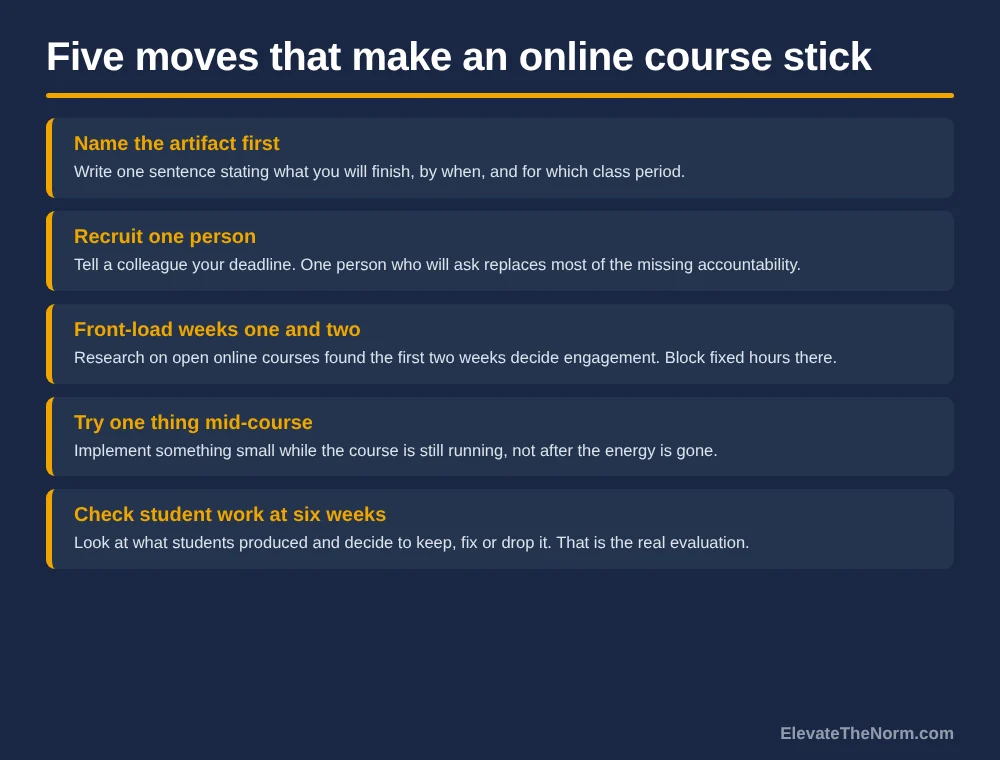
This is the practical core of the article. Treat an asynchronous course like a unit you are teaching yourself: it needs a calendar, an audience and a product.
| When | What you do | Why it matters |
|---|---|---|
| Before you start | Write one sentence: “By [date] I will have [artifact] ready for [class period].” | Gives the course a product. Without one, completion becomes the goal and nothing reaches students. |
| Before you start | Recruit one person — a colleague, a department partner, a teacher friend in another district — and tell them your deadline. | Replaces the accountability the format removed. One person who will ask is enough. |
| Week 1 | Block two fixed hours on your calendar and finish modules 1 and 2, even roughly. | Jordan’s MOOC analysis found the first two weeks decide engagement. Front-load deliberately. |
| Each module | Keep a two-column log: left, what the module claims; right, what it would mean in your room. | Forces translation. Notes that only restate the video produce nothing on Monday. |
| Mid-course | Try one small thing with one class and write down what happened in three sentences. | Implementation during the course, not after it. After the course, the energy is gone. |
| Mid-course | Send your partner the artifact in progress and ask one specific question about it. | Creates the feedback the course did not provide. |
| Final week | Finish the artifact and schedule the class period you will use it in. | A date on a calendar is the difference between a plan and a folder. |
| Six weeks after | Look at student work from that lesson and decide: keep, fix or drop. | This is the only honest evaluation of whether the course was worth it. |
None of that requires the course to cooperate. It is all on your side of the screen, which is the point: the format’s weaknesses are the ones you can personally patch.
What should you ask before enrolling in an online course?
- “Is this facilitated by a person, or is it a recorded library?”
- “Are there live sessions, and what times are they held?” — then check that against your actual week, including anything you coach or sponsor.
- “Is there a cohort, and how large are the working groups?”
- “What do I submit, and who reads it?”
- “How long do I keep access to the materials after the course ends?”
- “What is the completion rate, and what counts as completion?”
- “Does this include any look at my actual teaching — video, lesson artifacts, student work?”
- “Which states have confirmed these hours for renewal, and who do I contact to verify?”
Question five matters more online than in person. Materials you can still reach in February, when you finally teach that unit, are worth considerably more than materials that vanish at the end of the term. Question eight you verify yourself with your state licensing office, not with the provider.
Is online PD worth it for a teacher paying out of pocket?
Sometimes, and the deciding factor is usually whether anyone on the other end will respond to your work. That is my opinion, and I will label it as such rather than dress it as a finding.
The reasoning is simple. Recorded content is abundant and much of it is free. What is scarce — and therefore what is actually worth money — is a person who will look at your unit, your assessment or your student work and tell you something true about it. If a paid online course does not include that, you are paying for curation and convenience. Those have value. They just do not have much value, and you should not pay a lot for them.
Before you spend anything, work through the criteria for judging whether any PD course is worth your time and money, which applies the same scoring to online and in-person options. And check the genuinely free offerings and what free actually costs first, because a surprising amount of serious content-focused material from federal agencies and museums is online, free and better than things people pay for.
Where online professional development for teachers actually fits
Use online PD for access to content and people you cannot otherwise reach, and build the accountability it leaves out before you start. That is the whole recommendation.
Concretely: pick a cohort over self-paced when the schedule allows, front-load the first two weeks, name an artifact and a class period, and recruit one person who will ask you about it in six weeks. If you do those four things, the delivery format mostly stops mattering, which is what the comparison studies have been saying for over a decade.
Do not let anyone tell you the evidence here is settled in either direction. It is not. After seven years of classroom experience I am comfortable saying the format is far less important than whether somebody is waiting for your work — and that if a course has nobody waiting, you should plan to be that person yourself.
Sources
- Morina, F., Fütterer, T., Hübner, N., Zitzmann, S., & Fischer, C., “Effects of online teacher professional development on teacher-, classroom-, and student-level outcomes: A meta-analysis,” Computers & Education, 228 (2025), 105247. Source of the finding that online PD shows positive effects on teachers and students, larger for teachers, with the strongest effects where teachers participated together and simultaneously. Caveat: the paper is paywalled; the figures and quotations here come from an institutional summary published by the authors’ research network, which is a summary rather than the study. https://uni-tuebingen.de/en/research/core-research/lead-graduate-school-research-network/newsfullview/article/enable-online-training-for-teachers-it-works
- Webb, D. C., Nickerson, H., & Bush, J. B., “A Comparative Analysis of Online and Face-to-Face Professional Development Models for CS Education,” SIGCSE ’17, March 2017. Source of the 75-teacher, 4,832-student comparison finding no negative student outcomes from online or blended PD. Caveat: computer science PD specifically, with a much smaller online sample (479 student respondents) than face-to-face (4,353). https://par.nsf.gov/servlets/purl/10095644
- Heitin, L., “Benefits of Online, Face-to-Face Professional Development Similar, Study Finds,” Education Week, June 2013. Reporting on Barry Fishman and colleagues’ comparison of 48 hours of face-to-face workshops against self-paced online coursework for a high school environmental science curriculum, including the 3-to-52-hour range of online time. Caveat: this is press coverage of the study, not the Journal of Teacher Education paper itself. https://www.edweek.org/teaching-learning/benefits-of-online-face-to-face-professional-development-similar-study-finds/2013/06
- Jordan, K., “Massive open online course completion rates revisited: Assessment, length and attrition,” International Review of Research in Open and Distributed Learning, 16(3), 2015. Source of the 221-course sample, the 0.7 to 52.1 percent range, the 12.6 percent median and the finding that weeks one and two are decisive. Caveat: open MOOCs with general-public audiences, not teacher PD courses with employers attached. https://www.irrodl.org/index.php/irrodl/article/view/2112/0
- Chuang, I., & Ho, A., Four Years of Open Online Courses, Fall 2012-Summer 2016 (institutional report on edX courses), December 2016. Source of the scale figures: 290 courses, 4.5 million participants, 245,000 certificates. The teacher-specific figures (32 percent of participants, 16 percent certificate rate) are as reported by Education Week in January 2017. https://papers.ssrn.com/sol3/papers.cfm?abstract_id=2889436
- Kraft, M. A., Blazar, D., & Hogan, D., “The Effect of Teacher Coaching on Instruction and Achievement: A Meta-Analysis of the Causal Evidence,” Review of Educational Research, 2018. Supports the claim that a responsive expert is the active ingredient, with 0.49 SD on instruction and 0.18 SD on achievement across 60 causal studies. Caveat: effects from large-scale programs are a fraction of those from small efficacy trials. https://annenberg.brown.edu/publications/effect-teacher-coaching-instruction-and-achievement-meta-analysis-causal-evidence
- Yoon, K. S., Duncan, T., Lee, S. W.-Y., Scarloss, B., & Shapley, K. L., Reviewing the Evidence on How Teacher Professional Development Affects Student Achievement, REL Southwest, October 2007. Supports the duration floor referenced here: studies offering 5-14 total hours showed no statistically significant effects. Caveat: only nine of more than 1,300 studies met the evidence standards, and all nine were conducted with elementary teachers. https://files.eric.ed.gov/fulltext/ED498548.pdf
Frequently Asked Questions
Is online PD taken less seriously than in-person training?
By some administrators, yes, though that is changing. What matters for renewal is whether your state recognizes the provider and the hours, which has nothing to do with delivery format in most states. If you are worried about how it will be perceived, the fix is to bring back something visible: a unit you redesigned, student work from a lesson you built in the course, or a short share-out at a department meeting. Perception follows evidence of use.
Can online PD really work for subjects that depend on hands-on practice?
Partly. The comparison studies that found equivalent outcomes used online conditions that included facilitator contact and, in at least one case, physical materials shipped to participants. A recorded video library will not teach you to run a lab or a shop safely. If the practice is physical, look for a hybrid: online content for the knowledge and a live or local component for the hands-on part. Be suspicious of any course that claims the physical piece is unnecessary.
How much time should I expect an online course to take?
More than the advertised hours, and the spread is wide. In one comparison study, participants working through identical self-paced material spent anywhere from 3 to 52 hours on it. Plan for the advertised contact hours plus implementation time, which is usually where the real cost sits. If a course claims a fixed small number with no implementation work attached, it is probably measuring seat time only, and seat time is not the part that changes your teaching.
What if the live sessions conflict with coaching, tutoring or my own kids?
Then pick the self-paced version and build the accountability back in deliberately. Cohorts show the strongest effects in the research, but a cohort you cannot attend is worse than self-paced work you actually finish. Replace the missing piece with one named person who knows your deadline and will ask about your artifact, plus a fixed two-hour block on your own calendar in week one. That costs nothing and addresses the format’s real weakness.
Does the low completion rate for online courses mean they do not work?
No, it means finishing is the hard part. The 12.6 percent median figure comes from open MOOCs with general public audiences and no employer attached, which is a very different setting from a paid or district-sponsored PD course. What transfers from that research is the timing finding: the first two weeks decide engagement. If you clear the opening modules quickly, you are in a different group than the one that produces those averages.
Is online PD a way for districts to save money on teacher learning?
It can be, and that is a fair thing to watch for. Online delivery removes travel, substitute coverage and lost instructional days, which are real savings and real benefits to students. The risk is that savings become the point and the expensive parts get cut first, which means coaching, feedback and follow-up. If a district moves PD online, the question worth asking is whether anyone is still paid to respond to teachers’ work. That is the part that carries the evidence.
Will an online course give me anything I can show students?
It should, and that is a reasonable test of whether it was worth taking. Students do not experience your course, they experience what came out of it: a clearer assignment, a better rubric, a project with a real audience, feedback that arrives faster. If you cannot point at something in your classroom six weeks after the course ends, the course gave you material rather than practice. Name the artifact before you start to avoid that outcome.
Are free online courses worse than paid ones?
Not reliably. A good deal of serious, content-specific material from federal agencies and museums is online at no cost, and some of it is better than commercial courses. What money usually buys is a person who responds to your work, extended access to materials, and documented hours for renewal. If a paid course offers none of those three things, price is not telling you anything about quality, and the free option is the better bet.