By Clay Shumate
Free professional development for teachers is real, and some of the best content-specific material available costs nothing: federal agencies, museums, libraries and public media all run it. What free usually does not include is the expensive part — somebody who responds to your work — and it rarely carries the credit hours a license renewal needs. Know which you are short of before you start looking.
This article is a map of where genuinely good free PD comes from, with working links, plus an honest accounting of what free costs you instead of money. It is not a list of recommendations and nothing here is endorsed. This site takes no money from any professional development provider, and I am naming these as factual examples of what exists.
Key Takeaways
- Federal agencies and national museums run substantial free PD, and it tends to be the most content-specific material a secondary teacher can find at no cost.
- Some free programs pay you. National Endowment for the Humanities summer institutes for K-12 educators carry participant stipends.
- Free PD from a company is usually product training. That is not a scandal, but know what you are learning: the tool, not the teaching.
- Free rarely means credit. Most free offerings do not generate the documented hours or graduate credit a state renewal requires, and state rules differ.
- The most underrated free PD is structured time with a colleague, and the research on teacher collaboration is stronger than the research on most courses.
- What free actually costs is your time and your follow-through. Nobody is waiting for your work, so you have to arrange for somebody to be.
Is free professional development for teachers actually any good?
Some of it is better than things people pay for, and the reason is funding rather than charity. A federal agency, a national museum or a central bank runs educator programs because public outreach is part of its mission, not because PD is its revenue stream. That changes what the material is for.
Judge it the same way you judge anything: is it specific to your subject, is it long enough to matter, does anyone respond to your work, and does it leave you something you can use. The criteria do not change because the price did. Our writeup on how to judge whether any PD course is worth your time includes a scoring checklist that works on free offerings too.
Where free material tends to be strong: content knowledge, primary sources, subject-specific depth, and ready-made classroom materials. Where it tends to be weak: feedback on your teaching, accountability, and anything resembling coaching. That pattern holds across almost every category below.
Federally funded and government-run programs
This is the first place to look, and most teachers never do. Several federal agencies run educator programs that are free by design.
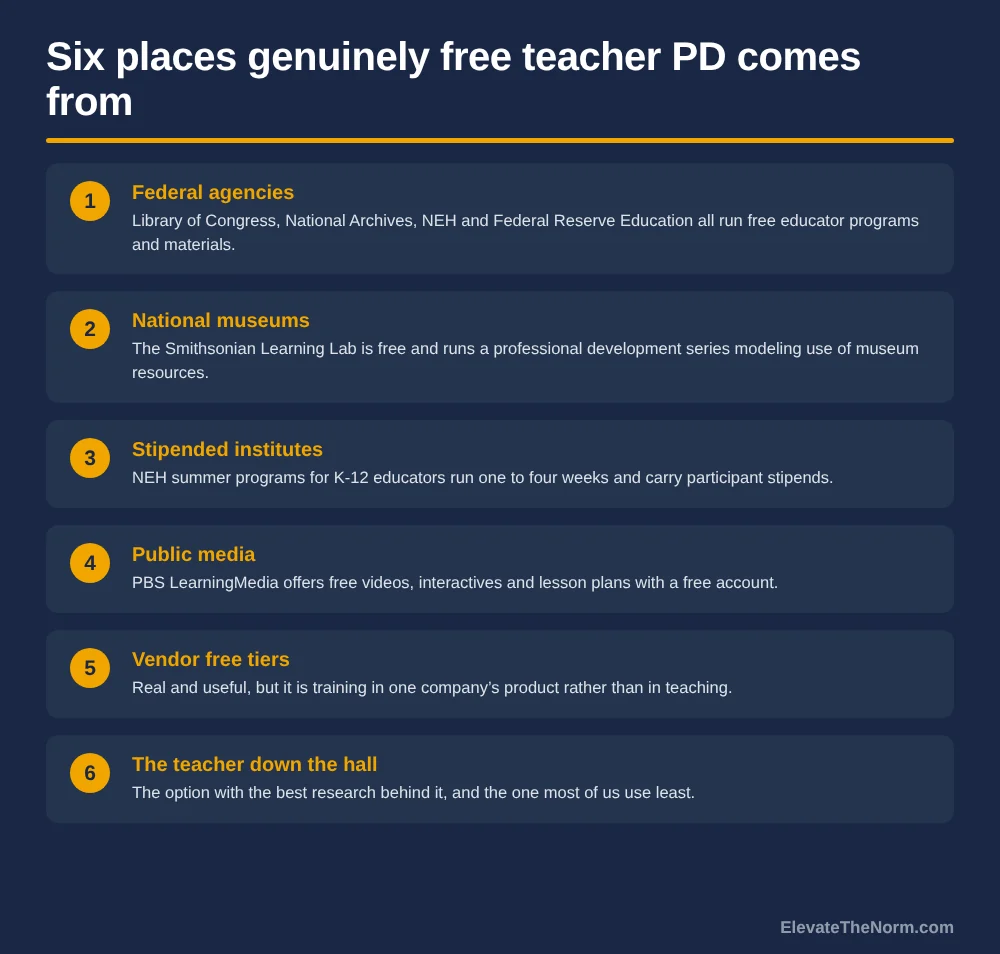
The Library of Congress teacher professional development program describes itself as free primary-source-based professional development and includes onsite Teaching with Primary Sources workshops, self-guided online modules, webinars led by Library education specialists, ready-to-facilitate staff development content, and a regional partner network. For a history, English or government teacher, the primary-source modules are about as on-target as free material gets.
Federal Reserve Education publishes economics and personal finance resources for grades K-12 and college, and runs free webinars and self-paced courses. As of October 2026 the site lists free self-paced professional development certificate courses and digital badge modules issued through Credly, and at least one webinar listing states that participants receive one hour of professional development credit. A free account is needed for some features such as answer keys. If you teach economics, government, or a personal finance requirement, this is the most directly useful free option I am aware of in that content area.
The National Archives runs DocsTeach, which is free and hosted with funding from the National Archives Foundation. It is primarily a document and activity library rather than a course — thousands of primary sources plus activities built by other teachers, and tools to build and share your own. Treat it as material and a model of document-based task design rather than as training.
The National Endowment for the Humanities also runs EDSITEment, a free K-12 humanities resource with peer-reviewed material and several hundred lesson plans.
One more category, worth knowing exists: the Institute of Education Sciences funds ten Regional Educational Laboratories on a 2022-2027 contract cycle. Alongside applied research, each provides training, coaching and technical support for implementing evidence-based practices. Those partnerships are arranged with states and districts rather than individual teachers, so the realistic route for one teacher is the published reports and webinars — or asking whoever handles curriculum in your system whether your REL is already a partner.
Museums, libraries and cultural institutions
National museums produce free educator programming of a quality that is hard to buy.
The Smithsonian Learning Lab is free to use, with millions of digital assets across history, art, culture and science. It also runs a professional development series called Cultivating Learning, in which Smithsonian educators model teaching techniques for using digital museum resources; the site describes these as free and accessible to anyone.
PBS LearningMedia is free with a free account and provides videos, interactives and lesson plans. Note the distinction: the LearningMedia library itself is free, while PBS TeacherLine is a separate line of graduate-level courses, and you should check its terms directly rather than assuming the free label carries over.
And the category where free PD can actually pay you. The NEH summer programs for K-12 educators are one-to-four-week institutes that convene teachers to study a humanities topic in depth, and the page states that participant stipends are based on program format and duration. For the 2026 cycle, the page lists applications opening December 8, 2025, closing March 6, 2026, with all applicants notified by April 6, 2026. If you have ever wanted several uninterrupted weeks inside your own subject, this is the structure that exists for it. It is competitive and it costs you the summer weeks, which is a real cost.
Local institutions follow the same pattern smaller. State humanities councils, state archives, historical societies, art museums and science centers frequently run free or stipended teacher workshops that never appear in a national search. Get on their educator mailing lists.
Professional associations
Associations are a mixed bag, and the honest summary is that the good material usually sits behind membership.
Most subject-area associations charge dues, so journals, conference content and member webinars are not free. What is often freely available: position statements, standards documents, some archived webinars and public-facing guidance — genuinely useful for understanding what your field considers good practice. Before paying dues, check whether your district already holds an institutional membership, because teachers routinely buy access their system already has.
Open courseware and self-paced modules
Open courseware is excellent for shoring up content knowledge and nearly useless for changing your teaching.
University open courseware and free online course platforms can give a secondary teacher real depth in a subject they teach at the edge of their training — the chemistry teacher covering a physics section, the social studies teacher assigned economics, anybody teaching outside their primary certification area. That is a legitimate and underrated use of free material.
What it will not do is tell you how to teach that content to fourteen-year-olds. Open courseware is usually built from university lectures for university students, and the pedagogy in it is aimed at that audience. Take the content and do your own translation; our material on checking for understanding during a lesson is the shortest path from content knowledge to something students experience. Completion is the known weak point of self-paced free material, so expect to need a deadline and a reason.
Free from vendors: name the catch
Free PD from a company is usually training on that company’s product, and that is fine as long as you know it.
The clearest example of the category: Google for Education’s educator certifications. As of October 2026 the page lists Level 1 and Level 2 Certified Educator and Gemini Certified Educator as valid for three years and free of charge, with training materials in a learning center. That is a real, substantive, no-cost credential. It is also, by definition, training in one company’s tools. Both things are true at once. Prices and offerings in this category change often, so check the page rather than trusting this paragraph in two years.
The pattern to watch for across the vendor category: a free webinar that is a product demo, a free course that only works if your school buys the platform, a certificate whose value depends on one company continuing to exist, and a free library whose account is used for sales contact. None of that is dishonest. It is marketing.
My own test is simple. Ask what this material teaches that would still be true if the company went out of business tomorrow. If the answer is nothing, it is tool training. Tool training has a place — if your district has adopted a platform, learning it properly is a reasonable use of two hours — but do not file it under professional learning about teaching. Our rundown of tools that support project work stays deliberately agnostic for the same reason.
The most underrated free PD: structured time with a colleague
The free option with the best research behind it is not a course at all. It is organized collaboration with the teachers already in your building.
Matthew Ronfeldt, Susanna Owens Farmer, Kiel McQueen and Jason Grissom studied more than 9,000 teachers across 336 schools in Miami-Dade County Public Schools using survey data from 2010 to 2012. Eighty-five percent of teachers reported participating in instructional teams. They found that high-quality collaboration — and collaboration about assessment in particular — was associated with greater student achievement gains, and that the effect extended to the students of teachers who were not themselves the strongest collaborators. Their conclusion: “Student achievement gains are greater in schools with stronger collaborative environments and in classrooms of teachers who are stronger collaborators” (summarized in Learning Forward’s journal, October 2015; the study is Ronfeldt et al., American Educational Research Journal, 52(3), 2015, pp. 475-514).
Note what that study does and does not show. It is correlational and it is one large urban district. It does not prove that scheduling more meetings produces achievement. What it supports is that the quality of what teachers do together tracks with outcomes, which is a more interesting claim than “collaboration is good.”
The coaching evidence points the same direction. Kraft, Blazar and Hogan’s meta-analysis of 60 causal studies found teacher coaching produced effects of 0.49 standard deviations on instruction and 0.18 on student achievement, with effects shrinking substantially as programs scaled (Kraft, Blazar & Hogan, 2018). The active ingredient in coaching is somebody watching you teach and responding. A colleague can do that for free, and a small arrangement between two teachers is closer to the small efficacy trials than to the large programs where the effects faded.
Here is my position on this, offered as opinion. Keeping your ears open and your mouth closed sometimes pays off. But sometimes keeping your ears open and asking questions really pays off. I have borrowed practices from other teachers, and I got them by asking — not by waiting to absorb them. The teachers around you have already solved problems you are currently losing to, and almost none of them have written it down. Asking is the cheapest professional development available and the one most of us use least.
How to actually set that up
The thing that separates this from a hallway conversation is structure. A four-step version that does not require anyone’s permission:
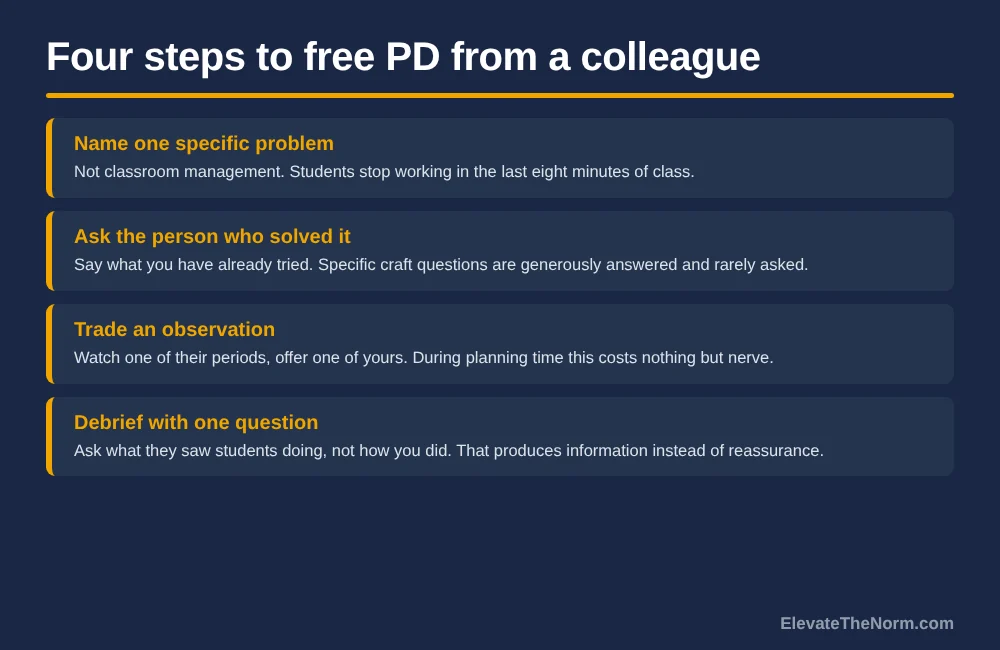
- Pick one specific problem. Not “classroom management.” “Students stop working in the last eight minutes of class.” Specific problems get specific answers.
- Ask one person who you suspect has solved it. Say what you are struggling with and what you have already tried. Teachers answer that question generously and almost nobody asks it.
- Trade an observation. Ask to watch one period of theirs, and offer one of yours. During your planning period, this costs nothing but nerve, and it is the part that does the work.
- Debrief with one question. “What did you see students doing in the first five minutes?” is better than “how did I do?” because it produces information instead of reassurance.
If you want a structure for processing what you notice afterward, a practical approach to teacher reflection is free and takes about ten minutes a week.
What does free PD actually cost?
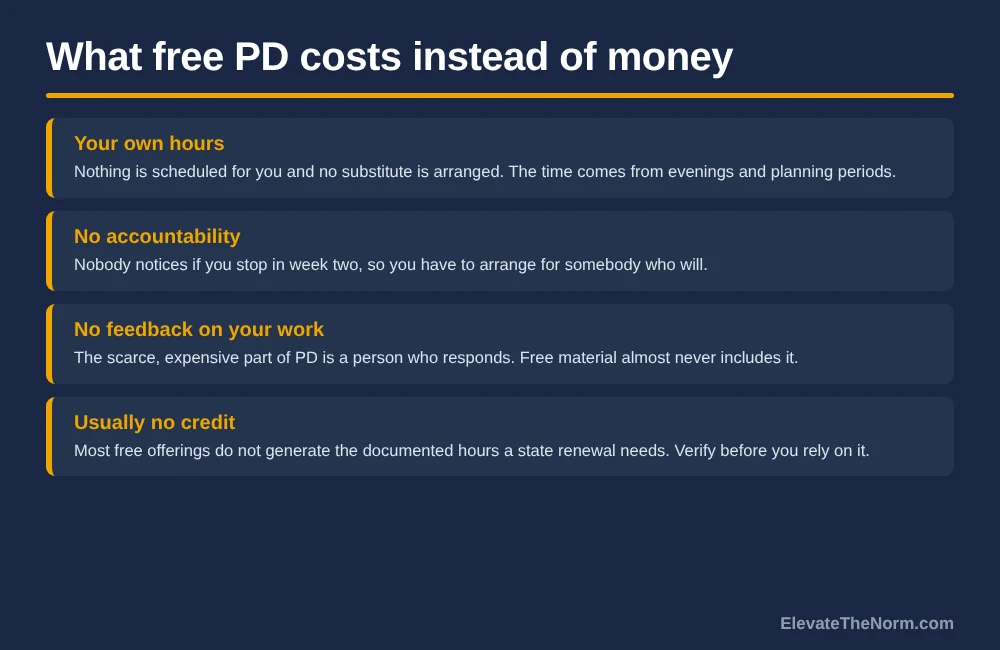
Time, follow-through, and usually credit. Those are the three prices, and they are not trivial.
| What free PD costs | Why it bites | What to do about it |
|---|---|---|
| Your own hours | Nothing is scheduled for you and no sub is arranged. The time comes from evenings, planning periods or summer. | Block it on a calendar like a meeting. Unscheduled intentions lose to grading every time. |
| No accountability | Nobody takes attendance and nobody notices if you stop in week two. | Tell one colleague your deadline and what you will show them. |
| No feedback | The scarce, expensive part of PD is a person who responds to your work. Free material almost never includes it. | Trade observations with a colleague, or bring a student work sample to a department meeting. |
| Rarely any credit | Most free offerings do not generate the documented hours or graduate credit a state renewal needs. | Verify with your state licensing office before counting on it. Some free programs do document hours; most do not. |
| Search cost | Good free PD is scattered across agencies, museums and councils with no central listing. | Spend one hour joining educator mailing lists. Then it arrives instead of being hunted. |
| Uneven quality | No price signal, and some free material is thin or dated. | Apply the same criteria you would to a paid course. Free does not exempt it. |
Will free PD count toward license renewal?
Often not, and you need to check before you count on it. Nearly every state ties license renewal to some form of continuing education, but the accepted providers, the hour-to-credit conversions and the documentation requirements are set state by state.
A 2018 New America report on relicensure found that most state systems are organized around accumulating approved credits rather than demonstrating growth, such that “whether a teacher grows considerably while fulfilling her state’s renewal requirements or does not improve at all is of no consequence” as long as the credits clear (Rethinking Relicensure). The practical consequence for free PD is that excellent uncredited learning and mediocre credited learning are not interchangeable on your renewal paperwork.
I am not going to tell you how your renewal works, because it depends on your state and it changes. What I will say is to separate the two questions. “What will make me better at this?” and “what will clear my renewal requirement?” are different questions with different answers, and the continuing-education question deserves its own research with your own state’s certification office rather than an answer from a blog. Some free programs do document hours — the Federal Reserve webinar listing above states a professional development credit, and badge-issuing programs produce a record — but documentation is not the same as your state accepting it.
A four-week plan to build your own free PD
If you want a starting structure rather than a list, this is what I would do with four weeks and no budget. It assumes about two hours a week.
- Week 1: Name the problem and find the content. Write down one thing your students consistently struggle with in your subject. Then spend ninety minutes in the agency or museum collection closest to your content area looking specifically for material about that, not browsing generally.
- Week 2: Ask a person. Identify one colleague who seems to handle that problem better than you do and ask them how. Arrange to watch one of their class periods during your planning time.
- Week 3: Build one thing. Make a single usable artifact — a task, a document set, a rubric, a sequence of questions — that combines what you found and what you saw. Not a unit. One artifact.
- Week 4: Use it and look at the work. Teach it, then read what students produced and decide whether to keep, fix or drop it. Tell the colleague what happened.
Total cost: eight hours and some nerve. That sequence has more of the features the research associates with effective PD — content focus, modeling, practice, feedback, implementation — than most one-day workshops do. It is also, as far as I know, the only version you can start this week without anyone’s approval.
Where to start with free professional development for teachers
Start with the agency or museum closest to what you teach, and start with one problem rather than one browse. If you teach history or English, the Library of Congress modules and the National Archives material are the obvious first stop. Economics or personal finance, Federal Reserve Education. Science or art, the Smithsonian collections. If you have a summer to give and a subject you love, the NEH institutes are the most serious free option on this page, and they pay a stipend.
Then add the part the free material leaves out: one person who will look at your work. That is the whole gap, and a colleague closes it for nothing.
Two cautions before you go. Verify any credit claim with your own state rather than the provider. And if you are weighing a paid option against these, read the criteria for judging whether a course is worth the money first, and what specifically changes when PD moves online if the format is the question. After seven years of classroom experience, the free thing I would defend hardest is still the simplest: ask the teacher down the hall how they did it.
Sources
- Library of Congress, Professional Development for Teachers. The source for the Library’s description of its offerings as free primary-source-based professional development, including Teaching with Primary Sources workshops, self-paced modules and webinars. Caveat: program availability and formats change; confirm current offerings on the page. https://www.loc.gov/programs/teachers/professional-development/
- Federal Reserve Education. The source for free K-12 economics and personal finance resources, free self-paced professional development certificate courses, Credly-issued badge modules, and a webinar listing stating one hour of professional development credit. Caveat: described as of October 2026; offerings and credit statements change. https://www.federalreserveeducation.org/
- National Endowment for the Humanities, Summer Programs for K-12 Educators. The source for one-to-four-week institutes, the statement that participant stipends are based on program format and duration, and the 2026 application dates (open December 8, 2025; close March 6, 2026; notification April 6, 2026). Caveat: stipend amounts are not published on this page and vary by program; application cycles change annually. https://www.neh.gov/divisions/education/summer-programs
- Smithsonian Learning Lab. The source for the free platform description and the Cultivating Learning professional development series in which Smithsonian educators model teaching techniques. https://learninglab.si.edu/
- Google for Education, Certification Programs. The source for the statement that Level 1, Level 2 and Gemini educator certifications are listed as valid for three years and free of charge. Caveat: checked October 2026; this is training in one company’s products and its terms and pricing can change at any time. Naming it here is description, not endorsement. https://edu.google.com/for-educators/certification-programs/
- Ronfeldt, M., Farmer, S. O., McQueen, K., & Grissom, J. A., “Teacher Collaboration in Instructional Teams and Student Achievement,” American Educational Research Journal, 52(3), 2015, pp. 475-514, as summarized in Learning Forward’s journal, October 2015. The source for the 9,000-plus teachers across 336 Miami-Dade schools, the 85 percent instructional team participation, and the association between collaboration quality and achievement gains. Caveat: correlational, one large urban district, survey data from 2010-2012; this is a summary of the study rather than the paper itself. https://learningforward.org/journal/october-2015-issue/high-quality-collaboration-benefits-teachers-and-students/
- New America, Rethinking Relicensure: Promoting Professional Learning Through Teacher Licensure Policies, August 2018. The source for the finding that most state renewal systems are organized around credit accumulation rather than demonstrated growth. https://www.newamerica.org/education-policy/policy-papers/rethinking-relicensure/
Frequently Asked Questions
Why would anyone pay for PD if good free options exist?
Because money buys the part free material almost never includes: a person who reads your work and responds to it, plus documented hours a state will accept for renewal. Free offerings are strongest on content knowledge and classroom materials and weakest on feedback and accountability. If what you need is depth in your subject, free is often equal or better. If what you need is coaching or credit, that is usually what you are paying for, and it is worth paying for.
Can I count free professional development toward my license renewal?
Sometimes, but never assume it. Renewal rules, approved provider lists, hour-to-credit conversions and documentation requirements are set state by state, and a program that issues a certificate or badge is not the same as a program your state will accept. Check with your own state certification office before you rely on anything, and keep whatever documentation the provider gives you. Treat growth and credit as two separate questions with two separate answers.
Is free PD from a company a bad idea?
Not bad, just narrow. A company’s free training teaches its product, which is genuinely useful if your district has already adopted that platform and you need to use it well. The thing to avoid is filing tool training under professional learning about teaching. A simple test: ask what this material teaches that would still be true if the company disappeared tomorrow. If the answer is nothing, you have learned software, which is fine as long as you know that is what happened.
How do I find the local free programs that never show up in a search?
Get on educator mailing lists. State humanities councils, state archives, regional historical societies, art museums, science centers and public university outreach offices frequently run free or stipended teacher workshops that are advertised only to their own lists. It is roughly an hour of signup work once, after which opportunities arrive instead of being hunted. Asking whoever handles curriculum in your system what they already receive is the other fast route.
Is asking a colleague for help going to make me look incompetent?
It reads as the opposite to most teachers, especially when the question is specific. “My students stop working in the last eight minutes, what do you do?” is a craft question, and craft questions are flattering to receive. Vague requests are what feel awkward, for both people. If it still feels risky, start by offering something: ask to watch one of their periods and offer one of yours. A trade is easier to accept than a favor.
Should a principal count free PD as real professional learning for staff?
Judged on the same criteria as anything else, much of it holds up, and the federal and museum material is often more content-specific than what a building can afford to bring in. The honest caution runs the other way: free PD is not a substitute for coaching, because coaching is labor and labor costs money. A plan that replaces paid follow-up with free content has cut the part the evidence most supports, and that is worth saying out loud in a budget conversation.
Does observing a colleague raise fairness or privacy issues?
It can, which is why the arrangement should be voluntary, reciprocal and kept away from evaluation. A peer visit is not an evaluation, nothing about it belongs in anyone’s personnel file, and what you see students do stays between the two teachers. Tell your administrator what you are doing so it does not look like something else, and do not record anything. The value comes from the exchange, and the exchange depends on it being safe for both people.
What do students get out of a teacher doing free PD on their own time?
Whatever actually reaches the classroom, which is the only part that counts. Done well, it shows up as a task worth doing, a document set that is not condescending, clearer feedback, or an assessment that matches what was taught. Done badly, it shows up as nothing, or as a tired teacher. That is a real trade-off and worth being honest about. The four-week plan in this article ends with reading student work for exactly that reason.