By Clay Shumate
Continuing education for teachers is the ongoing coursework, clock hours, and professional learning a state requires you to complete to keep your teaching license valid. There is no national requirement. Every state sets its own renewal cycle, its own unit of measurement, and its own list of providers it will accept — so the only requirement that matters is the one your state board publishes today.
That last sentence is the whole article, and it is the part most writing on this topic gets wrong. You will find plenty of pages promising to tell you “how many hours teachers need.” They cannot, because the answer changes at the state line and sometimes changes again when the legislature meets. What an article can honestly do is teach you the vocabulary, show you how different the rules really are, and walk you through finding and reading your own state’s actual rule. That is what this one does.
Key Takeaways
- There is no national number. Licensure is a state function, so the requirement, the cycle length, and the unit of measurement are all set state by state.
- Clock hours, CEUs, and graduate credit are different units. Ohio treats 18 CEUs as 180 contact hours and as the equivalent of six semester hours, which means one “hour” can mean ten hours or fifteen depending on who is counting.
- Who provides the learning can matter as much as what you learn. New York only counts hours from sponsors the department has approved, and Texas publishes its own provider categories.
- Some states require nothing at all. California renews a Clear credential without any additional coursework.
- The research on whether this improves teaching is not flattering. Large-scale district spending on teacher development has repeatedly failed to show up as measurable improvement.
- Verify everything yourself. Requirements change, pages move, and an article — including this one — is not a legal authority on your license.
What does continuing education for teachers actually mean?
It means the professional learning your state counts toward keeping your license, measured in a unit your state defines, provided by someone your state will accept. Those three conditions are separate, and failing any one of them can leave you with a stack of certificates that do not count.
In practice the phrase covers a lot of ground. Graduate coursework counts in most states. District in-service days usually count. Conference sessions, online modules, book studies, curriculum writing, and mentoring another teacher count in some places and not others. The same workshop can be worth renewal credit in one state and worth nothing in the next.
You will also see the term written several ways. “Continuing education credits for teachers,” “CEUs for teachers,” and “teacher continuing ed” all point at the same idea, but they are not interchangeable as units. A CEU is a specific measurement. A credit is usually a college credit. A clock hour is sixty minutes in a seat. Mixing them up is the most common way teachers miscount.
Why is there no national answer?
Because teacher licensure has never been a federal function. Each state board of education or professional standards commission writes its own rules, and those rules are amended by state boards and state legislatures on their own schedules.
New America’s 2018 review of relicensure policy looked at all fifty states and the District of Columbia and found that the vast majority require some form of professional learning for renewal, but that only eleven states articulate why — what the requirement is actually supposed to accomplish. The report’s blunt summary of the typical system is worth sitting with: “whether a teacher grows considerably while fulfilling her state’s renewal requirements or does not improve at all is of no consequence under most renewal systems” (New America, August 2018).
That is a policy critique, not an excuse to skip your hours. But it explains why the rules look arbitrary from the inside. They often are.
Clock hours, CEUs, and graduate credit are not the same unit
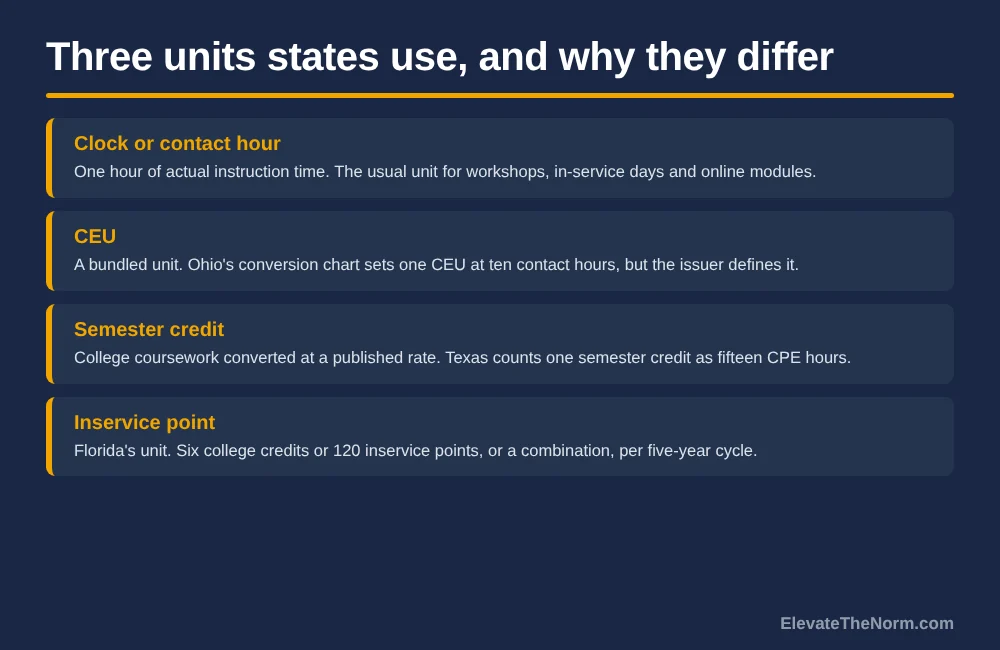
Before you count anything, find out which unit your state uses, because the conversion factors are large. Ohio publishes a conversion chart stating that “one CEU equals 10 contact hours” and that “3 CEUs equal one semester hour” (Ohio State Board of Education conversion chart). Texas, by contrast, treats one semester credit as fifteen CPE hours.
So a single semester of graduate coursework is worth 30 contact hours in Ohio’s accounting and 15 CPE hours in Texas’s. Neither is wrong. They are different measuring systems, and the only number that matters is the one your state applies to your transcript.
The three units, plainly
- Clock hour or contact hour. One hour of actual instruction time. The most common unit for workshops and in-service.
- CEU (continuing education unit). A bundled unit. Commonly ten contact hours, but confirm — the definition is set by whoever issues it.
- Semester credit. College coursework, converted into hours at a rate your state publishes.
Four states, four different rules
The fastest way to understand the variation is to look at real requirements side by side. Everything in this table was read directly from the state’s own page in October 2026. Treat it as an illustration of how different the rules are, not as current advice for your license.
| State | Requirement per cycle | Cycle | Notable condition |
|---|---|---|---|
| New York | 100 clock hours of approved CTLE | Five-year registration period | Hours must come from a CTLE sponsor approved by the department; one requirement per educator regardless of how many certificates are held |
| Texas | 150 CPE hours for classroom teachers; 200 for principals, counselors, librarians, diagnosticians, and reading specialists | Five years | Independent study is capped at 20 percent of total hours; all educators must include training on educating students with disabilities, including dyslexia |
| Ohio | Six semester hours of coursework, or 18 CEUs (180 contact hours) | Five years | A Local Professional Development Committee must approve your Individual Professional Development Plan; filing after October 1 of the expiration year raises the requirement to nine semester hours |
| Florida | Six college credits or 120 inservice points, or a combination | Five years | At least three credits in each retained specialization area, plus a minimum of one credit in teaching students with disabilities |
| California | No additional coursework | Five calendar years | A Clear credential “may be renewed without the completion of additional course work or service requirements” |
Sources for each row, in order: NYSED CTLE requirements; Texas Education Agency CPE information; Ohio State Board of Education renewal page; Florida Statutes § 1012.585; California CTC leaflet CL-494.
Look at the spread. A Texas classroom teacher owes 150 hours. A California teacher with a Clear credential owes none. An Ohio teacher owes a number that is only meaningful after a local committee signs off on a plan. New York’s CTLE credits — the state example most people have heard of — are 100 hours, but only from approved sponsors, which is a constraint Texas and Florida handle very differently. Five states, five genuinely different systems.
What counts, and who is allowed to provide it?
The provider question trips up more teachers than the hour count does. New York is explicit that acceptable CTLE must come from a sponsor the department has approved, and that activities have to target content area, pedagogy, or language acquisition for English learners. A good webinar from an unapproved provider is still a good webinar. It is not 100 hours of CTLE.
Texas publishes provider categories instead of an approval list — the agency itself, accredited universities, education service centers, districts, and tax-exempt professional associations. It also recognizes activity types beyond sitting in a session: curriculum development and mentoring other educators count, and mental health first aid, trauma-informed care, and suicide prevention training count up to sixteen hours. Independent study of professional materials counts, but only up to twenty percent of the total.
That twenty percent cap is a useful signal. States are telling you they will tolerate self-directed reading as a slice of your renewal and not as the whole thing. If your plan for 150 hours is “read a lot of books,” the plan fails on arithmetic before it fails on philosophy.
How do I find my own state’s actual requirement?
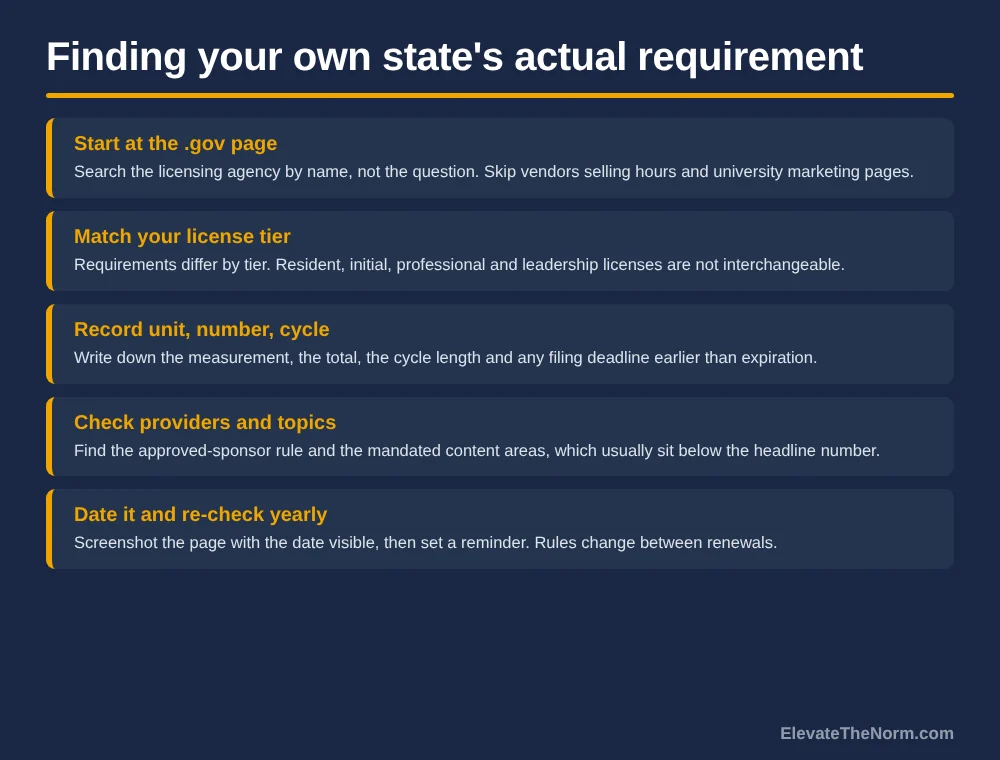
Go to the state agency that issues the license, not to a blog, a university continuing-education department, or a vendor selling hours. Vendors have a reason to describe requirements loosely. Here is the sequence I would use.
- Search the agency name, not the question. Try “[state] department of education educator licensure renewal.” You are looking for a .gov domain belonging to the state board, department of education, or professional standards commission.
- Find your exact license type. Requirements differ by tier. Ohio’s rules for a Resident Educator license are not its rules for a Professional license. New York treats Initial, Professional, and Teaching Assistant certificates differently.
- Write down the unit and the number. Hours, CEUs, or credits — and the conversion chart if the state publishes one.
- Write down the cycle and the deadline. Note whether the deadline is your expiration date or an earlier filing date. Ohio’s October 1 cutoff raises the requirement by three semester hours if you miss it. That is the kind of detail that costs money.
- Find the approved-provider rule. Approved sponsor list, provider categories, or no restriction at all. Save the page.
- Find the mandated topics. Many states now require specific content — students with disabilities, dyslexia, reading science, child abuse reporting. These are usually buried below the headline number.
- Screenshot the page with the date visible, and set a calendar reminder to re-check annually. Rules change between your renewals. Pages move. Having dated evidence of what the rule said when you planned is worth the thirty seconds.
One more thing: call or email the licensing office with your specific question and keep the reply. A state employee’s written answer about your license is worth more than any article.
Does any of this make teachers better?
Honestly, the large-scale evidence is weak, and pretending otherwise would be dishonest. TNTP’s 2015 study The Mirage examined three large public school districts and one midsize charter network, surveying more than 10,000 teachers and 500 school leaders. The districts spent roughly “$18,000 per teacher, per year on development efforts,” and teachers reported spending about nineteen full school days a year on development activities — close to ten percent of the school year. The finding: “The evaluation ratings of nearly seven out of 10 teachers remained constant or declined over the last two to three years,” and researchers found “no type, amount or combination of development activities appears more likely than any other to help teachers improve substantially” (TNTP, 2015).
That study is a decade old now and covered four systems, not a national sample. It does not prove that professional learning cannot work. What it shows is that volume and spending alone have not reliably produced improvement, which is precisely what an hours-based renewal requirement measures.
There is better news on the other side. A 2017 Learning Policy Institute review of 35 studies that used experimental, quasi-experimental, or appropriately modeled designs identified seven features of professional development that showed effects: it is content focused, incorporates active learning, supports collaboration, uses models and modeling, provides coaching and expert support, offers feedback and reflection, and is of sustained duration (Darling-Hammond, Hyler, and Gardner, 2017).
Read that list against your last compliance module and you will see the problem. A 45-minute asynchronous video with a quiz at the end hits roughly none of the seven. It still counts toward your hours. If you get to choose how you spend renewal hours, spend them on the things on that list. Sustained work with colleagues on something specific to your content beats a scavenger hunt for the cheapest hours every time — which is part of why a staff that believes it can move student outcomes together tends to get more out of the same calendar.
What does it cost, in money and in time?
The cost is real and it is unevenly distributed, which is worth saying out loud. The U.S. results from the 2018 TALIS survey of lower secondary teachers — grades 7 through 9 — found that 49 percent of American teachers named conflict with their work schedule as a barrier to professional development, 47 percent named a lack of incentives, 42 percent named family responsibilities, and 38 percent named cost (NCES, TALIS 2018).
Those four numbers describe the actual experience of meeting a renewal requirement. The hours are not the hard part. Finding them inside a schedule that is already full, without a stipend, while paying for them, is the hard part. If you are a department chair or an administrator reading this, those percentages are a to-do list: fund it, schedule it inside contract time, and stop treating the renewal cycle as a private problem.
What happens if I move to another state?
Your hours do not automatically travel, and neither does your license. Reciprocity agreements usually get you a license in the new state, often a provisional or initial one, but the renewal clock and the renewal requirement reset to the new state’s rules. Coursework completed under an old state’s system may or may not be accepted.
Practical advice: before you move, request an official transcript and a printed record of completed hours from your current state and your district. Do it while you are still an employee. Reconstructing nine years of in-service credit from another state, after you have left, is a miserable job.
A renewal cycle you plan instead of survive
Spread the requirement across the cycle and tie it to something you actually want to get better at. The teachers who hate this process are usually the ones doing 150 hours in the final eighteen months.
A simple structure that fits most state systems:
- Year one. Read the rule, record the unit and deadline, pick one instructional problem you genuinely want to solve. Start a running log with dates, provider names, hour counts, and certificate files.
- Years two through four. Take roughly a quarter of the requirement each year, weighted toward the seven features above — sustained, collaborative, content-specific work. Knock out mandated topics early; they are usually the cheapest and the easiest to schedule.
- Year five. File early. Re-read the rule before you file, because it may have changed since year one. Confirm every provider was approved at the time you completed the hours.
Keep the log in a single place you will still be able to find in four years, with the certificates attached. A folder in cloud storage beats a drawer. The log is also useful for a reason that has nothing to do with compliance: it is a record of what you chose to learn, which makes honest reflection on your own practice considerably easier than trying to remember it.
Common ways teachers get burned
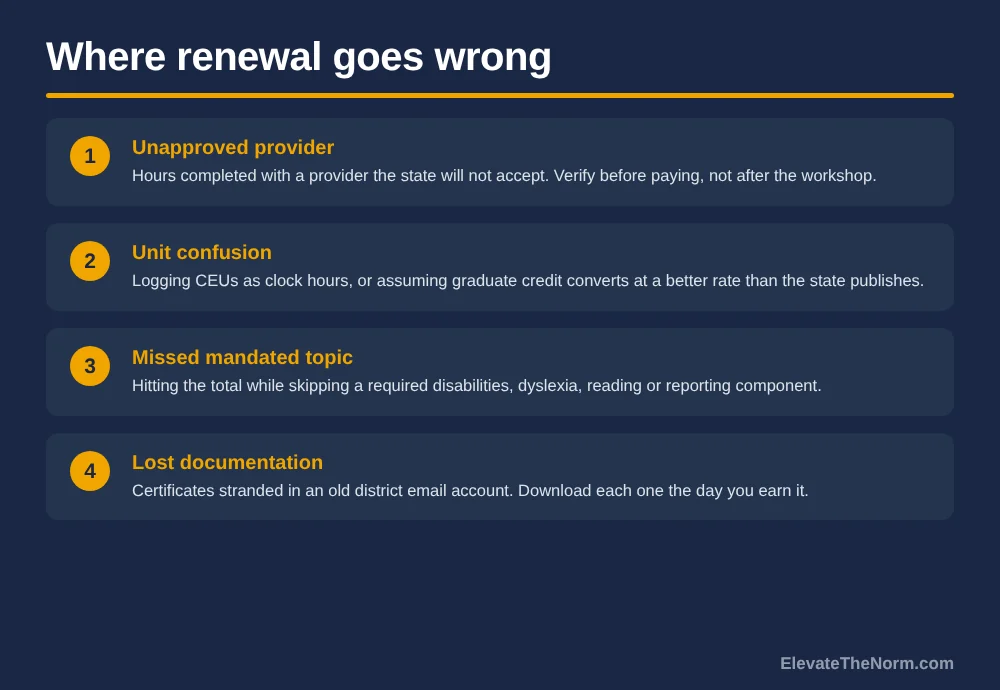
- Unapproved providers. Hours completed with a provider the state does not accept. Check before you pay, not after.
- Unit confusion. Logging CEUs as clock hours, or assuming a three-credit course is worth more hours than your state says it is.
- Missing the mandated topic. Hitting the total and missing the required disabilities, dyslexia, or reading component.
- Filing-date surprises. Deadlines that precede the expiration date, with penalties attached.
- Lost documentation. Certificates in an email account you no longer have access to. Download them the day you earn them.
- Trusting a vendor’s summary of your state’s rule. Including, I will say again, this article.
Link rot is a real hazard too. While checking sources for this piece in October 2026, I found that the deep links to the National Endowment for the Humanities’ EDSITEment lesson plans — a resource recommended in teacher materials for decades — now redirect to a single project page. If a federal humanities site can move out from under its own URLs, a state licensure page certainly can. Open the link. Do not trust the summary.
Where continuing education meets the work you actually care about
The requirement is a floor, not a plan. Hours get your license renewed. They do not make Tuesday better. The useful question is whether the learning you are already paying for in hours is pointed at a problem you can see in your own students’ work.
If you teach grades 6–12 and you want the hours to do double duty, pick a problem narrow enough to observe. Students not reading the primary source before the discussion. Groups where one kid does everything. Feedback that students never act on. Then look for sustained, collaborative learning aimed at that, rather than whatever module is cheapest. Building a goal that is observable and revisited on a schedule turns a compliance cycle into something you would have done anyway. And if the materials you need to try something new are the barrier, free classroom materials worth printing exist in more places than most teachers realize — our own classroom resource library downloads directly with no email required.
Continuing education for teachers: what to do this week
Spend thirty minutes doing three things, and continuing education for teachers stops being a background anxiety. First, open your state licensing agency’s page for your exact license type and write down the unit, the number, the cycle, the filing deadline, and the provider rule. Second, start a log with every hour you have already earned, with provider names and dates, and attach the certificates. Third, pick the one instructional problem you want the next cycle to address.
Then verify what you wrote down. Requirements change, and the only authority on your license is the agency that issued it. If something in this article conflicts with what your state board publishes today, your state board is right.
Sources
- New York State Education Department, “Registration and Continuing Teacher and Leader Education (CTLE),” Office of the Professions / Higher Education, accessed October 2026. Supports the 100 clock-hour CTLE requirement, the five-year registration period, and the one-requirement-per-educator rule. Caveat: the language-acquisition portion of the requirement is described on a separate departmental page and is not quantified here. https://www.highered.nysed.gov/tcert/resteachers/ctle.html
- Texas Education Agency, “Standard Certificate Renewal and Continuing Professional Education (CPE) Information,” accessed October 2026. Supports the 150-hour and 200-hour figures, the 20 percent independent-study cap, the 1 semester credit = 15 CPE hours conversion, and the disabilities and dyslexia content requirement. https://www.tea.texas.gov/texas-educators/certification/certification-renewals/standard-certificate-renewal-and-continuing-professional-education-cpe-information
- Ohio State Board of Education, “Renew an Advanced, Associate or Professional License,” and the State Board’s professional development conversion chart, accessed October 2026. Supports the six semester hours / 18 CEUs / 180 contact hours figures, the LPDC and IPDP approval requirement, the October 1 filing date, and the CEU conversions. https://sboe.ohio.gov/educator-licensure/renew-a-license/renew-an-advanced-associate-or-professional-license
- Florida Statutes § 1012.585, “Process for renewal of professional certificates,” 2025 edition, Florida Senate. Supports the six college credits or 120 inservice points requirement, the three-credit specialization rule, and the one-credit students-with-disabilities requirement. https://www.flsenate.gov/Laws/Statutes/2025/1012.585
- California Commission on Teacher Credentialing, Leaflet CL-494, “Renewal and Reissuance of Credentials,” accessed October 2026. Supports the statement that Clear teaching credentials renew without additional coursework, and the five-calendar-year term. https://www.ctc.ca.gov/credentials/leaflets/cl-494/
- TNTP, The Mirage: Confronting the Hard Truth About Our Quest for Teacher Development (executive summary), 2015. Supports the $18,000 per teacher per year figure, the 19 school days figure, and the finding that nearly seven in ten teachers’ evaluation ratings held constant or declined. Caveat: three large districts and one midsize charter network, not a national sample, and now a decade old; the summary does not report grade levels. https://tntp.org/wp-content/uploads/2023/02/TNTP_Mirage_Executive_Summary_2015.pdf
- Linda Darling-Hammond, Maria E. Hyler, and Madelyn Gardner, Effective Teacher Professional Development, Learning Policy Institute, 2017. Supports the seven features of effective professional development and the 35-study review base. Also: U.S. Department of Education, National Center for Education Statistics, TALIS 2018 U.S. Highlights, for the barrier percentages among grade 7–9 teachers. https://learningpolicyinstitute.org/sites/default/files/product-files/Effective_Teacher_Professional_Development_REPORT.pdf
Frequently Asked Questions
Is there a national number of continuing education hours teachers need?
No. Teacher licensure is a state function, so the hour count, the unit, the cycle length and the list of acceptable providers are all set state by state. Texas asks classroom teachers for 150 CPE hours across five years. New York asks for 100 clock hours of approved CTLE across a five-year registration period. Ohio asks for six semester hours or 18 CEUs. California renews a Clear credential with no additional coursework at all. Any page that gives you a single national figure is wrong, and the only authority on your license is the agency that issued it.
What is the difference between a clock hour, a CEU and a college credit?
A clock hour or contact hour is one hour of actual instruction. A CEU is a bundled unit, commonly ten contact hours, but the definition belongs to whoever issues it. A college credit is coursework converted into hours at a rate your state publishes. The conversions are not small. Ohio states that one CEU equals ten contact hours and that three CEUs equal one semester hour, while Texas treats one semester credit as fifteen CPE hours. Record which unit your state uses before you count anything, because mixing units is the most common way teachers miscount.
Will hours from any provider count toward renewal?
Often not. New York requires that acceptable CTLE come from a sponsor the department has approved, which means a genuinely good workshop from an unapproved provider earns you nothing toward renewal. Texas publishes provider categories instead — the agency, accredited universities, education service centers, districts and tax-exempt professional associations. It also caps independent study at twenty percent of the total. Check the provider rule before you pay, save the page you checked, and keep the certificate the day you earn it rather than hoping the provider still has records in four years.
Who is supposed to pay for this, and when am I supposed to do it?
That depends entirely on your district contract, and the survey data says it is a genuine problem. Among U.S. grade 7 through 9 teachers in the 2018 TALIS survey, 49 percent named conflict with their work schedule as a barrier to professional development, 47 percent named a lack of incentives, 42 percent named family responsibilities and 38 percent named cost. If you lead a department or a building, those numbers are an argument for funding renewal and scheduling it inside contract time rather than treating the cycle as each teacher’s private expense.
Does meeting a renewal requirement actually make someone a better teacher?
The large-scale evidence is not encouraging. TNTP’s 2015 study of three large districts and one charter network found roughly $18,000 per teacher per year spent on development, about nineteen school days a year of teacher time, and no type or amount of activity that reliably produced substantial improvement. That is four systems rather than a national sample, and it is now a decade old. The 2017 Learning Policy Institute review is more useful: professional learning that is content focused, collaborative, coached, sustained and tied to feedback does show effects. Hours alone do not.
What should I do if I move to a different state?
Assume nothing transfers automatically. Reciprocity agreements usually get you licensed in the new state, frequently at a provisional or initial tier, but the renewal clock and the renewal requirement reset to the new state’s rules, and hours earned under the old system may not be accepted. Before you leave, request official transcripts and a printed record of completed in-service hours from both your current state agency and your district, while you are still an employee. Reconstructing years of credit from a state you no longer work in is a genuinely miserable job.
How often should I re-check my state’s requirement?
Once a year, and again immediately before you file. Requirements get amended by state boards and legislatures on their own schedules, mandated topics get added, and the pages themselves move. When I checked sources for this article in October 2026, deep links to a long-recommended federal humanities teaching resource redirected to a single project page. If that can happen to a federal site, a state licensure page can certainly move. Screenshot the rule with the date visible when you plan your cycle, and set a calendar reminder.
Can I use this article as documentation of my requirement?
No, and please do not try. Everything in the state comparison here was read directly from official state pages in October 2026 and is accurate to those pages as of that date, but it is an illustration of how much the rules vary, not a legal authority on your license. Open your own state agency’s page for your exact license type, confirm the unit, the number, the cycle, the filing deadline, the provider rule and the mandated topics, and keep that page. If your state board contradicts this article, your state board is right.