
By Clay Shumate
The best value online PD subscription for teachers is usually ISTE+ASCD’s $99 Enhanced Digital membership, paired with free sources like Edutopia and your state’s PD portal. If you need graduate credit for a raise or recertification, skip subscriptions and buy single Teaching Channel courses ($289–$489) after your district confirms it accepts them.
Key Takeaways
- ISTE+ASCD’s Enhanced Digital membership costs $99 a year and includes four member ebooks and two free Learning Academy courses, which ISTE+ASCD values at $130 and $170.
- Teaching Channel sells graduate credit per course, not by subscription: $289 for one credit, $389 for two and $489 for three.
- Coursera Plus and the ISTE+ASCD Learning Academy each cost $399 a year and only pay off for a teacher who finishes several courses.
- A certificate from Coursera, edX or the Learning Academy is not automatically a state-approved CEU, so ask your district before paying.
- Edutopia is free and awards no credit; some state education agencies run free portals that award hours that count in that state.
An online PD subscription is a paid plan that gives a teacher a year or a month of professional learning, such as courses, books, webinars or credit, from one provider. Value here means three things together: what you pay, whether your state or district will count it, and whether it changes what you do in class on Monday. This page compares the options we could verify on all three. For a broader look at PD formats, see our guide to online professional development for teachers.
How do the main online PD subscriptions for teachers compare on price and credit?
No single online PD subscription wins on price, credit and classroom use at once, so match the platform to the job: free sources for ideas, ISTE+ASCD for reading, and Teaching Channel for graduate credit.
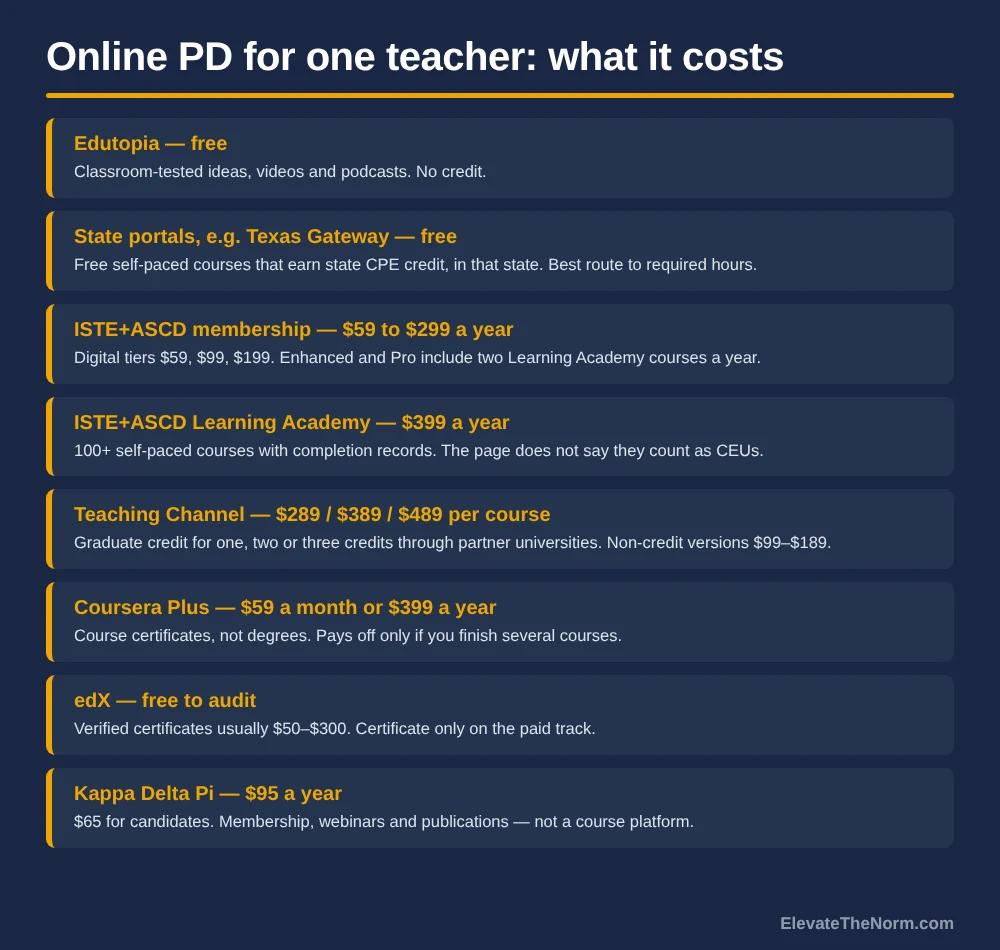
| Platform | Price for one teacher | Credit or record you get | Best for |
|---|---|---|---|
| Edutopia | Free | None | Classroom-tested ideas, videos and podcasts |
| State portals (example: TEA Learn, formerly Texas Gateway) | Free | State CPE credit, in Texas | Required hours in your own state |
| ISTE+ASCD membership | $59–$299/yr (digital $59, $99, $199) | Enhanced and Pro include two Learning Academy courses a year | Reading, books, webinars, a professional network |
| ISTE+ASCD Learning Academy | $399/yr individual subscription | Completion records; 100+ self-paced courses | Teachers who want many short, focused courses |
| Teaching Channel (formerly Learners Edge) | $289 / $389 / $489 per 1-, 2- or 3-credit course; non-credit $99–$189 | Graduate credit through partner universities, or a letter of completion | Salary lane changes and recertification |
| Coursera Plus | $59/month or $399/yr | Course and Professional Certificates | Teachers who’ll finish many courses, including outside education |
| edX | Free to audit; verified certificates usually $50–$300 | Certificate only on the paid track | Trying a subject before paying |
| Kappa Delta Pi | $95/yr practicing teachers; $65 candidates | Membership certificate; webinars and workshops | Community, publications, scholarships |
Sources are linked in each section below. Prices change, so confirm on each provider’s site before you buy.
What is the best free online PD for teachers?
Edutopia is the best free online PD for classroom ideas, and a state education agency’s own portal is the best free source of hours that count. Edutopia is run by the George Lucas Educational Foundation, a nonpartisan 501(c)(3), which describes it as “a free resource” that spotlights what’s working in education (GuideStar profile). It publishes videos, podcasts and topic pages (Edutopia, About). It doesn’t award credit.
Some states run free portals that do. The Texas Education Agency, for example, launched the Texas Gateway as a free online resource library whose self-paced courses let Texas educators earn continuing professional education (CPE) credit (TEA Texas Gateway announcement). Texas Gateway addresses now redirect to the agency’s TEA Learn site, so Texas teachers should start there. Check your state department of education and your regional in-service center before you pay anyone. More free options are collected in our free professional development for teachers guide.
Is an ISTE+ASCD membership worth it for one teacher?
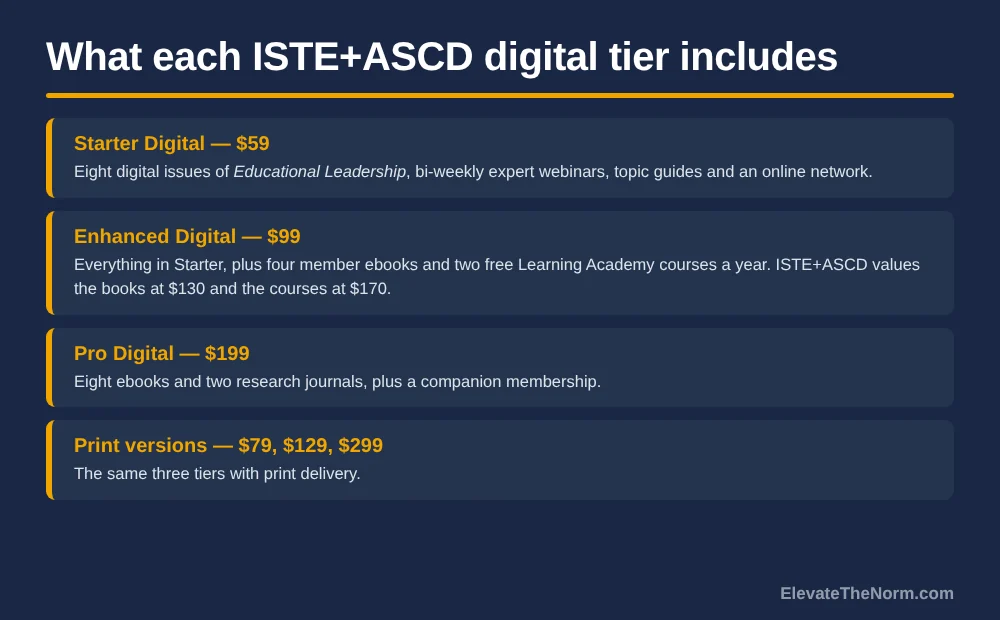
ISTE+ASCD’s $99 Enhanced Digital membership is the best-value tier for most individual teachers, because it adds four ebooks and two Learning Academy courses a year to the $59 Starter tier. ASCD now operates as ISTE+ASCD, and it lists these individual tiers (ISTE+ASCD membership):
- Starter Digital, $59: eight digital issues of Educational Leadership, bi-weekly expert webinars, topic guides and an online network.
- Enhanced Digital, $99: everything above, plus four member ebooks and two free Learning Academy courses a year. ISTE+ASCD values the books at $130 and the courses at $170.
- Pro Digital, $199: eight ebooks and two research journals, plus a companion membership.
- Print versions run $79, $129 and $299.
The membership page also lists 25% off Learning Academy courses. Dues aren’t refundable, though they are transferable, and individual memberships aren’t prorated. If you’d rather have unlimited courses than books, the Learning Academy individual subscription is $399 a year for 100+ self-paced courses in two-hour and five-hour formats, with completion records (ISTE+ASCD Learning Academy). The page doesn’t say those records count as CEUs, so check with your district.
How much does Teaching Channel cost for graduate credit?
Teaching Channel charges per course, not by subscription: $289 for one credit, $389 for two and $489 for three. Non-credit, hours-only versions cost $99, $149 and $189 and come with a letter of completion. New customers get $100 off a first 3-credit course ($80 off a 2-credit course, $59 off a 1-credit course), and buying more than one graduate-credit course in one order takes 10% off (Teaching Channel pricing).
Learners Edge became part of Teaching Channel in 2023 (Teaching Channel), so if you’re searching for Learners Edge courses, this is where they are now. Credit is issued through accredited partner universities, including American College of Education, Southern New Hampshire University, Concordia University St. Paul and others. Two partners accept registrations only from certain states (Teaching Channel university partners).
At $489 for three credits, that’s about $163 a credit, or about $130 a credit with the first-course discount. Before you buy, get written confirmation from your district or state that the credit counts for what you need.
Are Coursera and edX good for teacher professional development?
Coursera and edX are good for learning and weak for credit, because their certificates aren’t automatically accepted as state-approved teacher hours. Coursera Plus costs $59 a month or $399 a year and covers over 90 percent of Coursera’s courses, Projects, Specializations and Professional Certificates (Coursera Plus). Education-specific options exist, such as Commonwealth Education Trust’s Foundations of Teaching for Learning: Introduction, which is included with Coursera Plus and rated 4.6 from 875 reviews (Coursera).
edX lets you audit most open courses free. The audit track doesn’t include certificates or graded assignments, and verified certificates usually cost $50–$300 per course (edX Help Center).
The catch for both platforms: a course certificate isn’t automatically a state-approved CEU. If you need hours that count, ask first.


Is a Kappa Delta Pi membership a PD subscription?
Kappa Delta Pi is closer to a professional society than a course platform: practicing teachers pay $95 a year for webinars, workshops, two publications and scholarships, not formal courses. Kappa Delta Pi dues are $95 a year for practicing teachers and $65 for teacher candidates, and some chapters add local dues. Benefits include webinars and workshops, The Teacher Advocate magazine, The Educational Forum journal, scholarships and discounts (KDP FAQ). Its FAQ doesn’t describe formal courses or continuing education credit.
How should a teacher choose the best-value online PD subscription?
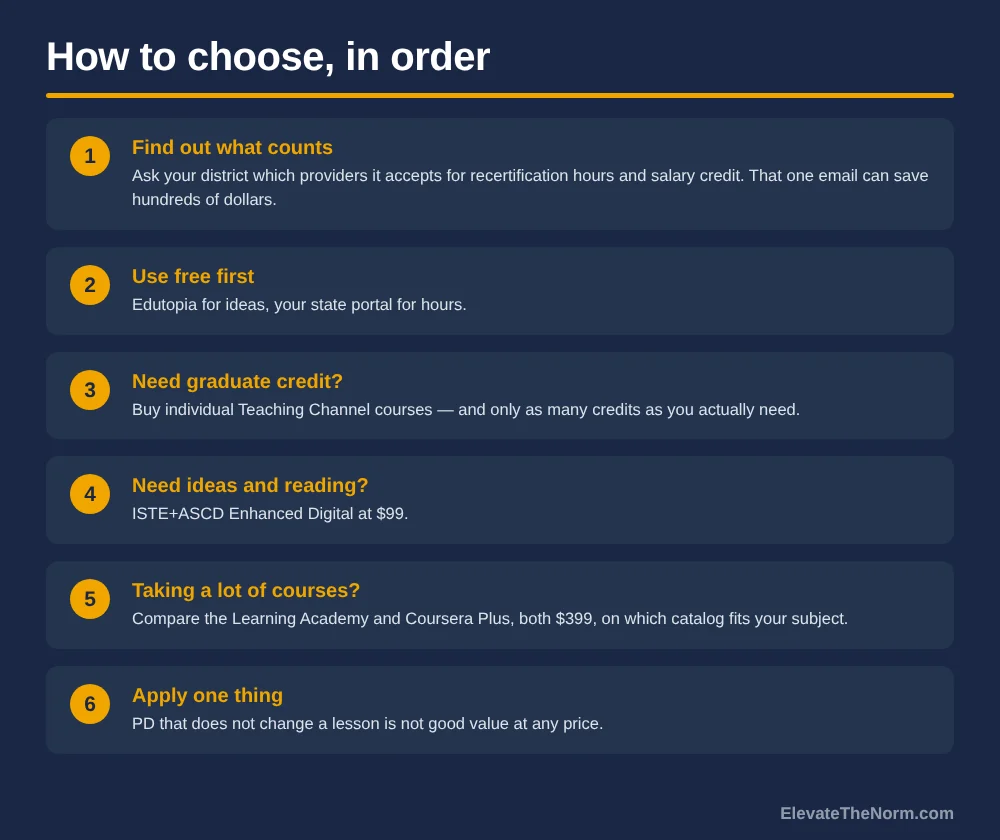
A teacher should choose online PD in this order: confirm what the district counts, use free sources first, then pay only for the one thing needed, whether that is credit, reading or a large course catalog.
- Find out what counts. Ask your district which providers it accepts for recertification hours and salary credit. That one email can save hundreds of dollars.
- Use free first. Edutopia for ideas, your state portal for hours.
- Need graduate credit? Buy individual Teaching Channel courses, and only as many credits as you need. If you are weighing those against Teachstone’s CLASS training, the two are compared side by side here.
- Need ideas and reading? ISTE+ASCD Enhanced Digital at $99.
- Taking a lot of courses? Compare the Learning Academy ($399) and Coursera Plus ($399) based on which catalog fits your subject.
- Apply one thing. PD that doesn’t change a lesson isn’t good value at any price. Our PD courses guide and continuing education guide go further.
Clay’s take: send the district email and use one free source before spending anything, and pay for a subscription only when you know you’ll finish it. That’s a judgment on the prices and credit rules on this page from a grades 6–12 teacher, not a hands-on review of each product.
Does Elevate the Norm offer teacher PD or credit?
Elevate the Norm isn’t a PD platform and doesn’t award credit. Elevate the Norm is this site’s own free grades 6–12 classroom approach, built by Clay Shumate, a certified 6–12 social studies teacher, and it hasn’t been independently evaluated. Its classroom management and project-based learning materials are free with no email gate on the resource library, which makes them a no-cost complement to whatever PD you buy. If you’re weighing a schoolwide framework instead of individual PD, start with the classroom culture frameworks Q&A hub.
Frequently Asked Questions
What is the best free professional development for teachers?
Edutopia is a strong free source of classroom ideas, videos and podcasts, though it awards no credit. For hours that count, check your state education agency first. Some run free portals: the Texas Education Agency launched the Texas Gateway, now TEA Learn, with self-paced courses that let Texas educators earn continuing professional education credit. Your regional service center is the next place to ask.
How much is an ASCD membership?
ASCD now operates as ISTE+ASCD. Individual digital memberships cost $59, $99 or $199 a year, and print memberships cost $79, $129 or $299. The $99 Enhanced Digital tier adds four member ebooks and two free Learning Academy courses a year, which ISTE+ASCD values at $130 and $170. Dues aren’t refundable, and individual memberships aren’t prorated.
Is Learners Edge the same as Teaching Channel?
Yes. Learners Edge became part of Teaching Channel in 2023, so its graduate-credit courses are now sold by Teaching Channel. A one-credit course costs $289, a two-credit course $389 and a three-credit course $489. Credit is issued through partner universities, and two of those partners accept registrations only from certain states, so check before you enroll.
Do Coursera certificates count as teacher CEUs?
Not automatically. Whether a Coursera, edX or ISTE+ASCD Learning Academy certificate counts toward recertification depends on your state and district, so get the answer in writing before you pay. Coursera Plus costs $59 a month or $399 a year and covers over 90 percent of Coursera’s catalog, which only pays off if you finish several courses your district will accept.
What is the best value PD subscription for one teacher?
For ideas and professional reading, ISTE+ASCD’s Enhanced Digital membership at $99 a year is the best value, because it bundles four ebooks and two Learning Academy courses. For graduate credit toward a salary lane change or recertification, buy individual Teaching Channel courses only as needed, after your district confirms in writing that it accepts them.
Should a school buy PD subscriptions or let teachers choose their own?
This page compares prices for one teacher, not school or district contracts, so it can’t price a group purchase. The step that carries over is deciding which providers count for recertification and salary credit before anyone buys. A district that publishes that list in advance keeps teachers from spending their own money on courses that won’t count.
How much does a graduate credit cost through Teaching Channel?
At Teaching Channel’s listed prices, a three-credit course costs $489, or about $163 a credit. New customers get $100 off a first three-credit course, which brings it to about $130 a credit, and buying more than one graduate-credit course in the same order takes 10 percent off. Non-credit versions cost $99 to $189 and come with a letter of completion.
Will online PD change what happens in class?
Only if a teacher applies something from it. A certificate or a credit shows hours spent, not a better lesson, which is why this page treats classroom use as one of three measures of value, alongside price and whether the district counts the hours. The practical test is to take one idea from each course and use it in an upcoming lesson.
How is this page kept accurate?
Prices and plan details come from each provider’s own site, and we only include platforms whose prices we could confirm. Corrections follow the editorial standards and corrections policy.
Sources
- GuideStar profile
- Edutopia, About
- TEA Texas Gateway announcement
- TEA Learn
- ISTE+ASCD membership
- ISTE+ASCD Learning Academy
- Teaching Channel pricing
- Teaching Channel, Learners Edge is now Teaching Channel
- Teaching Channel university partners
- Coursera Plus
- Coursera, Foundations of Teaching for Learning
- edX Help Center
- KDP FAQ