By Clay Shumate
A document based question gives students a prompt and a small set of primary sources and asks them to build one argument from the evidence. It is scored on a published rubric that rewards a defensible thesis, use of the documents, outside evidence, sourcing, and complexity — not on how much students remember.
Key Takeaways
- The document thresholds changed, and College Board’s own general rubric PDF still shows the old numbers. The released scoring guidelines require four documents for the second evidence point and two for sourcing. The general “Rubrics for AP Histories” PDF still says six and three. Teach from the scoring guidelines.
- Document-based teaching works, modestly. Reisman’s study found significant gains on all four measures across five urban high schools, partial eta-squared .03 to .09. A real effect, not a transformation.
- The largest recent study found nothing in year one. Steiss and colleagues followed 867 students in grades 6–11 through 32 hours of professional development and found no significant difference in writing quality for first-year teachers. A moderate effect (d = 0.29) appeared only in year two.
- Contextualization is the point students lose, and the research struggled to move it too. Of four reading moves Reisman measured, sourcing and close reading improved significantly; contextualization and corroboration did not. Those are the rows that separate a middling score from a strong one.
- Students need the rubric before they write, not after you grade. In Monte-Sano’s analysis of 56 timed essays, the recurring failures were summary in place of argument, evidence attributed to no source, and quoting one document without corroborating it. All fixable in advance.
What is a document based question?
A document based question is a timed writing task that hands students a prompt and a set of primary sources — usually around seven — and asks them to defend a position using those sources. Students are graded on the argument they build, not on the facts they recall.
That is what teachers miss when writing their first one. It is not a reading comprehension worksheet with harder passages, and not a research paper with the research already done. It is an argument task with the evidence supplied, so what you assess is selection and reasoning rather than retrieval. One practical note: search the full phrase, not the abbreviation — “DBQ” is also a Veterans Affairs form and the airport code for Dubuque, Iowa.
The format is not only an Advanced Placement thing. New York’s Regents Examination in Global History and Geography II ends with an Enduring Issues Essay built on five documents, weighted at 15 of the exam’s 50 credits — the largest single share — and never uses the word DBQ. Same task, different name.
What does a document based question actually measure?
A document based question measures whether a student can build and defend a historical argument from evidence. It does not measure whether they know the content. A student can earn most of the rubric’s points while getting the period wrong.
That is a feature if you want it and a problem if you do not notice it. If the unit goal is explaining the causes of industrialization, this is a poor instrument — a careful reader can argue well from seven excerpts they have never seen. If the goal is weighing conflicting evidence and committing to a claim, it is the best instrument available at this age.
Here is how it compares with what you could set instead:
| Task | What it actually measures | Grading cost | Where it misleads you |
|---|---|---|---|
| Document based question | Building an argument from supplied evidence; sourcing; handling disagreement | High — six rubric rows per essay | Tells you almost nothing about content knowledge |
| Short-answer question | Whether a student can use one piece of evidence correctly | Low — minutes per student | Never tests whether they can sustain a claim |
| Research paper | Finding and selecting sources, at length, over weeks | Very high; the grade partly reflects home circumstances | You cannot tell whose work it is, and that has got worse |
| Multiple-choice test | Recall and recognition, efficiently and reliably | Near zero | A strong score looks like understanding and often is not |
Clay’s view, as a grades 6–12 teacher: treat these as a set, not a ranking. And worth naming what every teacher is now thinking about — a take-home essay can be produced by a chatbot in seconds; a timed, in-class task built on unseen documents cannot. That is a real advantage this format picked up without changing at all, and it means the work happens under the same conditions for the student with a quiet desk at home and the one without.
Did the AP History DBQ rubric change?
Yes. The thresholds were lowered. On the current rubric the second evidence point needs four documents and the sourcing point needs two. The older version required six and three. College Board’s general rubric PDF still shows the old numbers, so work from the released scoring guidelines.
Be precise about this, because both documents sit on College Board’s own site and they disagree. The released scoring guidelines and the second set from the same exam both state the two-point evidence row as “Supports an argument… using at least four documents” and require sourcing “for at least two documents.” The general rubric PDF states those rows as six and three. The scoring guidelines are what readers scored against, so they are the live version.
The current rubric is seven points across four rows: thesis (1 point, a historically defensible claim that establishes a line of reasoning, in one place); contextualization (1 point, a broader historical context, not a passing reference); evidence (3 points — one for using the content of three documents, two for supporting an argument with four, plus one for a piece of outside evidence that differs from the contextualization); and analysis and reasoning (2 points — one for explaining how or why point of view, purpose, situation or audience matters, for at least two documents, and one for a complex understanding that corroborates, qualifies or modifies the argument).
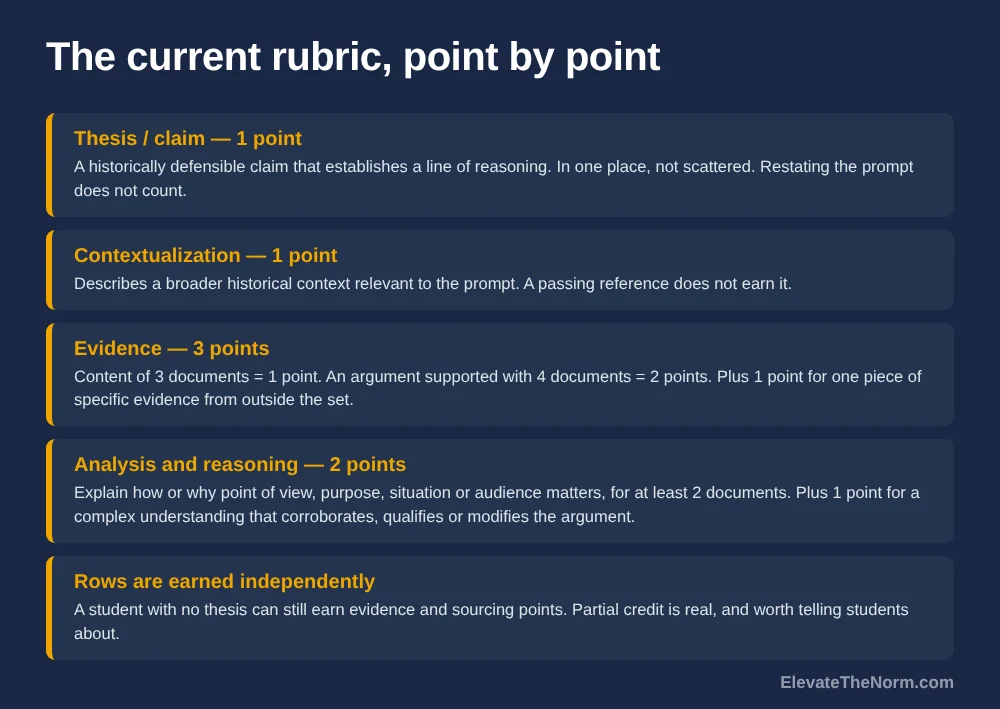
Two things follow. Rows are earned independently, so a student who never writes a thesis can still earn evidence and sourcing points — partial credit is real, and students should be told so. And the exam supplies seven documents, so a little over half the set maxes the evidence row; students who think they must use all seven burn the time they need for complexity.
Does teaching with documents actually improve student writing?
The honest answer is: sometimes, modestly, and not quickly. Document-based curricula show real gains in historical thinking and reading comprehension. The largest recent study of source-based argument writing found no significant effect in teachers’ first year, and a moderate effect only in their second.
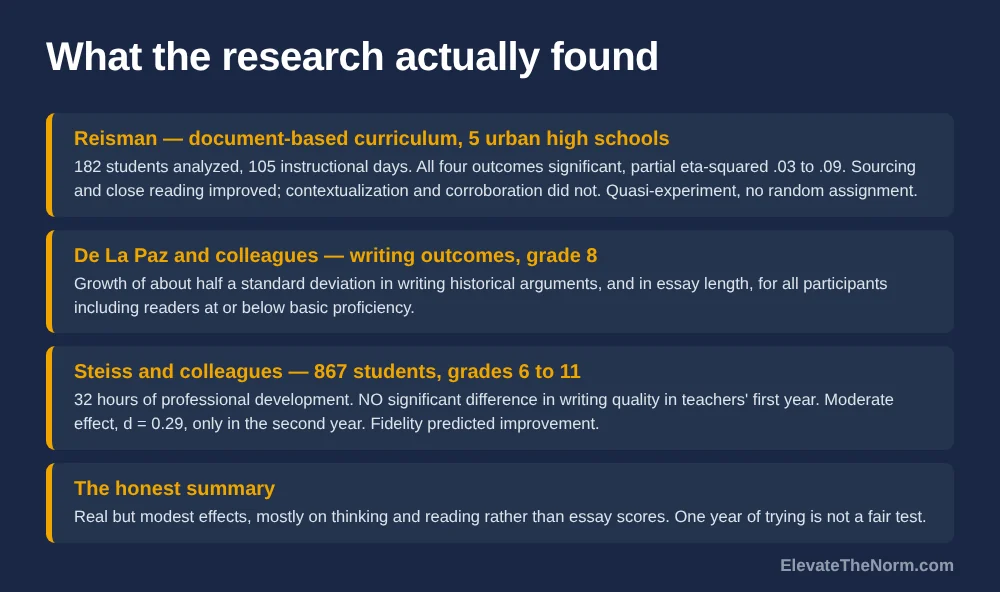
Reisman’s study is the anchor: five public high schools, 182 students analyzed, 105 instructional days. All four outcomes improved significantly — historical thinking, transfer, factual knowledge and reading comprehension — with partial eta-squared from .03 to .09. Effects for struggling readers were larger, not smaller (.17 and .22), and the factual knowledge result answers anyone claiming document work costs content: the treatment group knew more. On writing, De La Paz and colleagues reported growth of about half a standard deviation in writing historical arguments, and in essay length, for all participants including readers at or below basic proficiency — a middle-school result, which is useful, because most of this literature is not.
The caveats are not small. Reisman’s was a quasi-experiment with no random assignment; the author calls the design “less powerful and susceptible to error.” Fidelity ranged from 42 to 72 percent of instructional time, confounding the curriculum with how well it was taught. Of the four reading moves measured individually, only sourcing and close reading improved. And the reading comprehension gain was measured on a standardized reading test, not on essays — it gets quoted as an essay result. It is not.
Then the newest and largest study, which should temper any sales pitch. Steiss and colleagues worked with 867 students in grades 6–11 across two urban Title I districts, through 32 hours of workshops plus coaching aimed at source-based argument writing. Controlling for demographics, prior achievement and English learner status, there was no significant difference in writing quality between control and first-year treatment teachers. The moderate effect — d = 0.29 — appeared only among students of teachers in their second year, and fidelity predicted improvement across both groups.
That points two ways. For a teacher: the skill being developed is partly yours, and one year is not a fair test. For a district: this will not carry a mandate. An effect appearing only in year two, tracking fidelity rather than assignment, argues for sustained support of teachers who choose it, not for requiring it of everyone by August. For context, the most recent NAEP U.S. history assessment put 40 percent of eighth graders below NAEP Basic.


How do I build a document based question from scratch?
Start from a genuinely contestable question, then pick documents that disagree with each other. Seven short excerpts beat three long ones. Every document should give a student something to argue with, and at least two should point away from the obvious answer.
An honest warning first: building a seven-document set properly takes a couple of hours the first few times. Adapting a released set, or cutting one down to four documents, is a legitimate first move.
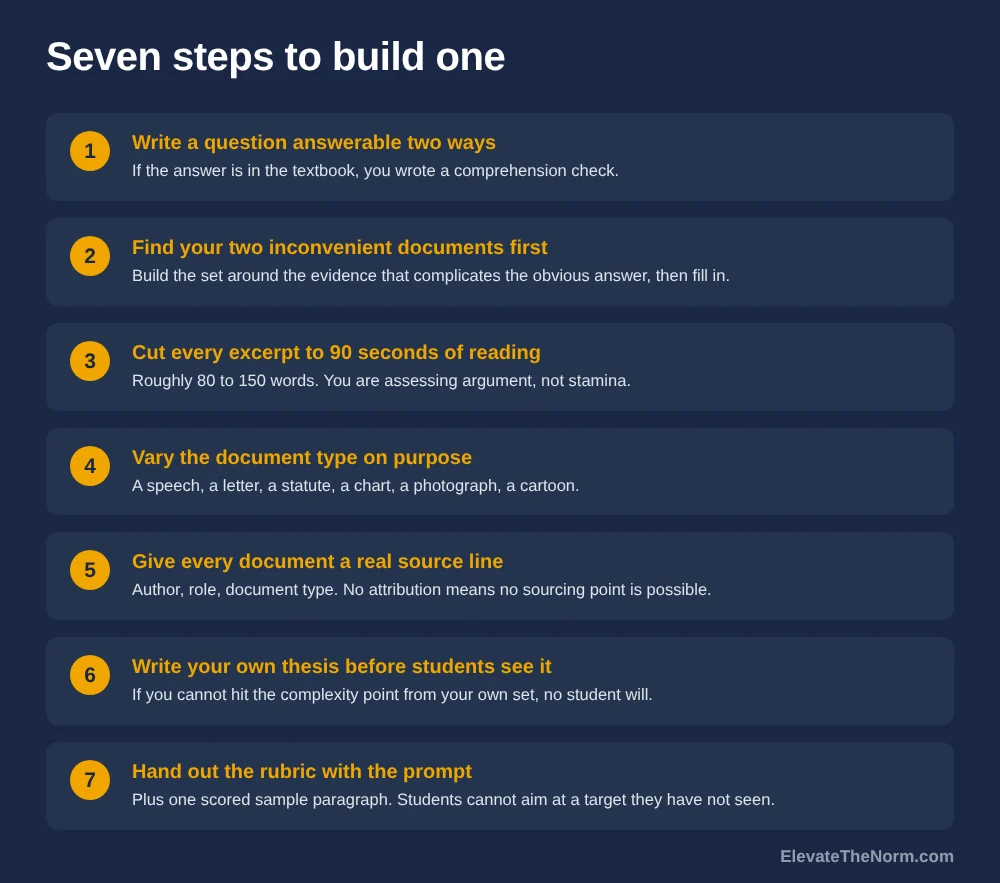
- Write a question that can honestly be answered two ways. If the answer is in the textbook, you wrote a comprehension check. Same discipline as writing a question students can actually disagree about.
- Find your two inconvenient documents first. Build around the evidence that complicates the obvious answer, then fill in. Sets built the other way round end up seven documents all saying the same thing, and the complexity point becomes unearnable.
- Cut every excerpt to 90 seconds of reading. Roughly 80–150 words. You are assessing argument, not stamina.
- Vary the document type on purpose. A speech, a letter, a statute, a chart, a photograph, a cartoon. Mixed types make sourcing natural rather than box-ticking.
- Give every document a real source line. Author, role and document type. No attribution means no sourcing point is possible — the commonest flaw in teacher-made sets.
- Write your own answer before you hand it out. A thesis and a note of which documents support which part. If you cannot hit the complexity point from your own set, no student will — and you found out for free.
- Hand out the rubric with the prompt, and a scored sample paragraph. Protect this step when time is short. A student who has not seen the rubric is being asked to hit a target they cannot see, and that score measures guessing, not reasoning.
Students need a sequence too, because the instinct is to walk through documents one at a time and that produces a summary every time. The reading moves are a separate skill, covered in how to walk a class through a single primary source and marking up a text so the notes are usable later. Teach those first, then three moves for the task itself:
- Read the prompt twice and underline the verb. “Evaluate the extent,” “compare” and “explain the causes” are different jobs. Students answer the wrong one constantly.
- One margin note per document, then sort them into piles by position. Four or five words each — the claim, not a summary. The piles become body paragraphs, the document fitting no pile is usually the complexity point, and the thesis comes from the piles, not from memory.
- Name the author in the sentence that uses the document. The cheapest fix in the task: a sentence starting with who said it earns sourcing almost by accident.
Arguing a position out loud makes writing it easier, which is why arguing a position out loud before writing it is a reasonable use of the day before.
Which rubric point do students lose most often?
Contextualization and the complex-understanding point. Both ask a student to step outside the documents and say something about the wider period, and both are rows the research has had least success moving. They are not lost to carelessness. They are harder than the rest of the task.
The evidence lines up with the rubric unusually neatly. Of the four reading moves Reisman measured separately, sourcing and close reading improved significantly, and contextualization and corroboration did not. Those map almost exactly onto the contextualization row and the complexity row — the two points separating a middling score from a strong one.
The essays agree: among the recurring problems Monte-Sano found were events placed in the wrong causal or chronological order — a contextualization failure by another name. Her conclusion is the useful one: “writing a historical argument is not the same as writing a conventional or generic argument.” A student taught five-paragraph persuasive writing has not been taught this.
So contextualization needs teaching on its own, away from the document set. A two-minute routine before any document work — what else was happening in the world when this was written — builds the habit the rubric pays for.
How do I score a document based question without losing a weekend?
Score one row at a time across the whole stack, not one essay at a time across all rows. Reading 30 theses takes ten minutes and makes the standard obvious. Reading 30 full essays against six rows each takes a Saturday and drifts by essay twelve.
- Sort for thesis only. Three piles: clear position, restated prompt, no claim. Mark the row and move on.
- Second pass for document use. Count documents used to support an argument, not mentioned. A margin tally is enough.
- Third pass for sourcing and outside evidence together. They live in the same sentences often enough that one pass catches both.
- Fourth pass for contextualization and complexity. Do this one fresh; it is the judgment call. If you are hesitating, it is not there.
- One comment per essay, on the lowest-hanging row. Not six. The student who attributed nothing needs that one thing; six comments mean they read none.
Two things make scores defensible rather than merely fast. Report the rows, not just the total — a 3 out of 7 tells a student or parent nothing, while “you had the argument and the documents, you did not source or contextualize” names the next thing to learn. And if a department sets these in more than one room, score five essays together before anyone grades alone; the complexity point drifts between teachers, and students notice.
A short check before handing the set back:
- Did students see the rubric before they wrote? If not, the scores measure guessing.
- Does the lowest score have a route to a better one? A student on 1 out of 7 with no idea which row to attack will not try again.
- Did anyone earn complexity? If nobody did, look at your document set before your students.
- Is it back within a week? Feedback on an argument a student no longer remembers making is paperwork, not teaching.
Do document based questions work in middle school?
Yes, with shorter sets and more scaffolding. The strongest writing evidence in this literature comes from a grade 8 study, not a high school one, and it included students reading at or below basic proficiency. Three or four documents and a single scored paragraph is a reasonable first version.
The De La Paz work reporting roughly half a standard deviation of growth was done with middle school students, including struggling readers. The Steiss study included grade 6. Reisman’s subgroup finding points the same way: struggling readers gained more, not less.
What changes in the younger grades is scale, not ambition. Cut the set to three or four documents, shorten the excerpts, score one paragraph rather than an essay, and do the grouping step together on the board the first few times. The thinking is identical; the stamina is not there yet, and conflating the two is how teachers conclude middle schoolers cannot do this. They can — just not unaided for 45 minutes on the first attempt.
The same move handles a mixed-readiness class without a separate assignment: hold the prompt and rubric constant and vary the number of documents. Four and seven are the same task at different loads, and nobody is handed a visibly easier sheet. Once students manage a full set, longer history projects that put the same skills to work are the natural next step, because students find the documents themselves.
What to do next
Pick a unit you already teach and write one document based question for it: four documents, one scored paragraph. Hand out the rubric with the prompt. Write your own thesis first to check the complexity point is reachable. Score one row at a time, and report rows rather than totals.
Then do it again next term: the finding nobody enjoys is the most consistent, and the teachers whose students improved were the ones doing it a second year. And if the general “Rubrics for AP Histories” PDF is saved on your drive, replace it with the current scoring guidelines first.
Sources
- College Board. “AP United States History Scoring Guidelines, Set 1” (2025). AP Central.
- College Board. “AP United States History Document-Based Question, Set 2” (2025). AP Central.
- College Board. “Rubrics for AP Histories.” AP Central. Still states the superseded six- and three-document thresholds.
- Reisman, A. “Reading Like a Historian: A Document-Based History Curriculum Intervention in Urban High Schools.” Cognition and Instruction, 30(1), 2012.
- Monte-Sano, C. “What Makes a Good History Essay?” Social Education, 76(6), 294–298, 2012. National Council for the Social Studies.
- De La Paz, S., Felton, M., Monte-Sano, C., et al. “Developing Historical Reading and Writing with Adolescent Readers.” Theory and Research in Social Education, 42(2), 228–274, 2014. Via ERIC.
- Steiss, J., Olson, C. B., Baker, T., Graham, S., et al. “Effects of a Cognitive Strategies Intervention on Secondary Students’ Argument Writing in History.” Reading and Writing, 39(3), 777–815.
- National Center for Education Statistics. “NAEP U.S. History Highlights 2022.” The Nation’s Report Card.
- New York State Education Department. “Educator Guide to the Regents Examination in Global History and Geography II.”
What is a document based question in simple terms?
A writing task that gives students a prompt and a small set of primary sources and asks them to argue one position using those sources. The evidence is supplied, so what gets graded is how well a student selects from it and reasons with it, not how much of the period they can recall from memory.
How many documents does a document based question use?
The AP History exam supplies seven. On the current rubric a student needs the content of three documents for the first evidence point and must support an argument with at least four for the second, so a little over half the set earns full credit. Teacher-made sets of three or four work well in the younger grades.
Did the AP History DBQ rubric change, and which version is current?
It changed: the two-point evidence row dropped from six documents to four, and sourcing dropped from three documents to two. The current numbers are in College Board’s released scoring guidelines. The general “Rubrics for AP Histories” PDF on the same site still shows the old six-and-three thresholds, so do not teach from it.
Which document based question point is hardest to earn?
Contextualization and the complex-understanding point. Both require stepping outside the document set to say something about the broader period. They are also the moves document-based curricula have had least measurable success improving — in Reisman’s study, sourcing and close reading gained significantly while contextualization and corroboration did not.
Does teaching with documents really improve student writing?
Modestly, and not in the first year. One middle-school study reported about half a standard deviation of growth in historical argument writing. But the largest recent study, covering 867 students in grades 6–11, found no significant writing difference for teachers in their first year of the program, with a moderate effect only in year two.
Can middle schoolers write a document based question?
Yes. The strongest writing evidence in this research comes from a grade 8 study, and it reported gains for students reading at or below basic proficiency as well as stronger readers. Shorten the set to three or four documents, cut the excerpts, score a single paragraph, and group the documents together as a class the first few times.
How do I grade a class set of document based questions quickly?
Score one rubric row at a time across the whole stack instead of one essay at a time across every row. Reading every thesis in one pass makes the standard obvious and takes minutes. Then write one comment per essay on the single lowest row — six comments means the student reads none of them.
Is a document based question the same as a research paper?
No. A research paper tests whether a student can find and select sources over weeks, and the grade partly reflects circumstances outside school. A document based question supplies the evidence and runs under time limits, so it isolates reasoning from research — and it is far harder to outsource to a chatbot.