By Clay Shumate
To run a classroom debate, pick a resolution with two defensible sides, assign sides by lot, give students a short source packet and prep time, then run timed speeches and cross-examination in small pods while classmates judge reasoning on a rubric. End by switching sides or writing a synthesis. Plan about four class periods.
Key Takeaways
- A classroom debate needs fixed structure: a resolution with two defensible sides, assigned sides, a shared source packet, timed speeches, cross-examination, a rubric and a debrief. Without them, a debate tends to reward whoever talks fastest.
- The evidence for debate in ordinary classrooms is thin. The strongest classroom study followed one urban middle school for three years: 48 students in a dialogue program, 23 taught conventionally. The program group did better, but the summary I could read gives no statistics.
- League debate shows an association, not a proven effect. Among at-risk Chicago students, debaters were 3.1 times as likely to graduate as non-debaters (95% CI 2.7 to 3.5), in an observational study of a sustained league.
- Structured disagreement beat debate in its own authors’ meta-analysis: an effect size of 0.40 on achievement across six comparisons. The authors designed the method, and the article’s examples come from college courses.
- Build the switch into any debate. A switch round, a concession statement or a synthesis paragraph has students state the other side’s best argument, which both structured-controversy methods require.
Debate is easy to start and hard to run well. With no structure, a few confident students do all of the talking while everyone else waits for the bell. The fix is the format, not the topic: who speaks, for how long, from what evidence, and who is judging.
This guide shows how to run a classroom debate in grades 6–12 and is honest about what the research shows. The evidence for debate in everyday classrooms is thinner than the enthusiasm around it, and the format below is compiled from the sources at the end, so treat it as a recommendation rather than a record of any one classroom. For open discussion with no sides and no winner, a Socratic seminar is the better tool.
What Is a Classroom Debate, and When Should You Use One?
A classroom debate is a structured, timed exchange in which students argue assigned sides of a resolution using evidence, while classmates judge the reasoning. Use one when a question has two defensible answers and the goal is evidence-based argument. Use a discussion format when the goal is open exploration.
Three related formats are worth telling apart. In constructive controversy and structured academic controversy, students defend assigned sides but then switch or concede and build a shared position. In a Socratic seminar, no one is assigned a side. The format below is a debate that borrows the switch from the other two. The student discourse guide covers the everyday talk that all three depend on.
Does Classroom Debate Actually Work? What the Research Says
The evidence for classroom debate is limited. One multi-year middle school program favored structured dialogue, and one observational study favored competitive league debate, but neither tested a single classroom unit. The longest research line, largely by its own developers, supports structured disagreement that ends in a shared position.
The most relevant classroom study is Deanna Kuhn and Amanda Crowell’s multiyear intervention. According to the Association for Psychological Science’s summary, it took place at an urban middle school beginning in sixth grade: two intervention classes totaling 48 students and a comparison group of 23 taught conventionally. Over three years, each quarter ran a 13-class segment on a social issue. Students chose sides, prepared in groups, anticipated the other side’s arguments, debated opposing pairs on a computer, and wrote individual essays. The comparison group held teacher-led discussions and wrote more essays, 14 a year against four.
The published abstract reports that the intervention groups wrote stronger arguments on new topics and showed greater awareness of the relevance of evidence. Two cautions apply. This was a multicomponent, three-year program, not a one-period debate. And the summary gives no statistics; the full paper is behind a login, so I could not check how students were assigned to groups.
Competitive debate has a larger but weaker record. Anderson and Mezuk’s analysis of urban debate participation among at-risk students in Chicago Public Schools, over a ten-year period, found that debaters were 3.1 times as likely to graduate as non-debaters (95% confidence interval 2.7 to 3.5) and more likely to meet ACT college-readiness benchmarks in English, reading and science. It is observational, and it concerns a sustained league rather than a classroom unit. The federal CrimeSolutions site rates the practice “Promising” on one study.
The research with the longest history comes from David Johnson, Roger Johnson and Karl Smith. They compare constructive controversy, in which students argue assigned sides, switch, and then write a joint position, against debate, concurrence-seeking and individual work. In their article, the authors cite their own meta-analysis and report an effect size of 0.40 on achievement and decision quality against debate (six comparisons) and 0.68 against concurrence-seeking (15 comparisons). The authors designed the method, and the article does not say how many studies involved school-age students; its examples are college courses.
Structured academic controversy, the classroom adaptation, has sides present, argue freely, pick the other side’s strongest argument, concede it, and seek consensus, as the Arizona State University description lays out. That page says research supports the method but cites no study. For contested political questions, Diana Hess and Paula McAvoy’s large mixed-method study of discussion in high school classrooms offers detailed cases and a framework, not an effect size for debate.
Taken together, the sources support a modest recommendation. Run debate as a structured, repeated format rather than a one-off event, because the strongest classroom evidence comes from a program that ran for three years. Build in a switch or a synthesis, because that is the feature the longest research line favors. And treat debate as one tool for teaching argument, not a proven fix. Nothing cited here tests a single classroom debate unit, so the unit described below is a reasoned design built from these sources, and your own ballots and student writing will be better evidence about it than anything above.
Standards are one reason to try it anyway. Kuhn and Crowell open their abstract by noting that argumentive reasoning is featured in the K–12 Common Standards, which say little about how to build it. Check your own state’s argument and discussion standards for the specific expectations. The ballots and the written synthesis described below can serve as the evidence of learning.
How Do You Run a Classroom Debate Step by Step?
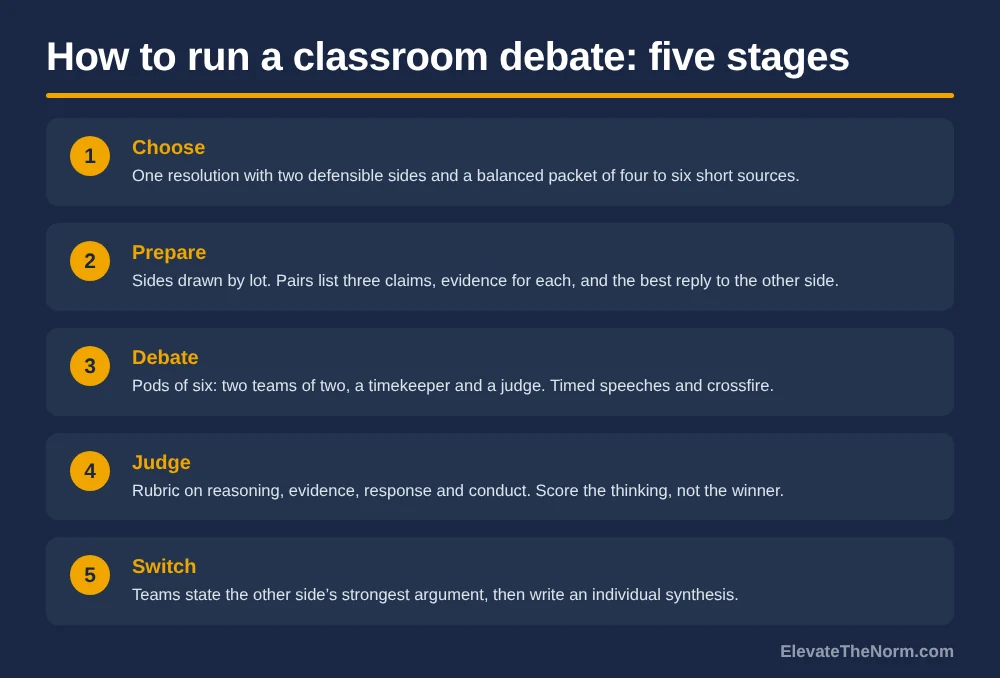
Run it in five stages: choose a resolution and source packet, assign sides and prepare, hold timed rounds in pods, score the reasoning with a rubric, then switch sides and write a synthesis. A first unit fits about four class periods.
- Choose one resolution and build a packet. Write one sentence students can affirm or reject. Collect four to six short sources, balanced across both sides, so evidence quality does not depend on what students find at home.
- Draw sides by lot and form pods. Pods of six are a workable default: two teams of two debaters, one timekeeper and one judge. Say plainly that an assigned side is a thinking exercise, not a statement of belief.
- Prepare for one full period. Each team lists three claims, evidence from the packet for each, and the strongest argument the other side will make, with a reply. Kuhn and Crowell’s program built in the same prepare-and-anticipate work.
- Run timed rounds. Use the times in the table below. Judges and timekeepers take notes with one column per speech.
- Judge on reasoning, in writing. Each judge scores the rubric criteria and finishes one sentence: “The most convincing point was ___ because ___.” Ballots are feedback. The teacher sets the grade.
- Switch or concede. In a short second round, teams argue the other side for two minutes, or each states the other side’s strongest argument and what would change its mind.
- Write and debrief. Each student writes an individual position that uses evidence from both sides. Then the class discusses what moved anyone and what evidence was missing.
| Period | What students do | What the teacher does |
|---|---|---|
| 1 | Read the resolution and packet, draw sides, begin preparing | Explains the rules and models one short speech |
| 2 | Finish preparing and rehearse speeches in pairs | Checks each team’s claims and evidence |
| 3 | Debate in timed pod rounds and write ballots | Circulates and notes one rubric line per student |
| 4 | Switch round, individual synthesis, debrief | Collects ballots and writing and returns feedback |
How Do You Choose a Resolution Students Can Actually Debate?
Choose a resolution with two defensible sides, enough readable evidence for both, and stakes that are real but not personal. Phrase it as one sentence students can affirm or reject. Avoid questions with settled factual answers and questions about students’ own identities, families or safety.
- Two defensible sides. You can name a credible source for each side before you assign anything.
- Readable evidence. Students can read a source in minutes and pull out a claim.
- Real stakes, not personal ones. Choose questions about policy, interpretation or design, not about who students are.
- Not already settled. If a quick search ends it, it is a research question.
Examples that meet those tests: “Industrialization improved ordinary workers’ lives more than it harmed them” (social studies); “Victor Frankenstein is more responsible than his creature for the harm in the story” (English); “Nuclear power should be expanded to cut carbon emissions” (science); “Our school day should start later” (school policy).
Build the packet the same week you pick the resolution. Aim for sources that disagree on the facts and not only on the conclusion, so students have something real to weigh. Trim each source to the passages students need and number the paragraphs, so a speaker can cite “source two, paragraph three” and the other team can find it. A one-page claims sheet, with a row for each claim, its evidence and its source, makes the preparation period visible to you and keeps teams from arriving with nothing but opinions.
Before running a charged topic, read your school’s policy on controversial issues and tell an administrator the topic and format. Send families a short note naming the resolution, saying sides are assigned by lot, and explaining how grades work. Hess and McAvoy’s framework centers on questions about how people should live together, a useful test for whether a political question is worth a class period.
Should Students Argue Sides They Disagree With, and Should They Switch?
Draw sides by lot and tell students plainly that an assigned side is a thinking exercise, not a belief. Then add a switch or a concession, because both structured-controversy methods end that way. Offer a researcher or judge role to any student whose family or identity the topic touches.
The research does not settle who should choose sides. Kuhn and Crowell’s students chose theirs, while Johnson, Johnson and Smith’s pairs and structured academic controversy assign them, and no source read for this guide compares the two. A random draw removes the social cost of picking a side in front of friends.
The switch matters more than the draw. Johnson and colleagues’ procedure has pairs reverse perspectives and then drop advocacy to write a joint position, and structured academic controversy ends with each side conceding the other’s strongest argument. In a debate, a switch round, a concession or a synthesis paragraph does the same work and shows whether students understood the other side.
You can give students a voice without losing quality control. Offer three resolutions that you have already checked against the tests above and let the class vote. Students get a real say in what they argue about, and you keep the packets balanced and the topics safe.
How Long Should Each Speech Be?
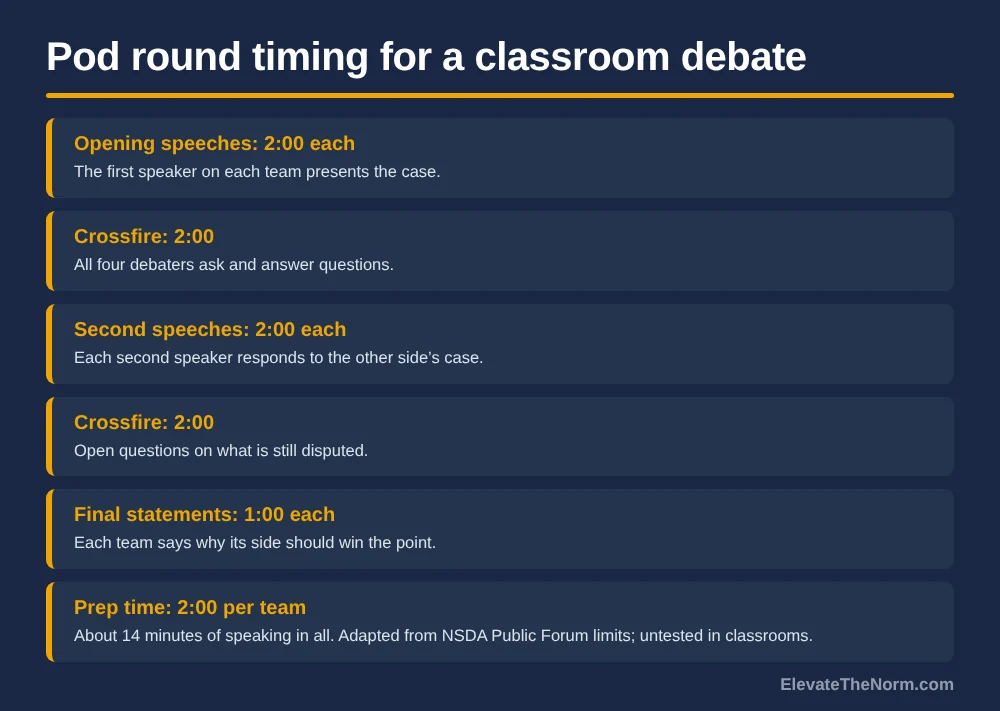
For a pod round, use two minutes for each opening and second speech, two-minute crossfires, one-minute final statements, and two minutes of prep per team. That is about 14 minutes of speaking. The times are adapted from NSDA Public Forum limits and have not been tested in classrooms.
| Segment | NSDA Public Forum pilot rules | Pod round (adapted for this guide) |
|---|---|---|
| Opening speeches | 4:00 each | 2:00 each |
| Crossfire | 3:00 | 2:00 |
| Second speeches | 4:00 each | 2:00 each |
| Crossfire | 3:00 | 2:00 |
| Summaries | 3:00 each | Skipped |
| Grand crossfire | 3:00 | Skipped |
| Final statements (final focus) | 2:00 each | 1:00 each |
| Prep time | 3:00 per team | 2:00 per team |
| Total speaking time | 35 minutes | 14 minutes |
Logistics decide whether a pod round runs on time. The timekeeper holds a visible clock, calls time without commentary and stops a speech at the limit, and teams spend prep minutes between speeches, not during them. Rotate roles so every student debates once and judges once, and stagger the pods so a round finishes inside one class period with time left for ballots. If a pod falls behind, drop the second crossfire before shortening any speech.
No study tests the compression or the pod format, which were adapted for this guide, so treat the times as a starting point and adjust after the first round.


How Do You Grade a Classroom Debate Fairly?
Grade the reasoning each student shows, not who wins and not how confident they sound. Score individual contributions on a short rubric covering claims, evidence, response to the other side, listening and conduct, and grade the written synthesis separately so quieter students have another way to show what they learned.
Treat judges’ ballots as feedback and keep the grade in the teacher’s hands, since a student’s grade should not depend on which classmate held the pen, and return ballots to teams privately rather than posting scores. The presentation rubric guide makes the same point about separating delivery from content.
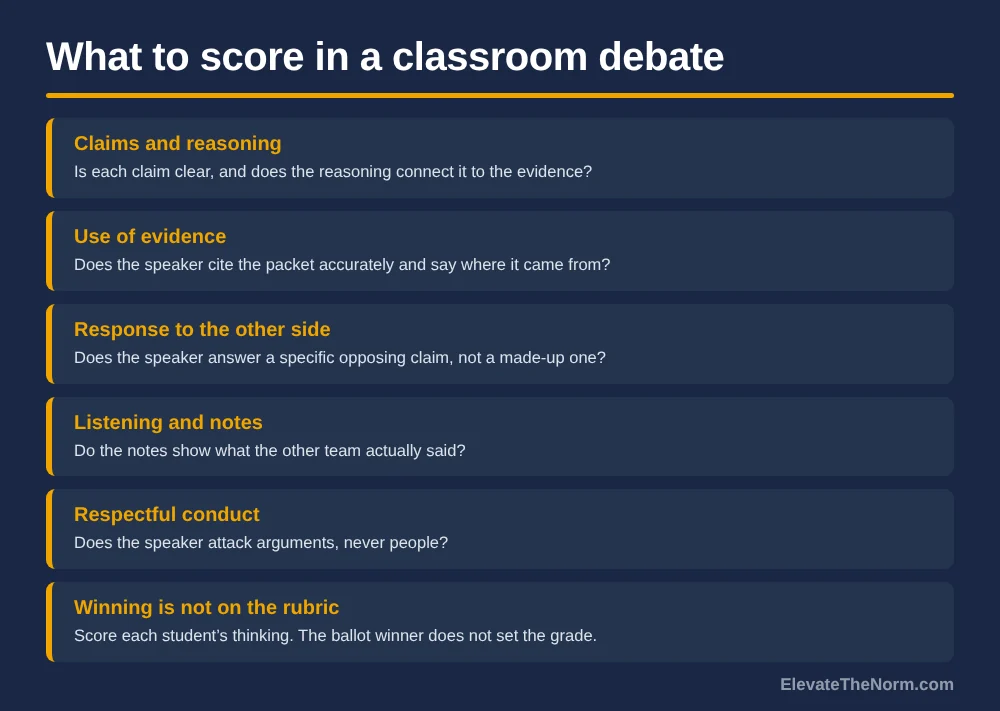
- Claims and reasoning. Is each claim clear, and does the reasoning connect it to the evidence?
- Use of evidence. Does the speaker cite the packet accurately and say where a fact came from?
- Response to the other side. Does the speaker answer a specific claim the other team actually made?
- Listening and notes. Do the notes show what the other team said?
- Respectful conduct. Does the speaker attack arguments rather than people?
A workable synthesis prompt has four parts: state your position in one sentence, give two pieces of evidence, state the strongest argument against you, and answer it. Grade it on the same rubric lines. A quiet student can then earn full marks on reasoning, evidence and response without speaking in front of the class.
To keep your workload manageable, grade from the written ballots and the synthesis instead of scoring live. One rubric line per student per round is enough.
What About Students Who Do Not Want to Speak?
Give every student a role with real work: debater, researcher, timekeeper, note-taker or judge. Offer written crossfire as an alternative to speaking aloud, and rotate roles so no one sits on the sidelines. Anxiety about speaking is a design problem, not a participation grade to subtract.
Roles can carry real weight. A researcher can scan the packet during prep and hand the team a one-line summary of each source. A note-taker can build the record of what each side claimed, which becomes raw material for the written synthesis. A judge learns the rubric from the inside, which makes the criteria concrete before that student is graded on them.
The group work roles guide covers giving each role a visible product so it counts as work. A debate also gives a quiet student a prepared turn with a known slot, easier than a surprise. If you use cold calling elsewhere, the cold calling guide explains how to keep it from feeling like a gotcha.
How Do You Keep a Classroom Debate Respectful and Safe?
Set the rules before the first round: attack arguments, not people; cite the packet; interrupt only in crossfire; and let any judge or the teacher stop a round that turns personal. Post sentence frames for disagreeing, and apply the same rules to every student every time.
- Sentence frames on the desk. “The source says ___, but it leaves out ___.” “I agree with ___ about ___. Where I would push back is ___.”
- A stop rule. Any judge or the teacher can pause a round, restate the rule and resume.
End every round out of role. Name that the assigned sides were exercises, then ask each student to say one thing they learned from the other side’s case. That closing step keeps students from carrying a position that was never theirs and gives you a quick read on whether the switch worked.
Debate rules work best as an extension of expectations the room already has. If you are building those, the classroom expectations framework is a good place to start.
What Goes Wrong in a Classroom Debate, and How Do You Fix It?
The usual failures are lopsided sources, one dominant speaker per team, memorized speeches that ignore the other side, and winner-takes-all grading. Fix them with balanced packets, assigned speaking turns, a required response to one opposing claim, and rubric grades that ignore who won.
Most failures trace back to design rather than to students. A packet that favors one side decides the round before it starts, so check that both sides hold comparable evidence. A team with one strong speaker lets that student carry the work, so assign each speech to a named student and require both teammates to speak. Memorized speeches that never touch the other side are fixed by requiring every second speech to answer one specific claim from the opening.
Two failures need a different fix. When students quit because they are losing, the switch round helps, because it hands everyone a fresh start on the opposite argument. When grades follow the ballots, grade from the rubric and the written synthesis and treat ballots as feedback only.
How Should the Format Change for Different Grade Bands?
Shorten speeches and add sentence frames for grades 6–8, use the full pod timings for grades 9–10, and add summaries and a longer final statement for grades 11–12. These are starting points, not tested settings, so adjust them after the first round.
| Grade band | Speech length | Support to add |
|---|---|---|
| 6–8 | 1:00 to 1:30 | Sentence frames on every desk, a packet of three short sources, teams of two |
| 9–10 | Full pod timings (2:00) | Packet of four to six sources, one source students find with teacher approval |
| 11–12 | Pod timings plus a 3:00 summary round | Students choose the resolution from a short list and write their own ballots |
Can a Department or School Use This Format at Scale?
Yes, because the cost is mostly teacher time. A department can share vetted resolutions, balanced packets and one rubric so each teacher is not rebuilding from scratch. Start with one pilot unit in one course, then adjust the packet, times and rubric before others adopt it.
The main costs are printing the packets and the planning time to build them, and the main risk is topic selection. Agree on a short approved list of resolutions, a common rubric and a shared family note, so a parent or administrator hears the same explanation from every classroom. Keep the pilot’s ballots and syntheses as evidence, since nothing in the research above shows how this format performs across a whole school.
The Short Version: How to Run a Classroom Debate This Month
If you only change one thing about how you run a classroom debate, build in the switch. Choose a resolution with two real sides, draw sides by lot, give every student a prepared role, grade the reasoning, and end by asking each team to state the other side’s best argument.
Run the format once, then change the times, packet or topic based on what your ballots and student writing show. Because the evidence is thin, your own results are the best data you will have.
Frequently Asked Questions
Does classroom debate improve student learning?
The evidence is limited. A three-year middle school dialogue program produced stronger arguments than conventional discussion, and a Chicago study linked league debate to higher graduation rates. Neither tested a single classroom unit, and the second was observational. Treat debate as one useful tool for teaching argument, not a proven fix for achievement.
How many students should be on each debate team?
Two per team is a sound default in pods of six: two debaters per side plus a timekeeper and a judge, with roles rotating each round. Larger teams let one student carry the work. In a single whole-class debate, three per side is workable if every student has a defined speech or task.
How long does a classroom debate take?
A first unit fits about four class periods: introduce the resolution and packet, prepare, run timed rounds with written ballots, then switch sides, write a synthesis and debrief. A pod round runs about 14 minutes of speaking plus prep time. Later debates in a familiar format can usually be shorter.
Should students have to argue a position they disagree with?
Drawing sides by lot is reasonable if you say plainly that an assigned side is a thinking exercise, not a belief, and if students can take a researcher or judge role when a topic touches their family or identity. Kuhn and Crowell’s students chose sides, while the structured-controversy methods assign them.
How do you grade a debate without rewarding the loudest student?
Grade each student’s reasoning, not the winner and not the volume. Score claims, evidence, response to the other side, listening and conduct on a short rubric, and grade a written synthesis separately so students who speak less can still show their thinking.
Can you debate political or controversial topics in class?
Often yes, with preparation. Read your school’s policy on controversial issues, tell an administrator and families the topic and format in advance, use balanced source packets, and choose questions on which informed people really disagree. Hess and McAvoy’s framework centers on questions about how people should live together.
What is the difference between a debate and a Socratic seminar?
A debate assigns sides, sets time limits and judges reasoning. A Socratic seminar assigns no side, has no winner and asks open questions about a shared text. Choose a debate for a question with two defensible answers; choose a seminar when you want students to explore a text together.
Sources
- Kuhn, D., & Crowell, A. (2011). Dialogic argumentation as a vehicle for developing young adolescents’ thinking. Psychological Science, 22(4), 545–552. Abstract read; the full text is behind a login and was not opened.
- Association for Psychological Science. Why argue? Helping students see the point. A news summary of the Kuhn and Crowell study; the participant numbers, program structure and comparison group described in this article come from this summary.
- Anderson, M., & Mezuk, B. (2012). Participating in a policy debate program and academic achievement among at-risk adolescents in an urban public school district. Journal of Adolescence, 35(5), 1225–1235. Read through the National Criminal Justice Reference Service abstract.
- CrimeSolutions, National Institute of Justice. Urban debate league (high school students). Program profile rating the practice “Promising” on one study; the evaluation sections of the page are blank.
- Johnson, D. W., Johnson, R. T., & Smith, K. A. (2000). Constructive controversy: The educative power of intellectual conflict. Change, 32(1). The effect sizes quoted are the authors’ own meta-analysis as reported in this article.
- Center for American Civics, Arizona State University. Structured academic controversies. Step-by-step description; the page asserts research support without citing a specific study.
- National Speech & Debate Association. (2019–2020). Public Forum pilot rules. Speech and prep times for pilot district and national tournaments.
- Hess, D. E., & McAvoy, P. The political classroom: Evidence and ethics in democratic education. Routledge. Publisher’s description read; the book itself was not.