By Clay Shumate
An anticipation guide is a short list of statements students agree or disagree with before they read, then revisit afterward with evidence from the text. It sets a purpose for reading and surfaces what students already believe. Three to five opinion statements work better than true-or-false facts.
Key Takeaways
- The statements have to be arguable, not factual. The IRIS Center at Vanderbilt is explicit that statements should be phrased “as opinions rather than true-false facts,” because opinions give students somewhere to stand.
- The after column is the whole point. A guide that never gets revisited is a warm-up. The learning sits in making students face what the text did to their first answer.
- The mechanism has strong evidence; the worksheet does not. the federal What Works Clearinghouse practice guide for grades 4–9 gives strong evidence, from 34 studies, to building topic knowledge and word meanings before reading — the thing an anticipation guide is a container for. The container itself has almost no controlled evidence at this grade band.
- The one experiment that measured learning found none. Valle, Antonenko, Wang and Luo (2020) randomly assigned 17 adults and found no significant difference in learning (p = 0.1), with the control group scoring numerically higher on the transfer test.
- Do not grade the before column. Score the first guess and students write what they think you want, which destroys the only data the instrument produces.
What is an anticipation guide?
An anticipation guide is a pre-reading tool: three to five statements about a text’s big ideas, which students agree or disagree with before reading and then return to after. It gives students a position to defend and a reason to look for evidence.
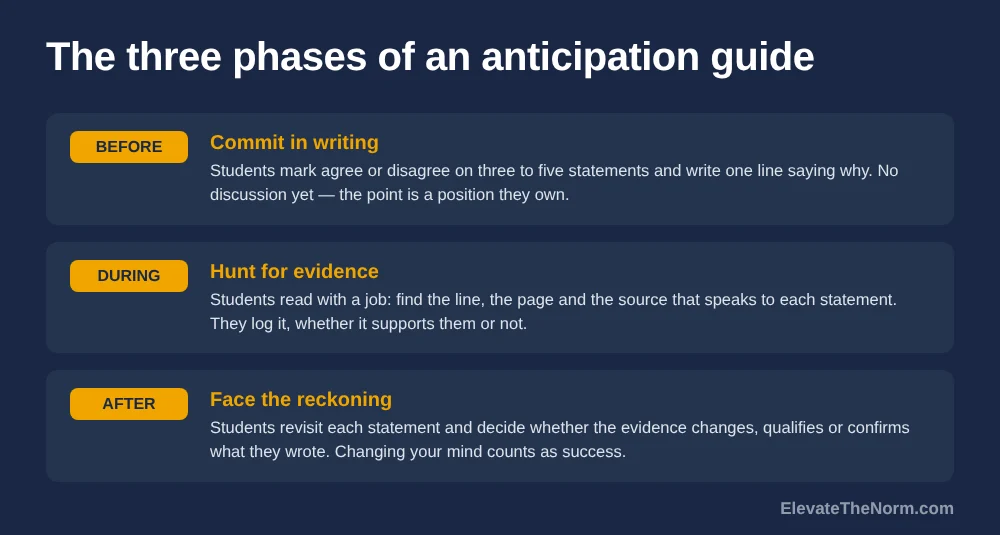
It is sometimes called an anticipation-reaction guide or an opinionnaire, and the second word in that first name matters. The IRIS Center at Vanderbilt builds the template around six columns: the statement, agree, disagree, the reader’s perspective before reading, textual evidence with a source and page number, and the reader’s perspective after reading. The evidence column is what separates this from a show of hands.
The practitioner trail for the modern version runs back to a 1994 article by Frederick Duffelmeyer in the Journal of Reading, which is the citation AdLit, the adolescent literacy service of public broadcaster WETA, gives for its own steps. Who invented the format originally is not something the major teaching references agree on, and this article is not going to pretend otherwise.
How do I make an anticipation guide?
Pick the three to five ideas the text actually argues, turn each into a sentence a reasonable person could disagree with, and build a place for students to record evidence. The whole job is about twenty minutes the first time and under ten after that.
- Read the text and find what it argues, not what it covers. The IRIS Center at Vanderbilt calls this identifying key concepts or themes. A chapter on industrialization covers dates; it argues that the trade-offs were uneven. Write toward the argument.
- Write three to five statements. Not ten. Students have to produce a before answer, an evidence line and an after answer for each one, so every statement you add costs three pieces of work.
- Phrase each one as an opinion. The IRIS Center at Vanderbilt warns against true-false facts and recommends statements that allow for competing perspectives, specifically so more than one reading becomes defensible.
- Say no to the topics that will not survive the room. The IRIS guidance is to consider somewhat controversial statements but avoid politically or emotionally charged ones the class has already handled badly. That is a judgment about your room, and you are the one qualified to make it.
- Add the evidence column and require a source. Page number, paragraph, speaker. Without it students will report a vibe and call it textual support.
- Decide now when the after column happens. Put it on the lesson plan with a time. The single most common failure of this strategy is that the class runs out of period before the reckoning and the guide quietly becomes a worksheet.
- Print one line at the top saying what the sheet is for. Something like: there are no wrong answers in the first column; changing your mind after reading is the point. It costs nothing, it settles the question for the student who is anxious about guessing, and it means the sheet explains itself if it ends up on a kitchen table.
One differentiation move is worth building in from the start, because retrofitting it mid-lesson never works: for students who need it, write the page or paragraph range next to each statement. They still have to find the evidence and decide what it means, which is the thinking the guide is for. What you have removed is the search, which is not.
What makes a good anticipation guide statement?
A good statement is one two prepared students could read the same text about and still land on opposite sides, with evidence. If the text settles it in one line, you have written a comprehension check.
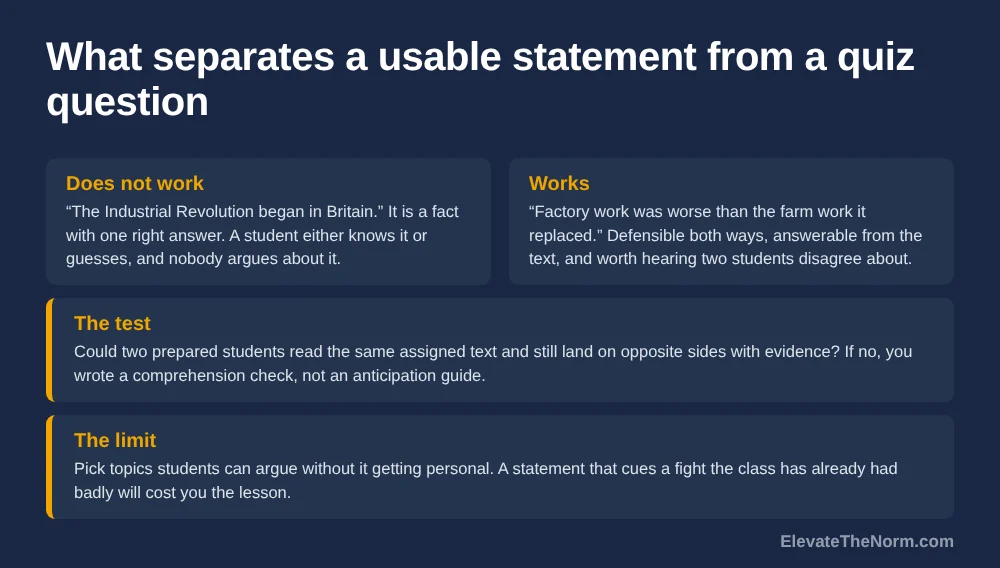
Compare two statements for the same chapter. “The Industrial Revolution began in Britain” is a fact. There is one right answer, a student either knows it or guesses, and after reading there is nothing to revisit. “Factory work was worse than the farm work it replaced” is arguable, answerable from the same chapter, and will split a class — which is exactly the condition that makes the after column worth doing.
There is a second test worth applying, and it catches the statements that look arguable and are not. Ask yourself what evidence in this text would move a student from one side to the other. If you cannot name it, students cannot find it, and the evidence column will come back empty with the opinions unchanged. That is also where this differs from reading a single source closely: there you interrogate one document; here you test a claim against whatever the reading offers.
What does a finished anticipation guide look like?
Four columns and four rows fits on half a page. Below is the shape, using example statements for a unit on industrialization — these are illustrations of the format, not a recommended reading list.
| Statement | Before reading | Evidence from the text | After reading |
|---|---|---|---|
| Factory work was worse than the farm work it replaced. | Agree / Disagree, plus one line saying why. | Page and quote. Wage data, hours, accounts from workers. | Changed, qualified or confirmed — and what did it. |
| New technology mostly helps the people who already have money. | Agree / Disagree, one line. | Who owned the machinery; who was paid what. | Same three options, in a sentence. |
| A country is better off when it industrializes quickly. | Agree / Disagree, one line. | Comparison of two countries or two decades in the chapter. | Same. |
| Child labor ended because people decided it was wrong. | Agree / Disagree, one line. | What the text says actually changed the law. | Same. |
The after column should take a sentence, not a paragraph. “I still agree, but only for the first twenty years” is a better outcome than a tidy reversal, and it is the kind of answer worth reading aloud.
Does the research say anticipation guides work?
Honestly: the evidence for the underlying move is strong, and the evidence for this specific worksheet is thin. No controlled trial in a secondary classroom shows that anticipation guides raise comprehension. That is worth knowing before a department adopts one.
Start with what is solid. the federal What Works Clearinghouse practice guide for grades 4–9, published in 2022 as WWC 2022007, assigns a strong level of evidence — its highest — to routinely using a set of comprehension-building practices, based on 34 studies, 23 of which met the Clearinghouse’s standards without reservations. The first part of that recommendation is building topic knowledge and word meanings before reading, roughly three to five minutes on each. An anticipation guide is one way to spend those minutes. The practice is evidenced; the format is a choice.
Now the specific studies, which are small and mostly not about teenagers. Valle, Antonenko, Wang and Luo (2020) ran the only randomized comparison we could find that measured learning: 17 adults aged 18 to 61, 8 with a guide and 9 without, watching a professional development video. Eye tracking showed the guide group made significantly more transitions between the text and the images — about 18 more in each direction, p = 0.002. Learning showed no significant difference (p = 0.1), and the control group scored numerically higher on the knowledge transfer test, 4.11 against 3.37. The authors are careful about it, writing that in the absence of a learning difference “it would be irresponsible to claim” the extra eye movement was integration rather than split attention.
Modjanggo (2019) is the study usually cited as the win: 25 university students in a Reading 1 course went from a 55.6 pretest mean to an 89 posttest mean after three sessions. But it is a single-group pre-post design with no control group, the participants are university students learning English rather than secondary readers, and the write-up reports two different degrees of freedom for the same test. A 33-point gain with nothing to compare it against cannot separate the strategy from three more weeks of practice.
Evans, Kodela and Khan (2022) is the most interesting of the three and the least like a classroom: 47 internal medicine residents used guides before and after five teaching conferences, and 35 of them — about 74 percent — showed a change in knowledge or thinking. It is a qualitative case study with no statistical test, and the authors say plainly that studies of guides in their field are scarce. What it does show is the mechanism working: the instructors used what residents got wrong to change what they taught next.
So the fair summary is this. Anticipation guides are a reasonable container for a practice with strong federal evidence behind it. They are not themselves a proven intervention, and anyone telling you they raise reading scores is extrapolating from studies that did not measure that.
There is one limit worth naming before you build the first one. The guide assumes students have enough footing on the topic to hold an opinion. A student who has never encountered the subject is not activating prior knowledge; they are flipping a coin in public, and if the class then discusses the split, they are flipping it in front of everyone. The federal guide pairs before-reading work on topic knowledge with word meanings for exactly this reason. If a class is coming in cold, spend two minutes establishing the ground first, then hand out the guide.


Should I grade an anticipation guide?
Grade completion, never correctness, and never the before column. The instrument runs on an honest first guess. The moment a wrong guess costs points, students stop guessing and start predicting what the teacher wants.
If you need it in the gradebook, score the evidence column — did the student find a real line with a real page number — and the after column, where the question is whether they engaged with what they found. Both are things a student controls through effort. The before column is not.
This is also the place to say something to students out loud, because they will not assume it: changing your mind on this sheet is the success condition, not an admission you were dumb. Teenagers read a graded before-and-after as a trap unless you tell them it is not one. Say that the only wrong answer in the after column is the one that ignores the evidence.
One adjustment on that, and it is the kind of thing that only shows up from a desk. Reading a good reversal aloud is worth doing, and it should be read without the name unless the student has said yes first. Praised or not, being held up as the person who was wrong at the start of the period is still being held up as the person who was wrong, and the quiet lesson a fifteen-year-old takes from it is to write the safe answer in the before column next time. Read the reasoning, keep the author out of it, and the honest first guesses keep coming.
How does this fit in a fifty-minute period?
Five minutes to commit, the bulk of the period to read and log evidence, and eight to ten minutes at the end for the reckoning. If the reading will not fit, split the guide across two days rather than cutting the after column.
The front end works well as the opening routine it has to fit inside: students are writing within ninety seconds of the bell and they have a reason to care about the reading before you have said anything. The residents in the medical study completed theirs in about five minutes and revisited them in about five, which is the right order of magnitude.
One structural pairing is worth knowing. If you want discussion in the middle, a structure that makes everyone commit before anyone talks is the natural partner, because the guide has already done the committing step for you. And if vocabulary is what will stop students from reading the evidence at all, handle that first — pre-teaching the words that would otherwise stop them is the other half of the practice the federal guide describes.
What goes wrong with anticipation guides?
Four failures account for most of it: grading the first guess, never running the after column, writing facts instead of arguable claims, and using too many statements. All four are avoidable in the planning, not in the moment.
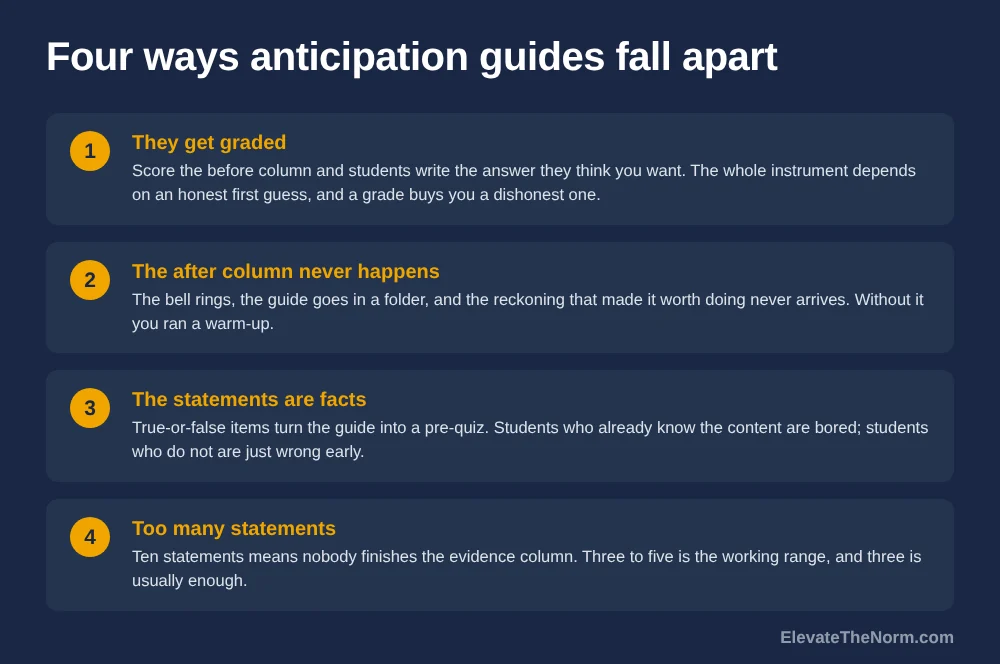
The missing after column is the one that happens to good teachers on busy days, and it is the one that costs the most. Without it students have made a prediction and never found out what happened, which is not a learning experience in any form. If the period is going badly, cut the number of statements you discuss rather than skipping the discussion.
The fourth failure — too many statements — is usually enthusiasm. Ten statements looks thorough on paper and produces thirty pieces of student work, none of them finished. Three good statements beat eight mediocre ones, and the IRIS guidance of three to five is a ceiling worth respecting.
There is a quieter failure too, which is the guide that duplicates work students are already doing. If your class already does marking up a text while they read, the evidence column may just be annotation with extra steps. Use the guide when you want students to arrive at the text with a position; use annotation when you want them to track one as it develops.
What to do next
Take the next reading you already planned to assign and write three statements about what it argues. Put ten minutes at the end of that lesson on the plan, in writing, for the after column. Then run it once before you decide anything about whether it belongs in your rotation.
And hold it at the right strength. Clay’s read, as a grades 6–12 teacher: this is a cheap, sensible way to do a thing the federal evidence says is worth doing, and it is not a reading intervention. If a department adopts it as one, the research will not back the claim, and the first year of flat scores will get blamed on the teachers rather than on the promise.
Frequently Asked Questions
What is an anticipation guide used for?
An anticipation guide is used before reading to activate what students already believe about a topic and give them a purpose for reading. Students mark agree or disagree on three to five statements, read while collecting textual evidence about each one, then revisit their positions. It is also called an anticipation-reaction guide or an opinionnaire, and the reaction half is where the learning sits.
How many statements should an anticipation guide have?
Three to five. The IRIS Center at Vanderbilt recommends that range, and the arithmetic supports it: each statement requires a before answer, an evidence line with a source, and an after answer, so ten statements produce thirty pieces of work that no class period can finish. Three strong arguable statements are more useful than eight weak ones.
Should anticipation guide statements be true or false?
Neither. They should be opinions a reasonable person could argue either way using the assigned text. The IRIS Center specifically advises phrasing statements as opinions rather than true-false facts, because factual items turn the guide into a pre-quiz with one right answer and leave nothing to revisit afterward.
Do anticipation guides improve reading comprehension?
There is no controlled secondary-classroom evidence that they do. The strongest related finding is from the federal What Works Clearinghouse guide for grades 4 to 9, which gives strong evidence to building topic knowledge before reading in general. The one randomized study measuring learning, by Valle and colleagues, found no significant difference between guide and no-guide groups.
Should I grade an anticipation guide?
Grade completion of the evidence and after columns if you need a grade, but never grade the before column for correctness. The instrument depends on students recording what they honestly think before reading. Once a wrong first guess costs points, students write what they expect the teacher wants and the guide stops producing useful information for anyone.
What is the difference between an anticipation guide and a KWL chart?
An anticipation guide asks students to take a position on specific claims the text addresses, which they then test against evidence. A KWL chart asks what students know and want to know about a topic in open form. The guide is narrower and more argumentative by design, which is what makes the after-reading comparison concrete rather than general.
How long does an anticipation guide take in class?
About five minutes at the start and eight to ten at the end, with the reading in between. The residents in the PRiMER study completed theirs roughly five minutes before instruction and revisited them about five minutes after, which is a realistic benchmark. If the reading will not fit in one period, split the guide across two days rather than cutting the after column.
Can anticipation guides be used outside English class?
Yes, and the published examples skew that way. The IRIS Center’s worked example is a middle school science lesson on rainforests and natural resources, and the PRiMER study used guides in medical education. Any subject with assigned reading that makes a claim will work, including science, history, health and career and technical courses.
Sources
- The IRIS Center, Peabody College, Vanderbilt University. Introduction to Anticipation-Reaction Guide, from the Secondary Reading Instruction module. Page. Source of the six-column template, the instruction to phrase statements as opinions rather than true-false facts, the three-to-five range, and the caution about emotionally charged topics. Note that this page cites no studies; it is authoritative guidance, not evidence.
- Vaughn, S., Gersten, R., Dimino, J., and colleagues (2022). Providing Reading Interventions for Students in Grades 4–9. WWC 2022007. Institute of Education Sciences, What Works Clearinghouse. Full text. Source of the strong evidence rating for Recommendation 3, the 34 supporting studies with 23 meeting standards without reservations, and the three-to-five minutes each on topic knowledge and word meanings before reading. This guide evaluates the practice, not the anticipation guide format.
- Valle, N., Antonenko, P., Wang, J., & Luo, W. (2020). Effects of Anticipation Guide Use on Visual Attention Distribution in a Multimedia Environment: An Eye Tracking Study. The Excellence in Education Journal, 9(3). Full text. Source of the null learning result (p = 0.1), the transition findings (p = 0.002), and the 4.11 against 3.37 transfer scores. The sample is 17 adults aged 18 to 61 — childcare providers and early childhood education majors — not secondary students, and the authors describe the work as exploratory. No effect sizes are reported.
- Modjanggo, V. K. (2019). The Effect of Anticipation Guide Strategy in Teaching Reading. sintuwumarosoJET, 5(1), 24–29. Full text. Source of the 55.6 to 89 pre-post gain. Single-group pre-post design with no control group, 25 university students in an English education program, selected purposively. The paper reports conflicting degrees of freedom and no effect sizes, and its causal framing goes beyond what the design supports.
- Evans, D. R., Kodela, J., & Khan, A. (2022). Anticipation Guides: A Tool to Highlight Knowledge and Promote Reflection on Learning. PRiMER, 6:20. Full text. Source of the 35-of-47 figure and the five-minutes-before, five-minutes-after timing. A qualitative case study of internal medicine residents at a single program, with no statistical tests and no effect sizes; the authors note that studies of guides in medical education are scarce.
- AdLit, an education service of WETA, Washington, D.C. Anticipation Guides. Page. Source of the Duffelmeyer (1994) attribution for the strategy’s steps and of the middle-and-high-school framing. AdLit cites no reference list beyond that single in-text citation.