Classroom expectations are the small set of standards that govern how your room runs — how people treat each other, how work gets done, and what happens when somebody falls short. They only work when you teach them, model them, and enforce them the same way on Thursday that you did on Tuesday. Here’s a complete framework for grades 6–12, plus a sample set you can adapt.
Key Takeaways
Keep the list short. Research supports a small number — three to five — of positively stated expectations, not a wall of rules.
Expectations have to be taught like content: defined, modeled, practiced, and revisited. Announcing them in August is not teaching them.
Structure is not the enemy of student freedom. A 2025 meta-analysis of 94 studies found that clear structure and support for student autonomy reinforce each other — and both raise motivation and engagement.
Consistency is a fairness issue. Expectations enforced by mood teach students to read the teacher instead of the standard.
The back half of the framework matters most: what happens after an expectation is broken — the consequence, the repair, and the way back.
What Classroom Expectations Are — and What They’re Not
Classroom expectations are the standards for how the room operates: how people treat each other, what prepared looks like, how work gets done, and what happens when things go wrong. They are not the same thing as procedures, and they are not a list of seventeen don’ts taped by the door.
All three exist. Only expectations belong on the short list.
The distinction matters because teachers blur these constantly. Procedures are mechanics — how to turn in work, where to sit, what to do when you walk in. Rules are specific boundaries. Expectations sit above both: they’re the values of the room with teeth in them. “Respect the people and the work” is an expectation. “Turn your paper in to the tray by the door” is a procedure. Both matter. Only one belongs on the short list you build the room around.
The research here is unusually clear. A widely cited review of evidence-based classroom management practices by Simonsen and colleagues identified 20 practices with sufficient evidence behind them, grouped into five categories — and one entire category is posting, teaching, reviewing, monitoring, and reinforcing expectations. Their guidance on the list itself: keep it to a small number of positively stated expectations, broad enough to cover the behavior you actually want. Tell students what to do. Seventeen versions of what not to do is not a standard; it’s noise.
Why Clear Expectations Matter More in Grades 6–12
Because teenagers read inconsistency as unfairness, and unfairness kills buy-in faster than strictness ever will. A firm room with a predictable standard feels safe. A loose room with a random standard feels rigged.
The evidence backs the firm room. The Simonsen review found that high-structure classrooms produce more task involvement, friendlier peer interactions, more attentive behavior, and less aggression. Structure works.
Here’s where a lot of secondary teachers get stuck, though. We’re told to give students voice, choice, and ownership — and clear expectations can feel like the opposite of that. The research says the tension is imaginary. In a study of 133 public high school classrooms with 1,584 students in grades 9–11, Jang, Reeve, and Deci found that teacher structure and autonomy support were positively correlated and both predicted student engagement — complementary, not antagonistic. A 2025 meta-analysis of 94 studies in Educational Psychology Review went further: structure and autonomy support reinforce each other with a large effect size, and both raise students’ motivation, engagement, and need satisfaction. That same body of research draws the line that matters: structure is not control. Structure tells students how to succeed here. Control tells them who’s in charge. Students can smell the difference from the hallway.
In my room, the structure is visible before I say a word. The daily plan goes on the whiteboard at the front with times attached. Those times are a budget and a promise — and when I blow one, I say so out loud and say why. Predictability is a form of respect. It tells teenagers I planned for their time like it’s worth something, because it is.
Clear expectations are also the foundation everything else stands on. Teaching responsibility doesn’t work if students are guessing at the standard. Neither does anything else you care about.
A Practical Framework for Classroom Expectations
Five expectation areas, plus the three commitments that make them real: consequences, repair, and improvement.
1. Respect — and it runs both directions
This covers how we speak to each other, how we disagree, and how we treat each other’s time and work. The part most frameworks skip: the teacher is inside this expectation, not above it. How you correct a student in front of their peers is the most-watched respect lesson you’ll teach all year. It’s also what this site believes at the foundation: respect isn’t a reward students earn — it’s the operating condition of the room.
2. Preparation
Materials and mindset. Define what prepared actually looks like in your room, because “be prepared” means nothing until you do. In a seventh-grade room that might be: notebook, something to write with, yesterday’s exit slip. In a junior-level class it might be: annotated reading done, your section of the group work drafted, questions ready. Say it in specifics or don’t expect it.
3. Effort and participation
In a workshop-style room, participation isn’t raising your hand. Students in my room are almost always working alongside somebody, so participation means your partner can count on you — you’re carrying your share of the thinking, not just occupying the chair next to it. Define effort the same way: visible, specific, checkable by the student themselves.
4. Collaboration and technology
Set device expectations by task, always inside your school’s policy. Some work needs screens; some work needs them dark. “Use tech for the task” travels better than a blanket ban you can’t hold or a free-for-all you’ll regret. And don’t copy anyone else’s tech expectation — including mine. Align it with your building, your subject, and the rules your school already has.
5. Deadlines and quality
Deadlines in a collaborative room are commitments to other people, not just to the gradebook. The quality bar worth teaching: would you put your name on this in public? Pair the deadline expectation with an honest escape valve — renegotiate before it passes, not after. That’s not softness. That’s how deadlines work everywhere adults keep them.
The back half: consequences, repair, and improvement
An expectation with no known “what happens next” is a suggestion. So the framework has to include what follows a miss: a consequence that’s connected, proportionate, prompt, and private — the opposite of the public correction that manufactures order instead of restoring it. Then repair: what’s owed, to whom, by when. Then improvement: the expectation that the standard gets easier to hit with practice, and that being re-taught is normal, not shameful.
One boundary, stated plainly: behaviors involving safety, harassment, threats, or anything else covered by school policy go through the required reporting process every time. Classroom consequences and repair sit alongside formal procedures. They never replace them.
How to Teach Expectations Instead of Just Announcing Them
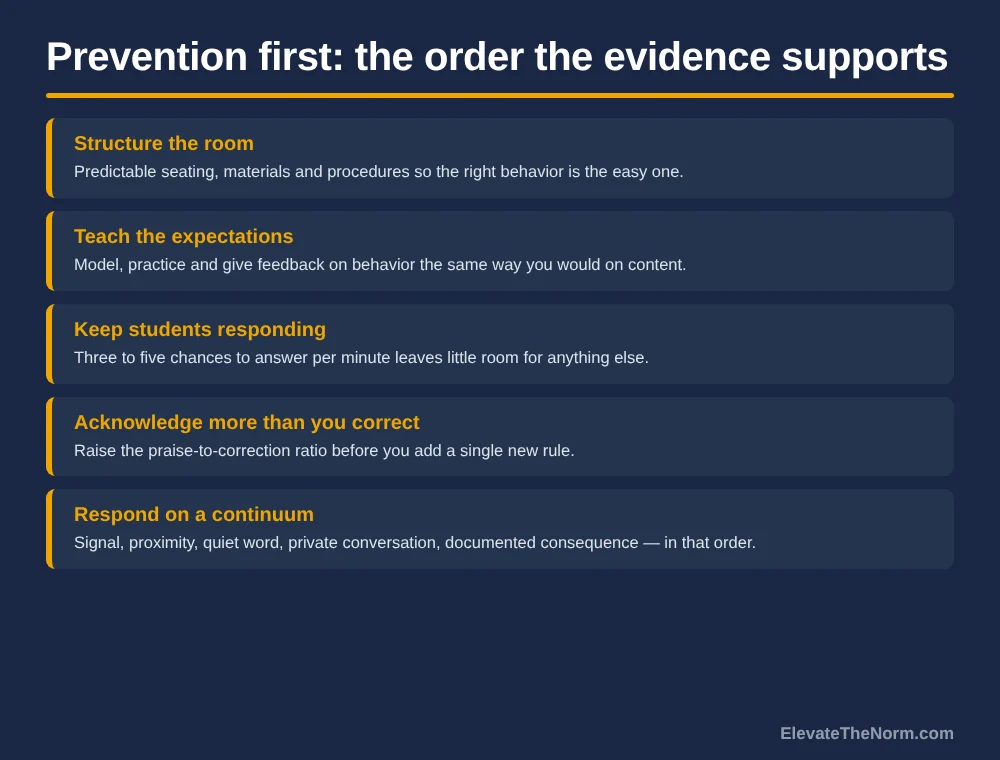
The same way you’d teach content: define, model, practice, revisit, reinforce. The Simonsen review is specific about what teaching expectations means — explicit instruction with examples and non-examples, frequent review, and active supervision: the teacher moving, looking around, interacting, correcting quietly, and reinforcing what’s going right.
That last part is just a description of circulating, which is how my room runs anyway. Monitoring doesn’t look like watching from a desk. I’m moving the whole period, so when somebody drifts off an expectation, the correction happens right next to them — a few quiet words at the table, low enough that the rest of the room keeps working. The standard gets held. Nobody gets a scene.
Expectations are taught like content, not announced like warnings.
The teaching sequence that works:
Define it in their language. For each expectation, show what it looks like and sounds like in a real moment — and what it doesn’t. Examples and non-examples, exactly like teaching a concept.
Model it — especially under pressure. Students learn your real expectations by watching you on a bad day. Handle your own mistakes out loud: name it, fix it, move on.
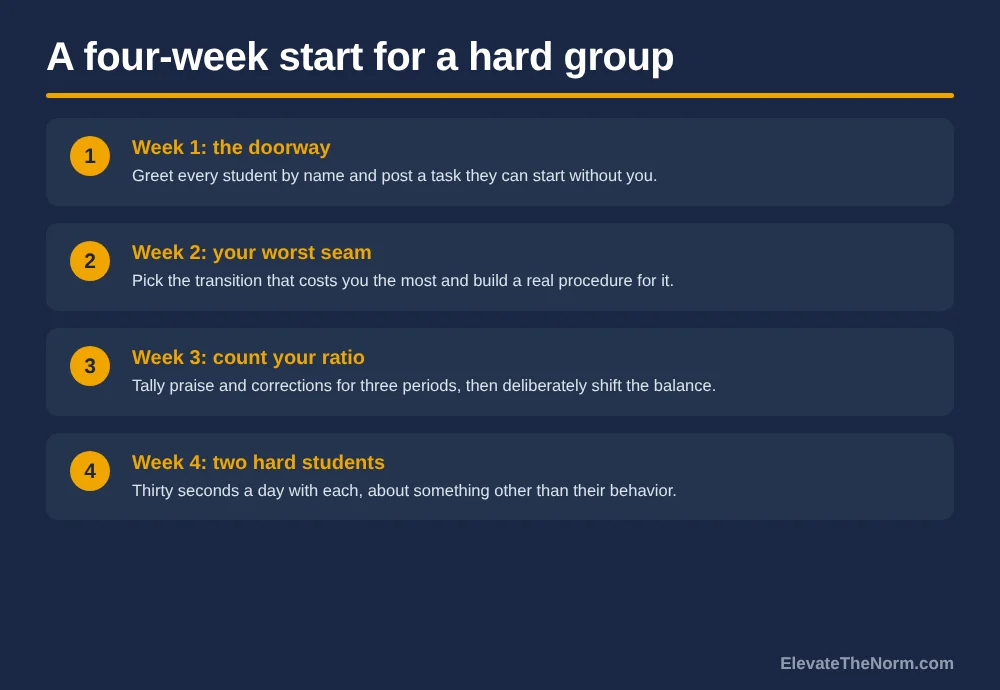
Practice it early. The first two weeks, run short reps inside real work — a two-minute partner task where the only goal is doing it the way the room does it.
Revisit on a schedule, not just after disasters. After every break. Before a new mode of work — labs, projects, discussions. The National Association of School Psychologists recommends teachers put reteaching on the calendar and track their own habits — like the ratio of encouragement to correction — because positive reinforcement moves behavior further than punitive correction does.
Hold it the same way every day. Same expectation, same response, whoever the student is. If a student needs more support to hit the standard — a visual cue, a private pre-correction, a quiet re-teach — vary the support, never the standard.
Two additions that pay off. Send the expectations home in the first week, in plain language, so families hear them from you before any problem exists. And when a student keeps missing the same expectation, treat it as information: is it a skill gap, a relationship gap, or something heavier? The answer changes your move. That diagnostic work sits on top of relationships you built before anything went wrong.
A Sample Classroom Expectations Set You Can Adapt
This is a starting point, not gospel. Adapt it to your building, your students, and your policies — an expectations set only works if the person enforcing it actually believes it.
A starting point, not gospel — adapt it to your room.
Come ready — materials, mindset, and your part of the work.
Respect the people and the work — in what you say and how you say it. That standard includes me.
Your group can count on you — show up for your share of the thinking.
Use tech for the task.
Meet the deadline — or renegotiate it before it passes, not after.
Notice what’s missing: threats. The what-happens-next conversation is real and students deserve to know it, but it happens separately and calmly, and it always includes the way back. A list of expectations that reads like a list of warnings tells students you’re expecting the worst. They tend to oblige.
Where Classroom Expectations Fall Apart
Too many to remember. Seventeen rules function like zero rules. If students can’t recite the list, the list isn’t running the room — your mood is.
Announced once, never taught. One speech in August plus a laminated poster is decoration. Laminated is not learned.
Enforced by mood. The expectation that flexes with your energy level teaches students to scan you instead of the standard — and the students who already trust school the least pay the highest price for that unpredictability. Consistency isn’t just management. It’s fairness.
Consequences without repair. If a miss just costs and never leads anywhere, students stop investing in the standard. The path back is what makes the standard worth meeting.
Expectations for students but not the adult. You are the most-watched person in the room. A teacher who demands punctuality and starts class late, or demands respect and corrects with sarcasm, is teaching the real expectations — and they aren’t the ones on the wall.
Conclusion
Classroom expectations come down to this: a short list you actually believe in, taught like it matters, enforced the same way every day, with a real path back when somebody blows it. So start here this week. Draft three to five expectations, positively stated. Cut anything you’re not willing to enforce on your worst Tuesday. Plan how you’ll teach and model each one — with examples, non-examples, and a rep or two inside real work. Then put a reminder on your calendar for three weeks out, because you’ll need to revisit them, and that’s not failure. That’s maintenance. The room you want isn’t built by the list. It’s built by what you do about the list, every single day.
Frequently Asked Questions
How many classroom expectations should I have?
Three to five, positively stated. The research on evidence-based classroom management specifically supports a small number of broad, positive expectations rather than a long list of prohibitions. Past five, students stop remembering them and start ignoring them — and so, honestly, do teachers.
Should students help create the classroom expectations?
Their input, yes — final ownership, no. Students can genuinely shape what respect looks like in this room, refine the language, and name what a fair deadline policy feels like. That input builds real buy-in. But the teacher owns the final set and the enforcement of it. Co-created doesn’t mean committee-run, and students respect a teacher who takes their input seriously more than one who pretends the room is a democracy.
What’s the difference between expectations, rules, and procedures?
Expectations are standards for how the room operates — the values with teeth. Rules are specific boundaries, often set by school policy. Procedures are mechanics: how to enter, submit work, transition. All three exist in every functioning classroom. The mistake is putting procedures on the poster and calling them your expectations.
What do I do when a student keeps breaking the same expectation?
Privately, and as a diagnosis, not just a penalty. Figure out whether it’s a skill gap, a relationship gap, or something heavier going on — the answer changes your response. Re-teach the expectation, apply a consequence connected to the behavior, and set a repair with a path back. For persistent patterns, bring the family in with facts and a plan, and involve the counselor or administration when the situation calls for it under your school’s process.
Do the same expectations work for middle school and high school?
The same categories work; the teaching changes. Middle schoolers need more reps, shorter loops, and more explicit modeling — expect to re-teach often and treat that as normal. High schoolers need more rationale and can handle more negotiated specifics. Both deserve expectations written in adult language. Nothing loses a ninth grader faster than a poster that talks to them like they’re eight.
What about cell phones?
Set a device expectation by task — “use tech for the task” — inside whatever your school or district policy requires. Then hold it with the same calm consistency as everything else. The rooms that lose the phone war usually lose it to inconsistency and escalation, not to the phones themselves. And don’t let the phone battle become the identity of your classroom; it’s one expectation among five, not the mission.
When should I revisit or re-teach expectations?
On a schedule: after every break, before any new mode of work — labs, projects, discussions, presentations — and any time you notice slippage. Put it on the calendar at the start of the year so re-teaching is maintenance instead of a reaction. A ten-minute refresher in January is cheaper than a February you spend fighting the room.
Jang, H., Reeve, J., & Deci, E. L. (2010). “Engaging Students in Learning Activities: It Is Not Autonomy Support or Structure but Autonomy Support and Structure.” Journal of Educational Psychology, 102(3), 588–600. https://eric.ed.gov/?id=EJ892818
Patzak, A., & Zhang, X. (2025). “Blending Teacher Autonomy Support and Provision of Structure in the Classroom for Optimal Motivation: A Systematic Review and Meta-Analysis.” Educational Psychology Review, 37, Article 17. https://link.springer.com/article/10.1007/s10648-025-09994-2
About Clay Shumate Clay Shumate is a certified secondary educator with a B.A. in History, an M.Ed. in Secondary Education, and more than eight years of classroom experience. He writes about project-based learning, student responsibility, respect, and practical ways to hold young people to a higher standard while giving them room to learn from mistakes.
An example of project based learning is any classroom project where students investigate a real question, make meaningful decisions, and create something for an audience beyond the teacher. The difference between PBL and a regular assignment is simple: in PBL, the project is the learning—not a reward for finishing the textbook chapter. Below you will find 25 concrete examples organized by subject and grade band, each one built around a real question, a public product, and standards worth teaching.
Key Takeaways
Project based learning requires a driving question, sustained inquiry, student voice, and a public product—not just a poster or presentation tacked onto the end of a unit.
A strong PBL example connects students to real audiences, real decisions, and real consequences for their work.
These 25 projects span English, social studies, science, math, and electives for grades 6–12, and most can be adapted for limited technology or resources.
Research shows PBL students in secondary schools outperform peers by significant margins on standardized assessments, with the strongest effects at the high school level.
The easiest way to start is small: pick one project, one class period, and one semester. Do not try to redesign your entire curriculum at once.
What Makes a Project “PBL” Instead of Just a Project?
Before the examples, this distinction matters. A lot of teachers assign projects. That does not mean they are doing project based learning.
According to PBLWorks, Gold Standard PBL includes seven essential design elements: a challenging problem or question, sustained inquiry, authenticity, student voice and choice, reflection, critique and revision, and a public product. If the project is missing most of those—if students are just following directions to build a diorama after the unit test—it is a project, but it is not PBL.
Here is the quick test I use: Who is doing the thinking? If students are making decisions about what to investigate, how to present their findings, and who their audience is, you are in PBL territory. If the teacher made every decision and the students are executing a recipe, that is an assignment with craft supplies.
A 2023 meta-analysis examining 66 empirical studies found that PBL produced a moderate overall effect on student learning (SMD = 0.441), with the strongest results at the high school level (SMD = 0.720). The gains were largest for academic achievement (SMD = 0.650), followed by thinking skills and emotional attitudes toward learning. Those numbers matter because they show that PBL is not just engaging—it produces measurable learning gains when done well.
PBL vs traditional projects: what peer-reviewed research shows.
25 Project Based Learning Examples for Grades 6–12
English Language Arts
1. The Community Oral History Archive (Grades 6–8)
Driving question: Whose stories in our community are not being told?
Students identify community members whose experiences are underrepresented—veterans, immigrants, retired workers, elders—and conduct recorded interviews using oral history protocols. They transcribe, edit, and publish the interviews as an online or physical archive donated to the local library or historical society.
Why this is PBL: Students choose their subjects, conduct sustained research, practice interview and writing skills, revise based on feedback from both their teacher and the interview subjects, and produce a public product with a real audience and lasting value. A book report does not do any of that.
Standards connection: Speaking and listening, narrative and informational writing, primary source analysis, digital literacy.
2. The Op-Ed Campaign (Grades 9–12)
Driving question: What issue in our school or community deserves a public argument?
Students research a local issue—school policy, city budget allocation, environmental concern, public health—draft an opinion editorial, workshop it through peer critique and revision cycles, and submit it to a local newspaper, school publication, or community blog. The goal is actual publication, not a grade.
Why this is PBL: The audience is real. The stakes are real. Students must build an evidence-based argument strong enough to survive an editor’s review. Revision matters because rejection is possible.
Standards connection: Argumentative writing, evidence evaluation, audience awareness, media literacy.
3. The Podcast Series on Student Identity (Grades 7–10)
Driving question: What does it mean to grow up in this place, at this time?
Students plan, script, record, edit, and publish a multi-episode podcast exploring aspects of adolescent identity—culture, language, family expectations, pressure, belonging. Each episode requires research, interviews, narrative structure, and production quality good enough for public release.
Why this is PBL: Students control the content, format, and production decisions. The public product (a published podcast) creates accountability that a classroom presentation cannot replicate.
Standards connection: Narrative techniques, speaking and listening, research, digital media production.
4. The Literary Magazine With an Editorial Board (Grades 6–12)
Driving question: What original writing and art from our school deserves a public audience?
Students run every aspect of a literary magazine: soliciting submissions, forming an editorial board, establishing selection criteria, editing accepted pieces with authors, designing layout, and distributing the finished publication. The teacher advises. The students decide.
Why this is PBL: Editorial decision-making, quality control, collaboration, revision, and publication for a real audience. This is not a creative writing assignment turned in for a grade—it is a functioning publication.
Standards connection: Writing across genres, editing, design, collaboration, project management.
Social Studies and History
5. The Local Policy Investigation (Grades 8–12)
Driving question: How does one local policy affect real people in our community?
Students select a local government policy—zoning, school discipline, curfew laws, water usage regulations—research its history, interview affected community members and officials, analyze data, and present findings and recommendations at a city council meeting, school board session, or community forum.
Why this is PBL: The audience is a decision-making body. Students produce evidence for people who can act on it. That changes how seriously students treat research and revision.
Standards connection: Civic engagement, primary and secondary source analysis, data interpretation, persuasive communication.
6. The Historical Marker Project (Grades 6–9)
Driving question: What happened here that people should know about?
Students research a local site with historical significance—a building, intersection, park, or neighborhood—write the text for an official historical marker, and submit a proposal to the local historical society or city government. The proposal includes a researched essay defending why the site deserves recognition.
Why this is PBL: The product has a real approval process. Students must build an argument backed by primary sources convincing enough for adults outside the school to accept. The stakes are authentic because the marker could actually be installed.
Driving question: How has immigration shaped our community’s economy, culture, and identity?
Students research immigration patterns in their region, conduct interviews with immigrants and longtime residents, analyze census and economic data, and produce a short documentary screened at a community event or submitted to a student film festival.
Why this is PBL: Students investigate a complex, relevant issue using multiple sources and perspectives. The documentary requires sustained inquiry, revision, and presentation to a public audience. Sensitivity to real people’s stories adds ethical weight the classroom rarely provides.
Standards connection: Historical analysis, geography, economics, media production, ethical research practices.
8. The Election Simulation With Real Data (Grades 7–12)
Driving question: How do campaigns actually persuade voters, and what role does evidence play?
Students research real candidates and ballot measures using primary sources—voting records, financial disclosures, policy statements—develop informed positions, create campaign materials, hold structured debates, and vote. The simulation ends with a published voter guide distributed to school families.
Why this is PBL: The voter guide is a real product for a real audience. Students must evaluate claims critically rather than parrot slogans. The project connects classroom learning to democratic participation.
Standards connection: Government, media literacy, argumentative writing, data analysis, civic responsibility.
Science
9. The Water Quality Investigation (Grades 6–9)
Driving question: Is the water in our community safe, and how do we know?
Students test water from local sources—taps, wells, creeks, fountains—using scientific protocols. They analyze results, compare them to EPA standards, and present their findings to the school board, city water department, or a community meeting. If results are concerning, students draft a formal letter to the appropriate authority.
Why this is PBL: Students collect real data, follow scientific methods, and present findings to an audience that may actually respond. The data is not hypothetical. If the water tests badly, students learn what it means to report uncomfortable truths backed by evidence.
Standards connection: Scientific investigation, data collection and analysis, environmental science, technical writing, civic engagement.
10. The School Energy Audit (Grades 7–12)
Driving question: How much energy does our school waste, and what would it cost to fix?
Students audit the school’s energy consumption—lighting, heating, cooling, electronics—calculate waste, research solutions, estimate costs and savings, and present a formal proposal to the principal or school board. The proposal includes a cost-benefit analysis and implementation timeline.
Why this is PBL: The data is real. The audience has budget authority. Students learn that persuading decision-makers requires more than good intentions—it requires numbers, evidence, and a realistic plan.
Driving question: What species live in our schoolyard or local park, and what does that tell us about ecosystem health?
Students conduct a systematic biodiversity survey using transects, quadrats, and species identification. They compile data, compare results to historical records or regional databases, and publish findings through a report to the local parks department or a citizen-science platform like iNaturalist.
Why this is PBL: Students contribute real data to real scientific databases. Their work has value beyond the classroom. The survey requires sustained fieldwork, accurate data collection, and scientifically defensible conclusions.
Standards connection: Ecology, data collection, species identification, scientific writing, environmental stewardship.
12. The Public Health Campaign (Grades 9–12)
Driving question: What health issue in our community needs better public information?
Students research a local health concern—teen vaping, nutrition access, mental health stigma, sleep deprivation—analyze data, consult local health professionals, and design and distribute an evidence-based awareness campaign. Products might include infographics, social media content, presentations to younger students, or informational materials for a community health fair.
Why this is PBL: The campaign targets a real audience with real health stakes. Students must verify claims, cite sources, and design communication that actually reaches people—not just earns a grade.
Standards connection: Health science, biology, statistics, graphic design, persuasive communication, media literacy.
Mathematics
13. The Small Business Financial Plan (Grades 9–12)
Driving question: Could our business idea actually survive its first year?
Students develop a business concept, research market conditions, create financial projections using algebra and statistics, and present their business plan to a panel of local business owners or entrepreneurs. The panel provides real feedback on whether the numbers hold up.
Why this is PBL: The math serves a real purpose—convincing skeptical adults that the numbers work. Students cannot hide behind procedures. They must defend their assumptions, explain their models, and revise when challenged.
Driving question: If we could redesign one space in our school, what would the data say we should change?
Students survey peers and staff, collect usage data, measure dimensions, create scale drawings or digital models, calculate material costs, and propose a redesign to the administration. The proposal includes blueprints, a budget, and evidence that the redesign addresses a real need.
Why this is PBL: The math—geometry, measurement, ratio, budgeting—serves a visible purpose. The audience (administration) has the authority to act on the proposal. Students see whether their calculations survive adult scrutiny.
Standards connection: Geometry, measurement, ratio and proportion, data analysis, scale drawing, budgeting.
15. The Statistical Investigation of School Data (Grades 8–12)
Driving question: What does our school’s data actually tell us about fairness, access, or student experience?
Students obtain anonymized school data—attendance patterns, discipline referrals, course enrollment, extracurricular participation—and conduct a statistical analysis looking for patterns, disparities, or trends. They present findings and recommendations to school leadership.
Why this is PBL: The data is real and the findings might be uncomfortable. Students practice statistical reasoning on questions that matter to their own school community. Presenting to administration makes accuracy and honesty non-negotiable.
Standards connection: Statistics and probability, data representation, bias and sampling, ethical data use, persuasive communication.
16. The Community Mapping Project (Grades 6–8)
Driving question: What resources does our neighborhood have—and what is missing?
Students map community assets—parks, clinics, grocery stores, bus stops, libraries—using measurement, coordinate systems, and data collection. They identify gaps in access, calculate distances and travel times, and present their findings to a community organization or neighborhood association.
Why this is PBL: Mathematics becomes a tool for understanding equity and access. The map and analysis serve a real community organization, and students must defend their data collection methods.
Driving question: What conversations should our school community be having?
Students pitch, produce, and publish regular podcast episodes covering school news, student perspectives, interviews with staff and community members, and student-reported stories. An editorial team manages content review, scheduling, and quality standards.
Why this is PBL: Students run a real media operation with real deadlines, audience feedback, and editorial standards. They must balance free expression with responsibility and accuracy—skills that no worksheet teaches.
Standards connection: Speaking and listening, research, writing, media production, journalism ethics, project management.
18. The Mentorship Curriculum (Grades 9–12)
Driving question: What do incoming freshmen actually need to know, and how should they learn it?
Older students design and deliver a mentorship program for incoming ninth graders. They research transition challenges, develop lesson plans, create resources, facilitate sessions, collect feedback, and revise the program based on results. The final product is a reusable curriculum guide for future mentors.
Why this is PBL: Students design instruction for a real audience and measure whether it works. The responsibility is genuine—younger students are depending on them. Revision is based on real feedback from real participants, not a teacher’s rubric alone.
Standards connection: Research, instructional design, leadership, communication, data collection, program evaluation.
19. The Community Art Installation (Grades 6–12)
Driving question: What message should our school send to our community through public art?
Students research public art, develop a concept, pitch it to school or city officials, design and create the installation, and manage the project from proposal through completion. The installation is displayed publicly—in the school, a local business, a community center, or a public space.
Why this is PBL: The approval process, budget constraints, material limitations, and public audience make this project authentic in ways classroom art projects rarely are. Students must persuade, plan, execute, and accept public reaction.
20. The Bilingual Community Resource Guide (Grades 7–12)
Driving question: What essential information in our community is not available in the languages families actually speak?
Students identify critical community resources—health services, legal aid, school enrollment, emergency contacts, transportation—and create a bilingual or multilingual guide. They verify accuracy with service providers, translate carefully, design for clarity, and distribute through schools, churches, clinics, or community organizations.
Why this is PBL: The product fills a real gap. Families who speak languages other than English will actually use this guide. Students must verify information, translate accurately, and design for people who need clear communication—not for a grade.
Standards connection: World languages, research, informational writing, design, community service, cultural competency.
21. The Career Investigation and Job Shadow Report (Grades 8–12)
Driving question: What does this career actually look like on a regular Tuesday?
Students research a career field, arrange a job shadow or informational interview with a professional, observe and document the daily realities of the work, and produce a detailed report comparing their expectations to reality. Reports are compiled into a career resource available to other students.
Why this is PBL: Students interact with real professionals, confront the gap between expectations and reality, and produce a resource other students will actually consult. The job shadow requires initiative, communication, and follow-through outside the classroom.
Standards connection: Research, informational writing, career readiness, professional communication, self-assessment.
22. The School Improvement Proposal (Grades 6–12)
Driving question: What is one thing about our school we could change with evidence and a plan?
Students identify a school problem—cafeteria waste, hallway congestion, library usage, schedule concerns—collect data, research solutions from other schools, calculate costs, and deliver a formal proposal to administration. The proposal follows a standard format with an executive summary, evidence section, implementation plan, and budget.
Why this is PBL: The audience makes real decisions. Students learn that complaining is easy but proposing evidence-based solutions is hard. If the proposal is good enough, the school might actually implement it.
Driving question: What can our school realistically do to reduce its carbon footprint in the next two years?
Students calculate the school’s carbon footprint, research reduction strategies, analyze costs and feasibility, consult with facilities staff, and present a phased action plan to school leadership. The plan includes measurable targets, timelines, responsible parties, and progress indicators.
Why this is PBL: The word “realistically” does a lot of work. Students cannot propose fantasy solutions. They must account for budgets, building codes, contracts, staff capacity, and political will. The constraints are what make it authentic.
24. The Peer Mediation Training Program (Grades 7–12)
Driving question: How can students help resolve conflicts fairly and reduce the need for adult intervention?
Students research conflict resolution, restorative practices, and mediation techniques. They design a training program, pilot it with volunteers, collect data on outcomes, revise based on results, and present the finished program to administration for adoption. Trained mediators then serve the school community.
Why this is PBL: Students create a lasting program that changes how their school handles conflict. The work is sustained over weeks, requires research and revision, and produces a public product that affects real people. Success is measured by whether the program actually works—not by a rubric score.
Standards connection: Psychology, communication, research, program design, leadership, data analysis, social-emotional learning.
25. The Local History Walking Tour (Grades 6–10)
Driving question: What stories does our neighborhood tell if you know where to look?
Students research the history of locations within walking distance of the school—buildings, monuments, former businesses, sites of historical events. They write informative scripts, create a mapped route, design signage or a digital guide, and lead public tours for families, community members, or younger students.
Why this is PBL: The walking tour is a real product for a real audience. Students must verify historical claims using primary sources, write for non-expert audiences, design for clarity, and perform publicly. A bad tour gets noticed. A good tour changes how people see their neighborhood.
If you are looking at a project and wondering whether it counts, ask these five questions:
Is there a driving question worth investigating? If the question can be answered with a Google search, it is not driving anything.
Are students making real decisions? If every step is predetermined, students are following instructions—not learning through inquiry.
Is the inquiry sustained? A one-day activity is an activity. PBL takes weeks because real investigation takes time.
Is there a public product? If the only person who sees the work is the teacher, the project lacks the accountability that makes PBL effective.
Did students revise based on feedback? First drafts are not final products. Critique and revision are where the deepest learning happens.
Research from PBLWorks identifies these as part of seven essential design elements that separate genuine PBL from dressed-up assignments.
Use these five questions to test whether your classroom project qualifies as genuine PBL.
What the Research Says About PBL Effectiveness
The examples above are not just engaging—they produce results.
A meta-analysis published in Frontiers in Psychology in 2023 analyzed 66 empirical studies with 190 effect values. The combined effect was a moderate positive impact (SMD = 0.441) on student learning outcomes. High school students showed the strongest gains (SMD = 0.720), outperforming primary, junior high, and university levels. Groups of four to five students produced the highest effects (SMD = 0.909), and projects lasting 9–18 weeks yielded the strongest results.
Lucas Education Research funded four peer-reviewed studies that reinforce these findings. In the Knowledge in Action study led by Anna Saavedra at the University of Southern California, over 3,600 students in project-based AP courses outperformed traditional AP classrooms by 8 percentage points in year one and 10 percentage points in year two. Low-income students showed similar gains as their wealthier peers. A Stanford University study found middle school science students outperformed comparison groups by 11 percentage points on NGSS-aligned assessments, with English language learners showing improved language proficiency as a side benefit.
PBLWorks reported in 2025 that over 66 percent of high school students report being bored daily in school, with 75 percent citing uninteresting material and 39 percent noting lack of relevance. Gold Standard PBL addresses both problems by building authenticity, student voice, and sustained inquiry into the structure of the learning itself.
The MDRC literature review by Barbara Condliffe further confirmed that well-implemented PBL improves content knowledge, problem-solving, and student engagement, particularly when projects include authentic tasks and audiences.
How to Start: A Practical Guide for Your First PBL Project
You do not need to overhaul your entire curriculum to try project based learning. Start with one project in one class.
Step 1: Pick a real question. Look at your standards and ask: what question connected to these standards would a real person actually want answered? That is your driving question.
Step 2: Identify an audience. The school board. A local business. Younger students. A community organization. The audience does not need to be impressive—it needs to be real.
Step 3: Define the product. What will students create that the audience will actually see, read, hear, or use? A proposal? A guide? A presentation? A published piece? Name it clearly.
Step 4: Build in checkpoints. PBL is not “assign the project and see what happens in six weeks.” Plan weekly check-ins, draft deadlines, peer critique sessions, and opportunities for revision.
Step 5: Protect the inquiry. Resist the urge to give students the answers. Your job during the project is to ask better questions, provide resources, and hold students accountable for doing the thinking themselves.
Step 6: Let the audience respond. The power of PBL comes from students hearing honest feedback from someone other than their teacher. An administrator who asks a tough question about their proposal teaches more in one moment than a week of lectures about “real-world relevance.”
Six steps to launch your first project based learning experience.
Practical Considerations Before You Begin
PBL works, but it works better when you plan for the realities that research papers do not always cover.
Preparation time is front-loaded. Your first PBL project will take more planning time than a traditional unit. You are designing a learning experience, not just a sequence of lessons. That investment pays off—once the project structure exists, you can reuse and refine it for years. But be honest with yourself about the time the first round requires.
Safety and supervision matter for community-based projects. Any project involving student contact with community members—interviews, job shadows, field investigations—requires appropriate parental consent, supervision protocols, and compliance with your district’s policies on off-campus activities and outside visitors. Plan these logistics early, not as an afterthought.
Equity and access must be designed in, not assumed. Not every student has transportation to visit a community partner, technology at home to edit a podcast, or family connections to arrange a job shadow. Design projects so the essential work can happen during school hours, using school resources. Offer alternatives for components that require outside access. A project that only works for students with advantages is not good PBL—it is privilege dressed up as pedagogy.
Communicate with families. Parents who experienced traditional education may be skeptical when their child comes home talking about “a project” instead of tests and textbook chapters. Send a brief explanation home at the start: what students will learn, what standards are being addressed, what the product will be, and how you will assess it. Transparency prevents the assumption that PBL means less rigor.
Differentiation is part of the structure. PBL naturally allows differentiation through student choice—in topic, product format, research depth, and role within a group. Students with IEPs or 504 plans should receive their accommodations within the project structure, not as a separate track. Build in scaffolds like research guides, planning templates, and sentence starters for students who need them, while allowing advanced students to pursue deeper questions.
Be ready for uncomfortable findings. Some of these projects—water quality testing, school data analysis, equity mapping—may produce results that are inconvenient for the school or community. That is a feature, not a bug. Teach students to report findings accurately and respectfully, and prepare administration for the possibility that student research might surface real problems worth addressing.
Conclusion
An example of project based learning is not hard to find—this article gives you 25 of them. The harder part is making sure the project actually qualifies as PBL rather than a dressed-up assignment. Real PBL puts students in charge of investigating questions that matter, making decisions that affect the outcome, creating products for audiences who will respond honestly, and revising until the work is genuinely good.
Start with one project. Choose a real question. Find a real audience. Build in checkpoints and revision. Let students make decisions you would normally make for them. Watch what happens when they realize the work matters to someone other than you.
The research supports it. The students deserve it. And your classroom will not be the same once you try it.
Frequently Asked Questions
How is project based learning different from assigning a project at the end of a unit?
In project based learning, the project is the unit—students learn content and skills through the investigation, not before it. A traditional end-of-unit project asks students to demonstrate what they already learned. PBL asks students to learn by doing the work. The driving question, sustained inquiry, and public product are built into the learning from day one, not added at the end.
Do students actually learn content through PBL, or just “soft skills”?
They learn both, and the research is clear. A 2023 meta-analysis of 66 studies found PBL’s largest effect was on academic achievement (SMD = 0.650), followed by thinking skills and emotional attitudes. High school PBL students showed even stronger academic gains (SMD = 0.720). The idea that PBL sacrifices content for engagement is not supported by the evidence.
How do I grade 25 different student projects fairly?
You do not grade 25 different projects—you grade against common criteria. A well-designed PBL rubric assesses content knowledge, quality of inquiry, evidence use, communication, and revision regardless of the specific product. Students can choose different formats and still be evaluated on the same standards. The rubric is the constant; the product varies.
What if I do not have time for long projects in my curriculum?
Start with a shorter project—three to four weeks—on a topic where your required standards align naturally with a real question. You do not need six months. Some of the strongest PBL happens within a single unit when the driving question is focused and the product is well-defined. One genuine project per semester teaches students more about inquiry and responsibility than no projects at all.
What about students who struggle with open-ended work or self-direction?
Scaffolding is essential. PBL does not mean handing students a question and disappearing. Teachers build in checkpoints, model inquiry skills, provide structured templates for research and planning, and check in regularly. Students who struggle with self-direction often need more structure at the beginning and less as the project progresses—not an exemption from the work.
How do I handle group projects when some students do not contribute equally?
Assign clear individual roles with visible deliverables so every student’s contribution is documented. Use individual accountability alongside group assessment. Peer evaluations, individual reflection, and graded individual components within the group project prevent free-riding. If a student is not contributing, the structure should make that visible early enough to intervene—not after the project is turned in.
Can I do PBL without much technology?
Absolutely. Many of the examples in this article—oral histories, community surveys, walking tours, art installations, mentorship programs—require little or no technology. A clipboard, a notebook, and access to the community are enough. Technology can enhance PBL, but the essential elements are a real question, sustained inquiry, student decision-making, and a public product. None of those require a device.
How do I get started if my school has never done PBL before?
Start alone if you have to. Pick one class, one project, one semester. Choose a driving question connected to your existing standards. Find an audience—even one administrator willing to listen to student presentations counts. Run the project, reflect on what worked and what did not, and adjust for next time. You do not need a schoolwide initiative to try project based learning. You need a question worth answering and students willing to do the work.
Chen, Chunhua, and Yilin Yang. “A Study of the Impact of Project-Based Learning on Student Learning Effects: A Meta-Analysis Study.” Frontiers in Psychology, vol. 14, 2023. https://pmc.ncbi.nlm.nih.gov/articles/PMC10411581/
Clay Shumate is a certified secondary educator with a B.A. in History, an M.Ed. in Secondary Education, and more than eight years of classroom experience. He writes about project-based learning, student responsibility, respect, and practical ways to hold young people to a higher standard while giving them room to learn from mistakes.