By Clay Shumate
Close reading means reading a short, difficult text more than once, with a different job each time: what it says, how it is built, what it means. That is the whole protocol. What it lacks is controlled evidence that it beats ordinary good teaching in grades 6–12, and the researcher most associated with it says so himself.
Key Takeaways
- It is several passes over one short, hard text, not one slow read with a highlighter. The questions are the method, not the count.
- The researcher whose three-pass version everyone was trained on says the comparison studies do not exist. Timothy Shanahan calls close reading “more of a desired outcome, a curricular goal” than a method.
- The mechanism has federal backing; the brand name does not. The What Works Clearinghouse guide for grades 4–9 recommends practice with “stretch text” and a routine set of comprehension-building practices, listed with 15 and 34 supporting studies. None of its four recommendations is called close reading.
- The only published head-to-head comparison lost. Boudreaux-Johnson, Mooney and Lastrapes found a validated alternative ahead for all six students — six fourth graders, six weeks, no statistics. It settles nothing, but it is what exists.
- Whether to front-load background knowledge is genuinely unsettled. Shanahan says leave it out; a UCLA guide quotes Catherine Snow warning that a cold read of too-hard text produces “destructive frustration”; a Berkeley study in high school classrooms found pre-reading helped.
What is close reading?
Close reading is the intensive analysis of a short, challenging text across repeated readings, each set to a different purpose. Shanahan’s formal definition is “an intensive analysis of a text with the purpose of determining what it says, how it says it, and what it means.” His shorter one is better: “to make sense of a text – to figure it out, to solve it like a problem.”
Two facts about the term explain most of the confusion around it. It came out of literary criticism, not reading research — in her Berkeley dissertation on close reading in secondary classrooms, Amy Koehler Catterson writes that “the phrase close reading originated with the New Criticism, a literary school most active from the 1930s through the 1970s.” And it is in your building because of standards policy: Shanahan says the Common Core State Standards “introduced the idea of ‘close reading,’ in elementary reading instruction.” A practice that arrives through a standards document rather than a trial never had to prove anything.
What do the three passes actually ask students to do?
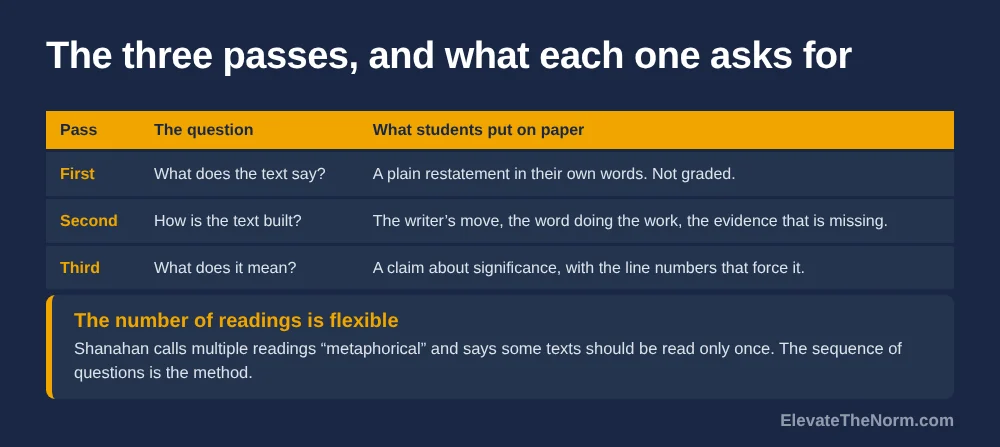
Three readings, three different questions: what the text says, how it worked, and what it means. A practitioner guide from UCLA’s CRESST describes Shanahan as recommending “at least three readings of a text,” each aligned to one of the three main categories of the reading anchor standards.
Here is what most training leaves out: he does not mean three literal trips every time. “The idea of multiple readings is metaphorical,” he writes, then gives the exemption outright — “One may read a text only once – and in some cases that would be sufficient.” If your department has turned close reading into a required three-read worksheet, it has standardized the one part of this its own author calls a metaphor.
| Pass | The question it answers | What students put on paper | What it is not |
|---|---|---|---|
| First | What does the text say? | A plain restatement — the claim, the sequence, who is speaking. Ungraded. | Not a summary written from the headline or from what they already assumed. |
| Second | How is the text built? | Marked structure: the move the writer makes, the word doing the work, the evidence that is missing. | Not colouring in every line that looks important. |
| Third | What does the text mean? | A claim about significance, with the line numbers that force it. | Not an opinion about the topic that the text never touched. |
Does close reading improve reading comprehension?
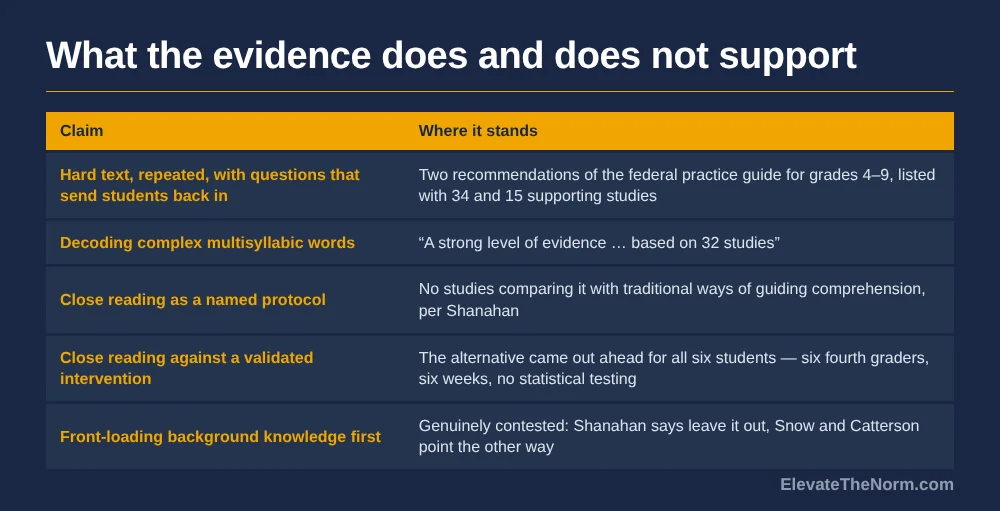
There is no controlled secondary-classroom evidence that it does. Shanahan, who wrote the three-pass version most teachers were trained on, puts it in his own words: “there are not studies comparing close reading with traditional ways of guiding students’ reading comprehension.”
He still thinks it belongs in a curriculum. He just will not promise it does anything measurable — “I don’t know whether practicing these activities will have a sufficient impact to guarantee those outcomes.” A researcher saying that about his own recommendation is the most useful sentence here. Catterson reached the same place from the other side, finding “very few empirical tests of particular approaches to adolescent close reading instruction.”
The one head-to-head test went against it. Boudreaux-Johnson, Mooney and Lastrapes ran close reading against Collaborative Strategic Reading, which already had an evidence base, in The Journal of At-Risk Issues: “in all six cases … the Daze score for CSR was higher than that for close reading by intervention’s end.” Close reading ran at 95 percent fidelity and the comparison at 75.6, so the worse-implemented condition still came out ahead. Their verdict is that “the present body of evidence supporting implementation of close reading practices is lacking.”
The caveats are big enough that nobody should use that study to kill close reading in a department meeting. The participants were six fourth graders in a Tier 2 programme at a rural public school, over six weeks, in a single-subject design read by eye with no statistical testing and no effect sizes. Six nine-year-olds in an intervention group are not a secondary classroom, and this site will not pretend otherwise.
Those authors do name one experiment in our grade band, calling it “the lone experimental study” of its kind: by their description, 438 students in grades 7 and 8 in an afterschool programme, 100 randomly assigned across five intervention classrooms, with gains in attendance, reader self-perception and state reading scores. I could not open that paper, so that is another team’s account, cited that way below — and by that account the treatment bundled close reading with independent reading and small-group instruction, so even if every number holds it cannot say which of the three did the work.
What does the federal evidence actually support?
The machinery underneath close reading, not the label on it. The What Works Clearinghouse guide Providing Reading Interventions for Students in Grades 4–9, chaired by Sharon Vaughn, makes four recommendations. Two are the engine of any close reading lesson, and neither is called close reading.
Recommendation 3 is to “routinely use a set of comprehension-building practices to help students make sense of the text,” listed with 34 supporting studies. Recommendation 4 is to “provide students with opportunities to practice making sense of stretch text (i.e., challenging text) that will expose them to complex ideas and information,” listed with 15. For scale, the guide gives its decoding recommendation “a strong level of evidence … based on 32 studies” — a tier it defines as “consistent evidence that meets WWC standards.”
Limits, stated rather than buried: the guide covers grades 4 through 9, so a high school junior sits outside its scope, and I read roughly its first third in full, so you are getting study counts and exact wording rather than a tier for Recommendations 3 and 4 that I did not see.
One passage deserves reading aloud in every secondary building. Writing about older students who need decoding help, the panel tells teachers to use real linguistic terms rather than the cute elementary ones “to ensure that the students do not feel like they are being treated like early-elementary students,” because “the goal is only for students to feel self-assured and respected as more mature learners.” Teenagers notice being talked down to, and they stop working when it happens.
Should I build background knowledge before a close reading?
This is the one piece where the evidence disagrees with itself, so decide on purpose rather than by whichever training you happened to get. Shanahan says leave prior-knowledge activation out. A UCLA guide quotes Catherine Snow warning that a cold read of a too-hard text produces frustration rather than struggle. A Berkeley study in high school classrooms found pre-reading helped.
Shanahan’s position is narrower than the slogan version. On previews: “No, you probably should not provide much of a preview.” On prior knowledge: “it would be better for a close reading lesson for the teacher to leave that out” — and, in the same breath, “it is reasonable to provide prior knowledge preparation often.” He is saying that on the day you teach students to wring meaning out of the page itself, handing them the meaning first defeats the lesson. The CRESST guide describes that same minimal-preview practice and prints the objection beside it, recording that Snow “cautions against what she calls cold close reading”: reading a text too hard “often results, not in productive struggle, but in destructive frustration.” That quotation reached me through the UCLA guide rather than Snow’s own article, and is credited that way below.
Catterson ran the question instead of arguing it, in a high school chemistry classroom: 28 students aged 14 to 17, one teacher, one semester, with randomized comparisons inside a mixed-methods design. She found that “students who had their background knowledge activated with pre-reading activities prior to closely reading an article wrote more argument-generating questions than students who did not.” Weigh it at its real strength: an unpublished dissertation whose author says her design is “less concerned about establishing specific causal relations.”
In a real room the cold read is defensible when the text is inside reach and the lesson is about reading strategy. It is indefensible when students have never met the topic, because then you are not watching them solve a problem, you are watching them drown politely. If the topic is new, spend two minutes on the words that actually unlock the passage, or get their position on the table with a short set of arguable statements they commit to before reading. Neither tells them what the text says.
If the barrier is the words themselves, more passes will not fix it — which is why the federal guide treats decoding as its own recommendation. Pre-teach the words, pair students for the first pass, or give the same three questions against a shorter excerpt of the same source; not a different, easier topic, which quietly tells a student they are in the group that does not get the real thing. And when a child comes home saying they did not understand the reading at all, that is information about the text, not a verdict on the reader.
Which texts are worth reading closely?
Short ones that resist you. Shanahan is blunt about the filter — “not all texts are worth the trouble of close reading” — and what he asks for is “high-quality texts, texts with a lot of depth,” because “challenging texts do not give up their meanings easily.”
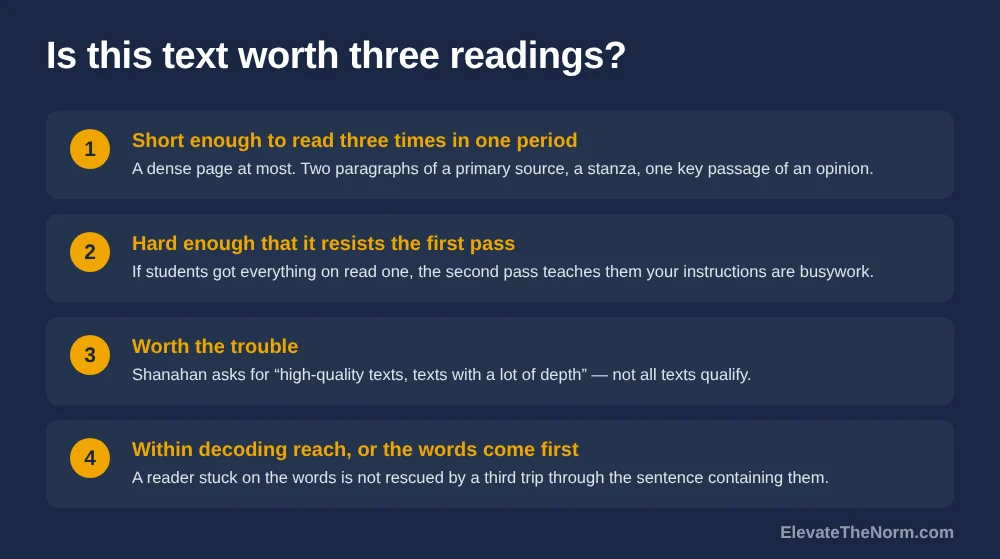
The practical filter is arithmetic: if students read a text three times and discuss it inside one period, each reading has to cost a few minutes. A dense page is plenty — two paragraphs of a primary source, a stanza, one court opinion’s key passage, a methods section. A chapter is a reading assignment, and treating it as a close reading is how this becomes a week nobody enjoyed. The other half of the filter is whether the text rewards the second trip. If students get everything on the first pass, the second teaches them your instructions are busywork, and they are right.
Subject matters too, and Shanahan warns the single-protocol version is too narrow: historians read “author centered” while scientists read across texts to compare them, so “there are other kinds of reading that students should also be exposed to.” In history the second pass is usually about the author rather than the structure, which is its own sequence — working a single historical document for what it is and who made it. Once the task becomes comparing several documents under time pressure, you have arrived at the document-based question as an assessment task, with its own rubric and failure modes.


How do I run a close reading in one fifty-minute period?
Pick a text short enough to read three times, give each read a different question, and spend the back half of the period arguing about the third. The sequence below assembles what the sources above describe into one period — the protocol as the research and the practitioner guides lay it out, not a recipe anybody has tested end to end in this form.
- Decide the pre-reading question before the bell. New topic or a text at the top of their range: two minutes on context and the words that gate the passage. Familiar topic, text inside reach: go in cold, and say out loud that you are doing it on purpose.
- Give the general purpose and nothing else. “Find out what this says” is a purpose. “Find the three ways the author builds sympathy” is the answer, handed over before they read a word.
- First read for what it says, and do not grade it. Score the first attempt and the unsure student writes nothing or copies a neighbour, and you have lost the one honest reading of the three.
- Second read for how it is built. This is where marking the page earns its keep, and the only pass where it should happen. One question, not nine.
- Walk the room, and do not correct what you overhear. Fix a misreading with a question — “read me the sentence that makes you think that” — not with a correction. A student told they are wrong in front of the two people they were talking to learns to say nothing during the second pass, which destroys the only reason you were listening.
- Third read for meaning, in the open. Ask questions that cannot be answered without going back into the text, and require line numbers in every answer. That requirement is the mechanism: it makes the conversation about the page rather than about opinions.
- End with something written and short. One claim, two pieces of text evidence, one sentence on what the author did to make it work. If you cannot read the class set in twenty minutes, you assigned too much.
Two omissions are deliberate: no reading it aloud first, because that replaces their first read with yours, and no vocabulary quiz at the end, because the close reading is the lesson. Finding the text is the prep; the three questions take about a quarter of an hour, and there is nothing to buy. If the room dies halfway through the second pass, that usually means the text was too long for three trips, or gave everything up on the first.
Is annotation the point of close reading?
No, and the person most associated with the protocol thinks schools have this backwards. Shanahan says annotation’s “use has been overblown in lots of classrooms”: “too often the notetaking seemed to be the point of the reading, rather than accomplishing those goals.”
Students agree, for what it is worth: in the Boudreaux-Johnson comparison the lowest-rated element of the close reading condition was “the annotating/note taking component,” at 5.5 on a nine-point scale. Neither that study nor Shanahan measured what annotation does to comprehension, so this is not evidence that marking a text is useless — it is evidence that students can tell when the marking has become the assignment. Marking well is its own skill, and there is a whole separate discipline to marking up a text while you read. Inside a close reading, confine it to the second pass and give it one job.
This matters most to whoever is doing walkthroughs, because a marked-up page is easy to count and so it is what gets looked for — precisely the failure Shanahan names. Listen instead for whether students’ answers point back at specific lines. A silent room full of highlighted paper is the version that does nothing.
Doesn’t this site say rereading is a weak strategy?
It does, and both are true, because they are different acts. Rereading your own notes alone at a kitchen table the night before a test is one of the weakest ways to study. Reading a hard source a second time with a specific question attached, in a room with a teacher in it, is an instructional move.
I flag it because someone will eventually quote this site against itself. Our page on which study strategies actually survive scrutiny rates passive rereading poorly, and it is right to. The difference is the question and the audience: solo rereading has no purpose attached and nobody to catch the misreading, which is exactly what the second and third passes supply. If a student asks why the teacher who said rereading does not work just asked them to read it three times, that is the answer — and it is a good question.
Clay’s take: use it, but stop selling it
Close reading is a good thing to do two or three times a unit with a text that deserves it, and a bad thing to make into a weekly ritual. That is my read of the evidence above, not a finding from it.
What keeps me doing it is the second pass. I run a workshop room — tables in groups, no rows, me on a stool moving between them rather than talking at the front — and the most useful thirty seconds of any reading lesson is overhearing a group confidently build on a sentence they have misread. On a one-pass assignment I never hear it; it turns up a week later in an essay, by which point it is theirs and load-bearing. What you do with those thirty seconds decides whether you keep getting them. Correct the table and you have taught them that thinking out loud is how you get caught being wrong. Ask which sentence gave them that, and they fix it themselves while you walk away.
What I would refuse: adopting close reading as a department-wide intervention for struggling readers, because the evidence for that use does not exist and the one published head-to-head went the other way; and putting it in an improvement plan as a way to raise reading scores, because anybody claiming that is extrapolating from studies that did not measure it. As a shared habit in content classrooms it is a different proposition — no purchase, no licence, no platform, just a passage, three questions and a teacher. If your school already paid for the training, Shanahan’s own advice is to retain it and “expand the focus to some other approaches to text.”
And teenagers can be told the truth about this. “We are reading this three times because it is hard and I think it is worth it” is a sentence a fifteen-year-old can respect. “Because this is how we do close reading” is not.
What to do next
Pick one text in your next unit that you have always wished students understood better and that fits on a single page. Write three questions for it — what it says, how it is built, what it means — and run one close reading lesson, deciding in advance whether you are front-loading the context or going in cold. Then judge it on what you learned about your readers, not on whether it felt like a strategy. That is a fair test, and the only one available until somebody runs the study nobody has run.
Frequently Asked Questions
What is close reading?
Close reading is the intensive analysis of a short, challenging text across repeated readings, with each reading set to a different purpose: what the text says, how it is built, and what it means. The term comes from literary criticism rather than reading research, and it reached most American classrooms through the Common Core standards rather than through a trial.
What are the three reads in close reading?
The first read establishes what the text says, as a plain restatement. The second looks at how the text is built: the writer’s moves, the words doing the work, the evidence offered or missing. The third asks what the text means, answered with specific lines. Timothy Shanahan, who set out this sequence, stresses that the three readings are metaphorical and that some texts need only one.
Does close reading improve reading comprehension?
There is no controlled secondary-classroom evidence that it does. Shanahan states that no studies compare close reading with traditional ways of guiding comprehension. The only published head-to-head comparison, involving six at-risk fourth graders, favoured a validated alternative intervention. The underlying practices of working with challenging text do have federal evidence behind them; the named protocol does not.
How long should a close reading text be?
Short enough to read three times and discuss inside one class period, which in practice means a dense page at most. Two paragraphs of a primary source, a single stanza, or one key passage of a court opinion all work. A full chapter is a reading assignment, not a close reading, and treating it as one is how the lesson collapses on the second pass.
Should students be given background knowledge before a close reading?
This is genuinely contested, so decide deliberately. Shanahan advises leaving prior-knowledge activation out of a close reading lesson, while agreeing it is reasonable to build knowledge often. A UCLA guide records Catherine Snow warning that a cold read of too-hard text produces destructive frustration rather than productive struggle, and a Berkeley study in high school classrooms found pre-reading helped.
Is close reading the same as annotating a text?
No. Annotation is one tool inside the second pass, and Shanahan argues its use "has been overblown in lots of classrooms," with notetaking becoming the point of the reading instead of a means to it. In the one comparison study available, students rated the annotation component the lowest-scoring part of the whole close reading condition.
Does close reading work for struggling readers?
Not if the barrier is decoding. A student who cannot read the words on the page will not get there through additional passes, and the federal practice guide for grades 4 to 9 treats decoding complex multisyllabic words as a separate recommendation carrying a strong evidence rating from 32 studies. Pre-teach the words, pair the first read, or shorten the excerpt rather than reassigning an easier topic.
Is close reading only for English class?
No, but it looks different by subject and should not be the only approach. Shanahan notes that historians read in an author-centred way and scientists read across texts to compare them, concluding that students need exposure to other kinds of reading too. In history the second pass is usually about who wrote the document and why, rather than about its structure.
Sources
- Shanahan, T. Should We Still Teach Close Reading? Shanahan on Literacy. Post. Source of the three purposes, the “metaphorical” status of multiple readings, the statements that no comparison studies exist, the position that close reading is a curricular goal rather than a method, the judgment that annotation has been overblown, the advice to schools to retain and expand, and the text-selection filter. An opinion essay by a reading researcher, not a study; it reports no data of its own.
- Boudreaux-Johnson, M., Mooney, P., & Lastrapes, R. E. An Evaluation of Close Reading With At-Risk Fourth-Grade Students in Science Content. The Journal of At-Risk Issues, 20(1). Full text via ERIC. Source of the head-to-head comparison against Collaborative Strategic Reading, the fidelity figures, the 5.5 annotation rating, and the authors’ conclusion that the evidence base is lacking. Six fourth-grade students in a Tier 2 programme at a rural public school, six weeks, single-subject alternating treatments design read by visual inspection, with no statistical testing and no effect sizes. It is also the source for this article’s description of Fisher and Frey’s grades 7–8 study, which is reported here as their account of it because the original could not be opened.
- Vaughn, S., Gersten, R., Dimino, J., Taylor, M. J., Newman-Gonchar, R., Krowka, S., Kieffer, M. J., McKeown, M., Reed, D., Sanchez, M., St. Martin, K., Wexler, J., Morgan, S., Yañez, A., & Jayanthi, M. (2022). Providing Reading Interventions for Students in Grades 4–9. WWC 2022007. National Center for Education Evaluation and Regional Assistance, Institute of Education Sciences, U.S. Department of Education. Full guide. Source of the four recommendations and their wording, the 32/34/15 study counts, the strong-evidence tier definition and its assignment to the decoding recommendation, the multisyllabic-word passage, the instruction to use formal linguistic terms so older students feel respected, and the “not a cookbook” caveat. Roughly the first third of the guide was readable in full for this article, which is why the evidence tiers for Recommendations 3 and 4 are not quoted here.
- Jones, B., Chang, S., Heritage, M., Tobiason, G., & Herman, J. Supporting Students in Close Reading. National Center for Research on Evaluation, Standards, and Student Testing (CRESST), UCLA. Full text via ERIC. Source of the alignment between the three readings and the reading anchor standards, the description of minimal pre-reading, and the Catherine Snow caution against “cold close reading,” including the “destructive frustration” quotation. A practitioner guide with no study population, design or results, and the Snow quotation is cited here as this guide reproduces it, because Snow’s own article could not be opened.
- Catterson, A. K. (2017). Close Reading in Secondary Classrooms: A 21st-Century Update for a 20th-Century Practice. Doctoral dissertation, University of California, Berkeley. Full text via eScholarship. Source of the New Criticism origin, the assessment that there is very little research on close reading instruction, and the finding that activating background knowledge before a close read produced more argument-generating questions. A doctoral dissertation rather than a peer-reviewed trial; the empirical chapter covers 28 students aged 14 to 17 with one teacher in four non-AP chemistry sections, and the author states her design is less concerned with establishing causal relations. Her question counts are not quoted here because they could not be verified against the document.
- Named but not cited as evidence, because they could not be opened for this article: Bogaerds-Hazenberg, Droop and van Steensel’s literature review of close reading interventions in grades 3–9, Still too close to call, published in Reading Psychology and referenced above only as Shanahan cites it; and Fisher and Frey’s grades 7–8 study, described above through Boudreaux-Johnson and colleagues. Neither is quoted here beyond those attributions.