By Clay Shumate
Study skills are the methods students use to learn material on their own. Two beat the rest: practice testing and spacing study across days. A ten-technique review rated those two high utility and rated rereading, highlighting and summarizing low — and surveys show rereading is what most students actually do.
Key Takeaways
- Of ten study techniques reviewed by Dunlosky and colleagues, only practice testing and distributed practice earned a high-utility rating. Summarization, highlighting, the keyword mnemonic, imagery for text, and rereading all earned low ones.
- A later meta-analysis of 242 studies and 1,619 effects agreed on the top two — distributed practice d = 0.85, practice testing d = 0.74 — but put rereading at d = 0.47 and argued that none of the ten should be dismissed as ineffective. The gap between those two verdicts is the most useful thing on this page.
- The same meta-analysis found a larger average effect for secondary students (0.69) than for primary (0.42) or university students (0.59). Whatever else is true of teenagers, these methods are not weaker on them.
- In a survey of 177 undergraduates, 84 percent named rereading as a study strategy and 55 percent ranked it first, while 11 percent mentioned practising recall. That sample was not teenagers, and a 2019 reexamination disputes the conclusion — both caveats are given below.
- The federal practice guide rates two things strong: using quizzes to re-expose students to key content, and asking deep explanatory questions. Teaching students to manage their own study time is rated minimal. The strongest moves belong to the teacher, not to a study-skills handout.
Ask a class how they studied for a test and most of them will describe reading something again. Notes, the chapter, a slide deck, a highlighted page. It feels like work, it takes real time, and it is close to the least effective thing on a list that researchers have been ranking for over a decade.
The honest version of this article is not “your students study wrong.” It is that the two methods with the best evidence are both easier to run from the front of the room than to assign as homework — which means study skills are mostly a teaching problem wearing a student’s name.
What are study skills?
Study skills are the methods a student uses to learn and retain material outside direct instruction — how they review, test themselves, organize time, and decide when they know something. That last part matters more than it sounds. A student who cannot tell the difference between recognizing a page and being able to produce what is on it will stop studying too early every single time.
Two terms are worth defining, because the rest of the research uses them constantly. Practice testing — also called retrieval practice — means pulling information out of memory without looking, through self-quizzing, flashcards used honestly, or low-stakes classroom quizzes. Distributed practice, or spacing, means spreading the same amount of study across several sessions instead of one. Neither requires technology, money, or a new curriculum.
Which study skills actually work?
Practice testing and distributed practice. Those two were the only techniques rated high utility in the review that put this question on the map, and they stayed on top when a different team re-ran the numbers eight years later.
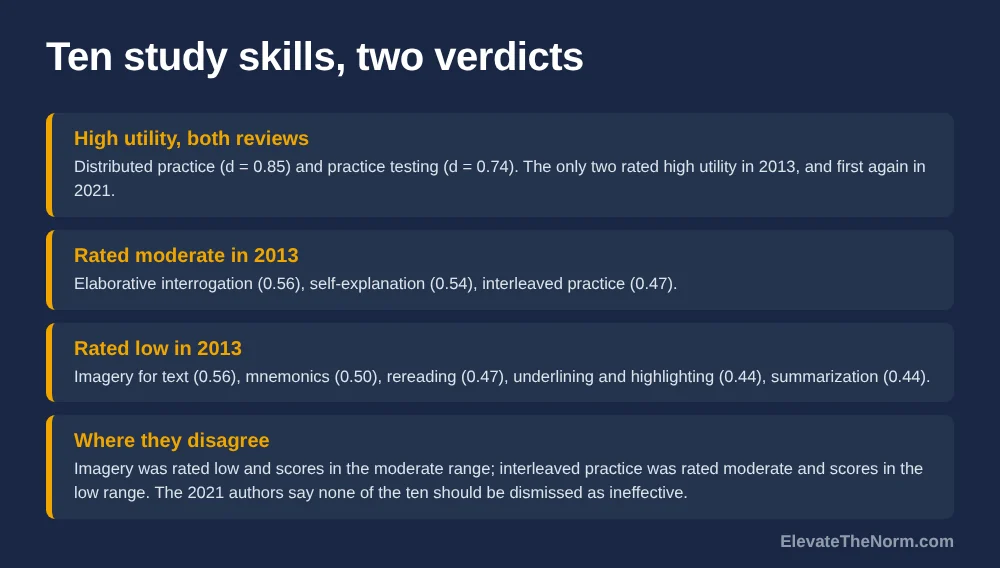
In 2013, John Dunlosky, Katherine Rawson, Elizabeth Marsh, Mitchell Nathan and Daniel Willingham reviewed ten common techniques in Psychological Science in the Public Interest and rated each one for general utility — whether the benefit holds up across ages, abilities, materials and kinds of test. Two earned high. Three earned moderate. Five earned low.
In 2021, Gregory Donoghue and John Hattie meta-analyzed the same ten techniques across 242 studies and 1,619 effects and produced an effect size for each. The headline agreed: distributed practice and practice testing came first. The fine print did not entirely agree, and that is worth putting in front of you rather than hiding.
| Technique | Dunlosky et al. (2013) rating | Donoghue & Hattie (2021) mean d | What it looks like in a grades 6–12 class |
|---|---|---|---|
| Distributed practice | High | 0.85 | The same review split across four short sessions instead of one night. |
| Practice testing | High | 0.74 | Ungraded recall questions at the start of class, no notes open. |
| Elaborative interrogation | Moderate | 0.56 | Making students answer “why would that be true?” about a fact they just read. |
| Imagery for text | Low | 0.56 | Students build a mental picture of a described process or event. |
| Self-explanation | Moderate | 0.54 | A student talks through how they got an answer, step by step. |
| Mnemonics | Low | 0.50 | A keyword or acronym attached to a list. Fine for a list; not a study plan. |
| Rereading | Low | 0.47 | Reading the chapter or the notes again. |
| Interleaved practice | Moderate | 0.47 | Mixing problem types in one set instead of doing twenty of the same kind. |
| Underlining / highlighting | Low | 0.44 | Marking a text while reading it. |
| Summarization | Low | 0.44 | Writing a short summary of what was read. |
Read the disagreements rather than the ranking. Imagery was rated low in 2013 and came out at 0.56 in 2021, which is moderate in that paper’s own bands. Interleaved practice was rated moderate and came out at 0.47, which is low in those bands. And rereading — the technique everyone is told to abandon — came out at 0.47, not zero. The 2021 authors say so directly: their cut-offs are somewhat arbitrary, several techniques sit right on a boundary, and none of the ten should be called ineffective.
Why are highlighting and rereading rated so low?
Because they produce a feeling of knowing without producing the thing that gets tested: the ability to retrieve the material cold. A reread page is familiar, and familiarity is easy to mistake for mastery. A quiz question answered without notes cannot be faked that way.
But keep the honest version in view. Low utility in the 2013 review means the benefit was inconsistent or narrow, not absent, and the 2021 effect sizes put rereading, mnemonics, highlighting and summarizing between 0.44 and 0.50. The accurate sentence for students is not “rereading does nothing.” It is that rereading is the most expensive way to get a modest return, because it eats the study time that a few minutes of self-testing would have used better.
There is a second caution worth stating before anyone builds a professional-development slide on those effect sizes. The 2021 authors report that 93 percent of the studies they pooled measured surface or factual outcomes, almost all measured near transfer, most measured the outcome within a day, and no publication after 2014 was included. Heterogeneity was high. So the numbers are a good guide to learning facts and procedures that will be tested soon, and a weak guide to whether a student still understands something in April.
Do students know which study methods work?
Mostly not, though the most-cited evidence for that claim is weaker than its reputation. Both halves belong here, because this is the finding teachers repeat most often and the one most likely to be overstated.
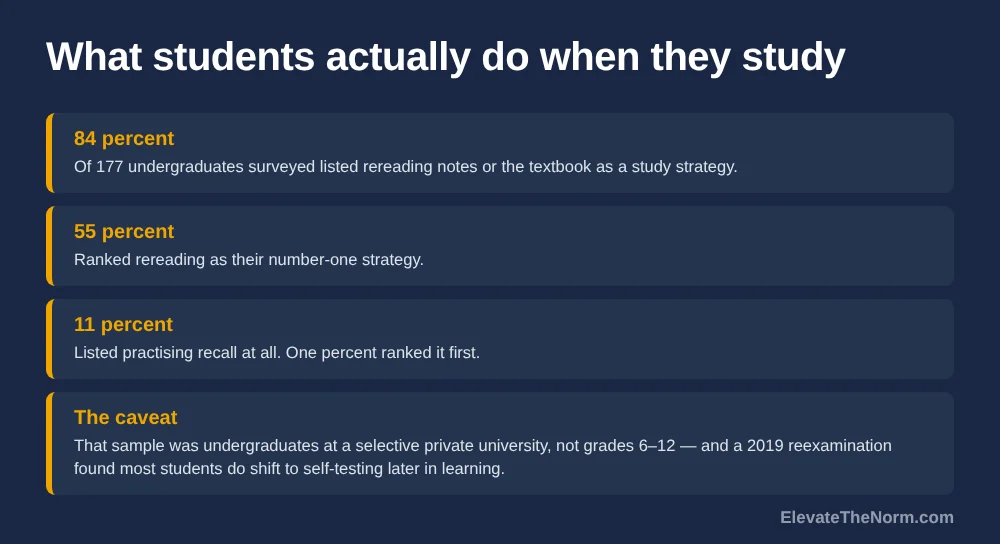
Jeffrey Karpicke, Andrew Butler and Henry Roediger surveyed 177 undergraduates about how they study. Rereading notes or the textbook was listed by 84 percent and ranked first by 55 percent. Practising recall was listed by 11 percent and ranked first by 1 percent. Asked what they would do with a chapter if they could not restudy afterwards, 57 percent chose to restudy and 18 percent chose to test themselves — and most of those who chose testing said they wanted feedback, not better memory.
Two caveats, both from the research rather than from me. First, that sample was undergraduates at a selective private university, not students in grades 6–12, and the authors themselves note that other surveys using different question formats found much higher rates of self-quizzing. Second, Christof Kuhbandner and Kathrin Emmerdinger re-examined the question in 2019 with finer measures of what students actually do, and found that few students preferred rereading early in learning and almost all shifted to testing later, with rereading used mostly to revisit a part they had not understood. Their conclusion is that the preference for rereading has been overstated.
What survives both: students systematically underuse self-testing as a learning tool, even when they use it as a checking tool. That is a smaller claim than the one usually made, and it is still enough to act on.
What does practice testing look like in a grades 6–12 classroom?
Short, ungraded, frequent recall with the notes closed — run by the teacher during class, not assigned as studying. This is the version with the best classroom evidence behind it and the lowest cost to run.
Henry Roediger, Pooja Agarwal, Mark McDaniel and Kathleen McDermott ran three experiments with sixth graders in a real social studies course, using the students’ actual chapter and semester exams as the outcome. Quizzed material beat material that was simply presented again, and the advantage held to the semester exam. The federal What Works Clearinghouse guide reaches the same place from the research side, rating “use quizzes to re-expose students to key content” as strong evidence, alongside asking deep explanatory questions.
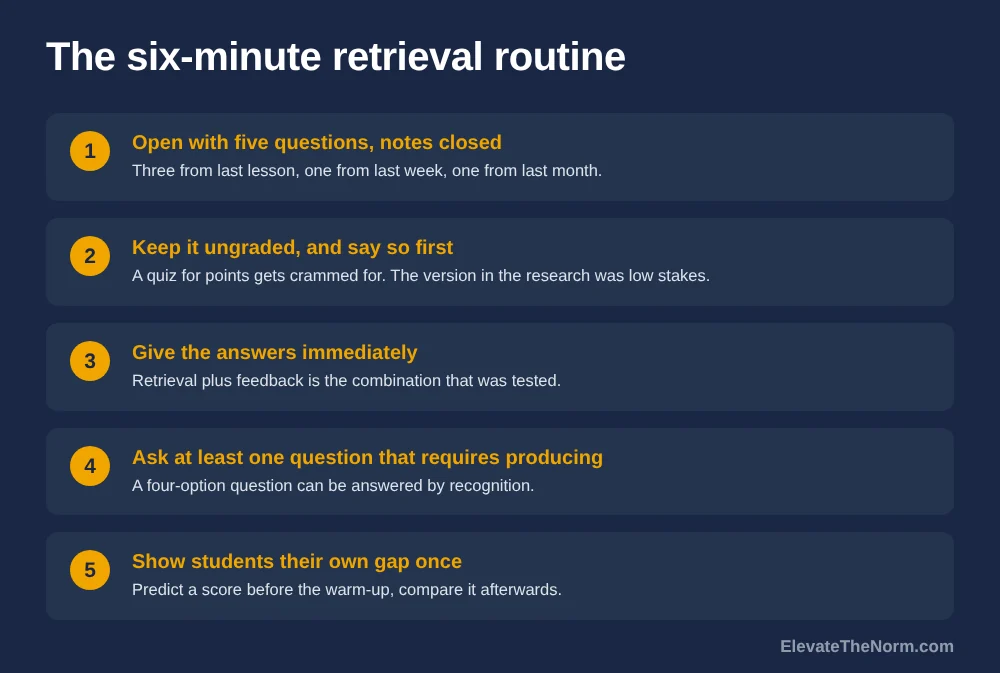
- Open class with five questions, notes closed. Three from last lesson, one from last week, one from last month. The old questions are the spacing; you do not need a separate spacing plan if the warm-up carries it.
- Keep it ungraded, and say so before the first question. A quiz for points is an assessment and students prepare for it by cramming. A quiz for learning is a study method, and the version in the research was low stakes.
- Give the answers immediately. Retrieval plus feedback is the combination that was tested. Thirty seconds of correction while the attempt is fresh is doing most of the work.
- Ask at least one question that requires producing, not choosing. “Name two causes and say which mattered more” forces retrieval; a four-option question can be answered by recognition.
- Show students their own gap once. Have them predict a score before the warm-up and compare it afterwards. The reason students stop studying early is that rereading feels like knowing; one honest comparison does more than a lecture about metacognition.
Total cost: about six minutes a day, no grading, no platform. If you already run a bell ringer, this is a change of content rather than a change of routine — and the same five minutes doubles as a formative check on what the last lesson actually cost.
Two practical problems come up in the first week, and both have cheap answers. Students who were absent cannot retrieve a lesson they never had, and a daily cold-recall routine will land on them as a daily reminder of that. Let a student write “absent” and skip to the older questions; the spacing items are the ones that matter most for them anyway. And keep the scoring private. Students mark their own, nobody reads a score aloud, and you collect nothing. A recall warm-up that turns into a public ranking stops being a study method and becomes a daily performance, and the students it would help most are the ones who will start guessing to look finished.
You will also get the question from a parent or an administrator eventually: if it is not graded, why does it count? The honest answer is that it is not an assessment at all. It is the studying, moved inside the class period where every student gets it rather than only the ones who already know how to study at home. That framing is also the fairness argument, and it is worth saying in those words at open house.
How do you teach spacing when you don’t control homework time?
Build the spacing into the course calendar instead of asking students to build it into their evenings. Distributed practice carried the largest effect in the 2021 meta-analysis and a moderate evidence rating in the federal guide, and it is the technique a teacher can impose without anyone’s cooperation.
Three ways to do that without adding instructional minutes. Let old content keep appearing: every warm-up pulls at least one question from more than a week back. Make the review for a unit test happen three times at five minutes rather than once at thirty — same total time, different distribution. And let assessments be cumulative in a small, announced way, so that last month’s material is never finished. Say the last one out loud to students early, because a surprise cumulative question is a fairness problem rather than a spacing strategy.
For students who do study at home and want to use this, the instruction is one sentence: study the same total time in four sittings instead of one, and start each sitting by writing down what you remember before opening anything.


Should study skills be taught as a separate class?
The evidence read for this article does not answer that question directly, and I am not going to pretend it does. What it does show is that the strongest-rated moves are teacher-run and content-specific, while the student-managed ones rate weakest.
Look at how the federal guide splits. “Use quizzes to re-expose students to key content” and “ask deep explanatory questions” are rated strong. “Space learning over time” is moderate. Both halves of “help students allocate study time efficiently” — including teaching delayed judgments of learning and using quizzes to identify what needs study — are rated minimal. The recommendations with the best support describe things a teacher does inside a course. The recommendation about managing one’s own studying has the weakest support in the same document.
And the classroom study with the clearest result ran inside a sixth-grade social studies course on that course’s own content, measured on that course’s own exams. That is an argument for teaching these methods on the material students are already responsible for. It is not a measured comparison against a standalone study-skills course, because no source read here ran that comparison. Treat the paragraph above as reasoning from the evidence, which is what it is.
If someone is selling your district a study-skills program on these numbers, two questions settle most of it. What did the outcome measure, and how long after instruction? The pooled evidence is overwhelmingly factual recall measured within a day, which is a fair description of a unit test and a poor description of a state assessment in May. A vendor who cannot answer those two questions is quoting an effect size past the end of its own sentence, and the fix costs nothing anyway: the practice is free, so a district can adopt the method without buying the product.
For anyone coaching this rather than buying it, the walkthrough observables are narrow enough to be fair. Were notes closed? Did the answers arrive inside the same five minutes? Was at least one question older than a week? Those three are visible from the back of a room in under five minutes and they do not require a judgment about whether a lesson was engaging.
What about students with ADHD or learning differences?
Nothing read for this article tested these techniques separately on students with ADHD, dyslexia, or any identified disability, so this page makes no claim about them. That is a real gap and it is one of the most common searches attached to this topic, so naming it beats guessing at it.
What can be said without inventing evidence: the versions recommended here are the ones that do not depend on a student planning, scheduling, or self-monitoring their own study time, because the teacher runs the retrieval and the calendar carries the spacing. Whether that helps a particular student is a conversation for their IEP or 504 team, who have information no article has. If executive function is the actual obstacle, the evidence on executive functioning strategies is a better starting place than this page.
Clay’s take
I think “study skills” is one of the most dishonest phrases in school, because we hand students the responsibility and keep all the levers. The two methods with the best evidence are both things a teacher can simply do: ask questions with the notes closed, and refuse to let old material disappear. Telling a fifteen-year-old to space their practice while every assessment in the building rewards a single night of cramming is not advice. It is a request to ignore the incentives we built.
Where I would push back on the research culture around this: the effect sizes get quoted with a confidence the papers themselves do not have. Most of the pooled studies measured facts, measured them the same day, and stopped at 2014. That is a strong case for six minutes of recall at the start of class. It is not a case for buying a program, and anybody selling you one on the strength of d = 0.74 is quoting past the end of the sentence.
The part I would protect is the student’s dignity in all this. A teenager who reread the chapter four times and failed the test did not refuse to work. They worked hard at the wrong thing, usually because nobody ever showed them the difference between recognizing a page and producing what is on it. Say that out loud when you hand the test back. The number is not a verdict on their effort, and they will believe you about the method afterwards.
What to do next
Change one routine this week. Replace whatever opens your class with five recall questions, notes closed, ungraded, answers given immediately, and make one of those questions reach back more than a week. Do it for a unit, then compare the unit test to the last one. That is the whole intervention, and it costs you nothing but the first five minutes you were already spending.
If you want the pieces that sit next to this one: note taking strategies for high school students covers what students should capture in the first place, annotation strategies covers the marking-up habit that highlighting is a weak substitute for, vocabulary instruction covers the words that stop a student before any study method can help, and test corrections covers what to do with the test once the studying is over. Everything on this site is free and nothing asks for your email address.
Rereading rates badly here as a solo study strategy, and that verdict still stands. It is worth knowing why the same verb behaves differently in class: a second trip through a hard text with a specific question attached and a teacher circulating is an instructional move rather than revision. The close reading protocol explains the distinction and does not overstate what it buys.
Interleaved practice rates as a middling technique on the table above, and the classroom trials in secondary math report far larger effects. Both readings are defensible, and the gap is explainable: the pooled averages are built mostly from laboratory studies of undergraduates learning visual material. Why the trials and the meta-analyses disagree about interleaving sets the two side by side rather than picking the flattering one.
Frequently Asked Questions
What are study skills?
Study skills are the methods a student uses to learn and retain material outside direct instruction: how they review, test themselves, manage time, and judge whether they know something. The last of those matters most, because a student who mistakes a familiar page for mastery will stop studying too early every time.
What are the most effective study skills?
Practice testing and distributed practice. In a review of ten techniques, those two were the only ones rated high utility, and a later meta-analysis of 242 studies put distributed practice at d = 0.85 and practice testing at d = 0.74. Practice testing means recalling material with notes closed; distributed practice means spreading the same study across several sessions.
Does highlighting or rereading actually help?
A little, and less than the time they cost. Both were rated low utility in the 2013 review, and a 2021 meta-analysis put rereading at d = 0.47 and underlining at 0.44, so neither is worthless. The problem is opportunity cost: rereading eats the study time that a few minutes of self-testing would have used better.
How should a student study for a test?
Split the same total time across several sittings rather than one, and begin each sitting by writing down what can be recalled before opening anything. Check that attempt against the source, then study what was missing. Reading the chapter again produces a feeling of knowing that a cold recall attempt will not let you fake.
How do you teach study skills in a middle or high school class?
Run the methods yourself rather than assigning them. Open class with about five ungraded recall questions with notes closed, give the answers immediately, and pull at least one question from more than a week earlier so the calendar carries the spacing. That takes roughly six minutes a day and needs no grading or platform.
Do students know which study methods work best?
Usually they underuse self-testing. In one survey of 177 undergraduates, 84 percent named rereading and only 11 percent named practising recall. That sample was not school-age, and a 2019 reexamination found most students do shift to self-testing later in learning, so the honest claim is narrower: students use testing to check themselves rather than to learn.
Are these study techniques less effective for teenagers?
No. The 2021 meta-analysis reported a mean effect of 0.69 for secondary students against 0.42 for primary and 0.59 for university students. The authors caution that heterogeneity was high and some subgroup estimates rest on small samples, but nothing in the data suggests these methods work less well in grades 6 through 12.
Will a study skills class raise our test scores?
That is not established by the evidence here. The federal practice guide rates teacher-run quizzing and deep explanatory questions as strong evidence, while helping students allocate their own study time is rated minimal. No source read for this article compared a standalone study skills course against teaching the same methods inside a content course.
Sources
- Dunlosky, J., Rawson, K. A., Marsh, E. J., Nathan, M. J., & Willingham, D. T. (2013). Improving Students’ Learning With Effective Learning Techniques. Psychological Science in the Public Interest, 14(1). High utility: practice testing, distributed practice. Moderate: elaborative interrogation, self-explanation, interleaved practice. Low: summarization, highlighting and underlining, the keyword mnemonic, imagery use for text, rereading. Read via the journal’s own article page for the monograph — the ratings and abstract are quoted from there, and no figure from the body of the 58-page report is quoted.
- Donoghue, G. M., & Hattie, J. A. C. (2021). A Meta-Analysis of Ten Learning Techniques. Frontiers in Education, 6, 581216. 242 studies, 1,619 effects. Distributed practice d = 0.85; practice testing 0.74; elaborative interrogation 0.56; imagery 0.56; self-explanation 0.54; mnemonics 0.50; rereading 0.47; interleaved practice 0.47; underlining 0.44; summarization 0.44. By level: secondary 0.69, university 0.59, primary 0.42. Authors’ stated limitations: 93 percent of outcomes were surface or factual, almost all near transfer, most measured within a day, nothing published after 2014, heterogeneity about 85 percent, and their own high/moderate/low cut-offs described as somewhat arbitrary with none of the ten to be dismissed as ineffective. Full text read, open access.
- Karpicke, J. D., Butler, A. C., & Roediger, H. L., III (2009). Metacognitive strategies in student learning: Do students practise retrieval when they study on their own? Memory, 17(4), 471–479. 177 undergraduates; rereading listed by 84 percent and ranked first by 55 percent; practising recall listed by 11 percent and ranked first by 1 percent; in the chapter scenario 57 percent chose to restudy and 18 percent to self-test, rising to about 42 percent when restudy was allowed after testing. Sample was undergraduates at a selective private university, not grades 6–12. The authors note that other surveys with different question formats found higher rates of self-quizzing. Full paper read.
- Kuhbandner, C., & Emmerdinger, K. J. (2019). Do students really prefer repeated rereading over testing when studying textbooks? A reexamination. Memory, 27(7), 952–961. Finds few students preferred rereading early in learning and nearly all shifted to testing later, with rereading used mainly to revisit misunderstood parts; argues the preference for rereading has been overstated. Read at the repository record level, so no sample size or percentage from this paper is quoted above. Included because it is direct published disagreement with the previous source.
- Pashler, H., Bain, P. M., Bottge, B. A., Graesser, A., Koedinger, K., McDaniel, M., & Metcalfe, J. (2007). Organizing Instruction and Study to Improve Student Learning. Institute of Education Sciences, What Works Clearinghouse. Evidence ratings: use quizzes to re-expose students to key content — strong; ask deep explanatory questions — strong; space learning over time — moderate; interleave worked examples with problem solving — moderate; pre-questions to introduce a topic — minimal; helping students allocate study time, both parts — minimal. Guide page read.
- Roediger, H. L., Agarwal, P. K., McDaniel, M. A., & McDermott, K. B. (2011). Test-enhanced learning in the classroom: Long-term improvements from quizzing. Journal of Experimental Psychology: Applied, 17(4), 382–395. Three experiments with sixth graders in a social studies course, using the students’ own graded chapter and semester exams; quizzed material outperformed material merely re-presented. Read at the institutional record level; the record reports no percentages, so none are quoted here and no effect size is claimed for this study.
- The five-step warm-up routine, the three spacing moves, and the right-hand column of the comparison table are written for this article to describe what each technique looks like in a secondary classroom. They are worked descriptions and editorial judgment, not findings, and they do not report any individual teacher’s classroom. No source above tests this particular routine.