By Clay Shumate
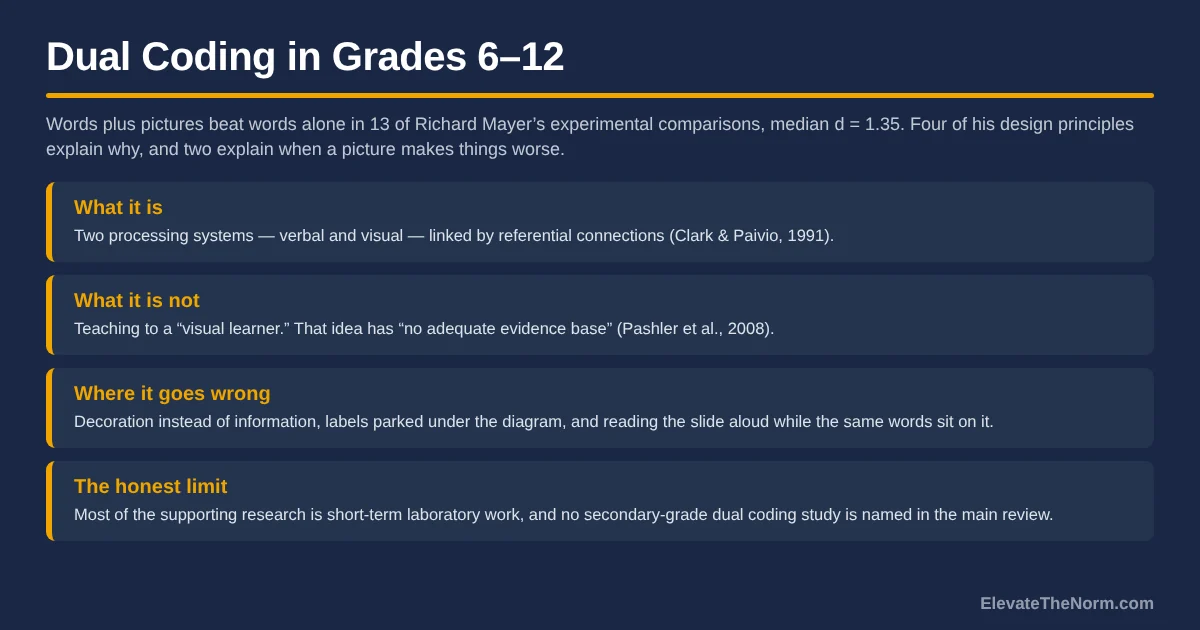
Dual coding means pairing words with a visual that carries information the words do not. Across 13 experimental comparisons, Richard Mayer found a median effect size of 1.35 for words plus graphics over words alone. Dual coding is not the same thing as teaching to a visual learner, and that distinction does most of the work.
Key Takeaways
- Dual coding is a claim about the material, not about the student. It says a well-matched picture and a set of words build two connected representations instead of one. It does not say some students learn through their eyes and others through their ears.
- The headline number is strong and the setting is narrow. Mayer reports 13 experimental comparisons with a median effect size of d = 1.35 for words plus graphics over words alone — and says in the same chapter that “most of the supporting research involves short-term laboratory studies.”
- The “visual learner” version of this idea was tested and failed. Pashler, McDaniel, Rohrer and Bjork found “virtually no evidence” for the pattern that matching instruction to a learning style would have to produce, and concluded there is “no adequate evidence base to justify incorporating learning-styles assessments.”
- Two of Mayer’s own principles tell you when a picture is a waste. Putting the same words on the screen and in your mouth produced a median effect of 0.10 in his redundancy tests, and adding a picture of the person talking produced 0.19. He treats anything under 0.40 as not educationally important.
- Nobody has run the grades 6–12 study. The main practitioner review of this research names no secondary-grade dual coding study, and its authors say the definition of dual coding itself still needs to be formalised.
What is dual coding?
Dual coding is the idea that we process words and images in two separate but connected systems, so material arriving as both leaves more to hold on to than words alone. It is a claim about the material, not about the student.
James Clark and Allan Paivio set out the educational version in 1991, describing a theory that “explains psychological phenomena by the collective action of nonverbal and verbal mental systems” specialised for imagery and for language.
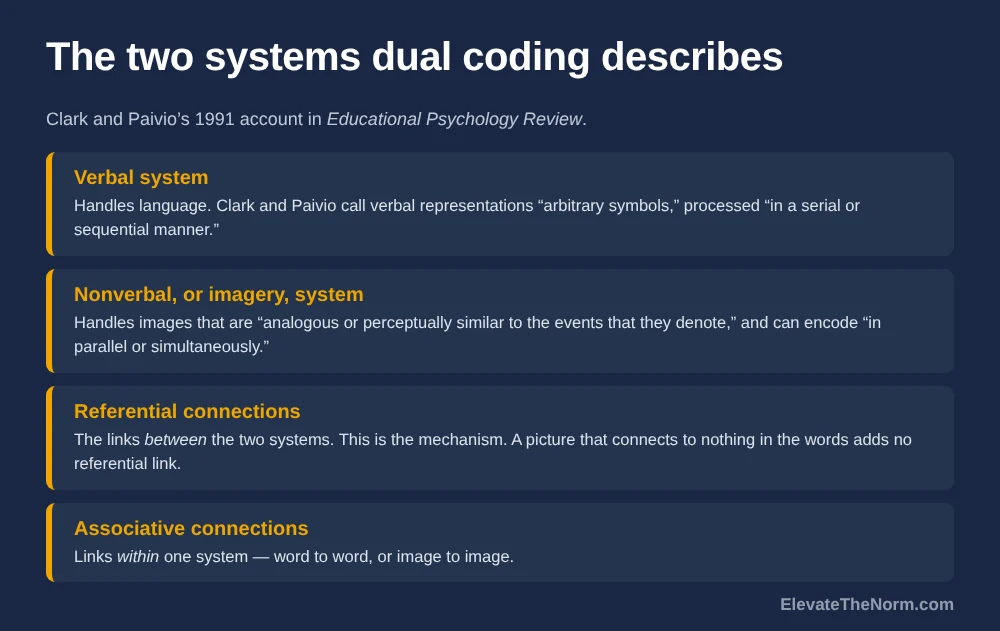
The detail that matters for teaching sits in the plumbing. Clark and Paivio describe verbal representations as “arbitrary symbols” processed “in a serial or sequential manner,” and images as “analogous or perceptually similar to the events that they denote,” able to encode “in parallel or simultaneously.” The two systems are joined by what they call referential connections. Those connections are the whole mechanism. A picture that does not connect to anything in the words is not dual coding. It is a picture.
That is a narrower claim than it usually gets reported as, and it sits next to rather than inside cognitive load theory. Cognitive load theory is mostly about not overloading working memory. Dual coding is about what you gain by adding a second, different kind of representation. They overlap, and the places they overlap are where most of the practical advice lives.
Does dual coding actually work?
Yes, under test conditions, and by a wide margin. In Mayer’s own words, across 13 experimental comparisons students “perform much better on a transfer test when they learn from words and graphics than from words alone,” with a median effect size of d = 1.35.
For scale, Mayer treats “any effect size greater than d = 0.40 to be educationally important,” following Hattie. So 1.35 is not a borderline finding. It is one of the largest numbers in instructional design research, and it is the number every training deck quotes.
Here is the part the training decks leave out. Mayer says in the same chapter that “most of the supporting research involves short-term laboratory studies.” The chapter does not state the age or background of the participants in those 13 comparisons at all. One school-based study he does name, a medical school lecture trial, found d = 0.76 on an immediate transfer test and 1.17 on a delayed one — which is encouraging, and is also medical students. Teachers of thirteen-year-olds are reading across a gap there, and ought to know it.
Is dual coding the same as learning styles?
No. Dual coding says a picture and words together beat words alone for everybody. Learning-styles theory says particular students learn better when instruction matches their preferred mode. Those are different claims, and only one survived testing.
Pashler, McDaniel, Rohrer and Bjork call the learning-styles claim the meshing hypothesis — that “instruction is best provided in a format that matches the preferences of the learner.” To test it, they say, students have to be grouped by learning style, randomly assigned to instructional methods, given the same final test, and then shown to produce a specific style-by-method interaction. Their verdict: “very few studies have even used an experimental methodology capable of testing the validity,” they “found virtually no evidence for the interaction pattern,” and “several found results that flatly contradict the popular meshing hypothesis.”
| Dual coding | Learning styles | |
|---|---|---|
| What the claim is about | The material in front of the class | The individual student |
| What it predicts | Words plus a relevant visual beat words alone, for everyone | Each student does better when teaching matches their preferred mode |
| What you would do on Monday | Add a diagram that carries information the words do not | Sort students by style and teach them differently |
| How it has been tested | Controlled comparisons of the same lesson with and without graphics | Needs a style-by-method interaction; almost nobody has run that design |
| Where it stands | Supported in Mayer’s comparisons, mostly in short-term lab studies | “No adequate evidence base,” and several results contradict it |
Yana Weinstein, Christopher Madan and Megan Sumeracki make the same separation in their review of six learning strategies, describing dual coding as resting on “additional, complementary forms of information” rather than on tailoring instruction to individual preferences. If you remember one sentence from this article, make it that one. Adding a diagram to a lesson is supported. Deciding that one student is a visual learner and another is an auditory one is not.
That distinction matters beyond accuracy, because the labelling version has a cost the diagram version does not. A student who has been told since fourth grade that they are a visual learner has been handed a reason to disengage from reading, and a teenager will use it. Telling a sixteen-year-old they cannot learn from text is not a kindness, and the research never said it. Plenty of families have been told this in good faith by people who believed it. The honest correction is that every student in the room benefits from a good diagram, and no student is excused from the words.
Which visuals help, and which ones do nothing?
Mayer’s research programme is useful here precisely because it does not stop at “use pictures.” It tests particular design decisions one at a time and reports how many tests each survived. The spread between the best and worst is enormous.
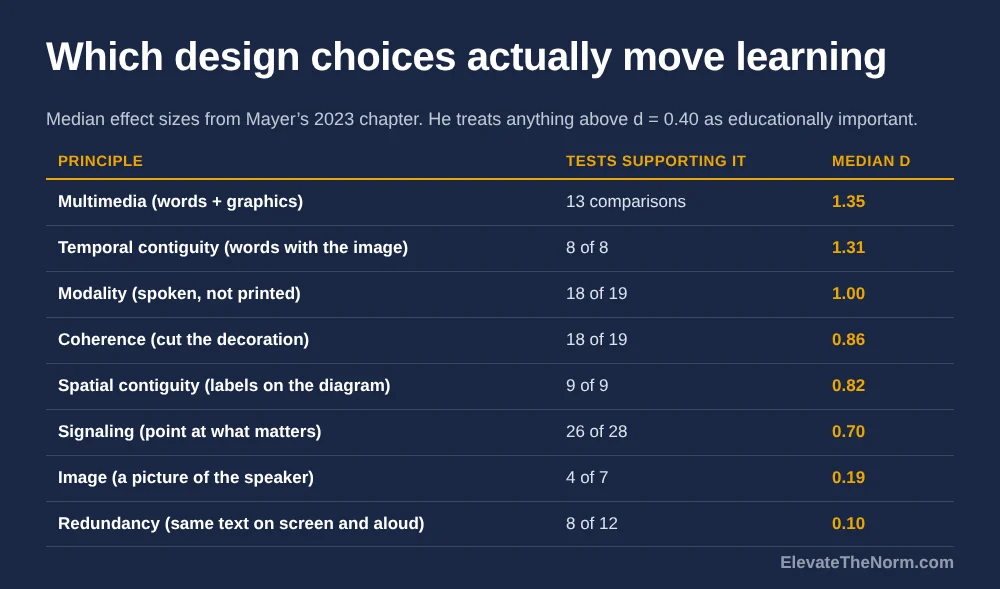
Temporal contiguity — saying the words while the image is on screen rather than before or after — held in 8 of 8 tests at a median of 1.31. Modality, narrating a diagram instead of captioning it in print, held in 18 of 19 at 1.00. Coherence, cutting the decorative image and the entertaining aside, held in 18 of 19 at 0.86. Spatial contiguity, labels on the diagram rather than in a key below it, held in 9 of 9 at 0.82. Signaling, pointing at the part that matters right now, held in 26 of 28 at 0.70.
Then the bottom of the table. Putting a picture of the speaker on the slide: 4 of 7 tests, median 0.19. Printing the narration on screen as well as saying it: 8 of 12 tests, median 0.10. Read those two again. The two things teachers most often do when they are told to dual code — add a picture, and put the words on the slide so students can follow — are the two with almost no effect. Mayer reports the redundancy result as 8 of 12 tests “yielding a median effect size of 0.10 favoring no onscreen text.” Favouring no text. The slide with your script on it is the thing to delete.
When does adding a picture make learning worse?
When the picture competes for attention instead of adding information. Three of Mayer’s principles describe that directly: coherence says cut material that is not needed, redundancy says do not duplicate your narration in print, and the image principle says a face on the slide buys almost nothing.
David Didau, writing about how the idea has travelled, puts the classroom version bluntly: “In classroom life, ‘dual coding’ has been simplified into ‘add pictures to your teaching’”, and of the icon sets that result, “None of these abstract symbols adds information.” He is describing a training culture, not a study, and he is right about the training culture. A magnifying glass beside the word analyse is not a second representation of anything.
Prior knowledge changes the arithmetic too. Mayer reports that several of these effects are strongest for low-knowledge learners, that signaling “may apply most strongly when the learner might otherwise be overwhelmed,” and that pre-training “may not apply to high prior knowledge learners.” He also notes the redundancy effect “can be diminished or even reversed when the lesson is slow-paced or under learner control” — so a handout a student reads at their own speed is not the same artefact as a slide you are narrating over. Same words, different job.


How do you dual code a grades 6–12 lesson?
Start with the material, not the strategy. The highest-value moves are small, free and easy to check, and none of them requires drawing ability.
- Pick the content that has parts or a sequence. A process, a structure, a comparison, a causal chain. Three branches of government, the stages of a bill, the chambers of the heart, the steps in a titration. Dual coding has nothing to offer a list of dates.
- Draw the relationship, not the object. A picture of a courthouse adds nothing to the word judiciary. A diagram showing which branch can stop which other branch adds the thing the sentence cannot show at a glance.
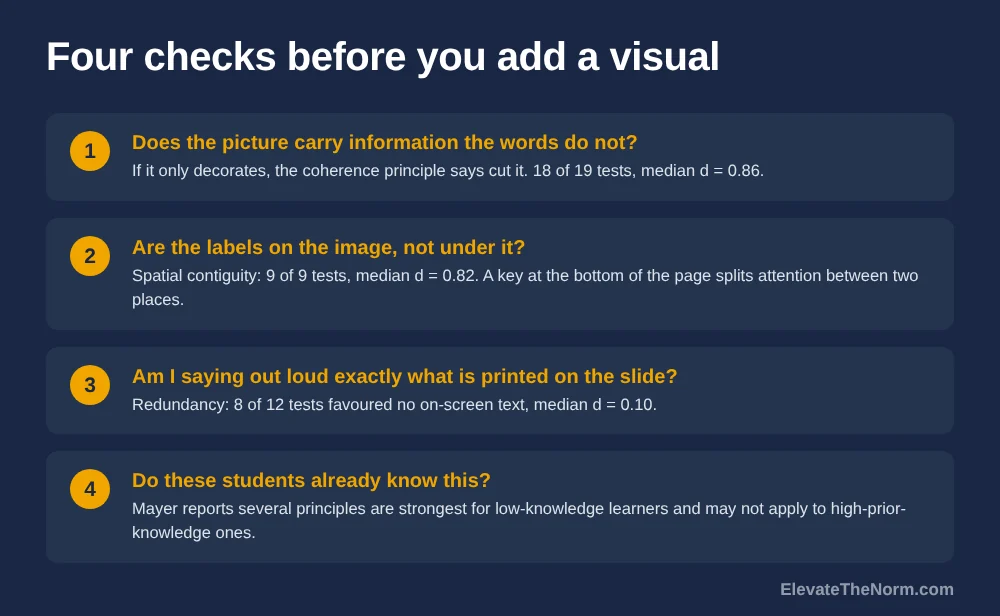
- Put the labels on the image. Spatial contiguity held in 9 of 9 tests at a median of 0.82, and this is the cheapest fix on the list. Project the diagram and write the labels onto it, or hand out a copy with the key already on the picture.
- Say something the slide does not say. If the text is on screen, narrate the reasoning instead of reading it. If you want students listening rather than reading, strip the slide to the image and a heading — and if students are supposed to be capturing it, say so, because note-taking while reading a slide aloud is the redundancy effect with extra steps.
- Point at what matters, when it matters. Signaling survived 26 of 28 tests. On a dense diagram, the difference between useful and overwhelming is often just a finger and a sentence.
- Take one thing out. Coherence held in 18 of 19 tests. Before you add a visual, find the decorative one already on the page and delete it.
- Ask who is in front of you. Students who already know the material do not need the scaffold, and for them the extra representation can be noise. This is the same judgement call that shows up in deciding when to remove a scaffold.
Should students make the visuals themselves?
Probably, for content with parts — but the evidence for student-generated visuals is thinner than the evidence for well-designed teacher-provided ones.
Weinstein and colleagues illustrate dual coding with students drawing two neurons and explaining how one communicates with the other across the synaptic gap, and say explicitly that students “could draw a similar visual representation themselves.”
That is a reasonable classroom recommendation from a careful review, and it is not the same as a measured effect in a secondary classroom. The practical test is the one in step two above: did the student draw a relationship, or did they draw a nice picture of the noun? A labelled diagram of how a feedback loop runs is dual coding. A coloured-in cell with the parts copied off the board is colouring in, and it eats a period. If you want students building their own representations of a concept, a structure like the Frayer model at least forces them to produce something with parts.
What the evidence does not say
It does not say every lesson needs a diagram, it does not say visuals reduce cognitive load, and it does not support any fixed percentage of improvement. It also does not reach as far into secondary classrooms as the confidence of the training decks implies.
- Clark and Paivio caveat their own theory. They write that effects of imagery on comprehension “are not universal,” that the qualifications “often involve interactions with individual differences,” and that “much additional research needs to be done.” That is 1991, and the people who built the theory said it.
- The practitioner review calls for the definition to be tightened. Weinstein, Madan and Sumeracki conclude that dual coding needs to be better formalised and that more research is needed on how it is actually implemented in classrooms.
- No secondary-grade dual coding study is named in that review. Its other strategies are supported by work with middle- and high-school students — the interleaving evidence includes a seventh-grade study on graph and slope problems. The dual coding section does not have that.
- Swapping words for pictures is not dual coding at all. Replacing text with an icon removes a representation rather than adding one, and that version of the practice has not been tested.
Clay’s take: the cheap half is the good half
The moves with the best numbers behind them are the ones that cost nothing and can be checked in ten seconds. Move the labels onto the diagram. Delete the decorative image. Stop reading the slide out loud.
None of that needs a training day, a template, or a drawing tablet, and the effect sizes behind those three decisions are better than most of what gets handed down as best practice.
The part I would be slowest to spend a period on is students drawing. Not because it cannot work — the review recommends it — but because the gap between a labelled diagram of a relationship and a nicely shaded picture of a noun is wide, it is invisible from the front of the room, and the second one takes longer. If you are going to spend the time, spend it on content with parts, and make the labels the graded thing.
And be careful what you call this. The moment “dual coding” becomes the reason a worksheet has clip art on it, the term has stopped meaning anything and the practice has stopped helping. It is not a box to tick on a lesson plan. It is a question about whether the picture is carrying its own weight.
What to do next week
Pick one lesson you already teach that has a diagram in it, and do three things to it. Move every label from the key onto the image itself. Delete the one picture that is there only to look nice.
Then write down what you are going to say while the diagram is up, and make sure none of it is already printed on the screen.
That is the entire intervention, it takes about fifteen minutes, and it is backed by three principles with 53 supporting experimental tests between them. Everything else in this article is a reason to be careful. Those three things are just better.
Frequently Asked Questions
What is dual coding in simple terms?
It is pairing words with a visual that carries information the words do not. The theory says verbal and visual information are handled by two separate but connected systems, so well-matched words and pictures together leave more to recall than words alone. The picture has to connect to the words to count. A decorative image is not dual coding.
Is dual coding the same as learning styles?
No. Dual coding says words plus a relevant picture beat words alone for all learners. Learning-styles theory says individual students learn better when teaching is matched to their preferred mode. Pashler and colleagues found virtually no evidence for the interaction pattern that claim requires, and concluded there is no adequate evidence base for learning-styles assessments.
How big is the effect of adding pictures to words?
Richard Mayer reports 13 experimental comparisons in which learners did better on transfer tests from words plus graphics than from words alone, with a median effect size of 1.35. He treats anything above 0.40 as educationally important. He also notes that most of the supporting research consists of short-term laboratory studies.
Does dual coding work in middle and high school?
The principles are plausible there, but the direct evidence is thin. The main practitioner review of learning strategies names no secondary-grade dual coding study, and Mayer’s chapter does not report the ages of participants in the multimedia comparisons. Treat the design principles as well supported in general and the grade-specific claim as untested.
When do visuals make learning worse?
When they duplicate or compete rather than add. Mayer’s redundancy tests favoured removing on-screen text that repeats the narration, with a median effect of 0.10. His coherence principle, supported in 18 of 19 tests at a median of 0.86, says cut material that is interesting but unnecessary. Students who already know the content gain least.
Should I put the words on the slide so students can follow along?
Not if you are narrating the same words. That is the redundancy effect, and 8 of 12 of Mayer’s tests favoured no on-screen text. The exception he names is a slow-paced lesson under the learner’s own control, such as a handout they read themselves. A slide you talk over is a different artefact from a page they read.
My child was told they are a visual learner. Is that wrong?
The label is not supported by the research, and it can do harm if a student concludes they cannot learn from reading. What is supported is that a clear, relevant diagram helps everyone, including your child. A teacher saying that is on solid ground. A teacher sorting a class into visual and auditory learners and teaching them differently is not.
Is asking students to draw a diagram a good use of class time?
It can be, for content with parts or steps, and the Weinstein review recommends students producing their own visual representations. The test is whether the drawing shows a relationship rather than an object. A labelled diagram of how a process runs is worth the time. Colouring in a picture copied from the board is not.
Sources
- Clark, J. M., & Paivio, A. Dual Coding Theory and Education. Educational Psychology Review, Vol. 3, No. 3 (1991). Full text (PDF). Source of the definition of dual coding theory, the description of verbal representations as arbitrary symbols processed serially and images as perceptually analogous and processed in parallel, the referential and associative connections, and the authors’ own cautions that such effects are not universal and that much additional research needs to be done.
- Mayer, R. E. Research-Based Principles for Designing Multimedia Instruction. In C. E. Overson, C. M. Hakala, L. L. Kordonowy & V. A. Benassi (Eds.), In Their Own Words: What Scholars and Teachers Want You to Know About Why and How to Apply the Science of Learning in Your Academic Setting, pp. 143–157. Division 2, American Psychological Association, 2023. Chapter (PDF). Source of every effect size and test count in this article, the d = 0.40 threshold following Hattie, the statement that most of the supporting research involves short-term laboratory studies, the Issa et al. medical school figures, and the boundary conditions on coherence, signaling, redundancy, pre-training and modality.
- Pashler, H., McDaniel, M., Rohrer, D., & Bjork, R. Learning Styles: Concepts and Evidence. Psychological Science in the Public Interest, Vol. 9, Issue 3, pp. 105–119 (2008). Repository record with abstract. Source of the meshing hypothesis definition, the experimental design the authors say is required, and the conclusions that very few studies have used a methodology capable of testing the claim, that virtually no evidence was found for the interaction pattern, and that there is no adequate evidence base to justify incorporating learning-styles assessments.
- Weinstein, Y., Madan, C. R., & Sumeracki, M. A. Teaching the science of learning. Cognitive Research: Principles and Implications, 3:2 (2018). doi:10.1186/s41235-017-0087-y. Full text. Source of dual coding as one of six strategies described as combining words with visuals, the neuron-drawing classroom example and the statement that students could draw a similar visual representation themselves, the separation of dual coding from learning styles, the seventh-grade interleaving study, and the conclusion that the definition of dual coding needs to be better formalised.
- Didau, D. The Dual Coding Delusion. The Learning Spy, 2025. Article. Source of the observations that dual coding has been simplified in schools into adding pictures to teaching and that abstract decorative symbols add no information. This is a practitioner commentary rather than a study, and the systematic review it refers to sits behind a paywall and was not read for this article.