By Clay Shumate
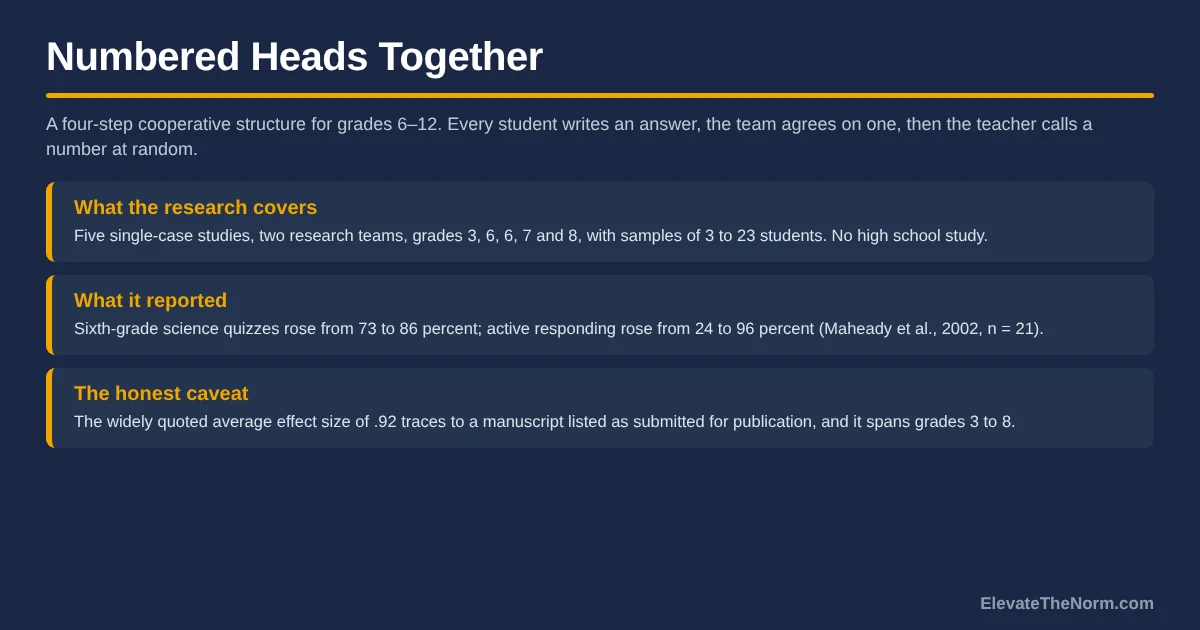
Numbered heads together is a cooperative structure where students in numbered teams of four each write an answer, agree on a team answer, then wait for the teacher to call one number at random. Reported quiz gains run from 9 to 46 percentage points — across five small single-case studies, none of them in high school.
Key Takeaways
- The random call is the whole point. Nobody knows who will answer until after the team has agreed, so there is no way to volunteer out of it and no way to sit back and let the strongest student carry it.
- The evidence is real, consistent and very small. Five single-case studies covering grades 3, 6, 6, 7 and 8, with samples of 3 to 23 students. Every one found gains. None was a randomised trial and none was in high school.
- It was produced almost entirely by two research teams. The authors of the 2015 review say so plainly: “To date, empirical evidence has been collected primarily by two research teams” — and several of those authors wrote the studies the review summarises.
- The effect size everyone quotes has a weak chain of custody. The figure of .92 comes from Kagan’s own magazine, averages seven comparisons across grades 3 to 8, and is cited in the research literature to a manuscript listed as submitted for publication.
- The cooperative-learning research it leans on is about something slightly different. Slavin’s syntheses found that group goals plus individual accountability are what make group work raise achievement — but his individual accountability means a team reward based on each member’s own quiz score, which is not what a random call does.
What is numbered heads together?
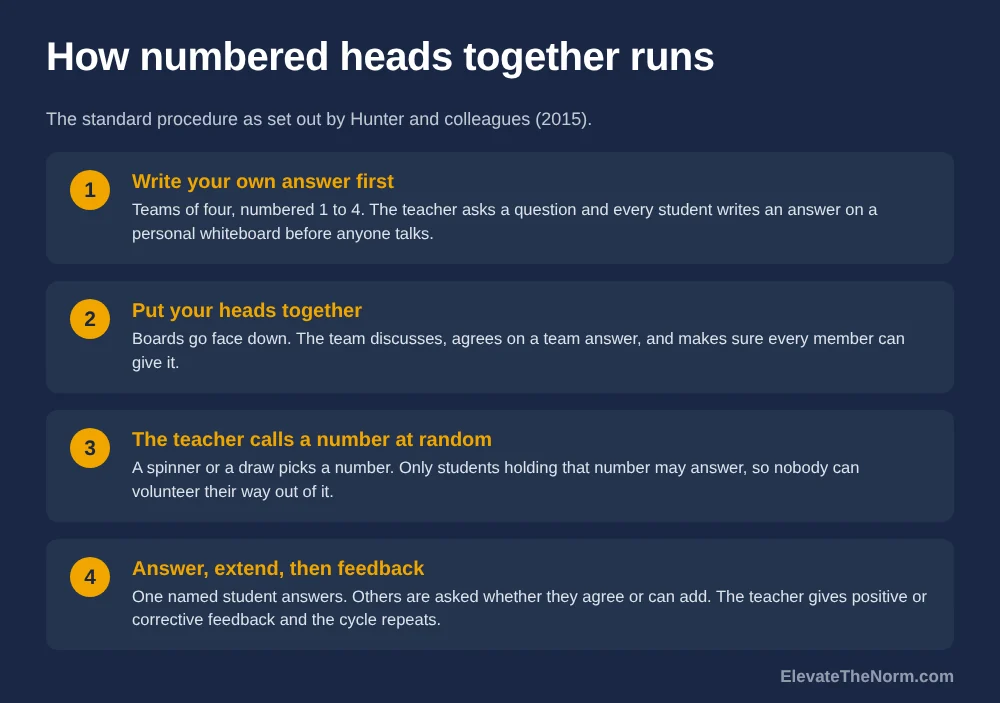
Numbered heads together is a cooperative learning structure in which small mixed teams of four are numbered off, answer a question individually in writing, agree on one team answer, then find out which number the teacher has drawn at random to give it.
It is a questioning routine with a built-in reason for every student to be ready.
It belongs to the same family as the other structures on this site — think pair share, the jigsaw method, and peer tutoring — all of which sit under cooperative learning as the umbrella. What distinguishes this one is the delay. Students commit to an answer, then help each other, then discover who is accountable for saying it out loud. The order matters, and most classroom versions get it wrong.
How do you run numbered heads together, step by step?
The procedure set out by Hunter and colleagues runs in a repeating cycle of four moves. A full round on one question takes two or three minutes once students know the routine.
- Form small heterogeneous teams and number off. The review specifies teams “preferably with four members,” numbered 1 to 4. Heterogeneous means you build them, not the students.
- Give every student something to write on. The studies used a personal dry-erase board, a marker and a cloth. Paper works; the point is that each student produces an answer with their own hand.
- Ask the question, then make everyone answer it alone. Students write their own answer and turn the board face up in front of them before any discussion happens.
- Heads together. Boards go face down. The team discusses, settles on a team answer, and — this is the step that gets cut — makes sure every member can give it.
- Draw a number. A spinner, a deck of cards, a dice. Students holding that number stand or raise a hand, and the teacher picks one of them.
- Answer, then extend. The named student answers. The teacher then asks others whether they agree or have something to add, which keeps the rest of the room in the question.
- Feedback, recognition, reset. Positive or corrective feedback, recognition for the team’s effort, boards wiped, next question.
The review publishes a 15-item observer checklist for watching the routine run over at least twenty minutes, which is a useful signal in itself: these are not loose suggestions, they are the conditions the studies tested.
Does numbered heads together actually work?
In every published study, yes — and the published studies are five in number, all small, all single-case designs, and all below grade 9. Quiz scores rose in all five and on-task behaviour rose in the four that measured it.
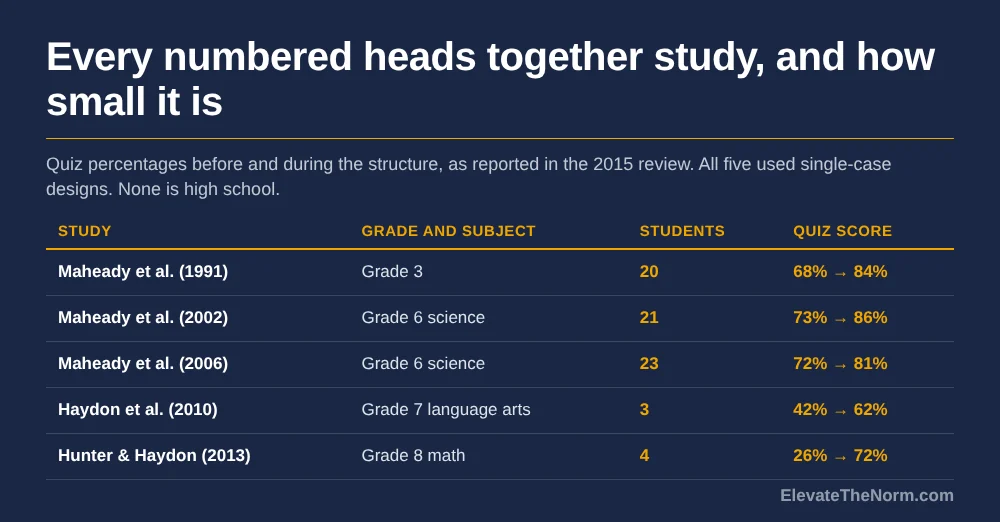
| Study | Grade and subject | Students | Quiz score | On-task behaviour |
|---|---|---|---|---|
| Maheady et al. (1991) | Grade 3 social studies | 20 | 68% → 84% | 39% → 71% |
| Maheady et al. (2002) | Grade 6 science | 21 | 73% → 86% | Active responding 24% → 96% |
| Maheady et al. (2006) | Grade 6 science | 23 | 72% → 81%, and 89% with incentives | Not reported in the review’s table |
| Haydon et al. (2010) | Grade 7 language arts | 3 | 42% → 62% | 63% → 96% |
| Hunter & Haydon (2013) | Grade 8 mathematics | 4 | 26% → 72% | 48% → 86% |
The sixth-grade science results are the ones closest to a general secondary classroom. In the 2002 study, 21 students went from a 73 percent average under whole-group question and answer to 86 percent under the structure, and the proportion of students actively responding went from 24 percent to 96 percent. That second number is the more interesting one. It is not a claim about learning; it is a measurement of how many students in the room were doing anything at all.
The two studies with the largest gains have the smallest samples. Haydon, Maheady and Hunter (2010), published in the Journal of Behavioral Education, ran with three students with disabilities in seventh-grade language arts. Hunter and Haydon (2013) ran with four students in a self-contained class for students with emotional and behavioural disorders. Those are real findings about real students and they are not estimates of what will happen in a class of 28.
Why is the evidence base thinner than it looks?
Because five single-case studies from two research teams, with no high school data and no randomised trial, is a thin base to carry a strategy that appears in every cooperative learning handbook. The authors of the review say this themselves.
Their stated limitations are worth quoting in order. They write that “there is need for additional replications across geographic locations, age/grade levels” and settings; that “to date, empirical evidence has been collected primarily by two research teams”; and that longer durations and measures of generalisation and maintenance are needed. The review also lists Maheady and Hunter among its own authors, which does not make the findings wrong but does mean the field has not yet been checked by anyone outside it.
Two of the five studies used the same sixth-grade science teacher in the same small urban district, a teacher with 27 to 28 years of experience. That is a strong implementation under the best possible conditions. It is not evidence about a second-year teacher with five preps.
Then there is the number everyone repeats. Kagan’s own article reports “the average positive effect size for Kagan Structures was .92” and says the experiments examined grades 3 through 8. The 2015 review cites the same .92 figure and attributes it to a source its reference list describes as a manuscript submitted for publication. So the most quoted figure in this literature comes from a vendor’s magazine, averages seven comparisons drawn from four papers, spans elementary through middle school, and traces to something unpublished. It may well be about right. It is not a number to put in a slide deck without saying where it came from.
Do you need an incentive or reward package?
No. The review says the structure worked “with and without” behavioural incentives, and reports no clear difference between the two versions in the 2010 study. Incentives may add something, but the evidence does not make them a requirement.
The one study that compared them directly, Maheady et al. (2006) with 23 sixth graders in science, reported quiz averages of 72 percent under existing practice, 81 percent under the plain structure, and 89 percent with a package of team points and certificates added. That looks like a real additional bump. The review’s own verdict is more cautious: future work should “tease out the relative contributions and costs and benefits of a behavioral incentive package.” If you are weighing it up, the costs side of that sentence is the part worth sitting with — points and certificates are a system you then have to maintain, and they change what the activity is about.
How is it different from cold calling or think pair share?
All three distribute participation; they differ in when the student finds out they are on the hook. Cold calling puts a student on the spot before they have rehearsed. Think pair share gives rehearsal without accountability. Numbered heads together gives rehearsal first, then accountability.
| Routine | When the student knows they might answer | What they have before they speak | Main weakness |
|---|---|---|---|
| Cold calling | The moment their name is said | Whatever they had in their head already | Can feel like a trap if the class culture is not right |
| Think pair share | Usually never — sharing is often volunteered | A rehearsed answer and a partner’s view | The same students volunteer; the rest coast |
| Numbered heads together | After the team has agreed, never before | Their own written answer plus the team’s | Takes longer per question and needs built teams |
| Jigsaw | They always present; the role is assigned up front | Expertise on one piece only | Depends on every expert group doing its job |
Put plainly: numbered heads together is what you use when you want the honest answer to “does this class understand it?” rather than “does anyone in this class understand it?” That is a different question from the one a show of hands answers, and it is the same question behind every decent check for understanding.
What does cooperative-learning research say about why it should work?
The standard justification is Robert Slavin’s: group work raises achievement when it combines a group goal with individual accountability, and mostly does not when it lacks either.
His 1991 synthesis of more than 70 studies is blunt about it — “two elements must be present if cooperative learning is to be effective: group goals and individual accountability.”
The numbers behind that sentence are stark. Slavin reports that 37 of 44 studies (84 percent) using both elements found significant positive achievement effects, against only 4 of 23 studies (17 percent) lacking them. His wider review of 99 studies of at least four weeks puts the median effect size at +.32 for methods with group rewards based on the sum of individual learning, against +.07 for methods using a single group product or no group reward at all.
Here is where honesty costs the argument something. Slavin’s “individual accountability” is specific: a team reward calculated from each member’s own quiz score. He writes that the effect holds “if and only if the group rewards are based on the individual learning of all group members.” Numbered heads together does not do that. One student’s answer, drawn at random, stands in for the team. Slavin does mention structures in which “group members might be chosen at random to represent the group” — but in his version that student’s performance determines the reward, which is a harder and rarer arrangement than a teacher drawing a number to pick who speaks.
So the Slavin research is supporting evidence by analogy, not direct support. He does also write that “carefully structuring the interactions among students in cooperative groups can also be effective, even in the absence of group rewards,” which is the closest thing in his work to a defence of structures like this one. Anyone who cites Slavin as proof that numbered heads together works has not read him carefully.


Where does numbered heads together go wrong in grades 6–12?
Four places, and three of them are the teacher quietly dropping a step. The structure is doing a specific job, and each shortcut removes the part that does it.
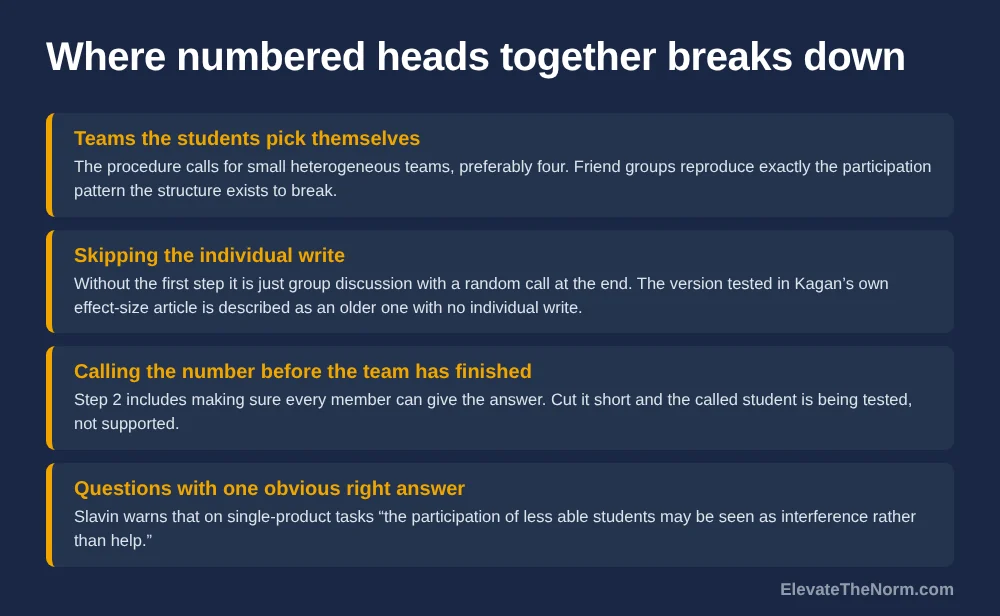
- Students pick their own teams. The procedure calls for small heterogeneous teams you build. Friend groups reproduce exactly the participation pattern the structure exists to break, and they put the quiet student with the other quiet students.
- The individual write gets skipped. Without it the routine is group discussion with a random call bolted on, and the student who was not thinking has nothing of their own to fall back on. Notably, the version tested in Kagan’s own effect-size article is described there as an older one without an individual write.
- The number is drawn before the team has finished. Step four includes making sure every member can give the answer. Cut that short and the called student is being tested rather than supported, which is the thing this structure was designed not to do.
- The questions have one obvious right answer. Slavin warns that on single-product tasks “the participation of less able students may be seen as interference rather than help.” If the answer is a date or a definition, the fastest student says it and the team nods. Questions with reasoning in them are the ones worth the three minutes.
- It becomes the whole lesson. The studies ran it in sessions of 30 to 42 minutes as the questioning portion of a lesson, not as a replacement for teaching. There is nothing in this research that says a period of whiteboard rounds is a good period.
What about the student who freezes when the number comes up?
Plan for them before you start, not in the moment. The structure is built so nobody is caught unprepared, but preparation is not the same thing as being willing to speak in front of 28 people.
The sensible accommodations do not break anything. A student can read their board rather than speak from memory. A student can be allowed to hold up the team’s board instead of narrating the answer. The teacher can pick a different student from among those holding the drawn number, which the standard procedure already allows — everyone with that number raises a hand and the teacher chooses one of them. And where a student has a plan in place for oral participation, that plan governs; a classroom routine is not a reason to override it. None of that removes the accountability, because the student still had to have an answer ready.
What does break the structure is quietly never drawing the number of the student you are worried about. Students work that out in about two rounds, and the moment they do, the routine has told them they are not expected to be able to answer. That is a much heavier message than being asked a question.
Clay’s take: a good structure with an overstated research record
Two things are true at once here, and the training materials only ever tell you the first one. The structure itself is well designed, and it solves a problem every secondary teacher actually has: a show of hands tells you nothing.
It solves it without ambushing anybody, too. Writing your own answer, then helping your team, then finding out you are the one who has to say it — that sequence respects students. It gives them a fair shot before it holds them responsible, which is the right order.
The second thing is that the evidence behind it is five small studies from two research teams, topping out at eighth grade, with a headline effect size traced to an unpublished manuscript. That is not a reason to avoid it. Plenty of sensible classroom practice has less behind it than that. It is a reason to stop calling it research-proven, and it is a reason to watch what happens in your own room rather than assuming the 86 percent transfers.
What I would want to know before committing a unit to it: do the questions actually need four people, or am I running an elaborate routine to get a one-word answer? That is the question that decides whether this is good teaching or theatre, and no study is going to answer it for you.
What to do next week
Pick one lesson with three or four questions in it that genuinely need reasoning, not recall. Build the teams yourself, four to a team, mixed. Run the full four steps on those questions only, and draw the number with something visibly random.
Keep the individual write and the check that everyone on the team can give the answer. Those are the two steps that get dropped first and they are the two doing the work.
Then measure the thing the studies measured that is easiest to see: how many students in the room were doing something during the question. If the honest answer is a lot more than usual, it is worth keeping. If students are waiting for the number and then switching off, one of the four steps has gone missing, and it is almost always the write.
Frequently Asked Questions
What is numbered heads together?
It is a cooperative learning structure in which students sit in numbered teams of about four, answer a question individually in writing, agree on a team answer, make sure every member can give it, and then wait for the teacher to draw a number at random to decide who answers. The random call is what makes every student prepare.
How long does one round take?
Two to three minutes per question once students know the routine. The published studies ran it in sessions of 30 to 42 minutes as the questioning part of a lesson, covering several questions, rather than as a whole-period activity. Budget more for the first few rounds while students learn the sequence.
Does numbered heads together work in high school?
Nobody has published a high school study. The five studies in the 2015 review cover grades 3, 6, 6, 7 and 8, with samples of 3 to 23 students. The sixth-grade science results are the closest thing to a general secondary classroom. Treat high school use as reasonable and untested rather than evidence-based.
Do you need team points or rewards for it to work?
No. The review reports the structure worked with and without behavioural incentives and found no clear difference between the two versions in one study. One sixth-grade study did report 81 percent under the plain structure against 89 percent with team points and certificates added, so incentives may help, but they are not a requirement.
How is it different from think pair share?
Think pair share gives students rehearsal but usually lets them volunteer, so the same students answer. Numbered heads together gives the same rehearsal and then removes the choice by drawing a number. The accountability arrives after the preparation, not instead of it.
Is there strong research evidence for numbered heads together?
There is consistent evidence and very little of it. Five single-case studies, all finding gains, produced primarily by two research teams, none in high school and none randomised. The widely quoted .92 average effect size comes from the publisher’s own magazine and is traced in the literature to a manuscript submitted for publication.
What do you do about a student who will not speak in front of the class?
Decide in advance, not mid-round. Let them read from their board, hold up the team’s answer, or be one of several students holding the drawn number from whom the teacher picks. Where a student has a plan covering oral participation, follow it. What does not work is silently never drawing their number, because students notice and read it as low expectations.
What kind of questions suit it best?
Questions with reasoning in them, where four students have something to work out together. Recall questions waste the structure, because the fastest student supplies the answer and the team simply agrees. Slavin notes that on single-answer tasks weaker students’ contributions can be treated as interference rather than help.
Sources
- Hunter, W. C., Maheady, L., Jasper, A. D., Williamson, R. L., Murley, R. C., & Stratton, E. Numbered Heads Together as a Tier 1 Instructional Strategy in Multitiered Systems of Support. Education and Treatment of Children, 38(3), 345–362 (2015). Full text (PDF). Source of the step-by-step procedure, the 15-item fidelity checklist, every study in the comparison table with its grade level and sample size, the statement that evidence has been collected primarily by two research teams, the call for replications across age and grade levels, and the note that the relative contribution of a behavioural incentive package is still to be determined.
- Haydon, T., Maheady, L., & Hunter, W. Effects of Numbered Heads Together on the Daily Quiz Scores and On-Task Behavior of Students with Disabilities. Journal of Behavioral Education, 19(3), 222–238 (2010). doi:10.1007/s10864-010-9108-3. ERIC record with abstract. Source of the three-student seventh-grade language arts study and the finding that both versions of the structure raised on-task behaviour and daily quiz scores. The numerical results quoted here are as reported in the 2015 review; the ERIC record itself carries no figures.
- Slavin, R. E. Synthesis of Research on Cooperative Learning. Educational Leadership, February 1991. Article (PDF). Source of the statement that two elements must be present — group goals and individual accountability — the counts of 37 of 44 and 4 of 23 studies, the finding that effects appear at all grade levels 2–12 while research has more often taken place in grades 3–9 than 10–12, and the warning about single-product tasks.
- Slavin, R. E. Research on Cooperative Learning and Achievement: What We Know, What We Need to Know. Center for Research on the Education of Students Placed at Risk, Johns Hopkins University. Working-paper version (PDF). Source of the median effect sizes of +.32 and +.07, the review of 99 studies of at least four weeks, the “if and only if” condition on group rewards, and the statement that structuring interactions can be effective even without group rewards. Note that the copy read for this article is a Johns Hopkins working-paper version dated October 1995 and adapted from Slavin (1992); the figures also appear in the published 1996 review, which was not accessible.
- Kagan, S. Effect Size Reveals the Impact of Kagan Structures and Cooperative Learning. Kagan Online Magazine, Winter 2014. Article. Source of the .92 average effect size for Kagan Structures, the statement that the experiments examined grades 3 through 8, and the description of the tested version as an older one without an individual write. This is the publisher’s own site and it sells the training and materials described, which is why the figure is reported here with its provenance attached.