By Clay Shumate
A desirable difficulty is a change to how students practice — spacing it out, mixing it up, recalling instead of rereading — that makes performance worse now and retention better later. Robert Bjork’s condition is strict. If the learner cannot respond to the difficulty successfully, it is not desirable. It is just an obstacle.
Key Takeaways
- The definition turns on the student, not on the task. Bjork and Bjork write that “if the learner does not have the background knowledge or skills to respond to them successfully, they become undesirable difficulties.” Hardness is not the criterion. Surmountable hardness is.
- There is no effect size for desirable difficulty, and there never was. No meta-analysis of the construct exists. The Bjorks’ own 2020 stock-taking article reports no effect sizes at all. Individual techniques have numbers; the umbrella does not.
- The best secondary evidence is good. A cluster-randomized trial in 7th-grade math — 54 classes, 787 students analyzed — found 61 percent against 38 percent on an unannounced test, d = 0.83, and it worked for all fifteen teachers.
- The best counter-evidence is just as good. A spaced-revision program delivered as intended to about 12,000 Year 11 students in 125 schools returned an effect size of −0.01 and zero months’ progress.
- Students will prefer the method that works less well, and so will you. In one study 78 percent of participants learned better from spaced practice and 78 percent said massed practice was as good or better. Effort gets read as failure.
What is a desirable difficulty?
A desirable difficulty is a condition of practice that slows learning down while it is happening and improves what the student can still do weeks later. Spacing, mixing problem types, recalling from memory and varying the format all qualify. Being confused by the textbook does not.
Robert Bjork coined the phrase in a 1994 chapter, and it is worth knowing that the chapter never defines it. He mentions “the types of desirable difficulties summarized in the preceding section” in passing. The criterion in that chapter is about outcomes, not hardness: manipulations that impede performance during training often improve performance later, and manipulations that speed up training often fail to support it.
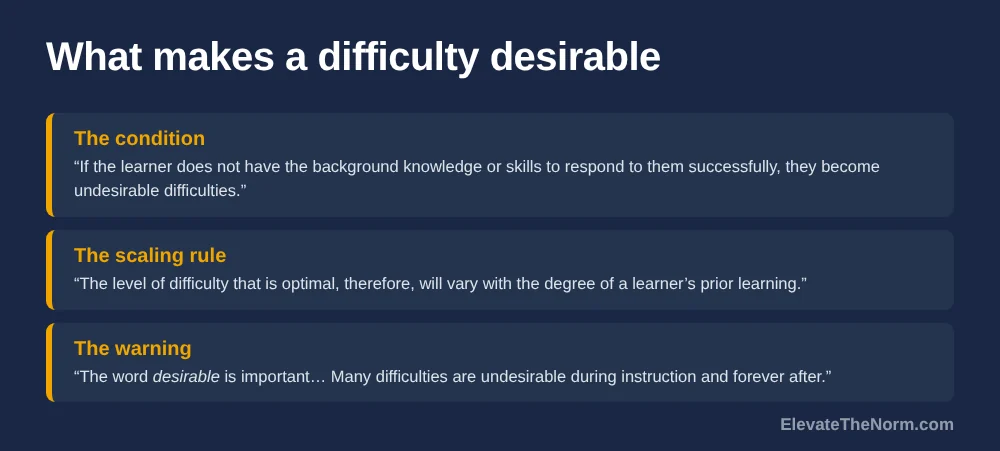
The definition everyone should be quoting is the 2011 one. Difficulties are desirable because “they trigger encoding and retrieval processes that support learning, comprehension, and remembering” — followed immediately by the sentence that does all the work: “If, however, the learner does not have the background knowledge or skills to respond to them successfully, they become undesirable difficulties.”
By 2020 the Bjorks were sharper about it, because the idea had been simplified into “make it harder” in a thousand training decks. In their stock-taking article they write that “the word desirable is important” and that “many difficulties are undesirable during instruction and forever after.” They also state the scaling rule: “The level of difficulty that is optimal, therefore, will vary with the degree of a learner’s prior learning.”
That scaling rule is why the same mixed problem set can be a desirable difficulty for one row of your class and a waste of a period for another. It is also why “differentiate the difficulty” is the mechanism here rather than a concession.
Which difficulties count as desirable?
Six show up repeatedly in the Bjorks’ own writing: spacing, interleaving, retrieval practice, generating before being shown, varying the conditions of practice, and reducing feedback. Each has its own evidence, and each has a documented way of backfiring.
| Difficulty | What it looks like in grades 6–12 | Evidence, with its population | When it backfires |
|---|---|---|---|
| Spacing | The same content revisited across weeks rather than finished in one block | In 1,354 adults learning trivia facts, the best gap was about 43 percent of a one-week retention interval, falling to 8 percent for a one-year one | A six-lesson spaced revision program in 125 schools returned −0.01 for Year 11 students |
| Interleaving | Mixed problem sets where no two consecutive problems use the same strategy | 7th-grade math, 787 students, cluster-randomized: 61% against 38%, d = 0.83 | For learning words, blocking wins (g = −0.39); for expository texts the effect is null |
| Retrieval practice | Low-stakes closed-book quizzing with feedback, including on last month’s unit | 50 classroom experiments, 5,374 students; 46 of 49 effects positive, and largest in middle school | Three of those effects were negative, and no-feedback studies produced mostly very small ones |
| Generating | Students attempt the explanation or the formula before the model goes up | Called an effect that “rivals the spacing effect” in generality — with no figures given for it | With novices, worked examples beat generation for geometry problem solving |
| Varying practice | The same skill in different formats, question framings and contexts | 8- and 12-year-olds throwing at a target did better after varied-distance practice than fixed | High variability helped alongside worked examples but not alongside ordinary problem solving |
| Reducing feedback | Summary feedback after a set of attempts rather than after every one | Simple motor skills only: summary and faded feedback hurt acquisition and helped retention | No school-subject evidence I could find, and it collides with the feedback finding above |
Read the last row carefully before you act on it. Everything verifiable about reducing feedback is laboratory work on simple motor skills with no sample sizes reported. It is on the canonical list because of where the idea came from, not because anyone has shown it works in a classroom.
What is the effect size of desirable difficulty?
There isn’t one. No meta-analysis of desirable difficulty as a construct exists, and the Bjorks’ own 2020 article about the concept reports no effect sizes or sample sizes anywhere in it. Any slide quoting “the effect size of desirable difficulties” has invented the number.
What exists are numbers for the individual techniques, and they do not aggregate into a single claim. Interleaving has a meta-analysis. Retrieval practice has a systematic review of classroom studies. Spacing has decades of laboratory work and one large school trial that found nothing. Averaging those together would hide exactly the disagreements a teacher needs to see.
One number does deserve a specific warning, because it is the one that travels. The famous “63 percent versus 20 percent” for mixed practice comes from Rohrer and Taylor’s second experiment in 2007 — 18 university undergraduates, volume-of-solids problems, one-week delay, standard errors of 12 and 9 percentage points. It gets quoted as though it were a school result. If you want a classroom number for mixing problems, the 7th-grade trial below is the real one.
Does desirable difficulty work in a real classroom?
Sometimes, by a lot, and sometimes not at all. Three studies run on school students, in schools, at real delays, give the honest range — and the range is wide enough that anyone telling you this is settled has read one of them.
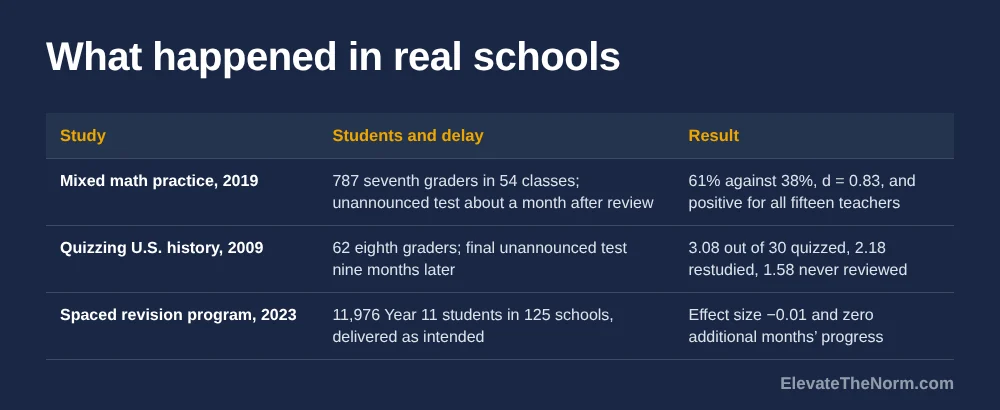
The strongest result is Rohrer, Dedrick, Hartwig and Cheung’s 2019 trial. One Florida district, 54 classes, 15 teachers, 787 students analyzed, classes randomized within each teacher. Students got eight practice worksheets over about 103 days, either mixed or blocked, then an unannounced test roughly a month after a shared review. Mixed practice scored 61 percent against 38 percent, d = 0.83, and the effect was positive for every one of the fifteen teachers. The teachers were given no training. That is as close to a clean classroom win as this literature gets, and it is why mixing problem types is the one technique here I would act on without hedging. Two costs are in the same paper, though: most teachers said students found the mixed sets slightly harder and more time-consuming, and somebody has to build the worksheets.
The sobering one is Carpenter, Pashler and Cepeda’s 8th-grade study. Sixty-two students, U.S. history questions, a final unannounced test nine months later. Questions that had been quizzed with feedback scored 3.08 points out of 30. Restudied questions scored 2.18. Never-reviewed questions scored 1.58. The differences are real, d = .32 and .51, and the authors note floor effects. The technique works. It also means that after nine months, the best condition recovered about a tenth of the material.
Then the null. The Education Endowment Foundation funded SMART Spaces, a manualized spaced-learning revision program for GCSE chemistry: six lessons, each split into three content segments with short activities in between. It was a school-level randomized trial across 125 schools, 14,098 Year 11 students randomized and 11,976 analyzed, at the funder’s highest security rating. The effect size was −0.01, credible interval −0.17 to 0.12, zero additional months’ progress. Implementation was reported as delivered to plan, and 70 percent of teachers said they would happily run it again.
That last sentence is the important one. You cannot wave that result away as bad implementation. A principle can be true in a laboratory and produce nothing when it is packaged into six lessons and shipped to a hundred schools.
When does a difficulty become undesirable?
When the student cannot overcome it. That is the whole test, and it has three recognizable shapes: the student lacks the prior knowledge to respond, the task overloads working memory rather than taxing thinking, or the student already knows the material well enough that the support reverses on them.
The first shape is Bjork’s own condition, quoted above. A retrieval quiz on material a student never encoded is not a desirable difficulty; it is a measurement of absence. Soderstrom and Bjork say it directly: retrieval practice stops being desirable when the earlier material cannot be retrieved at all.
The second shape comes from cognitive load research, and the line worth memorizing is from Chen, Castro-Alonso, Paas and Sweller: “Element interactivity refers to working memory load, not difficulty.” When a task already requires holding more pieces at once than a student can hold, they argue, adding difficulty “may be undesirable rather than desirable.” Their evidence is a pattern rather than a number: testing and generation effects show up with simple material and vanish or reverse with material where everything connects to everything else. A reverse testing effect has been documented, and a one-week delay has produced no testing effect at all. This is the seam with cognitive load theory, and it is the honest version of it.
Fair warning on the vocabulary, though. Ton de Jong’s critique argues that cognitive load theory “is constructed in such a way that it is hard or even impossible to falsify,” that attributing extra load to useful processing is “a post-hoc explanation,” and that the distinction between the kinds of load is “very much a matter of degree, and possibly non-existent.” Use the gate as a heuristic. Do not report it as a measurement.
The third shape is the expertise reversal effect, named by Kalyuga, Ayres, Chandler and Sweller. The same support that rescues a novice drags on someone who already knows the material. In one of the studies they review, added explanatory text helped low-knowledge high school biology readers while high-knowledge readers did best with the original, minimally helpful version. Worked examples beat problem solving for apprentices with little experience and lost to it once they had more.
One honest complication, because the prior-knowledge rule is less settled than it sounds. Buchin and Mulligan manipulated prior knowledge directly and reported that testing effects were nearly identical for high and low prior knowledge, concluding prior knowledge is not a critical boundary condition for retrieval practice specifically. I could only read that paper’s abstract. The principle holds firmly for generation and for worked examples; for quizzing, it is contested.
How do you tell a desirable difficulty from a pointless one?
Run it through seven gates before you change anything. Each one comes straight out of a study rather than out of a workshop, and a difficulty that fails any of them is costing your students time they do not have.
- Can this student respond to it successfully? Not perfectly — successfully, eventually, with effort. If the quiz comes back blank, you have measured an absence rather than created a difficulty.
- Is the difficulty in the thinking, or in the number of things being juggled? It should sit in recalling, choosing and connecting. If a student is holding six unfamiliar parts at once just to begin, you have added load, not difficulty.
- Has the student had any straightforward practice on this skill first? The 7th-grade trial’s authors say their own result might not hold without some initial blocked practice. The successful version was not pure mixing from day one.
- Is there corrective feedback? In the classroom review of retrieval practice, no-feedback studies produced mostly very small effects, and the 7th-grade students were shown solutions and asked to correct their own errors. A difficulty without a correction loop just rehearses a wrong answer.
- Is this the kind of material the effect holds for? The interleaving meta-analysis found blocking better for learning words and no effect for expository texts, and its authors say plainly that they are reluctant to recommend mixing for vocabulary, grammar rules or foreign languages.
- Is the practice itself ungraded? A student has no way to verify a payoff that arrives in February. Asking them to take that on faith while their grade moves is not a fair trade. Put the difficulty in practice work and keep the grade on the delayed measure.
- Are you judging it on a delayed measure? Performance during practice is a poor index of learning, and the gap should match the horizon you care about — roughly a fifth to two-fifths of the interval for a one-week target, falling to a tenth or less for a one-year one. Erring long costs less than erring short.
Gate six is the one that separates this from deciding how much support to withdraw. Scaffolding is judged on whether the student can do it now. A desirable difficulty is judged on what they can still do in a month, which means you will not know whether you were right during the lesson where it felt wrong.


Why do students hate the thing that works?
Because effort feels like failure. Students read mental strain as a signal that learning is not happening, and they are reading it backwards. The mismatch has been measured several times and it is large, consistent, and it catches teachers as reliably as it catches teenagers.
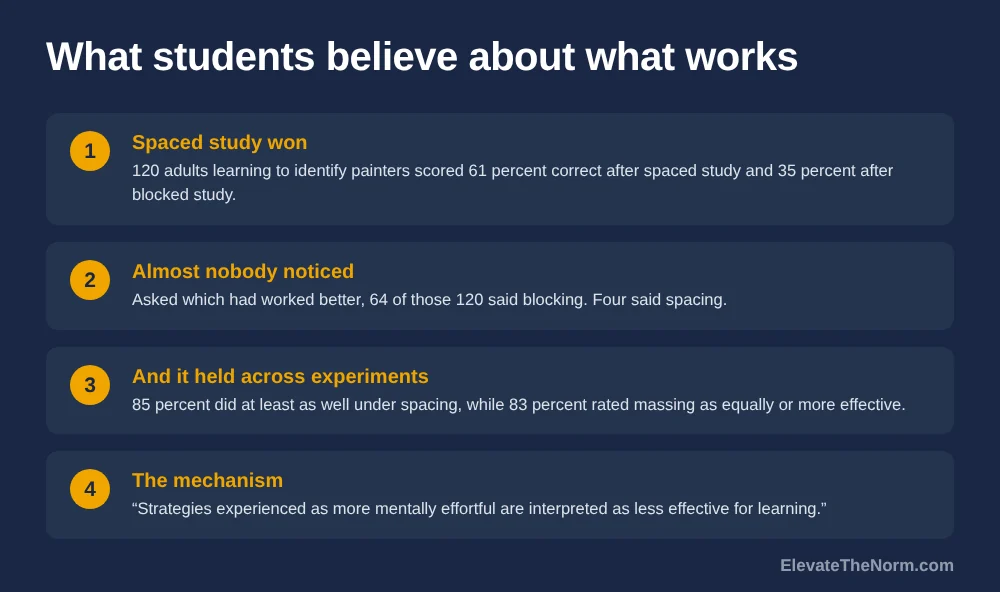
Kornell and Bjork had 120 undergraduates learn to identify painters’ styles, with some artists’ work spaced out and some blocked together. Spaced study produced 61 percent correct against 35 percent for blocked. Then they asked which had worked better. Sixty-four of the 120 said blocking. Four said spacing. Across two of their experiments, 85 percent of participants did at least as well under spacing while 83 percent rated massing as equally or more effective.
Kirk-Johnson, Galla and Fraundorf went after the mechanism and found it: “Strategies experienced as more mentally effortful are interpreted as less effective for learning.” In their third study, 80 undergraduates rated retrieval practice as both more effortful and less effective than restudying — and the students who chose retrieval anyway recalled more.
Bjork named the teacher-side version of this in 1994 and it is uncomfortable reading. Trainers are overexposed to day-to-day performance, are judged on how learning looks while it is happening, rarely see what happens afterward, and almost never collect the measurement that would tell them. Every one of those is true of a teacher with a gradebook. The method that makes your Tuesday look best is not necessarily the one your students will still own in May. Which study techniques students actually believe in, and what the evidence says about each, is the subject of the site’s page on study skills.
How is desirable difficulty different from productive struggle?
They answer different questions. Productive struggle is about a student working on a task right now and whether you step in. Desirable difficulty is a claim about how practice is scheduled and formatted, and it can only be judged weeks later.
The practical consequence is that you can watch productive struggle happen and make a judgment call in the moment. You cannot watch a desirable difficulty work. If you are mixing problem types in November to improve what students retain in February, every signal available to you in November — lower scores, slower work, complaints — points the wrong way. That is not a reason to ignore the signals. It is a reason to decide in advance what you will measure and when.
Clay’s take: pick one, and measure it late
If I acted on one line of this research, it would be mixed practice in problem sets. The 7th-grade trial is the only study here run on students this age, in real classes, by teachers given no training — and it worked for all fifteen of them.
What I would not do is adopt all six at once and call it a philosophy. The Bjorks themselves quote the line that “too often, the classroom is where promising interventions go to die,” and they concede they had assumed, unrealistically, that telling teachers about the research would be enough. A 125-school null result on spacing is what that looks like in practice.
And I would tell students what you are doing and why, before the scores dip. “This set is mixed on purpose, it will feel worse than last week’s, and the first score is not the measure” costs thirty seconds and answers the only fair objection a teenager has here — that their grade moved while you ran an experiment on them. Better still, do not let it move: keep the harder practice ungraded and put the grade on the delayed test. The research says students will not believe you anyway. Say it, and then show them the February result.
Frequently Asked Questions
What is a desirable difficulty in simple terms?
It is a change to how students practice that makes their performance worse while they are practicing and better weeks later. Spacing content out, mixing problem types, recalling from memory instead of rereading, and varying the format are the usual examples. The difficulty has to be one the student can actually overcome.
Who came up with desirable difficulties?
Robert Bjork coined the phrase in a 1994 book chapter, though that chapter never defines it. The definition people quote comes from Elizabeth and Robert Bjork’s 2011 chapter, and they restated it in a 2020 article where they stressed that the word desirable is important and that many difficulties are undesirable permanently.
What is the effect size of desirable difficulty?
There is no such number. No meta-analysis of desirable difficulty as a construct exists, and the Bjorks’ own article about the concept reports no effect sizes at all. Individual techniques have their own figures, and those figures disagree with each other, which is exactly why averaging them would be misleading.
Does desirable difficulty work with middle and high school students?
The best evidence says sometimes. A cluster-randomized trial of mixed math practice with 787 seventh graders found 61 percent against 38 percent on a delayed test. A spaced revision program delivered to about 12,000 Year 11 students in 125 schools found nothing at all. Both studies are good ones.
When is a difficulty undesirable?
When the student cannot overcome it. That happens when they lack the prior knowledge to respond at all, when the task overloads working memory rather than taxing their thinking, or when they already know the material well enough that the extra support or demand reverses on them. A quiz on material never learned measures absence.
Is desirable difficulty the same as productive struggle?
No. Productive struggle describes a student working on a task in front of you and whether you intervene. Desirable difficulty is a claim about how practice is scheduled and formatted, and it can only be judged on a delayed test. You can watch productive struggle. You cannot watch a desirable difficulty work.
Why does studying that feels easy not work?
Because fluency is a bad signal. Rereading and massed study feel smooth, so students read that smoothness as learning. Research on the mismatch found that most participants learned more from spaced practice while most of them judged massed practice to be as good or better. Effort gets interpreted as failure.
Does making work harder improve learning?
Not on its own, and the researchers behind the idea say so. Difficulty is only desirable when the learner has the background knowledge or skills to respond successfully, and the optimal level varies with how much a student already knows. Plenty of difficulties are undesirable during instruction and afterwards too.
Sources
- Bjork, E. L., & Bjork, R. A. Making Things Hard on Yourself, But in a Good Way: Creating Desirable Difficulties to Enhance Learning. In Gernsbacher, Pew, Hough & Pomerantz (Eds.), Psychology and the Real World, Worth Publishers, 2011. Chapter (PDF). Source of the definition and of the condition that a difficulty becomes undesirable when the learner lacks the background knowledge or skills to respond successfully, the canonical list, the storage-and-retrieval-strength distinction, and the quotation of the 63 against 20 percent figure.
- Bjork, R. A. Memory and Metamemory Considerations in the Training of Human Beings. In Metcalfe & Shimamura (Eds.), Metacognition: Knowing About Knowing, MIT Press, 1994. Chapter (PDF). Source of the phrase itself and of the fact that the chapter never defines it, the outcome-based criterion, the reduced and summary feedback findings for simple motor skills, and the account of why trainers misread their own learners.
- Bjork, R. A., & Bjork, E. L. Desirable difficulties in theory and practice. Journal of Applied Research in Memory and Cognition, Vol. 9, No. 4, pp. 475–479 (2020). Full text (PDF). Source of “the word desirable is important,” “many difficulties are undesirable during instruction and forever after,” the rule that the optimal level of difficulty varies with prior learning, the requirement that a difficulty be potentially solvable, and the classroom-is-where-interventions-go-to-die quotation. This article reports no effect sizes anywhere.
- Soderstrom, N. C., & Bjork, R. A. Learning versus Performance: An Integrative Review. Perspectives on Psychological Science, Vol. 10, No. 2, pp. 176–199 (2015). Full text (PDF). Source of the learning and performance definitions, the statement that performance during acquisition is a highly imperfect index of long-term learning, the point that retrieval practice stops being desirable when nothing can be retrieved, and the varied-practice studies described second-hand here.
- Rohrer, D., Dedrick, R. F., Hartwig, M. K., & Cheung, C.-N. A randomized controlled trial of interleaved mathematics practice. Journal of Educational Psychology (2019). Full text (PDF). Source of the 7th-grade cluster-randomized design, 54 classes and 15 teachers in five schools, 787 students analyzed, the 61 against 38 percent result and d = 0.83, the positive effect for all fifteen teachers, and the authors’ own cautions about initial blocked practice, corrective feedback and time cost.
- Hodgen, J., Bretscher, N., Hardman, M., Anders, J., & Lawson, H. SMART Spaces: Spaced Learning Revision Programme — Evaluation Report. UCL Institute of Education for the Education Endowment Foundation, 2023. Evaluation report (PDF). Source of the school-level randomized design, 125 schools and 14,098 Year 11 pupils randomized with 11,976 analyzed, the effect size of −0.01 with a credible interval of −0.17 to 0.12, zero additional months’ progress at a high security rating, and the finding that the program was delivered as intended with 70 percent of teachers willing to run it again.
- Carpenter, S. K., Pashler, H., & Cepeda, N. J. Using tests to enhance 8th grade students’ retention of U.S. history facts. Applied Cognitive Psychology, Vol. 23, pp. 760–771 (2009). Full text (PDF). Source of the 8th-grade classroom design with 62 students analyzed, the nine-month delayed test, the scores of 3.08, 2.18 and 1.58 out of 30, the effect sizes of .32 and .51, and the authors’ own note that floor effects limit the size of those differences.
- Cepeda, N. J., Vul, E., Rohrer, D., Wixted, J. T., & Pashler, H. Spacing effects in learning: A temporal ridgeline of optimal retention. Psychological Science, Vol. 19, No. 11, pp. 1095–1102 (2008). Full text (PDF). Source of the optimal gap ratios of roughly 43, 23, 17 and 8 percent of a 7-, 35-, 70- and 350-day retention interval, and of the finding that an overly long gap costs less than an overly short one. The participants were 1,354 adults with a mean age of 34, not school students.
- Brunmair, M., & Richter, T. Similarity matters: A meta-analysis of interleaved learning and its moderators. Psychological Bulletin (2019). Full text (PDF). Source of the overall effect of g = 0.42 across 158 samples and 8,466 participants, the reversal for words at g = −0.39, the null result for expository texts, the figure of g = 0.34 for mathematical tasks, and the authors’ stated reluctance to recommend interleaving for vocabulary, grammar rules and foreign languages. Most samples were university students.
- Agarwal, P. K., Nunes, L. D., & Blunt, J. R. Retrieval practice consistently benefits student learning: A systematic review of applied research in schools and classrooms. Educational Psychology Review (2021). Full text (PDF). Source of the 50 classroom experiments with 5,374 students, the 46 of 49 positive effects and the three negative ones, the finding that effects were largest in middle school, and the finding that studies without feedback produced mostly small or very small effects.
- Kornell, N., & Bjork, R. A. Learning concepts and categories: Is spacing the “enemy of induction”? Psychological Science, Vol. 19, No. 6, pp. 585–592 (2008). Full text (PDF). Source of the 61 against 35 percent spacing result with 120 undergraduates, the 64-against-4 judgment split, and the combined finding that 85 percent of participants did at least as well under spacing while 83 percent rated massing as equally or more effective.
- Kirk-Johnson, A., Galla, B. M., & Fraundorf, S. H. Perceiving effort as poor learning: The misinterpreted-effort hypothesis. Cognitive Psychology, Vol. 115 (2019). Full text (PDF). Source of the finding that strategies experienced as more effortful are interpreted as less effective, and of the third study with 80 undergraduates in which retrieval practice was rated more effortful and less effective while the students who chose it recalled more. The participants were online adults and undergraduates, not school students.
- Chen, O., Castro-Alonso, J. C., Paas, F., & Sweller, J. Undesirable Difficulty Effects in the Learning of High-Element Interactivity Materials. Frontiers in Psychology, Vol. 9, Article 1483 (2018). Full text (PDF). Source of the statement that element interactivity refers to working memory load rather than difficulty, the argument that added difficulty may be undesirable when working memory is already exceeded, and the documented reverse testing and generation effects. This paper reports no sample sizes or effect sizes, so it is cited here for the pattern only.
- Kalyuga, S., Ayres, P., Chandler, P., & Sweller, J. The expertise reversal effect. Educational Psychologist, Vol. 38, No. 1, pp. 23–31 (2003). Full text (PDF). Source of the definition of the effect and of the reviewed cases, including the high school biology readers for whom added coherence helped the low-knowledge group and hurt the high-knowledge one, and the worked-example reversal with more experienced apprentices. The paper reports no sample sizes or effect sizes.
- de Jong, T. Cognitive load theory, educational research, and instructional design: some food for thought. Instructional Science, Vol. 38, pp. 105–134 (2010). Full text (PDF). Source of the criticism that cognitive load theory is hard or impossible to falsify, that attributing load to useful processing is a post-hoc explanation, and that the distinction between types of load is a matter of degree and possibly non-existent. The paper does not discuss desirable difficulties and is cited here as a critique of the vocabulary, not of Bjork.
- Rohrer, D., & Taylor, K. The shuffling of mathematics problems improves learning. Instructional Science, Vol. 35, pp. 481–498 (2007). Full text (PDF). Source of the 63 against 20 percent figure and of its true population: Experiment 2, 18 university undergraduates, a one-week delay, with standard errors of 12 and 9 percentage points.
- Buchin, Z. L., & Mulligan, N. W. Retrieval-based learning and prior knowledge. Journal of Educational Psychology, Vol. 115, No. 1, pp. 22–35 (2023). Abstract. Source of the finding that testing effects were nearly identical for high and low prior knowledge and that prior knowledge is not a critical boundary condition for retrieval-based learning. Only the abstract was read for this article, so the sample size, country and statistics are not reported here.