By Clay Shumate · Updated October 24, 2026
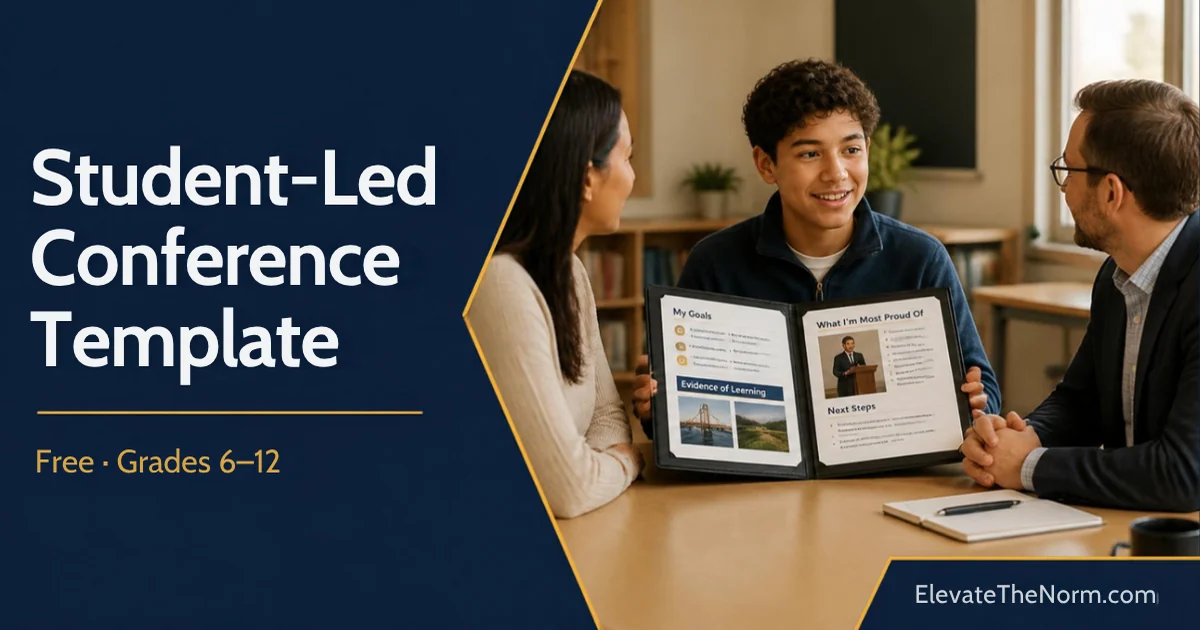
A student-led conferences template works when it gives the student real control without leaving the room to chance. The complete four-part template is printed on this page below — no email, no signup, nothing to unlock. It is a readiness checklist for the week before, an evidence and portfolio planner that keeps students from collecting everything instead of choosing what proves a pattern, a speaking script built as prompts rather than a memorized speech, and a next-step agreement that turns the conference into a plan instead of a performance. It’s built for grades 6–12 and works whether the audience is a parent, a case manager, or another teacher.
Free. No email address required. Built for grades 6–12. Print it, adapt it, and use it tomorrow.
If you are setting this up for the first time, start with the guide to how student-led conferences actually run in grades 6–12 — the four-part script students follow, the four-week run-up, what the evidence does and does not show, and what to do about the families who will not be there.
Editable Student-Led Conference Template (Word)
The PDF above is built to print and hand out. This version is built for the student to type in before the conference: the readiness checklist, the evidence planner, the script prompts, and the follow-up agreement are all open fields, plus a 20-minute agenda that is not in the printed pack. It opens in Word, Google Docs, and Pages.
Free, no email address, no macros. Students who type their evidence notes and next step in advance walk into the conference with something to point at instead of something to remember.
What’s in the Pack
Four pages, printable on US Letter paper, branded ElevateTheNorm.com on every page.
- Conference readiness checklist covering the week before and the day before
- Evidence and portfolio planner for choosing growth, challenge, and strongest-work pieces
- Student speaking script structured as opening, evidence, reflection, and next-step prompts
- Family/teacher follow-up agreement to close the conference with a shared action
What Goes in a Student-Led Conference Template?
Copy any part of this straight into a doc, or print this page. Nothing below is held back.
Part 1 — Conference Readiness Checklist
A student-led conference works only when the student has evidence, practice, and a realistic amount of control.
One week before
- ☐ Choose three pieces of evidence: growth, challenge, and strongest work.
- ☐ Identify one pattern across grades, feedback, or habits.
- ☐ Draft one strength and one honest next step.
- ☐ Confirm the audience, time limit, and available technology.
The day before
- ☐ Rehearse the opening and transitions.
- ☐ Check that every claim points to evidence.
- ☐ Prepare for one likely family question.
- ☐ Choose the first action to take after the conference.
Part 2 — Evidence and Portfolio Planner
Do not collect everything. Choose evidence that helps the student explain a pattern.
| Piece | What it has to show | Student’s notes |
|---|---|---|
| Evidence 1 | What it shows about my growth | |
| Evidence 2 | A challenge and how I responded | |
| Evidence 3 | Work I can defend under questioning | |
| The pattern | The pattern I notice across my work |
Part 3 — Student Conference Script
Use the prompts as a guide, not a speech to memorize.
| Section | The student answers |
|---|---|
| Opening | What I want you to understand about my progress |
| Evidence | The work that best proves it |
| Reflection | What is still difficult, and why |
| Next step | What I will do, by when, and what support I need |
Part 4 — Family and Teacher Follow-Up Agreement
The conference is not finished until somebody writes down what happens next. Keep it to one action.
| The student will | |
| By this date | |
| Support needed at home | |
| Support needed from the teacher | |
| Student / family / teacher |
What Evidence Should Students Bring to a Student-Led Conference?
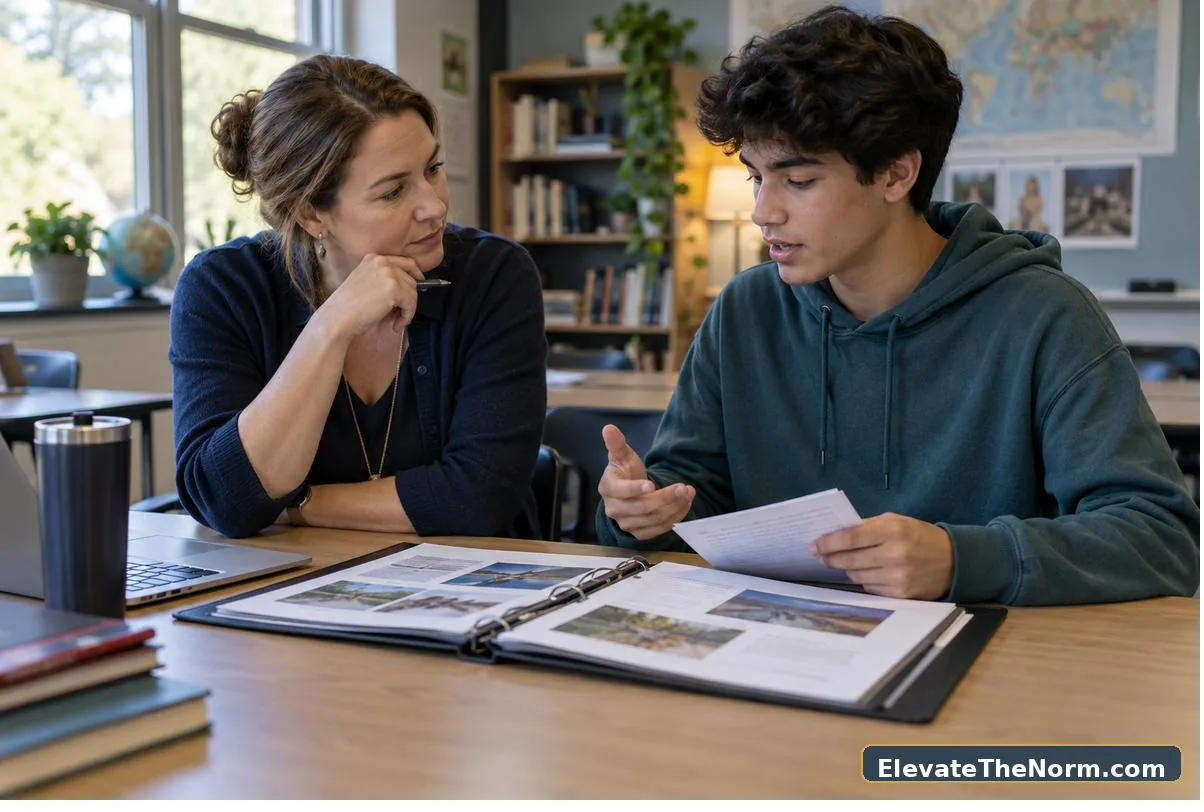
The planner deliberately limits students to three pieces — one showing growth, one showing how they handled a challenge, and one they can defend under questioning. Students who try to bring everything usually can’t explain any of it clearly. Push back on a fourth or fifth piece; the constraint is what makes the conference sound like the student’s own thinking instead of a stack of paper.

How Should Students Rehearse a Student-Led Conference?
Use the script’s four prompts — opening, evidence, reflection, next step — as a rehearsal checklist, not a transcript to read aloud. The most common rehearsal problem is a student who can state a claim but can’t point to which piece of evidence backs it; if that happens in rehearsal, send them back to the portfolio planner before the actual conference, not during it. If the four-part structure is more than your schedule allows, the shorter conference formats built around a single artifact use the same planner and fit a ten-minute advisory slot.
A Caution Worth Repeating
This system assumes students have had some practice choosing and explaining evidence before their first conference — running it cold in week two of the semester will be rougher than running it after a unit or two of practice judging their own work before a family is in the room. It also isn’t a substitute for standard progress reporting; it’s a structure for the conversation itself.
The Student-Led Conference Template at a Glance
All four parts on one page — useful for a department meeting, a printed handout, or a reminder the day before conferences.
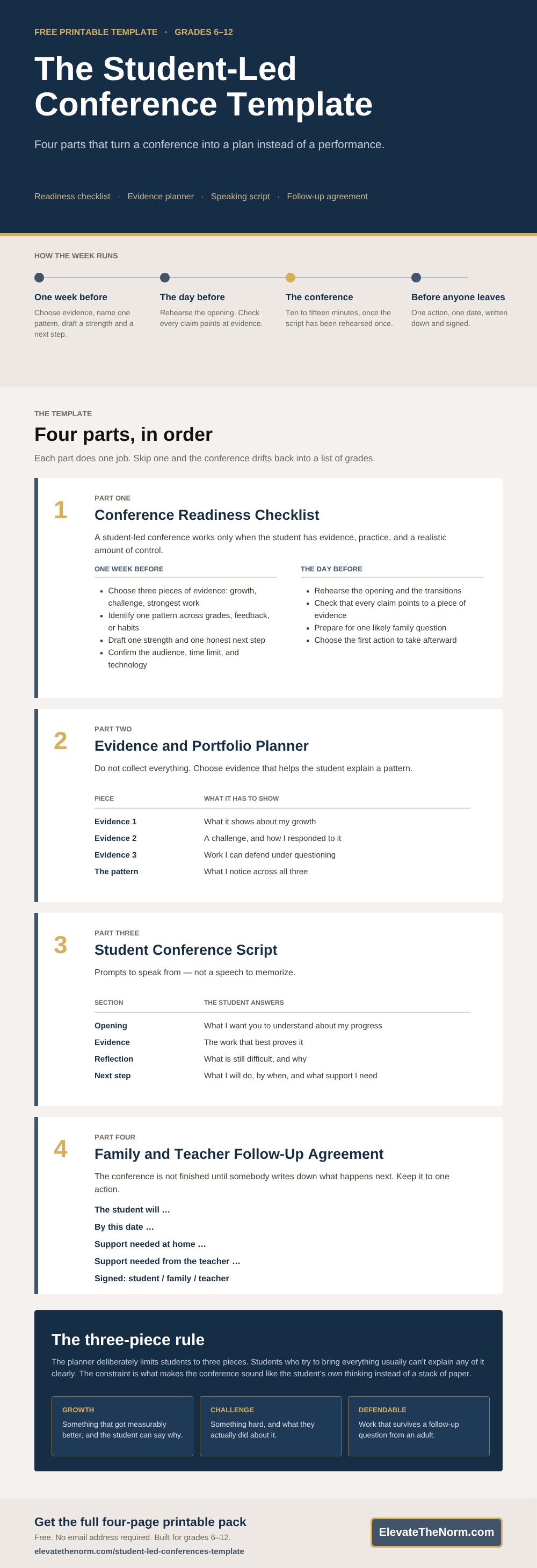
Use This Infographic on Your Site
Free to republish on a school, district, or teacher blog. Copy the code below — it keeps the credit link intact.
<a href="https://elevatethenorm.com/student-led-conferences-template/"><img src="https://elevatethenorm.com/wp-content/uploads/2026/09/student-led-conference-template-infographic.png" alt="Student-led conference template for grades 6-12" width="1000" height="2920" style="max-width:100%;height:auto;" /></a>
<p>Source: <a href="https://elevatethenorm.com/student-led-conferences-template/">Student-Led Conference Template</a> by Clay Shumate, <a href="https://elevatethenorm.com/">Elevate the Norm</a>.</p>Want this pack plus the other nine, each with a one-page guide on how to use it? Grab the free 43-page Classroom Systems Playbook. Same deal: no email, no sign-up.
For more on the ideas behind this pack, see the site’s guides to checking what students actually know, activities that give students real ownership, student autonomy without losing the room, and what student responsibility looks like in practice.
Browse every free, no-email classroom download on the Elevate the Norm resource hub.
Teachers are sharing how they use this student-led conference template on the student-led conference discussion board.
Frequently Asked Questions
What should a student say in a student-led conference?
Students follow four prompts rather than a memorized speech. Opening: what I want you to understand about my progress. Evidence: the work that best proves it. Reflection: what is still difficult, and why. Next step: what I will do, by when, and what support I need. Every claim should point to a specific piece of evidence.
What is in this student-led conference template PDF?
Four printable US Letter pages: a conference readiness checklist for the week and day before, an evidence and portfolio planner for choosing three pieces, a student speaking script built on four prompts, and a family and teacher follow-up agreement with one action. An editable Word version adds a 20-minute agenda. Both are free with no email required.
What age group is this student-led conference template for?
Grades 6–12. The script and portfolio planner assume students who can explain their own reasoning with some scaffolding, which is realistic starting in middle school.
How long should a student-led conference actually take?
This pack doesn’t set a fixed time, but the four-part script — opening, evidence, reflection, next step — comfortably runs in ten to fifteen minutes once students have rehearsed it once.
Do I have to give an email address to get this template?
No. The full template is printed on this page and the PDF downloads directly with no form of any kind. Every resource on this site works the same way.
Do students need a digital portfolio for this to work?
No. The evidence and portfolio planner works with physical work samples, printed screenshots, or a mix — it’s a decision tool for which three pieces to bring, not a storage system.
What if a student can’t identify a pattern across their work?
That’s exactly what the readiness checklist’s “identify one pattern” step is for — give students extra one-on-one time with it before the conference rather than letting them walk in without one; a conference without a stated pattern tends to drift into a list of grades.
Can this replace a traditional parent-teacher conference?
It can replace the format for conferences where the goal is student ownership. For conferences focused on a specific concern the teacher needs to raise privately with a family, pair this with the site’s parent-teacher communication log pack instead.
Is there a version for students with an IEP or 504 plan?
The toolkit doesn’t include a modified version, but the script’s open-ended prompts adapt well with additional scaffolding, sentence starters, or a co-presenting support person — adjust based on what’s already in the student’s plan.
How far in advance should I introduce this to students?
At least one week, using the readiness checklist as written. Students who see the checklist the day before the conference don’t have time to build real evidence or rehearse.
About Clay Shumate
Clay Shumate is a certified secondary Social Studies teacher in the public schools of West Alabama, with seven years of classroom experience, a B.A. in History, and an M.Ed. in Secondary Education. He writes about project-based learning, student responsibility, respect, and practical ways to hold young people to a higher standard while giving them room to learn from mistakes. He is a member of the Society of Professional Journalists and writes to its Code of Ethics; this site’s editorial standards and corrections policy are published in full.