By Clay Shumate
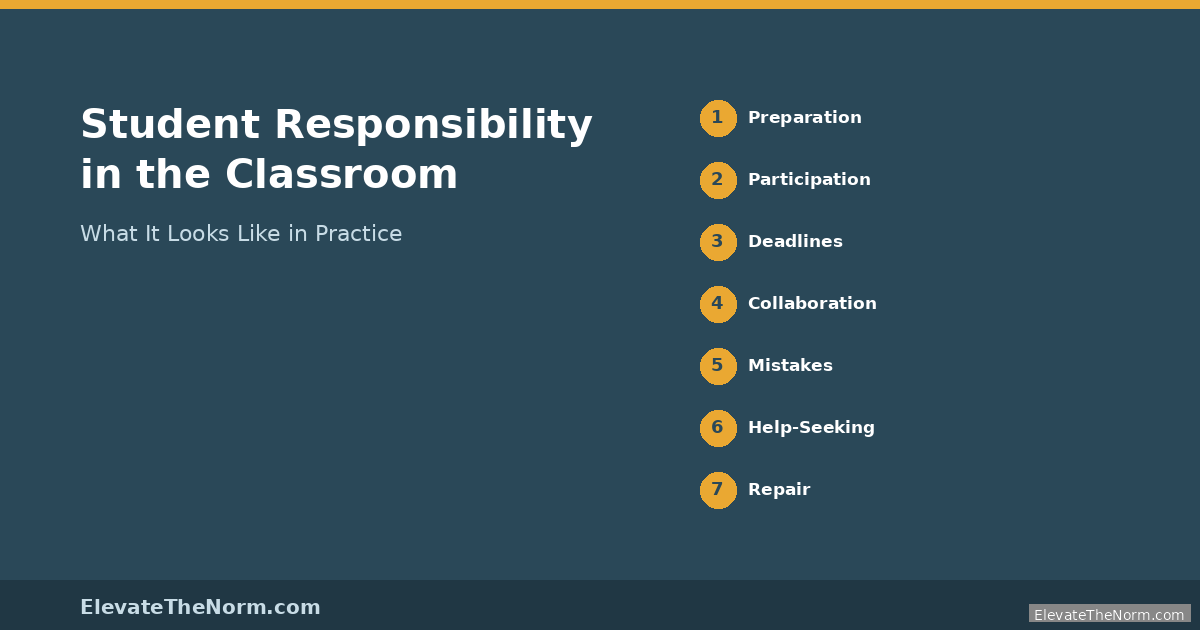
Student responsibility in the classroom means students consistently do what needs to be done—prepare for class, participate honestly, meet deadlines, collaborate fairly, own their mistakes, ask for help, and repair what they break—without needing to be monitored every minute. This article explains what responsible behavior actually looks like in grades 6–12 and how teachers build it through structure, not speeches.
Key Takeaways
- Responsibility is observable behavior, not a personality trait. You can see it, teach it, and measure growth.
- Responsibility and compliance are not the same thing. A student who follows rules out of fear is compliant. A student who meets a standard because they understand why it matters is responsible.
- Students learn responsibility through practice, feedback, and natural consequences—not lectures, reward charts, or shame.
- The teacher’s job is to build the structure that makes responsible behavior possible and then hold the standard when students fall short.
- Responsibility grows when students have genuine choices, real stakes, and a clear path to repair after mistakes.
Responsibility Is Not Compliance
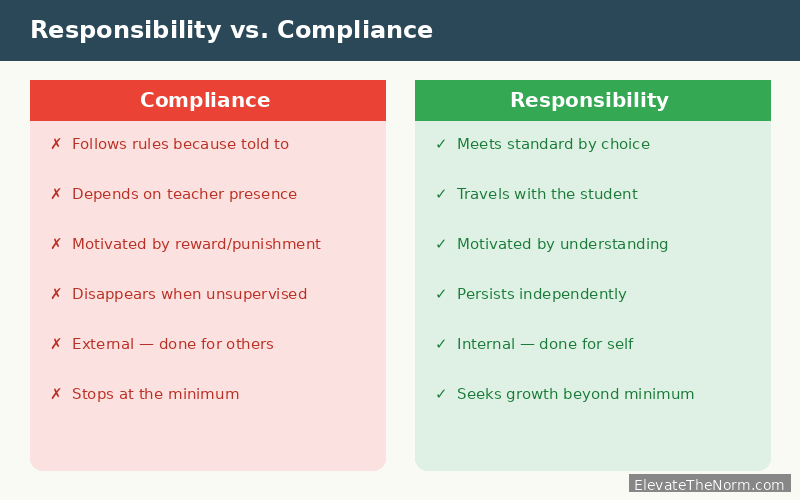
This is the distinction that changes everything.
A compliant student does what you say because you said it. A responsible student does what needs to be done because they understand the purpose. Compliance depends on the teacher being in the room. Responsibility travels with the student.
Research on self-determination theory makes this concrete. Niemiec and Ryan (2009) found that students who experience autonomy, competence, and relatedness in the classroom are more likely to internalize the value of academic behaviors—not just perform them for a grade or to avoid trouble. When students feel controlled rather than supported, motivation drops and so does the quality of their effort.
Most classroom management systems are built to produce compliance. They work—until the teacher steps out of the room, until the reward loses its appeal, or until the student decides the consequence is worth the trade. Responsibility requires a different design: one where students understand the reason behind the expectation and have practiced meeting it enough times that it becomes automatic.
This does not mean you stop enforcing standards. It means the enforcement is a tool for building capacity, not just maintaining order.
What Student Responsibility Actually Looks Like
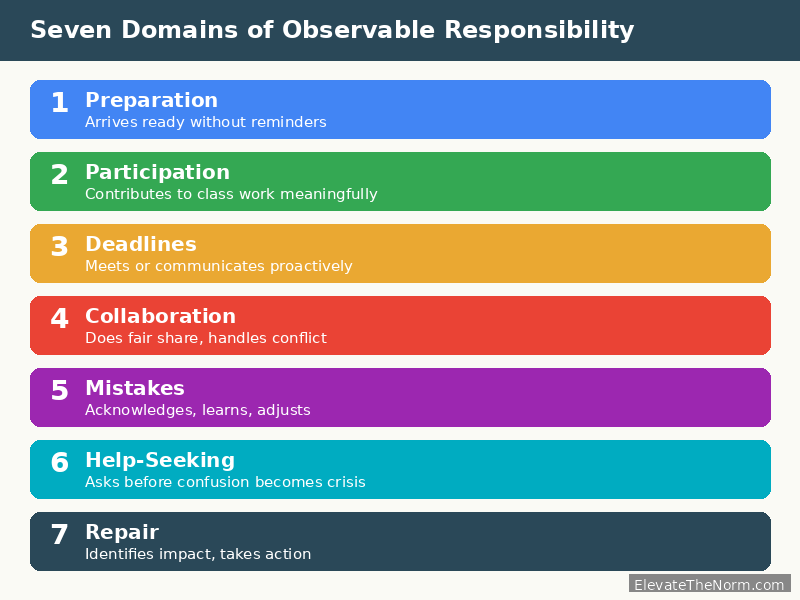
Talking about responsibility in the abstract does not help anyone. Teachers need to know what responsible behavior looks like when it walks into the room on a Tuesday morning. Here are seven domains where responsibility becomes visible.
1. Preparation
A responsible student arrives with materials, has completed required preparation, and is ready to begin when class starts. This does not mean perfect compliance every day—it means a pattern of readiness that the student maintains without being reminded.
What to watch for: Does the student bring what they need without being asked? When they forget something, do they solve the problem or wait for you to notice? For a precise definition that distinguishes responsibility from obedience, the companion article on what is student responsibility gives teachers and families a clear shared starting point.
2. Participation
Participation is not the same as talking. A responsible student contributes to the work of the class—through discussion, through written response, through active listening, through collaboration. Quiet students can participate responsibly. Loud students can participate irresponsibly.
What to watch for: Is the student engaged with the content, or performing engagement for your benefit?
3. Deadlines
A responsible student meets deadlines or communicates proactively when they cannot. The communication matters as much as the deadline itself. A student who emails you the night before to say they are stuck and asks for help is showing more responsibility than a student who turns in mediocre work on time to avoid a consequence. If missing work is what eats your week, my Makeup Work System on TPT hands students a triage form so they own the catch-up.
What to watch for: When a student misses a deadline, what happens next? Do they take the initiative to address it, or do they wait for you to chase them?
4. Collaboration
Working with other people is where responsibility gets tested hardest. A responsible student does their share, communicates honestly with group members, handles disagreement without withdrawal or domination, and gives credit where it is owed.
What to watch for: Does the student contribute to the group’s success, or simply avoid being the one who gets blamed for failure? There is a difference.
5. Mistakes
Every student makes mistakes. A responsible student acknowledges the mistake, understands its impact, and takes action to repair it. This is not about guilt or shame—it is about ownership. That balance between accountability and a second chance is what makes the difference.
Zimmerman’s research on self-regulated learning (2002) shows that self-regulated learners treat errors as information rather than evidence of failure. They adjust their approach based on what went wrong. That is a skill, not a character trait, and it can be taught through structured reflection and consistent adult modeling.
What to watch for: When a student makes a mistake, do they deflect, shut down, or face it? Your response in that moment teaches them which option is safe.
6. Help-Seeking
Asking for help when you are stuck is an act of responsibility, not weakness. A responsible student monitors their own understanding and reaches out before a small problem becomes a crisis.
What to watch for: Does the student ask for help at the right time—after a genuine attempt but before the frustration becomes unproductive? Students who never ask for help are not necessarily independent. They may be hiding confusion.
7. Repair
When a student’s behavior damages a relationship, disrupts the class, or violates an expectation, repair is the responsible response. Repair means identifying what went wrong, acknowledging its impact on others, and taking specific action to make it right.
What to watch for: Can the student articulate what happened, who was affected, and what they will do differently? If they can, they are practicing responsibility. If they cannot, they need you to teach them how—not punish them for not knowing.
How Teachers Build Responsibility
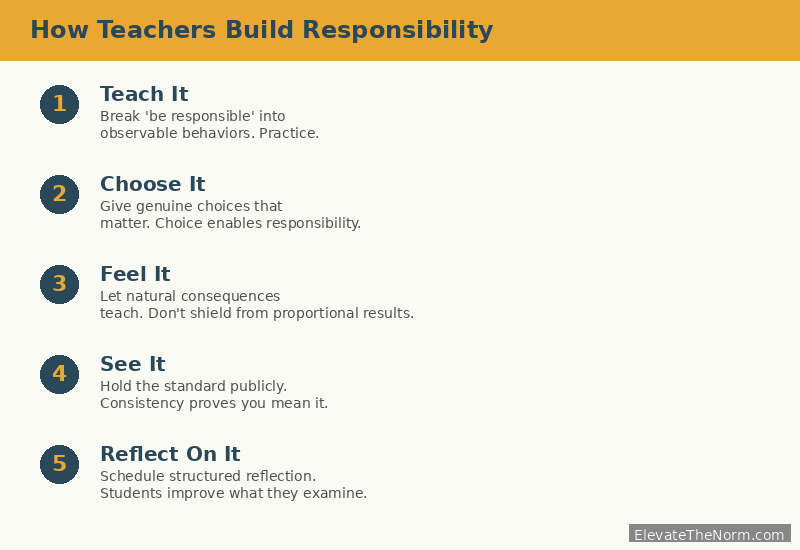
Students do not arrive responsible or irresponsible. They arrive with whatever habits their previous environments rewarded. Your job is to build an environment where responsible behavior is taught, expected, practiced, and reinforced—not assumed.
Teach the Behavior You Expect
This sounds obvious, but most teachers skip it. They state the expectation—”Be responsible”—and then are frustrated when students do not meet it. “Be responsible” is not an instruction. It is a category. Break it into the observable behaviors listed above, the same way you would build a set of clear classroom expectations. Teach each one explicitly. Practice it. Give feedback. Reteach when necessary.
Give Real Choices
Responsibility requires choice. If students have no decisions to make, they have no opportunity to practice being responsible. Offer choices that matter: which topic to investigate, which format to present in, which resource to use, which role to play in a group. The choice does not have to be enormous. It has to be genuine. This is the practical core of teaching responsibility without treating teenagers like children.
The CASEL framework for social and emotional learning identifies responsible decision-making as one of five core competencies—and defines it as the ability to make caring and constructive choices about personal behavior and social interactions across diverse situations. That definition matters because it links responsibility to decision-making, not obedience.
Use Natural Consequences
When a student does not prepare for a group meeting, the group’s work suffers. When a student misses a deadline, the revision cycle shrinks. When a student damages a relationship, trust takes time to rebuild. These are natural consequences, and they teach more than any punishment chart.
Your job is not to shield students from consequences. It is to ensure the consequences are proportional, educational, and accompanied by a path back. A student who loses a day of revision time because they did not draft on schedule has experienced a natural consequence. A student who gets a zero with no chance to recover has experienced a dead end. One builds responsibility. The other builds resentment. I hand students a page from my Behavior Reflection Sheets on TPT so the reflection is written down before we talk.
For more on this approach, see natural consequences in the classroom on this site.
Hold the Standard Publicly
Students watch whether you mean what you say. If the expectation is that work is due on Thursday and half the class turns it in Friday with no conversation, the real expectation is Friday. Hold the standard—but hold it with respect. If you want structured ways to practice this, these activities for teaching responsibility give students repeated low-stakes reps.
I count before I respond—roughly fifteen, adjusted to the room and the day and the student. It is not a script. It is a deliberate pause that gives me time to respond with clarity instead of reacting with frustration. When a student falls short of an expectation, the conversation that follows needs to be about the behavior and the path forward, not about how disappointed I am. Disappointment is about me. Accountability is about them.
That pause does something else, too. It models self-regulation for students who have never seen an adult choose not to react immediately. In a room where the tables are pushed together and students are almost always working alongside somebody, composure travels. When I stay calm, the room stays calm. When I raise my voice, the room raises its guard.
Build in Reflection
Students cannot improve what they do not examine. Schedule structured reflection at regular intervals—not just at the end of a project. Ask students to assess their own responsibility across the seven domains. Compare their self-assessment to your observations. Use the gap as a conversation starter, not a gotcha.
What Responsibility Is Not
Responsibility is not doing what adults want without questioning it. It is not silence. It is not never making mistakes. And it is not something you can grade on a report card the same way you grade a math test.
A student who pushes back on an assignment because they think it is pointless is not being irresponsible—they are expressing a judgment. Whether that judgment is right or wrong, your response should address the substance of their concern, not just the fact that they raised it. A student who questions an expectation respectfully and then meets it after the conversation is demonstrating more responsibility than a student who never questions anything.
Responsibility also does not mean handling everything alone. A student who asks for help, communicates a struggle, or admits they do not understand is acting responsibly. The mythology of the independently responsible student—the one who never needs support—is a fantasy that harms the students who believe it.
When Students with IEPs or 504 Plans Need Different Structures
Responsibility expectations must account for students whose plans include specific accommodations. Extended deadlines, modified assignments, alternative assessments, and additional support structures are not exceptions to responsibility — and it is worth being clear that a classwide support such as a posted plan does not discharge any of them—they are the framework within which that student practices it.
A student with an IEP who uses their extended time and meets the adjusted deadline is meeting their standard. A student with a 504 plan who uses their accommodations and still comes prepared is demonstrating responsibility within the structure designed for them.
When in doubt, coordinate with the special education team. The goal is the same: build the student’s capacity to manage their own learning. The path may look different, and that is by design.
A Note for Administrators
Student responsibility is not a classroom-level problem with a classroom-level solution. It is a school-culture issue.
If the schoolwide discipline system is built entirely on compliance—silent hallways, no talking during transitions, consequences that escalate without teaching—then individual teachers who try to build genuine responsibility are fighting the current. Administrators who want responsible students need to audit whether their own systems reward compliance or build capacity.
Ask your teachers: Do students in your school practice making decisions, or do they practice following directions? The answer will tell you more about responsibility than any behavior data report. One concrete place to start is handing students the job of rating their own conduct against observable criteria rather than waiting to be told how they did. For a ready-to-use tool on this, see a free academic integrity response pack.
Sources
- Niemiec, C. P. & Ryan, R. M. (2009). “Autonomy, competence, and relatedness in the classroom: Applying self-determination theory to educational practice.” Theory and Research in Education, 7(2), 133–144. https://journals.sagepub.com/doi/10.1177/1477878509104318
- Zimmerman, B. J. (2002). “Becoming a self-regulated learner: An overview.” Theory Into Practice, 41(2), 64–70. https://eric.ed.gov/?id=EJ656632
- CASEL. (2020). “CASEL’s SEL Framework.” Collaborative for Academic, Social, and Emotional Learning. https://casel.org/casel-sel-framework-11-2020/
- Lewis, R. (2001). “Classroom discipline and student responsibility: The students’ view.” Teaching and Teacher Education, 17(3), 307–319. https://www.sciencedirect.com/science/article/abs/pii/S0742051X00000597
- Batdı, V., Elaldı, Ş., & Sönmez, A. (2026). “Project-based learning in schools: a multi-complementary study of its effectiveness.” Humanities and Social Sciences Communications, Nature. https://www.nature.com/articles/s41599-026-06684-4
Frequently Asked Questions
How is student responsibility different from student compliance?
Compliance means a student follows rules because an authority figure is enforcing them. Responsibility means a student meets a standard because they understand its purpose and have internalized its value. Compliance disappears when the authority figure leaves. Responsibility travels with the student. Both have a place in schools—safety rules require compliance regardless of understanding—but building genuine responsibility produces students who function independently, which is the whole point of education.
Can you actually teach responsibility, or is it just a personality trait?
You can teach it. Responsibility is a set of observable behaviors—preparing, communicating, meeting deadlines, repairing mistakes—and behaviors are learned through practice, feedback, and consistent expectations. Some students arrive with stronger responsibility habits than others because of their previous environments, not because of their character. Your job is to build the environment where all students practice these behaviors regularly.
What do I do when a student is consistently irresponsible?
Look at the pattern, not the incident. A student who is consistently unprepared, missing deadlines, or avoiding help may be struggling with something you cannot see—a home situation, a learning difficulty, a trust issue with adults. Start with a private conversation that asks what is getting in the way, not one that lists everything they have done wrong. Build a plan together. Set one small, achievable target. Check in regularly. Responsibility grows through supported practice, not through accumulated consequences.
How do I balance responsibility expectations with IEP and 504 accommodations?
Accommodations are not exceptions to responsibility—they are the structure within which a student practices it. A student with extended time who uses that time and meets the adjusted deadline is being responsible. The standard is the same: do what needs to be done, communicate when you are stuck, and repair what goes wrong. The path to that standard may look different for different students, and that is exactly how it should work. Coordinate with the special education team when expectations and accommodations seem to conflict.
Should I grade students on responsibility?
Be careful. Responsibility behaviors—preparation, participation, deadline management—are legitimate learning outcomes, but grading them requires clear, observable criteria and consistent application. If “responsibility” becomes a subjective judgment call that penalizes quiet students or rewards charming ones, it does more harm than good. If you grade it, define exactly what you are measuring, use the same criteria for every student, and separate it from content grades so a student’s mastery of your subject is not buried under a behavior score.
How do I build responsibility in a classroom where students have had no previous practice?
Start with the smallest unit of responsibility you can find. Ask students to bring one specific material. Ask them to self-assess one assignment before turning it in. Ask them to communicate one problem before it becomes a crisis. Celebrate the behavior when it happens—not with a reward, but with acknowledgment. Build from there. Students who have never been trusted with responsibility will test whether you mean it. They are supposed to test it. Hold the standard, keep the relationship, and give them time.
What role do parents play in building student responsibility?
A significant one, but not the one schools usually assign them. Telling families to “make sure your child is responsible” is outsourcing the school’s job. Instead, communicate clearly about what responsibility looks like in your classroom, what you are doing to teach it, and how families can reinforce it at home. When a student is struggling, bring the family in as a partner, not a target. Most parents want their child to be responsible—they may just need to know what you are working on and how to support it.
About Clay Shumate
Clay Shumate is a certified secondary Social Studies teacher in the public schools of West Alabama, with seven years of classroom experience, a B.A. in History, and an M.Ed. in Secondary Education. He writes about project-based learning, student responsibility, respect, and practical ways to hold young people to a higher standard while giving them room to learn from mistakes. He is a member of the Society of Professional Journalists and writes to its Code of Ethics; this site’s editorial standards and corrections policy are published in full. More about Clay.