By Clay Shumate
Student autonomy is a student’s genuine ability to make meaningful decisions about their own learning — what to study, how to demonstrate understanding, when to ask for help, and how to manage their own time — within boundaries an adult has thoughtfully set. It is not freedom without structure. It is freedom because of structure. This guide explains how teachers in grades 6–12 can offer autonomy that increases engagement and responsibility without creating chaos.
Key Takeaways
- Autonomy does not mean students do whatever they want. It means they make real decisions within boundaries the teacher has planned.
- Self-determination theory identifies autonomy, competence, and relatedness as three basic needs that drive genuine motivation in classrooms.
- Structure and autonomy are not opposites. The research shows they work best together.
- Autonomy should increase gradually as students demonstrate they can handle it. Start tight, expand deliberately.
- The biggest risk of student autonomy is not chaos — it is giving choices students are not prepared to make.
What Student Autonomy Actually Means
Student autonomy sounds like a simple concept until you try to implement it in a room of twenty-eight teenagers. The word “autonomy” gets used to mean everything from letting students pick their own seats to running an entirely student-directed classroom, and the gap between those two things is enormous. Practical activities that hand students real decisions bridge that gap with structure.
In research, student autonomy has a specific meaning. Deci and Ryan’s self-determination theory (1985, updated by Ryan & Deci, 2020) defines autonomy as the experience of volition and willingness — acting from one’s own values and interests rather than from external pressure. In a classroom, this means a student who writes an essay because they find the question genuinely interesting is acting autonomously. A student who writes the same essay only because it is graded is not.
That definition matters because it separates autonomy from permissiveness. A student can experience autonomy within a highly structured environment — as long as the structure makes sense to them, they understand why the expectations exist, and they have some genuine say in how they operate within it.
Why Student Autonomy Matters for Grades 6–12
Adolescents are developmentally primed for autonomy. Their brains are building the capacity for independent decision-making, abstract reasoning, and identity formation. When schools respond to this developmental reality by tightening control — more rules, fewer choices, stricter consequences — they create a mismatch between what students need and what the environment provides.
The research on this point is consistent. A meta-analysis by Vasconcellos et al. (2020) across 144 studies found that autonomy-supportive teaching was associated with higher autonomous motivation, greater engagement, and better academic outcomes across age groups, with effects that held across cultures and subject areas. Jang, Reeve, and Deci (2010) studied 133 high-school classrooms and found that autonomy support and structure were positively correlated — teachers who offered more autonomy also tended to provide more structure — and both predicted students’ observed behavioral engagement. That finding is the usable part of the answer to the student who appears not to care.
The point is worth emphasizing because it contradicts the most common objection to student autonomy: the fear that giving students choices means giving up control. The evidence suggests the opposite. Autonomy and structure rise and fall together, not inversely.
The Difference Between Autonomy and Chaos
This is the section most autonomy guides skip, and it is the section teachers most need.
Autonomy without preparation is not autonomy. It is abandonment. Handing a student a choice they are not equipped to make — pick any topic, design any project, manage your own time with no checkpoints — does not develop independence. It develops anxiety in the students who care and apathy in the students who have learned that unstructured time means nothing matters.
Here is what that looks like in practice. A teacher announces that students can research any topic related to the unit. No constraints on scope, no required sources, no checkpoint before the final product. Some students thrive. Most flounder. Several pick topics that cannot be meaningfully researched at a secondary level. A few do nothing at all. The teacher then blames the students for “not being ready for autonomy,” when the truth is the task was not ready for the students.
The fix is not less autonomy. It is better structure around the autonomy. Define the boundaries. Provide the scaffolding. Check in at defined points. And then let the student make real decisions within that frame.
Seven Domains of Student Autonomy
Student autonomy is not a single switch you flip. It is a set of decisions across different parts of the learning experience, and the teacher can offer autonomy in one domain while maintaining control in another. Here are seven domains where autonomy is practical in a secondary classroom.
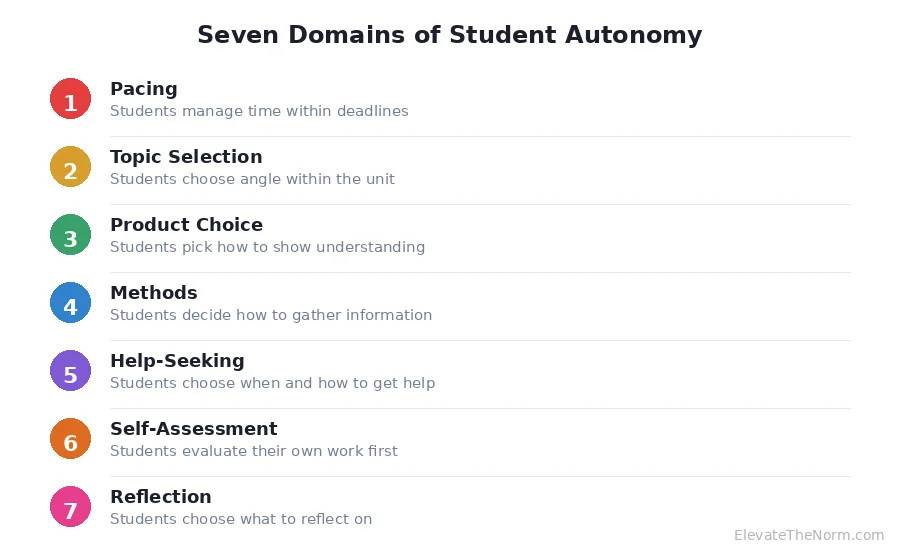
Pacing
Let students manage their own time within a defined window. Instead of “everyone moves to step two at 10:15,” try “you have until 10:40 to complete steps one through three — manage your time across those three steps however you need to.” Some students will spend more time on step one. Others will move quickly and spend more time on step three. Both are fine as long as the deadline holds.
The structure is the deadline. The autonomy is the path to it.
Topic Selection
Within a unit, let students choose which specific question they want to investigate. In a unit on the causes of the Civil War, a student might choose to focus on the economics of slavery, the political compromises that failed, or the role of abolitionist media. The unit stays the same. The angle is the student’s.
The structure is the unit scope and the required evidence. The autonomy is the angle.
Product Choice
Students demonstrate understanding through a written argument, a presentation, a recorded analysis, a visual timeline with annotations, or a structured debate. The learning target is fixed. The product is negotiable.
This domain has a common trap: offering product choices that are not equivalent in rigor. A poster board is not equivalent to a written analysis. If you offer it as an option, the expectation for depth, evidence, and clarity must be just as high.
Methods and Resources
Let students decide how they gather information. Some students prefer reading a primary source. Others learn better from a documentary or an interview. The content standards do not require a specific resource type — they require understanding. Let students find the path that gets them there.
Help-Seeking
Autonomy in help-seeking means students decide when they need help, what kind of help they need, and who to ask. This sounds minor, but it is one of the most important autonomy skills a student can develop. A student who can accurately assess their own confusion and seek targeted help is a student who will succeed beyond your classroom.
Build this by making help available without making it mandatory or punitive. In my room, students can come to the whiteboard table for focused small-group instruction whenever they need it. It is not assigned. It is not remediation. It is the best seat in the room — a corner with a lamp, a rug, better chairs, and a surface where we can draw out ideas together. Students ask to work there, which is exactly the point. When the help feels like an opportunity rather than a correction, students seek it out on their own.
Self-Assessment
Before turning in work, students evaluate their own product against the rubric and identify one area of strength and one area that could improve. This is not a substitute for teacher assessment — it is preparation for it. A student who can assess their own work accurately is a student who does not need the teacher to be the only source of quality information.
Reflection
Let students choose what they reflect on. Not “answer these three reflection questions” but “write about one thing from today’s work that changed how you think about the topic, and explain what changed.” The reflection is required. The content of the reflection is the student’s.
How to Build Student Autonomy Gradually
The most effective approach to student autonomy is progressive. You do not open the semester with full choice in every domain. You start tight and expand deliberately as students demonstrate they can handle it.
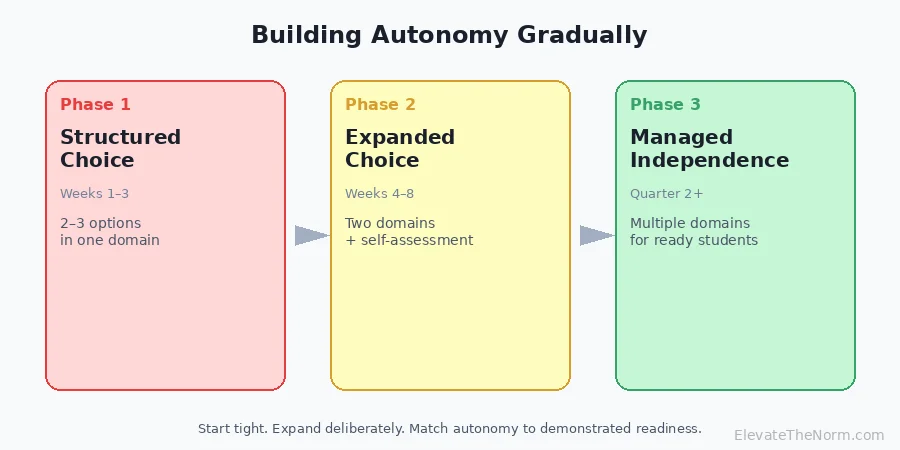
Phase 1: Structured Choice (First Three Weeks)
Offer two or three options in one domain — typically product or pacing. Keep everything else structured. This teaches students how choice works in your room and establishes that autonomy comes with accountability.
Phase 2: Expanded Choice (Weeks Four Through Eight)
Add a second domain. Let students choose both their topic angle and their product. Introduce self-assessment alongside teacher assessment — how students learn to judge their own work is the skill you are actually building here. The check-in structure stays tight — you are circulating, conferencing, and holding students to the timeline.
Phase 3: Managed Independence (Second Quarter and Beyond)
Students who have demonstrated responsibility in Phases 1 and 2 can manage multiple domains simultaneously. They propose a topic, choose a method, manage their pacing, and assess their own work before conferencing with you. Students who have not demonstrated that readiness stay in Phase 2 — not as punishment, but because they need more practice with fewer decisions at once.
This progression is the critical piece most autonomy guides miss. A room where every student has the same level of autonomy regardless of demonstrated readiness is a room that has confused equality with equity. Meeting students where they are means some students have more freedom because they have earned it through consistent, responsible work.
What Autonomy Support Looks Like in the Classroom
Ryan and Deci (2020) describe autonomy-supportive teaching through specific, observable behaviors. Autonomy-supportive teachers listen to students, make time for independent work, give students opportunities to speak, acknowledge improvement and mastery, and provide rationales when requiring specific tasks.
Controlling teachers, by contrast, monopolize learning materials, tell students answers directly, issue directives, and rely on controlling language like “should” and “have to.”
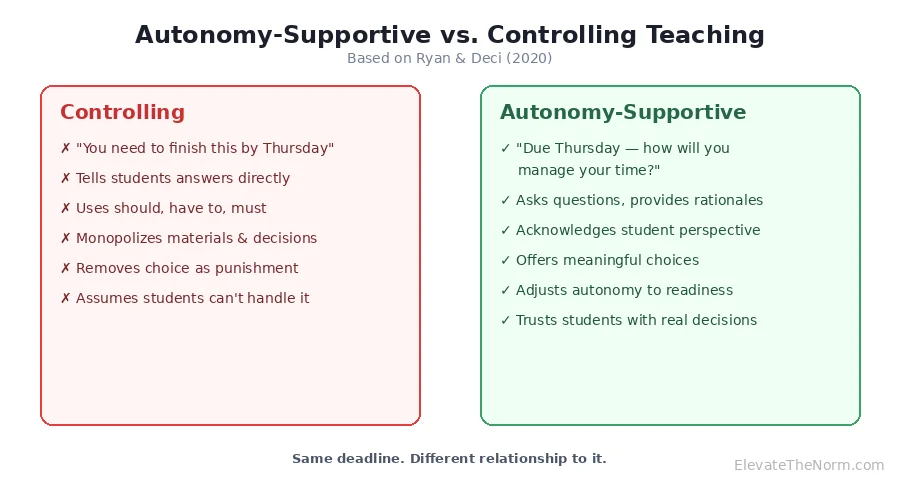
The practical difference is often in language. “You need to finish this by Thursday” is controlling. “This is due Thursday — how are you planning to manage your time?” is autonomy-supportive. The deadline is identical. The relationship to the deadline is different.
Bloem et al. (2024) found that teachers reported giving students from lower socioeconomic backgrounds less autonomy support and more controlling instruction — and teachers with more biased attitudes toward low-SES students differentiated the most. That finding matters for every school in which I have worked. The students who most need the experience of genuine decision-making are often the students least likely to get it, not because they cannot handle it, but because adults assume they cannot.
When Student Autonomy Does Not Work
Autonomy does not work when it is a substitute for planning. A teacher who hands students unstructured time and calls it “student-directed learning” has not given students autonomy. They have given themselves a break.
Autonomy does not work when the choices are not meaningful. Letting students pick between blue paper and green paper is not autonomy. Letting students choose which essay prompt to respond to when both prompts require the same depth of thinking — that is autonomy.
Autonomy does not work without a relationship. A student will not take intellectual risks for a teacher they do not trust. Autonomy support and relatedness — the third pillar of self-determination theory — work together. Building the relationship comes first.
And autonomy does not work when consequences are absent. A student who chooses poorly and faces no consequence has not experienced autonomy. They have experienced permissiveness. Real autonomy includes real accountability — not manufactured stakes, but honest follow-through. If a student chose not to manage their time well, the conversation is not punitive. It is honest: this is what happened, this is what you chose, and this is what you owe now.
The Repair Conversation — Student Autonomy After a Mistake
One of the most important moments in building student autonomy is what happens after a student makes a poor choice. The standard school response is a consequence — a zero, a detention, a phone call home. Those responses are sometimes necessary, but they do not teach autonomy. They teach compliance under threat.
A repair conversation teaches autonomy because it puts the student in the position of identifying what went wrong, who was affected, and what they owe. It is not a lecture. It is a set of questions: What happened? Who was affected by that? What do you think you owe them? When will you do it?
The student does the thinking. The teacher holds the boundary. That is student autonomy at its most practical — a student making real decisions about how to respond to their own mistake, within a structure where the adult is present and the expectation is clear.
This is also where the line between autonomy and permissiveness becomes sharpest. Permissiveness lets the mistake pass. Control punishes it without discussion. Autonomy support says: you made a choice, you are capable of evaluating that choice, and here is what accountability looks like. For a ready-to-use tool on this, see a printable seating chart planning pack.
That same question — how much control students should hold — extends beyond the repair conversation into everyday classroom decisions. For a close look at how that line is drawn across five levels of agency, see student voice and choice in practice.
Frequently Asked Questions
What is the difference between student autonomy and letting students do whatever they want?
Student autonomy means students make genuine decisions within boundaries a teacher has thoughtfully planned. Letting students do whatever they want is not autonomy — it is the absence of teaching. The boundary is what makes the choice meaningful. Without it, students are not exercising autonomy. They are just unsupervised.
How do I give autonomy to students who are not ready for it?
Start with structured choice in one domain — two or three options rather than open-ended freedom. Students who are not yet ready for full autonomy are not incapable of making decisions. They need smaller decisions with more support. Expand the choices as they demonstrate readiness. This is a graduated process, not a binary switch.
Does student autonomy work in tested subjects?
Yes. The learning targets in a tested subject are fixed. Autonomy applies to how students reach those targets — which resources they use, how they pace their work, what product they create to demonstrate understanding, and how they assess their own readiness. Standards constrain the destination. Autonomy applies to the journey.
What about students who choose not to work when given freedom?
A student who stops working when given choice is telling you something about their relationship to the work, the environment, or both. The answer is not to remove the choice for everyone. It is to have a private conversation with that student about what happened, then adjust the level of autonomy for that individual while maintaining it for students who are using it well.
How does student autonomy affect classroom management?
Research consistently shows that autonomy support improves classroom behavior, not the reverse. Jang, Reeve, and Deci (2010) found that autonomy support and structure both predicted observed behavioral engagement in 133 high-school classrooms. When students feel their choices matter and the environment is predictable, disruptive behavior decreases — not because it is punished more effectively, but because the underlying need driving it is addressed.
Can I offer student autonomy in a highly structured school environment?
Yes. Student autonomy lives inside your classroom, within your lesson plans. Even in schools with rigid bell schedules, required curricula, and standardized assessments, you can offer meaningful choice in how students engage with content, how they demonstrate understanding, and how they manage their time within your class period. Autonomy does not require administrative permission. It requires teacher planning.
Sources
- Ryan, R. M., & Deci, E. L. (2020). “Intrinsic and Extrinsic Motivation from a Self-Determination Theory Perspective.” Contemporary Educational Psychology, 61, 101860.
- Jang, H., Reeve, J., & Deci, E. L. (2010). “Engaging Students in Learning Activities: It Is Not Autonomy Support or Structure but Autonomy Support and Structure.” Journal of Educational Psychology, 102(3), 588–600.
- Vasconcellos, D., et al. (2020). “Self-Determination Theory Applied to Physical Education: A Systematic Review and Meta-Analysis.” Journal of Educational Psychology, 112(7), 1444–1469.
- Niemiec, C. P., & Ryan, R. M. (2009). “Autonomy, Competence, and Relatedness in the Classroom.” Theory and Research in Education, 7(2), 133–144.
- Bloem, N., et al. (2024). “Teachers’ Autonomy Support and Control Towards Students from Different Socioeconomic Backgrounds.” Social Psychology of Education, 27, 1247–1270.
- Reeve, J. (2012). “A Self-Determination Theory Perspective on Student Engagement.” In S. L. Christenson, A. L. Reschly, & C. Wylie (Eds.), Handbook of Research on Student Engagement (pp. 149–172). Springer.
About Clay Shumate
Clay Shumate is a certified secondary Social Studies teacher in the public schools of West Alabama, with seven years of classroom experience, a B.A. in History, and an M.Ed. in Secondary Education. He writes about project-based learning, student responsibility, respect, and practical ways to hold young people to a higher standard while giving them room to learn from mistakes. He is a member of the Society of Professional Journalists and writes to its Code of Ethics; this site’s editorial standards and corrections policy are published in full. More about Clay.