By Clay Shumate
Activities for student centered learning only work when students are doing the thinking — not just following instructions that feel participatory. The activities below transfer real decision-making to students while keeping the teacher present, circulating, and holding the standard. Each one works in grades 6–12 without requiring a technology budget, a flexible schedule, or permission from anyone outside your room.
Key Takeaways
- Student-centered activities shift the cognitive load to students — they think, decide, and defend rather than listen and record.
- The teacher does not disappear. The teacher circulates, intervenes at the right moment, and holds the standard.
- Structure prevents confusion. Every activity below includes a clear task, a time frame, and an accountability check.
- A 2023 meta-analysis of 31 studies found that student-centered approaches produced the largest effect sizes at the secondary level — stronger than primary or higher education.
- Start with one activity. Trying to overhaul everything at once is how student-centered learning gets abandoned by October.
What Makes an Activity Student Centered — and What Just Looks Like It
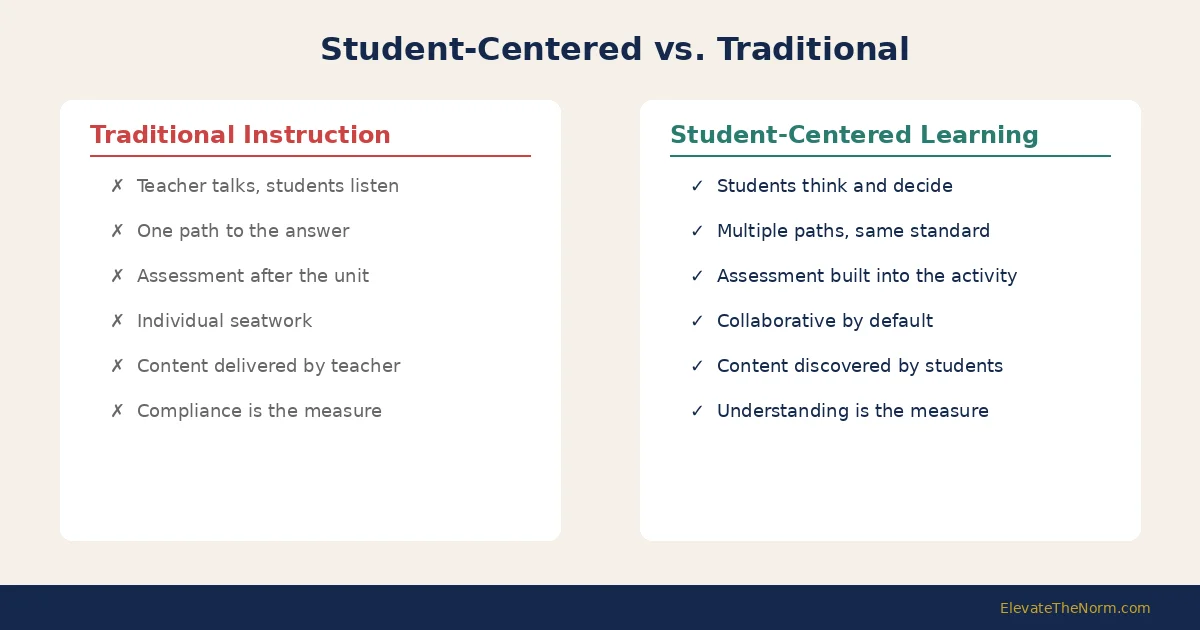
A lot of activities get called student centered because students are moving, talking, or using colored markers. That is not the test. The test is: who is doing the thinking?
If students are following a step-by-step handout, filling in blanks, or rotating through stations that ask nothing beyond recall, the teacher is still doing the cognitive work — just delivering it through a different medium. Student-centered means students are making decisions about what to investigate, how to approach a problem, or how to present evidence. It means they encounter genuine uncertainty — not a question where the answer is already written on the back of the card.
A meta-analysis by Baeten, Dochy, Struyven, Parmentier, and Vanderbruggen (2023), published in SAGE Open, reviewed 31 studies and found a large overall effect of student-centered education on learning outcomes (SMD = 0.72, p < .001). The finding that matters most for middle and high school teachers: secondary education showed the strongest effect of any level, with an SMD of 0.98 — meaning student-centered approaches produced nearly a full standard deviation of improvement at the grades where many teachers still default to lecture. Programs that ran longer than six months showed the largest gains (SMD = 1.08), which means this is not a novelty effect. It is a sustained instructional advantage.
That said, the study’s heterogeneity was very high (I² = 99.7%), which means the quality of implementation matters enormously. Poorly structured student-centered activities will not produce these results. The activities below are designed with that constraint built in: every one of them includes the structure that makes the approach work, not just the freedom that makes it sound good.
Activities That Transfer Real Thinking to Students
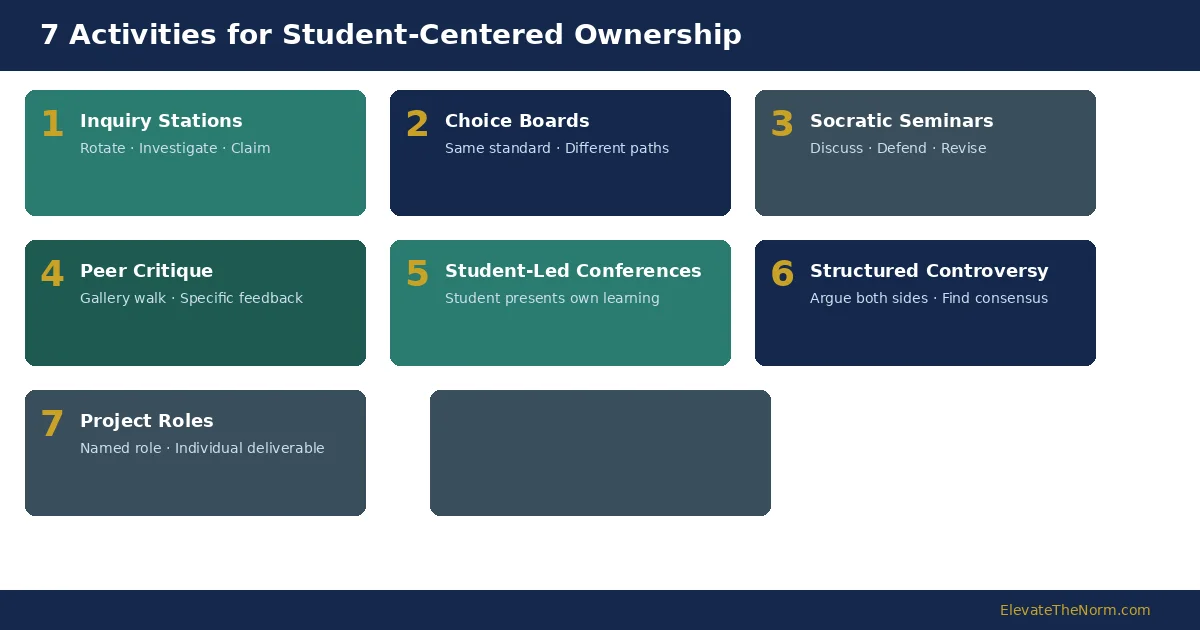
Inquiry Stations
What it is: Students rotate through three to five stations, each presenting a different primary source, data set, image, or short text related to the same question. At each station, they record observations, generate questions, and build toward a claim they will defend at the end of the rotation.
Why it works: Students encounter evidence before they encounter the teacher’s interpretation. They have to look at something, decide what it means, and compare it against what they found at the previous station. The thinking is theirs.
The structure that prevents confusion: Post the driving question where everyone can see it. Give each station a task card with one or two specific prompts — not open-ended “discuss what you see” instructions that lead to three minutes of silence followed by off-task conversation. Set a timer for each rotation. Have students record individually, even if they talk in groups, so there is an accountability artifact.
In my room, I set up inquiry stations on trapezoid tables pushed together, which means groups of three or four are already facing each other when they sit down. I circulate during rotations. More than once, I have caught a group building a misconception from one station’s source — they misread a chart or drew a conclusion the data did not support — and the only reason I caught it was because I was standing close enough to hear them reason through it before they wrote it down. That is the teacher’s job in a student centered learning classroom: not to deliver the content from the front, but to be close enough to redirect the thinking before it hardens into a wrong answer. The same demand on your attention runs through the longer bank of experiential activities for grades 6–12.
Choice Boards Within Standards
What it is: A grid of options — typically three-by-three or four-by-four — where each cell is a different way to demonstrate understanding of the same learning target. Students choose which cells to complete. Every option meets the same standard; only the mode of expression changes.
Why it works: A meta-analysis by Patall, Cooper, and Robinson (2008) reviewed 41 studies on the effects of choice on intrinsic motivation and found a moderate positive effect (d = 0.30–0.36). More importantly for teachers, choice also improved perceived competence (d = 0.59) and task performance (d = 0.32). The authors found that younger learners benefited more than older ones, and that a moderate number of options — two to four — worked better than an overwhelming menu.
The structure that prevents confusion: The board is not a buffet of busywork. Every cell must require the same depth of thinking — do not put “draw a poster” next to “write an analytical paragraph” and pretend those are equivalent. Build the board so a student who picks any combination of cells has demonstrated the target. Include a rubric that applies across all cells. Require students to commit to their choices before starting, not to switch mid-task when the first one gets hard.
Choice boards are one of the clearest ways to give students real student responsibility without lowering the bar. The standard does not move. The path to it does.
Socratic Seminars
What it is: A structured discussion in which students — not the teacher — drive the conversation about a text, question, or problem. Participants sit in a circle (or an inner-outer circle variation), reference evidence, build on each other’s ideas, and disagree respectfully. The teacher observes, tracks participation, and intervenes only to redirect or probe.
Why it works: Students practice every skill that matters and cannot be tested on a multiple-choice exam: listening, articulating a position, responding to disagreement, revising their thinking in real time. Research from the Association for Supervision and Curriculum Development describes Socratic seminars as developing “listening, speaking, and critical-thinking abilities” through peer dialogue rather than teacher-directed Q&A (ASCD, 2023). In one documented middle school implementation, students who participated in regular seminars began using structured discussion moves spontaneously during regular class activities — evidence of transfer, not performance.
The structure that prevents confusion: Assign the text in advance. Require students to come with at least two prepared questions. Use a fishbowl format (inner circle discusses, outer circle evaluates and rotates in) if your class is larger than fifteen. Set a participation tracker — a simple grid where the teacher tallies contributions — so quiet students are noticed and dominant talkers learn to make space. Follow every seminar with a written reflection: “What changed in your thinking today, and why?”
Socratic seminars work in every subject. A history class argues over primary sources. A science class debates competing hypotheses. An English class examines authorial intent. The format is the same; the content changes. It is one of the most powerful activities for student centered learning because the students genuinely cannot predict where the conversation will go — and neither can the teacher. The long version — six moves, six norms, and an honest read of what the discussion research does and does not support — is in the full walkthrough of running a seminar in a secondary classroom.
Peer Critique Protocols
What it is: A structured process in which students review each other’s work using specific criteria. The most effective version is the gallery walk, where student work is posted around the room and classmates circulate, leaving written feedback on sticky notes or feedback forms. Ron Berger’s framework from EL Education requires that feedback be “kind, specific, and helpful” — three words that do more than any rubric to prevent critique from becoming cruelty or flattery.
Why it works: Students learn to evaluate quality by evaluating someone else’s work against a standard. That is harder than evaluating their own, and it builds the judgment they need to self-assess later. PBLWorks, which runs this protocol constantly, reports from its own practice that giving participants a specific focus — such as content accuracy, argument structure, or evidence quality — helps generate higher-quality feedback, where open-ended instructions produced superficial comments like “good DQ!”. That is practice knowledge rather than a study; the article cites no research. What is well evidenced is the peer assessment underneath the protocol — a meta-analysis of 54 control-group studies put it at g = 0.31 on achievement, and higher at secondary level.
The structure that prevents confusion: Give students the rubric or success criteria before the gallery walk, not after. Require written feedback — verbal feedback disappears the moment the bell rings. Use structured stems: “I notice…,” “I wonder…,” “One thing that would strengthen this is….” Set a time limit per station. Debrief as a class afterward, pulling patterns from the feedback rather than singling out individual work. The six-step version of this protocol, and the four ways it most often collapses, are in the full walkthrough of running one so the feedback is worth reading.
Peer critique teaches respect in the classroom through practice, not through a poster. When students learn to disagree with someone’s work without attacking the person who made it, they are learning a skill most adults have not mastered.
Student-Led Conferences
What it is: Instead of the teacher reporting to the parent about the student, the student leads the conversation. They present their work, explain their progress, identify their strengths and weaknesses, and set goals — with the teacher and parent as listeners and questioners, not narrators.
Why it works: The student has to articulate what they know, what they do not know, and what they plan to do about it. That requires self-assessment, organization, and the ability to speak about learning — not just perform it. It also shifts the parent-teacher conference from a conversation about the student to a conversation with the student, which is what project based learning looks like when it extends beyond the classroom walls.
The structure that prevents confusion: Give students a preparation template at least a week in advance. Include sections for: “one piece of work I am proud of and why,” “one area where I need to improve,” “my plan for improvement,” and “questions I have for my teacher or parent.” Rehearse the conference format in class. Set a time limit — ten to fifteen minutes is enough. Have the teacher take brief notes during the conference and follow up privately if anything the student said needs correction or support.
Structured Academic Controversy
What it is: Pairs of students are assigned a position on a debatable question. They research and present their side, then switch sides and argue the opposite. Finally, the group drops the assigned positions and reaches a consensus based on the evidence from both sides.
Why it works: Students cannot settle for their first opinion. They have to argue a position they may disagree with, which forces them to engage with evidence rather than preference. The consensus requirement at the end prevents the activity from becoming a performance — it requires synthesis, not just persuasion.
The structure that prevents confusion: Choose a question where both sides have legitimate evidence — not a question with a clear factual answer. Provide curated sources so the research phase is productive, not a twenty-minute Google detour. Set time limits for each phase: five minutes to prepare, three minutes to present each side, five minutes for consensus. Require each group to write a one-paragraph consensus statement citing evidence from both sides.
Project Roles With Built-In Accountability
What it is: Within a group project, each student holds a named role with a specific deliverable that the group depends on. Roles might include project manager (owns the timeline and check-ins), lead researcher (synthesizes sources), quality controller (evaluates drafts against the rubric), or presentation coordinator (designs the final product). The key: each role has a visible individual deliverable, not just a title.
Why it works: The most common complaint about group projects — “one person does all the work” — is a design problem, not a student problem. When the role includes a deliverable that the group cannot complete without, freeloading becomes structurally difficult. Students learn to manage real project work rather than divide a poster into four corners.
The structure that prevents confusion: Define each role on a printed card with the title, the deliverable, the deadline, and how the role connects to the final product. Rotate roles across projects so students build multiple skills. Include a brief individual reflection at the end: “What did your role require? What did you do well? What would you do differently?” This makes individual accountability visible without turning group work into individual work in disguise.
Reflection Protocols
What it is: A structured end-of-task or end-of-week routine in which students write about what they learned, how their thinking changed, what confused them, and what they would do differently. This is not a journal entry. It is a directed reflection with specific prompts and a purpose.
Why it works: Learning that is not reflected on tends to stay shallow. A student who completes an inquiry station, participates in a seminar, or finishes a project but never pauses to consolidate what happened will forget most of it by the following week. Reflection is where experience becomes understanding — which is exactly why experiential learning frameworks like Kolb’s cycle put reflection at the center of the process, not the end.
The structure that prevents confusion: Use three to four specific prompts, not “reflect on your learning.” Try: “What did you think before this activity? What do you think now? What evidence changed your mind?” or “Name one thing that confused you today. Write down what you tried before asking for help.” Keep it to five minutes. Read the reflections — they are your best formative data, and students write more honestly when they know the teacher actually reads them.
The Teacher’s Role: Present, Not Passive
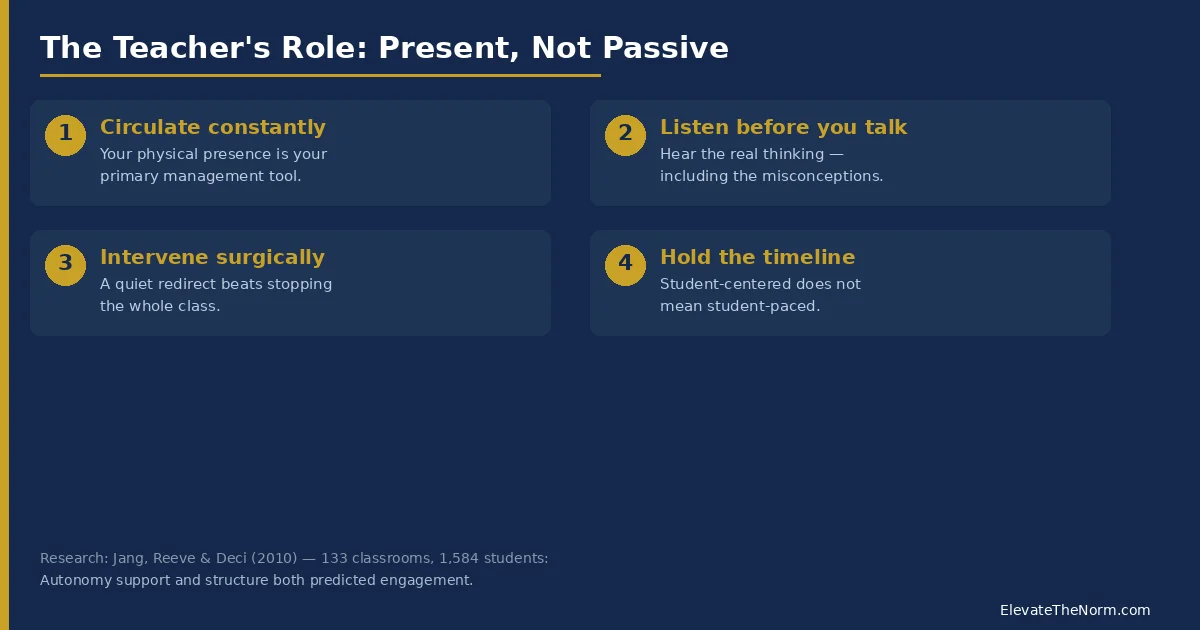
Every activity above requires a teacher who is actively working the room — not sitting at a desk, not grading papers, and certainly not treating “student centered” as a synonym for “teacher absent.” The research is clear on this. Jang, Reeve, and Deci (2010) studied 133 high school classrooms with 1,584 students and found that autonomy support and structure were positively correlated — teachers who gave students meaningful choices also provided clear expectations and active guidance. Both predicted behavioral engagement, and autonomy support uniquely predicted students’ self-reported engagement.
That finding should end the false dichotomy between “teacher-directed” and “student-centered.” The best version of student-centered instruction is teacher-led in terms of structure and student-led in terms of thinking. The teacher builds the frame. The students fill it.
In practical terms, this means:
- Circulate constantly. Every activity in this article assumes the teacher is moving. If you are standing in one spot, you are missing what is happening across the room.
- Listen before you talk. When you approach a group, listen for thirty seconds before saying anything. You will hear the real thinking — including the misconceptions you need to address.
- Intervene surgically. A quiet redirect to one group is more effective than stopping the whole class. Save the full-class interruption for patterns, not individual mistakes.
- Hold the timeline. Student-centered does not mean student-paced. Post the schedule. Keep it visible. Name the time remaining. Students work better inside a boundary they can see.
How to Prevent Freedom From Becoming Confusion
The number one reason teachers abandon student-centered activities is not that the activities failed — it is that the room fell apart during the transition. Students did not know what to do, took too long to start, or interpreted “work with your group” as “talk to your friends about the weekend.”
Here is the fix, and it is not complicated:
- Explain the activity in under two minutes. If your instructions take longer than that, the activity is too complicated or your explanation is too detailed. Students learn the activity by doing it, not by listening to you describe every contingency.
- Post the task, the time, and the product. Every student should be able to look at the board and answer three questions without asking you: What am I doing? How long do I have? What do I turn in?
- Start with a model. The first time you run a Socratic seminar, model it with a small group while the rest of the class watches. The first time you use peer critique, walk through one example piece of feedback as a class. This takes ten minutes and saves you from answering the same question thirty times.
- Build in a two-minute check. Two minutes after students begin, stop and ask: “Raise your hand if you are not sure what you should be doing right now.” Fix the confusion immediately. Do not wait until the end of the period to discover that half the room was lost from the start.
- Debrief every time. Spend the last three minutes of the activity debriefing what worked and what did not. This is where student motivation builds — when they see that the activity had a point, that their effort produced something, and that the teacher noticed.
Starting Small: A Realistic Entry Point
Do not try to run all of these activities next Monday. Pick one. Run it once. See what happens. Adjust. Run it again.
If you have never done anything student-centered beyond group work, start with a choice board. It requires the least classroom management adjustment, gives you a visible product to assess, and lets students practice making decisions within a structure you control. Once that feels routine — two or three times, usually — add a Socratic seminar or a gallery walk. Build the repertoire over weeks, not days.
The Baeten et al. (2023) meta-analysis found that student-centered interventions lasting longer than six months produced effect sizes nearly double those of shorter interventions (SMD = 1.08 vs. 0.63–0.72). Translation: this is a long game. The activities get more effective the more students experience them, which means the worst thing you can do is try everything once, decide it did not work, and go back to lecture. It did not fail. It had not started yet.
Teach the way you want students to learn: start with what is manageable, build from experience, and treat the mistakes as data, not as evidence that you should quit. For a ready-to-use tool on this, see a printable student-led conference toolkit.
Student-centered activities work best when students also have a real say in how the work is structured. For a framework on how much say students can hold at each level — and where teacher authority must stay — see student voice and choice.
Frequently Asked Questions
Do student-centered activities work in large classes?
Yes, but the structure matters more. Inquiry stations, choice boards, and peer critique protocols all scale to thirty-plus students because they operate in small groups. Socratic seminars work best with fifteen or fewer in the inner circle — use the fishbowl format for larger classes. The key is that every student has a specific task, not that every student is doing the same thing at the same time.
How do I assess student-centered activities?
Use the products the activities produce. Inquiry stations generate claim statements. Choice boards produce varied demonstrations of the same standard. Peer critique generates written feedback. Socratic seminars pair with participation trackers and written reflections. Every activity in this article includes a built-in artifact you can grade, which means assessment does not require a separate test.
What if students are not used to this kind of work?
Expect the first attempt to be messy. Students who have spent years in teacher-directed classrooms need time to adjust to making decisions, and that adjustment sometimes looks like confusion or off-task behavior. The fix is not to abandon the approach — it is to start with the most structured option (choice boards), build routines over several weeks, and explicitly teach the behaviors each activity requires before running it.
Can student-centered activities cover required standards?
They must. Student-centered is not a license to skip the curriculum. Every activity in this article is designed around a learning target tied to standards. Choice boards offer multiple paths to the same standard. Inquiry stations present evidence aligned to specific content. Socratic seminars and structured academic controversies require engagement with course material. If the activity does not serve the standard, redesign the activity — do not lower the standard.
Is student-centered learning the same as project based learning?
No, but they overlap. Project based learning is one type of student-centered instruction — one that is sustained, inquiry-driven, and produces a public product. The activities in this article are shorter, can fit inside a single class period, and do not require a multi-week project structure. A teacher running PBL will use many of these activities within a project. A teacher who does not run PBL can still use all of them.
How do I handle students who refuse to participate in group activities?
First, find out why. A student who refuses to participate is telling you something — about the group, the task, the social dynamics, or their own confidence. Offer a structured alternative that meets the same objective individually, and check in privately. Do not force public participation as a compliance test. That said, opting out of collaboration entirely is not a long-term option in a classroom that values it, so build toward participation gradually with low-risk entry points like written peer feedback before verbal discussion.
Do these activities work for students with IEPs or 504 plans?
Student-centered activities are often more accessible than traditional instruction, not less. Choice boards allow students to demonstrate learning through their strongest mode. Inquiry stations can include differentiated source materials at different reading levels. Socratic seminars can be supported with sentence stems and pre-discussion preparation time. The built-in flexibility of student-centered work makes accommodation a design feature, not an add-on — but you still need to review each activity against the specific accommodations in each student’s plan.
Sources
- Baeten, M., Dochy, F., Struyven, K., Parmentier, E., & Vanderbruggen, A. (2023). “Student-Centered Education: A Meta-Analysis of Its Effects on Non-Academic Achievements.” SAGE Open, 13(2). https://doi.org/10.1177/21582440231168792
- Patall, E. A., Cooper, H., & Robinson, J. C. (2008). “The Effects of Choice on Intrinsic Motivation and Related Outcomes: A Meta-Analysis of Research Findings.” Psychological Bulletin, 134(2), 270–300. https://doi.org/10.1037/0033-2909.134.2.270
- Jang, H., Reeve, J., & Deci, E. L. (2010). “Engaging Students in Learning Activities: It Is Not Autonomy Support or Structure but Autonomy Support and Structure.” Journal of Educational Psychology, 102(3), 588–600. https://doi.org/10.1037/a0019682
- Association for Supervision and Curriculum Development (ASCD). (2023). “Socratic Seminars: Engaging Students in Intellectual Discourse.” Educational Leadership. https://www.ascd.org/el/articles/socratic-seminars-engaging-students-in-intellectual-discourse
- PBLWorks. (2024). “Using Gallery Walks for Critique & Revision in PBL.” Buck Institute for Education. https://www.pblworks.org/blog/using-gallery-walks-critique-revision-pbl
- Berger, R., Rugen, L., & Woodfin, L. (2014). Leaders of Their Own Learning: Transforming Schools Through Student-Engaged Assessment. Jossey-Bass/EL Education.
About Clay Shumate
Clay Shumate is a certified secondary Social Studies teacher in the public schools of West Alabama, with seven years of classroom experience, a B.A. in History, and an M.Ed. in Secondary Education. He writes about project-based learning, student responsibility, respect, and practical ways to hold young people to a higher standard while giving them room to learn from mistakes. He is a member of the Society of Professional Journalists and writes to its Code of Ethics; this site’s editorial standards and corrections policy are published in full. More about Clay.