An academic integrity email is a record. That is the first thing to understand about it, and it changes almost everything about how it should be written — because under federal law a written communication that is directly related to a student and kept by the school can become part of that student’s education record, which a parent has the right to read.
So the question is not what you feel like writing at 9pm with a plagiarised essay open in another tab. The question is what you would be comfortable reading aloud, months later, in a meeting with the student, both parents and an assistant principal.
Three emails usually have to be written: one to the student, one to the family, one to whoever handles this in your building. They have different jobs and should not contain the same paragraph. Below is what goes in each, worded out, along with the five sentences that cause most of the trouble.
Key Takeaways
- Write observations, not verdicts. “Three paragraphs match a source that is not cited” is a fact. “You plagiarised this” is a conclusion you may not be the one authorised to reach.
- Assume a parent will read it. FERPA gives parents of K–12 students the right to inspect their child’s education records, and schools must respond within 45 days.
- Talk to the student before you email anyone else whenever the timetable allows. An email that arrives home before the student has been asked what happened turns a fixable situation into an ambush.
- Specific beats gentle. In a high-school field experiment, messages to parents about what a student needed to improve outperformed messages about what they were doing well.
- Never put another student’s name in it. Two students, two separate emails, no cross-references.
- Say what happens next and when. Most of the panic in these situations is uncertainty, not consequence.
- Do not send it angry. The pause costs nothing and prevents the sentence you cannot unsend.
Free Download · Printable PDF
Academic Integrity Email Templates
All three emails from this article — student, family, administrator — as copy-and-adapt templates, plus the phrase-swap table and a pre-send checklist.
Free. No email address required. Designed for grades 6–12. The full response process is on the academic integrity response page.
Before You Write Anything: What an Email Actually Is
Teachers tend to treat email as conversation. It is closer to filing.

The U.S. Department of Education’s guidance defines an education record as one that is “directly related to a student” and maintained by the school. Parents of K–12 students have the right to inspect those records, and a school must comply “within a reasonable period of time, but not more than 45 days after receipt of a request.” Whether any particular email meets that bar depends on how your district stores and treats it — which is a question for your administrator, not for a blog. The practical takeaway does not depend on the edge cases: write every one of these as though it will be read by the family, because it may be.
The same guidance is why the other rule exists. Sharing personally identifiable information from a student’s record with a third party generally requires written consent from the parent or eligible student. A second student’s name in an email to the first student’s parents is the most common way a teacher creates a problem that is genuinely larger than the cheating was.
One more framing point before the templates. You are almost never the person who decides that a violation occurred — your handbook names that person, and it is usually not you. What you are qualified to write is what you observed. Keeping to that is not timidity. It is the thing that makes the email survive.
It also assumes the line was clear in the first place. A good share of what lands in these emails is not defiance but a student guessing at a boundary nobody wrote down — which is why what academic honesty actually means in grades 6–12 is worth settling before an incident rather than during one, and why the worked examples of where the line falls are more use to a class than a policy paragraph. If you find yourself writing the same email four times a term, the assignment design is the thing to look at, not the students.
The Email to the Student
Send this one first, and keep it short. Its only job is to get the student into a conversation without pre-judging the outcome.
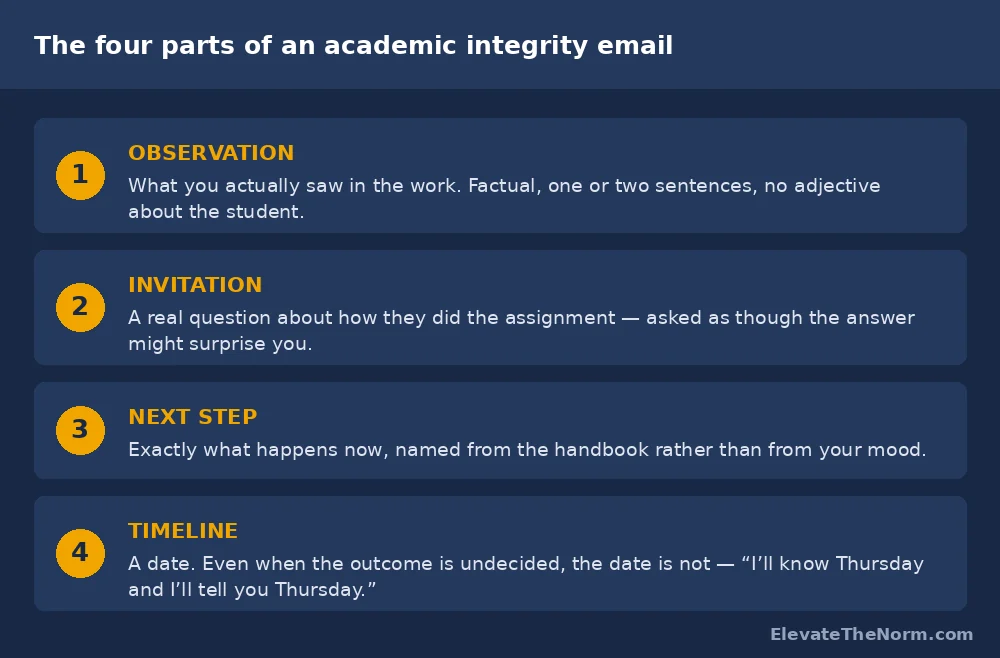
The University of California San Diego’s academic integrity office frames this conversation around what it calls clarity, compassion and candor, and its recommended opening is an observation rather than a charge — some version of I have some concerns about your recent assignment; specifically, it appears that you may have… followed by an open question about how the student did the work. Their guidance is written for a university, where the student is an adult and no parent is in the loop. In grades 6–12 the structure transfers; the surrounding obligations do not, which is why there are two more emails below.
Template · to the student
Subject: Your [assignment name] — quick conversation Tuesday
Hi [Name],
I’m reading through the [assignment] and I have a question about yours. [One sentence of plain observation — e.g. “Three of the paragraphs closely match a source that isn’t in your citations,” or “Two of the sources listed don’t appear to exist.”]
Before I do anything else I want to hear how you put it together. Come see me during [specific time], or tell me a time that works.
I’m not assuming anything yet. I do need to understand it.
[Your name]
Note what is absent. No adjective about the student. No mention of the handbook, the consequence, or the word cheating. No parent copied in. A thirteen-year-old who reads that email is anxious, which is unavoidable, but they are not cornered, and they can still tell you the truth without it being a confession.
Give a specific time rather than “come see me.” A vague summons is worse than a direct one, because the student spends two days constructing the worst version of it.
The Email to the Parent or Guardian
This goes after you have spoken to the student, not before, unless your policy explicitly requires otherwise. Its job is to inform accurately and to say what happens next.
There is decent evidence that the specific, improvement-focused version of a message home does more than the softened one. Kraft and Rogers ran a field experiment in a high-school credit recovery programme, sending parents weekly one-sentence individualised messages from teachers. The share of students failing to earn course credit fell from 15.8 percent to 9.3 percent, and the messages emphasising what students could improve produced larger effects than the messages about what they were doing well.
Read the limits before borrowing the conclusion. That was a credit-recovery setting with students already at risk, the gain came mainly from students not dropping out rather than from better grades, and the messages were about ordinary progress, not integrity violations. It is not evidence that a blunt email about cheating improves anything. What it reasonably supports is the narrower claim: parents respond to specific information about a problem, and vagueness is not kindness.
Template · to the parent or guardian
Subject: [Student name] — [assignment], and what happens next
Dear [Name],
I’m writing about [student]’s [assignment], submitted [date]. [One or two sentences of observation — the same factual sentence you sent the student.]
I spoke with [student] on [date]. [One sentence on what they said, neutrally reported.]
Under our [handbook section / department policy], the next step is [exact next step]. That will happen by [date]. [If a grade is affected, say precisely how. If it is not yet decided, say that instead.]
I want to be straightforward with you about two things. The first is that this is being handled as a teaching situation, not a character judgement. The second is that [student] is not in any trouble they cannot come back from — the repair is defined and it is finite.
I’m glad to talk. [Phone/time].
[Your name]
The paragraph most teachers omit is the third one, and it is the one families actually need. Parents are rarely angry about the report. They are angry about not knowing what it means, what it does to a grade, and whether it follows their child around. Say all three.
If your school is going to notify them anyway, you want to be the first message they read. A family who hears it from an automated referral before they hear it from you will spend the whole meeting recovering from that.
And tell the student what is going home before it goes. Not for approval — you are sending it either way — but so they are not blindsided at the dinner table by a document they have never seen. One sentence covers it: I’m emailing your mum this afternoon, here is what it says. A teenager who knows what is coming can walk into that conversation as a participant. One who does not walks into an ambush arranged by an adult who had already decided to be fair to them. Being fair without being transparent still feels, from the inside, like being handled.
It helps enormously if this is not the first message that family has had from you all year. A parent whose only contact from a teacher is bad news reads every email as bad news, which is one practical argument for keeping some kind of routine family contact going when nothing is wrong.
Two practical notes. Email is not universal access — some families do not read English comfortably, some do not use email at all, and many districts route family contact through the student information system rather than your inbox. Use whatever channel actually reaches them, and make sure a written record exists afterwards either way. And if the student has an IEP or 504 plan, bring the case manager in before you send anything, because procedural protections may apply to how a discipline matter is handled.
The Email to an Administrator
Shortest of the three, and the one that most often gets over-written. An administrator needs the facts, the artefacts and what you are asking for — not your interpretation.
Template · to an administrator
Subject: Possible integrity issue — [student], [class, period]
[Name],
Reporting under [handbook section].
What I observed: [Factual, one to three sentences.]
Evidence attached: [The submission, the source, the comparison, the timestamp — whatever you actually have.]
Student conversation: [Date, and what they said, neutrally reported.]
Family contact: [Date and method, or “not yet — advise.”]
What I’m asking: [Guidance / formal referral / confirmation that my planned response is correct.]
[Your name]
Write this one before you are asked for it rather than after. The version composed a fortnight later from memory is weaker, and by then the timestamps you would have wanted are gone.
Five Sentences That Cause Problems
Every one of these appears in real teacher emails, and every one creates work later.
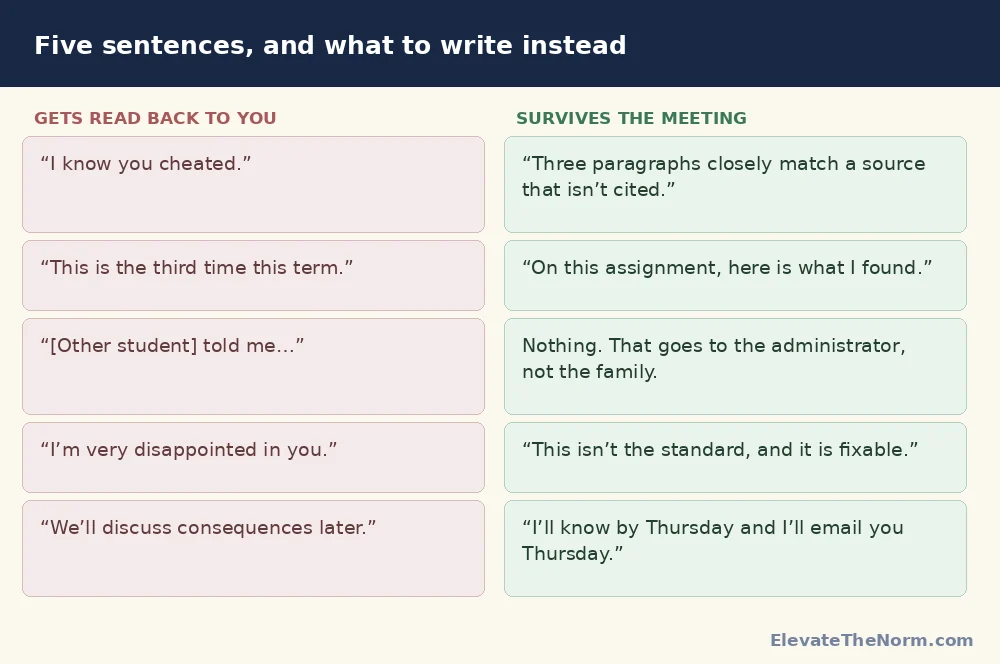
“I know you cheated.” You know what you observed. Certainty you cannot evidence is the fastest route to a retraction, and if you are wrong even once the student is owed an apology you will find hard to write.
“This is the third time this has happened in this class.” True, probably, and it tells a parent their child is being read against a pattern of other people’s behaviour. It also edges toward other students’ records.
“[Other student] told me…” Never. Name no one. If another student’s account matters, it goes to the administrator, not into an email to a family.
“I’m very disappointed in you.” It reads as a character verdict, and it is the sentence teenagers remember for years. You can hold the standard without grading the person; that distinction is the whole of what makes a repair possible.
“We’ll discuss consequences later.” Later is the cruellest word in the email. Give a date even if you cannot give an outcome: I’ll know by Thursday and I’ll tell you Thursday.
The Pause Before You Send
I have a rough count I use before responding to anything in the room — somewhere around fifteen, though it is an average rather than a rule and it moves with the day, the class and the student. It is not a technique so much as a refusal to answer at the speed of my first reaction.
Email deserves a longer version of the same thing, because the medium removes every correction a conversation gives you. There is no face telling you the sentence landed badly. There is no chance to say that came out wrong. And unlike a spoken word, it is still there in March.
So the one habit worth building: write the integrity email, then do not send it. Leave it until the next morning and read it once more. The version you would have sent the night before is almost always half a degree sharper than the situation needed, and that half degree is what the family remembers.
Nothing is lost by the delay. There is no academic integrity situation that gets worse overnight, and a good many of them look different once you have slept.
When you do not have time for all three
Three emails and a conversation is the complete version, and on a Tuesday with two duties and a deadline you will not have it. Here is what compresses without damage.
- The student email never gets cut. It is six sentences and it is the one that keeps the situation recoverable.
- The student conversation can be two minutes at a desk rather than a scheduled meeting, as long as it is out of earshot of the room.
- The administrator email can wait a day in most cases — but write the facts down the same day, even as a note to yourself, because that is the part memory ruins.
- The family email is the one to do properly. If something has to slip to tomorrow, slip this one and send it well rather than sending it fast.
Before you go: grab the free Academic Integrity Email Templates (PDF) — ElevateTheNorm.com branded, printable, no email required.
Frequently Asked Questions
What should an academic integrity email say?
Four things, in this order: the observation, an invitation to explain, the next step, and a date. The observation is factual — what you saw in the work, not what you concluded about the student. The invitation is a real question about how they did the assignment. The next step is whatever your handbook actually requires. The date matters more than teachers expect, because most of the distress in these situations is uncertainty rather than consequence. Anything beyond those four things is usually you managing your own feelings in a document that will outlive them.
Should I email the parents before or after talking to the student?
After, unless your policy says otherwise. An email that reaches home before the student has been asked what happened removes their chance to explain and converts a fixable problem into an ambush — and a meaningful share of suspected violations turn out to be a misunderstood instruction, a citation done badly, or a permission the student genuinely believed they had. Talk first, then write the family a message that includes what the student said.
Can I say a student cheated in an email?
Be careful, and check who in your building is actually authorised to make that determination — in most handbooks it is not the classroom teacher. What you can always write is what you observed: matching text, sources that do not exist, two identical submissions, a timestamp that does not fit. Observations survive scrutiny. Conclusions you are not empowered to reach create a retraction problem if any part of the picture turns out to be different.
Is a teacher’s email about a student part of their school record?
It can be. The U.S. Department of Education defines an education record as one directly related to a student and maintained by the school, and parents of K–12 students have the right to inspect those records, with schools required to respond within 45 days. Whether a specific email qualifies depends on how your district stores and treats it, which is a question for your administrator rather than an article. The safe working assumption is that anything you put in writing about a student may be read by that student’s family.
Can I mention another student in the email?
No. Two students means two separate emails with no cross-references, no names, and no “and the other student involved.” Beyond the practical fairness problem, disclosing personally identifiable information from one student’s record to another family generally requires written consent. If another student’s account is part of what you observed, that belongs in your report to the administrator.
What if I send the email and then find out I was wrong?
Correct it in writing, quickly, to everyone who received the original, and do it without hedging. This is precisely why the observation-not-verdict rule earns its keep — “three paragraphs matched an uncited source” is a fact that stays true even when the explanation turns out to be innocent, so the correction is a clarification rather than a retraction. If you did accuse, apologise plainly to the student, including in front of anyone who saw the accusation.
How formal should the email to the student be?
Less formal than the one to the parent, and much shorter. You are trying to start a conversation, not open a file. Six sentences is plenty. Formality reads as escalation to a teenager, and the more official the email sounds, the more likely they are to arrive with a rehearsed story rather than an honest one.
Sources
- U.S. Department of Education, Student Privacy Policy Office. FERPA frequently asked questions. Read the guidance — source for the definition of an education record (directly related to a student and maintained by the institution), the parental right of inspection, the 45-day response requirement, and the written-consent rule for third-party disclosure. General federal guidance; it does not rule on any particular email, and district policy and state law both apply on top of it.
- Academic Integrity Office, University of California San Diego. How to talk to a student suspected of cheating. Read the guidance — source for the clarity/compassion/candor framing and for opening with an observation rather than an accusation. Written for a university, where students are adults and families are not involved; the conversational structure transfers to grades 6–12 but the notification obligations do not.
- Kraft, M. A., & Rogers, T. (2015). The underutilized potential of teacher-to-parent communication: Evidence from a field experiment. Economics of Education Review, 47, 49–63. Read the record — weekly one-sentence individualised messages to parents in a high-school credit recovery programme; students failing to earn credit fell from 15.8% to 9.3%, driven by reduced dropout rather than improved grades, with improvement-focused messages outperforming praise-focused ones. Not a study of integrity communication — cited here only for the narrower finding that specific information outperforms vague reassurance.
Every link above was checked on September 17, 2026. This article is not legal advice and does not interpret any district’s policy. Where federal guidance and your handbook appear to disagree, ask your administrator before you send anything.