By Clay Shumate
The most effective classroom management strategies for difficult students in grades 6–12 are mostly about you: stay neutral when a student tests you, handle corrections privately, and follow through on exactly what you said you’d do. Then look for the cause behind the behavior and give the student a real way back in, like a role, a fresh start, or a reachable goal.
Every teacher gets the student who tests them. Sometimes it’s a comment from the back row, sometimes it’s a flat refusal to open a notebook, sometimes it’s a week of small moves designed to find out whether you’ll crack. How you handle that student teaches the rest of the room what your classroom is really like.
With around 150 students across five or six periods, you can’t run a long intervention every time someone pushes. You need responses that are short, calm, and the same every time.
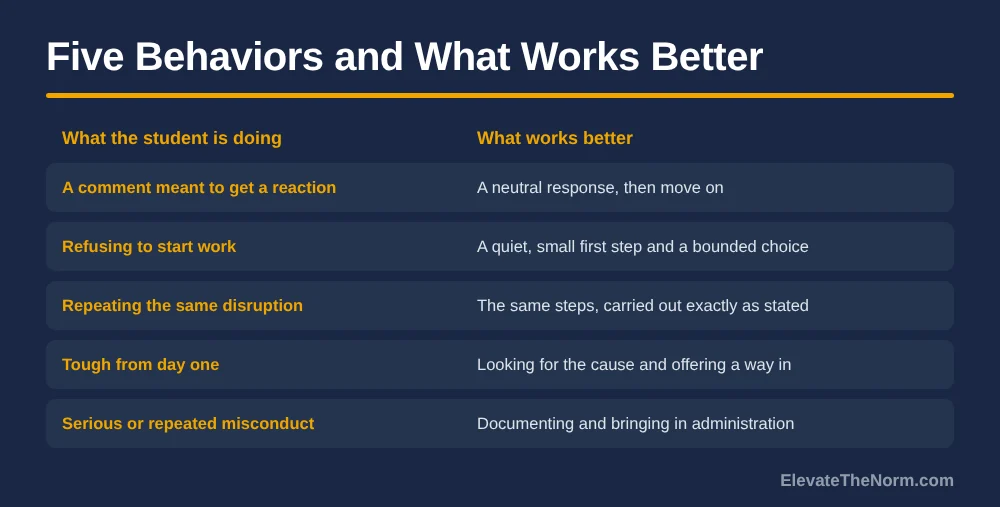
Quick Guide: What the Student Is Doing vs. What Works
| What the student is doing | What usually backfires | What works better |
|---|---|---|
| A comment meant to get a reaction | Snapping back, arguing in front of the class | A neutral response, then move on |
| Refusing to start work | A public ultimatum | A quiet, small first step and a bounded choice |
| Repeating the same disruption | New threats every time | The same steps, carried out exactly as stated |
| Tough from day one | Deciding they’re “just a hard kid” | Looking for the cause and offering a way in |
| Serious or repeated misconduct | Handling heavy remediation alone | Documenting and bringing in administration |
Stay Neutral When a Student Tests You
A student who is testing you wants a reaction. A raised voice, a sharp comeback, or a visible flash of frustration tells them the button works, and they’ll push it again.
My advice is simple: don’t react to what a student says to bait you. Staying neutral shows confidence. With grades 7–8 and up, a little light sarcasm can do the same job, as long as it’s aimed at the situation and never at the kid. A calm “Noted. Page 42, please” takes the air out of a comment faster than a lecture.
Neutral doesn’t mean ignoring behavior. It means you choose when and where to deal with it, and you don’t let the student pick the stage. If you’ve ever found yourself raising your voice to win a moment, the piece on teacher yelling at students covers why that usually costs more than it gains.
Describe the Behavior, Not the Kid
Name what you see in words you could write down accurately later. “You’re talking while your partner is explaining” gives you something to fix. “You’re being disrespectful” gives you an argument.
A quick correction has three parts:
- The action: “Your conversation is carrying across the room.”
- The expectation: “Partner voice, please.”
- Space: Step away and keep teaching. Don’t stand over them waiting for compliance.
Take It Private Whenever You Can
Most standoffs happen because a student has an audience. Take the audience away and a lot of the fight goes with it.
Crouch next to the desk, keep your voice low, and talk about the next step instead of the last mistake. If a student refuses to work, give them a small starting point and a choice that still ends in the work:
- “Read the first paragraph and mark the claim. Start there.”
- “Here or the quieter seat. The assignment is the same.”
- “Show me where you got stuck.”
Then come back when you said you would. If the bigger conversation needs to happen, schedule it for after class or a moment when the rest of the room is working. A hallway chat two minutes before the bell does more than a public showdown ever will.
Follow Through on Exactly What You Say
Difficult students are often experts at spotting the gap between what a teacher says and what a teacher does. If you say “next time, you move seats,” the next time has to mean a seat change, not another warning.
In the Elevate approach, the “quiet down” reminder gets said up to three times before remediation starts. The number matters less than the consistency. Students should be able to predict exactly what happens next, because you’ve done it the same way every time.
That’s also why it pays to only say what you’re willing to carry out. Promise small, deliver every time. Positive reinforcement only works once students know your kindness isn’t weakness, and that lesson comes from follow-through, not speeches. The guide to classroom consequences has more on building steps you can actually enforce.
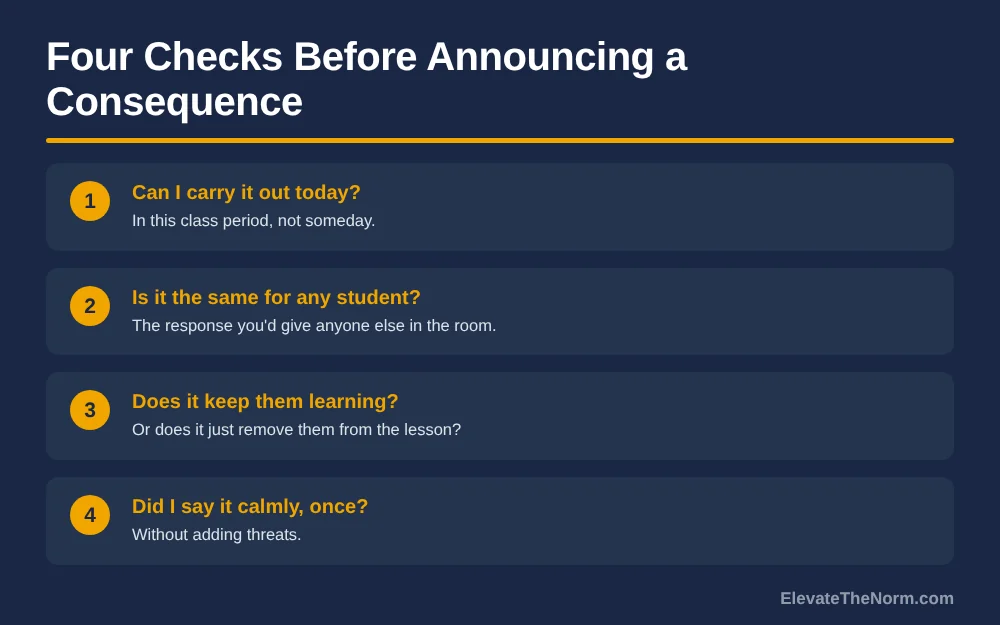
Before you announce any consequence, check:
- Can I carry this out today, in this class period?
- Is it the same response I’d give any other student?
- Does it keep the student in the learning, or just remove them from it?
- Have I said it calmly, once, without adding threats?


Look for the Cause Behind “Hard” Behavior
I don’t believe a kid is born “hard.” When a student shows up tough on arrival, that toughness has a cause, and it’s worth looking for instead of treating it as a fixed trait.
Sometimes the cause is in the room. Ask the student to show you the first step of the task. A kid who can follow the argument in a document but can’t decode the vocabulary may act out rather than admit they’re lost. If several students stall at the same point, reteach that step to the group.
Sometimes the cause is outside the room: a rough morning, a conflict with a peer, something at home you’ll never fully hear about. You don’t need the whole story to change your approach. A neutral greeting at the door, a fresh start each class period, and a quiet “What’s getting in the way today?” go a long way. Steady, small commitments are the core of building relationships with students, and they matter most with the students who expect adults to give up on them.
Give Them a Role and a Real Second Chance
A student who has decided they’re “the bad kid” needs evidence that the label isn’t permanent. Give them something to do that makes them useful: passing out materials, running the timer, checking that stations are reset, leading a review round. A role changes how the class sees them, and how they see themselves.
Recognition helps here too, as long as it’s built on effort and improvement instead of perfection. In the Elevate system, Student of the Week is judged on self-improvement and consistency, not perfect behavior. When a new, tough student joined my class, I told him that simply rising to the occasion and trying was enough to put him on the Student of the Week shortlist.
That’s the kind of second chance that means something: a clear, reachable bar, said out loud, with a real reward on the other side. More on how the award works is in the Student of the Week guide.
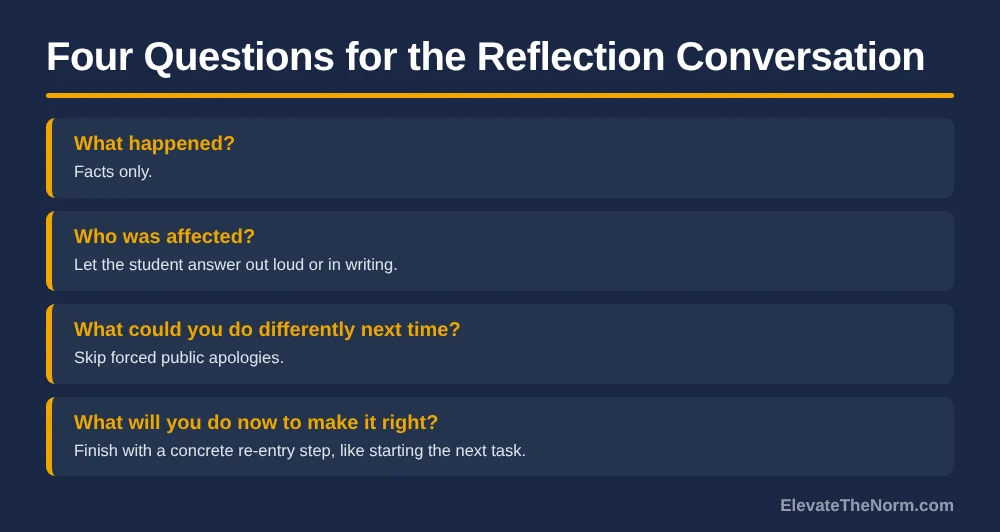
When things go wrong, give the student a structured way back. After they’ve calmed down, a short reflection conversation works well:
- What happened? (Facts only.)
- Who was affected?
- What could you do differently next time?
- What will you do now to make it right?
Let them answer out loud or in writing, and finish with a specific re-entry step, like getting materials and starting the next task. Skip forced public apologies. The restorative practices in schools post goes deeper on repair conversations.
Know When Administration Needs to Take Over
Your job is to manage the classroom, not to carry every serious consequence alone. In the Elevate approach, serious remediation should come from administration, not the classroom teacher. That keeps you in the role of the adult who teaches, recognizes, and rebuilds, while the heavier discipline comes from the people whose job it is.
Bring in administration or your school’s support team when:
- Behavior involves safety, threats, harassment, or anything you’re required to report
- The same behavior keeps happening after your steps have been followed consistently
- A consequence goes beyond what your classroom plan allows
Document as you go: the setting, what happened, what you did, and what happened after. Stick to what you saw, not guesses about motive, and note the days the student does well too. IEPs, behavior plans, and required accommodations always come first.
If you’re working on new teacher classroom management, this is one of the hardest lines to learn. Handing off serious remediation isn’t giving up on a student. It’s what lets you keep a working relationship with them.
Frequently Asked Questions
How do I handle a student who argues with everything I say?
Don’t argue back in front of the class. Give a short, neutral response, restate the next step, and move on. Save the real conversation for a private moment, when the student doesn’t have an audience to perform for.
Is sarcasm ever okay with difficult students?
Light sarcasm can work with grades 7–8 and up when it’s aimed at the situation, not the student, and it shows you’re not rattled. If it embarrasses the kid or lands as a put-down, it’s the wrong tool. Neutral is always safe.
What if a difficult student never seems to improve?
Keep your steps the same, document what you see, and look for the cause behind the behavior. Recognize small effort when it shows up. If the behavior stays serious after you’ve followed through consistently, bring in administration and your school’s support staff.
Should difficult students be eligible for class rewards?
Yes. Rewards built on effort and self-improvement give difficult students a reason to try. A reachable goal, like making the Student of the Week shortlist by showing up and trying, often does more than any consequence.
Stay Steady, and Leave the Door Open
The student who tests you is watching to see whether you’ll stay calm, keep your word, and still give them a fair shot. Stay neutral, keep corrections private, follow through every time, and keep looking for the reason behind the behavior.
For printable tools that support all of this, from expectations posters to recognition trackers, visit the free Elevate the Norm resource library. Free to download, no email required.