By Clay Shumate
Student of the week works in grades 6–12 when it’s a short, criteria-based award for something a student actually did that week, judged on consistency and self-improvement rather than perfection. Publish the criteria, keep brief notes, name the specific action when you present it, and every student, not just the stars, has a real shot at earning it.
Teenagers can smell a popularity contest or a participation trophy from across the room. What they respond to is being seen: a teacher who noticed they showed up on time all week, finally started the bell ringer without a reminder, or kept a group discussion on track.
The hard part in secondary isn’t the idea. It’s running it fairly across five or six periods and roughly 150 students while you’re also teaching. Here’s how to set it up so it fits an ordinary week.
Rotating Spotlight or Earned Award?
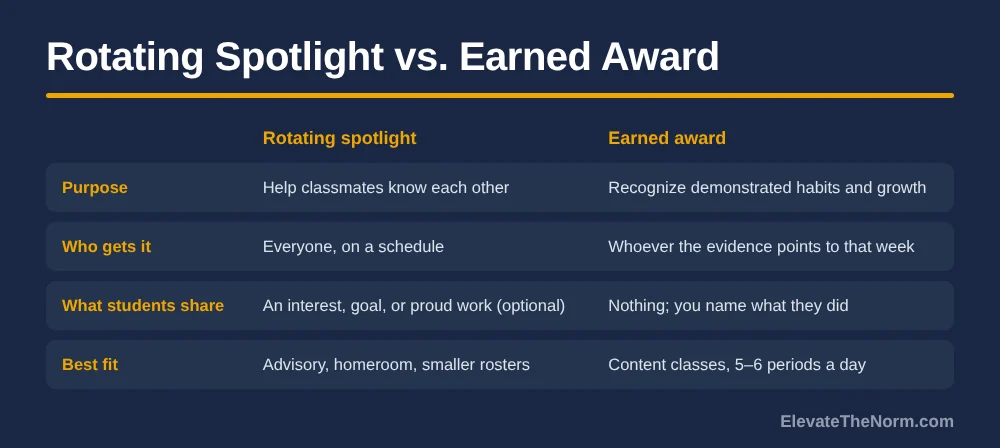
Decide this first, because students will ask. A rotating spotlight gives everyone a scheduled turn. An earned award recognizes habits you observed. Both are fine, but don’t blur them together under one name.
| Rotating spotlight | Earned award | |
|---|---|---|
| Purpose | Help classmates know each other | Recognize demonstrated habits and growth |
| Who gets it | Everyone, on a schedule | Whoever the evidence points to that week |
| What students share | An interest, goal, or work they’re proud of (optional) | Nothing; you name what they did |
| Best fit | Advisory, homeroom, smaller rosters | Content classes, 5–6 periods a day |
If you run a spotlight, check your roster against the weeks you have left before announcing it, give shared weeks equal attention, and let students decide what personal details they share. Giving prep time in class keeps it fair for kids without supplies or help at home.
For an earned award, tell students plainly: you earn it through the habits you practice, your progress counts, and you get a fresh chance every week.
Pick a Name Your Oldest Class Won’t Roll Their Eyes At
“Student of the Week” is fine. So are “Weekly Recognition” or “Class Contributor.” If your building already uses “star student,” just explain what it means in your room. You can let students weigh in on the name through student voice and choice, but the criteria and the final pick stay with you.
How I Run Student of the Week in My Classes
Student of the Week is the middle tier of the Elevate recognition system I use. There are three tiers: Immediate Recognition, Student of the Week, and Student of the Month. The whole program costs me about $81 a year, out of my own pocket.
I run Student of the Week every week in all of my classes. It’s judged on self-improvement and consistency, not perfection. I tell students straight out that nobody’s perfect, so nobody needs to be perfect to win it. One winner earned it simply by always being on time, participating, and doing the bell ringers. That’s it. Nothing flashy, just showing up the right way every day.
I build anticipation by walking the room with the prize bag while I explain the award and what the winner did. By the time I get to the name, everybody’s paying attention.
It also gives you a way in with students who arrive guarded. I once told a new, tough student that simply rising to the occasion and trying was enough to put him on the shortlist. A kid isn’t born “hard.” Toughness on arrival is usually a cause to look for, not a fixed trait, and a reachable award is one way to show him the door is open.
How Do You Choose Students Fairly?
Write down what you saw before you decide who wins. When the evidence comes first, the choice is easy to explain and hard to argue with.
Suggested Traits to Watch For
These aren’t a formal framework, just a practical list of traits you can actually observe. Pick a few that match your classroom expectations and teach them with examples.
| Trait | What it looks like |
|---|---|
| Consistency | On time, materials out, bell ringer started without a reminder |
| Participation | Asks a question, shares a written idea, or does a task that moves the work forward |
| Listening | Accurately sums up a classmate’s point before responding |
| Responsibility | Finishes their part of the work without being chased |
| Cooperation | Helps the group fix a problem and splits work fairly |
| Flexibility | Adjusts without a fuss when the plan or group changes |
| Respect | Takes care of classmates, ideas, materials, and the room |
In a World History class, that might be a student who asks a partner to explain their reading of a primary source before the group writes its claim. That’s listening and cooperation, and it goes in your notes.
Count Growth, Not Just the Usual Winners
Compare a student with where they were last week, while keeping the expectation the same for everyone. A kid who used to need three reminders and now needs one has improved, and that counts. Pair high expectations for students with the support to meet them.
Keep support needs out of your effort judgments. Honor IEPs, behavior plans, and accommodations, and don’t let eye contact, sitting still, or speaking up in front of the class become hidden requirements.
No Popularity Votes, and Track Who Gets Missed
Peer nominations can be useful information, but only if they name a specific action, and you make the final call. Keep a private roster with columns for date, trait, what you saw, and recognition already given. Before you pick, scan for names with few notes and watch those students more closely the next day. Quiet kids, kids who do their best thinking in writing, and kids who get pulled out for services are the easiest to miss.
How Do You Run It Across Five or Six Periods?
One private tracking sheet, one routine per period, same day every week. With 150-plus students, anything more elaborate won’t survive October. For new teacher classroom management especially, start with just a reusable roster document and a certificate master, and add extras only once the basics run on their own.
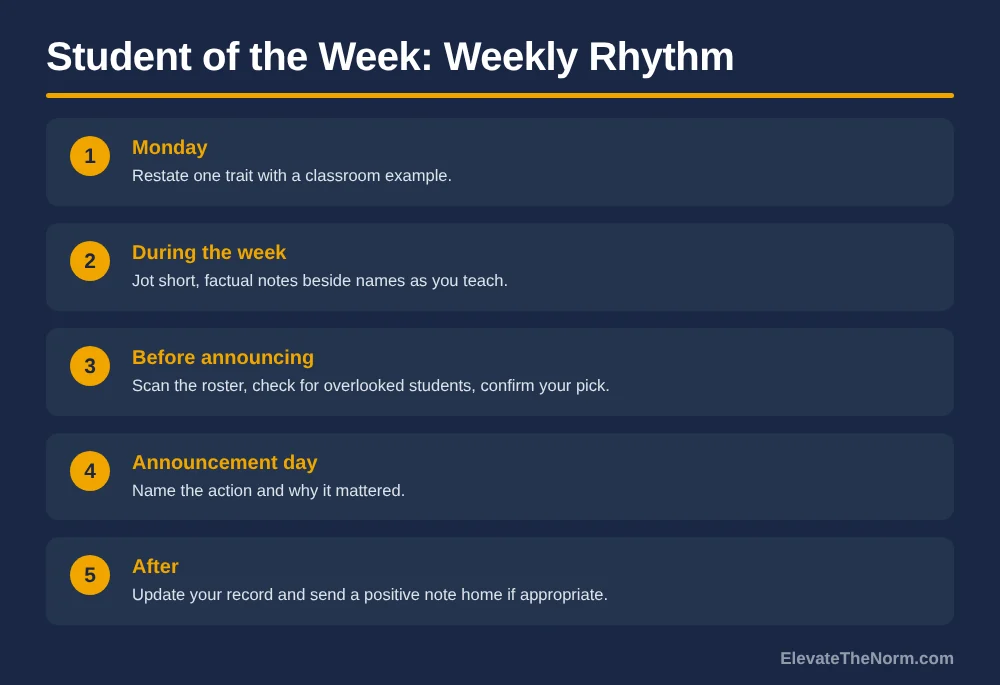
A weekly rhythm that works:
- Monday: restate one trait with a classroom example.
- During the week: jot short, factual notes beside names as you teach.
- Before announcing: scan the roster, check for overlooked students, confirm your pick.
- Announcement day: name the action and why it mattered.
- After: update your record and send a positive note home if appropriate.
How the Three Tiers Fit Together
Immediate Recognition happens right after the action: “You pulled your group back to the question and got everyone through the comparison.” Student of the Week recognizes a pattern over the week. Student of the Month looks back across the whole month using the criteria you announced. Keep the monthly award open to everyone; don’t make a weekly win a prerequisite.
Keep It Separate From Class Competitions
If you also run class-vs-class points (I use 3-2-1-Done, where each class starts the week at zero and earns points for how fast it gets quiet), keep that scoreboard completely separate from individual recognition. The class game measures a shared routine. Student of the Week is about one student’s evidence. A great kid in a period that struggles with transitions still deserves a shot. More on the class side in whole-class rewards and games for classroom management.
Absences, Short Weeks, and Repeat Winners
Set the rules before they come up. On a short or testing week, roll the observation window into the next week. If the winner is absent, present it when they’re back. You can allow repeat winners, but check your roster first. If someone’s winning twice while others have no notes at all, look harder at the others.


What Recognition Do Teenagers Actually Want?
Specific words, and some say in how it’s delivered. Early in the year, ask students privately whether they’d rather get a quiet word, a written note, or a public announcement. Skip surprise speeches, required photos, and forced applause.
A Positive Message Home
Use your school’s approved channel and confirm the right contact first. Keep it factual and specific, something like: “This week in World History, your student asked classmates to explain their reasoning and helped the group connect evidence to its claim.” Keep unrelated concerns for a different conversation, and track contacts so good news reaches families across your whole roster.
Small Prizes and Privileges
A prize bag of inexpensive items goes a long way. Privileges work too: picking work-time music from an approved list, choosing a review topic, displaying a project with permission, or leading a review question as a student leadership opportunity if the student wants it. Never trade grades or required instruction for a reward. For more no-cost options, see free classroom rewards.
Respect Stays Unconditional
Every student gets the same baseline dignity before and after an award. Positive reinforcement only works once students know kindness isn’t weakness, so follow through on exactly what you say, and remember a positive classroom still needs enforcement. If a recent winner breaks an expectation, handle it through your normal classroom consequences. The award they earned still stands for what they did.
What Should a Student of the Week Certificate Say?
A good student of the week certificate includes the student’s preferred name, the week, the trait, and one specific sentence about what they did. That sentence is what makes it mean something.
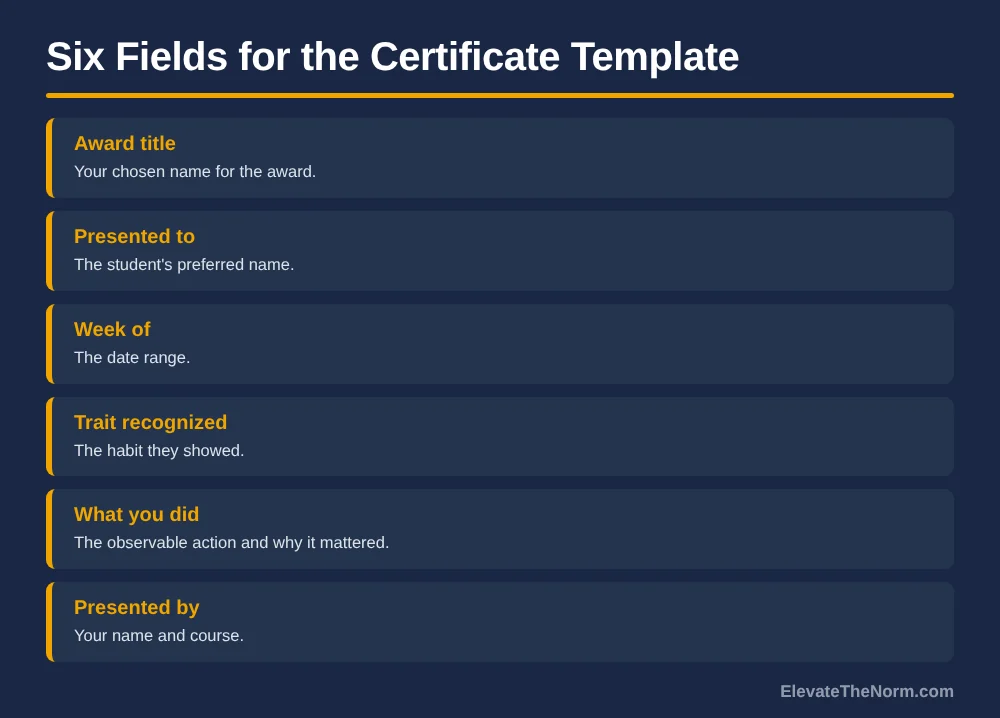
Build a reusable template with these fields:
- Award title: your chosen name
- Presented to: the student’s preferred name
- Week of: date range
- Trait recognized: the habit they showed
- What you did: the observable action and why it mattered
- Presented by: your name and course
Save a blank master separately, and double-check the name and evidence before you print.
Sample Certificate Wording
| Trait | Sample wording |
|---|---|
| Consistency | “You were on time every day, jumped into every bell ringer, and joined in every discussion this week.” |
| Listening | “You summed up your partner’s interpretation before adding your own evidence, so both ideas made it into the group’s answer.” |
| Responsibility | “You finished your research and organized your sources so your group was ready to build its presentation.” |
| Growth | “You used feedback to revise your historical claim and explain more clearly how your evidence supports it.” |
For growth wording, keep past struggles private. Describe what they accomplished now, not the missing work or discipline history that came before. Avoid “always” unless it’s literally true.
Protect Student Privacy
Hand printed certificates directly to students and send digital copies only through approved private channels. Check your school’s media permissions before posting names, photos, or work anywhere public. Keep your tracking notes private and leave behavior history, accommodations, and comparisons with classmates off the certificate.
Frequently Asked Questions
Is student of the week too babyish for high school?
Not if it’s specific and low-key. Teenagers tune out generic praise, but they notice when a teacher names exactly what they did. Let students choose public or private recognition, and keep prizes simple.
How do you pick student of the week fairly?
Publish the criteria, take short notes during the week, and decide based on evidence rather than who stands out. Weigh consistency and self-improvement alongside achievement, and check your roster for students you haven’t noticed yet.
Can the same student win more than once?
Yes, under a rule you announce ahead of time. Before picking a repeat winner, scan your notes for students with little recognition and make sure you’ve actually looked at them.
How do you run student of the week with five or six classes?
Pick one winner per period, on the same day each week, using one private tracking sheet for all your classes. Keep the routine small: a roster, a certificate template, and a few minutes on announcement day.
What should a student of the week certificate say?
The student’s name, the week, the trait, and one specific sentence about what they did and how it helped. That sentence matters more than any border or clip art.
Keep It Specific, Fair, and Doable
Base every award on something you actually saw and criteria students already know. Count consistency and growth, give students a say in how they’re recognized, and keep checking your roster for the kids who are easy to miss. Start with one routine per period and a reusable certificate, and let it grow from there.
Want ready-made tools? The free Elevate the Norm resource library has printables built for grades 6–12. Free to download, no email required.