By Clay Shumate
The best classroom management strategies for talkative class periods in grades 6–12 treat talking as something to schedule, not stamp out. Set a voice level for each task, teach one attention signal and practice it, give students structured reasons to talk, and use a class-vs-class quiet-down competition like 3-2-1-Done to make getting quiet fast a habit.
A chatty class isn’t a defiant class. Most of the time the kids like each other, they’re comfortable in your room, and they don’t know where the line is between “we’re working together” and “we’re just talking.” Your job is to draw that line clearly and give them a reason to stay on the right side of it.
That matters even more when you see 150 or so students across five or six periods. Whatever you pick has to work the same way every period without you thinking about it.
Quick Fixes: Match the Problem to the Strategy
| What’s happening | Try this | Where it’s covered |
|---|---|---|
| Side talk during directions | Name the voice level before you start | Volume levels per task |
| It takes forever to get quiet | One signal, practiced like a procedure | Attention signals |
| Talk drifts off topic during group work | Turn and talk, roles, a clear product | Structured talk |
| The whole class is slow every time | 3-2-1-Done class-vs-class points | The competition |
| One or two students won’t stop | Reminders, then remediation | When reminders run out |
What Should Talking Sound Like During Each Activity?
Decide how loud the room should be before the activity starts, and say it out loud. “Be respectful” doesn’t tell a seventh grader whether they can whisper to their partner during a reading. “This is silent work; if you’re stuck, raise your hand” does.
Use a Simple Voice Level Chart
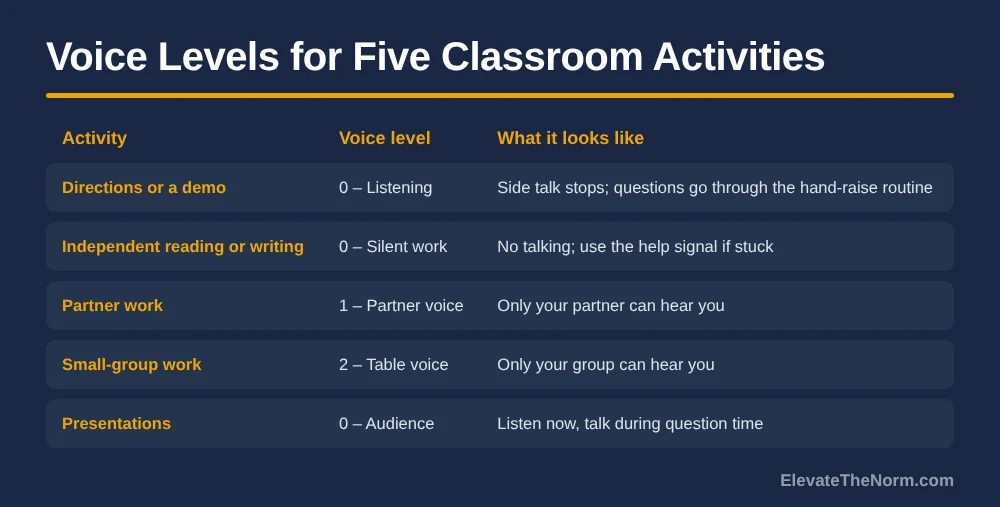
Post one chart and stick with it. Five levels cover almost everything in a secondary classroom:
| Activity | Voice level | What it looks like |
|---|---|---|
| Directions or a demonstration | 0 – Listening | Side conversations stop; questions go through the hand-raise routine |
| Independent reading or writing | 0 – Silent work | No talking; use the help signal if stuck |
| Partner work | 1 – Partner voice | Only your partner can hear you |
| Small-group work | 2 – Table voice | Only your group can hear you |
| Presentations | 0 – Audience | Listen now, talk during the question time |
Model the difference between partner voice and table voice with a real content question, let students try it, then stop and tell them how it sounded. One chart, the same labels every period. Three different charts just means three sets of rules to forget.
State the Talk Rule With the Task
Every time you release students to work, say three things: the task, the voice level, and how to get help. For example: “Write your claim. This is silent. If you’re stuck, mark the spot and raise your hand.” Then ask one student to repeat the voice level back before anyone starts. It takes ten seconds and catches confusion before it turns into noise.
Listening Isn’t the Same as Silence
A quiet room isn’t automatically a listening room. Check listening by asking students to do something with what they heard, like paraphrasing a partner’s point or naming the evidence that changed their mind. In World History, that might be: “Which part of your partner’s explanation best explains why the empire fell?” Follow accommodations, and don’t treat eye contact as the only proof of attention.
How Do You Get Attention Without Raising Your Voice?
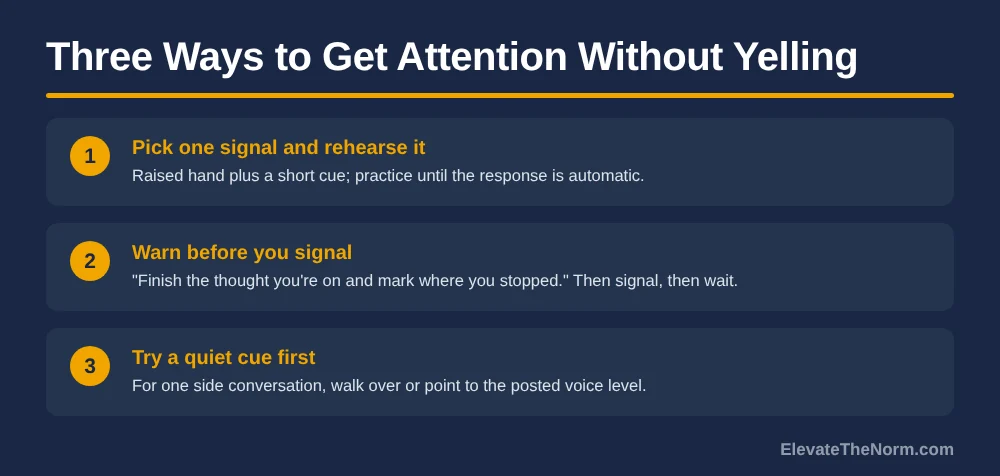
Teach one signal and the exact response it means, then practice it until it’s automatic. Yelling over a chatty class only teaches them that the real signal is you getting loud, which is the pattern covered in teacher yelling at students.
Pick One Signal and Rehearse It
A raised hand plus a short verbal cue gives students something to see and something to hear. Define the response: stop talking, put materials down, eyes on you or the board. Practice it during a low-stakes partner chat, thank the class when they nail it, and don’t start directions until the room is actually ready. For more options, see these classroom attention-getters.
Warn Before You Signal
Kids talk past the signal partly because they’re mid-sentence. Give them a heads-up first: “Finish the thought you’re on and mark where you stopped.” Then signal. Then wait. That small warning makes the stop feel fair instead of abrupt, and it makes your classroom transitions shorter.
Try a Quiet Cue Before You Stop the Lesson
For one side conversation, you don’t need to stop everyone. Walk toward the students, point to the posted voice level, or use a hand signal you’ve agreed on privately. Give them a moment to fix it. Staring them down turns a tiny correction into a show.


Give Students Real Reasons to Talk
Talkative classes need talk time built into the lesson. If students know they’ll get to talk in five minutes, it’s a lot easier for them to hold it during directions.
Break Up Teacher Talk
Stop every ten minutes or so for a turn and talk with a clear question. After looking at a historical map, partners might argue which geographic feature mattered most for trade. Think-pair-share works well when students need a minute first:
- Give everyone quiet thinking or writing time.
- Say who talks first.
- Have partners compare their reasoning.
- Collect one individual answer afterward.
Give Group Work Roles and a Product
Group talk drifts when nobody owns anything. Assign group work roles like evidence finder, questioner, recorder, and task checker, and require something individual at the end, like each student’s own explanation of a turning point. Don’t let your quietest student become the permanent note-taker for everyone else.
Spread Out the Discussion
Give writing or partner time before you open the floor, so more students have something ready to say. Prompts like “What evidence supports that?” and “Who sees it differently?” keep the talk on content. If the same three voices take over, pause for another written response, then come back.
3-2-1-Done: My Main Fix for a Talkative Class
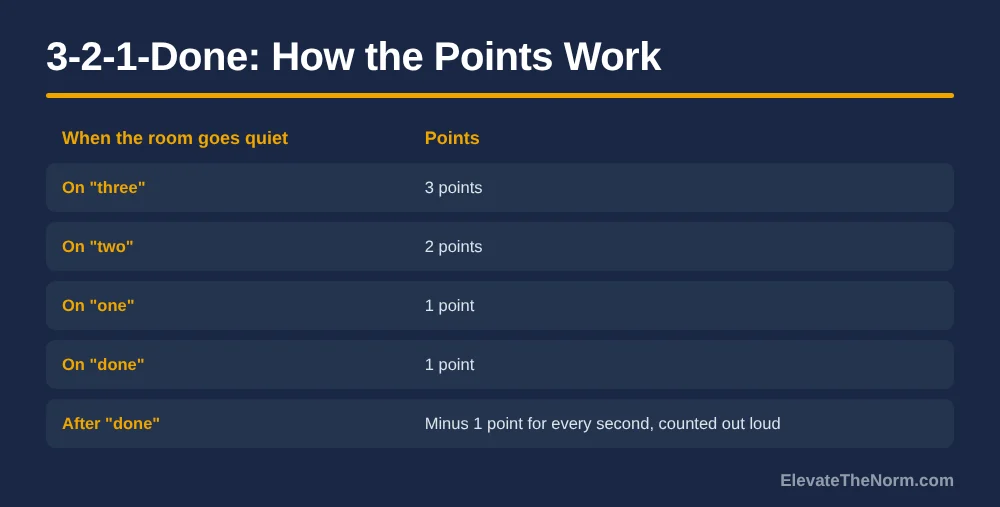
This is the class-vs-class quiet-down competition I use. Every class starts the week at zero. When I count down “three, two, one, done,” the class earns points based on when the room goes quiet:
- Quiet on three: 3 points
- Quiet on two: 2 points
- Quiet on one: 1 point
- Quiet on done: 1 point
- After done: minus 1 point for every second, counted out loud (“one Mississippi, two Mississippi…”)
You can add an optional plus when all work gets turned in and a minus for tardies, but keep the negatives low. The class with the most points at the end of the week gets Pringles, a water, and 15–20 minutes of their own time, as long as they stay seated at a low murmur.
The key is consistent reward: same rules, same prize, every week, every period. Be patient with buy-in. It usually takes about three weeks, and this year’s group took about six. Check food allergies and policies and keep a nonfood option ready. Keep the scoring yours, too. No student should ever be able to point at one classmate as the reason the class lost.
For more on running it alongside other games, see games for classroom management, and for prize ideas that fit a class-wide win, see whole-class rewards.
What If Students Keep Talking After Reminders?
Some students will still talk through everything. Stay calm, stay predictable, and follow through on exactly what you said you’d do.
Three Reminders, Then Remediation
I say “quiet down” up to three times before remediation. I use the word “remediation” rather than “negative reinforcement.” Serious remediation should come from administration, not the teacher.
Between reminders, give students a moment to respond. If talking keeps going, have a private word: “What’s getting in the way of starting?” Then name the behavior plainly. “You kept talking during directions” tells a student what to change. “You’re being disrespectful” just starts an argument. Keep your classroom consequences proportional and in line with school policy.
Check the Task Before You Blame the Kid
Sometimes the talking is really “I don’t know what to do.” Ask the student to tell you the first step. If they can’t, clarify it. Check materials, look at seating, and follow every IEP, behavior plan, and accommodation. If a pattern continues even with a clear task and a working routine, bring in support.
Kindness Still Needs Enforcement
Positive reinforcement only works once students know kindness isn’t weakness. A positive classroom still needs enforcement, and respect has to go both ways. That’s the backbone of new teacher classroom management: keep your word every time, then start the next day fresh.
Quick checklist for a chatty period:
- Voice level stated with every task.
- One signal, practiced and used the same way.
- Talk time built into the lesson.
- 3-2-1-Done scored every day, rewarded every week.
- Reminders, then remediation, the same every time.
Frequently Asked Questions
How do you manage a class that talks too much but isn’t disrespectful?
Give the talking a place. Set a voice level for each task, schedule partner and group talk into the lesson, and use one practiced attention signal to stop it. A friendly competition like 3-2-1-Done gives the class a reason to get quiet fast without you raising your voice.
What’s the best attention signal for middle and high school?
The one you use every time. A raised hand with a short verbal cue works well because students can see and hear it. What matters more is practicing the response until it’s automatic and waiting for full quiet before you start talking.
How long does it take for a talkative class to buy in?
Usually a few weeks if you stay consistent with the same rules and the same reward. Some groups take longer, sometimes about six weeks. Don’t change the system just because the first couple of weeks are rough.
Should the whole class lose points because of one student?
No student should ever be singled out as the reason the class lost. Keep the scoring yours, keep the negatives small, and handle individual behavior privately with your normal reminders and remediation.
Pick One Activity and Start There
Choose the part of class that loses the most time to talking. Teach its voice level, practice your signal, and run 3-2-1-Done every day for a few weeks before you add anything else. Talkative classes usually aren’t the problem. Unclear expectations are.
Need printables for voice levels and routines? The free Elevate the Norm resource library has classroom tools built for grades 6–12. Free to download, no email required.