By Clay Shumate
Whole class rewards work best in grades 6–12 when the whole room earns one small, age-appropriate payoff together: a few minutes of free time, a game session, a student-picked playlist, or an outdoor lesson. Tie the reward to one routine you’ve actually taught, track each class period separately, and never let a single student become the reason everyone lost.
A shared reward is different from an individual one. It gives a class a common goal and a reason to pull in the same direction, and it’s cheap to run because you’re delivering one celebration instead of thirty. That’s also its risk: done carelessly, it turns classmates into enforcers. Whether a reward is worth attaching at all is a separate question — the cases where incentives help and the ones where they backfire sets out when to reach for one.
If you’re building the bigger picture (tiers, budgets, individual recognition), start with our guide to designing a classroom rewards system. This post stays focused on the part the whole class earns together.
Whole Class Reward Ideas Teenagers Actually Want
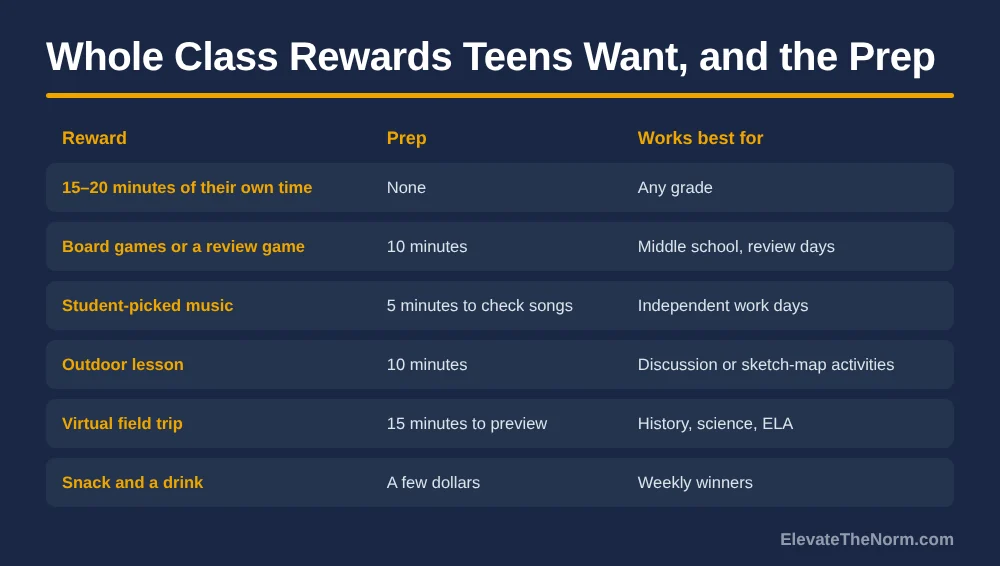
Middle and high schoolers don’t want stickers. They want time, choice, and a little independence. Pick things you can start fast, supervise easily, and wrap up before the bell.
| Reward | Prep | Works best for |
|---|---|---|
| 15–20 minutes of their own time | None | Any grade; the reward teens ask for most |
| Board games or a review game like Kahoot | 10 minutes | Middle school, or review days |
| Student-picked music during work time | 5 minutes to check songs | Independent work days |
| Outdoor lesson | 10 minutes | Discussion or sketch-map activities |
| Virtual field trip | 15 minutes to preview | History, science, ELA |
| Open mic or “something I learned outside school” share | 5 minutes | Classes with a few willing performers |
| Theme day (hat day, jersey day) | Admin check | Middle school |
| Snack and a drink | A few dollars | Weekly winners |
Free Time With Clear Boundaries
Free time is the reward older students want most, and it costs nothing. It only works if “free” has rules: where students can sit, how loud the room can get, what’s off-limits, and when it ends. Put the end time on the board so there’s nothing to negotiate. Phones follow your school’s normal rules.
Games, Music, and Screens
Keep games you already own sorted and ready, and choose ones students can join without a long explanation. If you run a review game, make sure a low score doesn’t become public embarrassment. For music, collect suggestions ahead of time so you can check lyrics, then keep control of the playlist and the volume.
Outdoor Lessons and Virtual Field Trips
An outdoor lesson keeps the academic task and just changes the room. A primary source discussion or map activity travels well. Check that the space is approved, accessible, and supervised before you promise it. Virtual field trips need a full preview first, captions included. Letting the class vote between two museum or historic-site tours adds some student voice and choice without extra work.
Celebrations Students Help Shape
Open mic, a drawing session, a student-built trivia game, or a theme day can all work if participation stays optional. Preview anything students plan to share, and never build a reward that requires families to buy something. If food is involved, check allergy plans and school policy first. For more zero-cost options, see our list of free classroom rewards.
My Example: 3-2-1-Done
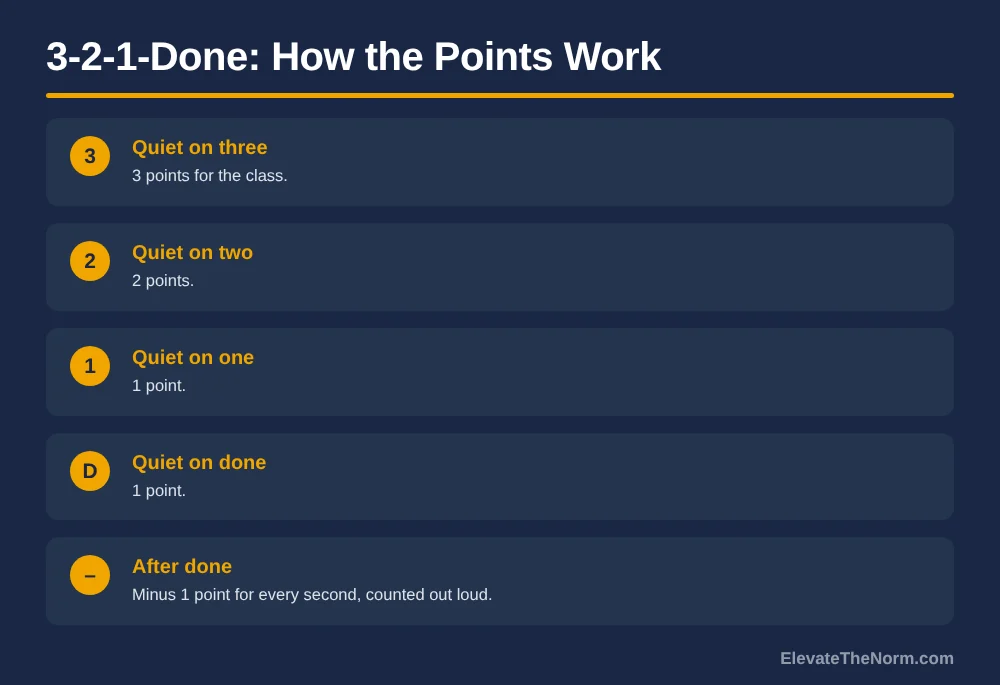
The whole class reward I use every week is a class-vs-class competition called 3-2-1-Done. Every class starts the week at zero. When I count down “three, two, one, done,” the class earns points based on when the room goes quiet:
- Quiet on three: 3 points
- Quiet on two: 2 points
- Quiet on one: 1 point
- Quiet on done: 1 point
- After done: minus 1 point for every second, counted out loud (“one Mississippi, two Mississippi…”)
You can add an optional plus when everyone turns in their work and a minus for tardies, but I keep the negatives low. The class with the most points at the end of the week gets Pringles, a water, and 15–20 minutes of their own time, as long as they stay seated at a low murmur.
The key is a consistent reward. Same rules, same prize, every week. Buy-in usually takes about three weeks. This year’s group took closer to six, and it still came. If you want more games built the same way, check out our games for classroom management.


How Do You Set a Whole-Class Goal Students Can Reach?
A good class goal is specific, visible, and reachable within a week or two. “Be respectful” isn’t a goal you can score. “Quiet and facing the speaker within three seconds of the signal” is.
Before you launch, decide:
- The target behavior: one routine you can see and count, like responding to your attention-getter.
- How progress is recorded: a tally on the board, a progress bar, or a points column per class.
- The finish line: the score or count that earns the reward.
- The reward and date: what students get and when it happens.
- The budget: what you already own, or a small spending limit.
- The reset: when the next round starts fresh.
- The disruption plan: what happens when an assembly or closure eats a day.
Watch the class for a few days before you set the target so the bar fits where they actually start. Teach the routine, model it, let them practice, and then add points. For new teacher classroom management, starting with one routine instead of five keeps the tracking manageable while you’re still learning everything else.
Let Students Vote, Within Limits
Put only approved options on the ballot so you can honor whatever wins. Check cost, time, and school policy first. A private vote avoids peer pressure, and you should decide ahead of time how you’ll break a tie. Have a quiet alternative ready for students who don’t want to join the winning activity.
Track Each Period on Its Own
Every class gets its own score and the same chances to earn. Display class-level progress only, never individual names. Keep grades out of it entirely; a behavior reward shouldn’t touch academic marks.
How Do You Avoid Group Punishment?
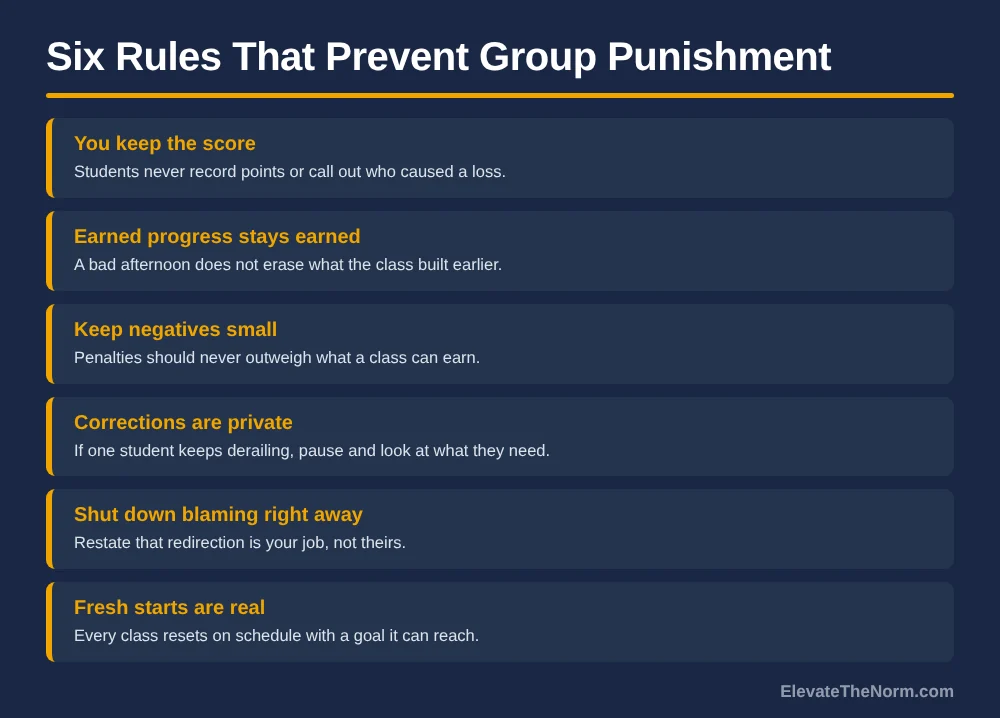
This is where whole class rewards go wrong most often. When one student can sink the whole class, classmates start policing each other, and the reward creates the exact conflict you were trying to prevent. A few rules keep it fair:
- You keep the score. Students never record points or call out who caused a loss.
- Earned progress stays earned. A bad afternoon doesn’t erase what the class built Monday through Wednesday. Handle the misbehavior on its own through your normal classroom consequences.
- Keep negatives small. In a points system, the penalties should never outweigh what a class can earn.
- Corrections are private. If one student keeps derailing the class, pause the competition and look at what that student needs, privately. Toughness isn’t something a kid is born with; there’s usually a cause worth finding.
- Shut down blaming right away. If classmates start accusing someone, stop and restate that redirection is your job.
- Fresh starts are real. Every class resets on schedule, and a period that keeps losing needs a goal it can actually reach.
Basic supports are never part of the prize menu. Required accommodations, IEP and behavior plan supports, needed brain breaks, and access to help stay available no matter what the score says. Be careful with homework passes too, since they can trade away practice students need.
Keep Expectations Firm While You Reward
A shared reward doesn’t replace follow-through. Positive reinforcement only works once students know kindness isn’t weakness, so do exactly what you said you’d do: deliver the reward when it’s earned, and enforce expectations when it isn’t. I’ll tell a class to quiet down up to three times before remediation, and serious remediation should come from administration, not from the teacher. Our guide to positive discipline for teens covers the correction side in more depth.
Pair Class Rewards With Individual Recognition
A class reward shouldn’t be the only way a student gets noticed. In Elevate, the class competition runs alongside three recognition tiers: Immediate Recognition, Student of the Week, and Student of the Month. Individual awards are judged on self-improvement and consistency, never on how the rest of the class performed. Our Student of the Week guide walks through that piece.
When the Reward Gets Stale
If participation fades, ask students what they’d want instead and change the menu at the next reset, not mid-cycle. Always honor rewards already earned before introducing new terms. If the reward still appeals but the class keeps missing, the target probably needs clearer teaching or a closer finish line, in line with high expectations for students and the support to reach them.
Frequently Asked Questions
What are good whole class rewards for high school?
Time and choice beat prizes. Fifteen to twenty minutes of their own time, a student-picked playlist, an outdoor lesson, or a game session all land well with teenagers. A small snack for the weekly winner adds a little extra without much cost.
How often should a class earn a reward?
Weekly works well for points competitions like 3-2-1-Done, because the reset keeps every class in the race. Bigger rewards can run on a two- to four-week cycle, but longer than that and students lose interest.
Is it fair to reward the whole class when a few students misbehave?
Yes, as long as earned progress stays earned and individual behavior is handled individually. A shared reward recognizes what the group did well. Taking it away from everyone because of one student is group punishment, and it tends to backfire.
What if one class never wins?
Make sure the goal fits that group’s starting point, and consider giving each class its own target in addition to the competition. Consistency matters more than winning; buy-in can take several weeks.
Start With One Shared Goal
Pick one routine, one simple scoring method, and one reward your students actually want. Keep the score yourself, keep corrections private, and deliver the reward every single time it’s earned. After each cycle, look at whether the class understood the goal and whether the tracking fit into your teaching day, then adjust.
Want printable support for planning it? The free Elevate the Norm resource library has classroom tools built for grades 6–12. Free to download, no email required.