By Clay Shumate
An exit ticket is a short written response students hand in during the last few minutes of class, usually one or two questions tied to the day’s objective. There is no research on the card itself. What makes it worth the time is whether you read the stack before you plan tomorrow, and change something.
Key Takeaways
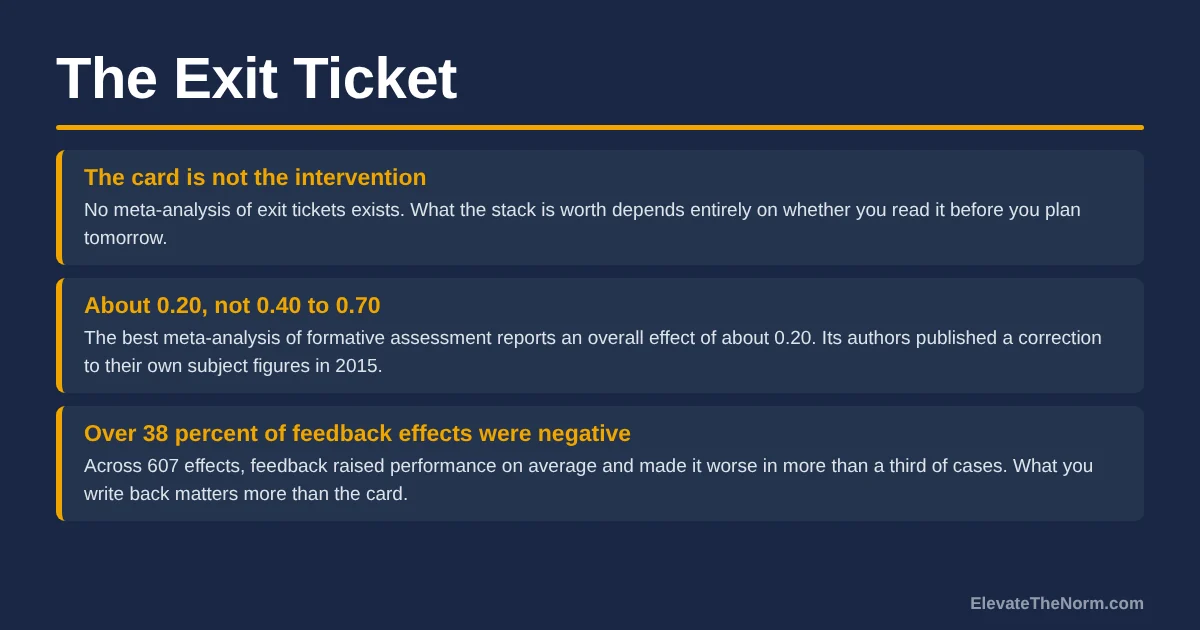
- There is no effect size for exit tickets, and there never was one. No meta-analysis of the instrument exists. The number teachers borrow comes from the formative assessment literature, and the best meta-analysis of that body of work reports an overall effect of about 0.20.
- The famous 0.4 to 0.7 range is a summary sentence, not a pooled estimate. Black and Wiliam wrote that “typical effect sizes of the formative assessment experiments were between 0.4 and 0.7” without listing the studies, across samples running from five-year-olds to university undergraduates.
- The authors of the 0.20 figure corrected their own paper. Eight science studies had been miscoded as reading studies. The corrected content-area means are English language arts 0.32, science 0.19 and mathematics 0.17, and the overall conclusion held.
- Feedback is not automatically good. In the largest meta-analysis of feedback interventions, the mean effect was d = 0.41 and “over 38% of the effects were negative.” What you write back on the card can make things worse.
- The writing itself does some of the work. A 2020 meta-analysis of 56 studies and 6,235 students, 65 percent of them secondary, found that writing about content raised learning in science, social studies and mathematics at g = 0.30.
What is an exit ticket?
An exit ticket is a brief written answer collected at the end of class, usually on a half sheet, an index card or a short digital form. It is one of the oldest and plainest formative assessment tools there is, and it is the one almost every teacher already owns.
It goes by exit slip, ticket out the door and a dozen other names. The format does not matter. What makes a piece of paper an exit ticket rather than a worksheet is that it is collected to inform the next lesson, not to be graded, and that it is short enough to read a whole class set in a few minutes.
That last condition is the one teachers skip. A page of six questions handed in at the bell is a quiz you have not graded yet. It will sit in your bag. An exit ticket that cannot be read in the passing period is not an exit ticket.
Does research show that exit tickets work?
No study has tested exit tickets as an intervention and produced an effect size. What exists is research on formative assessment generally, on feedback, and on writing about content. All three are relevant. None of them is about a notecard.
That is not a reason to stop using them. It is a reason to be honest about what you are claiming when you put one in a lesson plan or a professional development slide. The exit ticket is a delivery mechanism. Whether it helps depends on what you deliver and what you do next.
Where does the 0.4 to 0.7 effect size come from?
It comes from one sentence in a 1998 Phi Delta Kappan article by Paul Black and Dylan Wiliam: “Typical effect sizes of the formative assessment experiments were between 0.4 and 0.7.” It is a summary of a range, not a pooled estimate from a meta-analysis.
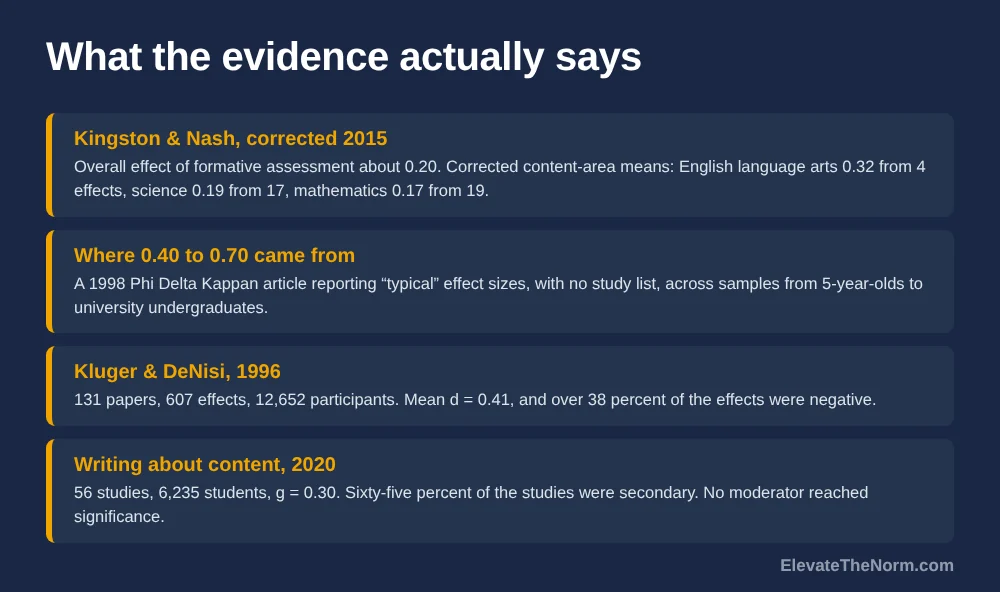
Read the paragraph around it and the picture gets more complicated. The earlier review they build on, by Fuchs and Fuchs in 1986, was work “primarily on classroom assessment work for children with mild handicaps,” from which 23 studies were selected. Black and Wiliam added “at least 20 more studies,” and said plainly that “the number depends on how rigorous a set of selection criteria are applied.” The studies behind the range “range over age groups from 5-year-olds to university undergraduates, across several school subjects, and over several countries.”
They also wrote, in the same article, that “we do not conclude that formative assessment is yet another ‘magic bullet’ for education,” and that “it does not follow that it would be an easy matter to achieve such gains on a wide scale in normal classrooms.” The caution was in the original. It fell off somewhere between 1998 and the slide deck.
When researchers went looking for the pooled number, they got something smaller. Neal Kingston and Brooke Nash screened the literature and, as a 2012 critique by Briggs, Ruiz-Primo, Furtak, Shepard and Yin describes it, derived 42 effect-size estimates from 13 studies that met their criteria, with a median of 0.25 and a random-effects mean of 0.20. That critique calls the 0.4 to 0.7 figure an “urban legend,” and reports that in their longer 1998 review Black and Wiliam said specifically that they could not conduct a meta-analysis because amalgamating the results would be meaningless.
The correction nobody mentions
Here is the part that should make anyone quoting a number slow down. Kingston and Nash published an erratum to their own paper in 2015. Three problems were named: many of the effect sizes came from a single 2004 article by Wiliam, Lee, Harrison and Black; eight science studies had been miscoded as reading studies; and one effect size should not have been included at all, because that study compared two different approaches to formative assessment rather than formative assessment against ordinary teaching.
The corrected content-area table gives English language arts 0.32 from 4 effects, science 0.19 from 17, and mathematics 0.17 from 19. In the original table the confidence interval for science crossed zero. In the corrected one it does not. The headline held: the authors restate that “current empirical evidence of the efficacy of formative assessment indicates an overall effect size of about .20.”
So the honest summary is this. The best available pooled estimate for formative assessment is about 0.20, it was corrected once by its own authors, and almost nobody who quotes 0.4 to 0.7 knows either of those facts. Four effects is a thin basis for the English language arts figure, and you should treat it that way.
What should go on an exit ticket?
One or two questions tied directly to what you wanted students to be able to do today. If you cannot say which sentence of your objective the question tests, the question is decoration.
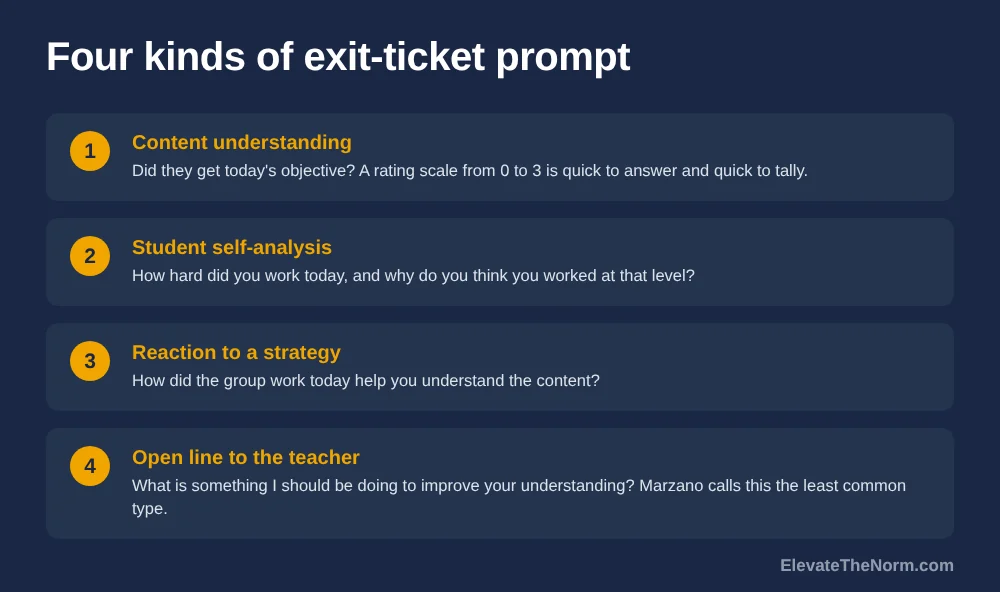
Robert Marzano set out four categories of exit slip prompt in a 2012 Educational Leadership column. It is practitioner advice rather than research, and he says so by what he cites, but the four categories are a genuinely useful way to decide what you are asking for:
- Content understanding. Did they get it? His example is a 0 to 3 rating scale, which he notes produces short responses that are easy to tally.
- Student self-analysis. “How hard did you work today? Explain why you think you worked at the level you did.”
- Reaction to an instructional strategy. “How did the group work today help you understand the content?”
- An open line to you. “What is something I should be doing to improve your understanding of the content?” Marzano calls this the least common type of prompt, which is worth sitting with.
Mix the types across a week rather than within a card. A ticket asking what students learned and how hard they worked and what you should change produces three half-answers from a fourteen-year-old with a bus to catch.
There is also a reason to prefer writing a sentence over circling a number, at least some of the time. A 2020 meta-analysis of writing about content in science, social studies and mathematics — read here through the Clearinghouse Unterricht summary of Graham, Kiuhara and MacKay — covered 56 studies and 6,235 students and found a mean effect of g = 0.30, with 65 percent of the studies at secondary level. The summary is careful to say that none of the moderator analyses reached significance, so it will not tell you which kind of writing is best. It does tell you that making students put a thought into a sentence is not wasted time.
How many questions should an exit ticket have?
One is usually right. Two is the ceiling. The limit is not pedagogical, it is arithmetic: whatever you assign, you will read 150 of them standing up, and the number of questions multiplies directly into the time that takes.
Anastasia Thayer’s Clemson land-grant press piece on exit tickets puts the window at the final three to five minutes of class and says the ticket “should not be burdensome.” Worth knowing that it is written for an undergraduate course of roughly 20 to 50 students, so the workload arithmetic there is not yours. The design advice transfers; the time estimate does not.
What about students who cannot write one in three minutes?
Give them a different way to answer the same question. A multilingual learner, a student with a writing accommodation, or a slow processor should not be invisible in your stack just because the format is a sentence. The point is their understanding, not their handwriting speed.
What works without building a second lesson: a sentence stem printed on the card, a 0 to 3 scale with a one-word reason, a labeled drawing or diagram, or a thirty-second verbal answer to you at the door while the rest of the class writes. Any accommodation already in a student’s plan applies here the same as anywhere else — a quick check is still an assessment.
One administrative note while you are reading a class set. Students sometimes use an anonymous-feeling card to say something that is not about the lesson. If that happens, it goes through your school’s reporting procedure, not into the pile. Anything a student discloses in writing to a teacher is subject to the same obligations as anything they say out loud.
What do you do with the stack in four minutes?
Sort, do not grade. Three piles is enough: most of the class missed the same thing, different students missed different things, or almost everyone has it. Each pile points at one decision for tomorrow, and the decision is the only thing the stack was ever for.

Marzano’s own account of what to do with the results runs along the same lines. If most of the class is confused about one topic, reteach it the next day. If different students are confused about different things, run small-group work on specific concepts and use the students who got it as topic-specific experts. If the responses say a strategy did not help, try a different way of running it.
This is also where Black and Wiliam are most useful, and most ignored. Their article says that “for formative purposes, a test at the end of a unit or teaching module is pointless; it is too late to work with the results,” and that “research studies have shown that, if pupils are given only marks or grades, they do not benefit from the feedback.” Feedback helped, they wrote, “when it gives each pupil specific guidance on strengths and weaknesses, preferably without any overall marks,” and only when “each pupil must be given help and an opportunity to work on the improvement.”
Put plainly: a stack you read and do nothing about is worth zero, and a stack you hand back with a score on it may be worth less than zero. Which brings up the uncomfortable part.
Can writing on an exit ticket make things worse?
Yes, and the size of that risk is well documented. Kluger and DeNisi screened about 3,000 papers, kept 131, and pulled 607 effect sizes from 12,652 participants. The weighted mean was d = 0.41. In the same distribution, “over 38% of the effects were negative.”
They checked whether that was an artifact of one unusual set of laboratory studies. Removing those 91 effects, 33 percent of what remained was still negative, and the paper calls the negative effects “robust and not artifacts.” The theory they build on top says effectiveness “decreases as attention moves up the hierarchy closer to the self and away from the task.”
Two honest caveats. Only part of that paper was readable for this article, so the figures above are the ones stated in its opening sections rather than the full moderator analysis. And its studies are a mixture of laboratory and field work — the paper describes feedback coming from “a teacher, manager, boarding school counselor, or computer-program designer” and outcomes from reading errors to motor performance. That is not a clean grades 6 to 12 sample, and you should not treat 38 percent as the share of comments on your exit tickets that will backfire.
What it does establish is the direction. Writing “good job” or a 7/10 at the top of a card points a student at themselves. Writing “you have the cause right and the date wrong, check page 212” points them at the task. The second one costs about the same amount of ink.
Should exit tickets be graded?
Not for correctness. The moment a ticket counts, students stop telling you what they do not understand, and the one thing the instrument is good for is gone. If you need it in the gradebook for completion, keep the weight trivial and say out loud why.
Thayer’s Clemson piece takes the same line from a different direction: credit is optional, and where it is given it should be “minimal so that they are low stakes,” often pass or fail, with “grades intended to communicate effort, not necessarily correctness.” If you want the longer version of that argument, this site works through which checks belong in the gradebook and which do not at length.
It is worth saying this to families in the same words. A parent who sees ungraded work in a binder is entitled to ask what it was for. The answer is that it is the teacher’s homework, not the student’s: their child wrote two sentences so that tomorrow’s lesson would be built on what the class actually knows rather than on what the schedule said it should know.
Paper or digital?
Paper is faster to sort and slower to store. Digital is slower to collect and far faster to tally. The right answer depends on whether your bottleneck is the four minutes after class or the fifteen seconds at the door.
| Format | What it is good at | Reading 150 of them | Main drawback |
|---|---|---|---|
| Half sheet or index card | Extended answers, diagrams, work shown | Fast to sort into piles, slow to count exactly | You are now carrying 150 pieces of paper |
| Sticky note on the door | One sentence, visible pattern on the wall as they leave | Fastest of all — the pattern is already sorted | No privacy, so the quiet admission never gets written |
| 0 to 3 rating scale | A class-level reading in under a minute | Trivial — count four piles | Tells you how many, never what |
| Short digital form | Tallying, keeping a record, absent students | Instant totals, but you still read the open responses | Costs two to three minutes of class to log in and load |
| Whiteboard held up at the bell | Instant whole-class check with no collection at all | No stack exists | Nothing to look at tomorrow, and nothing to show a coach |
Two to three minutes of logging in, five classes a day, is north of an hour a week. Worth it if you use the tallies, a bad trade if you do not.
When is an exit ticket the wrong tool?
When you need the information during the lesson rather than after it. An exit ticket tells you what happened. A check in the middle of class lets you fix it while the class is still in front of you, and that is nearly always more valuable.
It is also the wrong tool on a day when nothing is settled yet. On the first day of a hard unit, the honest answer from most of the class is confusion, and collecting 150 cards that say so buys you nothing you did not already know from their faces. Save it for days where you genuinely cannot tell.
Black and Wiliam are worth quoting once more here, because they put a limit on frequency that almost no exit ticket advice mentions: “It is better to have frequent short tests than infrequent long ones,” and new learning should be tested within about a week of a first encounter, after which “more frequent tests are counterproductive.” Daily is not automatically better. If you are collecting a ticket every period of every day, you are collecting data you have no time to act on.
For the in-lesson version of this job, the site has a longer piece on what actually counts as evidence that students understood, and a working list of formative assessment strategies organized by where they fall in a lesson. The difference between the quick read and the recorded one is covered in formal versus informal formative assessment.
What should a coach or administrator look for?
Not the cards. Ask to see what changed because of them. A teacher who can point at Tuesday’s plan and say which part of it exists because of Monday’s stack is running formative assessment. A teacher with a drawer full of tickets is running a collection.
Two things not to do with this in a walkthrough. Do not count exit tickets as a look-for, because the instrument will immediately appear in every classroom and mean nothing. And do not ask for the data in a spreadsheet, because the moment the ticket becomes a reporting obligation it becomes a quiz, and the honest answers stop.
What goes wrong with exit tickets?
- The ticket is too long. Six questions is a quiz. You will not read it, and you will feel bad about not reading it for a week.
- The question does not test the objective. “What did you learn today?” gets you 150 copies of the lesson title.
- It gets graded. Students work out within two weeks which answers are safe, and after that you are reading performances.
- It is collected at the door with no time. Students write a word while walking. Build the three minutes into the lesson or do not run it.
- Nothing happens. The most common failure by a distance, and the only one that makes the whole thing pointless.
Clay’s take: the stack is a decision, not a record
Every bad version of this instrument shares one feature. The teacher is collecting evidence for somebody else — an evaluator, a data meeting, a folder — rather than collecting it to decide what to do tomorrow. The moment the audience changes, the design changes, and the honest answers go away.
Here is the part I would argue hardest for. An exit ticket asks a teenager to tell an adult, in writing, what they do not understand. That is not a small thing to ask. Students will do it if they have seen it change something and if it has never once been used against them. They will stop the first time a ticket comes back with a grade on it, and they will not tell you they stopped.
So the evidence question and the respect question turn out to be the same question. The research says the instrument is worth roughly what you do with it, and students decide what to write based on what they have watched you do with it. Both of those are about tomorrow, not about the card.
What to do next
Pick one class and one week. Write one question a day that tests one sentence of your objective, give students three real minutes, and sort the stack into three piles before you leave the room. Then change one thing in the next day’s plan and tell the students which thing and why.
If after five days you cannot name five changes, the problem is not the ticket. It is that you already knew what the stack was going to say, and your time is better spent on a learning target students can actually use or on a mid-lesson check instead. Our free formative assessment strategies PDF has the mid-lesson options, and it downloads with no email.
An exit ticket tells you what to do tomorrow. A hinge question tells you what to do in the next four minutes. Same instinct, different moment, and the mid-lesson version has to be designed far more carefully because you have no time to interpret it. The mid-lesson version of the same check covers what makes a hinge question diagnostic, how long students should get, and why reading the room in thirty seconds is the constraint that shapes everything else.
Frequently Asked Questions
What is an exit ticket in simple terms?
It is a short written answer students hand in at the end of class, usually one question tied to the day’s objective, on a half sheet, an index card or a quick digital form. It is collected to tell the teacher what to do tomorrow, not to be graded. If it cannot be read in a few minutes, it is a quiz instead.
What is the effect size of exit tickets?
There is not one. No meta-analysis of exit tickets as an instrument exists. The number usually borrowed comes from research on formative assessment generally, where the best pooled estimate is about 0.20, not the 0.4 to 0.7 range commonly quoted. That range came from a 1998 summary article rather than from a meta-analysis.
How many questions should be on an exit ticket?
One is usually right and two is the ceiling. The constraint is the stack: whatever you assign, you will read roughly 150 of them in the minutes before the next class arrives, and every extra question multiplies that time. One question that tests one sentence of your objective beats four that sample the whole lesson.
Should exit tickets be graded?
Not for correctness. Once a ticket counts, students answer strategically and you lose the only thing the instrument is good for, which is an honest report of confusion. If it has to appear in the gradebook, give completion credit at a trivial weight and tell students plainly why it is not graded for accuracy.
Can feedback on an exit ticket do harm?
It can. The largest meta-analysis of feedback interventions found a positive average effect and reported that over 38 percent of the effects were negative, a pattern the authors describe as robust. The direction that matters is whether your comment points the student at the task or at themselves. A score at the top of a card points at them.
Are digital exit tickets better than paper?
They tally better and collect worse. A short digital form gives you instant totals and a record, but logging in and loading costs two to three minutes of class time, five times a day. Paper sorts into piles faster and leaves you carrying the stack. Choose by which bottleneck is actually hurting you.
How often should you use exit tickets?
Less often than most advice suggests. Black and Wiliam argued that frequent short checks beat infrequent long ones, but also that after new learning has been tested once within about a week, more frequent testing becomes counterproductive. If you are collecting a ticket every period every day, you are gathering more than you can act on.
What is the difference between an exit ticket and a formative assessment?
An exit ticket is one instrument. Formative assessment is what you do with any evidence of student learning while there is still time to change the teaching. A ticket you read and act on is formative assessment. A ticket you collect, score and file is a very small summative test.
Sources
- Kingston, N., & Nash, B. Erratum to “Formative Assessment: A Meta-Analysis and a Call for Research.” Educational Measurement: Issues and Practice, Vol. 34, No. 2, p. 55 (Summer 2015). Full text (PDF). Source of the corrected content-area means (English language arts 0.32 from 4 effects, science 0.19 from 17, mathematics 0.17 from 19), the three errors identified, the statement that the original science confidence interval crossed zero and the corrected one does not, and the restatement that the overall effect is “about .20.” The erratum does not reproduce the original table’s values, so the size of each change cannot be given here.
- Briggs, D. C., Ruiz-Primo, M. A., Furtak, E., Shepard, L., & Yin, Y. Meta-Analytic Methodology and Conclusions About the Efficacy of Formative Assessment. Pre-print (2012). Full text (PDF). Source of the 42 effect-size estimates from 13 studies, the median of 0.25 and random-effects mean of 0.20, the description of the 0.4 to 0.7 range as an “urban legend,” and the report that Black and Wiliam stated they could not conduct a meta-analysis because amalgamating the results would be meaningless. The study counts and the median are reported here as this critique describes Kingston and Nash, because their paper itself could not be opened.
- Black, P., & Wiliam, D. Inside the Black Box: Raising Standards Through Classroom Assessment. Phi Delta Kappan, Vol. 80, No. 2, pp. 139–148 (October 1998). Full text (PDF). Source of the “between 0.4 and 0.7” sentence, the Fuchs and Fuchs 23 studies on “children with mild handicaps,” the “at least 20 more studies” and the note that the number depends on the selection criteria, the age range from five-year-olds to university undergraduates, the “magic bullet” caution, the frequency guidance, and the statements about marks, grades and specific guidance.
- Kluger, A. N., & DeNisi, A. The effects of feedback interventions on performance: A historical review, a meta-analysis, and a preliminary feedback intervention theory. Psychological Bulletin, Vol. 119, No. 2, pp. 254–284 (1996). Full text (PDF). Source of the 131 papers from about 3,000 screened, the 607 effect sizes, 12,652 participants, the weighted mean of d = 0.41, the sentence “over 38% of the effects were negative,” the 33 percent figure after removing one laboratory set, and the statement that the negative effects are “robust and not artifacts.” Only the first third of this paper was readable here, so no moderator result and no population breakdown is reported from it.
- Farrell, E., Schönbeck, M., & the CHU Research Group. Short Review 29: The Effects of Writing on Learning in Science, Social Studies, and Mathematics (2023), summarising Graham, S., Kiuhara, S. A., & MacKay, M., Review of Educational Research, Vol. 90, No. 2 (2020). Full text (PDF). Source of the 56 studies, 6,235 students, g = 0.30 with a confidence interval of 0.20 to 0.41, the 65 percent secondary share, and the statement that the moderator analyses did not reach significance. This is a summary, not the paper — the original was not reachable, and no figure is attributed directly to Graham and colleagues here.
- Marzano, R. J. The Many Uses of Exit Slips. Educational Leadership, Vol. 70, No. 2 (October 2012). Full article. Source of the four prompt categories, the example prompts quoted, and the guidance on reteaching, small-group work and topic-specific experts. This is practitioner advice, not a study — the column reports no research on exit slips and cites two sources only for the general claim that effective lessons end with reflection.
- Thayer, A. The Exit Ticket: a snapshot of student learning and potential participation points for students. Clemson University Land-Grant Press, LGP 1201 (November 2024). Full article. Source of the three-to-five-minute window, the guidance that credit should be minimal and low stakes and that grades communicate effort rather than correctness. Written for an undergraduate course of roughly 20 to 50 students, so its workload assumptions do not transfer to a secondary teaching load.