By Clay Shumate
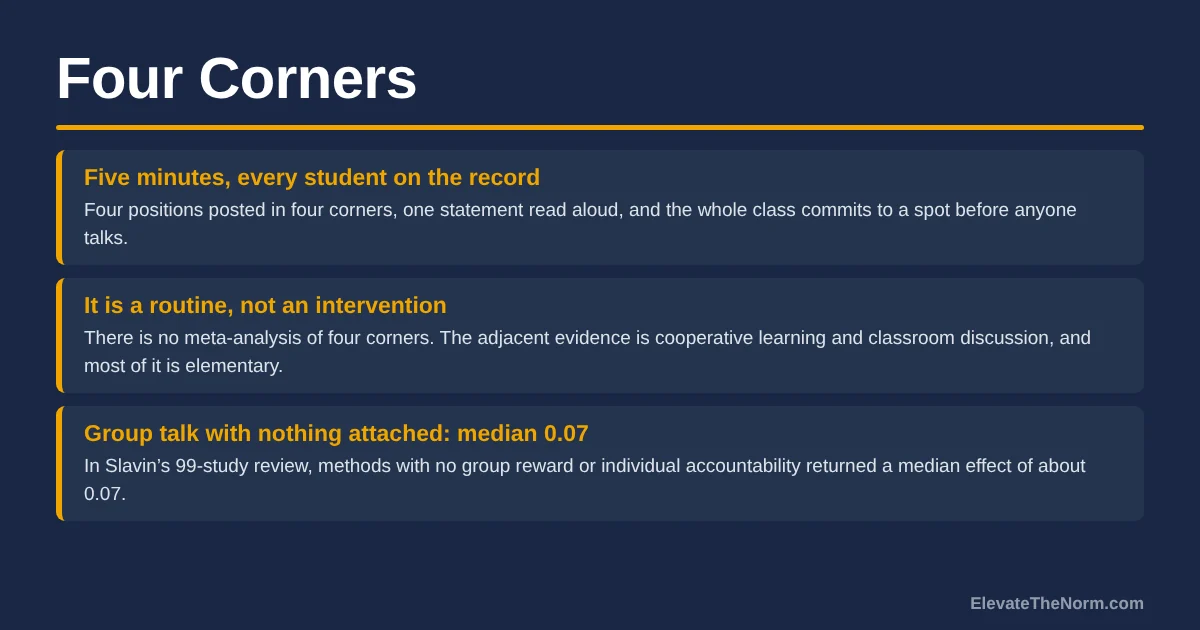
A four corners activity posts a different position in each corner of the room, reads one statement, and sends every student to the corner they agree with. It takes five to ten minutes. What it buys you is a visible distribution of where the class stands, and a reason for students to defend a position they have already committed to.
Key Takeaways
- Four corners is a classroom routine, not a tested intervention. No study has measured it by name. Everything below is adjacent evidence — cooperative learning, classroom discussion, whole-class responding — and most of that evidence was collected in elementary classrooms.
- Group talk with nothing attached to it has a poor track record. In Robert Slavin’s review of 99 studies, methods where rewards rested on each member’s individual learning returned a median effect of 0.32. Methods built on a group product or no reward at all returned a median of 0.07.
- More talk does not automatically mean more learning. A meta-analysis of 42 studies of classroom discussion found several approaches sharply increased student talk while few improved literal or inferential comprehension or critical thinking.
- The clearest thing four corners fixes is response rate. In a class of 30 where students are called on one at a time, each student is actively participating for less than a minute an hour. A corner puts all 30 on the record in fifteen seconds.
- Public commitment is the cost as well as the benefit. Students can read the room before they move, and some of them will. Have them write the corner down before anyone stands up.
What is a four corners activity?
Four corners is a discussion structure in which four positions are posted around the room, the teacher reads a statement, and every student walks to the position they hold. Students then explain their reasoning to the others standing with them, and the corners argue it out.
The four labels are usually strongly agree, agree, disagree and strongly disagree. They do not have to be. Four interpretations of a document, four candidate causes of an event, four answers to a problem where three are wrong in interesting ways — any set of four positions a student could honestly hold will do the job.
The whole thing runs in five to ten minutes. It belongs at the front of a lesson, where it surfaces what the room thinks before you teach, or at the end of one, where it forces students to apply what they just read.
How do you run a four corners activity, step by step?
Post the labels, give students the statement in writing, have them record their corner privately, then move. Talk in corners first, then across corners, then invite anyone who has changed their mind to move. Six steps, ten minutes, no materials.
- Post four signs before class. Big enough to read from across the room, in the same four places every time, so the routine costs no explanation after the first week.
- Put the statement on the board in writing and read it once. Do not paraphrase it afterward. Students arguing about different versions of a statement is the single most common way this falls apart.
- Everyone writes their corner down before anyone stands. Thirty seconds. This is the step that separates a reading of the room from a reading of the room’s social map.
- Move, then talk inside the corner for two minutes. The task is specific: agree on the strongest reason for your position and the piece of evidence behind it. Not every reason. The strongest one.
- One speaker per corner, ninety seconds each, smallest corner first. Going smallest first keeps the majority from setting the terms, and it gives the two students in the empty corner a reason to have thought hard.
- Open the floor to movement. Say plainly that moving is the point, not a defeat, and ask anyone who moves to name the argument that moved them. That sentence is the most valuable thing the activity produces.
What makes a good four corners statement?
A statement that a well-prepared student could honestly land in any of the four corners on. If the content makes one corner obviously correct, the class is taking a quiz standing up, and the students who move last are copying.
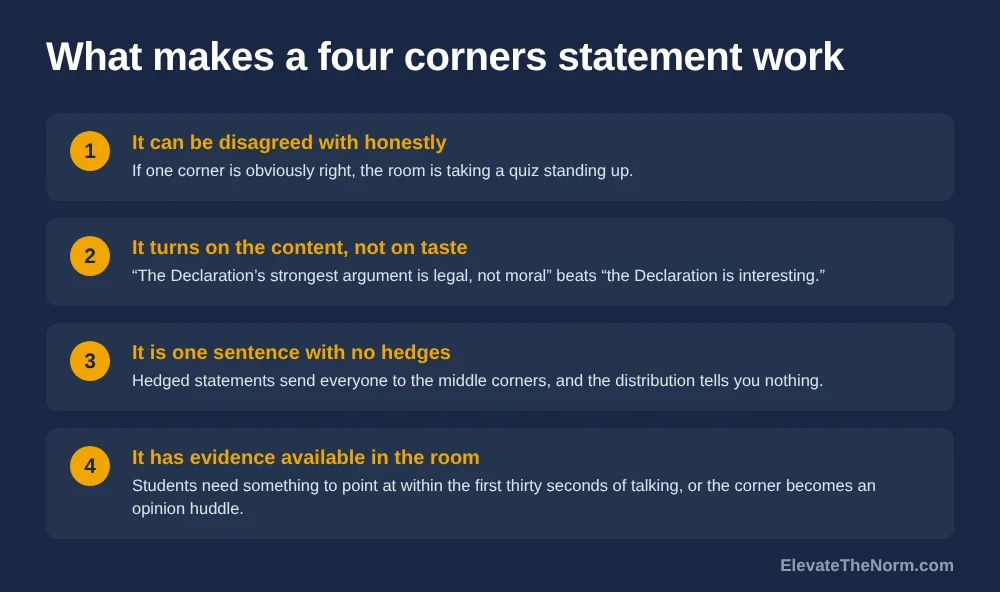
Four tests, in order of how often they get failed. One: can it be disagreed with honestly? Two: does it turn on the content rather than on taste? “The strongest argument in this document is legal rather than moral” is a content claim. “This document is interesting” is not. Three: is it one sentence with no hedges? Hedged statements send everybody to the two middle corners and tell you nothing. Four: is the evidence available in the room? Students need something to point at within the first thirty seconds, or the corner becomes an opinion huddle.
A statement that fails test one is the most common error and the hardest to see while you are writing it. The check is simple: write the best case for each of the four corners yourself. If you cannot write four, your students cannot stand in four.
Is four corners research based?
Not in any direct sense. No study has tested four corners by name and reported an effect size. It is a practitioner routine that circulates through cooperative learning training, and anyone telling you it is evidence based is borrowing the evidence from somewhere else.
That borrowing is not illegitimate, but it has to be done out loud. There are three bodies of work that bear on what four corners is doing: cooperative learning, classroom discussion, and whole-class responding. Two of them are mostly elementary. One of them says something uncomfortable about structures like this one.
What does the cooperative learning research actually show?
That the structure is not what raises achievement. In Slavin’s review of 99 cooperative learning studies lasting at least four weeks, what separated the methods that worked from the methods that did not was whether the group’s reward rested on every individual member’s learning.
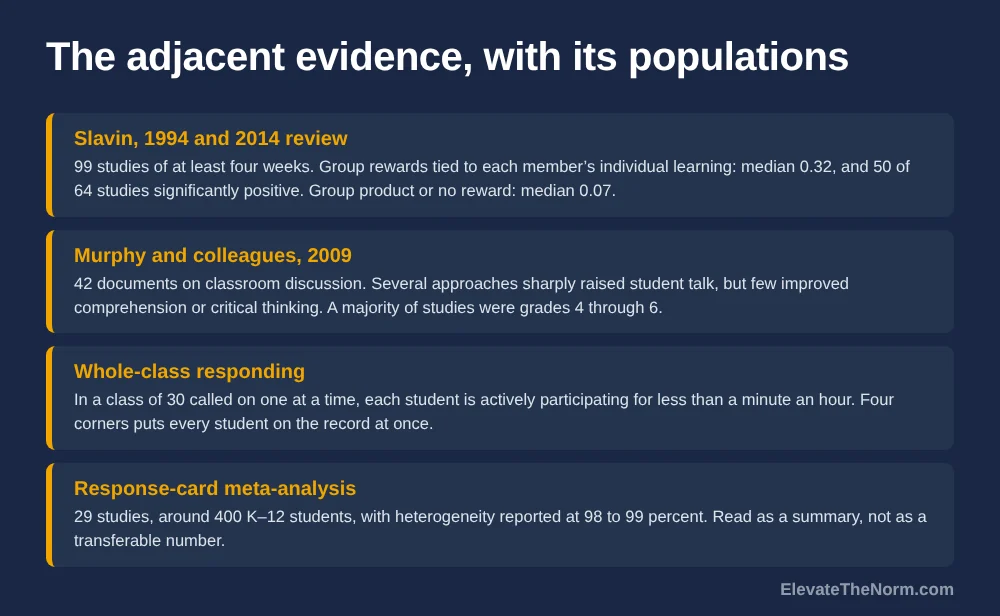
Of the 64 studies where rewards were based on individual learning, 50 found significantly positive achievement effects and none found negative ones, at a median effect of 0.32. Where the group turned in one shared product, or where there was no group reward at all, the median was 0.07. Slavin writes that methods emphasizing team-building and group process without group rewards are “no more effective than traditional instruction” at raising achievement.
Read that honestly and it is a warning about four corners specifically. A five-minute corner activity has no group reward, no individual accountability and no quiz at the end. On Slavin’s own numbers, the family of methods it belongs to returns about 0.07.
Two things complicate that, and both are in the same paper. Slavin reports “some evidence” that carefully structuring student interactions can be effective even without group rewards — though the single study he cites for it had no unstructured control group, so it does not establish that structure alone beats ordinary teaching. And he reports that students who gave elaborated explanations gained most, and that in scripted pairs the student doing the recalling learned more than the listener while both learned more than students working alone.
That is the mechanism four corners can actually claim. It does not raise achievement by existing. It creates a situation in which a student has to say out loud why they think what they think, which is the thing the evidence says pays. Whether the explanation gets made is up to how you run it, not to the signs on the wall.
One caveat on the whole review: Slavin’s scope is elementary and secondary schools together, he gives no separate secondary breakdown of the 99 studies, and most of the individual studies he names are elementary.
Does more student talk mean more learning?
Not reliably. A meta-analysis of classroom discussion drawing on 42 documents found that several approaches produced strong increases in the amount of student talk and substantial improvements in text comprehension, while few of them showed increases in students’ literal or inferential comprehension or critical thinking.
The authors also report that effects were moderated by study design, by the kind of outcome measure used, and by students’ academic ability. And the population matters a great deal here: the abstract states that a majority of the studies were conducted with students in fourth through sixth grades. That is not your room.
What that finding should do is kill one specific argument. “The kids were all talking” is not evidence that the lesson worked. It is evidence that the lesson was loud. This site makes the longer version of that case in its guide to getting students talking to each other rather than to you, and the same caution applies to every structure in that family.
So what does four corners actually fix?
Response rate, and nothing else automatically. When you call on students one at a time in a class of 30, the arithmetic is brutal: each student is actively participating for less than one minute per hour. Four corners puts every student on the record at once, which is the one thing hands cannot do.
That arithmetic comes from a Center on Innovations in Learning practice guide on active student responding, which also reports the sharpest numbers in this area. In a fifth-grade science class, response cards produced fourteen times higher active responding than hand raising, and all 22 students scored higher on next-day quizzes and a review test. In a fourth-grade math class, responses rose from 0.12 per minute to 0.94 per minute.
Those are elementary classrooms, and small ones. The broader picture is a meta-analysis of response cards covering 29 studies and just over 400 students from kindergarten through high school, which — as summarised by Andrew Watson, since the paper itself was not reachable for this article — reported participation up roughly 60 percent and off-task behavior down more than 25 percent, with heterogeneity between 98 and 99 percent. Heterogeneity that high means the studies disagree with each other enormously, and an average across them is a weak thing to carry into your classroom.
A separate Temple University literature review of response cards among students with disabilities covered 15 studies and 141 participants aged five to nineteen, reporting increases in active responding, correct responding, on-task behavior and achievement, with variable results for reducing inappropriate behavior.
So the defensible claim is narrow and worth having: four corners raises the proportion of students who commit to an answer, and raising that proportion has a decent track record in adjacent work. It is not a claim about comprehension.
How is four corners different from philosophical chairs or a debate?
Length and formality. Four corners is a five-minute commitment with four options and no turn-taking rules. Philosophical chairs is a thirty-minute two-sided protocol with speaking rules. A debate is a prepared, researched, assessed event. Picking the wrong one is how a quick check eats a class period.
| Structure | Time | What it is best at | Accountability built in? | Main drawback |
|---|---|---|---|---|
| Four corners | 5–10 min | Showing you the distribution of positions in the room | No — you have to add it | Students can read the room before committing |
| Think-pair-share | 2–5 min | Getting every student to rehearse an answer privately first | No | No visible class-level result |
| Numbered heads together | 5–10 min | Making every group member responsible for the group’s answer | Yes — random selection is the mechanism | Needs stable groups and a right answer |
| Philosophical chairs | 30–45 min | Sustained two-sided argument with a paraphrase rule | Partly — through speaking turns | Takes most of a period and needs prior reading |
| Classroom debate | Multiple periods | Researched, assessed argument with assigned positions | Yes — it is graded | Expensive, and students argue positions they do not hold |
If the statement deserves thirty minutes, run philosophical chairs instead and let students switch sides under its rules. If you need every student answerable for a correct answer rather than a position, numbered heads together is the structure that does that. If you want private rehearsal before any public commitment, think-pair-share costs two minutes. And if the question is worth researching, it is a debate, not a corner.
Why do students move to where their friends are?
Because you asked a fourteen-year-old to take a public position in front of people whose opinion of them matters more than yours does. That is not a character flaw and it is not fixable by a speech. It is fixable by changing the order of operations.
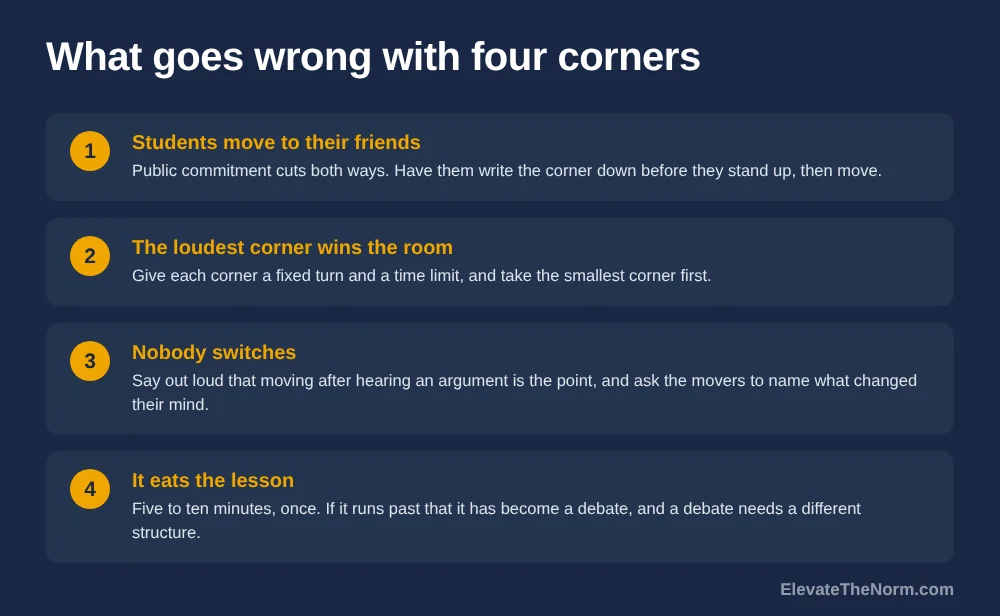
Write the corner down first, every single time. Thirty seconds of silent writing before anybody stands up gives you two things: a private record you can collect, and a student who has already decided before they can see where the room is going. If the written corner and the standing corner disagree for the same student three times in a month, that is worth a quiet conversation rather than a public one.
The other half of the fix is making the unpopular corner survivable. Take the smallest corner first, every time. Say out loud, before the first one you ever run, that a corner with two people in it gets the same ninety seconds as a corner with twenty. Students work out quickly whether that is true.
How do you make four corners accountable?
Attach something individual to it. The cooperative learning evidence is unambiguous that structures without individual accountability underperform, so if you want this to be more than a stretch break, the accountability has to be added on purpose.
Three cheap ways, in increasing order of cost. Collect the written corner slips at the end — thirty seconds, and now you have a record of who thought what before the talking started. Ask one randomly selected student per corner to give the corner’s reason rather than letting the corner choose its speaker. Or have every student write one sentence afterward naming the strongest argument from a corner they did not stand in, which is the version that forces them to listen to the other side.
That last one is also the version that makes the activity worth a grade if you need one, because it produces something individual on paper. The quality of what students say to each other inside a corner is a separate problem, and the named talk moves that make a reply count as thinking are the tool for that one.
What about students who should not take a public position?
Build an opt-out that costs nothing socially, and never run a statement where a student’s honest corner would disclose something private about their family, their beliefs, their immigration situation or their household. Keep the statement on the content.
Practically, that means two things. Offer a fifth option — an undecided spot, or a seat for anyone who would rather write their reasoning than stand with it — and treat choosing it as ordinary rather than as a refusal. And apply the mobility question before you plan the activity: a student on crutches, a student with a mobility device, or a student whose anxiety makes crossing a room in front of everyone genuinely hard should have a version that works, which can be as simple as holding up a numbered card from their seat.
On the topic choice, the test I would use is whether the statement could be answered differently by two students in the same family. If it could, it is a content question. If a student’s corner would tell the room something about their home, it is not a four corners statement, however interesting it looks on paper.
What goes wrong with four corners?
- The statement has an obvious right answer. Three corners stand empty, the activity takes four minutes, and nobody learns anything.
- It becomes a vote on who is popular. Fixed by writing the corner down first, not by asking students to be braver.
- The loudest corner takes the room. Fixed by fixed turns, a timer, and going smallest first.
- Nobody ever switches. Usually means you have never said that switching is the point, or never praised it when it happened.
- It runs long. Past fifteen minutes it has turned into a debate without a debate’s preparation, which is the worst of both.
- It becomes the lesson. Run weekly it is a routine. Run daily it is a way of not teaching.
What should a coach or administrator look for?
Look at the smallest corner, not the biggest one. Whether the two students standing alone get their full ninety seconds, and whether anyone in the room moves afterward, tells you more about the classroom culture than the energy level does.
Two cautions for anyone considering this at scale. Do not put four corners on a walkthrough look-for list — it will appear everywhere within a month and mean nothing, which is what happens to every nameable structure that gets counted. And do not describe it to staff as evidence based. It is a sound routine with borrowed and mostly elementary evidence behind it, and teachers notice when a district oversells something they can check.
Clay’s take: the corner is cheap, the sentence is the point
Strip away the signs and the walking and what is left is one student saying out loud why they think what they think, in front of people who might disagree. That is the part the evidence actually supports, and it is also the part that is easiest to lose while the room is in motion.
So I would judge a four corners activity by exactly one thing: did anybody change their mind out loud, and did the room treat that as a win? A teenager who says “I was in the agree corner and now I am not, because of what she said about the second paragraph” has done something most adults will not do in a meeting. If that happens and the class moves on without anyone smirking, the structure is working. If it never happens, you have built a seating chart with extra steps.
The honest limit is that none of this is a reason to run it often. It is five minutes that makes thinking visible, and five minutes that makes thinking visible is worth having once a week. It is not an instructional strategy, and the moment it gets treated as one, the statements get lazy and the corners stop meaning anything.
What to do next
Write one statement for a text or topic you are teaching this week, then write the best case for all four corners yourself. If you cannot write four, rewrite the statement. That single exercise will catch most of what goes wrong before any student stands up.
Then run it once, with the written-corner step, and collect the slips. Compare what students wrote to where they stood. If those two columns match, you have a room where it is safe to disagree, and the structure is doing real work. If they do not, the gap is the most useful thing you will learn all week, and it is worth more than the discussion was.
Frequently Asked Questions
What is a four corners activity in simple terms?
Four positions are posted in the four corners of the room, the teacher reads one statement, and every student walks to the corner matching the position they hold. Students explain their reasoning to the others in their corner, each corner speaks, and anyone persuaded by another corner may move. It runs in five to ten minutes with no materials.
Is the four corners activity research based?
Not directly. No published study has tested four corners by name and reported an effect size. The evidence usually cited for it belongs to cooperative learning, classroom discussion or whole-class responding, and much of that research was conducted in elementary classrooms. It is a sound routine with borrowed evidence, which is worth saying out loud.
How long should a four corners activity take?
Five to ten minutes, once. Thirty seconds to write a corner down, a minute to move, two minutes of talk inside corners, ninety seconds per corner to speak, and a moment for anyone to switch. Past about fifteen minutes it has become a debate without a debate’s preparation, which is the worst of both structures.
How is four corners different from philosophical chairs?
Four corners offers four positions, takes five to ten minutes, and has no turn-taking rules. Philosophical chairs offers two sides, runs thirty to forty-five minutes, and uses speaking rules that often require paraphrasing the previous speaker before responding. Four corners surfaces a distribution quickly. Philosophical chairs sustains an argument.
How do you stop students from standing with their friends?
Have every student write their corner on paper before anyone stands up. That gives them a decision made before they can see where the room is going, and gives you a private record to compare against where they actually stood. Taking the smallest corner first, every time, is the other half of the fix.
Should a four corners activity be graded?
The movement should not be. If you need a grade, attach it to something individual produced afterward, such as one sentence naming the strongest argument from a corner the student did not stand in. Grading the position itself teaches students to pick the corner they think you want, which destroys the only thing the structure is good for.
What topics should you avoid for four corners?
Anything where a student’s honest corner would disclose something private about their family, beliefs, household or immigration situation. A useful test is whether two students in the same family could answer differently. If they could, it is a content question. If the corner would tell the room something about a student’s home, choose a different statement.
Does more student talk mean students learn more?
Not reliably. A meta-analysis of 42 studies of classroom discussion found several approaches sharply increased the amount of student talk while few of them improved students’ literal or inferential comprehension or critical thinking, and a majority of those studies were conducted in grades four through six. A loud room is not evidence of learning.
Sources
- Slavin, R. E. Cooperative Learning and Academic Achievement: Why Does Groupwork Work? Anales de Psicología, Vol. 30, No. 3, pp. 785–791 (2014). Full text (PDF). Source of the 99-study review of cooperative learning in elementary and secondary schools, the 64 studies with rewards based on individual learning of which 50 were significantly positive at a median of 0.32, the median of 0.07 for group-product or no-reward methods, the statement that teambuilding without group rewards is “no more effective than traditional instruction,” the single cited study behind structure without rewards, and the elaboration findings. The paper gives no separate secondary breakdown and most individual studies it names are elementary.
- Murphy, P. K., Wilkinson, I. A. G., Soter, A. O., Hennessey, M. N., & Alexander, J. F. Examining the Effects of Classroom Discussion on Students’ Comprehension of Text: A Meta-Analysis. Journal of Educational Psychology, Vol. 101, No. 3, pp. 740–764 (2009). Full text (PDF). Source of the final pool of 42 documents, the finding that several approaches produced strong increases in student talk while few improved literal or inferential comprehension or critical thinking, the moderation by study design, outcome measure and student ability, and the statement that a majority of studies were conducted with students in 4th through 6th grades. Only the abstract, introduction and method were readable here, so no individual approach’s effect size is reported in this article.
- Tincani, M., & Twyman, J. S. Enhancing Engagement Through Active Student Response. Center on Innovations in Learning, Temple University (2016). Full text (PDF). Source of the figure that in a class of 30 called on one at a time each student is actively participating for less than one minute per hour, attributed there to Kagan and Kagan (2009); of the Gardner and colleagues (1994) fifth-grade result of fourteen times higher active responding with all 22 students scoring higher; and of the Lambert and colleagues (2006) fourth-grade increase from 0.12 to 0.94 responses per minute. Both classroom studies are elementary.
- Watson, A. Mini-Whiteboards Work. Participation Is the Point. Learning and the Brain (2026), summarising Marsh, Cumming, Randolph and Michaels, Updated meta-analysis of the research on response cards, Journal of Behavioral Education. Full article. Source of the 29 studies and just over 400 K–12 participants, the participation and off-task figures, and the heterogeneity of 98 to 99 percent. This is a summary, not the paper — the journal page could not be opened for this article, so no volume, issue or page numbers are given here and the figures are reported as the summary states them.
- Kuntzmann, L. E. A Review of the Literature on Response Cards Among Students with Disabilities. Temple University (2021). Record and abstract. Source of the 15 studies, 141 participants aged 5 to 19, and the reported increases in active responding, correct responding, on-task behavior and academic achievement with variable results for inappropriate behavior. Only the abstract was read, so no effect sizes or study-level detail are reported here.