By Clay Shumate
The gradual release of responsibility is a teaching model in which a skill moves from the teacher doing it, to the class doing it together, to students doing it alone. It came from 1983 reading-comprehension research, its own authors say it is not a linear lesson format, and nobody has tested it as a whole model.
Key Takeaways
- The original model was never a lesson-planning format. Webb, Massey, Goggans and Flajole (2019), writing in The Reading Teacher, put it plainly: “Pearson and Gallagher (1983) presented GRR as a theoretical model rather than an explicit process for lesson planning.”
- “I do, we do, you do” is a catchphrase, not the model. The same paper credits the phrase to other authors — Archer and Hughes (2010) and Hollingsworth and Ybarra (2009) — and says reducing the model to “a strict sequence” “oversimplifies the complexity of learners, learning tasks, and texts.”
- Douglas Fisher, who added the fourth phase, says the model is not linear. Quoted in that review: “the gradual release of responsibility model is not linear. Students move back and forth between each of the components.”
- Most of the research behind it is reading comprehension, much of it elementary. A 2022 reference entry co-authored by P. David Pearson himself states that “the bulk of research that has employed the GRR has focused on reading comprehension instruction.”
- There is real research on when to stop helping, and it is not the GRR literature. The expertise reversal work says support that novices need “may inhibit learning for more experienced learners” — which turns “when do I release?” from a scheduling question into an evidence question.
What is the gradual release of responsibility?
The gradual release of responsibility is an instructional model in which the work of a task shifts over time from the teacher to the student. The 2022 Routledge reference entry by Salehomoum, Revelle, Duke and Pearson defines it as “an approach to teaching that emphasizes a gradual shift in responsibility from the teacher to the student,” and names the 1983 version’s three phases as “modeling, guided practice, and independent application.”
That is the whole idea. The teacher demonstrates, then the class works on it with help, then students do it without help. The destination, in Pearson and Gallagher’s own words as that entry quotes them, is that students accept “total responsibility for the task.”
Everything controversial about the model is in the word gradual. Nobody disputes that beginners need to be shown and experts do not. The argument is about how you decide when to hand the work over, and whether that decision belongs on a lesson-plan template at all.
Where did the model come from, and what was it for?
It came from a 1983 review of reading comprehension research. P. David Pearson and Margaret Gallagher published “The instruction of reading comprehension” in Contemporary Educational Psychology, working from Dolores Durkin’s 1978 observational finding that comprehension was barely being taught at all, and proposed what they called a model of explicit instruction.
Two things about that origin matter for a grades 6–12 teacher. The model was built for teaching reading strategies, not for sequencing a class period. And it was offered as theory. Webb and colleagues are explicit: it was “a theoretical model rather than an explicit process for lesson planning,” and it was only later “appropriated as a practice-based instructional model.”
The versions multiplied from there. Duke and Pearson (2002) expanded three phases into five components, adding an explicit description of the strategy and when to use it. Fisher and Frey added a collaborative phase in 2008 — the “you do it together” step — which is why you will see both three-phase and four-phase diagrams presented as the same model. Webb and colleagues open their review by asking the obvious question out loud: “Is it a model or a teaching framework? Does it have three phases or four phases?”
| Version | Who | Phases or components | What it added |
|---|---|---|---|
| Original model | Pearson & Gallagher, 1983 | Modeling, guided practice, independent application | The idea itself, as theory, for reading comprehension |
| Expanded | Duke & Pearson, 2002 | Five components | Explicitly describing the strategy and when to use it; collaborative use |
| Four zones | Fisher & Frey, 2008 and 2013 | “I do it,” “we do it,” “you do it together,” “you do it alone” | The collaborative phase, and the vocabulary most schools now use |
| The catchphrase | Archer & Hughes, 2010; Hollingsworth & Ybarra, 2009 | “I do, we do, you do” | Nothing instructional. It is a slogan the originators did not write |
| Flexible release | Webb, Massey, Goggans & Flajole, 2019 | Invitation/observation, pathways, explicit teaching, guided practice, independent practice, sustaining practice | Starts from watching students rather than from a sequence |
Is “I do, we do, you do” the same thing as gradual release?
No. “I do, we do, you do” is a slogan that got attached to the gradual release of responsibility, and Webb and colleagues attribute it to Archer and Hughes (2010) and Hollingsworth and Ybarra (2009) rather than to Pearson, Gallagher, Fisher or Frey. The model is a claim about how responsibility moves. The slogan is a claim about the order of a lesson.
That slippage has a cost, and the 2019 review names it: “One unintended outcome has been the simplification of GRR to a series of strict sequential moves expected to be accomplished in a single class period.” It goes on to say that answering the complexity of real students with a strict sequence “oversimplifies the complexity of learners, learning tasks, and texts,” and that teachers under that pressure “can easily seek to implement a format rather than respond to student needs.”
It is worth saying why the slogan won anyway. “I do, we do, you do” is observable, it fits a walkthrough form, and it can be coached in one conversation. The flexible version cannot — it asks a coach to judge whether a teacher read their students correctly, which takes longer and produces arguments. That is a real advantage for the slogan and a real reason schools adopted it. It is not an argument that the slogan is the model.
If your evaluation rubric has a box for each of three phases and your period is fifty minutes, you have been handed the slogan, not the model. The U.S. Department of Education’s own adult-education guidance says the same thing in one line: “Gradual Release is not a linear sequence; you cycle through the approaches multiple times as you start new topics or address knowledge gaps.”
How strong is the evidence for gradual release of responsibility?
Weaker than the model’s reach would lead you to expect, and that is the honest answer. No study tests the gradual release of responsibility as a package against a credible alternative. What exists is a body of research on explicit strategy instruction in reading, from which the model was assembled.
Webb and colleagues say it about the original claim itself: Pearson and Gallagher argued that explicit strategy instruction accelerated reading performance “while acknowledging that there has been little research to support that conclusion.” Their review closes by calling for exactly what is missing — that “revisiting the theoretical and research foundations of this widely used instructional framework may be an important focus of research.” A 2019 call for foundational research on a 1983 model is a tell.
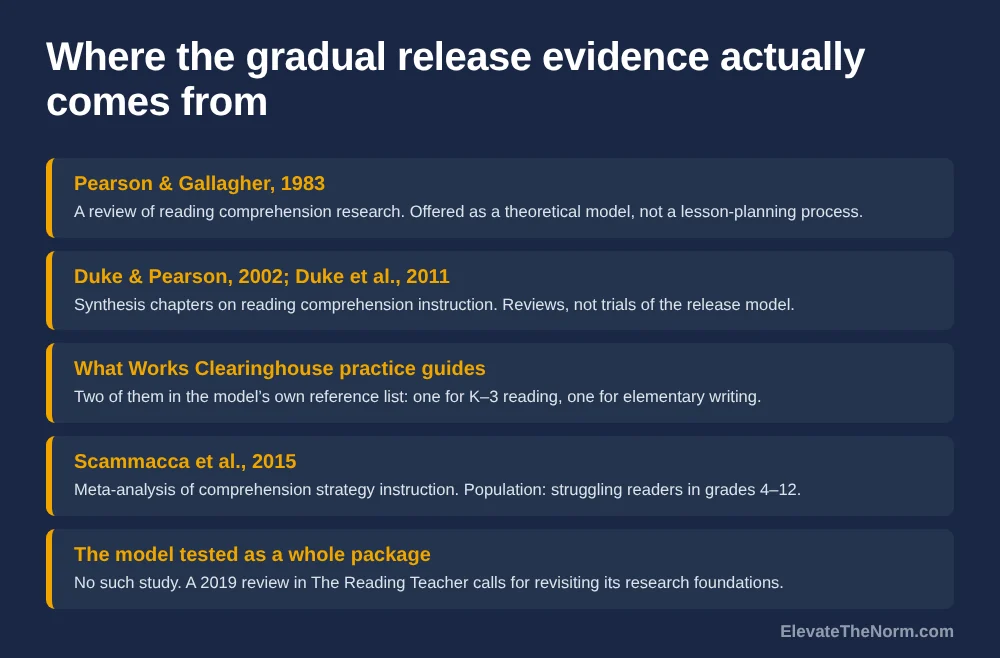
The 2022 reference entry’s citation list is the clearest picture of the real base. It leans on reviews and syntheses — Durkin’s observational study, Duke and Pearson’s synthesis chapters, Rosenshine and Meister on reciprocal teaching, and two What Works Clearinghouse practice guides, one for K–3 reading and one for elementary writing. The single closest thing to a secondary result is Scammacca and colleagues’ 2015 meta-analysis, whose population is struggling readers in grades 4–12, and whose subject is reading comprehension rather than the release model.
Two further caveats belong in the same paragraph. The Hattie figure sometimes attached to gradual release is not about gradual release: in that entry it describes reciprocal teaching, ranked third of 49 strategies, which is a different intervention. And the Department of Education page that teachers find when they search the term is about adult writing instruction — its only citation is Fisher and Frey’s 2008 book, it never mentions K–12 classrooms, and it should not be read as federal endorsement for secondary content teaching.
None of that makes the model wrong. Modeling before independent work is defensible on grounds much older than 1983. It does mean that when an administrator tells you the research requires three phases in a period, the research does not say that, and nobody has shown that it does.
How long should the release take?
Longer than one period, usually, and the literature refuses to give a number on purpose. Webb and colleagues write that “gradual release may occur over a day, a week, a month, or a year,” and describe a flexible cycle that “might all occur in a 15–20-minute lesson” as one possibility among many — an example, not a rule.
Set against that, the version most teachers are evaluated on is a strict “I do, we do, you do” sequence “often within a single 20–40-minute lesson.” The honest reading is that the timescale is a property of the skill, not of the schedule. Citing a source for a claim is a one-period skill. Building an argument from competing sources is a semester.
There is also a case for modeling less often than the template implies. The 2019 review cites Duffy (2014) for the position that explicit instruction “should not be provided on a routine basis but only ‘when students are struggling.’” That is close to the opposite of a mandated opening phase every day.
How do you know when to stop modeling?
Watch for the point where your support stops adding anything, because past that point it starts subtracting. This is the expertise reversal effect, and it is the most useful research a teacher can bring to the release question. Kalyuga and Renkl, introducing a 2010 special issue of Instructional Science on it, define it as “a reversal in the relative effectiveness of instructional methods as levels of learner knowledge in a domain change,” and state the practical version: “instructional guidance that is essential for novices may inhibit learning for more experienced learners.”
Three results in that issue are worth a secondary teacher’s time. Oksa and colleagues gave explanatory notes alongside Shakespearean text: grade 10 novices did better with the notes, and adult expert readers did better without them. Nückles and colleagues gave university students writing prompts for learning journals across a term — and by the end, the group that kept the prompts “performed worse than the control group,” while in a second experiment “the permanent prompts group showed substantially lower learning outcomes than the fading group.” Salden and colleagues compared adaptive with fixed fading of worked examples in high school geometry; adaptive fading won on the immediate and delayed tests in the lab, but in the classroom it replicated “on the delayed posttest but not on the immediate posttest.”
Said from a student’s desk, this stops being a research finding and becomes an obvious complaint. A sophomore who already knows how to cite a source and has to watch it demonstrated for fifteen minutes is not being supported. She is being held up, and she knows it. The expertise reversal literature is the formal version of a thing teenagers say out loud every year.
Report the limits with the findings. Kalyuga and Renkl say the reversal appears “more often, as a partial reversal” than a complete one, that most of the work sits in well-defined technical domains and needs extending to messier ones, and in one study — Homer and Plass on chemistry visualizations — the effect disappeared for the younger middle-school children, where the visual supports helped everyone. Two of the five studies ran on undergraduates. So treat this as a direction, not a dial.
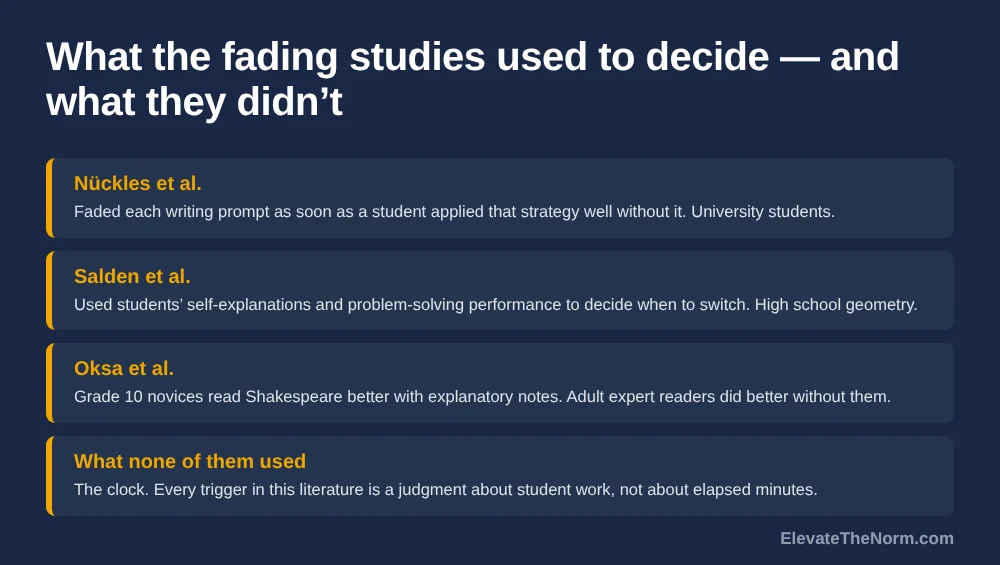
What the fading studies did share is the thing most lesson templates lack: a rule tied to the student rather than the clock. Nückles and colleagues faded each prompt “as soon as a student applied the prompted strategy to a satisfactory degree.” Salden and colleagues used students’ self-explanations and problem-solving performance to decide when to switch. Both looked at the work in front of them. Neither looked at the agenda. If you want a defensible trigger for releasing, that is where to get it — a check you actually read before deciding, rather than the twenty-minute mark.
What does gradual release look like in a grades 6–12 content classroom?
It looks like one skill followed across a unit, with the support level set by what students produce rather than by the day of the week. The model was built for reading strategies, and the 2022 entry says it “can be applied to any kind of instruction” while describing no content-area study — so the transfer to a history or chemistry classroom is reasonable inference, not demonstrated fact. Say that out loud when someone calls it research-based.
Take sourcing a document in history. The modeling phase is a think aloud in which the teacher narrates the questions they ask of a source, including the ones that lead nowhere. Guided practice is the same move on a second document with the class interrupting. The collaborative phase is a small group doing it on a third document with roles, which is where cooperative learning’s own research and its own catch apply. Independent work is a fourth document, alone, graded. In algebra the same arc runs across worked examples, paired problems and a problem set; in a lab it runs across a demonstrated procedure, a joint trial and an independent write-up.
Notice what is not in that arc: a requirement that all four steps happen on Tuesday. The sequence is the unit. Within a period you might model for four minutes and spend the rest watching, or skip modeling entirely because yesterday’s exit data said to. Scaffolding and release are the same question asked from two directions, and the answer to both is the same: fade the support when the evidence says the support is no longer doing work.
What are the most common ways teachers get it wrong?
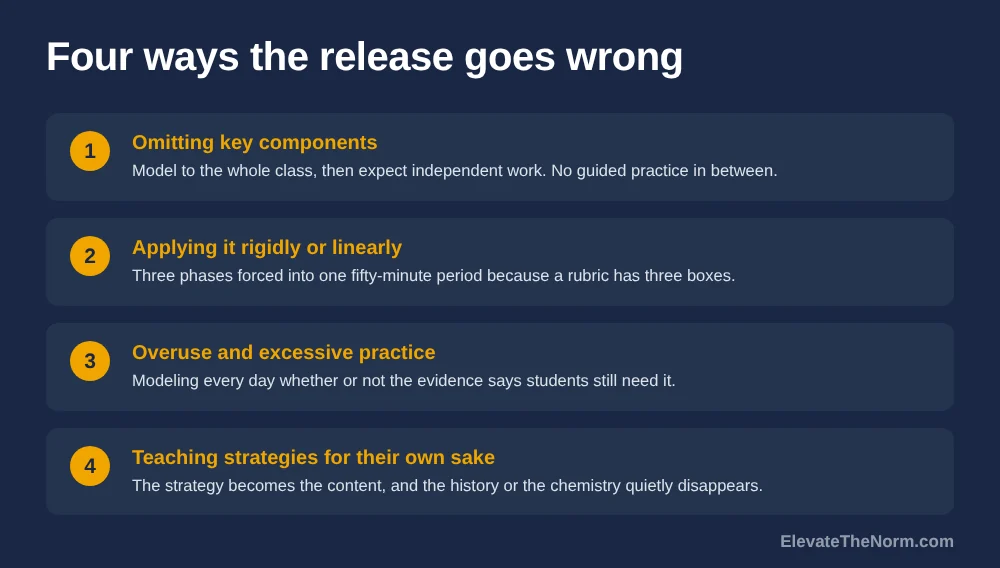
The 2022 reference entry lists four misuses directly, citing Duke and colleagues (2011) for the last: omitting key components; applying the model “in a rigid and/or linear manner”; overuse or excessive practice; and teaching strategies for their own sake. Its sharpest specific failure is the one most teachers will recognize — modeling to the whole class and then expecting independent work, where the teacher “expects students to independently apply strategies too soon,” with no guided practice in between.
Two more are worth naming. The first is monitoring: the entry reports that the model “has been criticized with regard to whether it adequately emphasizes the importance of monitoring” independent work, and warns that “unless teachers monitor maintenance and transfer of skills, the true potential of the GRR model will remain untapped (and its efficacy partial).” Releasing is not the finish line. Whether the skill survives next month is the finish line, which is a progress-monitoring problem.
The second runs the other way. Webb and colleagues cite Beers and Probst (2017) on the concern that a rigid approach “may actually disrupt thinking and the learning process for some students,” and that teachers can end up “doing too much of the work for students.” Their own caution is one sentence long and worth taping to a planner: “We must be cautious about removing difficulty entirely.” A model whose whole purpose is reducing difficulty will, run on autopilot, remove the productive struggle that was doing the teaching.
How do you plan a unit this way without turning it into a template?
Pick one skill, decide in advance what evidence would prove students have it, and let that evidence drive the support level. Six steps:
- Name one skill for the unit, not four. “Support a claim with a source” is a skill. “Analyze” is not. The release only works if you can see the skill in a piece of student work.
- Write the independent task first. If you cannot describe what a student will do alone in week three, you cannot design the help that gets them there.
- Decide your fading trigger before the unit starts. Borrow the research’s own rule: drop a support once a student uses the strategy well without it. Written down in advance, that is a decision; improvised on Thursday, it is a mood.
- Model the thinking, not the answer. Narrate the false starts. A clean demonstration teaches students that competent people do not struggle, which is both false and discouraging.
- Put a real check between guided and independent work. This is where most classrooms skip a phase. An exit ticket you read the same day is the cheapest version.
- Plan one unscaffolded return later in the term. Monitoring maintenance is the step the model’s own critics say gets dropped, and it is the only way to know whether the release held.
Where I land on it
The gradual release of responsibility is a good description of how teaching a skill tends to go and a bad lesson-plan template. My reading of the evidence above is that the model deserves its longevity as a way of thinking and has not earned the authority schools give it as a compliance item. Nobody has tested it as a package. The people who built it keep saying it is not linear, and the slogan that made it famous was written by somebody else.
So use it in the direction it was meant: as a reminder that teenagers should be doing the work by the end, and that the distance between your demonstration and their independence is yours to engineer. Then take the release trigger from the fading research instead of the clock. Teach the skill, show the thinking, check what came back, and get out of the way as soon as the evidence says you are no longer helping — which is both better teaching and more respectful of students who are closer to adults than the template assumes.
Frequently Asked Questions
What are the four stages of the gradual release of responsibility?
The four-zone version comes from Fisher and Frey: “I do it,” “we do it,” “you do it together,” and “you do it alone.” The original 1983 model by Pearson and Gallagher had three stages rather than four — modeling, guided practice, and independent application. Fisher and Frey added the collaborative phase in 2008, which is why three-phase and four-phase diagrams both circulate as the same model.
Is the gradual release of responsibility evidence-based?
Not as a package. No study has tested the model as a whole against an alternative. It was assembled from research on explicit reading-comprehension strategy instruction, and a 2019 review in The Reading Teacher called for revisiting its research foundations — a notable request about a model from 1983. Modeling before independent work is defensible; the specific three-phase format is not what the research tested.
What is the difference between gradual release of responsibility and scaffolding?
Scaffolding is the support itself; gradual release is the plan for removing it. The 2022 reference entry co-authored by Pearson calls scaffolding the core concept behind the model. In practice they are the same decision from two directions: scaffolding asks what help a student needs now, and release asks when that help should come off.
What should I do if my evaluation rubric requires all three phases in one lesson?
Teach the lesson your students need and be ready to explain the choice. The literature does not support a one-period requirement: the 2019 review says release may happen over a day, a week, a month or a year, and Douglas Fisher himself says the model is not linear. A rubric is a local decision, not a research finding, and saying so politely with a citation is usually more productive than ignoring it.
Should every lesson start with modeling?
No, and one cited position holds the opposite. The 2019 review cites Duffy (2014) for the view that explicit instruction should not be routine but should come “when students are struggling.” Daily mandatory modeling also runs into the expertise reversal effect, where support that helps a novice can hold back a student who already has the skill.
How do I know when a student is ready to work independently?
Use the rule the fading studies used, not the clock. Nückles and colleagues removed each prompt as soon as a student applied the strategy well without it, and Salden and colleagues used students’ self-explanations and problem-solving performance to decide when to switch. Both looked at the work in front of them. Decide your trigger before the unit starts, in writing.
Does releasing responsibility mean the teacher stops helping?
No. Release moves the work to the student while the teacher moves to monitoring. The 2022 reference entry warns that unless teachers monitor maintenance and transfer of skills, the model’s potential stays untapped and its effectiveness only partial. Independent work that nobody looks at is not the final phase of anything — it is the phase the model’s own critics say gets skipped.
Sources
- Webb, S., Massey, D., Goggans, M., & Flajole, K. (2019). Thirty-Five Years of the Gradual Release of Responsibility: Scaffolding Toward Complex and Responsive Teaching. The Reading Teacher. DOI 10.1002/trtr.1799. Full text. Source of the “theoretical model rather than an explicit process for lesson planning” statement, the Fisher “not linear” quotation, the single-class-period simplification, the day/week/month/year timescale, the Duffy (2014) and Beers and Probst (2017) positions, and the attribution of “I do, we do, you do” to Archer and Hughes (2010) and Hollingsworth and Ybarra (2009). This is a feature article arguing for one interpretation of the model, not an empirical study — it reports no data and no effect sizes, and it openly advocates its own “flexible release” alternative. The copy read carries placeholder issue details, so confirm the volume and issue before citing it formally.
- Salehomoum, M., Revelle, K., Duke, N., & Pearson, P. D. (2022). Gradual Release of Responsibility Instructional Model. Routledge Resources Online. DOI 10.4324/9781138609877-REE226-1. Full text. Source of the definition, the three-phase and five-component versions, the four named misuses, the monitoring criticism, and the statement that the bulk of GRR research is reading comprehension. This is an encyclopedia-style reference entry rather than a peer-reviewed study, and it is co-authored by one of the model’s originators, which makes it authoritative about what the model claims and a sympathetic witness about whether it works. The Hattie ranking it mentions describes reciprocal teaching, not gradual release.
- Kalyuga, S., & Renkl, A. (2010). Expertise reversal effect and its instructional implications: introduction to the special issue. Instructional Science, 38(3), 209–215. DOI 10.1007/s11251-009-9102-0. Article. Source of the definition of the expertise reversal effect and the summaries of Oksa et al., Nückles et al., Homer and Plass, Blayney et al. and Salden et al. It is an editorial introduction, so it reports no effect sizes of its own and the study results are given in words. Populations matter here: Oksa’s novices were grade 10 students but its experts were adults, Blayney’s participants were first-year undergraduates, and Nückles’ were university students — so the fading rules below are not secondary-classroom findings. Salden et al. ran on high school geometry students and replicated in the classroom only on the delayed posttest.
- LINCS, U.S. Department of Education. Gradual Release of Responsibility (TEAL “Just Write! Guide”). Page. Source of the “not a linear sequence” statement. Read the scope before citing it as federal support: the page is about adult writing instruction, never mentions K–12 classrooms or adolescents, its only reference is Fisher and Frey’s 2008 book, and the site states that its contents do not necessarily represent the positions of the Department of Education.
- What is not cited, and why. Pearson and Gallagher’s 1983 paper in Contemporary Educational Psychology could not be opened from this session, so every quotation from it here is reported as the two sources above quote it, and it is not presented as read. Fisher and Frey’s Better Learning Through Structured Teaching (ASCD, 2008) was likewise not opened; Fisher’s “not linear” line is quoted as the 2019 review gives it. Scammacca et al. (2015) and the two What Works Clearinghouse practice guides are named as they appear in the 2022 entry’s reference list and were not read directly, so no figure in this article comes from them. No number in this article comes from a source that was not opened.